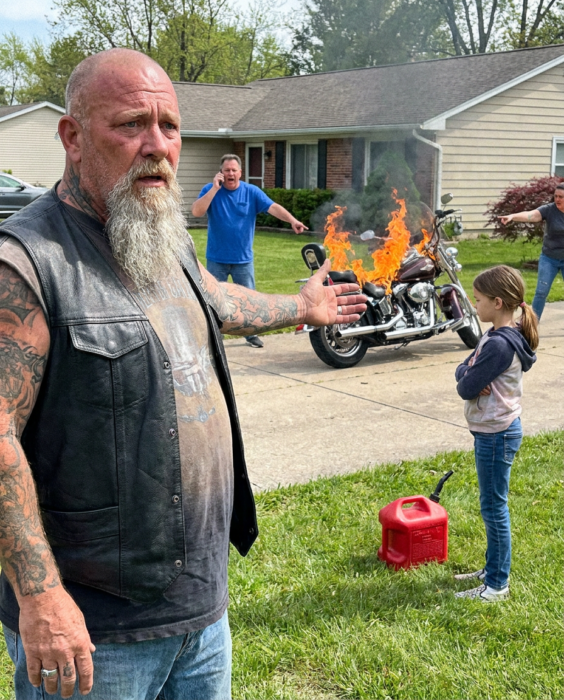
My Eleven-Year-Old Daughter Set Fire to My Motorcycle While I Was Inside the House—Then She Told Me Why She Could Not Let Me Ride It Again
Ava’s mother, Rachel, died when Ava was five. A driver who had been drinking crossed the center line on her way home from work. Rachel did not survive the crash. I was at home making dinner with Ava when the officers came to our door.
For a long time, Ava’s questions were the sort a young child asks again and again: whether her mother had been wearing a seat belt, whether the road was slippery, whether I had called her that day. I answered what I knew and said when I did not know. As Ava got older, she asked fewer questions aloud. I assumed she had found other ways to remember Rachel. I did not understand how carefully she still watched me leave the house.
I kept riding after Rachel died. My Harley had been part of our life together. She had ridden with me before Ava was born and had once made me drive forty miles back to a diner because she had forgotten a scarf there. After the funeral, the bike sat untouched for months. Luis came over one Sunday, checked its tires with me, and stood nearby while I started it. Eventually I rode short routes again.
Ava never asked me to sell it. She helped me wash it. Sometimes she sat on the parked seat while I held it upright and described the places Rachel and I had visited. We kept one photograph of the three of us beside the kitchen clock: Ava as a toddler in Rachel’s arms, me standing beside the motorcycle with my helmet in my hand. Ava liked that picture enough to move it into her room for a week, then bring it back.
By the time she was eleven, our routines looked steady from the outside. She went to school, played on a soccer team, and argued with me about bedtime. I worked at an equipment shop. Most Saturdays, I met the club at our building on the edge of town. Forty members belonged to it, though not all of us rode every week. We held breakfasts, helped with repair bills when someone was in trouble, and spent too long discussing which route to take when the weather was good.
We also drank together sometimes. Most men left their bikes at home if they expected to have more than a drink. Others decided for themselves when they were fit to ride. I told myself I knew my own limit. Rachel’s death should have made me question that confidence every time I heard someone say it. Somehow, over the years, I had allowed it to sound ordinary again.
The weekend before the fire, the club held a cookout. I had ridden over in the afternoon. A few people stayed after the food was packed away, talking around a folding table. I drank. I remember the bottles and the time on my phone. I also remember telling Luis I was fine when he offered to drive me home.
I did not ride recklessly in my memory of that evening. That is part of the trouble with relying on memory when you are defending yourself. I remember the engine starting, the road home, and my key going into our front door. I got there without a collision. That fact gave me room to tell myself I had judged correctly.
Ava had been awake. Mrs. Alvarez was watching her while I was out and had stayed a little later than planned. I came in still carrying my helmet. Ava hugged me around the waist. I thought she was happy I was home. Mrs. Alvarez said good night and crossed the street.
Ava later told me she had noticed the smell on my breath when I bent to kiss her hair. She had seen me put my helmet down and had known I had come home on the motorcycle. She had learned enough about drinking and driving from Rachel’s death to understand the risk. She had not known what words would make me listen.
The next morning, my keys disappeared for the first time.
I searched the porch, the kitchen, and the pockets of three pairs of jeans. Ava watched me. When I finally found the keys behind a stack of towels, I assumed I had left them there while carrying laundry. I was annoyed with myself. Ava said nothing.
The second time, she put them in a drawer and told me. I was late to meet Luis, and I responded as if we were arguing about whether she could control my schedule. I raised my voice. She said she did not want me to ride. I told her I was her father and would decide when I left the house. She went quiet. I rode to the clubhouse, still irritated.
At the garage that Saturday, after the fire, I remembered those small scenes in a different order. Ava had watched me come home after drinking. She had tried to remove the keys. I had found them, argued, and ridden away. She had then chosen a dangerous act because she thought it was the only one I could not undo before leaving.
Understanding why she did it did not make the fire safe. It made my failure to listen impossible to set aside.
Firefighters stayed long enough to make sure the motorcycle could not reignite and that the garage wall had not been damaged more deeply than its paint. One spoke with Ava in a calm voice while another checked the driveway. An officer took our names and asked what had happened. Ava said she had started the fire. She did not try to blame a neighbor or pretend it had been an accident.
I wanted to protect her from the consequences, and I also wanted her to understand how close the fire had come to the house. I told the officer I had been inside when it started, that the fuel can was normally kept in my shed, and that Ava had moved it. I did not describe the act for her or make guesses about how she had managed it. She could speak for herself, and the adults there had to respond to what she had done.
Mrs. Alvarez took Ava inside her house for water while I answered questions. Ava went with her only after I promised to stay in the yard. She looked back twice on the walk across the street. I think she believed the fire would keep me from riding but might make me leave her in some other way.
The firefighters told me not to handle the damaged bike until they had finished their work. I stood at the edge of the driveway with my helmet still hanging from a hook inside the front door. Charred pieces fell from the seat when a firefighter moved it to check for remaining heat. The left mirror hung at an angle. I had spent years keeping that bike running through winters and repairs; now I watched it become something I could no longer ride home.
Luis arrived after Mrs. Alvarez called him from Ava’s phone. He got out of his truck, looked at the motorcycle, and said nothing for a while. Then he asked whether Ava was safe. I told him she was with the neighbor. He asked about the house. I said the firefighters had checked it. Only then did he ask what had happened.
“Ava started it,” I said.
Luis leaned against his truck. He knew about Rachel. He also knew I had ridden home from the cookout the previous weekend, because he had offered me a ride that night. I had refused him in front of two other members and made a joke about living only a few miles away. The joke was no longer funny to either of us.
“Did she see you come home?” he asked.
“She did.”
He looked toward Mrs. Alvarez’s house. “Frank, I should’ve taken your keys.”
“You tried.”
“I offered a ride. I let you decide.”
We stood with that for a minute. I had been the one who started the motorcycle. Luis did not need to carry my decision, though I could see that he did.
When the officer finished speaking with Ava, she came back across the street with Mrs. Alvarez. She held the blanket around her shoulders. I asked if she would sit with me on the front steps while Luis moved his truck out of the way of the fire crew. She sat one step below me. The bike was in front of us, blackened and still wet from the hoses.
“I saw you drink,” she said.
I asked when. She told me about the cookout and about smelling alcohol when I came home. She had lain awake that night after I put her to bed. Every sound from the road made her think of the officers who had once come to our door. The following morning, she took my keys before I woke.
I apologized for shouting when she tried again. Ava pulled at a thread in the blanket. She said she had thought of telling Luis, but I had already brushed him off at the cookout. She thought I would be angrier if she told another adult.
That hurt to hear because it was reasonable. I had made it difficult for her to ask for help.
I asked whether she knew how dangerous the fire had been. She nodded. Mrs. Alvarez had explained it while I spoke with the firefighters. Ava looked at the garage wall, its paint blistered near the corner. “I thought if I did it outside, the house wouldn’t burn,” she said. Her voice was small. She had made a plan and missed risks that could have hurt her or anyone nearby.
I told her I was grateful she was alive and uninjured. I told her the fire could have spread in ways neither of us could control. I did not tell her she had done the right thing because she had stopped me from riding. She needed to hear me take responsibility for the drinking and riding, and she needed to know that setting a fire could not be our way of handling fear.
She listened. Then she asked the question that had been behind the keys, the silence, and the flames: “Were you drinking when you rode home?”
“Yes,” I said.
I wanted to add an explanation about how much, how far, and how I had felt. I stopped myself. She had asked a direct question. I owed her a direct answer.
Ava looked at the burned bike for a long time. “Mom didn’t get home,” she said. She had never put Rachel’s death beside one of my rides in words before. I sat with her until the firefighters left and the yard grew quiet again.
That night I called the club’s president, Martin, and told him I needed to speak at our next meeting. He had already heard about the fire from Luis. I asked him to hold off on discussing Ava with anyone else. It was her story as well as mine, and she was a child. I told him the part I was responsible for: I had ridden after drinking the previous weekend, my daughter had seen me, and I had dismissed her attempts to stop me.
Martin let me finish. Then he said he had been one of the men who heard Luis offer me a ride. He had heard me refuse it and had gone back to folding tables. We agreed that talking privately to two or three friends would be too easy. Forty people belonged to our club; if I wanted its habits to change, I needed to speak where all of us could answer for them.
There were practical things to do first. I followed the directions the fire crew had given me about the damaged motorcycle. Once it was safe to move, a specialist removed what remained of the fuel and fluids, disconnected and took away the battery, and secured the loose parts. I paid for the work. I did not want a burned machine leaking into the ground or leaving sharp edges where someone might walk.
Ava watched from the kitchen window while it was loaded onto a trailer. She asked whether I was having it repaired. I told her no. I also told her I was not making that decision as a reward for the fire. The bike could not be ridden in its condition, and I wanted to keep it as it was for a reason I needed to explain to the club. She asked if I was still allowed to ride other motorcycles. I said I owned no other one, but I would not promise never to ride again. I promised something I could keep: I would not ride after drinking, and I would let someone else hold my keys when I drank at a club event.
She asked how she could know. I said I would show her what the club decided and follow the rule in front of her. It would take time for her to trust me. She did not have to give me that trust because I asked for it.
I also arranged support for Ava through a counselor experienced in helping children after a death and after frightening events. Rachel’s crash had shaped years of her life; the fire had added another frightening memory. Ava could decide what she wanted to discuss there. I went to appointments when asked, including one in which I had to listen to her describe the night I came home smelling of alcohol.
The following Sunday, Luis helped me bring the motorcycle to the club’s yard. The building was an old repair shop, set back from the road with enough open space for members to park. Martin had told everyone we would have a serious meeting and asked them to come without guests. He had not told them what I would say.
We unloaded the burned bike in the middle of the yard. Its frame had held its shape, but the seat and painted parts were blackened. Some members walked over to inspect the damage. A few assumed there had been an electrical fault. One asked whether I had been hurt. I told him Ava and I were both safe and asked him to wait until everyone arrived.
When forty of us had gathered, I stood beside the motorcycle and told them what had happened. I began with the fire because it was right in front of them. Then I told them about the cookout: the drinks, Luis’s offer, my refusal, and the ride home. I told them Ava had smelled alcohol when I came through the door. I described the missing keys and my anger when she moved them a second time.
My voice held until I reached the front steps. I could still picture her in Mrs. Alvarez’s blanket, asking whether I had ridden after drinking. I told the men I had said yes. I looked at the bike while I told them about Rachel. Most already knew how she died. A few newer members did not.
Martin asked whether anyone had questions. For a moment no one spoke. Then Paul, who had ridden with us for twelve years, said he had gone home after drinking on more than one occasion. Another member admitted the same. By the time they finished, seven riders had said aloud that they had made that choice. Others looked down; I could not know whether they had done it, too.
Luis raised his hand. He said he had offered me a lift but had not insisted. Martin said he had seen me leave. We were not going to settle the matter by counting only the men who had ridden. We needed a rule that worked when someone was certain he was fine and his friends wanted to avoid an argument.
We talked until the afternoon light shifted across the burned frame. There was disagreement about details. One man wanted to ban alcohol entirely at the clubhouse. Another pointed out that members met at restaurants and other events beyond it. A third said a rule meant little unless someone had the job of getting people home. We worked through those objections instead of pretending a vote alone could carry anyone’s keys.
That day we voted: if a member drank, he would hand over his motorcycle keys before leaving the table. No exceptions based on how steady he felt or how close he lived. At organized events, two members would arrange rides home or a safe place for bikes to stay until their owners returned. Anyone could call for help without being mocked or charged for the lift. Martin and Luis took the first month of that duty; others signed up after them.
When the meeting ended, nobody applauded. They went inside to write the rule down and work out the ride schedule. I stayed beside the bike for a few more minutes. Seven men had admitted what they had done. I had believed Ava’s fire was a problem contained within my household. It had exposed something the club needed to face as well.
Keeping the burned motorcycle in the yard required more care than leaving it where we had unloaded it. The club rented the property, and Martin spoke to the owner before we built anything. We confirmed that the fluids and battery had been removed, had the remaining edges made safe, and mounted the frame securely away from where children or visitors would walk. It could not be started or ridden. It sat under a simple roof that kept rain from pooling inside it.
A member suggested a plaque with Ava’s name. I said no. She was eleven and had already had enough people discuss what she had done. We could explain our rule without identifying her. I did want her words there, if she agreed: I don’t want you to ride anymore.
I asked Ava before anything was made. She came with me to see the bike after the yard had been cleared. Luis was there, but the other members had gone. She stood beside the marked-off area and looked at the damaged seat. She said it was worse than she remembered. I told her she had seen it while it was burning and I had seen it after, when there was time to notice every part.
I explained what I had told the club about myself. I said seven other members had admitted riding after drinking and that the club had adopted a key rule. She wanted to know whether people followed it the first weekend. I told her they had. One rider had left his bike and taken a lift home. Another had decided not to drink because he wanted to ride early the next morning.
Then I asked about the plaque. Ava read the words on the paper I showed her. She said the sentence sounded as though she never wanted me on a motorcycle again. At the time of the fire, she had meant exactly that. Now she wanted to know whether we could also say what the riders had promised to do.
That was a fair correction. The finished plaque carried her sentence in the center. Below it, in smaller lettering, it stated the club’s rule about giving up keys after drinking and arranging a safe ride home. We did not put her name on it. We did not describe the fire for visitors unless there was a reason to explain the bike. Anyone reading the plaque could see both the fear that began the conversation and the commitment we had made afterward.
The first time Ava saw the completed display, she ran one finger along the edge of the plaque. She asked who cleaned the bike. I said a few members had been wiping dust from the stand and roof, leaving the burned surface as it was. She asked whether she could do it on the anniversary of the fire. I told her she could if she wanted to, and that there was no duty attached to it. She shrugged as if she had asked about an ordinary chore.
At home, trust returned unevenly. I stopped keeping alcohol where Ava had to wonder whether I would drink before riding. If I planned to meet friends and drink, I drove with someone else or arranged transport before leaving. Sometimes I told Ava my plan and she nodded. Sometimes she asked again when I came home. I answered each time. I had once expected her to accept “I’m fine.” I no longer used it as an answer.
We talked about the fire in counseling, too. Ava learned that fear could make her feel as though she had to solve an adult’s problem with whatever she could reach. I had to hear how alone she had felt after I shouted about the keys. Together we made a plan for what she could do if she ever saw me, or another adult, about to ride after drinking: tell another trusted adult, call for help, and stay away from the vehicle. She would not have to stop anyone by herself.
Luis became one of those trusted adults. He gave Ava his number and told her she could call if she worried about me. I told him not to soften the truth for my sake. He promised he would come for the keys or for me whenever he was needed. Ava tested the number once by sending him a photograph of Copper, my old dog, asleep under the kitchen table. Luis replied with a picture of his own dog wearing one of his work gloves.
The club’s first winter under the rule showed us where it needed work. A holiday dinner ran later than planned, and two members who had volunteered as drivers had already gone home. Martin made calls, and the remaining riders waited together until rides arrived. At the next meeting we added backup drivers and made it clear that a member could leave a bike at the clubhouse without worrying about it overnight.
Six years passed without an alcohol-related road accident involving a club member. We were grateful for those years. We did not treat them as proof that the burned motorcycle could keep anyone safe. People kept the rule by handing over real keys, making real phone calls, and sometimes accepting an inconvenient ride. The bike stood there to remind us why that inconvenience mattered.
Ava grew from eleven to seventeen during those six years. She changed schools, learned to drive, took a job on weekends, and developed opinions about almost everything I did. Some anniversaries she came to the clubhouse to wipe dust from the motorcycle’s stand and the plaque. Some years she stayed only twenty minutes. I was glad she could choose.
On the first anniversary, Ava brought an old soft cloth from home. The clubhouse yard was quiet when we arrived. She wiped the plaque, then the stand beneath the bike, working around the parts that still looked fragile. I stayed nearby but let her decide when she was finished. She read the words once before putting the cloth away.
“Did you give Luis your keys last night?” she asked.
I had been at a member’s birthday dinner. I told her I had driven there with Martin, who was not drinking, and Martin had brought me home. My motorcycle keys were in the kitchen bowl because I had left them there before dinner. She nodded. We got breakfast afterward and talked about a school project instead of the bike.
By the third anniversary, Ava could tease Luis about the photograph of his dog in the glove. He kept it saved on his phone. She also had questions about Rachel that had nothing to do with the crash. She wanted to know what music her mother played in the car and whether she had ever been afraid on a motorcycle. I told her what I remembered, asked Rachel’s sister about things I did not, and tried to give Ava stories of her mother’s life as well as the account of her death.
Ava eventually asked me whether I missed riding the burned bike. I told her I missed the way it sounded when it started on a cold morning and the places Rachel and I had taken it. I did not wish I could ride it again in secret. It belonged in the yard now because I had agreed to let the club see what my decision had cost my daughter.
I began riding another motorcycle a few years after the fire. I spoke with Ava before I bought it. She came to look at it with me, checked the seat, and told me she liked the color of the old one better. I told her I did, too. On the day I first rode the new bike home, Luis followed me. Ava was on the porch when we arrived. She waited for me to take off my helmet before she went back inside.
The club rule had become familiar by then. At a summer cookout, I saw Paul put his keys into a small lockbox Martin kept behind the counter. Paul had been one of the seven who spoke up at the meeting. He gave them over without a speech, poured himself a drink, and asked who was driving toward his neighborhood. A new member heard the exchange and did the same. The habit had spread through ordinary repetition.
When Ava was sixteen, one member suggested holding a large public event around the burned motorcycle. He meant to raise money for road-safety work. I asked Ava what she thought before anyone made a plan. She said she supported the cause but did not want strangers taking photographs of the bike while asking what she had done as a child. Martin chose another way to raise money. The motorcycle stayed in the club yard, where members could see it without making Ava answer for it again.
The anniversary remained hers to observe or ignore. At seventeen, she drove herself to the clubhouse and found me tightening a loose board on the roof over the display. She took the cloth from her car and waited until I moved the ladder. Then she wiped the plaque, careful around the engraved letters. She had a shift at work in an hour and did not intend to stay for lunch.
Before she left, she looked at the new motorcycle parked by the building and asked whether I was riding home. I said I was. She glanced toward Luis, who was packing his tools into his truck. I told her Luis was following me as far as the turnoff, though I had not been drinking and did not need an escort. She smiled a little. “I know,” she said. “I was asking what time to expect you.”
I reached home before Ava finished her shift. Copper was older and slower now, but he still came to the door when he heard the motorcycle. I set my helmet on the shelf and put my keys in the blue bowl. For years, that bowl had been the place Ava searched when she was afraid. These days she walked past it on her way to the kitchen without checking.
At the clubhouse, the burned bike remained under its roof. The frame was dark, the left mirror still crooked. Martin had replaced the boards beneath it once, and the plaque needed cleaning every spring. Nobody tried to make it look newly damaged or dramatic. Time showed on it, as it showed on the rest of us.
People sometimes ask why I kept the motorcycle. The answer has changed a little over the years. At first I wanted the forty riders to see what I had made my daughter afraid of. Later, I wanted the seven who spoke up to know I remembered their honesty. Now I think of the ordinary things the bike asks us to do: offer a ride, accept one, leave keys behind, answer when somebody says they are worried.
Ava came home from work that evening and found me making dinner. She dropped her own car keys in the bowl beside mine. I asked how her shift had gone. She told me about a customer who had spent fifteen minutes trying to return an item from a different store. We ate while Copper waited under the table for something to fall.
Before bed, Ava asked if I had seen the plaque after she cleaned it. I said I had. She told me she might miss next year’s anniversary if she went away to college. I said that was all right. I could wipe the dust off, or Luis could. She was allowed to be somewhere else.
She went upstairs. I washed the dishes and looked through the kitchen window toward the driveway, where my new motorcycle stood in the dark. Ava’s car was beside it. Both sets of keys were inside the house.
Follow this page for more biker stories about family, hard choices, and the people who help us find our way home.