I Tore Up the Letter a Ten-Year-Old Girl Had Just Written in a Diner, and Everyone Thought I Was Cruel—Until She Wrote One Sentence Without Anyone Telling Her What to Say
I had been at the diner for twenty minutes before I spoke to the girl. Most of what happened later turned on those twenty minutes, so I’ve gone over them more times than I care to admit.
I came in from a morning ride with my friend Luis. We were taking separate roads home. His bike needed a part from a shop across town; mine needed gas, and I needed to get out of the rain. He called as I sat down to say the shop had what he wanted. I told him I’d meet him later. My coffee arrived cold enough to drink immediately, and I stayed for a second cup.
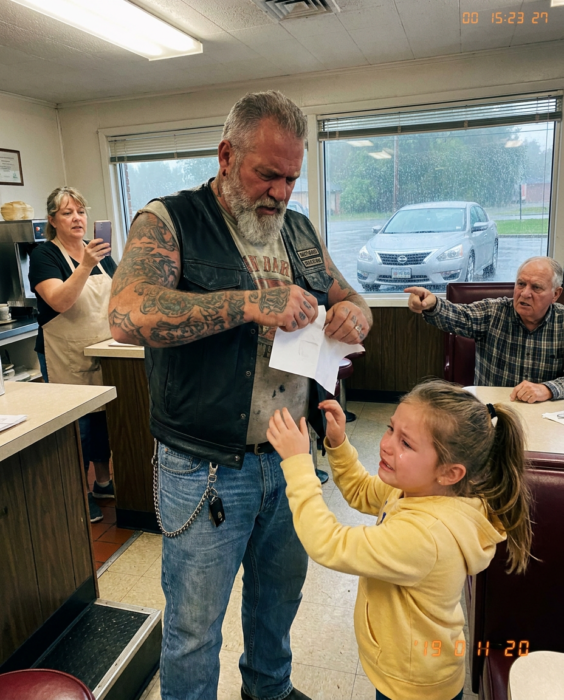
The girl and the man came in while I was waiting for eggs. He chose the booth beside mine and sat on the side facing the counter. She slid in across from him. He took a pencil and a piece of paper from a folder, laid both before her, and spoke quietly. I caught only fragments: school, your mother, explain it properly. He smiled when the waitress approached, then ordered the girl milk and said he had to make a call outside.
I looked out the window after he left. He wasn’t on a call. He sat in the sedan with the folder on the passenger seat and watched her.
The girl’s name was Ellie. I learned the rest much later, from conversations I was allowed to have with her grandmother and from what Ellie chose to tell me herself. That morning, a staff member at her school had noticed the marks on her arms and asked her about them. Ellie had not known what to say. The man had picked her up afterward and told her they needed to make sure nobody misunderstood.
In the diner, all I knew was what I could see: a child writing a letter while a man kept time from a car.
I made excuses for what I saw. The marks could have come from sports. A child could have been embarrassed by a school question that had nothing to do with home. I had no standing to ask her to account for either. My own appearance didn’t help; when I caught her eye, she looked down at once. I folded my hands around my cup and tried to give her room.
Then I heard her rehearse the words. She spoke softly but distinctly, the way children do when they want to remember every part of an instruction. I recognized the sentence from the man’s voice before he left: she had been careless, she had made him upset, and the marks were her fault.
He had said it while she was reaching for the pencil. I remembered because she had asked him to repeat the last part.
I got up to pay and saw more of the page as I passed. Ellie had written “I am sorry” across the top, then crossed out “I” and written it again. Near the bottom she had left a blank space after “I promise.” I went to the counter and asked the waitress, whose name tag read Ruth, whether the girl had come in before. Ruth said she hadn’t seen her. I told her what I had heard, keeping my voice down. Ruth looked toward the booth, then toward the car. She said she would check on Ellie while she brought my coffee.
Ruth was cautious, which I appreciated later. She had a diner to run and a frightened child to consider. She walked over with the pot and asked Ellie whether she needed anything. Ellie said no without looking up. Ruth poured my coffee and stayed long enough to see Ellie rub her wrist. When Ruth returned to the counter, she told me she was going to call her manager.
I went back to my booth. I could have stayed there and let Ruth handle it. In fact, I meant to. Then Ellie dropped her pencil, and as she reached for it the paper slid near the edge of her table. I picked it up and handed it back. She took it by the corner, keeping her fingers away from mine.
“I’m sorry,” she said.
She said it so readily that I wondered how often she had been made to practice. Still, wondering wasn’t knowing. I asked only whether she wanted Ruth to come sit with her. Ellie shook her head. After a pause she said the man outside expected a letter, and if she didn’t finish, he would come back in.
That was the first time I heard fear in her voice.
My past made me slower in some ways and faster in others. Years earlier, when my son was young, I had been the father who spoke for him at every appointment because I thought I was helping. His mother finally told me to be quiet and let the boy answer. It was a small correction, but I remember his face when someone waited for his words. Since then, I’ve tried to pay attention when a child looks toward an adult before speaking.
I also knew attention could turn into presumption. I wasn’t Ellie’s family. I was a stranger in a booth. I had told Ruth my concern, and she was bringing another adult into it. All I needed to do was wait.
Ellie finished the last line, folded the sheet, and looked toward the car. The man reached for his door. I made the choice the entire diner would see, while the reasons for it stayed hidden in my head.
When I tore the letter, Ellie made a sound I still hear. It wasn’t loud at first. It was the sharp breath of someone trying to hold herself together, followed by a sob when the page gave way in my hands.
I had meant to keep him from taking it. I succeeded at that and hurt her doing it.
Ruth came around the counter with her phone. She told me to step back and asked Ellie whether I had touched her. Ellie said I had taken her paper. Ruth made me put my hands where she could see them. I did. A man from the counter stood beside her, close enough to intervene if I moved toward Ellie again.
The stepfather came through the door then. He introduced himself as Mark and asked what had happened. He looked at Ellie first, at her wet face, and then at me. He asked for the letter. I said it was in pieces in my pocket.
“I’m calling the police,” he said.
“Please do,” Ruth answered before I could speak. She had already called.
Mark’s eyes moved to her phone. For the first time, he seemed less concerned with Ellie’s crying than with who else might walk into the diner. He said he was taking her home. Ruth told him she had asked for help and wanted everyone to wait. She did not accuse him of anything. She didn’t have to; her body was between him and the booth.
Ellie wiped her face with her sleeve. Mark told her she was making a scene. She folded her arms and stared at the tabletop. I had heard him use the same tone when he told her how to write, and I felt my jaw tighten. Ruth caught my eye and gave a small shake of her head. I stayed back.
My phone buzzed. Luis had reached the parts shop and wanted to know where I was. I texted him the diner’s address and asked him to come inside quietly when he arrived. I didn’t tell him to bring the club. I needed someone who knew me and could help me keep calm if this dragged on.
Ruth’s manager opened the office at the back. She asked Ellie if she wanted to sit with her there while they waited. Ellie looked at Mark, then nodded. Ruth walked with her. Mark objected, saying Ellie was his daughter and had done nothing wrong. The manager said she would stay with Ellie and the door would remain open. From my booth, I could see Ruth pull up a chair just inside.
The man at the counter asked me what the letter said. I told him what I had heard Ellie repeat and said the pieces were still in my pocket. He looked at my hands, with the tattoos over the knuckles, and asked why I hadn’t just handed the page to Ruth.
“I should have,” I said.
Luis came in five minutes later, carrying a small paper bag of motorcycle parts. He saw Mark by the counter, Ruth at the office door, and me sitting in front of a plate of eggs I hadn’t touched. I told him, in a few sentences, what I had done. Luis didn’t defend me. He sat down and said we should tell the officers exactly that.
Two officers arrived. One spoke with Ruth and her manager; the other asked Mark to wait at the counter. An officer took my name and the pieces of the letter. I watched her put them into a paper envelope. She asked whether anyone had seen the page intact. I had. Ellie had. Mark said he knew what it was supposed to say because Ellie had agreed to write it.
The officer wrote that down.
She asked me why I had torn it. My answer sounded thin aloud: I had heard a child repeating words she said her stepfather wanted, and I had seen him coming in to collect the page. I told her I knew I had frightened Ellie. I also told her Ruth had called her manager before I touched the paper. The manager confirmed it.
For a little while I thought that would settle the immediate question. The officers would hear Ellie, keep the letter, and find someone safe to take her home. Instead, one officer came out of the office and asked if I had told Ellie what to say next.
“No,” I said. “I told her I’d wait if she wanted to write again.”
Ellie had asked for paper. Ruth had given her a diner notepad and a pencil. She sat in the office with the manager while the officer stood outside the doorway. I could see only the back of her yellow sweatshirt. She wrote a few words, stopped, and pushed the pad away. Then she pulled it back.
Mark said the whole thing had been planted in her head by a stranger. He pointed at me. I wanted to argue, but the officer told us both to let Ellie finish. Luis put his hand on the edge of my table. It was a quiet reminder to stay seated.
A woman from children’s services arrived later that afternoon. Until then, nobody at the diner told Ellie where she would sleep that night. I had assumed she would not be sent back to the car. I learned, sitting there with cold eggs and damp boots, that my assumption wasn’t a decision anyone had made.
The second letter was one sentence.
I saw it only after Ellie chose to show it to Ruth. The officer had asked whether she wanted it folded and put away. Ellie shook her head. Ruth brought it to our booth because Ellie said she wanted me to know what she had written. On the small white sheet, in pencil that grew darker toward the end, were six words: I did not do anything wrong.
I read them once. Then I handed the page back to Ruth.
Ellie had asked to write without Mark in the room. She had also asked the manager not to suggest a sentence. Those details mattered to her. The letter wasn’t a neat replacement for the one I had torn; it said the opposite, and it belonged to Ellie. Ruth asked where she wanted to keep it. Ellie said she wanted the worker from children’s services to see it first, then she wanted it back.
The worker arrived and spoke with Ellie privately. An officer spoke with Mark. I stayed with Luis at the booth, where I could hear the coffee machine and little else. From time to time Ruth came out of the office for water. She was gentle with Ellie and blunt with me. “Let them work,” she said when I stood up to ask how Ellie was doing.
I sat down.
The worker asked me about the first letter. I described the words I had seen and heard. She asked me to distinguish between what Mark had said in front of me and what I had guessed he meant. I did my best. Mark had told Ellie how the marks needed to be explained. He had repeated the sentence about her being careless. I had watched her copy it. I had not seen what happened at home.
For an hour, that distinction was the hardest part of helping. I wanted to tell the worker what I thought had happened. She needed me to tell her what I knew.
The torn pieces were taken with the other information gathered that day. My hands had broken the page into small sections, but Ellie’s handwriting could still be seen on several of them. They showed what she had written, and the officers recorded the circumstances in which I took the letter. They also spoke to Ruth, the manager, and the customer at the counter. None of us could tell them everything.
Ellie could tell them more. Whether she felt able to was another matter.
Later, her grandmother explained something I hadn’t understood at the diner. Ellie’s mother was away caring for a relative and had believed the marks were from a fall Ellie had mentioned over the phone. Mark had insisted on the letter because the school had asked questions. Ellie thought that if she signed it, she would have to keep repeating its account to her mother, her teacher, and anyone else who asked.
That was why she held on when I grabbed it. She was frightened of handing it to Mark; she was also frightened of failing to hand it to him. I had treated the page as if it were the only thing at stake. For Ellie, both choices carried a consequence.
Her grandmother told me something else, much later. Ellie had tried to tell an adult about Mark before that Thursday. She stopped after being asked whether she was certain, because she thought being certain meant remembering every word in the right order. The first letter gave her a complete account she could recite. It was an account Mark had supplied. The second one was shorter because she had finally been allowed to begin with what she knew.
I had expected the paper to tell people what to do. It didn’t. The worker considered Ellie’s safety, spoke with the people responsible for her, and arranged for her to stay elsewhere while the concerns were investigated. I went home after giving my statement. Mark left the diner without Ellie. I saw him get into the sedan alone and sit there for several minutes before driving away.
Ruth came out with my bill. I reached for my wallet and found a tiny corner of lined paper caught along the seam of my vest pocket. I gave it to her. It held half a pencil mark and no readable word. Ruth put it in an envelope with the rest.
I asked whether Ellie had eaten anything. Ruth said she had managed half a grilled cheese. It was the first ordinary answer anyone had given me all afternoon, and I held on to it during the ride home.
The first night, Ellie stayed with her grandmother. I learned that from Luis, who had left his number with Ruth in case an investigator needed us. Ruth had heard from the worker only after Ellie was safely there. She told Luis enough to ease our worry and no more.
I did not go to the grandmother’s house. I had known Ellie for an afternoon, most of which she had spent afraid of me. Luis reminded me of that when I asked if we ought to deliver groceries. He said we could offer help through the adults caring for her and accept the answer they gave us. He was right.
Over the next two weeks, investigators gathered more than two pieces of paper. They spoke with Ellie, her grandmother, her mother, and people at the school. A clinician documented the marks on Ellie’s arms. The diner staff gave statements about what they had heard and seen. I spoke with an investigator again, this time in a quiet room where nobody was crying and I could take time to remember the exact order of things.
Mark was charged within those two weeks. Ellie’s grandmother called me after it happened. She did not discuss everything the case involved, and I didn’t ask her to. She said Ellie would remain with her while the adults worked through what came next. I thanked her for telling me and asked whether Ellie needed anything I could help provide.
“She needs people to keep their promises,” her grandmother said.
I thought of what I had said in the diner: You can write again. I’ll wait. I had stayed through that afternoon. I could do something steadier after it.
Our club had a small fund built from weekend breakfasts and a ride we held every spring. It usually paid for things a family could point to on a receipt: repairs, groceries, a ride to an appointment. I told the members what I was permitted to share and asked whether we could use some of it to support Ellie’s counseling if her grandmother wanted that help.
The room went quiet. One member asked if we had enough to keep paying beyond the first visit. Another asked whether Ellie knew us well enough to want us involved. Luis told them how she had looked when I tore the letter. He was careful to include that part. We agreed to make an offer through her grandmother, with no visit or photograph attached to it, and to set aside money each month if she accepted.
She did. For two years, the club helped cover the counseling costs her family asked us to cover. I knew the amounts because I kept the receipts. I knew very little about what Ellie said in those sessions. That belonged to her.
The club did bring groceries once, after her grandmother requested them during a week when her car was in the shop. Luis and I left the bags at the door. Ellie saw us from the hallway. She was still in the yellow sweatshirt, though the sleeves were rolled up. I raised my hand. She didn’t raise hers, and I understood.
A month later, her grandmother asked whether I would meet them at the diner. Ellie had chosen the place. I arrived early, parked the Harley away from the front window, and took the same booth. When Ellie came in, she stopped beside it and looked at my vest pocket.
“Do you still have it?” she asked.
I told her I had handed every piece of the first letter to the officer. She nodded. Then she asked if I had kept a copy of her second one. I said I had seen it but had not photographed it. The investigator had recorded it, and Ruth had helped return Ellie’s original to her. Ellie pulled a folded sheet from her own pocket and held it flat against the table. She had kept it herself.
She read the sentence aloud. She stumbled on the word anything, began again, and finished. I waited until she was done. Then I asked if she wanted pie. She chose chocolate, and we talked about the diner’s broken jukebox while her grandmother drank coffee.
I saw Ellie only a few times after that. Her grandmother sent occasional updates: a school play, a new bicycle, a picture of a dog Ellie had persuaded her to adopt. None of them contained details about the case. I was grateful for the glimpses and for the distance that let Ellie have a life larger than what happened at the diner.
I had once thought tearing the page would keep a false account from following her. The investigation made clear how many people had to listen, check, and act before Ellie was safe. My part had happened in seconds. Theirs took far longer. So did hers.
For a long time I avoided that diner. I could picture Ellie crying every time I came near the turnoff. On a rainy morning the following year, Luis asked me to meet him there for breakfast. He arrived before I did and took the booth beside the one where I had sat.
Ruth brought coffee without asking what we wanted. She still thought I should have let her take the first letter. She told me so while she set down the mugs. I agreed. We had spoken about it before, and I was glad she hadn’t grown tired of saying it. She had seen Ellie’s face from the other side of the room.
The diner had replaced the cracked vinyl on two booths. Everything else looked familiar: the window facing the parking lot, the bell over the door, the slow clock above the counter. I found myself watching people who sat alone. Ruth caught me at it.
“You can ask me for help,” she said.
I told her I would.
After that, I returned every few months. Sometimes Luis came, sometimes I rode alone. Ruth told me Ellie and her grandmother still stopped in for pie. When they did, I usually wasn’t there. I never arranged to cross paths. Once I left money for their meal, and Ruth gave it back. Ellie’s grandmother had already paid, and Ruth said they preferred it that way. I put the bills away.
The club kept its monthly arrangement with the grandmother until the two years were up. A few members who had voted for it never met Ellie. One of them, a quiet mechanic named Paul, checked the fund before every winter ride and made sure the amount was there. He had been the first to ask whether we could afford to keep our word.
When Ellie was thirteen, Ruth handed me a note her grandmother had said I could read. Ellie had written that she liked art class and that the diner’s chocolate pie was still too big to finish. At the bottom she added, “You waited.” I put the note in my wallet, where the fold eventually wore soft.
I used to keep my vest pocket empty because I could feel the scraps that had been there. Now it holds a pencil. Luis noticed it one morning and asked if I had taken up writing letters. I told him it was there in case someone needed one. He laughed, then saw I meant it and left the subject alone.
That summer Ellie came in while I was at the counter. She was taller, with paint on one hand from a school project. Her grandmother was beside her. Ellie stopped to say hello and asked if the motorcycle outside was mine. I said it was. We walked to the window, and I showed her which one.
She asked how loud it was. I told her she could decide for herself when I left. She stayed by the glass with her grandmother while I started it. I kept the engine low and pulled away. At the traffic light, I looked back. Ellie was still at the window, holding her grandmother’s hand.
I did not see Ellie on her eighteenth birthday. Her grandmother called that evening and asked if I could meet them for breakfast the following Saturday. Ellie wanted to show me something, she said. That was all the invitation I needed.
I arrived before them. Ruth had retired the previous winter, but the new waitress knew Ellie’s grandmother and brought out coffee when she saw us settle into a booth. Ellie looked older than I expected. She wore her hair tied back and spoke about a job she was starting, where she would be helping younger children with art projects.
She ordered chocolate pie after breakfast. I asked whether she could finish a whole slice now. “We’ll see,” she said, and her grandmother smiled into her cup.
Then Ellie turned her wrist toward me. The tattoo was small, in plain lettering: I DID NOT DO ANYTHING WRONG. She said she had kept the diner notepad sheet for eight years. She wanted the words where she could see them without unfolding it.
I looked at her grandmother before I answered. She nodded, giving Ellie room to tell the story herself. Ellie said she had almost thrown the paper away more than once because it reminded her of that day. Each time, she put it back in her drawer. Eventually the sentence felt less like something she had written for the adults in the diner and more like something she wanted to carry into the rest of her life.
I told her the tattoo looked like her handwriting. It wasn’t exactly, she said. The artist had made the letters easier to read. She held out her wrist so I could look closer, then pulled it back and picked up her fork. The moment passed because she let it.
We ate pie. Her grandmother asked after Luis, and I told her he was still riding and still finding excuses to fix things that worked. Ellie laughed at that. Before they left, she asked if I still carried the pencil. I took it from my vest pocket and laid it on the table. She rolled it once beneath her fingers, then handed it back.
Outside, I watched them walk to their car. Ellie opened the passenger door for her grandmother and waited until she was seated before going around to the driver’s side. I started the Harley after they had pulled away. Through the diner window I could see the booth where we had sat, three empty cups and a little chocolate left on the plate.
Follow this page for more biker stories about the people we meet, the choices we make, and what stays with us long after a ride ends.