Three People Called Police When I Put a Seven-Year-Old Girl in My Truck Bed—Then Her Mother Recognized the Man in the Van
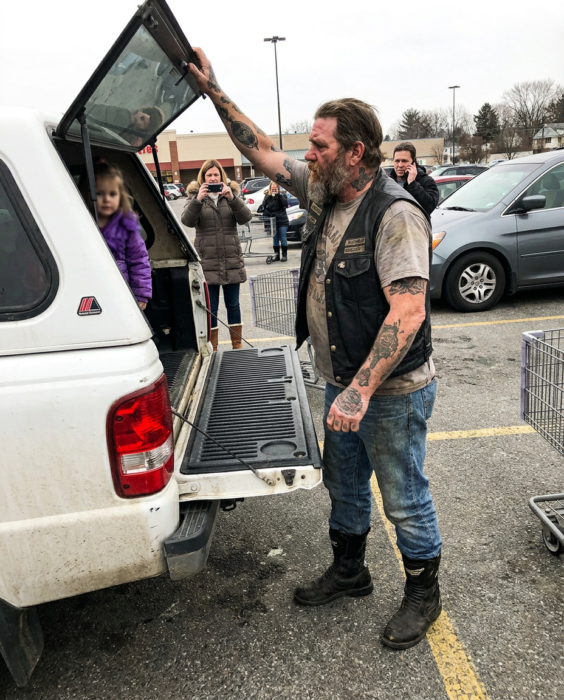
The parking lot was busiest between noon and two. I knew that because our club sometimes collected donations outside that supermarket, with the manager’s permission, for a local food pantry. I knew where the cart returns stood and which row filled first. On that Saturday I had gone alone, dressed for the garage instead of a ride. My vest was on because I had left it over the back of a chair the night before.
I was fifty-eight and accustomed to people stepping aside when they saw me. The beard, the tattoos, the size of me—none of it made for a gentle first impression. My friends knew I carried dog biscuits in my truck for a stubborn old hound named Copper. They knew I cried at my daughter’s wedding and denied it until she showed everyone a photograph. The people in that parking lot had no reason to know any of that. They had every reason to pay attention when I put a child in my truck.
Before the girl came out of the store, I had noticed a man near the van smoking beside the passenger door. He put out his cigarette when a woman and boy passed. I saw him get back in while I walked through the automatic doors. I thought nothing of it then.
Inside, I spent too long comparing bulbs because I had forgotten the number I needed. My friend Cal called to ask whether I was still coming to the garage. He was helping me change the Harley’s tire, and he wanted me to bring coffee. I told him I would be there shortly. The call lasted less than a minute, but I remember it because when I came out, the van was in a different space.
I set the dog food in my cab and looked up. The driver’s side faced the entrance. The passenger looked down at something in his lap, perhaps a phone. I did not know they had been there twenty minutes. Investigators established that later from store cameras and the times on several receipts. In the moment, I knew only that I had seen the van twice and that it had changed position.
The girl emerged from the store alone a little later. She was seven, though I would have guessed younger. Her purple coat was zipped to the chin, and she pushed an empty child-size cart someone had left near the entrance. She let go of it when she reached the painted crossing. I looked past her for an adult and saw shoppers moving in and out, none obviously with her.
I started toward her to ask if she needed help finding someone. Then the van crept forward. The passenger got out, closing his door quietly, and cut through the gap between two parked cars. He was approaching her from the side she had turned away from.
I know how that sounds when I tell it now. Every movement feels deliberate because I learned what the police found. At the time I was still trying to decide whether the man knew her. He called out, and she glanced at him. I could not make out the name he used. She took a step back.
I asked her whether she knew him. I wanted a clear answer before I approached a stranger’s child. She shook her head. The man told me she was with him. I asked her again, looking at her rather than him. She shook her head a second time and moved closer to my truck.
That was when I shouted for someone to call the police.
The van’s driver rolled down his window and called to the passenger. The girl flinched at his voice, though I could not tell whether she recognized it or was simply frightened. The passenger moved faster. I saw the store doors opening behind me, but the people coming through were carrying bags and watching their feet. If I ran toward them with the girl, I feared the passenger would reach us before they understood why I was running.
There was no good choice in front of me. I need to say that plainly because people have since told the story as though I had a clever plan. I had a covered truck bed close by. I thought I could put the girl out of the men’s sight, stay beside her, and draw the attention of everyone in the lot until officers arrived. I did not know how frightened the enclosed space would make her. I did not know how long help would take.
I told her, “I’m going to keep him away from you.” She may not have heard me. I picked her up, moved two steps, and placed her inside. I closed the lid and turned to face the man.
He stopped just beyond the next parking space. He could see my truck but not the girl. He could also see people raising their phones. I held my keys where the witnesses could see them and said I would not drive. The man glanced toward the van. Then he backed away.
For two seconds, hiding her had been the whole plan. The next four minutes were much harder.
The woman who first called police wore a green sweatshirt and had three grocery bags on the pavement beside her cart. She shouted that she had my license plate. I told her to give it to the dispatcher. Her voice shook as she read the numbers aloud. I repeated the van’s plate as much as I could see of it, but another car blocked the last digits.
A man by the cart return filmed me. He asked the girl’s name. I told him I didn’t know it. His expression changed when he heard that. He took a step closer and asked how I could put a child I didn’t know inside my truck. I asked him to watch the gray van and tell the dispatcher where it went. He stayed where he was, filming.
The girl beat her hand against the rear window of the truck cap. I moved to the side where she could see me without my body blocking the witnesses’ view. I said, “I’m here. The truck isn’t moving.” She called for her mother again. I asked if she knew where her mother was. She said “inside,” then cried too hard for me to hear anything else.
That gave me one useful thing to tell the store employee when she came out. She had a radio clipped to her shirt and a name tag that said Tasha. She saw the girl through the window and asked me to open the lid. I pointed to the man crossing back toward the van. “Find her mother,” I said. “Police are coming. Please tell them he approached her.”
Tasha looked from him to the girl. She asked whether the child could breathe. I told her the truck bed had a window and vents, and I could hear her speaking, but Tasha was right to ask. I had shut her in there in warm weather. I checked on her constantly while we waited. Had she gone quiet or seemed unwell, I would have opened it immediately, whatever the men were doing.
Tasha radioed the store and ran toward the entrance. The man in the green sweatshirt came between me and the truck. He said I needed to let the girl out. I told him I would as soon as officers could keep the van’s occupants away. He was angry, and I did not ask him to trust me. I asked him to stay where he could see the rear window.
The van began moving toward the lot exit. The passenger reached it and got inside. A car pulling into the lane delayed them for a few seconds. One of the witnesses told the dispatcher which way the van was pointing. I could hear her giving a description of me as well. She described my vest, my beard, and the fact that I was guarding the truck. She gave the dispatcher everything she saw, including the part that made me look guilty.
At some point I called Cal. I did not ask him to come. I wanted someone to know where I was if the situation went badly. I said I was in the supermarket lot, a child was in my truck bed, and police had been called. He asked me to repeat myself. I did, then ended the call because the girl had started crying harder.
I had been standing there for perhaps three minutes. It felt longer. I tried to measure the time by watching the crossing signal at the edge of the lot, but my attention kept returning to the rear window. The girl had slid away from it. I called to her, and after a moment her small hand appeared against the glass. I placed my palm on the outside where she could see it.
The first police car turned in with its lights on. I raised both hands. An officer stepped out and ordered me away from the truck. I told him my keys were in my right hand, set them on the pavement when he instructed me to, and stepped back. He asked where the child was. I pointed to the covered bed.
He opened it. The girl scrambled toward him. He lifted her out and set her on the ground behind his car while another officer arrived and headed for the van. Tasha came back with a woman running beside her. The girl cried “Mom,” and the woman knelt to hold her.
I wanted to know if she was all right. The first officer was asking me questions, so I answered them. I gave him the order of what I had seen: the van, the man walking toward the girl, her head shaking when I asked if she knew him. I also told him I had put her in the truck without permission and closed the lid. There was no way around that fact.
A few spaces away, officers stopped the van. The passenger protested loudly enough for us to hear. The driver stayed seated. I caught sight of a folded tarp behind them when an officer opened the side door, but I had no idea what else was inside. Later, some people talked as though the tarp alone proved what the men intended. It didn’t. The officers had to investigate far more than a piece of fabric.
The girl’s mother was holding her now. She looked toward me once. I do not know what she had been told in the store, but her face held fear and anger. She was entitled to both. I looked away and answered the officer’s next question.
I thought the arrival of police would make everything simple. It made the girl safe in that moment. The rest had only begun.
The girl’s name was Sophie. Her mother, Nora, had been at the customer-service desk trying to find her. They had separated near the pharmacy counter when Sophie went to look at a display by the front of the store. Nora had searched two aisles, then asked an employee for help. Tasha found her seconds after the first officer arrived.
At the scene, Nora wanted to know why I had put Sophie in a covered truck bed. I gave her the same answer I had given the officer. She asked if I understood how frightening that was for a child. I said I did now. Sophie held tightly to her mother’s coat and would not look at me. I did not try to approach her.
The officers took statements from the three witnesses, Tasha, Nora, and me. They collected contact details and asked the store to preserve its camera footage. They separated the two men from the van. I saw one officer speak with the passenger while another checked identification. After about an hour, an officer told me I could leave but might be asked to come to the station. I gave him my number and drove home without the dog food; it was still in the cab, but I had forgotten it existed.
Cal was waiting at my garage. He had changed the Harley’s tire, then spent the rest of the afternoon wondering why I had stopped answering my phone. I told him what happened. He listened without interrupting. When I finished, he asked whether Sophie had come out of the truck safely. I said she had. He nodded, then asked how long she had been in there.
“About four minutes,” I said.
He rubbed his face. “That’s a long four minutes for a kid.”
I knew. I had heard every second of it.
That evening an investigator called and asked me to come in the next morning. I barely slept. I replayed my choices: I could have lifted Sophie over the low rail toward the sidewalk, shouted for Tasha sooner, or gone straight toward the store doors. Each possibility worked better in my kitchen than it had in the parking lot, with a man closing the distance and a little girl shaking her head.
At the station, the investigator showed me several still images from the supermarket cameras. They established when the van had entered the lot, how it had changed spaces, and where its occupants had been while Nora and Sophie shopped. Another camera showed the passenger walking toward Sophie. My truck blocked part of what happened next. The witnesses’ phone videos filled in that gap, including the moment I lifted her.
The investigator asked whether I recognized either man. I did not. She told me their names only after I had given my account again. She also said both had prior convictions, but she was careful about what that meant. Their records did not, by themselves, establish what they had intended to do that afternoon. Investigators were looking at the footage, the van, messages, and the court documents Nora had brought in.
I did not know about the court documents until later. At the station, Nora had been shown a photograph of the passenger. She recognized him as her former husband and Sophie’s father. Two years earlier, a court had ended his custody rights after a long case. Nora told the officers he was not permitted to take Sophie. She had not expected him at the supermarket, and Sophie had not seen him for a long time.
That changed how I understood Sophie’s reaction in the lot. When I asked whether she knew the man, she had shaken her head. She may not have recognized him. She may have been too frightened to answer me fully. I had no way of knowing. What mattered was that she had pulled away when he approached, and the court order Nora produced made his claim to be taking her home a matter the police could check.
Investigators later found messages showing he had arranged for the driver to come with him and had discussed when Nora usually shopped. The tarp I had glimpsed in the van became one detail among many. The evidence was gathered over time; nobody settled the case by looking into a vehicle for thirty seconds. When Nora heard what they had found, she learned that the meeting in the parking lot had been planned.
She had gone to buy groceries with her daughter. Someone who knew her routine had waited for them.
Cal drove me home from the station because my hands were shaking. I kept thinking about the purple coat behind the truck’s rear window. I had feared the van would take Sophie. I had also become a stranger she needed to recover from. Both things were true, and I had to leave room for both.
Nora called three days later. An officer had asked whether she wanted my contact information, and she had waited before saying yes. When I answered, she introduced herself and thanked me for noticing the van. Then she asked if I would listen without explaining my choice again.
I sat down on the garage stool and said I would.
Sophie was home with her. She had slept beside Nora for two nights and startled whenever the bedroom door closed. Nora said she understood why I had kept the passenger away, but Sophie remembered the darkness and the lid striking shut. She was afraid of small spaces. Nora wanted me to know that thanking me did not mean she could pretend those minutes had been easy for her daughter.
I told her I was sorry Sophie had been frightened. I did not tell Nora it had all worked out, because it had not. She said Sophie was getting support and that the adults around her were trying to let her talk about the parking lot at her own pace. Then she thanked me once more for staying with the truck instead of driving away and ended the call.
Our club heard the story through Cal. He told only the members who needed to know why I had missed our garage work that Saturday. By Monday, other people had seen a short phone video online: me lifting Sophie, closing the truck bed, and standing in front of it. The person who posted it had not yet learned about the van. Some comments called me a kidnapper. Others, after a local report mentioned the investigation, called me a hero.
Neither group had met Sophie. I asked the club not to share the video. Cal helped me contact the person who posted it and ask that Sophie’s face be removed. The person took the clip down after speaking with Nora. I was relieved, though I knew copies might already exist.
The investigation continued. Officers and prosecutors reviewed messages, store footage, witness accounts, and the existing court order. Nora was given safety advice and help making plans for where she and Sophie would stay while the case moved forward. Eventually she chose to move. She told me that herself months later, after she was settled. I never asked for the address, and I did not share the city with the club.
Her former husband and the man who drove him were prosecuted. The case took time. I gave evidence about what I had seen in the lot and about Sophie’s response when I asked whether she knew the approaching man. I was asked about putting her in my truck bed, too. I answered that I had done it and that it frightened her. I would have distrusted an account that left that part out.
Nora’s former husband was convicted. When I heard the news, I was at the garage with Cal. He turned off the radio, and we sat for a while without talking. A conviction meant the evidence had been heard. It did not give Nora and Sophie back the ordinary Saturday they had expected, or spare Sophie the work of feeling comfortable in a parking lot again.
Almost a year after the incident, Nora called me once more. Sophie had asked whether the man with the pickup still had it. I told Nora I did. Sophie had also asked whether the back was still dark. The question stayed with me after we hung up.
I thought about changing the truck, but I could not change what Sophie remembered. I asked Nora whether Sophie wanted me to answer her question directly. Nora checked with her first. Sophie said she did not want to see the truck yet; she only wanted to know if I still closed the lid that way. I told Nora I had stopped using the cover until I could repair its heavy latch. That was true. When I used the truck bed, I kept the cover open or removed it.
Cal suggested I give Sophie something made from the truck, though neither of us knew what would help. Nora asked the professional working with Sophie before accepting any plan. After talking with Sophie, she told us there was one thing Sophie liked: making spaces for her stuffed animals with boxes and blankets. Sophie wanted to decide where the openings were and when a lid stayed up. She did not want anyone to surprise her.
That gave us a project we could make only if she wanted it. Cal and I took a removable panel from the old truck bed liner and cleaned it. A friend who built cabinets helped turn it into the outside trim of a toy chest. The chest had an open top. No lid, no latch, and no place for a child to be shut inside. We rounded the corners, lined the bottom for toys, and fitted a small battery light Sophie could switch on herself.
We showed Nora pictures before we brought it anywhere near Sophie. She asked Sophie if she wanted to see them. Sophie chose a blue cushion for the stuffed animals and asked us to leave one side low enough for her to reach across. We changed the design. The chest became hers through those choices, not through anything Cal and I imagined it might cure.
When it was finished, Nora invited us to bring it to her mother’s house. Sophie stood beside Nora while we carried it in. She touched the smooth edge, switched the little light on and off, and put a stuffed fox inside. Then she took the fox out again. Nobody asked her to get into the chest or demonstrate that she was no longer afraid.
She looked at me for the first time since the parking lot. “It stays open?” she asked.
“It stays open,” I said.
She tested that by pushing on the edge. Nothing moved over her head. She nodded and went to find another toy.
For the first year, Sophie still had days when a closing door bothered her. Nora told me that in an occasional call, never as a report I had asked her to make. I listened. She said Sophie was learning to tell her when she wanted a door open and when she wanted someone to wait beside her. The toy chest sat in her room, full of stuffed animals and drawing supplies. It gave her a place to arrange things exactly as she liked; the rest of her recovery belonged to her, Nora, and the people helping them.
I saw Sophie only when Nora invited me. Once we met at a public park with Cal nearby. Sophie stayed close to her mother and showed me a picture she had drawn of her stuffed fox in a purple coat. We talked about the fox. I did not ask her about the van or the truck. Nora had said Sophie might bring it up herself someday, and I could wait.
Our club changed its approach to the food-pantry collections outside the supermarket. We had always watched the donation table. After that Saturday, we asked the store manager how to alert staff promptly if we saw a child separated from an adult or someone in distress. She gave us the store procedure and the number for the service desk. At events, one member kept the contact information handy. It was a modest change, useful precisely because it did not depend on anyone making a perfect decision under pressure.
The three witnesses from the lot were part of that afternoon, too. Their calls brought officers to us. One of them later apologized for shouting at me. I told her she had seen a stranger put a child in a truck and had called for help. I was glad she had. I also told her about the van because the details mattered. She said she had given the dispatcher its direction of travel after I pointed it out. Her account helped officers find both vehicles quickly.
Tasha still worked at the supermarket when I returned months later. She recognized me at the checkout and asked how Sophie was. I said she was with her mother and doing well enough that she had begun choosing how to fill a toy chest. Tasha smiled, then asked whether the chest had a lid. “No,” I said. She seemed glad I understood why she had asked.
The pickup stayed in my driveway, though I used it less often. I repaired the cover so it would open properly, but I never thought of the truck bed the same way again. On hot days I remembered checking the rear window for Sophie’s hand. If I drove past the supermarket, I remembered the woman in the green sweatshirt reading my plate to the dispatcher and the moment an officer took my keys.
One afternoon Nora sent a photograph of the toy chest. Sophie had filled it with books and laid her fox across the blue cushion. A strip of sunlight fell over the open top. On the back of the photograph, Nora had written that Sophie now liked to keep the little light on while she read.
I pinned the picture inside my garage cabinet. Cal saw it when he came to help with a tire. He asked whether Sophie was doing better. I told him what Nora had said and left it there. We went back to work while Copper slept near the open garage door.
Several years have passed since that Saturday. Sophie is older now. She and Nora have a home and routines that do not include me, which is how it should be. Once in a while Nora sends news: a school project Sophie is proud of, a new drawing, a photograph of the fox beside a stack of books. I keep those messages and answer without asking for more.
Sophie chose to keep the toy chest when they moved again. Its open top has scratches along the low side where she used to drag books across it. Nora told me the little battery light has been replaced twice. That detail pleased me more than the condition of the wood. Sophie used the chest for years because she wanted to.
I have been asked whether I would make the same choice in the parking lot again. I know why I made it. I know the man from the van stopped when he lost sight of Sophie and saw the witnesses calling police. I also know she spent four minutes scared in my truck bed and a long time afterward learning to feel comfortable with closed spaces. I cannot give a simple answer on her behalf.
I can tell you what happened when the first officer arrived. I handed him my keys. He opened the truck. Sophie came out and ran to her mother, who had reached the lot just in time to hold her. That was the moment I wanted from the instant I saw the van move: Sophie in Nora’s arms, with other people there to help keep her safe.
These days, when our club collects food outside the supermarket, Cal usually brings the table and I bring the boxes. We set up near the entrance, say hello to Tasha if she is working, and go home when our shift ends. Some afternoons I see a child take a parent’s hand before crossing the parking lane. I wait for them to pass before I pull out.
Follow this page for more biker stories about the people we meet, the choices we make, and the journeys that stay with us after we get home.