A Twelve-Year-Old Sold the Game Console He Saved Two Years to Buy — Then a Biker Recognized His Wounded Brother’s Name
Bear did not speak during the drive to Milo’s house.
That worried me.
He usually filled silence with practical complaints: tire pressure, weather fronts, bad coffee, fuel stops. That afternoon he sat in the passenger seat of our support truck while Cole drove, holding Ethan’s name in his mind like something sharp.
Milo rode in the back with me. The console rested across his knees.
Every few minutes, he checked the tape sealing the box.
“You really know Ethan?” he asked.
“I do.”
“What was he like?”
“Too young to understand the value of sleep.”
Milo smiled faintly.
“He still doesn’t sleep much.”
That answer stayed with us.
Sarah Bennett lived in a duplex near an abandoned grain warehouse. One gutter sagged above the porch. The family van sat in the driveway with its hood closed and a dark stain beneath the transmission.
Milo asked us to wait outside.
He wanted to explain the sale himself.
Bear ignored him.
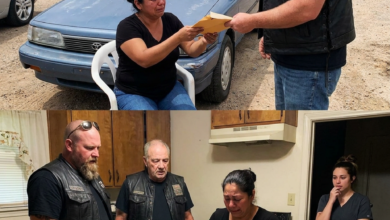
He climbed the steps, but before knocking, he removed his sunglasses and wiped road dust from his boots. It was the kind of courtesy nobody expected from a man with skull tattoos across his knuckles.
Sarah opened the door wearing a diner uniform beneath a winter coat.
She saw three bikers and stepped in front of Milo.
“What happened?”
“Nothing bad,” Bear said. “Not here.”
Her eyes dropped to the console.
“Milo?”
The boy lowered his head.
“I was going to buy your ticket.”
Sarah understood immediately. Her shoulders collapsed, and she pressed both hands against her face.
The sound she made was not loud.
It was worse than loud.
Milo wrapped his arms around her waist. “Ethan needs you.”
“So do you.”
“I’m okay.”
“You sold the one thing you wanted.”
“It’s just a game.”
Bear looked away.
Children should not become that good at minimizing loss.
We entered the narrow living room. Family pictures covered one wall: Milo missing his front teeth, Sarah in a diner apron, Ethan wearing a high-school wrestling uniform, Ethan beside his first battered motorcycle, Ethan in Army fatigues at the airport.
Our motorcycles appeared behind him in that final photograph.
Thirty bikes.
Thirty men.
Bear stood near the picture without touching it.
Sarah stared at him. “You’re from the club.”
“Yes.”
“Ethan talked about you.”
“He stopped talking to us.”
“He stopped talking to everyone.”
Sarah explained what she knew. During a training exercise in Missouri, a vehicle carrying several soldiers had overturned on wet ground. Ethan suffered fractures in his lower spine, pelvis, and left leg. Emergency surgery stabilized him, but nerve damage made his recovery uncertain.
He had been transferred to a military rehabilitation hospital in Illinois.
At first he called twice a week.
Then once.
Then only when Sarah begged.
“He says he’s fine,” she whispered. “But nurses call me because he refuses therapy. I hear him breathing on the phone, and I know he’s lying.”
“Why haven’t they arranged travel?” Cole asked.
“They offered one family assistance program, but the paperwork stalled because I work two jobs and missed a document deadline. I reapplied. They said four to six weeks.”
Bear’s fingers curled.
“Three months,” he said.
Sarah nodded. “Three months.”
She had considered taking a high-interest loan. The diner manager refused an advance. The van repair estimate was $2,600. Airfare cost too much, and the bus required two transfers.
She had $41 saved.
Milo had secretly checked the price every night.
Bear asked to see Ethan’s hospital information. Sarah hesitated, then retrieved a folder from the kitchen.
Room 412.
Rehabilitation Wing C.
Bear wrote it inside his palm.
Then he made two calls.
The first went to our club secretary.
“Emergency meeting. One hour.”
The second went to Marcus Reed, a former Army medic and one of our newer members.
“Find out what Wing C means.”
Marcus called back within minutes.
Wing C treated service members with serious orthopedic and neurological injuries. Patients there often remained for months. Some recovered mobility. Some learned different ways to live.
Bear listened without interrupting.
“What makes a kid refuse rehabilitation?” he asked.
Marcus exhaled.
“Pain. Fear. Depression. Shame. Thinking the future is already decided.”
“Can thirty motorcycles fix that?”
“No.”
Bear glanced at the airport photograph.
“Can they open a door?”
“Maybe.”
At the clubhouse, thirty-two men and women arrived before sunset. Some came directly from work. One still wore a mechanic’s coveralls. Another carried grocery bags because he assumed Sarah and Milo’s refrigerator needed attention.
Bear set the unopened console on our meeting table.
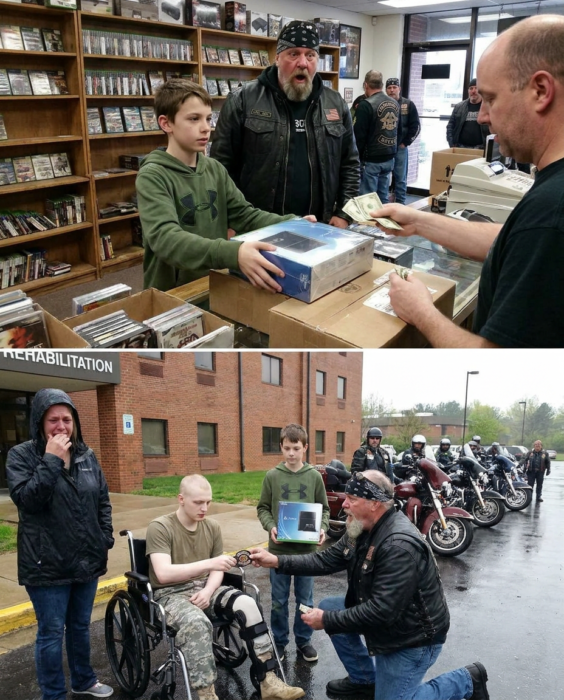
“This cost three hundred dollars,” he said. “A twelve-year-old saved two years for it.”
Nobody spoke.
“He sold it for ninety to buy his mother a bus ticket. The ticket is for Ethan Bennett.”
Several chairs scraped backward.
Tank Callahan stood first. “Our Ethan?”
“Our Ethan.”
“What happened?”
Bear told them.
As the details unfolded, disbelief turned to anger, then guilt. We remembered Ethan’s transfer notice. We remembered unanswered messages. We remembered promising to locate his new mailing address.
Life had filled the gaps.
A funeral. Two divorces. A garage fire. Jobs lost and found. Children born. Parents buried.
We had allowed silence to become an explanation.
Cole removed his cut and placed it on the table.
“When Ethan left, we told him this patch meant he never rode alone.”
He tapped the small empty space where Ethan’s support patch had once rested during club ceremonies.
“We lied.”
Bear shook his head.
“We failed. Different thing.”
“What’s the difference?”
“A lie stays a lie. A failure gives you work.”
He unfolded a highway map.
“We leave at dawn.”
The room shifted instantly from guilt to motion. Routes were planned. Fuel stops marked. Hotel owners contacted. Two members volunteered their vans so Sarah and Milo could travel comfortably. Marcus called the hospital and confirmed visitor procedures without revealing the surprise.
Tank went back to Replay Junction.
The shop owner had already accepted Bear’s money and voided the purchase. When Tank explained why, the man returned the full amount and added a gift card.
By ten that evening, the console belonged to Milo again.
But Bear made him a condition.
“You open it when Ethan can watch.”
Milo hugged the box.
“Deal.”
We left Cedar Falls at 5:30 the next morning.
Thirty Harley-Davidson motorcycles rolled out in two staggered columns, their V-twins pounding against the cold air. Dawn had barely touched the grain silos. Exhaust floated low over the highway, and headlamps stretched behind Bear like a chain of white fire.
Sarah and Milo rode in the support van with me.
Cole drove.
The console sat between them, still sealed.
Sarah had packed one small bag. Milo carried a backpack with crackers, two water bottles, and a drawing he had made of Ethan standing beside a motorcycle.
In the drawing, both of Ethan’s legs were straight.
Sarah noticed it.
She said nothing.
The trip measured a little over seven hundred kilometers, but Bear planned nearly nine hours because early spring weather could turn Iowa and Illinois roads ugly without warning. We stopped every ninety minutes to warm hands, check machines, and make certain Sarah had not changed her mind.
She came close twice.
At the first fuel stop, she stared at the line of bikers surrounding the van.
“I can’t let all these people do this,” she said.
Cole tightened a strap on his saddlebag.
“They’re already doing it.”
“They have families. Jobs.”
“So does Ethan.”
At the second stop, Sarah received a call from the hospital.
She walked away from us before answering.
When she returned, her face had changed.
“What happened?” I asked.
“Ethan refused therapy again.”
Milo looked up from the console.
“Why?”
Sarah could not answer him.
The hospital social worker had explained that Ethan’s progress had plateaued partly because he would not participate. His physical injuries were severe, but therapists believed he could regain meaningful movement with sustained rehabilitation.
Ethan no longer believed them.
He had begun keeping the curtains closed. He ate little. He refused video calls. When Sarah mentioned visiting, he told her not to waste the money.
That morning, he had asked whether the military could move him somewhere closer to “whatever comes next.”
Sarah did not know what he meant.
Marcus did.
He pulled Bear aside.
“They need a mental-health evaluation today.”
“Did he threaten himself?”
“Not directly. But that language matters.”
Bear’s face became stone.
“Call ahead.”
The hospital agreed to assess Ethan before our arrival. Nobody promised details, but the staff took the concern seriously.
We returned to the highway.
Rain found us east of Davenport. It came hard and sideways, turning the road silver. Leather darkened. Water crawled beneath collars. Tires hissed over standing water.
Bear never slowed enough to break formation, yet he never pushed beyond what the weakest rider could safely hold.
The support van followed twenty yards behind.
Milo watched the motorcycles through the windshield.
“Which one is Bear?”
“The first.”
“Can he see us?”
“He checks every mirror.”
As if hearing him, Bear raised one hand.
Milo waved back.
Near Joliet, one bike developed an electrical fault. The rider signaled and coasted onto the shoulder. Half the formation prepared to stop.
Bear ordered twenty-six onward.
Four remained with the disabled motorcycle.
Brotherhood was not everyone performing the same task. It was nobody being abandoned while the task continued.
We reached the military hospital shortly after three in the afternoon.
The building stood broad and gray behind trimmed lawns and flags snapping in the wet wind. Security had designated a lower parking area for the motorcycles, far enough from the main entrance to avoid disturbing patients.
Bear parked there.
One by one, engines died.
The sudden silence felt enormous.
Hospital staff met us beneath the awning. Marcus spoke with the rehabilitation director. Visitor limits meant thirty bikers could not enter together. Only Sarah, Milo, Bear, and Marcus would initially be allowed upstairs.
The rest of us remained outside.
Sarah looked up at the fourth floor.
One curtain was closed.
Room 412.
Inside, Ethan Bennett lay facing the wall.
We learned later that he had lost nearly thirty pounds. His left leg was braced. Surgical scars crossed his lower back and pelvis. The body that once lifted motorcycle engines had become unfamiliar to him.
He believed the club remembered him as strong.
That was why he had cut contact.
The door opened.
Sarah entered first.
“Ethan?”
His shoulders tightened beneath the blanket.
He did not turn.
She crossed the room and touched the back of his head.
For three months, she had imagined what she would say. She had practiced hope, anger, comfort, even jokes.
Nothing survived the sight of him.
She bent over and held her son.
Ethan whispered, “You shouldn’t have come.”
Sarah pressed her face against his hair. “Your brother sold his game for my ticket.”
Ethan turned then.
Milo stood in the doorway holding the sealed console.
“You did what?”
Milo shrugged, trying to look brave. “I can save again.”
Ethan stared at the box.
His mouth trembled.
Bear remained in the hall, hidden from view.
Ethan noticed the shadow first.
Then the black leather cut.
Then the white beard.
“No,” he whispered.
Bear stepped inside.
The young soldier’s face broke.
He raised one hand to cover it, but tears escaped between his fingers.
Bear approached the bed slowly.
“You transfer without leaving an address?” he said. “That’s poor road manners.”
Ethan tried to laugh. It turned into a sob.
“I lost your number.”
“Thirty men had yours.”
“I changed phones.”
“You could’ve written.”
Ethan looked toward his braced leg.
Bear understood.
“You didn’t want us seeing you like this.”
Silence answered.
Bear pulled a small weathered patch from his pocket. It matched the one Ethan had carried in his military bag.
“You know what this means?”
Ethan swallowed. “I did.”
“Wrong answer.”
Bear placed the patch on the blanket.
“It doesn’t mean you stand. It means we stay.”
Ethan gripped the cloth.
For one second, everyone believed that was enough.
Then a therapist entered with a wheelchair.
Ethan’s expression closed again.
“No.”
Sarah touched his arm. “Please.”
“I said no.”
Bear stepped back.
The reunion had brought tears.
It had not brought recovery.
Ethan turned toward the wall and ordered everyone to leave.
We went downstairs without him.
Sarah cried in a hospital consultation room while Milo sat beside her, the unopened console still balanced on his knees. Bear stood near the window with his fists pressed against the sill.
Nobody blamed Ethan.
That made the helplessness worse.
Marcus met privately with Ethan’s physician, therapists, and social worker. They could not share every medical detail, but with Ethan’s permission they explained the central problem.
His injuries were severe, not hopeless.
The nerves controlling parts of his left leg had been damaged. Recovery would be slow and uncertain. He might walk independently. He might require braces or a cane. He might rely on a wheelchair for longer distances.
No honest clinician could promise which future waited.
Ethan heard only the uncertainty.
Before the accident, he had been physically capable, stubborn, and proud of solving problems with his hands. During training, he had helped two other soldiers escape the overturned vehicle before collapsing.
He remembered saving them.
He also remembered failing to stand afterward.
His mind had converted that moment into a verdict.
Bear listened to Marcus’s summary.
“What does he think rehab is?”
“A daily chance to fail in front of strangers.”
Bear nodded.
He understood that kind of shame.
Years earlier, after his wife died, Bear had attended addiction counseling through a veterans’ outreach center. He once told me the hardest part was not admitting he drank too much.
It was letting witnesses see him try to stop.
Bear turned from the window.
“We’re doing this wrong.”
Sarah wiped her face. “How?”
“We came upstairs.”
Nobody understood.
Bear looked toward the parking lot where thirty rain-darkened motorcycles stood in precise rows beneath Ethan’s window.
“He needs to decide to come down.”
Hospital administrators refused our first request to start the bikes. They worried about noise, patient rest, and complaints.
They were right.
A hospital was not a rally ground.
Bear did not argue. He asked for two minutes at a scheduled time and offered conditions: engines at idle only, no revving, no horns, no movement, immediate shutdown on command.
The rehabilitation director hesitated.
Then an older nurse spoke.
“Room 412 hasn’t opened his curtains in six weeks.”
She looked out at the motorcycles.
“Maybe give him a reason.”
Approval came with strict limits.
At four o’clock, a nurse entered Ethan’s room.
She did not mention the club. She simply opened his curtains.
Ethan objected.
Then he saw the parking lot.
Thirty motorcycles filled the wet pavement below. Their riders stood beside them in black leather, looking up at his window.
Bear was in front.
Sarah and Milo stood beside him.
Milo held the sealed console above his head with both hands.
Ethan stared.
Bear raised one fist.
Thirty riders mounted their Harleys.
At the rehabilitation director’s signal, thirty engines started.
The sound rose through the glass—not a violent roar, not a performance, but a low, steady V-twin heartbeat. It trembled through the window frame and the metal rail of Ethan’s bed.
Patients appeared at other windows.
Nurses paused in hallways.
Ethan placed one hand against the glass.
Down below, Bear removed his leather cut.
He turned it around and held it up so Ethan could see the empty place reserved beneath the club’s main patch.
His place.
No words were readable from the fourth floor. None were needed.
Ethan’s therapist rolled the wheelchair beside the bed.
“You can hear them better downstairs,” she said.
Ethan looked at the chair.
Then at the window.
Then at his braced leg.
“No.”
The therapist waited.
The engines continued their quiet rhythm.
Not pressure.
Presence.
Milo lowered the console because his arms were shaking. Bear took it from him and held it up instead.
Ethan covered his face.
For three months, he had imagined thirty versions of how the club might react if they saw him unable to walk. Pity. Discomfort. Forced optimism. Silence.
He had never imagined them waiting without demanding that he become his old self first.
He reached for the wheelchair arm.
The transfer took eleven minutes.
Sweat covered his forehead. Pain tightened his jaw. Twice he told the therapist to stop.
She stopped.
She did not quit.
Neither did he.
When Ethan finally settled into the chair, the hospital staff wheeled him to the elevator. Sarah rode beside him. Milo stood behind, holding the console again.
Bear could not see any of this.
He continued facing the window.
The motorcycles idled until the approved two minutes ended.
Then he cut his engine.
The others followed.
Silence returned.
Bear lowered the console.
“He didn’t come,” Cole said quietly.
Bear nodded.
His eyes were wet, but nothing fell.
“He heard us.”
The automatic hospital doors opened.
Milo emerged first.
Sarah followed.
Then Ethan appeared in the wheelchair.
Every biker straightened.
Nobody cheered.
Nobody clapped.
Ethan did not need applause for appearing while injured. He needed men who would look at the chair, acknowledge it, and keep seeing him.
Bear walked forward.
Ethan’s left hand rested on the wheel rim. His right held the old patch.
“Thought I told you to leave,” he said.
Bear stopped in front of him.
“We’re bad listeners.”
Ethan looked across the motorcycles.
“You rode all this way?”
“Your brother sold his console.”
“That doesn’t answer me.”
Bear pointed at Milo. “Take complaints to management.”
A small laugh escaped Ethan.
It was the first sound of its kind anyone had heard from him in months.
Bear crouched carefully until their eyes were level.
“We can’t make your leg work,” he said. “Can’t tell you how this ends.”
Ethan looked down.
Bear continued.
“But thirty bikes came seven hundred kilometers through rain. So don’t tell me distance decides where home is.”
Ethan gripped the patch.
“What if I never ride again?”
Bear answered without hesitation.
“Then we build something else.”
That was the moment.
Not the engines. Not the reunion. Not the tears.
Something shifted when Ethan realized the club’s promise was not tied to two wheels or two working legs.
The following morning, he attended rehabilitation.
He lasted twelve minutes.
Then he vomited from pain and exhaustion.
He returned the next day.
Rehabilitation did not become easy because thirty bikers appeared beneath a hospital window.
That version would make a cleaner story.
It would also be a lie.
Ethan missed sessions. He cursed at therapists. He threw a resistance band across the room after his left foot failed to respond. Some mornings he stared at the ceiling and refused to move.
But he stopped refusing alone.
Sarah remained for ten days. The club paid her lost wages and arranged for a trusted mechanic to rebuild the van’s transmission. She objected until Bear handed her a written repayment plan requiring exactly one dollar per month.
“Interest?” she asked.
“Coffee, when available.”
Milo stayed through the weekend. He opened the console in Ethan’s room, as promised.
Ethan watched him peel away the protective tape.
“Two years?” Ethan asked.
Milo nodded.
“You’re an idiot.”
“You joined the Army.”
“Fair.”
They connected the console to the hospital television with permission from a nurse. Ethan’s hands still worked well enough to hold a controller, but medication slowed his reactions. Milo beat him repeatedly and celebrated every victory until Sarah threatened to unplug the machine.
For those hours, they were brothers again.
Not patient and visitor.
Not wounded soldier and brave child.
Just brothers arguing over a game.
When Sarah and Milo returned home, the Iron Lanterns created a rotation. Two members visited every weekend. Nobody arrived unannounced. Nobody demanded progress reports.
They brought ordinary things.
Road coffee. Diner pie. A broken carburetor for Ethan to diagnose from bed. Club arguments that needed settling. Photographs of Cole’s dog destroying a couch.
Bear visited every Wednesday.
He sat beside Ethan during therapy without giving speeches. When Ethan completed an exercise, Bear said nothing. When he failed, Bear said nothing.
One afternoon, Ethan snapped.
“Why do you keep coming if you’re not going to say anything?”
Bear folded his arms. “You’ve got therapists for talking.”
“You think sitting there helps?”
“No idea.”
“Then why?”
Bear looked at the clock.
“Because Wednesday came.”
Ethan turned away.
But the following Wednesday, he was waiting.
The small patch became part of his therapy. His occupational therapist sewed it onto a canvas pouch attached to his wheelchair. Ethan complained that it looked sentimental.
He never removed it.
After six weeks, he could stand between parallel bars with most of his weight supported through his arms. His left leg trembled. Sweat rolled from his temples. Every second looked like punishment.
Bear stood at the far end.
“Don’t cheer,” Ethan warned.
“Wasn’t planning to.”
Ethan lifted himself.
Three seconds.
Then five.
At eight seconds, his knee buckled and the therapist guided him down.
Bear checked his watch.
“Longer than your first prospect meeting.”
Ethan laughed despite himself.
Three months later, doctors fitted him with a custom brace. He took four uneven steps between the bars.
Milo watched through a video call.
The boy screamed so loudly that a nurse ran into the room.
Ethan’s recovery continued in inches. First the bars. Then a walker. Then forearm crutches for short distances. A wheelchair remained necessary, especially when fatigue or pain became too severe.
The club kept Bear’s promise.
If Ethan could not return to the motorcycle he had once ridden, they would build something else.
Cole found a used Harley-Davidson trike damaged in a garage fire. The frame was sound. The controls were not suitable for Ethan’s weakened left leg, so Marcus contacted an adaptive-mobility engineer.
Together, they designed hand-operated shifting controls, additional support, and a mounting system that allowed Ethan to transfer safely.
The project took eighteen months.
Nobody told him.
Milo helped sand the body panels during school breaks. He chose a deep green paint close to the color of Ethan’s old military duffel. Sarah stitched a weatherproof pouch for medical supplies.
Bear placed a small patch beneath the seat.
Not visible.
Still there.
Two years after the pawn-shop encounter, Ethan returned to the Iron Lanterns clubhouse.
He arrived in Sarah’s repaired van using one forearm crutch. His gait was slow, uneven, and hard-earned. Milo jumped out first and opened the side door.
Thirty bikers waited inside the garage.
The adaptive trike stood beneath a gray cover.
Ethan looked at Bear.
“What did you do?”
Bear handed him the edge of the cover.
“Built something else.”
Ethan pulled.
The green trike appeared under the garage lights.
For a long time, nobody spoke.
Ethan walked around it slowly, dragging the toe of his braced left shoe slightly across the concrete. He examined the hand controls, support rails, transfer step, and pouch Sarah had sewn.
Then he found the hidden patch beneath the seat.
His fingers rested on it.
“You kept my place.”
Bear shook his head.
“Was never ours to give away.”
The club had another surprise.
During Ethan’s absence, the membership committee had debated whether his unfinished prospect period should resume. Some members argued that military service and injury did not erase club procedure. Others believed asking him to begin again would reduce everything he endured to a technicality.
The debate became ugly.
Brotherhood was tested not by enemies but by rules created to protect meaning.
Bear listened for nearly an hour.
Then he placed Ethan’s old airport photograph on the table.
“He left as family,” Bear said. “He returns as family. If your rules can’t carry that weight, fix your rules.”
The vote was unanimous.
Ethan received his full patch that afternoon.
He did not stand for the ceremony.
Bear knelt to his level.
That mattered more.
The pawn shop changed too.
The owner, Luis Harper, never forgot how quickly Milo accepted ninety dollars for a three-hundred-dollar console. He began asking young sellers one extra question before completing a transaction:
“Are you selling this because you want to, or because your family is in trouble?”
Most answers were ordinary.
A few were not.
Luis kept a small community fund behind the counter. When a teenager tried to sell his laptop to cover an electric bill, Luis contacted a local assistance program. When a girl brought in a guitar to pay for medication, he called the Iron Lanterns.
The club never became wealthy.
We became reachable.
Milo continued saving money, though he no longer kept it in a coffee tin. Ethan helped him open a youth savings account and matched the first fifty dollars.
The console remained in their living room.
Its box sat on a shelf above it, still wrapped with the same black tape Bear had cut at the hospital. Milo refused to throw it away.
“Collectors like original packaging,” he claimed.
Nobody believed him.
Each spring, the club organized the Seven Hundred Kilometer Ride. Riders traveled from Cedar Falls to the military hospital, carrying comfort bags for wounded service members and travel grants for families who could not afford visits.
The first year raised enough for twelve families.
The fifth year helped sixty-three.
No engines started near patient rooms without permission. Usually, we parked quietly and entered in small groups. Presence did not require spectacle every time.
Ethan led the ride on his adaptive trike whenever his pain allowed.
His left leg never fully recovered. Cold mornings tightened it. Long distances required stops. He sometimes used a wheelchair, sometimes crutches, and sometimes the brace alone.
Nobody measured his worth by which one he needed.
At the hospital, Ethan met newly injured service members who used the same sentences he once used.
“Don’t let my family see me.”
“There’s no point.”
“I’m not who I was.”
He never argued.
He parked his green trike where they could see it, placed his crutch against the chair, and waited.
When one young soldier asked whether life ever returned to normal, Ethan rubbed the scar beneath his knee.
“No,” he said. “But normal wasn’t the only life available.”
Bear heard him say it once.
He looked away quickly.
Every year, after the hospital ride, our club stopped at Replay Junction. Luis placed the original ninety-dollar receipt in a frame behind the counter.
Beside it sat a photograph of Milo holding the unopened console, Bear standing behind him with one massive hand on the boy’s shoulder.
There was no caption.
The receipt said enough.
Eight years after Milo entered the game store, he graduated from college with a degree in physical therapy.
He chose neurological rehabilitation.
Nobody in the club pretended to be surprised.
Ethan attended the ceremony on the green trike. He walked from the parking area using one forearm crutch and sat between Sarah and Bear. His full Iron Lanterns patch covered the back of his leather cut.
Bear had grown thinner.
His beard was entirely white now, and arthritis made his hands slow. Still, he carried the same presence that once frightened customers inside Replay Junction.
When Milo’s name was announced, Bear stood before anyone else.
Ethan stood beside him.
Not easily.
Not without pain.
But he stood.
Milo later accepted a job at the military rehabilitation hospital where Ethan had spent those three lonely months. On his first day, he placed two objects inside his office.
The pawn-shop receipt.
The game controller Ethan used during their hospital reunion.
The console itself stayed at Sarah’s house. It still worked, though its fan rattled and one controller button stuck.
Every Thanksgiving, the brothers played the same racing game.
Milo usually won.
Ethan accused him of cheating.
Sarah served pie while thirty motorcycles crowded the street outside.
The old club promise changed after Ethan returned. Before any young member left for military service, college, prison, treatment, or simply a new city, we no longer said, “You know where to find us.”
We gave them three numbers.
Then we checked.
Silence was no longer accepted as proof that someone wanted to be forgotten.
One cold morning, I asked Bear what he remembered most about the seven-hundred-kilometer ride. I expected him to mention the rain, Ethan’s wheelchair appearing through the hospital doors, or thirty engines echoing beneath the fourth-floor windows.
He shook his head.
“The kid at the counter.”
“Milo?”
Bear nodded.
“He took ninety dollars without bargaining.”
“That’s what stayed with you?”
“That’s when I knew.”
“Knew what?”
Bear watched Ethan guide his green trike out of the clubhouse while Milo secured a medical bag behind the seat.
“That somebody had already waited too long.”
The trike’s engine caught.
Thirty others answered.
Then they turned toward the hospital road.
Want the next full biker story? Drop BEAR in the comments and follow the page—another powerful brotherhood story is coming soon.