My Nine-Year-Old Niece Threw Her Mother’s Phone into a Drain During Dinner—Two Days Later, Her Mother Was Supposed to Sign Away the House
Mai and I grew up in a house smaller than hers, with a tin roof that made conversation difficult whenever it rained. She was the older sister who remembered which bills were due and reminded me to take my school uniform off before repairing a bicycle. I was taller by the time we were teenagers, but she continued to speak to me as if I might forget to eat lunch.
When her marriage ended, she moved with Linh to Đồng Nai and began taking alterations at home. Over the years she saved enough to rent a small shop. She worked there six days a week, hemming trousers, adjusting wedding clothes, and repairing school uniforms for parents who had waited until the last moment. The house was her security. She had paid for it slowly, and every corner held some evidence of her work: a table she had refinished, shelves assembled from a neighbor’s spare boards, curtains made from fabric customers did not collect.
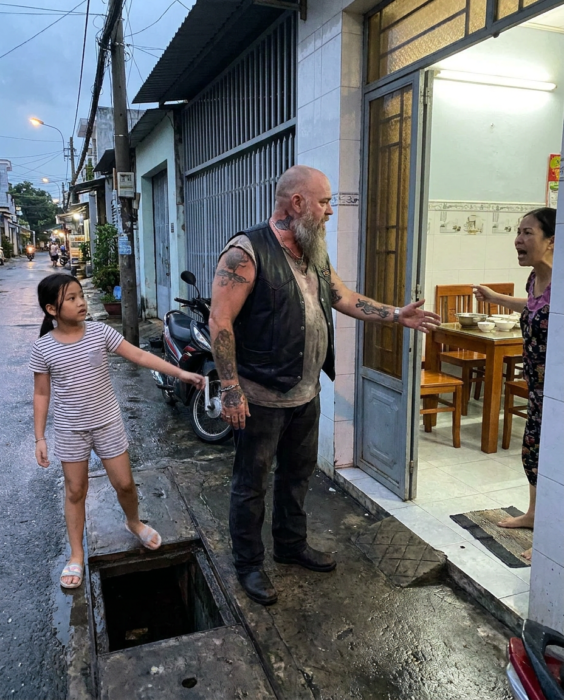
I visited most Saturdays. Sometimes I arrived on my Harley and left my helmet by the kitchen door. Sometimes another rider came with me to help fix a fan or carry a heavy sewing machine. Linh liked the motorcycles when they were parked. She could name several of the riders, though she called us all her uncles. She had never been shy about telling me I was wrong.
That was why her silence at dinner troubled me. Linh generally wanted to describe something that happened at school before I had taken off my boots. On the night of the phone, she gave me a greeting and little else. She watched Mai as if she were waiting for a moment when her mother might become someone familiar again.
Mai had been lonely for longer than she admitted. Work gave her contact with people all day, but most conversations concerned measurements and pickup times. After Linh went to bed, the house grew quiet. A man had first contacted her through a social account several months earlier. He asked about her shop, remembered details she mentioned, and sent messages when she finished late. Mai told me later that she began looking forward to seeing his name on her screen.
He said he worked on projects that required travel. There was always a reason he could not meet Mai at an ordinary time. A meeting changed, a trip ran long, or he promised to come after an investment was complete. He sent photographs and spoke about a future with her and Linh. Mai did not describe these things to me at first because she wanted to see whether the relationship became real before the family had opinions about it.
Eventually he told her about a private investment project. The messages she later shared described modest deposits followed by growing returns. A screen displayed numbers that rose each week. Mai transferred forty million đồng over several payments. When she asked to withdraw some of the money, the man said there were fees and a larger commitment to make before the account could be released.
Linh knew none of the financial details at the beginning. She knew her mother had changed. Mai stepped away to answer calls and grew tense when they ended. She checked her balance repeatedly. One night Linh woke to find her sitting at the kitchen table, studying a photograph of the house.
The first time Linh tried to warn her, she said the man on the phone was asking for too much money. Mai told her adults understood their own finances. The second time, Linh had seen a message saying Mai must keep the project secret until the next payment. Mai was angry that she had read it. On the third attempt, Linh asked why someone who loved them wanted the house involved. Mai told her to stop repeating things she could not fully understand.
I learned the order of those conversations over several days, not all at dinner. Linh told me one part while we walked to a shop. Mai told me another when she could bear to describe it. Neither had intended to keep me out of their lives. Mai was protecting what she believed was a promising relationship. Linh thought I would side with Mai if she could not show me the messages.
Then came Saturday. The man pressed Mai for an answer by the end of the weekend. On Monday, she had an appointment about borrowing against the house. Linh knew the date because it was written on a slip of paper near the sewing machine. She could not stop her mother from leaving for that appointment, but she could stop the phone from ringing through dinner.
She chose the drain. I wish she had called me. I also understood, once I heard her account, why an adult she had watched walk into the house and fail to notice anything would not have been her first thought.
The cracked phone sat in a cloth beside Mai’s bowl. Linh remained by the wall. Nobody had touched the food since she came back inside. I asked Mai to tell me the man’s full name, what he said the project did, and where she had sent the money. She answered the first question with the name he used online. For the others, she kept glancing at the dead screen.
I told her we should stop trying to reach him until we understood what had happened. Mai said silence would make him worry. I asked whether she had ever met him face to face. She had not. She reminded me of calls they had shared and photographs he had sent. I asked if she knew anyone else who could confirm his work. She said he had introduced her to an adviser through the project.
She spoke quickly, as though each answer might prove I had interrupted something legitimate. I let her finish. Then I asked what would happen if she did not sign anything on Monday. She said the money she had already sent might remain locked. I asked what would happen if she did sign and sent more. She looked toward Linh, who had lowered herself onto the floor near the doorway.
Mai’s phone was not the only record. She had banking receipts, an appointment slip, and an account that might still hold copies of messages. I asked her to gather those. I also asked her to call her bank through a number she already knew, explain that she believed she might have sent money to a fraudster, and ask what they could do. She resisted the word fraudster. I said we did not have to settle that argument at the dinner table to protect what remained.
Our neighbor, Mrs. Hạnh, knocked to ask if we had found the phone. She had helped with the flashlight. Mai thanked her and shut the gate. Through the window I could see my motorcycle under the porch light. I had ridden there expecting a meal; now I was looking at an appointment that could put my sister’s house at risk. I wanted to take charge. Linh had tried that in the only way she could, and Mai had felt cornered. I needed to keep asking and listening.
Linh finally spoke. She said the man had called while Mai was out collecting fabric. He had asked her to remind her mother not to discuss the project with family. Mai turned to her. She had not known he had spoken to Linh. Linh said he sounded friendly until she asked why it was a secret. Then he told her a child could ruin an adult’s chance at happiness.
Mai went still. She asked when it had happened. Linh gave her the day and said she had tried to tell her afterward. Mai remembered telling her not to interfere. She put her hand over her mouth.
That changed the conversation more than anything I had said about money. The man had reached into the house and warned a nine-year-old not to question him. Mai picked up the appointment slip and looked at the date again. She asked me to sit with her while she called the bank.
The bank employee took the transfer details and told her what information to keep. There was no promise that the forty million đồng would be recovered; time had passed, and the money might have moved through other accounts. Mai wrote down the case reference and the next steps. The employee also advised her to report the suspected fraud to police promptly.
Linh listened from the floor. I told her she could come sit at the table. She asked whether Mai was going to be angry about the phone. Mai said she was angry that it was broken and frightened about what it might contain. She also said she should have listened when Linh first tried to speak. That was more honest than saying everything was suddenly fine.
I covered the dishes, and Mai gathered the bank records. On her other device, she found some notifications and a photograph of the appointment slip. She could not reach every message. The broken phone might still hold the conversation, and she wanted it examined by someone who could recover it properly. We left it powered off.
We went to the local police that evening with what we had: transfer receipts, the account name, screenshots Mai had saved, the appointment details, and the wet phone. I drove the two of them in my sister’s car. Linh fell asleep against the window on the way, exhausted by a day spent expecting her mother to sign away their home.
At the station, an officer asked Mai to tell the story from the beginning. She was embarrassed, and the room was bright and unfamiliar. She took a breath and began with the first message she had answered. I sat beside Linh and let Mai speak.
The officer did not declare the case solved when he saw the phone. He recorded what Mai brought and asked careful questions about the transfers and the people behind the accounts. He wanted to know whether the supposed adviser had called from the same number as the man Mai believed she loved, whether any documents carried a company name, and how the borrowing appointment had been arranged.
Mai had to go through months of messages in her memory. Some had made her laugh. Some had comforted her when she was tired. Now she described them to a stranger as possible evidence of manipulation. I watched her struggle to say that the man had spoken about caring for Linh. She had wanted that to be true.
The phone was handled for examination, but the investigation did not depend on a single wet device coming back to life. Mai still had access to the account through a replacement phone, and investigators could work with banking records and other evidence. Later, a specialist recovered additional material from the damaged device. The messages helped establish timing and links between accounts; they were a starting point, not a shortcut to every person in a criminal network.
On Sunday morning, Mai called to cancel Monday’s appointment. The person arranging the loan tried to keep her on the line and asked why she had changed her mind so close to signing. Mai said only that she would not proceed. She wrote down the time of the call and what was said. Then she blocked the numbers she had been told to block after recording them for the report.
The man who had messaged her contacted her through another account. He said the project would fail if she did not make the payment. Then he said she had betrayed him by involving other people. Mai handed the message to the officer rather than answering. It hurt her to do that. I could see her fingers pause above the screen before she set the phone down.
Linh asked whether the forty million đồng was gone. Mai said they did not know what could be recovered, but she would not send more. The house was still theirs. I watched Linh take in that distinction. She had imagined the whole house disappearing on Monday; now she had a loss she could understand and a door she could still walk through.
Over the next several weeks, investigators contacted Mai again. They asked her to clarify dates and identify which account had sent particular messages. She went to the bank for certified records. She kept a folder on the shelf above her sewing machine. Every time she opened it, I could tell she wished the folder did not exist.
The case reached beyond her. Other reports named accounts, phone numbers, and a pattern of introductions that resembled hers. Some victims had been approached with a promised relationship followed by an investment opportunity. Others had encountered different stories that led to the same channels for payment. By the time police had built the wider case, they identified sixty victims across four provinces.
I learned the number from a later public report and from what Mai was told as a complainant. I did not know those people. The phone from the drain had helped investigators connect part of the pattern, alongside records and testimony gathered from many places. The discovery was larger than any one device and more painful than a number. Sixty households had made decisions under pressure, sometimes hiding them from family because the person messaging them had made secrecy feel like loyalty.
Members of the group were arrested after months of investigation. Mai gave another statement. Linh did not have to sit through every adult conversation about the case. She knew enough to understand that her mother had been deceived and that police were working to find who had taken the money. Mai kept the detailed paperwork away from the dinner table.
Our club heard about the case when I told Luis why I had missed a Sunday ride. He listened, then asked if Mai needed practical help. At first I said no. I did not want forty men appearing outside her shop as though the problem could be solved by noise and motorcycles. A week later Mai asked whether someone could help repair a leaking awning. Three riders came in ordinary clothes, fixed it, and bought hems they had been putting off.
The arrests did not bring all the money back. Mai had to adjust her shop expenses and put off replacing a sewing machine. She kept the house because she had stopped before signing the papers or sending the larger sum. That was the difference Linh had fought to create, though throwing the phone had made the night more frightening for everyone.
Mai told her daughter so one evening while I was there. She also said, “Next time, tell Uncle Thanh. Tell Mrs. Hạnh. Keep telling us until somebody listens.” Linh asked whether there would be a next time. Mai said she hoped not, but there would always be adults she could ask for help.
I thought about the three warnings Mai had missed and the dinner at which I almost missed the fourth. Linh deserved a better answer than praise for breaking a phone. She deserved adults who would pause when she said something was wrong.
After Mai’s report, people in our club began telling their own stories. One rider’s father had lost money to a caller claiming to be from a bank. Another member had spent weeks speaking to someone who said she needed help paying a fee before they could meet. He had stopped before transferring money, but he remembered how embarrassed he felt when he realized the photographs might not belong to the person writing to him.
We met in our garage on a Sunday afternoon to decide whether the club could do anything useful. I brought Mai’s permission to speak about the pattern, without her name or Linh’s. Luis brought a list of neighborhood groups that had previously invited us to help with food drives. We agreed to ask whether those groups wanted a conversation about fraud and how to report concerns, with information checked by people who handled such reports. We were riders and neighbors, not investigators.
Our first gathering took place in a small community room. Fewer than twenty people came. Some wanted to know whether every online friendship was a scam. I said I could not judge a stranger’s relationship from the back of a room. Mai, who had decided to attend, described the point at which a person she trusted asked for money and secrecy. She did not owe anyone that account. She chose to give it because she remembered how ordinary the first messages had felt.
We learned to make the meetings less like speeches. People asked what to save if they suspected fraud, whom to call at their bank, and whether reporting mattered if the transfer had happened weeks earlier. We used verified local reporting information and encouraged people to speak directly with their bank and police. We did not promise recovered funds or an instant arrest. Those promises would have sounded too much like the ones Mai had already heard.
At one event, an older woman waited until most people had left. She said someone had been messaging her every night and that she liked talking with him. He had recently asked her to invest. She did not want to lose the conversation. Mai listened, then asked whether the woman would consider discussing the money request with someone she trusted before sending anything. The woman took the printed contact information. We never learned what she decided. I hoped she had somebody who would hear her without mocking her.
Over time, the club helped organize talks in twenty neighborhoods. Sometimes we supplied chairs and water while a local officer or community worker answered questions. Sometimes Mai described her experience. Linh attended only when she wanted to, and we never pointed her out as the child who had stopped a scam. Her place was at school, with friends, or beside her mother if she chose to be there.
The investigation had its own pace. The case eventually moved through prosecution, and the group behind the scheme was broken up. I did not attend every hearing, nor did I pretend I knew what happened to every victim. Mai followed the parts relevant to her and told me when she needed a ride. She kept the bank receipts, messages, and reports in a folder that grew thick enough to need a second clip.
The broken phone came back after its role in the investigation was finished. Mai put it in a drawer beneath her sewing supplies. She could have thrown it away; it no longer worked. Linh asked why she kept it. Mai said it reminded her that Linh had tried to warn her and that she, Mai, had been wrong to dismiss it.
Linh did not want the phone to become a lesson repeated whenever guests came over. Mai respected that. It remained in the drawer. Once, while looking for thread, I saw the cloth I had wrapped around it that evening. Mai had washed the cloth and folded it underneath. She noticed me looking and closed the drawer without making a speech.
Their relationship took longer to repair than the Sunday appointment had taken to cancel. Mai had to show Linh she could admit a mistake without asking her daughter to carry the shame of it. Linh had to learn that an angry adult could still stop, listen, and apologize. Some evenings they managed it well. On others, Mai got tired after work and Linh asked a question at the wrong moment. They kept practicing.
One night I came to dinner and found a new phone in the middle of the table, face down. Mai had told the person messaging her about a customer’s order that she would reply after eating. Linh noticed and smiled into her bowl. We talked about school uniforms and a loose tile at the shop. For the length of one meal, no screen lit up beside Mai’s hand.
The first anniversary of the drain incident passed without ceremony. I remembered it because rain filled the channel along Mai’s lane that Saturday, and I watched water run beneath the grate as I parked my bike. A year earlier I had climbed into the shallow concrete section looking for a phone. Now Linh opened the gate before I reached it and asked whether I had brought the mangoes I promised.
She was taller and less inclined to tell me everything about school. I carried the fruit inside and found Mai finishing a customer’s alteration at the dining table. Business had steadied. The replacement sewing machine had finally arrived, bought with savings rather than the returns promised by a stranger. Mai told me it was quieter than the old one. She made me listen to it for a minute so I would appreciate the difference.
We still went to neighborhood talks when invited. I had grown more comfortable saying, “I don’t know; let’s ask someone who does.” Luis kept the club’s printed information current. Mai was better at explaining how a person could become attached to a voice on a phone without being foolish. People trusted her because she did not stand above the room.
Linh once asked why adults talked about victims as though they should have seen everything from the first message. Mai answered while cutting vegetables for dinner. She said the first message usually was not the whole scheme. A person had time to become familiar before asking for something costly. I stood at the sink washing the rice and thought about the speed with which I, too, had asked Mai why she had trusted him on that Saturday.
Mai still lost forty million đồng. Some of it might never come back. Keeping the house did not erase the loss. She had worked extra hours to cover orders she would otherwise have turned away, and there were months when she worried about every repair bill. Linh knew money was tight, but Mai was careful not to make her responsible for fixing it.
At a club gathering, a new rider asked whether the story about the girl and the drain was true. I said yes and told him Linh did not want to be discussed as a brave little mascot. He apologized. Then he asked what he should do if someone in his family was being drawn into a suspicious investment. I told him to start with a conversation, not a verdict, and to help preserve records and contact the right people if money had moved. He wrote down the reporting details Luis had brought.
On another Saturday, Mai asked me to pick Linh up from an art class because she was delayed at the shop. Linh came out carrying a drawing tube almost as tall as she was. On the ride home in Mai’s car, she asked if I was still embarrassed that she had damaged the phone. I said I had been worried about what was on it and about how frightened she looked when she returned to the table. She said she had been certain Mai would never believe her otherwise.
“I believe you when you tell me you’re worried,” I said.
She looked out the window. “You didn’t know what it was about.”
“That’s when I should ask.”
She nodded and turned the drawing tube between her hands. We spent the rest of the drive arguing about whether a motorcycle would fit in the painting she was making. I told her it depended on the size of the paper. She said I always found a way to put a bike into things.
The last time I ate at Mai’s house, the gate was open and the evening air moved through the kitchen. Linh set out three bowls. Mai’s phone rested on a shelf across the room because she was using the table for food. I had ridden over after helping Luis close a neighborhood meeting, and my vest smelled faintly of rain.
Halfway through dinner, the phone rang. Mai glanced at it but stayed seated. When we finished eating, she checked the missed call and returned it. It was a customer asking when a dress would be ready. Mai gave her the pickup time, wrote it on a scrap of paper, and came back to help Linh clear the plates.
Afterward, Linh asked me to look at a drawing. It showed the narrow lane outside, the houses on either side, and my motorcycle parked just inside the gate. She had included the street drain. I asked whether she wanted to change that part. She said no; it was there, and she was drawing the whole lane.
Mai came to stand beside us. She studied the picture and said Linh had made my motorcycle too clean. Linh said she could add dirt if I wanted the drawing to be accurate. I told her it looked fine as it was. She rolled it carefully and set it aside to take to class the next morning.
When I left, Mai walked me to the gate. She told me she had found the broken phone while searching for a packet of needles. She was keeping it in the drawer. She wanted to remember that Linh had been right, and that listening sooner was something she could still choose on every ordinary day after it.
Linh called good night from the doorway. I started the bike only after she went inside, then rode past the drain and down the lane toward home.
Follow this page for more biker stories about family, second chances, and the people who speak up when someone needs to listen.