Part 2: The 12-Year-Old Witness Who Changed the Trial of the Man Who Saved Him
For three weeks, Cedar Falls had already decided what kind of man Caleb Morris was.
He was the mechanic from the edge of town, the one who kept late hours and rarely smiled. His shop sat behind a gas station, with old tires stacked near the fence and a faded American flag above the garage door.
People trusted him with their cars, but not always with their opinions.
He was blunt. He was private. He had once argued with a city councilman about road repairs in front of half the town. After that, some people called him difficult, though they still brought him their engines when the noise got too bad.
So when the accident happened, it was easy for the town to believe the worst.
The prosecutor told a clean story.
Caleb had parked his tow truck near the curve on Route 16. Jonah’s mother had swerved to avoid it. Their car hit the guardrail, spun into the ditch, and caught fire near the front engine.
Then Caleb, perhaps out of guilt, pulled Jonah from the back seat.
It sounded believable.
It sounded almost generous.
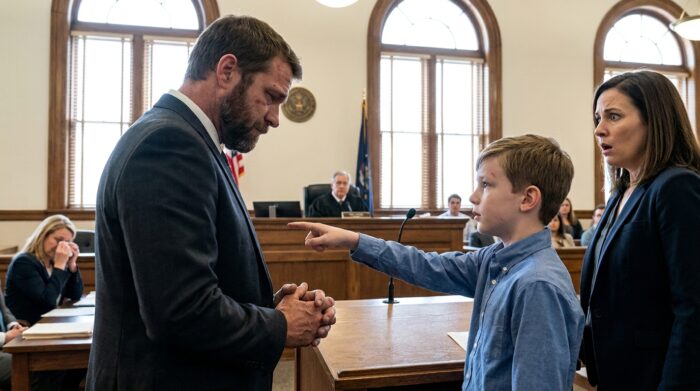
But Jonah’s first sentence on the stand made the courtroom shift.
“He told me not to look behind me.”
The prosecutor recovered quickly.
“Because he knew what he had done?” she asked.
Jonah looked down at his hands.
“No.”
His mother, Emily Ellis, a white American woman in her late thirties, sat in the first row with a tissue twisted between her fingers. She had been driving that day. She had survived with a broken collarbone and a memory full of smoke, glass, and screams.
The prosecutor softened her voice.
“Jonah, did Mr. Morris yell at you?”
“Yes.”
“What did he yell?”
Jonah closed his eyes.
“He said, ‘Keep your eyes on me.’”
The prosecutor nodded as if this helped her.
But Caleb’s defense attorney, a Black American woman named Denise Carter, watched Jonah differently. She noticed the boy’s left shoe tapping under the witness chair. She noticed how he stared not at Caleb, but at Caleb’s hands.
Those hands were large, scarred, and folded tightly on the table.
“Jonah,” Denise said when it was her turn, “do you remember what Mr. Morris was doing when he said that?”
Jonah nodded.
“He was carrying me.”
“From the car?”
“No,” Jonah said.
A small murmur rose.
The prosecutor frowned.
Denise waited.
“Then from where?”
Jonah’s throat moved.
“From the road.”
The courtroom went still.
Caleb shut his eyes.
Denise stepped closer, careful not to crowd him.
“The road?”
Jonah nodded again.
“My door was stuck. He broke the window. I crawled out, but I fell. I couldn’t breathe because of the smoke.”
The prosecutor stood.
“Your Honor, the child has already given prior statements that he was removed from the vehicle.”
The judge raised a hand.
“Let him answer.”
Jonah looked toward his mother.
She was crying now, not loudly, but steadily.
“I was in the car first,” Jonah said. “Then I was on the road. Then he carried me.”
Denise glanced at the jury.
“What was behind you, Jonah?”
The boy’s hands shook harder.
Caleb’s wife, Mary, looked at her husband as if she had heard this part before and still could not bear it.
Jonah whispered, “My mom.”
Emily bent forward like the words had struck her.
The prosecutor’s face changed.
Denise’s voice stayed soft.
“Why did Mr. Morris tell you not to look behind you?”
Jonah stared at Caleb then.
For the first time all morning, Caleb looked back.
Not like a defendant.
Like a man apologizing for a wound he could not heal.
“Because he went back for her,” Jonah said.
Another crack ran through the prosecutor’s story.
“And where was the truck?” Denise asked.
Jonah wiped his cheek with his sleeve.
“It wasn’t blocking us.”
The prosecutor turned sharply.
Denise did not look away from Jonah.
“Where was it?”
The boy took a breath.
“Behind the curve. With the flashers on.”
Someone in the back row whispered, “What?”
Jonah looked down again.
“He was trying to make cars slow down.”
The truth had been lying in pieces, scattered across a road, a hospital bed, and a boy’s frightened memory.
Caleb had not stopped on Route 16 by accident.
He had been driving home from a roadside repair when he saw a silver SUV ahead of him drifting between lanes. It moved strangely, speeding up and slowing down, as if the driver inside was fighting the wheel.
At first, Caleb thought the driver was distracted.
Then he saw the back tire.
It was coming apart.
He followed at a distance, honking once, then twice. He flashed his lights, but the SUV kept moving toward the curve, where the shoulder narrowed and the guardrail bent close to the road.
Caleb pulled his tow truck partly across the far lane behind the curve, not in front of the SUV, and turned on his hazard lights. He wanted other cars to slow down before they reached whatever was about to happen.
Then the tire blew.
Emily’s SUV lurched. It clipped the guardrail, spun, and slammed into the ditch.
Caleb ran before the truck door fully closed.
That part had never been in the first report.
The first officer on scene had arrived after the rescue. A witness from another vehicle had seen only Caleb’s truck angled near the road and assumed it had caused the crash. By evening, the rumor sounded like fact.
Caleb could have explained it.
He could have defended himself on television.
He could have told everyone exactly what he had done.
But he didn’t.
Because in the hospital, Jonah had woken screaming.
Every time someone asked about the crash, he shook so hard the nurses had to stop. Caleb learned from Emily’s sister that Jonah blamed himself for crawling out while his mother was still inside.
So Caleb said nothing publicly.
He took the blame because he believed a courtroom could handle anger better than a child could handle guilt.
That was the first hidden sacrifice.
The second sat inside a file Denise Carter carried to the stand.
A hospital record showed Caleb had suffered second-degree burns on his forearms. Not from pulling Jonah out once. From going back into the smoke for Emily after Jonah was already safe.
Denise placed the photographs before the jury.
Caleb looked away.
Jonah did not.
He stared at the pictures of burned skin and bandaged hands, then looked at the same hands folded on the table.
“Mr. Morris,” Denise asked quietly, “why did you not correct the story when people said your truck caused the crash?”
The prosecutor objected.
The judge allowed the question.
Caleb stood slowly.
His voice was rougher than people expected.
“Because the boy had already lost enough sleep.”
The courtroom became so quiet that even the fluorescent lights seemed loud.
Denise waited.
Caleb looked at Jonah.
“I heard him in the ambulance,” he said. “He kept saying, ‘I left Mom.’ He was twelve. I figured if folks needed somebody to blame, they could blame a grown man.”
Emily covered her face with both hands.
Jonah stared at him.
“You let them say you hurt us?”
Caleb’s jaw tightened.
“I knew what happened.”
“But nobody else did.”
Caleb looked at the jury, then at the floor.
“I was hoping that would be enough.”
It was not the answer of a man trying to look heroic.
It was the answer of a man who had done something decent and then paid for it quietly.
Then came the third twist.
Denise called a final witness: Hank Miller, a 68-year-old white American retired bus driver who had been driving behind Caleb that afternoon. He walked slowly to the stand with a cane and a folded cap in his hand.
“I should’ve come forward sooner,” Hank said before anyone asked him anything.
The prosecutor stiffened.
Hank explained that he had seen Caleb’s truck turn on its flashers before the crash, not after. He had seen Caleb wave traffic back. He had seen the SUV tire burst.
“Why did you wait?” Denise asked.
Hank looked ashamed.
“My wife had a stroke that morning,” he said. “I was on my way to the hospital. I told myself the police already knew enough.”
He removed a small dash camera from his coat pocket.
“I found this last night when my grandson cleaned out my old bus.”
The video was played in court.
No music. No dramatic sound.
Just a gray road. A silver SUV swaying. Caleb’s tow truck slowing behind it with hazard lights blinking. The tire bursting. The crash. Caleb sprinting into the ditch before any other car had stopped.
Then, several seconds later, Caleb appeared carrying Jonah.
The boy’s face turned toward the wreck.
On the video, Caleb covered Jonah’s eyes with one burned hand and turned him away.
The courtroom watched the moment again.
Now they understood the sentence.
Keep your eyes on me.
Not a threat.
A mercy.
Jonah began to cry without making a sound.
The prosecutor lowered her papers.
The judge removed his glasses.
Denise stopped the video before it showed Caleb running back toward the smoke.
No one asked her to continue.
The room already knew.
When the judge dismissed the charge for lack of evidence, there was no cheer at first. The silence felt too heavy for celebration.
Then Jonah stepped down from the witness stand.
His mother reached for him, but he moved past her, across the courtroom, toward Caleb.
A bailiff started to stop him.
The judge shook his head once.
Jonah stopped in front of Caleb.
For weeks, the town had seen a criminal.
For weeks, Caleb had let them.
Now the boy looked up at the man with the scarred hands and whispered, “I did look behind me.”
Caleb’s face broke.
Jonah continued, “I saw you go back.”
Then he wrapped his arms around Caleb’s waist.
That was when the courtroom finally stood.
Not because a judge told them to.
Because nobody knew what else to do.
After the hearing, the crowd outside the courthouse did not feel like a crowd anymore.
People who had arrived hungry for a verdict stood quietly on the courthouse steps, unsure where to place their eyes. Reporters lowered their cameras. Neighbors who had repeated the story looked at Caleb and then looked away.
Caleb walked out beside Mary.
His sleeves were buttoned low to cover the scars, though everyone had seen them now.
Emily Ellis stood near the bottom step with Jonah.
For a moment, she did not move.
Then she walked toward Caleb with the slow carefulness of someone carrying too many words.
“I believed them,” she said.
Caleb shook his head.
“You were hurt.”
“I still believed them.”
He did not answer.
Emily looked at his hands.
Then she reached into her purse and pulled out something small wrapped in a napkin. It was a toy compass, cracked at the edge, with a faded sticker on the back.
Jonah’s compass.
The one he had carried in his backpack since a camping trip with his father years earlier.
“They found it in the ambulance,” Emily said. “Jonah asked me to keep it until he could give it to you.”
Caleb looked confused.
Jonah stepped forward.
“You told me to keep my eyes on you,” he said. “So I did. I followed your voice.”
He placed the compass in Caleb’s hand.
“It should be yours now.”
Caleb stared at it for a long time.
The courthouse doors opened behind them, and Hank Miller came out with his cane. He paused when he saw them, then removed his cap and held it against his chest.
Nobody said thank you loudly.
Nobody made a speech.
The day had already taken enough sound from everyone.
Across the street, Caleb’s old tow truck sat by the curb. Someone had washed the dust off the windshield, but the dents remained. The hazard lights were off now.
Jonah noticed them anyway.
He walked over, touched one of the amber lights, then looked back at Caleb.
“Do they still work?”
Caleb nodded.
Jonah gave a small, tired smile.
“Good.”
Emily put a hand over her mouth.
Caleb turned the cracked compass in his palm, then slipped it carefully into his shirt pocket, right over his heart.
Later, people in Cedar Falls would tell the story differently.
Softer.
Slower.
They would mention the boy on the witness stand, the video from the old bus driver, and the mechanic who let the town hate him so a child could breathe.
But Jonah remembered one thing most clearly.
Not the crash.
Not the courtroom.
Not even the applause that rose after he hugged Caleb.
He remembered a man’s burned hand covering his eyes, and a voice in the smoke saying, “Stay with me, son.”
At the courthouse curb, Jonah reached for his mother’s hand with one hand and Caleb’s with the other.
For a few quiet seconds, the three of them stood there while traffic moved around them, and nobody seemed in a hurry to let go.
Follow the page for more heartfelt stories that stay with you long after the final line.