Her Father Refused to Claim His Pregnant Daughter at Graduation — Then the College President Revealed Who Had Quietly Paid the Final Tuition Balances of Seventeen Students
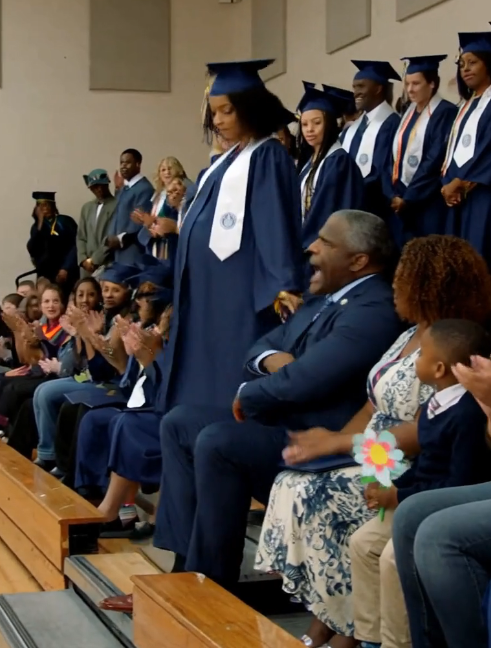
Raymond Turner remained seated when his pregnant daughter crossed the graduation stage, even after every family around him rose to applaud.
Alyssa noticed him immediately.
At twenty-seven, she had learned to scan crowded rooms for the people most likely to need help: an older visitor uncertain about the stairs, a classmate fighting dizziness during a twelve-hour clinical rotation, a frightened patient trying to understand discharge instructions.
That afternoon, she searched only for her father.
Raymond sat in the fourth row of the community-college gymnasium wearing the navy suit he had last worn to Alyssa’s mother’s funeral. He was fifty-seven, Black, broad through the shoulders and thick in the hands after thirty-one years repairing industrial presses. Gray had spread through his close-cropped hair since the MidRiver Components plant closed eight months earlier.
His arms remained folded.
Beside him, Alyssa’s aunt Rochelle stood and clapped. Alyssa’s five-year-old son Caleb balanced on a folding chair, waving a paper flower he made from blue construction paper.
“Mom!” he shouted. “I see you!”
Alyssa smiled at him.
She was seven months pregnant beneath the navy graduation gown. The white nursing stole rested unevenly across her shoulders, and the baby shifted whenever the audience applause became loud.
The baby was a girl.
She was not Alyssa’s daughter.
Alyssa was a gestational carrier for Priya and Daniel Shah, a married couple who had spent six years trying to have a child after Priya underwent treatment that made pregnancy medically unsafe. The embryo had been created from their genetic material. Alyssa had no genetic relationship to the baby.
The arrangement had required months of medical screening, psychological evaluation, separate attorneys, insurance review and a detailed contract protecting medical autonomy and establishing parentage.
Raymond knew none of that.
He believed his unmarried daughter had become pregnant by a man who refused responsibility. He also believed she had endangered her nursing degree, spent money recklessly and concealed the truth because she was ashamed.
Alyssa had tried to explain.
Four months earlier, Raymond found a medication cooler in the refrigerator containing the injections used during the embryo-transfer cycle. Beside it lay a payment schedule from the surrogacy escrow administrator.
He read only the compensation page.
“What did you agree to?” he asked.
Alyssa said she was carrying a child for another family.
Raymond stared at her stomach, then at the contract.
“You rented yourself out?”
“That is not what this is.”
“It has a payment schedule.”
“It also has my own attorney, health insurance, medical rights and an independent counselor.”
“People with money found a woman afraid of losing her house.”
Alyssa flinched because the statement contained part of the truth.
The Turner home was four months behind on its mortgage. Raymond lost his job when the factory closed, and his severance barely covered medical insurance and utilities. He told Alyssa the union hardship fund would protect the house.
No such protection had been approved.
A foreclosure warning arrived while he was at a job interview. Alyssa found it beneath a stack of advertisements.
She had already completed one uncomplicated pregnancy with Caleb, satisfying a common requirement for gestational carriers. Caleb’s father, Marcus Green, had died in a construction accident when their son was two. Alyssa had raised Caleb while completing prerequisite courses and working nights as a nursing assistant.
The surrogacy agency had contacted her after a former coworker described her experience. Alyssa researched the risks for five months before applying.
Saving the house influenced her decision.
It was not the only reason.
She understood what it meant to build a future around a child who did not arrive easily. She also wanted to finish nursing school without borrowing more money and create an emergency fund for Caleb.
Raymond heard only compensation.
He said his daughter was turning pregnancy into a transaction. Alyssa accused him of confusing control with protection. Their argument ended when he said he would not participate in a lie by pretending to celebrate.
They had not spoken since.
Now President Helen Brooks announced Alyssa’s name.
“Alyssa Renee Turner, Practical Nursing, honors.”
Alyssa crossed the stage carefully.
President Brooks was fifty-five, Black, with silver-streaked braids, narrow glasses and a burgundy academic robe. She shook Alyssa’s hand, then held it for half a second longer.
“You made it,” Helen whispered.
“So did they?” Alyssa asked.
“All seventeen.”
Relief passed across Alyssa’s face.
The exchange lasted only a moment, but Raymond saw it. He assumed they were discussing accommodations for the pregnancy.
Alyssa accepted the diploma cover and turned toward her family.
Rochelle applauded.
Caleb shouted again.
Raymond looked down.
After the ceremony, graduates filled the gym floor with flowers, balloons and families waiting to take photographs. Alyssa walked toward her father with Caleb holding one hand.
Raymond stepped backward.
“Dad.”
“You finished,” he said. “That is good.”
His voice offered the words without warmth.
Alyssa waited.
Caleb held out the paper flower. “Grandpa, I made Mom blue.”
Raymond looked at his grandson and softened. Then his eyes returned to Alyssa’s stomach.
“I cannot pretend I approve.”
“I did not ask you to approve my body.”
“You asked me to stand and celebrate.”
“I asked you to recognize that I graduated.”
“You made choices that could have taken you away from Caleb.”
“Every pregnancy carries risk. This one is medically supervised.”
“For money.”
“For several reasons.”
Raymond shook his head. “Your mother would not understand this.”
Alyssa’s expression changed.
“Do not use Mom because you stopped listening.”
Nearby families became quiet.
Raymond noticed them watching and lowered his voice. “I will not be photographed as though everything is normal.”
Alyssa looked toward the empty space where he might have stood beside her.
“Then do not.”
She took Caleb’s hand and turned away.
Before she reached the exit, Helen Brooks returned to the microphone.
“There is one final recognition,” she said.
The graduates slowed.
Helen explained that seventeen nursing students had entered their final semester with unpaid balances ranging from $340 to $1,850. The amounts were too small for traditional loans but large enough to block course registration, licensing documents or graduation clearance.
An anonymous donor cleared every balance.
The donor asked that no recipient be named publicly and that no photograph be taken.
“However,” Helen continued, “the donor has given permission for me to name her today because a lie has begun traveling faster than her work.”
Raymond looked up.
Helen opened a red envelope marked with a small blue star.
“Alyssa Turner paid the final balances of seventeen classmates.”
The gym became silent.
Alyssa stopped walking.
Raymond stared at her. “With what money?”
Alyssa did not answer.
Helen removed a second set of receipts.
“The same legally administered compensation that funded this gift also stopped the foreclosure of the Turner family home.”
Raymond’s face lost its anger.
The bank had told him a confidential hardship payment cured the arrears. He believed the money came from a union program.
Alyssa had paid it.
But Helen had not finished.
She lifted a faded red envelope from another folder. A blue star had been drawn in its corner.
“Twenty-eight years ago, someone used this same mark when he quietly paid my final examination fee.”
Helen looked directly at Raymond.
“That person was you.”
Part 2, The Seventeen Small Balances
Raymond did not remember Helen Brooks.
He remembered the blue star.
During his first years at MidRiver Components, Raymond worked second shift and supervised four apprentices. He kept cash for emergency meals and bus fare inside red payroll envelopes marked with a blue star so he would not confuse them with machine-parts receipts.
He never called the money charity.
He called it keeping a shift together.
Helen had been twenty-seven then, a single mother taking evening accounting classes while working in MidRiver’s payroll office. She needed forty-eight dollars to sit for her final certification examination.
Her childcare subsidy ended unexpectedly. She used the exam money to pay her sitter.
Raymond overheard her telling a supervisor she would reschedule the test the following year.
The next morning, a red envelope appeared inside her locker.
It contained forty-eight dollars and a blue index card:
Finish what you already worked for. Return nothing. Do it for someone else when you can.
Helen recognized Raymond’s block handwriting but respected his silence. The certification helped her become a payroll specialist, then a college administrator and eventually president of Franklin Community College.
“I never told anyone it was you,” she said from the stage. “Alyssa found the card after the factory closed.”
Raymond looked at his daughter.
Alyssa had been helping him clean out the garage when she discovered an old red metal toolbox containing several blue-star cards and receipts. Raymond had paid examination fees, bus passes and license renewals for thirteen coworkers over three decades.
He never told his family.
Alyssa brought one card to Helen while arranging her own tuition payment plan. Helen recognized the handwriting and explained what Raymond had done.
The idea for the Last Mile Fund began there.
Alyssa did not randomly pay classmates’ accounts. She worked with the bursar’s office to identify students who had completed the academic work but faced small final balances. An attorney confirmed the gifts created no obligations. The school applied the payments directly to the accounts.
The seventeen balances totaled $19,460.
Alyssa used part of her carrier compensation.
She did not pay anyone’s full degree.
She closed the final gaps.
One student had missed clinical work after caring for her father during dialysis. Another spent her registration money repairing a car needed to reach rural hospital rotations. A third had been sleeping in a relative’s dining room after a rent increase.
The students had not known who helped them.
Helen did not name them.
A young white graduate named Morgan Ellis approached Alyssa after the announcement. She had twin sons, an overnight warehouse job and a $612 balance that nearly prevented her licensing transcript from being released.
“You paid mine?” Morgan asked.
Alyssa nodded.
“Why didn’t you tell me?”
“Because you would have tried to repay me.”
“I still will.”
“No. Pay your licensing fee. Buy shoes for the hospital. Do the next thing.”
The sentence sounded like Raymond.
He heard it.
Instead of moving toward his daughter, he felt exposed.
The college president had revealed his old kindness at the exact moment his recent cruelty was visible to the same room. Shame turned defensive before it became remorse.
“You had no right to use that card,” he told Alyssa.
Helen stepped down from the stage. “She asked whether I could name you.”
“She did not ask me.”
Alyssa answered, “You did not answer my calls.”
“That does not give you permission to make me part of this.”
“You made me part of a public judgment when you refused to stand.”
Raymond looked around at the families. “So this was planned?”
“The announcement was planned. Your behavior was yours.”
He flinched.
Rochelle approached with Caleb. She told Raymond to stop turning every revelation into an attack.
Raymond asked Alyssa how much the surrogacy agreement paid.
“That is private.”
“You paid the house.”
“Yes.”
“And nineteen thousand dollars here?”
“Yes.”
“What is left for you and Caleb?”
Alyssa’s pause frightened him.
The original compensation had been $62,000, paid in scheduled installments, plus expenses, insurance and medical coverage. After taxes, mortgage arrears and the tuition gifts, far less remained than Alyssa first planned.
She had protected the house and seventeen students.
Her own emergency fund was smaller than it should have been.
Helen knew.
Inside the final red envelope was a notice showing Alyssa’s nursing-license examination fee remained unpaid.
Part 3, The Pregnancy That Was Not a Rescue Contract
Alyssa did not become a gestational carrier because one wealthy couple offered to save her family.
She rejected the first agency that interviewed her.
The recruiter emphasized compensation, used phrases like easy pregnancy and life-changing gift, and discouraged her from requesting an independent attorney. Alyssa left before completing the application.
Four months later, she contacted a nonprofit referral service recommended by an obstetric nurse. The program required independent legal representation, psychological screening, medical review and an escrow account managed separately from the intended parents.
Alyssa selected her own attorney.
She retained the right to make medical decisions about her body within the law and contract. The intended parents could not order a procedure or restrict her movement. Insurance covered pregnancy-related care and postpartum support.
Priya and Daniel Shah did not select Alyssa from a catalog.
They met through facilitated interviews. Priya was thirty-eight, Indian American and worked as a public-library branch manager. Daniel was forty-one, Mexican American and repaired municipal buses.
They had refinanced their small house to fund fertility treatment and the carrier agreement.
They were not buying a child.
Alyssa was not selling one.
They were adults entering a complicated arrangement involving risk, money, trust and boundaries.
Alyssa liked them because they did not call her an angel.
Priya asked how surrogacy might affect Caleb. Daniel asked whether Alyssa had someone who could help during recovery. When Alyssa said her father would probably disapprove, they offered to delay the process until she spoke with him.
Alyssa declined.
That was one of her mistakes.
She feared Raymond’s judgment enough to proceed without giving him a chance to understand. She told herself her medical choices were not his business, which was true. She also knew the pregnancy would affect the household they shared.
Privacy became secrecy because secrecy felt easier.
Alyssa moved with Caleb into the downstairs rooms of Raymond’s house after Marcus died. She paid utilities and groceries while attending school. Raymond handled childcare during night clinical rotations.
Her decision changed his responsibilities too.
She should have discussed logistics without surrendering authority.
Instead, Raymond found the contract.
He responded by reducing the entire arrangement to shame.
Both had protected themselves from a difficult conversation until only accusation remained.
The pregnancy was medically stable, but not effortless. Alyssa experienced severe nausea, anemia and pelvic pain. She completed classes with approved accommodations and made up one clinical shift after nearly fainting.
She did not drop out.
She did not spend carrier payments on clothing, travel or a new car, as Raymond told Rochelle he suspected.
She cured $27,800 in mortgage arrears and fees.
The seventeen tuition balances cost $19,460.
Taxes and legal financial planning consumed another portion. Alyssa retained enough for postpartum recovery and several months of expenses, but she had postponed her nursing-license fee because one additional student needed $410 to graduate.
That student was Morgan.
“You should not have paid mine,” Morgan said when she learned.
Alyssa answered, “I chose to.”
“Did you choose it because you had enough, or because you could not tolerate watching me miss graduation?”
Alyssa did not reply.
Her generosity carried its own flaw. She knew how to help but struggled to stop before help became self-neglect.
Raymond recognized it because he had done the same thing for years.
He paid other workers’ small fees while hiding overdue utility bills from Alyssa’s mother. Denise once found a disconnection notice inside his toolbox and made him promise their children would not lose electricity so he could rescue a coworker’s car.
He had forgotten the argument.
Helen had not.
She told Raymond the blue-star gift helped her, but his late wife later visited payroll and insisted the emergency envelopes be managed through a shared fund rather than Raymond’s pocket.
“Denise said kindness without a budget becomes another secret the family has to carry,” Helen told him.
Raymond looked toward Alyssa.
His daughter had inherited his impulse and her mother’s silence.
The college offered to pay Alyssa’s licensing fee through an existing scholarship. She refused at first because she had already received enough attention.
Helen asked whether she would advise a classmate to refuse.
Alyssa looked at the seventeen graduates holding diploma covers.
“No.”
“Then do not create a rule that only you must suffer.”
Alyssa accepted the licensing payment.
Raymond finally approached her.
Before he could apologize, Priya and Daniel entered the gym carrying a small wooden box.
Inside was the original foreclosure notice Alyssa had mailed to their attorney when adjusting the payment schedule.
Across its bottom, Raymond had written a sentence he did not remember:
If I cannot keep this house, I failed my family.
Part 4, The House Raymond Had Already Lost in His Mind
Raymond lost his job eight months before the factory officially closed.
MidRiver Components called it an indefinite furlough while executives negotiated a sale. Raymond called it temporary whenever Alyssa asked.
He continued waking at five-thirty, packing a lunch and leaving the house in work clothes. He spent mornings at the union hall and afternoons applying for maintenance positions that paid half his former wage.
For three weeks, Alyssa believed he was still working.
Raymond hid the truth because the Turner house represented every promise he believed a father should keep. He and Denise purchased it when Alyssa was six. They painted the kitchen yellow, planted a maple tree and measured both children’s height against the pantry frame.
After Denise died from ovarian cancer, the house became proof that Raymond had preserved something.
Losing it felt like losing her again.
His severance covered two mortgage payments. He withdrew from retirement funds for the next. When the lender denied a modification because his employment status remained uncertain, he stopped opening mail.
Alyssa found the foreclosure notice beneath grocery circulars.
Raymond came home to find her sitting at the kitchen table with the paper.
“I handled it,” he said.
“You hid it.”
“The union has a fund.”
“The fund application was denied.”
He looked at her.
Alyssa had called.
She already knew.
The embryo transfer was scheduled for the following month. She delayed it long enough for her attorney and counselor to review whether financial pressure compromised her decision. Both asked if she felt forced.
She said no.
The answer was complicated but honest.
Alyssa wanted to become a carrier before discovering the foreclosure. The financial crisis changed what she planned to do with the compensation. It did not create the entire choice.
She negotiated a higher emergency reserve and refused an offer from Priya and Daniel to advance money outside the contract.
“The arrangement has rules for a reason,” she told them.
That boundary protected everyone.
Raymond did not know Alyssa had paid the arrears. The lender sent confirmation addressed to her because she made the payment. She placed a copy in his toolbox but never showed him directly.
He assumed the union appeal succeeded.
His relief became pride.
He told relatives he had saved the house through benefits earned over three decades.
Alyssa allowed the story to stand.
At graduation, Helen placed the foreclosure confirmation beside Raymond’s handwritten note.
“You did not fail because the factory closed,” Alyssa told him. “You failed me when shame became more important than asking what I chose.”
Raymond looked at her stomach.
“I was afraid.”
“So was I.”
“I thought people took advantage of you.”
“You never met them.”
“I saw the money.”
“You saw one page.”
He understood the parallel. He had judged her from a payment schedule the same way employers judged laid-off workers from a payroll line.
Priya and Daniel remained several feet away. They did not step into a family reconciliation as though financing the pregnancy gave them authority over Alyssa’s relationships.
The wooden box they brought contained letters for the baby, copies of medical milestones and a written postpartum-support schedule. It also held a small silver maple leaf.
Priya explained that Alyssa once described the tree outside the Turner house. They planned to place the leaf inside their daughter’s baby book, not as a symbol of ownership, but as a record of where she was carried.
Raymond asked whether they expected Alyssa to surrender the baby immediately after birth.
Daniel answered carefully. Parentage orders and hospital plans had been established. The baby was theirs legally and genetically, but Alyssa’s physical and emotional recovery would not be treated as an afterthought.
“She is not a container,” Priya said.
Raymond lowered his eyes.
That was how his accusation had made Alyssa feel.
He asked whether the agreement allowed her to complete nursing work.
Alyssa answered. “I completed it.”
“I see that.”
“No. You saw me cross the stage. You chose not to see what it required.”
Raymond’s apology began with the word but.
Alyssa stopped him.
“If it has a ‘but,’ keep working on it.”
She picked up Caleb’s paper flower and left the gym with her son.
Raymond remained beside the stage holding the foreclosure notice.
Helen did not comfort him.
Instead, she gave him the old red envelope and said, “Finish what you already worked for.”
Part 5, The Fund That Did Not Use Alyssa’s Photograph
By the following morning, a video of Raymond remaining seated had spread through local social-media pages.
A second clip showed Helen announcing Alyssa’s tuition gifts. The two clips created a simple story: cruel father, selfless pregnant daughter and seventeen rescued students.
The truth was less convenient.
Alyssa asked the college not to publish her photograph or details of the surrogacy arrangement. She did not want future carriers to believe her medical choice guaranteed gratitude, money or a heroic ending. She also did not want Priya and Daniel’s child turned into evidence in a family argument.
The college removed the ceremony clip from its official page.
Copies remained elsewhere.
Raymond received angry messages from strangers. Several praised Alyssa while insulting him in language she would not allow Caleb to read.
Alyssa made no public defense of her father.
She also asked people to stop contacting him.
Accountability did not require turning Raymond into public property.
The seventeen students met privately with Helen. Some wanted to repay Alyssa. Others felt embarrassed that their financial hardship had been mentioned, even anonymously.
Morgan proposed formalizing the Last Mile Fund so future recipients would not depend on one student sacrificing personal savings.
The fund would accept small recurring contributions from alumni, unions, employers and community groups. Applicants would not submit photographs, essays about hardship or public thank-you statements. Payments would go directly toward final balances, licensing fees and required equipment.
Alyssa agreed to help design it only if no fund carried her name.
The blue star became its symbol.
Raymond was invited to the planning meeting.
He nearly refused because he believed the invitation was another public lesson.
Rochelle told him, “Everything feels like humiliation when pride is the only coat you brought.”
He attended.
During the meeting, Raymond learned that the plant closure had affected more students than he knew. Parents lost tuition support. Adult students took extra shifts. One graduate delayed buying prescribed glasses to pay for a background check.
Raymond offered to contribute when he found work.
Helen said money was not the only useful contribution. The college needed volunteers to repair simulation equipment and maintain donated wheelchairs used in nursing labs.
Raymond knew machinery.
He began on Tuesdays.
His first apology to Alyssa came through a letter because she was not ready to meet.
He wrote:
I was wrong about the pregnancy. I was wrong to use your mother’s name against you. I was wrong to remain seated after you completed something I watched you work for. My fear does not reduce those choices.
He did not ask to be forgiven.
Alyssa answered two weeks later.
She allowed Raymond to resume childcare with Caleb during her licensing preparation, but they established boundaries. He would not discuss the surrogacy with relatives without permission. He would attend one counseling session with Alyssa before the birth. He would not refer to the baby as his grandchild.
Raymond agreed.
He made mistakes.
At a grocery store, an old coworker congratulated him on “another grandbaby.” Raymond started to correct the man, became flustered and said too much about the agreement.
Alyssa learned through Rochelle.
She suspended Caleb’s visits for one week.
Raymond did not accuse her of punishment. He apologized to Alyssa and to Priya and Daniel for disclosing private information.
Trust returned through consequences accepted rather than avoided.
Alyssa passed her nursing licensure examination on the first attempt. Seventeen classmates waited outside the testing center—not with cameras, but with a paper bag containing comfortable hospital shoes.
Each contributed what she could.
Alyssa initially refused them.
Morgan said, “Do not make us watch you walk into your first shift wearing shoes with cardboard inside.”
The sole of Alyssa’s old nursing shoe had separated during the final clinical month. She had repaired it with adhesive and a piece of a cereal box so she could postpone buying another pair.
Raymond saw the shoes later.
His daughter had paid nineteen thousand dollars for classmates while walking through hospital corridors on cardboard.
He sat at the kitchen table holding the damaged shoe.
The image hurt him more than the tuition total.
He repaired the sole properly, though Alyssa no longer needed to wear it. She asked him not to make it look new.
“Why?”
“Because it should show what it carried.”
Raymond stitched a small blue star into the lining.
The shoe was placed inside the Last Mile Fund office—not with Alyssa’s name, but beside a sign reading:
Equipment should not decide who finishes.
By the next graduation, the fund had helped forty-one students. No donor was announced from the stage.
Part 6, The Child Who Already Had Parents Waiting
Alyssa delivered the baby at thirty-nine weeks.
Priya and Daniel were at the hospital under the agreed birth plan. Raymond waited in a separate family room with Caleb and Rochelle. He did not attempt to enter without Alyssa’s invitation.
The delivery was longer than expected but medically uncomplicated.
A baby girl named Leela Sofia Shah was placed with Priya and Daniel after Alyssa confirmed she was ready. Alyssa had requested a brief private moment first—not to claim the child, but to say goodbye to the pregnancy and the daily rhythm of carrying her.
She touched Leela’s small foot.
“Your parents have been waiting,” she whispered.
Then she asked for Priya.
Raymond saw the baby only through a photograph Priya later offered to share. He did not call her his granddaughter.
He asked Alyssa what she needed.
“Sleep, food and people who do not make recovery a lesson.”
He nodded.
The compensation agreement included postpartum support, but actual care still required people to perform ordinary tasks. Raymond prepared meals, drove Caleb to kindergarten and kept medication times on a yellow index card.
He did not describe those acts as repayment.
Alyssa experienced a difficult emotional period after delivery. Hormonal changes, physical recovery and the sudden absence of the pregnancy’s routine affected her more than expected. She met regularly with the independent counselor provided through the agreement.
When Raymond saw her crying, he nearly said she must regret the surrogacy.
He stopped.
“What are you feeling?” he asked instead.
“Several things.”
“Do you want to tell me?”
“Not yet.”
He brought tea and left the door open.
Priya and Daniel maintained the contact schedule Alyssa chose. They sent monthly updates during the first year and visited twice. Alyssa did not become a third parent. She also did not disappear from the story.
Caleb understood in simple terms: his mother helped carry a baby whose parents could not safely carry her themselves.
He asked whether Leela would live with them.
“No,” Alyssa said. “She lives with her mom and dad.”
“Did you give her away?”
“No. She was always theirs.”
Caleb accepted the answer and returned to his blocks.
Alyssa began work at a rehabilitation hospital four months later. She chose night shifts because they paid more, then discovered the schedule left her exhausted and impatient with Caleb.
Old habits returned. She tried to solve every financial concern through sacrifice.
Raymond noticed.
Instead of criticizing, he showed her his old utility disconnection notices and Denise’s handwritten budget.
“Your mother made me promise not to save everyone with money our children needed,” he said. “I broke the spirit of that promise more than once.”
Alyssa reduced her overtime.
The Last Mile Fund hired a part-time coordinator rather than relying on her unpaid labor. The college included emergency-balance screening at the beginning of each final semester, allowing students to seek help before graduation week.
Local hospitals began contributing licensing grants because they benefited from newly qualified nurses. The union representing former MidRiver workers contributed its remaining education funds after the factory sale.
Raymond obtained a maintenance position at Franklin Community College. The salary was lower than his factory wage, but the work included health insurance and predictable hours.
His first paycheck contained a deduction he requested for the Last Mile Fund.
Five dollars.
Helen asked whether he wanted his name attached.
“No.”
She marked the contribution with a blue star.
Part 7, The Seventeenth Chair
Six years after Alyssa’s graduation, Raymond Turner stood before every student’s name was called.
He no longer waited to see whether a life choice met his expectations before recognizing the work that came before it.
Franklin Community College’s nursing ceremony had moved from the gymnasium to a modest performing-arts hall. Raymond worked there as facilities supervisor. His hair was almost completely gray, and arthritis had begun stiffening the fingers that once repaired industrial presses.
Alyssa sat beside him wearing hospital scrubs beneath a long coat. She was thirty-three and supervised a rehabilitation nursing unit. Caleb, now eleven, complained quietly that graduation speeches were too long.
Alyssa handed him a snack and reminded him his mother once gave one.
“I hope it was shorter,” he said.
“It was.”
Leela Shah was six. Priya sent Alyssa a photograph that morning of Leela losing her first tooth. The families remained in contact within boundaries that had changed gradually and deliberately.
Alyssa never undertook another carrier pregnancy.
People sometimes assumed the first experience had been entirely positive because the birth went safely and a family received a child. Alyssa corrected them when appropriate. It had involved risk, medical work, money, generosity, privacy and complicated recovery.
No single word replaced the others.
The Last Mile Fund had helped 312 students complete degrees, licensing examinations or required equipment purchases. Its rules remained strict: no hardship essays used in marketing, no photographs required and no donor permitted to select an individual recipient.
The repaired nursing shoe remained in the fund office.
Its blue-star stitch had faded.
During that year’s ceremony, Helen Brooks prepared to retire. Before presenting the graduates, she invited Raymond onto the stage.
He resisted until Alyssa nudged him.
Helen gave him the original red envelope containing forty-eight dollars. She had preserved it for thirty-four years.
“I tried to return this once,” she said.
“You were told not to.”
“I know.”
Inside the envelope was no money now. Helen had replaced it with a list of every fund payment made in the previous semester, identified only by amount and purpose.
One line read:
Student 17 — licensing transcript, $390.
Raymond remembered seventeen students standing because of Alyssa.
He looked toward his daughter.
Years earlier, he had believed fatherhood required him to approve, provide and prevent every mistake. Losing his job exposed the limits of that role. Alyssa saved the house but could not save him from shame. He had to face that himself.
Helen offered him the microphone.
Raymond did not deliver a public apology. Alyssa’s pregnancy, finances and forgiveness were not material for a ceremony.
He said only, “There was a year when I forgot that finishing deserves to be seen. I do not plan to forget again.”
Then he returned to his seat.
A student crossed the stage using a cane. Another carried a photograph of her late mother. A father in the balcony held a sleeping toddler while his wife received her diploma.
Raymond stood for each one.
After the ceremony, Alyssa found the old repaired shoe inside a clear box waiting in the fund office. The cardboard patch had begun to crumble.
Raymond asked whether he should replace it.
“No,” she said. “Just keep the pieces together.”
He opened the display box and used transparent archival tape to secure the loose cardboard. His fingers moved more slowly than before.
Caleb watched.
“Why keep a broken shoe?” he asked.
Alyssa rested one hand on her son’s shoulder.
“Because it crossed before anyone knew what was underneath.”
Raymond closed the box.
On the shelf beside it stood the red envelope with its blue star. Neither object carried Alyssa’s name. Students entering the office did not have to know who paid first, who judged too quickly or whose house nearly disappeared.
They only had to see that a small unfinished distance could be crossed.
Outside, the auditorium emptied. Raymond held the door while Alyssa and Caleb walked through together.
This time, he had been standing long before her name was called.
Follow this page for more heartfelt stories about misunderstood sacrifice, family pride and the quiet choices that help someone finish what life nearly interrupted. 🌷
#SocialDrama #GraduationStory #FamilySacrifice #SurrogacyJourney #SecondChances