Part 2: He Put a Child’s Bed in the Club Garage — Then the First Boy Arrived With Police
Part 2
I did not know what Rook meant that night, and at first, none of the brothers wanted to admit they were bothered by it.
Men like them had a way of circling discomfort without touching it directly. Tank made jokes about baby wipes. Eli asked if the club was getting matching strollers. A lean old rider named Bishop stood near the back door and rolled a cigarette he never lit, his eyes stuck on the little blue nightlight.
Rook let them talk.
That was another thing about him.
He did not defend himself quickly.
He moved through judgment the same way he moved through bad weather on Route 93, shoulders down, jaw set, waiting for it to pass or break against him. He had been with the Iron Saints longer than most of the men had been sober, longer than the club had rented that garage, longer than the diner had been called Rita’s Place. Before that, people said he had been in county jail. Before that, construction. Before that, a boy nobody remembered except the kind of records adults keep when children become problems.
I only knew pieces.
Everybody did.
Rook had a daughter he did not talk about. He had an ex-wife whose name could empty his face. He had once beaten a man so badly in a bar parking lot that he still crossed the street when he saw police, even though the charges had been reduced and the victim had later admitted he started it. He had stopped drinking at forty-two, stopped gambling at forty-six, and stopped carrying a pistol at fifty, after a funeral in Flagstaff none of the brothers liked discussing.
But I had also seen him do things that did not fit the version Kingman kept of him.
One December morning, a Navajo grandmother came into my diner with a flat tire and no spare money. Rook heard two sentences, put down his coffee, and disappeared outside. Twenty minutes later, he came back with grease on his sleeves and frost on his beard. He left before she knew who fixed it.
Another time, a waitress named Carla had to bring her baby to work because the sitter canceled. The baby screamed through the lunch rush, and everyone got annoyed except Rook. He sat in the far booth and tore napkins into tiny strips, making little paper birds with fingers too big for such delicate work. The baby watched him, quiet as church.
Carla still keeps one bird taped inside her locker.
Then there was the boy at the gas station.
I saw that one myself.
A teenage kid, maybe sixteen, was pumping gas into an old Civic with his little sister in the passenger seat. His card declined twice. People behind him got impatient. The kid’s ears turned red as he counted coins in his palm, trying not to cry where his sister could see him.
Rook pulled in on the Harley, engine thudding hard enough to shake the trash can beside the pump. The teenager froze when Rook stepped off the bike.
Most people did.
Rook walked up, paid inside, came back out, and leaned against his Harley until the tank filled.
“You pay it forward when you can,” he told the kid.
The teenager nodded too fast.
Rook looked toward the little girl in the car and softened his voice.
“Not today. Today you just get her home.”
That was Rook’s real religion, I think.
Getting people home.
The brothers knew those pieces too, but they never collected them into one picture. To them, Rook was the old guard, the heavy hand, the man who ended arguments by standing up. He had been road captain once. He had pulled riders from wrecks, sat with widows, carried ashes in his saddlebags, and stayed awake outside hospital rooms while younger men slept in chairs.
But a child’s bed was different.
It made the garage feel exposed.
Brotherhood was easy when it meant riding together, fixing bikes together, standing shoulder to shoulder when some drunk fool at a bar wanted trouble. It was harder when brotherhood meant looking at a bed small enough for a child and admitting your club might be asked to protect something soft.
That Saturday morning, Rook put the brothers to work.
He did not ask.
He pointed.
Tank mounted a smoke detector near the hallway. Bishop replaced the old lock on the side door. Eli drove to Walmart for pajamas, bottled water, children’s toothpaste, and three stuffed dogs because Rook said bears looked too much like something with claws.
They argued about the stuffed dogs for fifteen minutes.
Rook won.
By noon, the garage had a safe corner.
Not pretty. Not perfect.
Safe.
The bed sat behind a half wall made from old plywood, painted pale blue by men who had no business holding paintbrushes. A curtain could be pulled closed, giving privacy without making the child feel trapped. The cabinet held clean clothes, small snacks, coloring books, a first-aid kit, and a prepaid phone with only three numbers programmed into it.
Police non-emergency.
A local family shelter.
My diner.
When I asked why my number was in there, Rook checked the cabinet twice before answering.
“Kids trust women faster.”
I almost asked how he knew.
Then I remembered the little yellow house patch sewn inside his vest.
The one nobody asked about twice.
Later that afternoon, as the sun baked the asphalt outside and the heat made the garage smell sharper, I found Rook sitting alone on the concrete floor beside the bed. His Harley stood twenty feet away, cooling with soft metallic ticks. The nightlight was off, but he stared at it anyway.
“You really going to tell me what this is?” I asked.
He rubbed one thumb over the brass key.
“Not yet.”
That should have made me angry.
It didn’t.
There was something in his voice that sounded less like secrecy and more like a door he could not open without bleeding on the floor.
So I sat down beside him, leaving the same careful distance he always gave frightened things.
After a while, he said, “When kids run, they don’t need a speech.”
“No?”
He shook his head.
“They need a light. A blanket. Somebody big enough to stand between them and the door.”
I looked at the bed again.
For the first time, it did not look strange in the garage.
It looked like it had been waiting.
Part 3
The first crisis came before anyone was ready, which is usually how the real ones arrive.
It was Sunday night, close to 11:40, and I had just locked the diner when my phone buzzed. Rook’s name filled the screen. He did not text unless something was broken, bleeding, or both.
Need coffee. Quiet kind. Bring soup if you got it.
That was all.
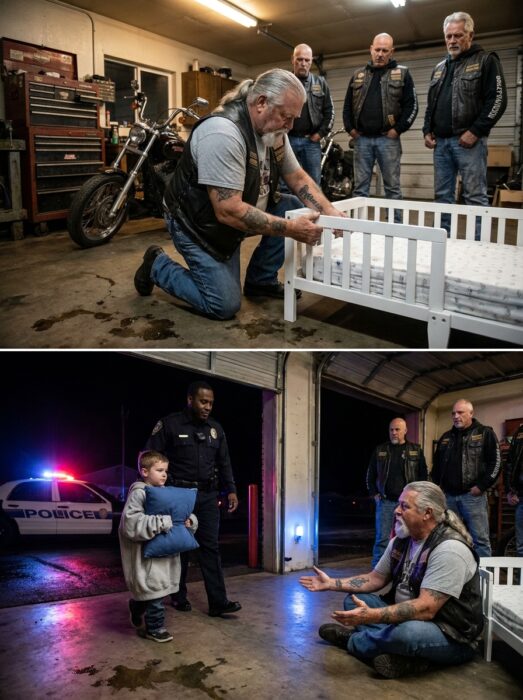
I looked across the street toward the tire shop and saw red and blue light blinking against the metal garage door.
My stomach dropped.
There are certain colors that make every small town feel smaller. Police lights do that. They pull faces to windows. They make people invent stories before anyone has facts. By the time I crossed the street with two thermoses and a container of chicken noodle soup, three people had already stepped onto the sidewalk pretending to check their phones.
A Kingman police cruiser sat outside the garage.
Officer Dean Alvarez stood near the open bay door, one hand on his radio, face tired in the flashing light. I knew Dean from the diner. Good cop. Quiet man. The kind who said thank you to dishwashers and never treated coffee refills like rights.
Beside him stood a boy.
Seven, maybe.
Small for seven.
He had brown hair stuck to his forehead, one sneaker untied, and a blue pillow clutched tight against his chest. He wore pajamas under a gray hoodie several sizes too big. His left cheek was red, not bruised exactly, but marked enough to make the room around him feel dangerous. He did not cry. He did not ask questions. He just stared at the floor and held that pillow like it was the last piece of a house that still belonged to him.
Behind me, Tank whispered something I could not hear.
Bishop took one step back.
Eli looked like he might be sick.
Rook stood near the bed, but not close to it. His hands hung open at his sides. For a man whose body usually filled every room, he had made himself smaller somehow, knees bent slightly, chin lowered, voice kept down.
Nobody had taught him that in a club garage.
Somebody had taught him that by surviving.
Dean saw me and nodded once.
“Rita, you got food?”
“Soup.”
“Good.”
The boy flinched when the garage door rattled in the wind.
Every biker in the room heard it.
Nobody moved fast after that.
Rook pointed two fingers at the bay door, and Tank lowered it slowly, inch by inch, letting the motor hum instead of slam. Bishop turned off the overhead fluorescent lights and left only the small lamp beside the workbench and the blue nightlight by the bed. Eli carried the soup to the table but stopped halfway, unsure whether getting closer would scare the boy.
Rook spoke first.
“Name’s Rook.”
The boy did not look up.
“That’s a dumb name,” he said.
Tank made a sound that was almost a laugh, then swallowed it.
Rook nodded.
“Yeah. It is.”
The boy’s grip loosened on the pillow by one finger.
Officer Alvarez stepped beside me, lowering his voice. “Domestic call on Sierra Road. Mother’s being transported. Father’s in custody. No relatives answering yet. Shelter is full tonight.”
I looked at the child’s bed.
Shelter is full tonight.
Those four words landed harder than any engine.
Rook must have known they would come someday. Maybe not that night, not with that boy, not with police lights shaking against the garage wall, but he had built the answer before the question reached him.
Dean kept talking quietly. “Child services is sending someone from Flagstaff, but that could be hours. I remembered what Rook filed with the department last week.”
I turned.
“Filed?”
Rook did not look at me.
Dean nodded. “Emergency respite partnership. Informal, but approved for short holds with police supervision. Background checks cleared for designated adults.”
Tank’s head snapped up.
“Background checks?”
Bishop’s mouth opened.
Eli whispered, “We passed?”
Rook shot him a look.
“Barely.”
It should have been funny.
Nobody laughed much.
The boy finally lifted his face and looked around the garage. His eyes moved over the motorcycles, the toolboxes, the men in leather cuts, the tattoos, the boots, the patches. I watched him calculate danger in the way children from violent homes learn to calculate it: exits, hands, voices, bottles, belts, sudden movement.
Then his eyes landed on the bed.
Not with hope.
Hope would have been too big.
He looked at it like he did not trust a kind thing to stay kind.
Rook saw that too.
He lowered himself slowly onto the concrete floor about eight feet from the bed, knees popping loud enough for Tank to wince. Then he sat with his back against the wall, palms on his thighs, making no move toward the boy.
“You don’t have to sleep,” Rook said.
The boy blinked.
“You don’t have to talk. You don’t have to tell us nothing. If you want soup, it’s there. If you want that bed, it’s yours. If you want the floor, I get that too.”
The boy looked at Dean.
Dean nodded gently.
“Am I in trouble?” the boy asked.
Rook answered before the cop could.
“No.”
The word was flat, solid, and complete.
The boy’s chin shook once, but no tears came.
His name was Marcus.
We learned that from Officer Alvarez, not from him. His mother had been taken to the hospital. His father had broken two cabinet doors, a lamp, and maybe her wrist. Marcus had called 911 from under the laundry room sink, speaking so softly the dispatcher almost lost him twice.
That was the first false climax.
We thought the night was about Marcus being brought to safety.
It was not.
The real crisis began when Marcus walked to the bed, set his pillow on it, sat down without taking off his shoes, and stared at Rook for nearly two full minutes.
Then he asked, “Are you gonna turn the lights off?”
Rook’s face changed.
Not much.
Enough.
His jaw tightened, and the scar near his left eyebrow pulled white. His fingers curled once against his jeans, then relaxed. For a moment, the club president, the old road captain, the man everyone feared, looked like he had been hit by a memory no one else could see.
He shook his head slowly.
“No, son.”
Marcus hugged his pillow tighter.
Rook swallowed.
“You don’t need to tell me anything. Here, the lights don’t go off until you’re ready.”
That was when Bishop turned away.
Tank stared at the floor.
Eli wiped his nose on his sleeve and pretended it was allergies.
I stood there holding soup that had gone lukewarm in my hands, and I understood only one thing clearly.
Rook had not built that bed for a grandson.
He had built it for a ghost.
Part 4
The truth came out because of the cabinet.
Not all at once. Men like Rook do not open their wounds neatly. They crack under pressure, then pretend the sound came from something else.
Marcus fell asleep around 1:15 in the morning, still wearing his sneakers, one hand tucked under his pillow and the other holding the stuffed dog Rook had chosen instead of a bear. Officer Alvarez stayed near the front office, filling out paperwork under a desk lamp. I sat by the coffee pot. Tank, Bishop, and Eli occupied three different corners of the garage, each pretending not to watch the sleeping boy.
Rook never left the floor.
He sat where Marcus could see him if he woke up, but far enough away that the boy would not feel crowded. Every twenty minutes, Rook shifted his bad knee and made a soft sound through his teeth. Every time Marcus stirred, Rook froze.
Around 2:00, Marcus woke suddenly.
No scream.
Just awake.
His eyes flew open, and his hand reached under the pillow like he expected something terrible to be there. Then he saw the nightlight, saw Rook against the wall, saw the garage unchanged, and his breathing slowed.
“I’m thirsty,” he whispered.
Rook did not stand.
He looked at me.
I brought the water.
Marcus drank half the bottle, then looked at the locked cabinet beside the bed.
“What’s in there?”
Rook glanced at the brass key on the workbench.
“Stuff kids might need.”
“Like what?”
“Clean socks. Toothbrush. Sweatshirts. Snacks.”
Marcus stared.
“You got Pop-Tarts?”
Eli, God bless that boy, jumped like he had been called to war.
“I can get Pop-Tarts.”
Rook raised one hand.
“Cabinet.”
That was when I used the key.
I opened the metal door, expecting exactly what Rook had listed. Clothes. Snacks. Toiletries. Maybe some paperwork. Instead, on the inside of the cabinet door, taped under clear plastic, was a black-and-white photograph.
A boy sat in the cab of an old Ford pickup.
He could not have been more than eight.
His knees were pulled to his chest, his hair was cut unevenly, and one eye was swollen nearly shut. He wore a thin shirt despite what looked like winter frost on the windshield. In his lap sat a pillow with a faded blue stripe.
The blue fabric on Rook’s key.
The same color.
The garage went silent in a way that felt physical.
Rook stood too fast, then stopped himself because Marcus flinched. He closed his eyes, breathed through his nose, and said, “Leave it.”
Nobody touched the photo.
Marcus looked from the photograph to Rook.
“That you?”
Rook’s voice came out rough.
“Yeah.”
Bishop whispered, “Brother.”
Rook shook his head once.
Not now.
But the photo had already opened something.
Marcus kept looking at it, not with curiosity, but recognition. Children who have slept in fear know each other across decades. They can spot the posture. The guarded hands. The way a kid folds his body to take up less space in a world that keeps hitting him.
“Why were you in a truck?” Marcus asked.
Rook did not answer at first.
Then he lowered himself back onto the floor, slower this time.
“Because nobody opened the door.”
That was the twist, but it was not the whole twist.
Rook told it in pieces, because pieces were all he could manage.
He was born Raymond Keller in a trailer park outside Needles, California, where Route 66 ran like a promise nobody in his family could afford. His mother cleaned motel rooms. His father drove trucks when he was sober and disappeared when he wasn’t. There was an uncle, a stepfather, neighbors who heard things, teachers who noticed too late, and a little yellow house two blocks away where Raymond once knocked at 10:30 on a winter night with blood on his sleeve.
A woman opened the curtain.
Not the door.
She saw him.
He knew she saw him.
Then the porch light went out.
He slept in the truck behind a feed store because it still smelled like hay and motor oil, and because the cab blocked the wind better than the alley. He used a moving blanket for warmth and a blue-striped pillow he had stolen from a laundry line. In the morning, a highway patrolman found him, but back then, records got messy, adults got believed, and boys with Keller as a last name were treated like trouble already written.
He was returned home before lunch.
Rook did not tell us what happened after.
He did not need to.
The yellow house patch inside his vest suddenly made terrible sense.
The brass key tied to blue fabric made sense.
The bed. The nightlight. The no-bears rule. The cabinet. The distance he kept from Marcus. Every small decision had a scar underneath it.
Tank turned his face toward the bikes.
Bishop gripped the edge of the workbench until his knuckles paled.
Eli stood with Pop-Tarts in one hand and his mouth open, looking younger than I had ever seen him.
But Rook still had one more truth to drop.
He looked at Officer Alvarez.
“Tell them the rest.”
Dean hesitated.
Rook nodded once.
Dean closed the folder in his hands. “Rook came to the department six months ago. Asked what it would take to make this place legal enough for temporary emergency placement.”
Tank stared at Rook. “Six months?”
Rook kept looking at the floor.
Dean continued. “He paid for background checks. Fire inspection. First-aid training. Camera outside, not inside. New locks. Emergency contact lists. He got the family shelter to agree to call when they were full.”
Bishop’s voice broke around the edges.
“You did all that alone?”
Rook’s mouth hardened.
“I asked.”
“No, you didn’t.”
Rook finally looked up.
“I asked by making sure it was done before you could vote no.”
That stung the room.
Because it was true.
The Iron Saints had always talked big about protecting the weak, but Rook had known his brothers well enough to know a child’s bed would scare them more than a bar fight. Not because they were cruel. Because tenderness asks more from a man than anger does.
Brotherhood had been tested without their permission.
And Rook had assumed they might fail.
Tank stepped forward then.
Slow. Heavy. Careful.
He took off his leather cut, folded it once, and placed it on the cold concrete near Rook’s feet.
“I failed before you asked,” Tank said. “That’s on me.”
Bishop did the same.
Then Eli.
Then, one by one, the men in that garage laid their cuts on the floor, not in ceremony exactly, but in apology. Leather against concrete. Patches against dust. All the names they had earned placed below the child’s bed they had not understood.
Marcus watched from the pillow.
Rook looked at the cuts, then at his brothers.
His eyes were wet.
He did not cry.
Not really.
He just pressed his thumb hard against the blue strip of fabric tied to the key and said, “Then don’t fail the next one.”
Nobody spoke after that.
There was nothing left to say.
Part 5
By sunrise, the whole story had changed shape.
Not for Marcus. Children do not heal because adults have meaningful revelations in garages. He still woke every hour, still reached for his pillow, still asked whether his mother was alive in a voice so small it made the coffee taste bitter. Officer Alvarez finally got confirmation around 6:10 that she was out of surgery, stable, and asking for him.
Marcus did not smile when he heard it.
He just breathed.
Sometimes that is the first sign a child believes tomorrow might arrive.
The child services worker came from Flagstaff a little after 7:00, tired and polite, with paperwork in one hand and apology in the other. She looked at the motorcycles first, then the bed, then Rook on the floor with a paper cup of coffee beside his boot.
I watched her decide what kind of place this was.
People had been doing that to Rook his whole life.
He did not help her.
He did not charm her, explain himself, or perform softness for approval. He simply stood up, slow from the knee, and handed her the folder Dean had prepared. Fire inspection. Contact list. Clean bedding log. Food inventory. Copy of the approved emergency agreement. Background clearance names.
The worker blinked.
“You keep a bedding log?”
Rook shrugged.
“Kids deserve clean sheets.”
That was all he said.
Marcus refused to leave at first.
Not loudly.
He just sat on the bed and shook his head when the worker told him they were going to see his mom. His eyes kept returning to Rook, then to the nightlight, then to the cabinet with the photograph hidden inside. I think he had found something in that garage he did not have words for, something less fragile than comfort.
Proof, maybe.
Proof that a boy could survive that kind of night and still become large enough to make a safe room for someone else.
Rook understood before anyone else did.
He lowered himself again, though his knee must have screamed.
“Marcus.”
The boy looked at him.
“Your mom’s waiting. That matters.”
Marcus swallowed.
“What if I have to come back?”
Rook reached into the plastic bin and pulled out the stuffed dog.
“Then this one keeps your spot.”
Marcus looked at the dog.
“You promise?”
Rook did not answer quickly. He was careful with promises around children. That was another thing I only understood later.
“I promise the bed stays,” he said. “Can’t promise much else. But that, yeah.”
Marcus nodded once.
Then he slid off the bed, walked across the garage, and did something nobody expected.
He hugged Rook’s arm.
Not his waist.
Not his chest.
Just his arm, because it was the closest safe piece of him.
Rook froze like a man standing on thin ice. His big hand lifted, hovered over the boy’s back, then lowered again without touching. He let Marcus choose the whole thing. He let the boy step away first.
That restraint broke me more than any speech could have.
After Marcus left, the garage looked emptier than it should have after one small child had spent only a few hours there. The bed was wrinkled. One sneaker mark smudged the white frame. The soup bowl sat half full on the workbench. A blue crayon had rolled under Rook’s Harley.
Nobody wanted to clean too fast.
Tank washed the spoon anyway.
Bishop folded the blanket.
Eli drove to Walmart and bought three boxes of Pop-Tarts without asking permission.
That afternoon, the Iron Saints held the strangest meeting I had ever witnessed.
No beer.
No shouting.
No engines running outside.
Just tired men sitting in folding chairs, staring at a child’s bed in the back corner while Rook stood near the tool chest with his arms crossed.
Tank spoke first. “We do this right.”
Bishop nodded. “Schedule. Two men here every night.”
“Three,” said Eli.
Everyone looked at him.
He flushed, but kept going. “If a kid wakes up scared, one stays back, one gets food, one calls whoever needs calling. Three makes sense.”
Rook studied him.
Eli straightened like he expected criticism.
Instead, Rook said, “Good.”
That one word almost knocked the boy over.
They made rules.
No drinking in the garage if a child was present. No raised voices. No sudden engine starts after 9:00 unless the kid had been warned first. No touching unless the child initiated. No questions about home unless police or a caseworker required it. No jokes about why a child was there. No posting. No photos. No stories told outside.
That last rule mattered.
Viral kindness can rot if people use it to polish themselves.
Rook knew that.
He made them write it down.
Then he opened the cabinet and removed the photograph of himself in the truck. For a moment, I thought he was going to hide it again, return the wound to the dark where he had kept it for fifty years.
Instead, he taped it to the inside wall, lower this time, at a child’s eye level.
Beside it, he taped a new note written in block letters.
YOU ARE NOT THE FIRST.
YOU ARE NOT ALONE.
YOU DO NOT HAVE TO TALK.
The brothers read it quietly.
Bishop took off his glasses.
Tank walked outside.
Eli stood with the Pop-Tarts against his chest like an offering.
I asked Rook later why he put the photo where children could see it.
He wiped his hands on a rag, though they were already clean.
“Because when I was seven,” he said, “I thought I was the only one.”
That sentence stayed in the garage long after his voice stopped.
It still lives there.
Part 6
The bed became a ritual.
Not a program, though eventually the town called it one. Not a charity, though money started arriving in envelopes slipped under the garage door. To Rook, it was just the bed.
Every evening around 8:30, after the last desert light faded behind the hills and the trains began their long metal groan through Kingman, Rook walked the garage the same way.
He checked the lock on the side door.
He tested the nightlight.
He opened the cabinet and counted what needed counting. Socks. Toothbrushes. Snacks. Sweatshirts. Bottled water. Pop-Tarts, because Eli had decided every safe place needed strawberry and brown sugar cinnamon.
Then Rook sat on the floor.
Not in a chair.
Never in a chair.
He sat where he had sat for Marcus, eight feet from the bed, back against the wall, hands open on his thighs. Some nights no child came. Most nights, in fact. The world is cruel, but not always on schedule.
Still, he sat.
The brothers took shifts, but Rook was there more than anyone. Tank pretended to complain and brought extra coffee. Bishop installed better insulation before winter. Eli painted small wooden dogs and lined them along the windowsill, each one carrying the name of a child who had stayed, though only first names, never stories.
Marcus came back once, two months later.
This time with his mother.
She wore a cast and sunglasses, even indoors, and she stood near the bay door like she did not trust a room full of bikers. Marcus walked straight to the bed, checked the stuffed dog, then turned to Rook.
“You kept it.”
Rook nodded.
“Told you.”
Marcus looked at his mother with the strange seriousness of children who have become older than their years.
“This is the place.”
She began crying then.
Quietly.
Rook stepped back and let her have the room.
That became his way with everyone.
He made space, then guarded the edges.
One winter night, a twelve-year-old girl arrived with a deputy and refused to speak to any man. Rook left the garage and sat outside in the cold on his Harley, engine off, hands tucked under his arms, until I got there from the diner. In the morning, the girl asked who had stayed outside all night.
I told her.
She looked through the window at Rook, asleep against his bike like an old dog guarding a porch, and said, “He didn’t come in?”
“No.”
She nodded.
“Good.”
Rook considered that a compliment.
The yellow house patch never moved to the outside of his vest. People asked about it more after the bed became known in quiet circles, but he still did not explain it to strangers. Some things are not stories for public hands.
But every year, on the first cold night of December, Rook rode alone west on Route 66 toward Needles.
He never called it a memorial ride.
He never invited the club.
He would leave before dawn, engine coughing to life behind the tire shop, saddlebags carrying one blue-striped pillow and a thermos of coffee from my diner. By noon, he would stop near an old feed store that no longer sold feed, sit in the parking lot for exactly twenty minutes, then ride back.
One year, I asked why twenty minutes.
He looked at the highway.
“That’s how long I waited for someone to come back.”
I never asked again.
Part 7
Rook is sixty-three now.
His beard is whiter, his knee is worse, and the Road King takes two tries on cold mornings. The Iron Saints garage looks different too. Cleaner, maybe. Softer in one corner. There are still motorcycles, oil stains, chains, boots, and men who scare people at first glance.
But there is also a blue nightlight that never gets unplugged.
The bed has held twenty-nine children so far.
Some stayed one hour. Some stayed until morning. One teenage boy slept on the floor beside it because he said beds made him nervous, and Rook said, “Floor’s fine,” then slept on the floor too, bad knee and all.
Marcus sends a Christmas card every year.
No long message.
Just his name, his mother’s name, and sometimes a school picture tucked inside. Rook keeps them in the cabinet behind the Pop-Tarts, beside the old photograph of the boy in the truck.
Last week, I stopped by after closing the diner and found Rook sitting in his usual spot. The garage was quiet except for the ticking engine of his Harley and the distant sound of a train moving through the dark.
The bed was empty.
The nightlight was on.
Rook looked at it for a long time, then said, almost too softly to hear, “Somebody should’ve left one on.”
He did not say anything after that.
He did not need to.
Outside, the red taillight of his Harley faded down Route 66, small and steady against the Arizona night.
The light stayed on.
Follow the page for more stories like this.