Part 2: Fifty Bikers Lined Up to Walk a Bride With No Father Down the Aisle — And She Had Never Met a Single One of Them Before Her Wedding Day
PART 2 — THE FATHER WHO NEVER MISSED A PROMISE ON PURPOSE
My father was not a biker in the way Bear and the Iron Haven Riders were bikers.
Dad owned one faded blue motorcycle that leaked oil across the garage floor and started only when the weather, battery, and family finances cooperated.
He called the machine Bluebird.
Mom called it the loudest unfinished project in Oklahoma.
Dad bought it before I was born, promising to restore it during weekends. Then parenthood arrived, followed by mortgage payments, school expenses, leaking roofs, and all the practical emergencies that quietly consume adult dreams.
The motorcycle remained half-finished.
Still, I loved sitting on its worn seat while Dad worked.
He handed me harmless tools and pretended I was assisting with important repairs. When I asked where we would ride once Bluebird worked, Dad always gave the same answer.
“Wherever you need to go.”
At six, I believed him literally.
At ten, I understood it meant more.
Dad attended every school event, even when his work uniform smelled like insulation dust and machine oil. He sat through dance recitals where I appeared onstage for forty-three seconds.
He once drove three hours to retrieve a stuffed rabbit I left inside a motel room because I said I could not sleep without it.
When I became embarrassed by public affection, he stopped kissing my forehead near classmates but continued placing a hand on my shoulder before I walked away.
Dad understood that loving a child sometimes means changing how love is delivered without changing how much is given.
The heart attack came on a Thursday morning.
He was preparing coffee before work when he collapsed near the kitchen table. Mom called emergency services. I stood barefoot in the hallway while paramedics tried to restart a life that had appeared completely ordinary twelve minutes earlier.
Dad died before reaching the hospital.
People remember grief through dramatic moments.
I remember smaller ones.
His boots remained near the back door.
The coffee cooled beside the sink.
A hardware-store receipt stayed inside his shirt pocket.
For months, I expected the garage to open and his familiar footsteps to cross the kitchen.
At fourteen, I did not understand finality. I understood only interrupted routine.
Dad’s friends helped Mom sell several tools and clear unfinished projects. She kept Bluebird beneath a canvas cover.
“Why not sell it?” I asked.
“Because he said it was yours when you turned eighteen.”
The motorcycle did not run when I reached eighteen.
Neither did I want it to.
I kept it inside a storage unit, telling myself I would restore it someday. Like Dad, I allowed practical life to move the promise farther into the future.
College.
Work.
Rent.
Marriage plans.
Bluebird waited.
When Daniel proposed, the first person I wanted to tell was Dad.
I visited the storage unit instead.
I pulled away the dusty canvas and sat on the cracked seat in my engagement dress. For almost an hour, I spoke aloud to a machine that had never reached the road.
“I found someone good,” I told him.
The silence answered honestly.
Dad was not coming.
That was the grief beneath my Facebook post.
I was not afraid of walking twenty yards through a church alone.
I was afraid that the empty space beside me would become the most visible proof that my father had missed the life he worked so hard to prepare me for.
PART 3 — THE POST THAT REACHED A CLUBHOUSE AT MIDNIGHT
Bear saw my post because a woman named Patricia Lewis shared it inside a local wedding group.
Patricia’s husband rode occasionally with the Iron Haven Riders during charity events. She included a note:
“Does anyone know a respectful father figure who might help this bride?”
One club member sent the screenshot to Bear.
He was sitting inside the clubhouse after a monthly meeting, drinking coffee while younger riders argued over a planned veterans fundraiser.
Bear read my words twice.
Then he placed his phone face down.
Deacon noticed.
“What happened?”
Bear showed him.
Deacon read the post and sighed.
“Hard day to walk alone.”
Bear stared toward a photograph hanging behind the bar.
It showed a young woman in a white dress beside a motorcycle.
Her name was Rachel Dalton.
Bear’s daughter.
Rachel had died in a highway accident six years earlier, eight months before her wedding.
Bear had expected to walk her down an aisle.
He had purchased a dark suit after Rachel complained that his only formal clothing made him resemble “a bouncer attending court.”
They chose a father-daughter song.
Rachel teased him about practicing because he stepped on her feet during every attempt.
The wedding never happened.
After Rachel’s funeral, Bear placed the unused suit inside the back of his closet. He could not throw it away, but seeing it made breathing difficult.
When he read my post, he did not think he could become my father.
He thought about the steps he had prepared to take but never received.
“I could walk her,” he told Deacon.
Deacon looked toward Rachel’s photograph.
“You sure?”
“No.”
“That wasn’t what I asked.”
Bear rubbed one hand across his beard.
“If I wait until I’m sure, she’ll already be married.”
Scout, the club’s fifty-six-year-old Black American road captain, overheard the conversation.
“One biker could feel strange,” she said. “Like we chose a replacement.”
Bear nodded.
“What if no one replaces him?”
The three riders developed the relay idea.
Each escort would walk only a few steps, symbolizing support rather than substitution. The bride would remain visibly in control, moving from one willing hand to the next.
They expected perhaps ten volunteers.
Bear posted the request in the club’s private group:
“Bride lost her father as a child. She does not need anyone pretending to be him. She needs respectful company across one aisle. Formal behavior required. No engines during ceremony. No alcohol before escort. No publicity unless the family approves.”
Within twenty minutes, sixteen riders volunteered.
By morning, there were thirty-two.
By the end of the day, fifty names filled the list.
Several were fathers.
Others had lost daughters.
Some never had children but remembered women who walked difficult roads without support.
One female biker wrote:
“Fathers are not the only people who can stand where love is needed.”
Bear agreed.
The fifty riders represented different races, ages, occupations, and histories. A retired firefighter stood beside a school custodian. A female mechanic stood beside a former Marine. One rider used a cane. Another had only recently joined the club.
They practiced the handoffs in the clubhouse parking lot.
At first, the process looked ridiculous.
Fifty bikers passed Deacon along the line while he pretended to hold a bouquet.
“You’re crushing my fingers,” he complained.
“You have hands like concrete,” Scout answered.
“You’re walking too fast,” Bear said.
“The imaginary bride seems athletic.”
They practiced again.
No grabbing.
No pulling.
Each rider would offer an arm and wait for me to accept it. At each transition, the next escort would ask silently through eye contact before taking my hand.
The club understood something many adults forget:
Support offered without choice can become another form of control.
They did not want to carry me.
They wanted to match my pace.
PART 4 — THE MORNING FIFTY MOTORCYCLES ARRIVED QUIETLY
The Iron Haven Riders met four miles from the church before sunrise.
Bear inspected every vest. Club patches could remain, but anything containing aggressive language had to be covered. Helmets would be carried, not left where guests could trip over them.
The riders were instructed to enter without revving engines.
The neighborhood surrounding the church woke to the low sound of fifty motorcycles moving carefully through morning fog.
My wedding coordinator nearly panicked.
She had been told several bikers might attend. She had not expected the entire parking lot to fill with chrome, leather, and riders large enough to rearrange the pews without assistance.
Bear found her near the entrance.
“We will do exactly what the bride wants.”
“She doesn’t know there are fifty of you.”
“She knows there will be support.”
“This is more than support. This is a parade.”
“No parade.”
Bear pointed toward the motorcycles.
“Engines stay off until the wedding party leaves. Riders enter quietly. If Emily says no, we sit in the back.”
The coordinator called my mother.
Mom stepped outside and saw the fifty riders forming two lines for rehearsal.
She covered her mouth.
Bear approached.
“Too much?”
Mom stared at him for several seconds.
“Thomas would have laughed.”
“Is that good?”
“He laughed when he was overwhelmed.”
She opened her purse and removed a stack of small photographs.
Each showed Dad beside Bluebird, smiling with one oily hand raised toward the camera.
“I brought these for the reserved chair.”
Bear looked toward the riders.
“May we carry him too?”
Mom understood immediately.
She helped pin one copy inside each biker’s vest, directly above the heart or on the inner lining where formal jackets covered the leather.
The final photograph went to Bear.
He placed it above the black tie Rachel had chosen for him six years earlier.
That was the suit he wore beneath his vest.
He had finally taken it from the closet.
Not to pretend another bride was his daughter.
To use the steps grief had left unfinished.
PART 5 — FIFTY PEOPLE CARRYING ONE PROMISE
The first steps were the hardest.
Bear offered his left arm because his right shoulder had been injured years earlier. My fingers closed around his sleeve.
“You set the pace,” he whispered.
The church music began softly.
We moved.
At the sixth step, Bear stopped before Deacon.
“This is Emily,” Bear said, though Deacon already knew.
Deacon extended his arm.
“May I?”
I nodded.
Bear released me only after my hand was secure.
That detail repeated through the entire aisle.
Every rider asked.
Every rider waited.
Some escorted me for five steps.
Others only three.
A seventy-year-old biker named Moses walked slowly with a cane, so I adjusted my pace to his. He apologized.
“We have time,” I said.
His eyes filled.
“So did I, once.”
I did not know what he meant until later. Moses had lost his daughter before they reconciled after a long family argument.
A female biker named Scout received my hand next. She wore small silver earrings beneath her close-cropped hair and smelled faintly of lavender.
“Breathe,” she whispered.
“I’m trying.”
“You’re doing it.”
The church guests had begun crying openly.
Daniel stood at the altar with both hands over his mouth. My mother held Dad’s old handkerchief against her face.
The bikers did not smile for cameras.
They watched me.
Each person treated those few steps as a responsibility rather than a performance.
Halfway down the aisle, the meaning became clear.
No single man could take Dad’s place.
That was not failure.
It was respect.
Dad’s place remained Dad’s.
The riders stood beside the emptiness without attempting to fill it.
By the thirtieth handoff, I was crying too hard to walk normally. Bear had moved quietly along the side aisle and now waited near the front.
Scout held me steady.
“You want to stop?”
“No.”
“Want a minute?”
“I want to finish.”
She nodded.
“Then we finish.”
The final escort was a seventy-two-year-old Latino American biker named Miguel “Pops” Alvarez. He had four daughters and eleven grandchildren.
Pops offered his arm.
“You all right, sweetheart?”
“No.”
“That sounds honest.”
He walked me the last steps toward Daniel.
Before releasing me, Pops placed something inside my palm.
A small brass motorcycle key.
I looked down.
“What is this?”
Bear stepped forward.
“Your mother told us about Bluebird.”
I looked toward Mom.
She was crying but smiling.
The Iron Haven Riders had visited the storage unit three days before the wedding. With Mom’s permission, six club mechanics inspected Dad’s motorcycle.
They replaced the battery, rebuilt the fuel system, repaired old wiring, changed the tires, and polished the faded blue tank without removing every scratch.
The key in my hand belonged to my father’s motorcycle.
“It runs?” I whispered.
Bear nodded.
“Your father said it would take you wherever you needed to go.”
Behind the church, Bluebird waited beneath a white cloth.
The riders had not only carried me through Dad’s promise.
They had finished one of his others.
Pops placed my hand into Daniel’s.
“This is where we step back.”
Daniel thanked him.
Pops shook his head.
“Thank her. She trusted strangers.”
The ceremony began.
For the rest of the service, fifty bikers sat in the final rows with my father’s photograph pinned over their hearts.
PART 6 — THE FATHER-DAUGHTER DANCE WITH NO FATHER
The reception was held inside a renovated barn several miles from the church.
The bikers had planned to leave after the ceremony. They believed the aisle was the only role they had been invited to fill.
Mom refused.
“You are all eating.”
Bear looked at the fifty riders.
“That may create a catering emergency.”
“Thomas raised a woman who plans for emergencies.”
Extra tables appeared near the back. Bikers removed their vests while eating so the formal guests could stop expecting an incident.
The children at the wedding discovered them immediately.
Within an hour, men who looked capable of dismantling furniture were wearing paper crowns and answering questions about tattoos.
Then the band announced the traditional father-daughter dance.
I had removed it from the schedule months earlier.
Daniel looked toward the bandleader, confused.
Mom stood beside the dance floor.
“I added something,” she said.
A familiar recording began.
It was Dad’s voice.
Mom had found an old home video from my eighth birthday. In the recording, Dad was attempting to teach me how to dance in the kitchen.
“Left foot,” he said.
“No, your other left foot.”
Young Emily laughed.
Then Dad said:
“One day, kid, you’ll dance better than this at your wedding.”
The room became silent.
Bear stood near his table but did not approach me.
He would not assume.
I walked toward him.
“Would all fifty of you dance with me?”
Bear’s face broke.
“Emily—”
“You walked me here.”
The bikers formed a wide circle around the dance floor.
Bear took the first few steps with me. Just like the aisle, he passed me gently to Deacon, who passed me to Scout.
Each rider danced for only several seconds.
Some knew how.
Most did not.
Moses nearly struck a table with his cane. Pops spun me too quickly and apologized through laughter. Scout held both my hands while I cried.
The dance was not elegant.
It was a celebration created from fifty imperfect offerings.
When the recording ended, Dad’s voice delivered one final sentence from the old video:
“Whatever happens, I’ll be proud when you get there.”
I stood in the center of the floor surrounded by leather vests, gray beards, tattooed arms, and strangers who were no longer strangers.
“I thought I had no father to walk me,” I said.
Bear lowered his head.
“I had one father.”
The room waited.
“And today, fifty people helped him keep his promise.”
PART 7 — THE AISLE THAT CONTINUED AFTER THE WEDDING
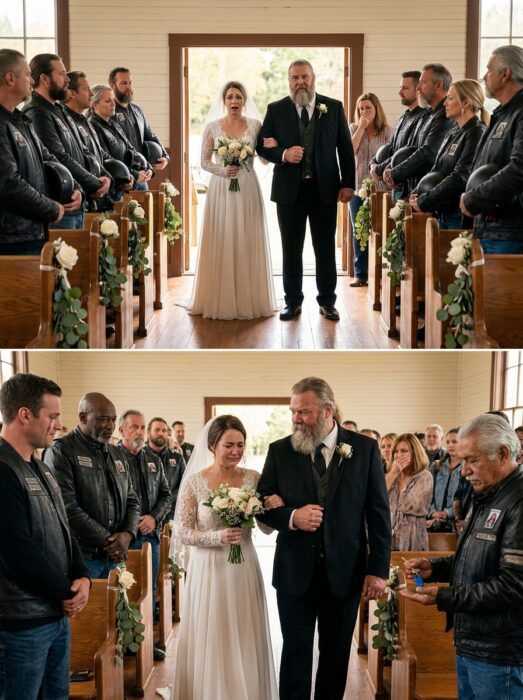
The photograph of the bikers lining the aisle spread online after I gave permission for our photographer to post it.
The caption read:
“She expected to walk alone. Fifty strangers made sure she never had to.”
Millions of people saw the image.
Most responded with kindness. Some criticized the gesture, arguing that a bride did not need men to deliver her to a husband.
I understood the concern.
But that was not what happened.
The bikers did not give me away.
They gave me company.
Every handoff required my consent. Every rider followed my pace. No one claimed ownership over the moment.
The Iron Haven Riders called it the Honor Aisle.
They expected it to remain a single wedding story.
Then messages arrived.
A bride whose father was incarcerated asked whether several riders might escort her.
A young man raised by his grandmother wanted someone to stand beside him during a military graduation.
A teenage girl entering foster care asked whether the club could attend her school award ceremony because nobody from her family planned to come.
Bear established rules.
The Honor Aisle would never be used for publicity without permission. Riders would undergo background checks for events involving children. No person would be touched without consent.
Most importantly:
They would never claim to replace someone who was missing.
Their purpose was simply to stand where absence had become too heavy.
Over the next five years, Iron Haven riders attended graduations, weddings, adoption hearings, hospital discharges, first days at new schools, and funerals where too few people had come.
The size of the group changed.
Sometimes fifty arrived.
Sometimes only two were needed.
My connection to them continued too.
Daniel and I visited the clubhouse after our honeymoon. Bluebird waited outside, fully restored.
Bear handed me the key.
“She still needs someone patient.”
“That eliminates most of your club.”
Deacon protested from across the garage.
I learned to ride slowly. Bear and Scout taught me balance, braking, road awareness, and how to listen when a motorcycle changed sound before something went wrong.
The first time I rode Bluebird alone, Mom stood beside the driveway holding Dad’s helmet.
I placed it on carefully.
“You look like him,” she said.
“No.”
I touched the faded blue fuel tank.
“But I know where he meant to take me.”
Three years after the wedding, Bear finally told me about Rachel.
We were sitting outside the clubhouse during an Honor Aisle fundraiser. He showed me her photograph in the white dress beside her motorcycle.
“She was beautiful,” I said.
“She was loud.”
“That isn’t the opposite of beautiful.”
Bear smiled.
“She would’ve liked you.”
I asked why he had brought exactly fifty riders to my wedding.
“At first, fifty volunteered.”
“That’s all?”
“No.”
He looked toward Rachel’s photograph.
“I kept thinking one man walking you might look like he was trying to become your father. Fifty made that impossible.”
I understood.
Fifty did not mean I suddenly had fifty fathers.
It meant no individual claimed the place Dad had earned.
Together, they became something different.
Witnesses.
Companions.
Temporary guardians of a promise.
Bear touched the black tie Rachel had chosen, now folded inside his vest pocket during every Honor Aisle event.
“You gave me an aisle too,” he said.
I shook my head.
“I didn’t walk you anywhere.”
“You let me take the steps I thought grief had stolen forever.”
We sat quietly.
Some kindness moves only in one direction.
The most meaningful kind travels both ways without keeping score.
It has now been seven years since my wedding.
Daniel and I have a five-year-old daughter named Grace Thomas Carter, her middle name honoring the grandfather she will know through photographs and stories.
The wedding picture hangs inside our hallway.
Fifty bikers form two rows.
I stand at the beginning beside Bear.
Dad’s photograph is pinned above his heart.
Grace asks about it often.
“Did all those grandpas walk you?”
“Some were grandpas.”
“Were they your family?”
“Not yet.”
Last month, Grace served as a flower girl at an Honor Aisle wedding. The bride had aged out of foster care and had no relatives attending.
Twenty-seven bikers stood along the path.
Grace scattered petals unevenly, then ran back to Bear.
He is sixty-eight now. His beard has become nearly white, and his injured shoulder makes long rides difficult.
Grace slipped her hand into his.
“You have to walk too.”
Bear looked toward the bride.
“Only if she asks.”
The bride approached.
She had been crying before the ceremony even began.
“Bear?”
He offered his arm.
The riders formed their lines.
No engines.
No speeches.
No one pretending to be somebody they were not.
Only people offering a few faithful steps at a time.
The bride reached the altar without walking alone.
Afterward, Grace asked why the bikers kept doing it.
I looked toward Bluebird parked beside the church.
“Because sometimes people cannot bring back the person who made a promise.”
“Then what can they do?”
“They can help carry it.”
Grace considered the answer.
Then she placed one flower on Bear’s motorcycle.
On my wedding day, I believed the aisle represented everything I had lost.
Fifty strangers transformed it into proof of what love could still build.
They did not replace my father.
They honored him by refusing to let his absence become abandonment.
Each biker walked only a few steps.
No one carried the entire journey.
That was the lesson hidden inside their unusual procession:
Family is not always one person strong enough to take you the whole way. Sometimes it is fifty people willing to carry a small part—and careful enough to keep passing your hand forward until you reach where love promised you would go.
Follow the page for more unforgettable biker stories about rough-looking strangers who never try to replace the people we have lost—but still step forward when no one should have to walk alone.