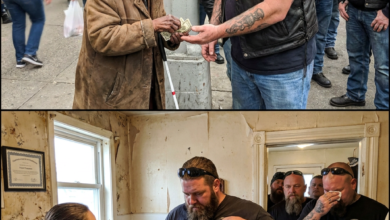
An Eleven-Year-Old Boy Was Caught Stealing Dog Food—Then a Biker Recognized the Gray Dog Waiting Inside an Abandoned Barn
The barn should not have worked.
Its roof leaked in four places. Wind entered through the east wall. The electrical wiring had been dead since the flood, and the nearest working water line was almost half a mile away.
Yet Eli had turned it into a shelter.
He collected rainwater in barrels and filtered debris through layers of cloth. He built beds from discarded pallets, feed sacks, and blankets people had thrown away. A row of metal bowls had been made from old baking pans.
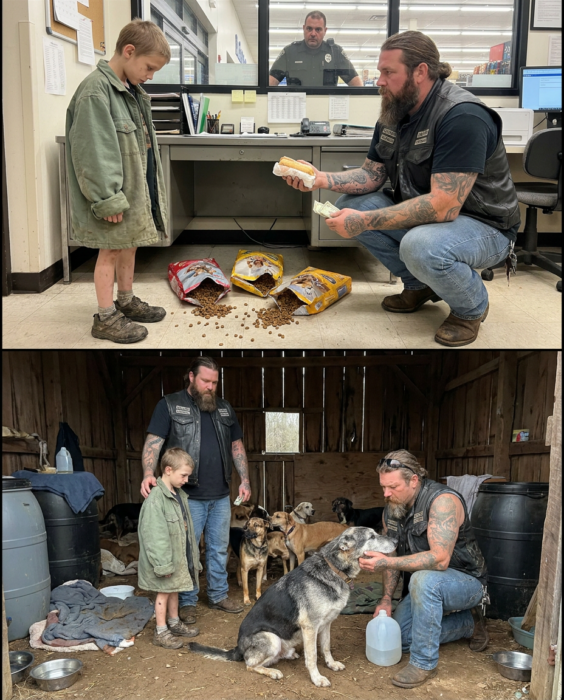
Each dog had a place.
Buster slept beneath the workbench during storms. Daisy chose the corner nearest the feed bin. Cricket guarded the door. Millie preferred an old tractor seat. Two young mixed breeds named Pepper and Rusty shared a wooden crate without a door.
Eli knew their habits better than most adults knew their neighbors.
He showed us a spiral notebook wrapped in a grocery bag. Every page contained a dog’s name, estimated age, appetite, injuries, and fears.
“Buster—thunder.”
“Daisy—men shouting.”
“Cricket—ropes.”
“Major—engines, except one.”
That last entry caught me.
“What does that mean?” I asked.
Eli pointed through the doorway toward my pickup.
“He hides from most engines. But sometimes a motorcycle passes on Route 9 and he runs outside. He listens until it’s gone.”
Cole turned away.
Tom Bennett had ridden a black Harley Road King. Major had spent years riding in a sidecar Tom built from salvaged parts and stubbornness. The dog wore goggles and leaned into turns like he understood the road.
After Tom died, Cole could not bring himself to repair the motorcycle.
It remained inside our garage beneath a gray cover.
Major sniffed Cole’s boots, then the hem of his cut. He pressed his nose against a faded patch on the lower pocket and exhaled.
That patch had belonged to Tom.
Cole had sewn it onto his own vest after the funeral.
He lowered himself beside the dog. Major leaned his full weight against him and closed his cloudy eyes.
None of us spoke.
Eli watched carefully.
“You know him?”
Cole’s voice came out rough.
“Yeah, kid. We know him.”
Eli looked frightened rather than relieved. He placed himself between Major and the barn door.
“You can’t take him.”
“We’re not taking anybody tonight,” Rook said.
“You’ll split them up.”
“No.”
“That’s what adults do.”
The boy had learned this somewhere. Not as an idea. As a fact.
Rook removed his sunglasses and sat on an overturned bucket. At six-foot-five and nearly three hundred pounds, he looked too large for the small space, but his voice stayed low.
“Tell us why you think that.”
Eli’s father had died before the flood. His mother disappeared from his life afterward, leaving him with Arthur. Social workers visited once when Arthur forgot to collect Eli from school, but Arthur was lucid that day.
Eli heard them discuss temporary placement.
He believed that meant losing his grandfather.
The dogs made the fear larger. If officials discovered the barn, they might send the animals to different shelters. Old, injured dogs such as Major could be considered difficult to adopt.
Eli had decided secrecy was safer.
He was eleven.
He was carrying an old man and nine dogs by himself.
We unloaded the food and filled every bowl. The dogs ate fast, except Major. He waited until Eli placed the bowl before him and remained nearby.
“You first,” Eli told him.
Major looked toward Cole.
Then he ate.
I handed Eli the sandwich from his pocket. Daisy had already received a full bowl, but the boy still hesitated.
Rook tore the sandwich in half.
“One for you,” he said. “One for her later.”
Eli accepted that arrangement.
While he ate, Denise Walker arrived. She was our club’s family advocate, a retired social worker with twenty years of experience and no patience for men who confused intimidation with help.
She examined the barn without criticizing Eli.
“You did all this?” she asked.
He nodded.
“You kept nine dogs alive for two years?”
Another nod.
“That’s a lot of work.”
Eli swallowed.
“Are you going to call people?”
“Yes,” Denise said.
He dropped the sandwich.
She did not soften the truth.
“Your grandfather may need medical care. The dogs need veterinarians. You need food, school, and adults who remember you are a child.”
“They’ll take me.”
“They may move you somewhere safe for a while.”
“I’m safe.”
“You stole dog food because nine lives depended on twenty dollars. That is brave, but it is not safe.”
Eli ran.
Major tried to follow but stumbled. Cole caught the dog while I chased the boy through wet weeds toward the road.
Eli was fast.
Fear was faster.
I found him crouched beneath the remains of a billboard, arms wrapped around his knees.
“You going to arrest me?” he asked.
“No.”
“Take the dogs?”
“No.”
“You can’t promise.”
He was right.
I sat in the mud beside him.
“I can promise you won’t face it alone.”
Behind us, Major barked once.
Eli stood immediately.
Even frightened, he returned for the dog.
Arthur Turner’s house smelled like burned coffee and damp wood.
The front door was unlocked. A saucepan sat blackened on the stove. Three unpaid utility notices lay beneath a fruit bowl, along with a property-tax warning and a prescription that had never been filled.
Arthur sat in a recliner wearing two different shoes.
He looked at Eli and smiled.
“David, you’re home.”
David had been Eli’s father.
Eli answered as if this happened often.
“It’s me, Grandpa. Eli.”
Arthur blinked.
“Of course.”
Ten seconds later, he asked who we were.
Denise took control. She checked for immediate danger, called a community medical team, and asked Arthur simple questions. He knew his name. He knew the year only after looking at a calendar. He believed his wife was shopping, though she had been dead for eight years.
Eli hovered beside him.
“He gets better in the morning.”
Arthur did not.
A doctor later diagnosed significant cognitive decline complicated by dehydration, medication errors, and poor nutrition. Arthur had not deliberately neglected Eli. He had been slipping away in small pieces while the boy built routines around each missing part.
Eli cooked canned soup.
Eli checked the locks.
Eli hid the stove knobs at night.
Eli attended school irregularly, telling teachers his grandfather was sick whenever anyone asked.
Then he walked to the barn.
No one saw the whole picture.
That evening, child protective services arrived. Animal control followed after Denise negotiated a temporary plan that kept the dogs at the barn under club supervision.
Eli stood in the yard with his fists closed.
A caseworker named Monica explained that Arthur needed hospital evaluation and Eli required temporary placement.
“No.”
“Eli—”
“No.”
He ran toward the barn again, but this time he stopped at the mailbox when two animal-control vans turned onto the road.
He believed they had come to take the dogs.
So did we.
Rook stepped into the road.
The vans stopped.
We did not threaten anyone. We did not surround the drivers. Rook simply asked for ten minutes while Denise reviewed the paperwork.
The animal-control supervisor said the barn lacked permits, sanitation controls, vaccinations, and secure fencing. Legally, she could impound all nine dogs.
“Where do they go?” Cole asked.
“Facilities based on available space.”
“Together?”
“I can’t guarantee that.”
“What happens to the old one?”
She looked toward Major.
“Medical assessment.”
Cole’s jaw tightened.
Everyone knew what those careful words might mean for an aging, injured dog considered difficult to place.
Our brotherhood reached its breaking point.
Bear wanted to move the animals before authorities could act. Luis suggested dividing them among club members for one night. Another brother offered to hide Major inside the garage.
Denise stopped us.
“If you interfere, you make Eli’s fear correct. We do this legally.”
Bear kicked the dirt.
“Legal didn’t feed them.”
“No. Eli did. Now we build something that lasts.”
The supervisor gave us twenty-four hours to present an approved emergency housing plan. Otherwise, the dogs would be removed.
Twenty-four hours.
Nine dogs.
One child entering temporary care.
One elderly man in a hospital.
A barn that could not pass inspection.
We rode back to Mercer Auto after midnight. The engines filled the wet road, but nobody spoke at the garage.
Behind the building sat an unused storage yard enclosed by chain-link fencing. It had drainage, electricity, and a concrete pad. With shelter structures, sanitation stations, and veterinary oversight, it could become a temporary rescue area.
Not in twenty-four hours.
Rook looked around the table.
“Who knows how to build kennels?”
Every hand rose.
We began before dawn.
Bear called a fencing contractor who owed him a favor. Luis contacted a veterinary clinic. Sam calculated costs and quietly emptied the club’s emergency fund. Denise filed applications. Rook met county officials when offices opened.
Cole stayed with Major.
By sunrise, lumber arrived. At 8:00 a.m., six club members erected covered runs. At 10:15, electricians restored safe power to the yard. At noon, a plumber installed wash stations.
Rain turned the ground to mud.
Nobody stopped.
Community members heard what was happening. A hardware store donated roofing sheets. A diner brought food. High-school students carried bags of bedding. Someone delivered nine stainless-steel bowls.
The story about the shoplifting spread.
That created another problem.
People photographed Eli.
A local social-media page posted his full name and called him “the dog-food thief with a heart of gold.” Donations arrived, but so did strangers who wanted pictures with the boy.
Rook ordered the garage gates closed.
“He’s not an exhibit.”
Some donors became angry. One threatened to withdraw supplies unless the club allowed an interview.
We returned the supplies.
Protecting Eli meant more than feeding dogs. It meant refusing to turn his worst day into our advertisement.
At 3:00 p.m., the animal-control supervisor arrived for inspection.
The kennels were not perfect.
One gate dragged. The drainage slope needed correction. The quarantine area lacked a second barrier. Our permit application had not yet received final approval.
She checked every detail.
Then Major collapsed.
Cole shouted.
The old dog’s back legs folded beneath him, and his breathing became shallow. We carried him to the veterinary truck while Eli, brought by his caseworker for the inspection, fought to stay beside him.
The veterinarian listened to Major’s chest.
Severe dehydration. Malnutrition. Heart irregularity. Possible kidney disease.
Eli heard every word.
“It’s my fault,” he whispered.
Cole turned so fast the boy stepped back.
“No.”
“I couldn’t get enough food.”
“You kept him alive.”
“He’s sick.”
“He was waiting for us, kid. You got him there.”
The vet transported Major to the clinic.
The inspector looked at the unfinished kennels, the soaked bikers, and Eli standing with dog hair stuck to his wet jacket.
She signed the emergency authorization.
All nine dogs could remain together.
We had saved the pack.
But as the clinic doors closed behind Major, none of us knew whether we had found Tom’s dog one day too late.
Major survived the night.
Cole did not leave the clinic.
He sat on the floor beside the kennel because the dog became agitated whenever he moved toward the door. Major received fluids, medication, and food in small portions.
At dawn, the veterinarian called us.
“The kidneys are compromised,” she said. “But he’s responding.”
Cole lowered his head until his forehead touched the kennel bars.
Major licked one scarred knuckle.
The rest of the dogs arrived at the new enclosure that afternoon. They were examined, vaccinated, and registered under a rescue partnership created between the county and the Iron Ravens.
Eli named it Tom’s Yard.
Nobody suggested the name.
He had heard us talking about Tom and understood that Major’s first owner had died helping people during the flood.
When Eli visited the clinic, he brought his notebook. The veterinarian read every entry and realized he had recorded useful patterns—appetite changes, limping, coughing, reactions to storms.
The eleven-year-old scrap collector had built two years of medical observations without knowing the term.
Then Cole noticed something hidden inside the notebook’s back cover.
A photograph.
Water had damaged most of it. It showed a black motorcycle lying on its side near flooded trees. Major stood beside it. Behind him, half-covered in mud, was a red waterproof pouch.
“Where did you take this?” Cole asked.
“I didn’t. It was already in the barn.”
Eli explained that Major had led him to the overturned motorcycle during the first week after the flood. The red pouch was caught beneath a branch nearby. Eli took it because he needed something waterproof for the dogs’ records.
He had never opened its inner sealed pocket.
The pouch belonged to Tom.
We returned to the barn.
Eli retrieved it from beneath a loose floorboard. The outer section held bottle caps, vaccination receipts, and a small photograph of each dog. Inside the sealed pocket, however, we found Tom’s emergency identification card, a flash drive, and a folded piece of paper protected inside plastic.
The note was written in Tom’s blocky handwriting.
It was not a final letter. He had written it months before the flood and kept it with his roadside emergency information.
“If anything happens to me, Major goes to Cole. He knows the garage. He knows the bikes. Don’t put him in a cage alone.”
Cole read it once.
Then again.
His beard moved as his jaw clenched.
For two years, he had blamed himself.
On the night of the flood, Tom called the club asking for help evacuating families. Cole was caring for his daughter, who had a fever. He told Tom he would join after taking her to his ex-wife.
The bridge washed out before Cole returned.
Tom went in alone.
He rescued a mother and two children from a house near Route 9. Witnesses saw him return toward another stranded vehicle. Floodwater swept him away.
Cole believed that if he had ridden with Tom, his brother might have survived.
Major’s return made the guilt worse.
The note changed something.
Tom had trusted Cole with the life he valued most after his family.
Major.
But Cole faced another problem: Tom’s Yard needed a full-time caretaker. The club members had jobs. Volunteers could rotate temporarily, yet nine traumatized dogs required consistency.
Eli wanted the role.
“You’re eleven,” Denise told him.
“I know more about them.”
“You do. But school is your job.”
“They need me.”
“So does your grandfather.”
Arthur remained hospitalized. Medication and hydration improved some confusion, but doctors confirmed he could no longer be Eli’s sole guardian.
The court scheduled a placement hearing.
Eli had no suitable relatives. His mother could not be located. His father was dead. A foster home fifty miles away had space, but it would separate him from Arthur, the dogs, and the school he knew.
Eli stopped eating again.
He did not steal this time.
He simply pushed food around his plate at the temporary shelter and asked when he could visit Major.
Denise searched for another option.
Inside our club were a married couple, Aaron and Melissa Ward. Aaron rode with us and worked as a diesel mechanic. Melissa was a veterinary technician who had helped treat the dogs.
They had tried to have children for years. They had also completed foster-parent training but never accepted a placement after Melissa’s mother became seriously ill.
Her mother had died the previous spring.
When Aaron suggested taking Eli, Melissa did not answer immediately.
She spent an afternoon at Tom’s Yard instead.
Eli showed her how Buster needed a blanket during thunder. He explained why Daisy’s bowl should face the wall. He demonstrated the hand signal Cricket understood when frightened.
Melissa asked what Eli wanted from a home.
He considered the question.
“A door I can come back through.”
Not a bedroom.
Not toys.
A return route.
Aaron and Melissa reopened their foster approval. The club helped prepare a room in their house, twelve minutes from Arthur’s care facility and seven from the garage.
But Eli refused.
“If I live with them, Grandpa thinks I left him.”
Arthur solved it during one of his clear afternoons.
He held Eli’s face between both hands.
“You’re not supposed to grow up this fast.”
Eli began crying.
It was the first time any of us saw him do it.
Arthur turned toward Aaron and Melissa.
“You bring him back to see me.”
“Every week,” Melissa promised.
Arthur nodded.
Then he forgot the conversation ten minutes later.
Eli remembered.
He moved into the Wards’ house carrying one backpack, his notebook, and Major’s old water bowl.
That night, Major returned to the garage.
Cole removed the gray cover from Tom’s motorcycle.
Major walked directly to the empty parking space beside it, circled twice, and lay down.
He had found his way home.
Tom’s Yard opened officially six weeks later.
We did not call it a shelter. The county already had one, and we were not interested in competing for attention. It was a recovery yard for dogs that needed time, routine, and more patience than crowded facilities could offer.
Melissa became the paid caretaker.
That mattered.
We had received donations, but reliable work deserved wages. Sam built a budget covering food, medical care, insurance, and a modest salary. The club organized monthly rides to support the fund.
Eli helped after school.
Only after school.
He completed homework at a desk inside the garage office, then changed into work boots and checked every dog. Melissa made him log feed amounts properly. The veterinarian taught him basic animal first aid.
He absorbed everything.
The supermarket did not press charges. Mr. Delaney visited Tom’s Yard carrying three bags of the same cheap dog food Eli had stolen.
Melissa thanked him, then explained that the dogs were transitioning to food selected by the veterinarian.
Delaney looked embarrassed.
Eli accepted the bags anyway.
“We can donate them to somebody else.”
That was Eli.
Nothing wasted.
Buster was adopted first by an older couple who lived outside town and kept the television on during storms. Daisy went to a quiet home with a widow who never raised her voice. Pepper and Rusty were adopted together.
Cricket remained longer.
The damaged eye required surgery, and ropes still terrified him. A postal worker named James began visiting every afternoon, sitting outside the run without trying to touch him.
On the thirty-second visit, Cricket placed one paw against James’s boot.
He went home with him two weeks later.
Eli remembered every adoption date.
He also remembered every fear.
Major was never listed for adoption.
Tom’s note had settled that. Cole became his legal owner, though everyone at the garage understood Major belonged partly to the whole club and partly to the empty space Tom had left.
The old dog slept beside Tom’s covered Road King.
When engines started, he raised his head. If Cole’s bike started, Major stood and waited near the garage door.
Eventually, Cole rebuilt the sidecar.
The first time he lifted Major into it, the dog’s legs shook. Cole fastened a broad safety harness and fitted him with Tom’s old riding goggles, replacing the cracked strap.
Major smelled the seat.
Then he settled.
We rode only around the block.
Major held his nose toward the air.
Cole cried where nobody could see except all of us.
Eli’s life changed more slowly.
He struggled to sleep in a clean bedroom because silence made him think something was wrong. He hid canned food beneath the bed and woke before dawn to check whether Aaron and Melissa were still in the house.
They did not punish him.
Melissa placed a basket in the bedroom and told him he could store food there until he no longer needed to.
Aaron installed a small whiteboard beside the door. Each night he wrote where everyone would be the next morning.
“Melissa—kitchen, 6:30.”
“Aaron—garage, 7:00.”
“Eli—school bus, 7:25.”
“Back home after work.”
The final line mattered most.
Eli began attending school regularly. His grades rose, though math remained difficult. He wrote a science report about fear responses in abandoned dogs and received his first A.
Arthur moved into a memory-care facility nearby. On good days, he called Eli by the correct name. On difficult days, he believed Eli was David.
Eli stopped correcting him every time.
He sat beside his grandfather and told him stories about the dogs.
Arthur enjoyed them either way.
The flood investigation also returned to Tom’s final hours. Information stored on the flash drive included photographs, road conditions, and time-stamped videos Tom recorded while helping residents. The files confirmed he had assisted the trapped family before returning toward another vehicle.
One clip contained Major barking from the sidecar.
Tom looked into the phone and said, “Stay, boy.”
Those were the final clear words Major heard from him.
The dog had obeyed.
Flood survivors later reported that Major remained on a strip of high ground near Tom’s fallen motorcycle for several days. Rescue crews could not reach the area immediately. By the time roads reopened, the dog had disappeared.
Eli found him on the fifth day.
Major did not trust him.
So Eli sat nearby.
First day: ten feet away.
Second day: eight feet.
Third day: six.
He left water and moved back.
On the fourth morning, Major drank.
On the fifth, he followed Eli to the barn.
The boy had not merely found Tom’s dog.
He completed Tom’s last command by keeping Major safe until the club came.
That truth changed Cole.
He had spent two years believing he failed his brother because he did not cross the washed-out bridge. Now he understood that Tom’s story had continued through an eleven-year-old child collecting aluminum cans.
One evening, Cole handed Eli the metal tag from Major’s ruined collar.
The leather was too rotten to use, but the tag had been cleaned. Tom’s name and phone number remained visible beneath the scratches.
“You keep it,” Cole said.
Eli shook his head.
“It belongs here.”
He pointed toward the clubhouse wall.
We mounted the entire collar inside a plain wooden frame, beside Tom’s photograph and the patch Cole had carried on his cut.
No dramatic inscription.
Only the dates.
And beneath them, one sentence:
HE WAITED. THE BOY FED HIM.
Major lived three more years.
The veterinarian called that remarkable.
We called it stubbornness.
He developed arthritis and needed medication with breakfast. His hearing faded. One cloudy eye lost most of its sight. Still, every morning he moved from Tom’s motorcycle to the garage entrance before the first mechanic arrived.
He always chose the same place.
Tom’s old parking spot.
Nobody left a motorcycle there again.
New club prospects learned the rule without explanation. If they placed tools, boxes, or tires in the space, Bear pointed toward Major and said, “Move it.”
That was enough.
Eli grew taller. At fourteen, he could lift food bags without dragging them. He volunteered at the veterinary clinic and began talking about becoming an animal-care technician.
He still visited Arthur every Wednesday.
He still kept Major’s records.
Appetite. Medication. Bad days. Good days. Weather. Distance walked.
On Major’s final morning, the old dog refused breakfast. He did not appear to be in severe pain, but he could no longer stand without help.
Cole carried him outside.
The Iron Ravens parked their motorcycles in a wide circle behind the garage. Nobody started an engine. Major disliked most loud sounds in his final years, and we would not make his last hour about us.
Eli sat on the concrete beside him.
Major rested his head across the boy’s legs, exactly as he had in the barn three years earlier.
Cole removed Tom’s old patch from his cut and placed it before the dog’s nose.
Major inhaled once.
His tail tapped the concrete.
One time.
Then he became still.
We buried Major on the hill behind Tom’s Yard, where he could face the garage. Cole placed the repaired goggles beside him. Eli added a stainless-steel bowl.
No collar.
That remained on the wall.
Afterward, Cole uncovered Tom’s Road King and started the engine. Its V-twin rumble rolled through the yard.
For one second, every man looked toward the empty parking place.
Eli did too.
Then Cole shut the engine off.
Silence returned.
The space remained Major’s.
Eli is nineteen now.
He no longer hides food beneath his bed. Aaron and Melissa officially adopted him when he was thirteen, but he kept the Turner name to honor his grandfather.
Arthur died the following year.
On his final clear afternoon, he recognized Eli.
“You taking care of those dogs?” he asked.
“Yes, Grandpa.”
“All nine?”
“Every one.”
Arthur smiled.
“Good boy.”
Tom’s Yard has helped more than two hundred abandoned animals since then. It remains behind Mercer Auto, though the original temporary kennels have been replaced with proper insulated runs and a small medical room.
Eli works there while studying veterinary technology.
He keeps the old spiral notebook inside a locked drawer.
The first page still lists Buster’s fear of thunder. The final childhood entry records the day Major returned to the garage.
Miller’s Market now donates damaged but usable pet supplies instead of discarding them. The security office where Eli once stood has a small card listing local food programs and animal-support services.
His name is not printed anywhere.
That was his choice.
The collar remains on our clubhouse wall beneath Tom’s photograph. Its leather is cracked, and the metal plate has darkened again despite cleaning.
Every new member hears the story.
Not the polished version.
The true one.
A hungry eleven-year-old stole nothing for himself. He kept nine abandoned dogs alive while caring for a grandfather who was forgetting him. Among those dogs was Major, still waiting for a biker who could never return.
And when the club finally arrived, Eli did not ask us to rescue him.
He asked us not to separate his pack.
On flood-anniversary mornings, we ride to Tom’s grave and then to the hill where Major rests. Eli comes with us in the truck that carries dog food.
Before leaving, he places one hand against the framed collar.
“Everybody’s fed,” he says.
Then we start the engines.
Drop MAJOR in the comments for the next full story, and follow the page for more unforgettable biker brotherhood stories.
The old parking space stays empty.