Part 2: Every Anniversary For 25 Years He Brought His Wife To My Diner On Route 66 — Year 26 He Showed Up Alone And Ordered For Two
I want to back up to 1994, because you cannot understand what I saw in my doorway in 2019 without understanding what I saw in my doorway in 1994.
I was thirty-one years old. I had owned the diner for five years. I had inherited it from my father, who built the building with his own two hands in 1962 on a stretch of old Route 66 that the new I-40 had bypassed in 1984, which meant that by the time I took over, the only people who came through Williams on the old road were truckers who knew better, drifters, and bikers.
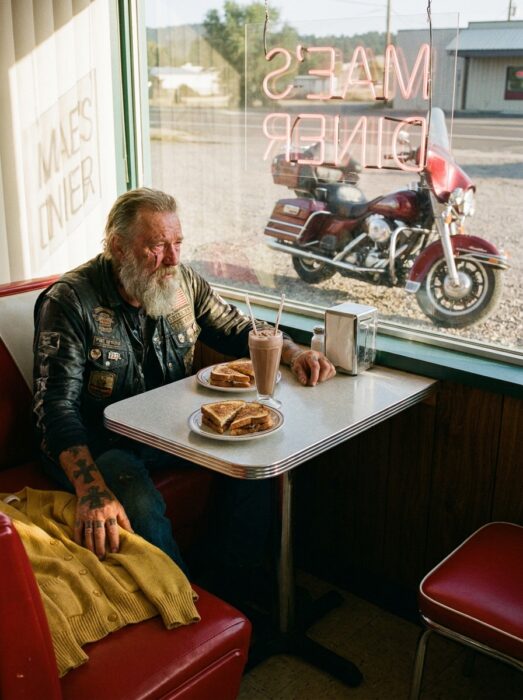
Cal came in on a Tuesday afternoon in late September of 1994. He sat at the counter. He ordered black coffee and a patty melt. He read a paperback Western while he ate. He paid in cash. He left a five-dollar tip on a six-dollar check. He did not say more than maybe twelve words to me the entire time.
He came back the next Tuesday. And the next. By the end of October he was a regular. He never sat in a booth. He always sat at the counter, third stool from the register, with the paperback open beside his coffee.
I learned over the next six weeks, in pieces, the way you learn things about a man like Cal: he was forty-three years old, he had ridden in from somewhere outside Bakersfield where he had been working on a ranch, he had no family he was willing to name, he had served in Vietnam, he had served four years in Lompoc for something he would not specify, and he had, at some point in the previous five years, decided that the only thing he was going to do for the rest of his life was ride and read paperback Westerns at counters in towns nobody had ever heard of.
Ruthie walked into my diner on a Friday night in November of 1994.
She was forty-two. She had been driving alone from Albuquerque to Las Vegas in a 1987 Buick LeSabre that her ex-husband had let her keep because he felt guilty about the woman he had left her for. She was wearing a butter-yellow cardigan over a denim dress. She had been crying for about three hundred miles.
She sat down at the counter. She sat down two stools away from Cal. She ordered coffee. The pot at her end of the counter had been sitting on the burner too long and was bitter. She tried to drink it. She made a face. She set it down.
Cal — without looking up from his paperback — slid his own coffee pot, the fresh one, two stools down to her.
Ruthie looked at him. She said, quiet: “Are you sure?”
Cal said: “It’s just coffee, ma’am.”
She poured herself a cup. She drank it. She slid the pot back. They did not speak again that night.
But she came back the next Friday. And Cal was there. And the Friday after that. And by Christmas of 1994 they were sitting in booth six together, sharing one chocolate milkshake with two straws because Ruthie liked sweet things and Cal pretended he didn’t but always finished his half.
They got married on the second Saturday of October, 1995. At the courthouse in Flagstaff. They came to my diner for lunch afterward, in their wedding clothes, and they sat in booth six, and they ordered two patty melts and one milkshake with two straws.
That was the start of the tradition.
I have to tell you about the year 2018 — the year before Cal walked in alone.
That October, on the second Saturday, Cal and Ruthie pulled into the lot at 11:46 a.m. like always. But Ruthie walked into the diner slower than I had ever seen her walk. She was leaning on Cal’s right arm in a way that wasn’t romantic anymore. It was structural.
She had lost weight. Her cardigan hung looser on her shoulders. Her braid was thinner. The silver hoops in her ears looked too heavy.
She sat down in booth six. She smiled at me when I brought the milkshake. She told me, in a voice that was quieter than her usual voice, that she had been a little tired this year. She told me she had a doctor’s appointment back in Bakersfield on Tuesday. She told me not to worry.
Cal did not say anything during this. Cal sat across from her with both his enormous tattooed hands flat on the formica and he watched her face the way a man watches a candle he is trying to keep lit in a wind.
She ate maybe half her patty melt. She drank maybe a third of the milkshake.
When they left that day, Cal stopped at the register. He paid in cash like always. He looked at me. He started to say something. He stopped. He started again.
He said, very low: “Mae. If next year — if it’s just me. You’ll seat me, won’t you.”
I said: “Cal, of course I will.”
He nodded. He put on his sunglasses. He walked out and he held the door for Ruthie and he helped her onto the back of the Electra Glide and he started the V-twin, and the rumble was the same as it had always been, but he rode out of my gravel lot at about half the speed he had ridden in.
That was the last time I saw Ruthie alive.
I learned later — from a phone call Cal made to my diner on a Wednesday afternoon in May of 2019, the only time he ever called me — that Ruthie had pancreatic cancer. Stage four. She had known since August of 2018. She had not told him until October. She had not told me at all.
She died on May 14th, 2019. Cal told me that on the phone. He told me in three sentences. He told me he was sorry he was bothering me. He told me he would see me in October.
He hung up.
I stood behind the counter for ten minutes after that phone call. I did not move. Roberta asked me twice if I was okay. I did not answer her either time.
He pulled into the gravel lot at 11:45 a.m. on October 12th, 2019. Two minutes early.
The Electra Glide sounded the same. The boots on the gravel sounded the same. The bell on the door sounded the same.
He walked in alone. He had the butter-yellow cardigan folded over his right forearm. He had the cardigan because Ruthie had been wearing it on the night they met, and he had kept it after she died, and he had folded it carefully on the passenger seat of his own bike for the entire two-hundred-and-forty-mile ride from Bakersfield to Williams that morning.
He sat down in booth six. He set the cardigan on the bench across from him, folded, the way you would set a person down. He smoothed the sleeves once.
Roberta started toward the booth. I caught her elbow. I said, quiet: “I’ve got it.”
I walked over with my order pad. I had served Cal three hundred and twelve patty melts. I knew what he was going to order. I asked anyway, because that’s what you do.
He looked up at me. His eyes were the kind of red that comes from a long ride, but underneath that they were the kind of red that comes from something else. He had not shaved. The smoke-grey beard was longer than I had ever seen it.
He said: “Two patty melts. Extra grilled onions. One chocolate milkshake. Two straws.”
I wrote it down. My hand was shaking. I did not let him see.
I said: “Cal, are you sure—”
He said: “Two straws, Mae.”
I went back to the grill. I made two patty melts. I made one milkshake. I put two straws in the glass. Roberta carried the food to the booth because I could not. I watched from behind the counter.
Cal ate his patty melt slow. He cut Ruthie’s into four pieces, the way she always cut hers. He did not eat hers. He let it sit on the plate.
He drank from his straw. He did not touch hers.
When he was done, he asked Roberta to wrap Ruthie’s patty melt in foil. He paid in cash. He left a hundred-dollar bill for a thirty-eight-dollar tab. He walked out to the gravel lot. He got on the Electra Glide. He started it up.
He rode away with a foil-wrapped patty melt in his right saddlebag and a butter-yellow cardigan folded across the passenger seat behind him.
He came back the next October. Same Saturday. Same time. Same order. Same two straws.
He came back the October after that. And the one after that. And the one after that.
I have served Cal six solo patty-melt-for-two orders in the six Octobers since Ruthie died. Six chocolate milkshakes with two straws. Six butter-yellow cardigans folded on the bench across from him.
The third year — October of 2021 — I finally asked him.
He had finished eating. He was paying at the register. The diner was empty because it was a Tuesday Saturday — the slow week between the leaf-peepers and the snowbirds — and we were the only two people in the building.
I said: “Cal. The patty melt. You take it home every year. What do you do with it?”
He looked at me for a long time. He looked at the wall behind my head. He looked at the cash register. He looked back at me.
He said: “Drive it to her, Mae.”
I did not understand right away. I said: “Drive it to her where?”
He said: “Mountain View Cemetery, Bakersfield. Section H. Plot 144. I leave it on her headstone for the night. The crows take it by morning. She liked the crows. Said they were the smartest birds. So they get her dinner.”
He paused. He said: “Two-forty miles back. Two-forty miles forward. It’s a long ride. But she waited for the patty melt for twenty-five years. She can wait six more hours.”
He put on his sunglasses. He walked out. I did not move from the register for a long time after that either.
I learned, later, the rest of it. I learned, from Cal himself, in pieces over the next few Octobers — the way you learn things from a man like Cal — that on the second Saturday of every October, between the time he leaves my diner at 12:40 p.m. and the time he arrives at Section H Plot 144 at 6:50 p.m., he does not stop the bike. He does not get gas. He does not pee. He fills up before he leaves Williams, and he runs the Electra Glide all the way to Bakersfield in one straight shot, with a foil-wrapped patty melt in the right saddlebag and a butter-yellow cardigan folded behind him on the seat where Ruthie used to sit.
He told me, the year before last: “She’s only got one anniversary dinner a year, Mae. I’m not gonna let it get cold.”
I keep booth six empty on the second Saturday of every month now.
Not just October. Every month. I taped a small handwritten card to the formica that says RESERVED. I put it up in May of 2020 because that was the first month after he started his Octobers alone, and I realized I had been holding the booth empty out of habit, and I decided to hold it empty on purpose.
Roberta thought I was crazy at first. Roberta thinks I’m sentimental, which I am.
But here is what I have noticed in the six years since.
Other bikers who come through Williams have started sitting at the counter on the second Saturday of the month. Word has gotten around the route. A trucker from Amarillo told me last spring he had heard about my booth six in a CB conversation outside Albuquerque. A couple on a touring Harley, retired teachers from Oregon, came in last August on the second Saturday and asked, very polite, if they could sit at the counter instead. They had heard.
Nobody asks me to take the card down. Nobody sits in booth six on the second Saturday.
Sometimes, when the diner is quiet, I bring a fresh place setting to that booth. Two patty melts on the grill, even though nobody ordered them. One milkshake. Two straws. I let them sit until they’re cold.
Then I wrap one patty melt in foil and I take it out behind the diner and I leave it on the picnic table for the crows.
She liked the crows.
Cal is sixty-eight now. The Electra Glide is thirty-six years old. The paint on the tank has gone from wine-red to dried-blood to something closer to rust. The seat has new electrical tape in three places.
Last October — the second Saturday, October 11th, 2025 — he walked in at 11:47 a.m. exactly, the way he always does. He sat down in booth six. He laid the butter-yellow cardigan across the bench. He smoothed the sleeves.
He looked older. He moved slower. The smoke-grey beard is now closer to white at the edges.
When I brought him the milkshake, he looked up at me. He said something he had never said before in twenty-six years of October Saturdays.
He said: “Mae. Save me a seat next year.”
I said: “Cal, you’ve got booth six. You’ll always have booth six.”
He shook his head, slow.
He said: “No. The other one.”
He pointed at the bench across from him. At the butter-yellow cardigan.
I did not say anything. I just nodded. He nodded back.
The bell rang at 12:43 p.m. when he walked out. The Electra Glide started up. The taillight cut west on the old Route 66 toward Bakersfield.
He had two patty melts in the saddlebag this time.
🏍️ If this story moved you, follow our page for more true stories from the road. Some men ride to forget. Some men ride to deliver dinner. Every share keeps a long marriage on the highway a little longer.