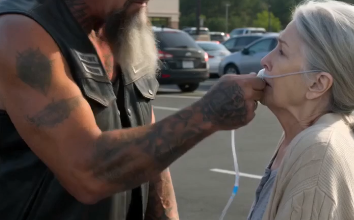
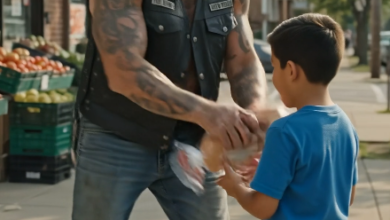
A Tattooed Biker Dragged a Teen Away From a Paint-Drenched Harley in a Crowded Parking Lot — Then Everyone Discovered the Bike Was a Memorial for a Police Officer’s Late Son
PART 2 — MISUNDERSTANDING GETS WORSE
By noon, the first video had already spread across town.
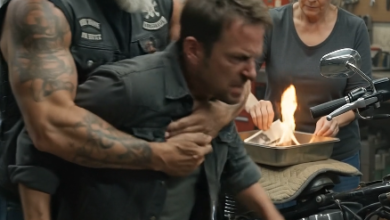
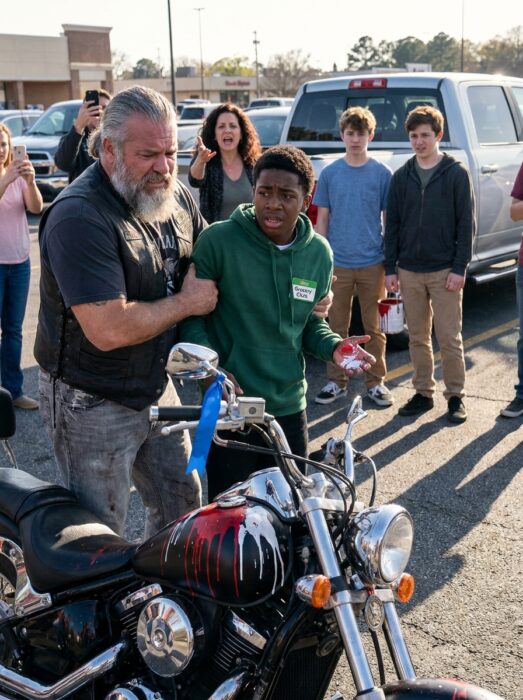
It was only eleven seconds long. That was all people needed to decide they understood everything. In the clip, the biker’s massive hand clamped onto Damon’s hoodie. Damon stumbled. The backpack flew across the pavement. Maria shouted from somewhere off camera. The ruined Harley appeared in the background, dripping paint like evidence, while Jake’s voice laughed from behind the phone.
The caption made it worse.
Biker loses it on kid over painted motorcycle outside Miller’s Market.
By one o’clock, a second clip appeared, cropped even tighter. It showed Damon’s terrified face and the biker’s tattooed arms. It did not show Jake. It did not show the west side of the lot. It did not show the pickup backing crookedly out of its space, or Damon stumbling toward it, or the way the biker had moved before anyone else had understood there was danger.
It only showed rage, or what looked like rage.
Damon’s mother arrived at the market with her work shirt still on and flour on one sleeve from the bakery where she had been covering a double shift. Tasha Hill was thirty-eight, Black American, with tired brown eyes, her hair pulled under a faded blue scarf, and a face that looked strong because life had not given her permission to look fragile. When she saw Damon standing near the cart return with paint on his hands and humiliation in his eyes, her first instinct was not anger. It was fear.
“What happened to my son?” she demanded.
Damon looked away. That hurt her more than any answer could have. He was seventeen, but in that moment, standing with his shoulders folded inward, he looked eight again. He looked like the little boy who used to hide behind her legs when landlords knocked too hard or men at bus stops talked too loud.
The biker stood ten feet away near the Harley, silent, holding a greasy shop towel against the painted tank as if he were pressing a bandage to something alive. His name was Silas Walker, though most people who knew him from the road called him Grizzly. He did not correct strangers. He had learned that once people chose a story about your face, they rarely gave it back.
Tasha pointed at him. “You put hands on my child?”
Silas looked at Damon, then at her. “I pulled him back.”
“That’s not what I asked.”
Silas’s eyes dropped. He could have explained. He could have said he had seen Damon step backward into the blind side of Jake’s pickup. He could have said the backpack had a half-open can inside it and someone was trying to make it look like Damon had carried all the paint. He could have said the boy in the varsity jacket had been filming from the beginning, not because he was shocked, but because he was waiting for the exact moment the story would look wrong.
But the security guard was still speaking into his radio. The manager was still trying to open the camera system. Jake was still standing too close to the pickup, thumb moving over his phone screen with quick little motions that made Silas’s skin prickle.
So Silas only said, “Check the camera first.”
Tasha let out a bitter laugh. “That’s all you got?”
Damon swallowed hard. “Mom, I swear I didn’t start it.”
“I know you,” she said, but her voice cracked because knowing your child did not stop the world from misunderstanding him.
Jake stepped forward then, his expression polished into something wounded and innocent. He was tall, broad, and handsome in the uncomplicated way that made older women call him respectful before he ever earned it. His father owned Holloway Auto Group, three dealerships and two towing contracts in the county. His mother served on the school board. Jake knew how to sound like a victim when adults were listening.
“Ma’am,” he said to Tasha, “we were just messing around. Damon got mad, and then this guy came out of nowhere. He went crazy.”
Damon spun toward him. “You liar.”
Jake raised both hands. “See? That’s what I mean.”
The crowd shifted. That was the dangerous thing about crowds. They did not need the truth. They needed a direction.
A white woman in yoga pants whispered that the biker looked like he belonged in jail. An older man near a pickup muttered that kids had no respect anymore. Someone else said Damon probably knew exactly what he was doing. Two stories were growing at once, both wrong, both loud, both easy to believe if you only looked at the pieces that confirmed what you already feared.
Maria Lopez, still holding her daughter Elena close, watched Damon’s face. She had yelled at the biker because she had seen a grown man drag a frightened teenager. She did not regret yelling. But now she noticed something small that bothered her.
The biker had not gone after Jake.
Not once.
He had stepped between Jake and Damon, but he had not swung, cursed, threatened, or even raised his voice. For a man who looked like thunder, he was standing strangely still. He kept glancing at the west corner camera, then at the pickup, then at the backpack he had kicked away.
And the backpack was not Damon’s.
Maria knew because Damon’s backpack was black, patched with duct tape on one strap, sitting near the market entrance where he had dropped it before his shift. The backpack on the pavement was navy blue, expensive, and embroidered with the initials J.H.
Jake Holloway’s initials.
Maria looked at the bag. Then she looked at Jake. For the first time, his perfect victim face seemed a little too perfect.
Inside the store, Miller’s Market manager Connie Miller, a white American woman in her sixties with short silver hair and reading glasses hanging from a chain, struggled with the security monitor. Kevin stood behind her, still tense. The front camera showed the crowd, the biker, the paint, the aftermath. It told the same ugly half-story the phones had captured.
Silas had asked for the west camera.
Connie clicked the next file.
The screen froze for a second, then opened on a wider angle of the parking lot ten minutes before everything had gone wrong.
And the first thing Connie saw was Damon Hill standing in front of the Harley with both hands raised, trying to stop three boys from coming closer.
PART 3 — FIRST HIDDEN CLUE
Connie did not gasp. She had owned Miller’s Market for thirty-one years, and in that time she had watched enough people lie badly to know that truth rarely entered a room with dramatic music. It came in quietly, through a detail nobody wanted to see.
On the monitor, Damon stood beside the Harley before any paint touched it. He was still wearing his grocery name tag. His hands were clean. His posture was not sneaky or proud. It was nervous. He kept glancing toward the market entrance, toward the clock, toward the boys closing in around him.
Jake Holloway appeared from the right side of the screen carrying the navy backpack.
The two football boys followed with paper bags from the hardware store. Connie could not see exactly what was inside them, but she saw the shape of the cans, the way one boy nudged another and pointed to the Harley’s tank. Jake said something. There was no audio on the security feed, but Damon’s reaction was plain. He shook his head hard.
Kevin leaned closer. “He’s telling them not to do it.”
Connie nodded, her mouth pressed thin. “Yes, he is.”
Outside, the argument kept rising.
A Cedar Falls patrol car rolled into the lot, lights off but presence heavy. The officer who stepped out was Lieutenant Mark Voss, a white American man in his early fifties, clean-shaven, careful-eyed, the kind of officer who had learned not to mistake volume for truth. He walked toward the crowd with one hand resting near his belt and the other lifted in a calming gesture.
“Everybody give space,” Voss said. “Phones down unless you’re a witness.”
Nobody put their phones down.
Jake went straight to him. “Officer, that guy attacked Damon. We got video.”
Voss looked at Damon. Then at Silas. Something flickered in his face, not recognition exactly, but awareness.
“You Silas Walker?” he asked.
Silas gave one nod.
The crowd noticed the officer knew his name. That made some people more suspicious. To them, it smelled like favoritism. To others, it felt like history stepping into the lot wearing a badge.
Tasha held Damon by the shoulder. “My son needs to be heard.”
“He will be,” Voss said. “Everyone will.”
Damon’s face twisted. He was angry now, but underneath the anger was something deeper. Shame. Not guilt. Shame was different. Guilt said you had done wrong. Shame said the world had seen you powerless.
“I told them to leave it alone,” Damon said. “I told them that bike wasn’t just some bike.”
Jake laughed once. “Now he knows what the bike is? Come on.”
Silas looked at Jake for the first time since the officer arrived. His eyes were cold enough to make the boy stop smiling.
“What did you call it?” Silas asked.
Jake blinked. “What?”
“When you walked up,” Silas said. “What did you call the bike?”
Jake’s mouth opened, but no answer came out.
That question landed strangely. People sensed it even if they did not understand why. Maria did. She remembered the way Jake had shouted, “Cry over your little motorcycle?” But before that, before the paint, she had not heard him. Silas had.
Connie came out of the store then, moving faster than a woman her age usually moved, Kevin right behind her. She held a small tablet in both hands. Her face had changed. She was not confused anymore.
“Lieutenant,” she called. “You need to see the west camera.”
Jake’s father arrived at almost the same moment in a black SUV polished bright enough to reflect the whole miserable scene. Randall Holloway stepped out wearing a charcoal jacket, tan slacks, and the expression of a man accustomed to turning trouble into inconvenience. He was white, late forties, smooth-faced, and built like a former athlete who still trusted his last name more than his body.
“What is going on here?” Randall demanded.
Jake moved toward him with relief. “Dad, this biker went psycho. He grabbed Damon and kicked my bag.”
Randall’s eyes swept over Silas with instant contempt. “Of course he did.”
Silas said nothing.
That silence annoyed Randall more than any insult would have. Men like Randall expected big men in leather to either explode or shrink. Silas did neither. He stood beside the ruined Harley, one hand resting near the blue ribbon, his jaw set, his eyes not leaving the evidence in Connie’s hands.
Voss watched the tablet.
The first minute showed Damon trying to stop the boys. The second showed Jake pushing the navy backpack into Damon’s chest. The third showed one of the football boys opening a paint can while Damon grabbed his wrist and mouthed what looked like, “Don’t.”
Then Jake leaned close to Damon and said something that had no audio, but Damon’s body answered it. The boy went still. His shoulders dropped. His eyes flicked toward the market, toward his job, toward the people inside who knew him as quiet and reliable.
Connie whispered, “That poor kid.”
The video continued.
A splash of red paint hit the Harley’s tank. Damon flinched like he had been struck. Jake laughed. One of the football boys shoved a paint can toward Damon’s hands, smearing him with evidence. Then Jake backed toward the pickup with his phone raised, angling himself so Damon and the biker’s bike filled the frame.
That was when Silas entered the camera view.
He did not charge at the boys first.
He ran toward Damon.
From the camera’s wider angle, everyone saw what the phone video had hidden. Damon had stumbled backward, half blinded by panic and paint, directly into the path of Jake’s pickup as it began rolling from its angled space. Whether the truck moved because someone left it improperly parked or because a nervous foot hit the wrong pedal, the camera did not make clear. What it showed clearly was Silas crossing fifteen feet in a burst that looked impossible for a man his size, grabbing Damon by the hoodie, and yanking him out of the truck’s path just before the rear bumper clipped the edge of a shopping cart.
The crowd outside did not know this yet.
But inside the circle around the tablet, the first truth had opened.
And it did not make anyone feel better.
It made them feel ashamed.
PART 4 — TRUTH BEGINS TO TURN
Lieutenant Voss asked Connie to replay the footage twice.
The second time, he watched Jake’s hands. The third time, he watched Silas’s feet. By the end of it, the officer’s expression had settled into the kind of calm that made guilty people nervous and frightened people breathe a little easier.
He turned to Damon first.
“You were trying to stop them,” Voss said.
Damon’s eyes filled before he could stop them. He blinked hard, furious with himself for almost crying in front of everyone. “I told you.”
Tasha pulled him closer, but even she looked stunned by the footage. A mother always knows her child, but the world can still make her doubt the safest parts of herself. For a few terrible minutes, she had wondered if Damon had been dragged into something dumb, if exhaustion and pressure had finally made him stand with the wrong boys at the wrong time. Now the truth gave her relief, but it also gave her rage. Not the loud kind. The cold kind.
She looked at Jake. “You let them think it was my son.”
Jake’s father stepped in quickly. “Hold on. We don’t know the context.”
Silas finally spoke. “Your boy knew the context.”
Randall Holloway’s face tightened. “You don’t speak to my son.”
Silas looked at him for a long moment. “I’m speaking about him.”
The crowd had begun to shift again, but this time the movement was different. People who had been leaning forward now stepped back. Phones lowered a few inches. Maria Lopez covered her mouth, her cheeks flushed with guilt. She had yelled at Silas. She still believed a child should not be dragged by a grown man, and the footage did not erase Damon’s fear. But it changed the shape of what she had seen. The biker had not grabbed Damon because he was angry about paint. He had grabbed him because a truck was moving and nobody else was looking.
Damon did not thank him.
He was not ready to.
His hoodie collar was stretched. His pride felt torn in front of half the town. A stranger built like a wall had put hands on him while people filmed, and even if that stranger had saved him from a bumper, the terror still belonged to Damon. Gratitude and hurt can sit in the same chest. They often do.
Silas seemed to understand that. He did not step closer. He did not say, “I saved you.” He did not ask the boy to forgive him for the ugly way survival had looked on camera.
He only said, “You can hate how I did it.”
Damon looked at him sharply.
Silas nodded toward the pickup. “Just stay alive long enough to hate me.”
That sentence landed hard. It did not sound like pride. It sounded like memory.
Voss moved toward the navy backpack. “Whose bag?”
Jake said, “Mine, but he kicked it.”
Voss crouched carefully and opened the main pocket enough to see inside. He did not make a show of it. He did not spill the contents in front of the crowd. What he found was simple: a store receipt, a paint-stained rag, two unopened cans, and a folded printed flyer from the community board outside Miller’s Market.
The flyer advertised a fundraiser that evening.
Caleb Reed Memorial Ride and Trade Scholarship Benefit.
A photo in the corner showed a smiling young white American man around nineteen, sandy-haired, wearing a mechanic’s shirt and standing beside the unfinished frame of a black Harley. Next to him stood a uniformed police officer, his father, Sergeant Daniel Reed. The older man’s hand rested on Caleb’s shoulder. Both of them had the same crooked smile.
The flyer also showed the completed Harley.
The same Harley now covered in paint.
Maria saw the flyer from where she stood and whispered, “Oh no.”
Damon looked down. “That’s what I was telling them,” he said. His voice had gone small. “I said it was for tonight.”
Voss looked at Jake. “You knew this bike was part of the memorial benefit?”
Jake’s face reddened. “Everybody knew. It was posted all week.”
His father snapped, “Jake.”
The boy realized too late that he had answered the wrong question.
Silas’s hand tightened around the shop towel. He still had not looked at the paint on the tank the way an owner looks at damage. He looked at it like someone had stepped on a grave.
Connie took the flyer from the backpack with two fingers and stared at the photo of Caleb Reed. Her voice softened. “This was his bike?”
Silas shook his head once. “Not exactly.”
Everyone waited.
But Silas did not explain further. Not yet.
He turned toward the Harley and gently lifted the blue ribbon off the mirror so it would not stick to the drying paint. Beneath the streaks on the right side of the tank, a few engraved letters had begun to appear where the paint was thinner.
Not a brand.
Not a slogan.
A name.
CALEB.
That was the moment the parking lot went almost completely quiet.
PART 5 — BIKER’S PAST / DEEPER TWIST
Silas Walker had not always looked like a man children crossed the street to avoid.
Twenty-five years earlier, before the gray beard and the scar over his left eyebrow, before the leather vest became his second skin, Silas had been a young Army mechanic who could rebuild a generator with three tools and a prayer. After he came home, he became an EMT for Cedar Falls County, not because he liked sirens or hero talk, but because he understood broken machines and thought maybe broken bodies were just another kind of urgent work.
He learned quickly that bodies were not machines. Machines did not call for their mothers. Machines did not ask whether they were going to miss graduation. Machines did not grip your sleeve with a hand that was losing strength and make you promise something you had no right to promise.
Caleb Reed was one of those promises.
Caleb had been nineteen, the son of Sergeant Daniel Reed, a respected Cedar Falls police officer known for walking old ladies across icy streets and buying coffee for kids who pretended not to be hungry. Caleb was not a police officer yet, though he talked about becoming one after trade school. He loved engines more than rules, country roads more than classrooms, and the half-built 1998 Harley he and his father had dragged out of a barn when Caleb was sixteen.
On the day Caleb died, Silas was the EMT who arrived second.
He never forgot that detail.
Second meant there had already been minutes when the world had watched. Second meant the first videos online showed confusion, shouting, one person laughing nervously, somebody saying, “It’s just a prank, man,” and a young man on the pavement trying to breathe while strangers filmed the angle that would get the most views. The official report said a reckless stunt in a parking lot had gone wrong. It did not say enough about the silence around it. It did not say enough about how many people had looked through screens before anyone looked for a pulse.
Silas had knelt beside Caleb and pressed gauze where it needed to be pressed. There was not much blood, not like movies taught people to expect. That almost made it worse. The injuries were hidden, deep, quiet. Caleb kept asking for his father.
Sergeant Reed arrived before the ambulance left.
He was still wearing his uniform. His face did not break at first. Police officers learn strange, cruel skills, and one of them is holding your face together while the world demands function from you. But when Caleb saw him, he tried to lift one hand.
“Dad,” Caleb whispered. “Don’t sell the Harley.”
Those were not his last words, but they were the ones that stayed.
Months later, Sergeant Reed came to Silas’s garage with a trailer. On it sat the unfinished Harley frame, a box of parts, two dented fenders, and Caleb’s old helmet with a blue ribbon tied around the strap. Reed looked smaller out of uniform. Grief had folded him inward.
“I can’t finish it,” Reed said. “But I can’t scrap it either.”
Silas understood things people did not say. He had been raised by a father who disappeared for weeks and a mother who stretched soup with water until it tasted like survival. He had buried friends from war, patients from the road, and eventually his own younger brother, who died after a night when everyone thought someone else had called for help. Silas understood the terrible weight of unfinished things.
So he told Reed, “Leave it here.”
The Harley took two years.
Silas rebuilt it slowly, mostly at night, when the garage was quiet and old grief came knocking. He used parts donated by riders who had never met Caleb but knew what it meant to keep a promise on wheels. The paint was deep black, not flashy, because Caleb had wanted it simple. The silver St. Michael medal came from Sergeant Reed’s first patrol key ring. The blue ribbon came from Caleb’s helmet strap. The engraved name on the tank was done by hand, small enough not to shout, permanent enough not to disappear.
Every year, the Harley led the Caleb Reed Memorial Ride, raising money for a trade scholarship given to a local kid who wanted to work with their hands and build a life without begging anybody to believe in them.
This year, the scholarship committee had chosen Damon Hill.
Damon did not know the final decision yet.
He knew he had applied. He knew his auto shop teacher had written a recommendation. He knew Miller’s Market had given him extra hours because he was saving for community college and a used toolbox. He knew he liked engines because engines made sense. If something knocked, leaked, stuck, or failed, there was a reason. People were harder. People could smile at you while setting up a camera to ruin your name.
Jake Holloway knew about the scholarship too.
His father had wanted the award to go to one of Jake’s friends, a boy whose family could have bought five toolboxes without noticing. When the committee leaned toward Damon, the mood around school changed. Damon started hearing jokes about pity awards. He found his locker taped shut one morning. Someone left a printed picture of a motorcycle wreck on his windshield with the words future mechanic written across it.
He told nobody.
Poor kids learn to measure trouble by cost. Reporting it costs time, reputation, safety, and sometimes the job that keeps groceries in the apartment. Damon had decided to keep his head down until the fundraiser passed.
That morning, Jake and the others cornered him before his shift.
They told him they were going to make a video. They told him he could either laugh with them or be the reason it happened. When Damon saw which bike they meant, something inside him refused. He had seen the flyer. He had stared at Caleb Reed’s picture longer than he admitted because Caleb looked like the kind of son whose father still talked to him in the garage.
Damon stepped in front of the Harley.
That was when Silas pulled into the far end of the lot and saw the scene forming in the wrong shape.
He saw the expensive backpack. He saw Jake’s phone already recording. He saw Damon’s clean hands raised in refusal. He saw the pickup angled badly, the rear wheels turned, the door half open. He saw what others missed because twenty-five years earlier, in another parking lot, he had arrived second.
Silas did not run because of paint.
He ran because he had promised a dying boy’s father that unfinished things would not be left unfinished if he could help it.
And he ran because Damon Hill was standing in the exact kind of trap that once took Caleb Reed from the world.
PART 6 — PUBLIC REVERSAL / EVIDENCE
The full footage did not go viral as quickly as the lie, but it traveled with a different kind of force.
Connie Miller refused to post it as entertainment. She had Kevin copy the security video for Lieutenant Voss, then she called the Reed family before speaking to anyone else. That mattered. In small towns, people often mistake speed for courage. Connie had lived long enough to know that dignity sometimes means slowing down when everyone else wants a show.
By three o’clock, Cedar Falls Police released a brief statement.
It said the department was reviewing a vandalism incident at Miller’s Market, that initial social media clips did not show the full sequence of events, and that one adult male appeared to have pulled a juvenile out of the path of a moving vehicle. It asked the public not to harass any minors or involved families while the investigation continued.
The statement did not name Silas. It did not name Damon. It did not name Jake.
But people knew.
They always knew just enough to talk.
By evening, Connie stood inside the community hall where the fundraiser had been moved after the parking lot incident. The room smelled of coffee, floor wax, and the nervous casseroles people bring when they do not know whether they are attending a celebration or a wake. Folding tables lined the walls. Photos of Caleb Reed sat near a donation jar. In one picture, he was twelve and grinning through missing teeth beside a bicycle. In another, he was nineteen, grease on his cheek, standing beside the Harley frame he never got to finish.
The Harley itself had been brought in through the side entrance.
Silas and two other riders had worked for hours to clean what they could. The paint had not destroyed the bike completely, but it had marked it. Faint red stains remained along one seam of the leather seat. White flecks clung near the footboard. The right side of the tank, where Caleb’s name was engraved, had been cleaned by hand with a patience that made everyone afraid to speak too loudly around it.
Damon stood near the back wall with his mother. He had changed hoodies, but his hands were still faintly stained around the nails. He kept them in his pockets. Tasha stood close enough that her shoulder touched his, not smothering him, just reminding him that someone in the room belonged to him completely.
Jake was there too, because Lieutenant Voss and his parents had insisted. He stood between Randall and his mother, pale and furious, wearing the stiff look of a boy who had discovered shame was not the same as inconvenience. The two football boys stood behind him, no longer laughing.
Sergeant Daniel Reed arrived last.
He was sixty now, retired, white-haired, his back slightly bent, but the room changed when he entered. Some people stood without meaning to. Old habits. Old respect. He wore no uniform, just a navy jacket and polished boots. In his left hand, he carried Caleb’s old helmet.
The blue ribbon on its strap was faded nearly gray.
Silas saw him and lowered his eyes. “Dan.”
Reed looked at the Harley for a long time. He walked around it slowly, taking in the cleaned chrome, the stubborn stains, the medal under the headlight, the engraved name on the tank. His face did not crumple. It did something more painful. It softened around a wound that never closed.
Then he turned toward Damon.
“You the young man who tried to stop them?” Reed asked.
Damon froze. “Sir, I tried. I didn’t stop it.”
“No,” Reed said. “Trying counts more than people think.”
That sentence nearly broke Tasha. She pressed one hand over her mouth.
Lieutenant Voss stepped forward and asked permission to show the relevant footage privately to the families and the scholarship committee. Reed nodded. The committee gathered near a projector in the smaller room off the hall. Damon, Tasha, Silas, Connie, Kevin, Maria, Jake, his parents, and the two other boys followed.
The video played on a white wall.
This time there was no shouting crowd, no cropped angle, no caption telling people what to think. There was only sequence. There was Damon blocking the Harley. There was Jake pushing the backpack at him. There was paint thrown by hands that were not Damon’s. There was Damon trying to grab the can. There was the pickup rolling. There was Silas moving fast, ugly, necessary. There was the backpack kicked away before Jake could reach it.
Maria began crying before the video ended.
“I’m sorry,” she said, not loudly, but in a room that quiet, every word carried. “I yelled at you.”
Silas looked uncomfortable. “You saw a man grab a kid. You did what you thought was right.”
“That doesn’t make it right.”
“No,” Silas said. “But it makes you human.”
That was the first time Damon looked at him without flinching.
Randall Holloway cleared his throat. “My son made a stupid mistake.”
Sergeant Reed turned toward him. The room chilled.
“A mistake is backing into a mailbox,” Reed said. “This was a choice with witnesses, planning, and a camera.”
Randall’s face colored. “They’re boys.”
Tasha stepped forward. Her voice was steady now. “So is mine.”
Nobody answered that.
The police did what the police were supposed to do. They took statements. They documented damages. They kept the adults from turning the room into a battlefield. Because the boys were young and nobody had been seriously injured, the path ahead would include restitution, community service, a formal apology, and consequences through school and juvenile court where appropriate. It was not as satisfying as revenge would have been in a movie. Real life rarely is. Real life asks people to live after the credits would have rolled.
Jake did not apologize well at first.
He mumbled. He stared at the floor. He said he did not mean for it to go that far. Then Damon asked him one question.
“Did you mean for it to look like me?”
Jake’s silence answered before his mouth did.
His mother started crying. Randall looked away.
Damon nodded once, as if a piece inside him had settled not into peace, but into clarity. “That’s what I thought.”
The room had no dramatic explosion after that. No one punched anyone. No one gave a perfect speech. People simply stood inside the truth, and the truth made them smaller.
Then Sergeant Reed walked to the front of the community hall and asked for the microphone.
PART 7 — EMOTIONAL PAYOFF / FINAL TWIST
Most people expected Sergeant Daniel Reed to talk about vandalism.
He did not.
He stood beside the Harley with Caleb’s old helmet tucked under one arm and the microphone in his hand. Behind him, the memorial photos caught the warm light from the hall windows. Silas stood a few feet away, large and uncomfortable, as if being seen kindly hurt more than being judged harshly.
Reed looked over the room.
“My son Caleb loved three things,” he began. “His mother’s peach pie, engines that refused to start, and people nobody else had patience for.”
A few people laughed softly, the careful kind of laugh allowed near grief.
Reed touched the Harley’s seat. “When Caleb was sixteen, he brought home this frame and told me it was going to be beautiful. I told him it was junk. He said, ‘That’s because you only see what it is now.’”
Silas looked down at his boots.
Reed continued, “After he died, I could not walk into my garage. Could not touch a wrench. Could not look at that frame without feeling like the whole world had ended halfway through a sentence. Silas Walker took the bike because I asked him to. He finished what my boy started when I could not.”
The room turned toward Silas.
He looked as if he wanted the floor to open.
Reed smiled faintly. “He will hate me for saying this, but that man put more nights into this motorcycle than most people put into their own homes. He never charged a dollar. Every year, he checks the brakes, cleans the medal, changes the oil, and ties a fresh blue ribbon on the mirror before the memorial ride.”
Maria glanced at the ribbon. Damon did too.
Reed lifted the old helmet. The ribbon tied to its strap looked fragile now, almost colorless with age.
“This ribbon was on Caleb’s helmet the day he brought the Harley frame home,” Reed said. “He tied it there because his mother said blue meant safe travels. Teenage boys pretend they don’t care about things like that. Then they keep them forever.”
Tasha wiped her eyes.
Damon tried not to.
Reed reached into his jacket pocket and took out a sealed envelope. “Tonight, we were supposed to announce the Caleb Reed Trade Scholarship recipient. The committee chose a young man who works after school, helps his mother, fixes neighbors’ lawn mowers for grocery money, and wrote in his application that engines are the first things in his life that ever made him believe broken does not mean worthless.”
Damon stopped breathing.
Reed turned toward him.
“Damon Hill,” he said, “my son would have liked you.”
The room rose to its feet before Damon moved. Chairs scraped. People clapped, but the applause did not feel loud. It felt protective. Tasha put both hands over her face and cried into them. Damon stared at the envelope like it might disappear if he reached for it too quickly.
Jake stood at the back with his head down.
That was when the final small truth came out.
Silas stepped toward the Harley and opened the left saddlebag. From inside, he took a clear plastic sleeve, wiped his hand once on his jeans, and handed it to Reed. The old officer stared at it, confused at first. Then his face changed.
Inside the sleeve was a folded letter, yellowed at the edges, written in a teenager’s uneven handwriting.
Reed whispered, “Where did you find this?”
“Under the seat pan,” Silas said. “Years ago. It was tucked behind the wiring. I figured Caleb hid it there before you two got the bike running.”
Reed’s hand trembled. “You never told me.”
“I was waiting for the right time.”
A room full of people seemed to hold its breath.
Reed unfolded the letter carefully. He read the first lines silently, and whatever was written there reached into him with both hands. When he finally spoke, his voice had the rawness of a father hearing his son through paper.
“He wrote, ‘Dad, when this thing finally runs, let’s take it past Miller’s Market, out to County Road 8, and keep going until Mom calls us idiots.’”
A broken laugh moved through the room.
Reed kept reading, but not all of it aloud. Some words belonged only to fathers and sons. When he reached the end, he pressed the letter to his chest and shut his eyes.
Silas spoke quietly. “The paint was running toward the saddlebag seam. I wasn’t worried about the chrome.”
Damon looked at him.
That was it. That was the whole truth at last.
Silas had not reacted like a man defending a motorcycle. He had reacted like a man protecting a dead boy’s last ride with his father, a grieving officer’s unfinished goodbye, and a living boy’s future from being stained by a lie.
The ugly moment in the parking lot had carried more than one rescue inside it.
It had saved Damon from a moving pickup. It had saved him from being framed. It had saved the scholarship from being quietly stolen by rumor. It had saved Caleb’s hidden letter from paint and weather and carelessness. And maybe, in a way nobody could measure, it had saved Silas Walker from arriving second again.
Damon walked toward him slowly.
He did not throw his arms around him. That would have been too neat, too easy, too much like a scene written by someone who had never been frightened in public. Instead, Damon stopped a few feet away and looked up at the huge biker with the scarred knuckles and the tired eyes.
“You scared me,” Damon said.
Silas nodded. “I know.”
“I hated you for a minute.”
“You had the right.”
Damon swallowed. “But you pulled me back.”
Silas looked toward the Harley, then toward the old officer holding Caleb’s letter. “Somebody should have pulled another kid back a long time ago.”
Damon understood then that Silas was not asking to be forgiven because he believed he deserved it. He was simply standing there, carrying the weight of every second he had ever been too late, grateful that this time his hands had reached someone in time.
Sergeant Reed walked over with the faded helmet ribbon in one hand and a new blue ribbon in the other. He handed the new ribbon to Damon.
“Would you tie it on?” Reed asked.
Damon looked startled. “Me?”
“My son liked people who saw value in broken things,” Reed said. “Seems fitting.”
Damon took the ribbon with paint-stained fingers. He walked to the Harley, touched the mirror gently, and tied it with awkward care. The knot was not perfect. It leaned a little to one side. Nobody corrected it.
Silas stood beside him and, for the first time that day, smiled.
It was small. Rough. Almost hidden in his beard.
But it changed his whole face.
Outside, the sky over Cedar Falls had cleared into the soft gold of early evening. The first bikes for the memorial ride began arriving one by one, their engines low and respectful rather than loud. Riders in leather parked beside minivans and work trucks. Neighbors who had judged too quickly carried coffee, towels, apology cards, and envelopes of cash for the repair fund. Maria brought Elena forward, and the little girl handed Silas a folded drawing of a motorcycle with a blue ribbon on the handlebar.
“I’m sorry my mom yelled,” Elena whispered.
Maria knelt beside her. “Your mom yelled because she thought a child was hurt.”
Silas took the drawing like it was made of glass. “That’s a good reason to yell.”
Later, when the memorial ride finally left the lot, the Harley did not look perfect. A faint red stain remained near the edge of the seat, and a tiny white mark still clung below the engraved name. Silas had offered to keep working until every trace was gone, but Sergeant Reed stopped him.
“Leave one mark,” Reed said. “Not all scars mean defeat.”
So they rode with it.
Sergeant Reed rode in a sidecar attached for the evening because his knees could no longer trust a long ride. Silas drove the Harley. Damon rode in the passenger truck behind them with his mother, the scholarship envelope held flat against his chest. Jake and the other boys did not ride. They stayed behind with Kevin and Connie, cleaning paint from the pavement under supervision, learning slowly that consequences are not cruelty when they are tied to truth.
The procession passed Miller’s Market, then turned toward County Road 8.
For a moment, as the sun lowered and the blue ribbon fluttered clean against the mirror, Sergeant Reed closed his eyes. Maybe he heard Caleb laughing. Maybe he imagined his son calling him an idiot for crying in public. Maybe he simply felt the unfinished sentence of his life move one word closer to peace.
At the first stoplight, Damon’s truck pulled beside the Harley.
Silas glanced over.
Damon lowered the window and called, “Mr. Walker?”
Silas raised his eyebrows.
Damon hesitated, then said, “When I get into trade school, maybe you could show me how to fix paint right.”
Silas looked at the stained tank, then at the boy whose name had almost been ruined by people who thought a camera could make a lie permanent.
“Yeah,” he said. “But first I’ll show you how to see what’s under it.”
The light turned green.
The Harley rolled forward, not as a perfect machine, not as a clean memorial, but as something better. It was proof that a cruel moment did not have to own the ending. It was proof that rough hands could protect delicate things. It was proof that sometimes the scariest-looking man in the parking lot is the only one watching closely enough to notice who is about to be broken.
And long after the sound of the engines faded down County Road 8, people in Cedar Falls remembered the lesson hidden beneath the paint.
A biker did drag a teenager across a parking lot.
But only because he had seen the danger, the lie, the grief, and the forgotten promise before anyone else did.
Follow this page for more unforgettable biker stories about misunderstood heroes, quiet kindness, and the rough-looking people who notice what everyone else misses.