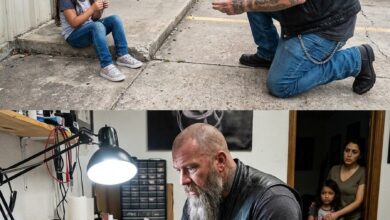
A WOMAN KICKED OVER A LITTLE GIRL’S LEMONADE STAND AND CALLED THE BIKER BUYING A CUP “TRASH”—THEN HE PULLED OFF HIS GLOVES, AND SHE SAW THE BADGE ON HIS BELT.
My daughter had been sitting at her lemonade stand since ten in the morning, and by three o’clock she had made $212.
I knew because she announced the total every time a car pulled up. “Two hundred and four!” “Two hundred and eight!” Sophie was nine and took this very seriously. She had painted her cardboard sign herself with red hearts, a yellow sun, and a careful drawing of a wheelchair.
The wheelchair was for her little brother.
Ben was six and had spina bifida. He had been using the same manual wheelchair since he was three. His knees came up too high now, and his shoulders ached after school. His physical therapist said he needed a power chair. Our military insurance had denied it twice, and the appeal was “under review,” which meant nothing.
Sophie decided to fix it herself.
“A thousand dollars,” she told me. “I’ll get it by the end of summer.”
I didn’t have the heart to tell her a power chair cost closer to twenty.
I was inside getting ready for my evening shift at the nursing home when I heard a car door slam out front. Through the screen door, I saw a white SUV pulled up behind a dark blue motorcycle at the curb.
My stomach dropped. I knew that SUV.
Diane Whitmore owned our duplex. She owned half the duplexes on Linden Street.
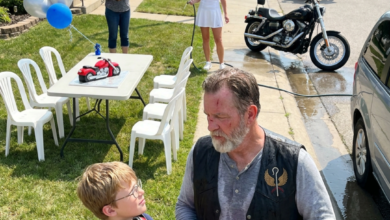
A biker was standing at Sophie’s table. He was a big man with a thick gray mustache, aviator sunglasses, and a black leather vest over a faded denim shirt. He was handing Sophie a dollar bill.
Diane walked straight past him.
“Sophie, what did I tell your mother about this table?”
“It’s for Ben,” Sophie said.
“I don’t care what it’s for.”
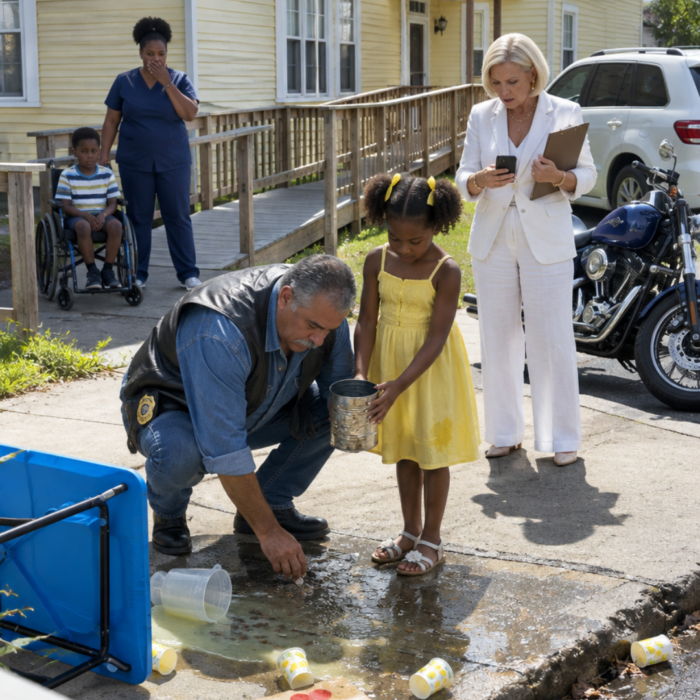
Diane kicked the table over.
The pitcher went flying. A sheet of lemonade splashed across the hot sidewalk. Paper cups rolled into the street. Sophie’s coffee can hit the concrete, popped its lid, and sent quarters spinning toward the storm drain.
Diane turned to the biker, who had lemonade dripping off his boots.
“And you can take your trash somewhere else. This is a nice street.”
He didn’t say anything. He didn’t move.
I came out the screen door and down Ben’s ramp so fast I almost slipped.
Diane grabbed my arm the second I reached the sidewalk. “Jessica, thank God. He got aggressive with me when I asked Sophie to move. I’m calling the police.”
She already had her phone up.
The biker crouched down by the gutter. He pulled off his leather gloves, one finger at a time, so he could pick up the quarters. As he leaned forward, his vest swung open.
A gold badge was clipped to his belt.
Diane’s thumb stopped above her screen.
The man finished gathering the coins. He stood, put them back in Sophie’s can, and handed it to her. Then he took off his sunglasses.
“Frank Navarro,” he said. “Chief of police. I started Monday.”
Diane laughed, a little too high. “Anyone can buy a badge online.”
“Not this one, ma’am.”
Then, slowly, Diane smiled again and tapped her clipboard.
“Well. Then I’m glad you’re here, Chief. You can enforce this.”
Part 2
She pulled the top sheet off her clipboard and handed it to him.
I didn’t have to read it. I had an identical copy on my refrigerator, under a magnet shaped like a cactus.
NOTICE TO VACATE. Tenant in default of rent for three months. Premises must be vacated within seventy-two hours.
It had been taped to my front door eight days earlier by a police officer in full uniform. He was a young blond guy who barely looked at me. When I asked him what it meant, he said, “It means you’ve got three days, ma’am. After that, we come back.”
I had spent the last five nights lying awake, doing math that never added up.
Chief Navarro read the paper slowly. Then he looked at me.
“Mrs. Reed, are you behind on rent?”
“No,” I said. “My husband’s deployed. Danny’s with the National Guard. His rent allotment goes straight from his pay to Mrs. Whitmore’s account every month. It has for two years.”
“I haven’t received a dime since May,” Diane said crisply. “I’ve been more than patient. I’m sorry about the children, I truly am, but I’m running a business, not a charity.”
The neighbors were listening. I could feel them listening.
The truth is, I didn’t know for sure. Danny handled the allotment. The Army’s pay system had glitches. There had been a month last year when his pay got delayed for three weeks. What if it had happened again? What if I’d been sitting in a house for three months that I hadn’t paid for, and I hadn’t even known?
I felt the heat climb up my neck.
Chief Navarro looked back down at the notice.
“Who served this?”
“A police officer,” I said. “He had a name tag. Whitmore.”
The chief went very still.
He looked at Diane. Diane looked back at him, chin lifted.
“T. Whitmore,” Chief Navarro said quietly.
“My nephew, Tanner,” Diane said. “He’s been with the department six years. He was kind enough to help me with the paperwork.” She folded her arms. “Is that a problem, Chief?”
Part 3
Chief Navarro didn’t answer her.
Instead, he turned to Sophie, who was clutching her dented coffee can to her chest. Her yellow ribbons had come loose. Her sundress had lemonade on the hem.
He crouched down to her level, his knees popping.
“You make good lemonade,” he said. “I only got one sip, but it was good.”
“It has real lemons,” Sophie said. Her voice wobbled. “Not powder.”
“I could tell.”
She looked at him for a long, careful moment, the way she studies a math problem.
“Did my daddy send you?”
I stared at her. “Sophie, honey, no—”
But Chief Navarro was nodding slowly.
He reached inside his vest and took out a folded envelope, soft and creased, with an overseas military postmark. He handed it to me.
I knew the handwriting before I unfolded it. Danny writes in tight, slanted capitals, like he’s always in a hurry.
Chief Navarro, sir. I’m a squad leader serving with your son Marco. He says you’re the best man he knows. I hope you don’t mind me asking a favor.
My daughter Sophie wrote me. She says the landlady told them they have to leave and a policeman put a paper on our door. She says Mom cries in the car. My wife hasn’t said one word to me about any of this, which tells me it’s bad. I’m 7,000 miles away and I can’t do a thing. Would you look in on them? Just make sure they’re okay. I’ll owe you for life. —SSG Daniel Reed
I couldn’t breathe.
“I didn’t tell him,” I whispered. “I didn’t want him to worry. He’s over there. He needs to focus—”
“He knew anyway,” the chief said gently. “Kids write letters.”
Sophie looked at her shoes. “I’m sorry, Mama. I told Daddy about the lady. And about Ben’s chair. I wasn’t supposed to.”
I knelt and pulled her against me, lemonade and all.
Chief Navarro stood back up.
“My son called me Tuesday night. Said there was a soldier in his unit with a family in trouble, right here in my new town. I figured the least I could do on my first day off was buy a cup of lemonade.”
Diane let out a little exhale through her nose. “How touching.”
Behind her, the passenger door of the white SUV opened.
A young woman in a blazer climbed out, holding a tablet and her phone. She walked up cautiously, glancing at the spilled table.
“Mrs. Whitmore,” she said quietly. “Mr. Lyle wants to know if this unit will be vacant by the thirtieth or not. He says the closing is in twelve days.”
Part 4
The closing.
I looked at the SUV. Through the tinted windshield, I could see a gray-haired man in a suit on the phone, looking annoyed.
Diane’s face tightened for the first time.
“Not now, Priya.”
But Chief Navarro was already looking at the young woman. “What closing?”
Priya hesitated. She looked at Diane, then at the badge on his belt.
“Lyle Development is purchasing six properties on Linden Street from Mrs. Whitmore’s company,” she said carefully. “For a townhome project. The contract requires them to be delivered vacant.”
“Six,” the chief said. “Including this one.”
“Yes, sir.”
I suddenly understood everything.
It wasn’t about rent. It had never been about rent. Diane needed us gone in twelve days so she could sell a building with no tenants in it.
Chief Navarro turned back to Diane. His voice stayed level.
“Mrs. Whitmore, are you aware of the Servicemembers Civil Relief Act?”
“I’m aware of a lot of things, Chief.”
“Then you’re aware you can’t evict the family of an active-duty servicemember without going to court. A judge has to consider the deployment. You can’t do it with a printed notice and a nephew in uniform.”
“That law is for people who pay their rent,” Diane said. “She hasn’t.”
“I have,” I said, but my voice came out weaker than I wanted.
Diane heard it. She smiled.
Then she turned toward the neighbors, raising her voice so it carried all the way down Linden Street.
“Everybody see this? Three days on the job and our new police chief is out here in a biker vest, harassing property owners on behalf of a squatter. I’ve been a member of this community for thirty years.” She held up her phone and started recording. “This man rides with a motorcycle club. I want everybody to know who’s running our police department.”
A couple of neighbors nodded. One older man on a porch muttered, “Biker cop. Figures.”
I watched the chief’s face. He didn’t react at all.
Then his phone started buzzing in his vest pocket.
He looked at the screen. His jaw tightened, just slightly.
He answered it on speaker, so everyone could hear.
“Frank,” said an angry male voice. “This is Mayor Hollis. What the hell are you doing on Linden Street?”
Part 5
“Buying lemonade, Mayor,” Chief Navarro said.
“Don’t get smart with me. Diane Whitmore just called my personal cell. She says you’re intimidating her in front of a crowd. Her family has supported every campaign in this town for twenty years. You’ve been chief for four days.”
“Yes, sir.”
“So walk away. Whatever this is, let it go through proper channels.”
“Sir, a family of an active-duty soldier was handed a fake eviction notice by one of my officers. Those are the proper channels.”
There was a long pause on the phone.
“Frank. I’m only going to say this once. Be very careful.”
“Understood, Mayor. If it’s a short job, it’s a short job.”
He hung up.
Diane looked delighted.
I felt sick. I looked at this stranger who had just put his brand-new career on the line for my kids, and I wanted to tell him to stop. We’d find an apartment somewhere. My sister had a couch. It wasn’t worth it.
But then Ben rolled up beside the chief.
He’d been sitting at the bottom of the ramp the whole time, listening. He pushed his wheels until he was right next to the big man’s boots and tipped his head back.
“Is that your motorcycle?”
Chief Navarro looked down at him. Something softened in his face.
“Sure is.”
“What kind of engine?”
“V-twin. Built it myself, mostly. Took six years.”
Ben nodded seriously. “My chair is too small. Sophie’s going to buy me a new one that goes by itself.”
“So I heard.”
The chief looked at Ben’s chair, the one his knees were folded up in, the one with the worn-down hand rims. He didn’t say anything else.
Then Priya stepped forward again. Her face was pale, and she was holding up her phone.
“Chief Navarro? I’m sorry. I don’t know if this matters.” She swallowed. “Mr. Lyle asked me to film the street for the project video. I was recording from the passenger seat when we pulled up.”
She turned the screen around.
On it, Diane got out of the SUV, still on the phone with someone, clearly not knowing the passenger window was down.
“Don’t worry about it, Richard. They’ll be gone by the thirtieth one way or another. Tanner’s handling it. He knows how to scare people.”
Then she walked over to Sophie’s table and kicked it.
The biker never moved toward her. He never raised a hand. He just stood there with a dollar in his fingers.
The street went silent.
That’s when a police cruiser turned the corner and pulled up behind the SUV, responding to Diane’s 911 call.
The driver’s door opened, and a young blond officer climbed out.
Part 6
Officer Tanner Whitmore walked up with a confident stride, one hand resting on his duty belt.
“Aunt Diane, you called? What’s—”
He saw the chief.
He stopped so fast his boots squeaked on the wet pavement.
“Chief,” he said. “Sir. I didn’t know you’d be—”
“Officer Whitmore,” Chief Navarro said calmly. “Did you serve this notice?”
He held up the paper.
Tanner’s eyes went to it, then to his aunt, then back to the chief.
“I—yes, sir. I delivered it.”
“Was it issued by a court?”
Silence.
“Officer, I asked you a question.”
“No, sir.” Tanner’s voice dropped. “My aunt asked me to drop it off. She said it was just paperwork. She said the tenants wouldn’t take it seriously unless it came from someone in uniform.”
“Tanner,” Diane snapped. “Stop talking.”
“Who printed it?” the chief asked.
Tanner stared at the ground. “She did. Off a website. She told me what to say. ‘Seventy-two hours, after that we come back.'”
“Did you know the tenant was a military family?”
Tanner closed his eyes. “Yes, sir.”
I had been holding onto my anger for eight days, and suddenly it was gone. All I felt was tired. This kid had stood on my porch in a uniform and frightened my children, because his aunt asked him to.
Chief Navarro held out his hand.
“Your badge, Officer. And your service weapon. You’re on administrative leave, effective now, pending an internal investigation.”
Tanner unclipped his badge with shaking hands. Diane grabbed his arm.
“You can’t do this. He’s done nothing wrong. Hollis will have your job by tomorrow—”
“Maybe so, ma’am,” the chief said. “But not today.”
Then my phone buzzed in my scrub pocket.
I pulled it out. On the screen was an incoming video call from a long string of numbers I knew by heart, a military line from overseas.
It was Danny.
Part 7
My hands were trembling so badly I almost dropped the phone.
His face filled the screen. He was sunburned and tired, wearing a tan T-shirt, sitting in what looked like a plywood office with a fan whirring behind him. Somebody stood just out of frame. I caught a flash of a young man with Chief Navarro’s mustache.
“Jess,” Danny said. “Marco said his dad was heading over. Are you okay? Are the kids okay?”
I couldn’t speak.
Sophie snatched the phone out of my hand. “Daddy! The mean lady kicked over my stand, but the policeman picked up all my money. He has a motorcycle and a mustache.”
Danny laughed. Then his eyes went wet.
“Turn me around, baby girl. Let me see.”
Sophie turned the phone. Danny saw the spilled lemonade. He saw Diane Whitmore in her white pantsuit. He saw the chief.
“Sir,” he said. “Thank you for coming.”
“Your daughter makes good lemonade, Sergeant.”
“Mrs. Whitmore,” Danny said, and his voice changed. It got very calm, the way it does when he’s holding something back. “I hear you think we haven’t paid rent since May.”
Diane lifted her chin. “Your allotment stopped, Sergeant. I can’t help that.”
“No, ma’am. It didn’t.”
He held up a stack of printed pages to the camera.
“These are my LES statements. My Leave and Earnings Statements. Every one of them shows an allotment of eleven hundred and fifty dollars to Whitmore Property Holdings LLC, the same routing number for twenty-six straight months. I also have bank confirmations for every deposit.” He paused. “Including June. July. And August. I’m emailing all of it to the chief right now.”
Chief Navarro’s phone buzzed in his pocket.
Diane’s mouth opened, then closed.
Priya cleared her throat very quietly. She was looking at her tablet.
“Chief,” she said, “I have the purchase agreement here. Mrs. Whitmore signed a disclosure stating that none of the units had tenants protected by military or federal law, and that every tenant was in default.”
The SUV’s passenger door opened. The gray-haired man in the suit got out. He walked straight up to Diane, and his face was red.
“Diane. You told me these people weren’t paying. You told me your family had an officer handling it.”
“Richard, it’s a misunderstanding—”
“I’m not buying a lawsuit.” He turned on his heel. “Deal’s off. Priya, get in the car.”
Priya didn’t move.
“I’ll get a ride, Mr. Lyle,” she said quietly.
Richard Lyle drove away. Diane stood on the sidewalk with lemonade drying around her white shoes.
Then Chief Navarro tilted his head and listened.
“You hear that?” he said to Ben.
At the far end of Linden Street, a low rumble was coming closer.
Part 8
Twenty-two motorcycles turned onto our street in a slow, double line.
They rolled to a stop along the curb, one behind the other, engines idling low and then cutting off one by one. The riders climbed off. There were men and women, gray-haired and young, all wearing black vests with the same eagle-and-shield emblem as the chief’s.
“Ironwood Riders,” the chief said to me. “Cops, firefighters, paramedics, some retired. I texted them from my bike when I pulled up and saw your daughter’s sign.”
“You texted them before any of this happened?”
“Her sign said a thousand dollars. That seemed like the kind of thing a few friends could help with.”
Sophie stood frozen behind her overturned table. A tall woman in a vest walked up and quietly set the table back on its legs. A gray-bearded man pulled a fresh jug of lemonade out of his saddlebag. Someone else produced a stack of new paper cups.
And then they lined up.
Twenty-two bikers formed a line down the sidewalk, and every single one of them paid fifty dollars for a cup of lemonade.
Sophie stopped announcing totals after the sixth one. She just kept pouring, her ribbons bouncing, her eyes huge.
The neighbors started coming down from their porches. The older man who’d muttered “biker cop” walked over with his wallet out. He handed Sophie a twenty, then turned to Chief Navarro.
“I owe you an apology.”
“You owe that little girl a cup’s worth of manners,” the chief said, not unkindly. “We’re square.”
Chief Navarro walked over to Diane Whitmore.
“Ma’am, you’re being cited for criminal mischief for destroying the child’s property, and for filing a false report to 911. The notice your nephew delivered, along with the video, the lease, and Sergeant Reed’s records, will be referred to the U.S. Attorney’s Office for violating the Servicemembers Civil Relief Act.” He paused. “I’d recommend calling your lawyer.”
Diane looked at him for a long moment. Then she got into her SUV and drove away without a word.
By the time the sun went down over Linden Street, Sophie’s coffee can held $4,860.
Later, after the bikers had gone and my kids were asleep in a sugar coma, I found Chief Navarro sitting on the bottom of Ben’s ramp, picking up the last of the paper cups.
“Why?” I asked. “You don’t know us. You risked your job on your fourth day.”
He was quiet for a while.
“Summer of 1971,” he said. “My dad was in Vietnam. My mom, me, and my three sisters lived in a rental in San Antonio. Landlord decided he wanted the place back. He put everything we owned on the curb while my mom was at work. I was seven. I sat on top of our mattress in the yard and tried to guard it.”
I didn’t say anything.
“A motorcycle cop pulled up. Officer Ruiz. He sat on the curb with me until my mom got home. Then he made the landlord carry every single thing back inside.” He turned a paper cup over in his hands. “I decided that day what I wanted to be.”
Ben’s voice came from the dark doorway behind us. He was supposed to be asleep.
“Chief Navarro? When Daddy comes home, can he see my new chair?”
The chief smiled.
“About that, buddy,” he said. “Let’s talk to your mom.”
Part 9
Here’s how the rest of it went.
Diane Whitmore pleaded guilty to a federal misdemeanor for violating the Servicemembers Civil Relief Act. She paid a fine, along with damages to our family, and was removed from the city’s zoning board. Lyle Development never came back to Linden Street. Six months later, Diane sold all six duplexes to a nonprofit that provides housing for veterans and their families. They kept our rent exactly the same.
Tanner Whitmore resigned from the department during the internal investigation. He was later charged with official misconduct. He came to our porch once, out of uniform, and apologized to me and to Sophie. Sophie told him he should apologize to Ben too. He did.
Mayor Hollis did not have Chief Navarro fired. After Priya’s video spread across town, the city council voted unanimously to commend him at their next meeting. The mayor gave a speech about “community values.” The chief said he had another engagement that night and didn’t attend.
Our insurance appeal was finally approved three weeks later. The money from Sophie’s stand covered everything the insurance didn’t, including a wheelchair ramp to the back door and new hand controls. The Ironwood Riders installed the ramp themselves on a Saturday.
Ben’s new chair arrived on a Tuesday. It was red, because Ben said red ones go faster.
Danny came home on a Friday.
The Ironwood Riders met his bus at the armory and escorted it through town. Twenty-two motorcycles rode in two lines with small flags snapping behind their seats. People came out on their lawns to wave. I stood at the end of our new ramp with my hands over my mouth.
When Danny stepped off the back of Chief Navarro’s motorcycle in front of our house, Ben rolled down the sidewalk to meet him at full speed in his new red chair. Danny dropped his duffel bag and knelt on the sidewalk where the lemonade had been. Sophie ran into both of them so hard all three nearly fell over.
I didn’t see anything else for a while. My eyes were too blurry.
Later that night, Sophie dumped her coffee can on the kitchen table to count it one last time before we deposited everything. Under the bills and quarters, at the very bottom, she found something heavy.
It was an old silver dollar, dated 1971. A strip of yellowed tape was wrapped around its edge, with faded writing in tiny letters.
PASS IT ON. —R.
Chief Navarro had dropped it into the can that first afternoon, while he was handing it back to her. It was the dollar Officer Ruiz pressed into the hand of a seven-year-old boy sitting on a mattress in a front yard in San Antonio, more than fifty years ago.
Sophie keeps it in a tiny box on her dresser now. She says she’s waiting for the right person.
People see a leather vest and a mustache and a loud motorcycle, and they decide who someone is before he says a word. That afternoon, a woman in a white linen suit called him trash and kicked over a little girl’s dream. She was the one with something to hide. Sometimes the person who looks the roughest is the one who rode forty minutes on his day off just to buy a cup of lemonade.
If this story stayed with you, follow our page. We share real stories like this one every week, about the people who show up when it matters most.