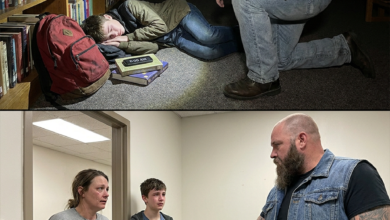
A Teenager Tore a Club Badge From a Biker’s Vest and Threw It Into His Father’s Coffin—Then the Funeral Director Opened a Ledger No One Was Supposed to See
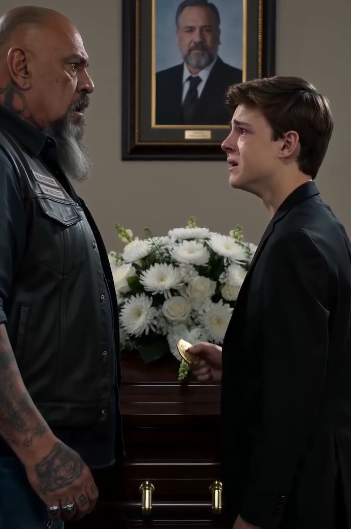
I ripped the brass club badge from the largest biker’s vest and threw it into my father’s open coffin, and every man wearing leather inside that Ohio funeral home moved toward me at once.
Boots struck the carpet.
Chairs scraped backward.
My aunt screamed my name, but I did not step away from the casket.
The biker whose badge I had taken was Gabriel Torres, though the Ash Creek Riders called him Brick. He was fifty-seven, six-foot-four, and built like a concrete wall beneath a black leather cut. A thick salt-and-pepper beard framed his weathered Latino face. Tattoos covered his neck, forearms, and scarred knuckles.
He looked capable of lifting me with one hand.
At sixteen, I probably looked capable of nothing.
My black suit had belonged to my father. The sleeves covered half my fingers, and the shoulders sagged whenever I breathed. Dad lay in front of me wearing the only dress shirt he owned, his hands folded over a chest that cancer had reduced to bone.
Around us stood twenty-three bikers who had not visited him publicly for seven years.
The same men our town said had expelled him.
The same club people claimed he had stolen from.
Now they had arrived together, filling the funeral-home windows with black motorcycles and the low ticking of cooling V-twin engines. They stood beneath an arrangement of white flowers as though leather, tattoos, and lowered heads could repair years of absence.
I hated them for coming.
I hated them more for looking sad.
Brick’s hand closed around my wrist, stopping me before I could reach for another patch. His grip was firm but not cruel.
“Easy, kid.”
“Don’t call me that.”
“You want to tell me what this is?”
The brass badge rested on Dad’s chest. It carried the Ash Creek Riders’ lantern-and-road emblem, the same symbol that had been cut from his vest when I was nine.
Club members formed a half circle behind Brick. One clenched his fists. Another stared at the badge as though I had thrown dirt into the coffin.
“You think this is funny?” a biker asked.
“No.”
“Then take it out.”
I looked at my father.
For seven years, I believed those men had abandoned him after accusing him of stealing money from a relief fund. I watched Dad enter hospitals alone. I saw him sell his truck, skip medication, and pretend our furnace worked when ice formed inside the windows.
Whenever I asked about the club, he gave the same answer.
“Not their road anymore.”
That morning, the funeral director had slipped me a sealed envelope Dad ordered him to deliver only after the Ash Creek Riders arrived.
Inside were copies of hospital statements marked PAID.
Mortgage receipts.
School-lunch deposits.
A photograph of Brick sitting inside an unmarked pickup across from my middle school.
And a handwritten ledger containing every night a biker had quietly watched our house while Dad was receiving treatment.
They had never left.
They had only removed their leather before coming near us.
Brick released my wrist.
I pointed toward the badge in the coffin.
“That belongs to him.”
A murmur moved through the club.
“He surrendered his colors,” one member said.
“No,” I answered. “He surrendered the lie.”
Brick’s face changed.
He knew what I had found.
I opened Dad’s suit jacket and revealed a faded patch sewn inside the lining, hidden over his heart. Twenty-three bikers lowered their eyes.
The patch read:
BROTHER—ASH CREEK—ALWAYS.
My father had never been expelled.
The public disgrace, the missing charity money, and seven years of silence had protected someone whose name did not appear anywhere in the funeral program.
Then Brick told me who had really taken the money.
The man was standing inside the room.
My name is Noah Carter, and for most of my childhood, motorcycles meant my father was home.
I could identify Dad’s Harley before it reached our street. The engine had a rough second beat, a deep stumble followed by a clean pull, and our kitchen glasses would tremble before the headlight appeared beyond the maple trees.
Dad’s road name was Harbor.
It sounded wrong for a man built like a fence post, but Brick said my father had a habit of becoming the safest place in any bad situation. Riders with broken bikes called him. Men leaving jail called him. Wives searching for husbands called him.
Dad answered.
The Ash Creek Riders were not an outlaw club, though some members had criminal records and most enjoyed letting strangers wonder. They ran a repair garage outside Marietta, Ohio, escorted veterans’ funerals, delivered groceries during floods, and maintained a hardship fund for local families.
Dad served as treasurer.
Brick was president.
They had met at a truck-repair shop when both were twenty-two. Brick was newly divorced, angry at everyone, and sleeping inside a van without heat. Dad gave him half a sandwich, a winter coat, and three nights on our grandmother’s couch.
Brick later said the sandwich was terrible.
He ate it anyway.
By the time I was born, the club had become part of our family. Amos Reed, a broad Black mechanic with a white beard, taught me to ride a bicycle. “Switch” Maddox dressed as Santa every December despite having skull tattoos across both hands. A quiet Asian American electrician named Kenji Park repaired our porch light so often he eventually rewired the entire house.
Then everything stopped.
I was nine.
Dad returned from a club meeting carrying his leather cut folded beneath one arm. The back patch had been removed. Pale stitch marks formed the outline of a missing rocker and emblem.
He placed the cut inside a cedar box.
“Where are your patches?” I asked.
“Returned.”
“Why?”
“Club business.”
I heard the rumors at school before he explained anything else.
Twenty-eight thousand dollars had vanished from the Ash Creek hardship fund. The money had been collected for the medical expenses of a local girl injured in a farming accident. Club records showed three withdrawals approved with Dad’s treasurer code.
The Riders announced that Dad had surrendered his colors.
People translated that into guilt.
Parents stopped letting their children visit our house. A teacher asked whether we needed help buying food. At a diner, a man called Dad a thief loudly enough for everyone to hear.
Dad finished his coffee.
He left exact change beneath the cup.
Outside, I asked why he had not hit the man.
“Because his mouth isn’t my steering wheel.”
That was how Dad spoke—plain sentences that took years to understand.
The club disappeared from our visible life. No Harleys outside the house. No Christmas toy runs beginning in our driveway. No Amos fixing the lawn mower while Dad made fun of his tools.
Yet strange things kept happening.
Our property taxes were paid during a month Dad had no work.
The electric company reversed a shutoff notice.
When the transmission failed in our sedan, the car vanished overnight and returned repaired before school.
Dad claimed an anonymous church group helped us.
We did not attend church.
At twelve, I spent six days in the hospital with pneumonia. Dad slept in a chair beside me, leaving only when nurses forced him to shower. Every afternoon, the billing office received a money order.
The payer used different initials each time.
A.R.
K.P.
G.T.
I never noticed.
Dad did.
He kept every receipt.
The year I entered high school, a man began parking across from our house after dark. He drove a gray pickup and wore a baseball cap low over his face. Dad told me not to approach him.
“Is he watching us?”
“Yes.”
“Why?”
“Making sure we’re boring.”
The truck appeared whenever Dad worked late. Sometimes a blue van replaced it. Once, during a snowstorm, I found motorcycle tracks beneath fresh snow behind our garage, though I had heard no engine.
I believed someone meant to frighten us.
The opposite was true.
At fourteen, I finally demanded the whole story about the missing money. Dad was at the kitchen table, sorting medication into a plastic organizer. Cancer had begun inside his colon and spread before doctors found it.
He looked smaller.
Still hard.
“Did you steal it?”
“No.”
“Then why does everyone say you did?”
“Because I let them.”
“That makes no sense.”
“It will.”
“Who actually took it?”
Dad closed the medication box.
“Some truths aren’t yours to carry yet.”
I hated that answer.
Children of secretive parents become detectives or liars. Sometimes both.
I searched court records. No charges had been filed against Dad. The club had repaid every dollar within two weeks. The injured girl’s family publicly said they had received the full amount.
There was no police report.
No lawsuit.
Only rumors.
If Dad was innocent, the Riders could have defended him. Instead, Brick released one statement saying that internal matters had been handled.
That silence condemned Dad.
By sixteen, I hated the Ash Creek Riders more than I hated cancer. Disease had no face. The club had twenty-three.
During Dad’s final month, I called Brick from a number written inside an old address book. He answered on the second ring.
“Torres.”
“My father is dying.”
Silence.
Then, “I know.”
The calmness enraged me.
“You know?”
“Yes.”
“How?”
Another silence.
“Your dad tell you to call?”
“No.”
“Then I shouldn’t be talking.”
“You threw him away.”
Brick breathed slowly into the phone. Behind him, I heard tools striking metal and a Harley idling.
“Noah—”
“Don’t come to the funeral.”
I disconnected.
Dad died three nights later.
At 2:14 in the morning, the hospital account showed a final payment of eleven thousand dollars.
The payer was listed as Ash Creek Community Outreach.
I assumed it was a clerical mistake.
Then twenty-three motorcycles appeared at the funeral home.
Brick entered first, carrying his helmet beneath one tattooed arm. His eyes went to Dad’s coffin and stopped.
No one spoke.
The bikers arranged themselves along the back wall, leaving every family chair empty. Their boots were clean. Their leather cuts bore black mourning bands.
They looked like men attending the funeral of a brother.
I wanted them to look guilty.
Instead, they looked broken.
The funeral director touched my elbow and handed me a thick envelope.
“Your father left instructions,” he whispered. “Open this only if the motorcycles come.”
That sentence changed the shape of the room.
Inside the envelope, the first page was a hospital bill.
Across the balance, someone had stamped PAID.
Beneath it, Dad had written three words:
They never left.
I read the documents inside the funeral director’s office while mourners gathered around my father.
Seven years of receipts covered the desk.
The Ash Creek Riders had paid our property taxes, utilities, repair bills, medical copays, and part of my school expenses. They never used the club’s name directly. Payments traveled through money orders, local businesses, anonymous deposits, and a nonprofit registered two counties away.
Each receipt carried initials.
A.R. was Amos Reed.
K.P. was Kenji Park.
G.T. was Gabriel Torres.
The gray truck outside my school belonged to Brick.
The blue van belonged to Switch.
They had rotated watching me whenever Dad was hospitalized because my mother had died when I was five, leaving no other parent at home. They drove behind my school bus during severe storms. They cleared snow from our back steps before dawn.
Once, when a former customer blamed Dad for an engine failure and threatened to hurt us, four club members spent six consecutive nights in vehicles near our property.
No visible patches.
No motorcycles.
No explanations.
Dad had forbidden those.
The ledger documented every watch:
10/14—Brick, school release, 2:30–5:00.
11/02—Kenji, hospital overnight, Noah home safe.
12/19—Amos, furnace repaired, invoice buried.
01/07—Switch, followed bus through ice, no contact.
They had protected me for years.
I had mistaken protection for surveillance.
Beneath the receipts lay an old photograph of Dad wearing his full cut. The Ash Creek emblem stretched across his back. Beside him stood Brick and another man I did not recognize.
The stranger resembled Dad.
Same narrow eyes.
Same bent nose.
My uncle Lucas.
I had seen him only twice. Dad said Lucas drifted between construction jobs and treatment programs. He sent birthday cards without return addresses.
On the back of the photograph, Dad had written:
My brother made the mistake. My brothers carried the cost.
My stomach turned.
Lucas had taken the money.
The documents included a confession signed seven years earlier. Lucas had obtained Dad’s treasurer code while staying at our house. He withdrew the hardship money to cover debts accumulated during an opioid addiction.
Dad discovered the theft before the club reported it.
He faced a choice.
Expose Lucas and send him back to prison, or accept public blame while Lucas entered long-term treatment and repaid the club through supervised work.
The Ash Creek Riders voted.
Not unanimously.
Amos wanted the truth made public. Kenji argued that protecting Lucas could destroy trust in the hardship fund. Switch believed Dad had no right to sacrifice his own name when a child depended on him.
Brick broke the tie.
He voted to honor Dad’s plan.
Publicly, Dad surrendered his colors.
Privately, he remained their brother.
The visible separation protected the club’s charity work from scandal while giving Lucas one final chance to recover without becoming the target of everyone he owed. Dad insisted that no member publicly defend him.
“He’s my brother,” Dad had written. “Let me buy him time.”
The club repaid the missing money immediately.
Lucas entered treatment.
Dad carried the rumor.
I carried the shame.
That was the part nobody had asked me to agree to.
Anger returned so hard that I kicked the desk.
The funeral director stepped backward.
Dad had protected Lucas, but he had also allowed me to grow up believing he was a thief. The Ash Creek Riders had paid bills and watched doorways, yet none had told a nine-year-old boy that his father was still honorable.
Their silence helped us.
It also wounded us.
Both things were true.
I returned to the viewing room holding the confession and ledger beneath my jacket.
Brick stood nearest the coffin.
On the left side of his vest was a small brass badge shaped like a lantern over a road. Unlike the stitched patches, it could be removed. Dad had owned one exactly like it.
Every full member received the badge after ten years.
Dad’s had disappeared with his colors.
I walked toward Brick.
He turned.
Before anyone understood, I gripped the brass emblem and tore it from the leather loop. The fastening broke. Metal flashed beneath the funeral-home lights.
Then I threw it into the coffin.
It struck Dad’s folded hands and came to rest above his heart.
Boots moved.
Fast.
Amos seized the shoulders of a younger rider charging from the back. Switch cursed. Kenji stepped between me and three others.
Brick closed one hand around my wrist.
“Easy, kid.”
“Don’t call me that.”
“You want to tell me what this is?”
I opened Dad’s suit jacket.
Beneath the lining, the funeral director had sewn a faded patch according to Dad’s instructions.
BROTHER—ASH CREEK—ALWAYS.
Every biker stopped.
Brick released me.
“That badge belongs to him,” I said.
A member named Deke pointed at the coffin. “He gave it up.”
“He gave up his reputation. You let him keep the brotherhood where nobody could see it.”
“Noah,” Brick warned.
I pulled out the ledger.
“You paid our bills.”
Silence.
“You watched my house. You followed my bus. You sat in hospital parking lots while I thought you hated him.”
Brick glanced at the coffin.
“Your dad made us promise.”
“He’s dead.”
The words struck the room with more force than the badge.
Promises to the dead are easy because the dead never ask what those promises are doing to the living.
I held up Lucas’s confession.
“Where is he?”
No one answered.
“Dad protected him. You protected him. Where is he?”
A chair creaked near the rear door.
The thin man from the photograph stood.
He wore no leather. His suit was cheap and too large. Gray touched his temples, and a recovery coin hung from a cord around his neck.
My uncle Lucas had been inside the funeral home the entire time.
He walked toward the coffin.
The Ash Creek Riders opened a path.
“I took the money,” he said.
His voice sounded like Dad’s after a long illness.
“I let your father wear it.”
My fists tightened.
Lucas stopped six feet away.
“I’m not asking you to forgive me.”
“Good.”
“I came to return something.”
He reached inside his coat and removed another brass lantern badge.
Dad’s badge.
The original.
For seven years, Lucas had carried it through treatment, halfway houses, night shifts, relapses, and recovery meetings. Dad gave it to him the night the club removed his colors.
“You bring this back when you’re worth the weight,” Dad had said.
Lucas held the badge toward me.
I looked at the one already resting in the coffin.
Then at Brick.
There were now two.
One represented the brotherhood Dad had surrendered publicly.
The other represented the brotherhood that had quietly refused to let him go.
The funeral room waited for me to choose which truth belonged beside him.
I took Lucas’s badge.
But I did not put it in the coffin.
I fastened it to the inside of my father’s suit jacket, directly over the hidden patch.
Brick’s badge remained on top.
“Now everyone can see one,” I said. “And he keeps one where you made him hide it.”
No biker argued.
Lucas lowered his head.
Then the funeral-home doors opened, and two nurses from Dad’s hospital entered carrying a wooden box.
Inside were hundreds of canceled checks.
The Ash Creek Riders had not only paid Dad’s medical bills.
Dad had been paying them back.
Not with money.
With a promise that would change what happened to me after the funeral.
The wooden box contained records from a program called Harbor House.
I had never heard of it.
Neither had most members of the Ash Creek Riders.
Dad created the program during his second year of cancer treatment. Whenever the club covered one of our expenses, he recorded the amount as a debt—not because anyone expected repayment, but because accepting help frightened him.
He could not repay money.
So he repaid time.
Dad spent his stronger weeks repairing wheelchairs, building porch ramps, and driving rural patients to oncology appointments. When chemotherapy left him too weak to work with tools, he called insurance offices for families who did not understand their bills.
The hospital nurses referred people quietly.
Dad helped sixty-three families.
He never attached his name.
The wooden box contained their letters.
A widow from Athens wrote that Dad drove her husband to treatment every Tuesday for four months. A farmer said Dad repaired the hydraulic lift on his accessible van using scrap metal and refused payment.
One letter came from the family whose hardship fund Lucas had stolen.
Their daughter, Molly, was twenty-one now.
Dad had attended every one of her rehabilitation appointments that first year. He taught her to operate the hand controls in her truck and persuaded a local mechanic to hire her.
She knew the truth about the money.
Her parents knew too.
They had chosen silence because Dad asked them to let Lucas recover without carrying the town’s hatred forever.
The secrecy was larger than I imagined.
So was its damage.
Molly entered the funeral home while I read her letter. She used forearm crutches and wore a blue coat. When Lucas saw her, he stepped backward.
She approached him.
“You owe me twenty-eight thousand dollars,” she said.
“I know.”
“No. You owe the fund. My bills were paid.”
Lucas nodded.
He had repaid nineteen thousand through seven years of warehouse work. Every month, part of his wages went into Harbor House. The remaining nine thousand would take another three years.
Molly extended one crutch toward the coffin.
“He owed me nothing,” she said. “Your brother paid in miles.”
Lucas’s face folded, but he did not cry loudly or ask anyone to comfort him.
He stood beside Dad.
That was his punishment.
And perhaps the beginning of something else.
Brick opened the final folder.
Dad had transferred Harbor House into a trust. The Ash Creek Riders were listed as administrators. Amos, Kenji, and two hospital nurses were trustees.
My name appeared as a future board member after I turned eighteen.
“He planned this?” I asked.
“Every line,” Brick said.
“But he told me nothing.”
“He wanted you to choose.”
“How can I choose something I don’t know exists?”
Brick had no answer.
Again, Dad’s instinct to protect had become another locked door.
I loved him.
I was furious with him.
Funerals allow those emotions to sit beside each other because death leaves no one available to settle the argument.
The club members gathered in the side room after the viewing. Their meeting began quietly and became an argument within minutes.
Deke accused Brick of allowing secrets to rot the brotherhood. Amos admitted he had nearly left the club seven years earlier. Kenji said the Riders had confused loyalty with obedience.
Switch defended Dad.
“He asked.”
“So?” Amos replied. “Brothers can ask wrong.”
Lucas stood outside the circle.
“I caused it.”
Brick shook his head. “You caused the theft. We chose the lie.”
That distinction mattered.
The Ash Creek Riders could have exposed Lucas while still helping him enter treatment. They could have defended Dad without publishing every detail. They could have told me, once I was old enough, that my father remained loved.
Instead, they honored a promise exactly and ignored what it was doing around them.
Brotherhood had become silence.
Silence had become reputation.
Reputation had become a boy believing his father died abandoned.
Brick removed his president patch.
He placed it on the table.
“I made the call,” he said. “Vote again.”
No one moved.
“You want me out, say it.”
Dad’s coffin lay twenty feet away.
The brass badge on his chest caught the light whenever someone passed.
Amos picked up the president patch.
“You think this is about throwing you out?”
“You said I broke trust.”
“You did.”
“Then handle it.”
“I am.”
Amos placed the patch back on the table instead of returning it.
“You don’t get to turn consequence into exile. That’s the same mistake.”
The room became still.
Brick had expected punishment to mean removal because men like him often understood only two conditions: wearing the patch or losing it. Amos proposed something harder.
Stay.
Repair what you damaged.
The club voted to suspend Brick as president for six months. Amos would serve as acting president. During that time, the Riders would contact every family affected by Harbor House and disclose how the fund operated.
No public spectacle.
No rewriting Dad as a saint.
Only honest records.
They also voted that no member could demand secrecy from the club when that secrecy materially harmed a child or dependent family member. Promises would be reviewed, not worshiped.
Brick accepted.
He removed his president patch but kept his cut.
Then he looked at me.
“We failed you.”
I wanted to tell him yes.
I wanted to blame him for every rumor, unpaid lunch, cold room, and lonely hospital corridor.
Instead, I asked, “Who sat outside during Dad’s last treatment?”
“All of us.”
“No. The last one.”
Brick’s eyes shifted toward Kenji.
The quiet electrician raised one hand.
“I did.”
“Why didn’t you come inside?”
“Your father said you were sleeping.”
“I wasn’t.”
Kenji nodded slowly. “I know that now.”
I remembered that night. A motorcycle had idled beyond the hospital garage at 3:00 a.m. Dad heard it through the window and smiled.
I asked what was funny.
“Old engine,” he said.
He knew.
He had not died believing himself abandoned.
That comforted me.
It also made the lie harder to forgive.
Before the meeting ended, Brick retrieved his broken brass fastener from the carpet. He placed it in my palm.
“You owe me a pin,” he said.
I looked at the giant biker who had allowed a sixteen-year-old to tear a badge from his vest in front of his entire club.
“You owe me seven years.”
He nodded.
“Fair.”
That was the first honest agreement between us.
After the funeral, the Ash Creek Riders took me to their clubhouse.
I had not entered since I was nine.
The building sat beside an old repair garage off State Route 7, where the Ohio River appeared between warehouses like a strip of hammered steel. The club room smelled of leather, engine oil, burned coffee, and wood smoke.
Dad’s photograph remained on the wall.
Not hidden.
Not removed.
He stood between Brick and Amos during a flood-relief ride, beard soaked, one hand raised at the camera. A small metal plate beneath the frame read:
HARBOR—MEMBER SINCE 1998
The date had no ending.
“You left this up?” I asked.
Switch looked confused. “Why wouldn’t we?”
“Because everyone said he was out.”
“Everyone wasn’t in this room.”
That sentence captured the club’s blindness. They had preserved Dad’s honor among themselves while allowing the world outside to strip it away.
To them, the truth inside the clubhouse had been enough.
To me, the outside was where I had to live.
Brick showed me a cabinet containing records of every payment made for our family. The money did not come solely from the club treasury. Members took extra shifts, sold spare parts, and gave up trips.
Amos postponed repainting his house for three years.
Kenji sold a vintage guitar.
Switch worked Christmas Day at a towing company.
Brick refinanced his repair shop after Dad’s cancer became terminal.
None told their wives the full reason at first. That created arguments. One marriage nearly ended because a member kept disappearing at night to watch our house.
The brotherhood had protected us while placing strain on families who deserved the truth too.
Nothing was clean.
Real sacrifice rarely is.
I asked why they guarded our home.
Brick opened another file.
After Lucas stole the hardship money, the people he owed began asking Dad for repayment. They assumed family pressure would make Lucas surface. One man appeared near my school. Another left a threatening note inside our mailbox.
Dad refused to involve the police because he feared exposing Lucas.
The club disagreed.
They respected his demand for public distance but created a quiet security rotation. No confrontations. No weapons. No threats. They documented vehicles, walked me home when necessary, and contacted law enforcement when boundaries were crossed.
The gray truck outside my school had not been following me.
Brick had been following the man following me.
Police eventually arrested that man for unrelated extortion offenses. The danger ended, but the Riders maintained occasional watches whenever Dad entered the hospital.
“Why after the threat was gone?” I asked.
Brick looked uncomfortable.
“House felt wrong empty.”
They had not merely protected me from danger.
They protected me from being alone.
Badly.
From a distance.
Without allowing me to know.
I opened the ledger again and chose a random entry.
04/11—Brick, Noah baseball game, visitor side, left after sixth.
I remembered that game.
Dad was receiving chemotherapy. I struck out twice and caught one fly ball. In the sixth inning, someone on the visitor side clapped loudly when I reached base on a walk.
I had never seen the man’s face beneath his cap.
“Were you there?”
Brick nodded.
“Why did you leave?”
“You looked toward the stands.”
“You thought I saw you?”
“Your dad said no contact.”
“So you ran.”
“Yeah.”
A giant biker admitted the word without decoration.
I closed the ledger.
“You were terrible at protecting people.”
“Probably.”
“You could have just sat with me.”
“Probably.”
“Dad was wrong.”
Brick looked at his photograph on the wall.
“Yeah.”
The answer released something in my chest.
No one had said it plainly.
Dad was wrong.
Not evil. Not foolish in every way. Not undeserving of love.
Wrong.
He protected Lucas at the cost of his own name. He protected me from the truth at the cost of trust. He turned help into secret accounting because he could not tolerate being carried.
The Ash Creek Riders loved him enough to obey.
They should have loved him enough to argue harder.
Over the following months, Brick kept his promise to repair the seven missing years. He did not attempt grand gestures. He came to our house on Tuesday evenings and helped sort Dad’s tools.
Most were rusted.
Brick cleaned each one.
Amos taught me to ride the old bicycle still hanging in our garage, though I had obviously known how for years. He needed an excuse to show up.
Kenji repaired the porch light again. This time, he installed a brass switch plate shaped like a lantern.
Lucas came too.
I did not make it easy.
He told me about addiction without using it as an excuse. He described taking Dad’s code, making the withdrawals, and lying until evidence trapped him. He admitted feeling relieved when Dad offered to take the public blame.
That admission disgusted him.
It also made me believe him.
“Did you ever ask Dad to tell the truth?” I asked.
“Every year.”
“What did he say?”
“Not until I finished paying it back.”
“You haven’t.”
“No.”
“Then he died carrying it.”
Lucas looked at the floor. “Yes.”
Forgiveness did not arrive.
But I began to understand that Lucas had spent seven years walking toward responsibility rather than away from it. He worked nights at a warehouse and days at a treatment center. Every payment to Harbor House came before his rent.
He lived in a room above the center.
He owned four shirts.
Dad’s brass badge had been the only object of value he kept.
Three months after the funeral, Lucas completed repayment early. The remaining money came from selling an old parcel of land their mother had left him.
He brought the final receipt to the clubhouse.
Molly, the woman whose family had needed the original hardship fund, attended the meeting. She checked the amount and placed the receipt inside Harbor House records.
Then she handed Lucas an application.
The program needed a driver.
“You trust me with money?” he asked.
“No.”
“With people?”
“Under supervision.”
It was not redemption.
It was work.
Brick watched from the back without his president patch. His six-month suspension was nearly over, but he had stopped counting days.
The club held a vote.
Before anyone spoke, Brick said, “No more hidden decisions.”
Amos nodded.
The vote returned him to leadership, but under new rules requiring written accountability for charity funds and family-impact decisions.
Amos resewed the patch onto Brick’s vest.
Crooked.
Brick looked down at it.
“You did that on purpose.”
“Leadership ought to bother you.”
The room laughed.
Then Brick took a small package from his pocket and handed it to me.
Inside was a brass lantern badge.
New.
“You replacing the one I buried?” I asked.
“No.”
“What is it?”
“Not a member badge.”
The back had been engraved:
HARBOR HOUSE—THE ROAD STAYS LIT
I fastened it inside my jacket.
Not outside.
Some things could remain private without becoming lies.
That was the difference we were all still learning.
The Ash Creek Riders changed how they attended funerals after Dad.
They still arrived together when invited. Engines settled into silence. Boots crossed church steps. Helmets rested beneath tattooed arms.
But they no longer stood at the back unless the family asked.
They sat.
They introduced themselves.
They told children how their parents had lived inside the club—not only how they had died.
At the funeral of Switch Maddox two years later, his granddaughter received a box of photographs before the service. Amos explained every road name written on the back.
Nobody made her wait for motorcycles to appear.
Harbor House grew too.
The program funded transportation, home repairs, medical copays, school meals, and temporary childcare for families navigating serious illness. Every payment carried the names of those who provided it.
Anonymous help remained available when needed, but the records could never be hidden from the family member affected.
I joined the board at eighteen.
My first vote concerned a father who wanted the program to conceal his diagnosis from his daughter. She was seventeen.
I voted no.
We offered counseling and helped him tell her safely.
Brick supported me.
After each meeting, he rode past our old house on Dad’s Road King.
The motorcycle had been stored behind the clubhouse since the surrender of Dad’s colors. Brick and Kenji restored it after the funeral. They kept every scratch on the tank and the uneven idle I remembered from childhood.
The brass lantern badge from Brick’s vest was still buried with Dad.
Lucas’s returned badge remained hidden beneath Dad’s suit jacket.
Mine rested inside my own coat.
Three badges.
One visible.
One concealed.
One carried forward.
Every September, the Riders visit Dad’s grave at dawn. They bring no flowers because Dad disliked arrangements that died twice.
Instead, they place a cup of diner coffee near the stone.
Black.
Too hot.
Brick sits on the grass while engines cool along the cemetery road. Lucas stands beside him. Sometimes they speak. Usually they do not.
I read the names in the Harbor House ledger.
People Dad never met now appear there.
His road continued through strangers.
Not because he was perfect.
Because those who loved him finally stopped protecting his mistakes from the light.
I am twenty-one now, the age Dad was when he gave Brick half a terrible sandwich and a place to sleep.
The funeral-home video still circulates online. It shows me ripping the brass badge from Brick’s vest and throwing it into the coffin. The clip ends as the Riders move forward.
People argue beneath it.
Some call me disrespectful.
Others call me brave.
Both judgments are too simple.
I was a grieving boy discovering that nearly every adult I trusted had hidden part of my life. I was angry at my father, the club, Lucas, and myself for believing the rumor so completely.
Throwing the badge was not courage.
It was the only sentence I could form.
Last spring, Harbor House purchased a van for rural hospital transportation. Lucas drives it three days a week. Molly manages the schedule.
Brick still checks the financial ledger personally, but never alone.
Amos checks him.
That is brotherhood now.
Not obedience.
Witness.
On the anniversary of Dad’s death, the Ash Creek Riders asked whether I wanted to ride his Road King. I had earned my motorcycle license months earlier but had never touched his bike.
I stood beside it at dawn.
The tank smelled faintly of wax and gasoline. Dad’s worn handgrips remained in place. The leather seat carried a shallow crease where his weight had settled over thousands of miles.
Brick handed me the key.
“You don’t have to.”
“I know.”
That made it possible.
The engine turned once, coughed, then caught with the rough second beat I remembered. Kitchen glasses were no longer nearby to tremble, but the sound moved through my ribs exactly as it had when I was small.
The club formed behind me.
Brick rode second.
Lucas followed in the Harbor House van.
We traveled along State Route 7 while the Ohio River flashed through morning fog. No one rode fast. There was nowhere urgent to reach.
At the cemetery, I shut off Dad’s Harley.
Twenty-three engines followed.
Silence arrived in layers.
I walked to the grave and placed my Harbor House badge against the stone. For a moment, I considered leaving it there.
Then I fastened it inside my jacket again.
Dad already had his.
I sat beside the headstone while Brick poured coffee into the grass. The giant biker looked older now. More gray filled his beard. The broken fastener from the badge I had taken remained attached to his vest.
He had never repaired it.
“You still think I owe you a pin?” I asked.
Brick examined the empty leather loop.
“Nah.”
“Why keep it broken?”
He looked at Dad’s name.
“Need the reminder.”
“Of what?”
“Don’t make a kid tear off the truth.”
That was all.
We returned to the motorcycles. Engines started one by one, low and uneven beneath the trees.
Dad’s Road King waited beneath me.
Brick pulled onto the cemetery road, and I followed, carrying the badge inside my jacket where it could stay close without ever becoming a secret.
Behind us, Dad’s grave grew smaller.
The road stayed lit.
Follow this page for more unforgettable biker stories about misunderstood families, tested brotherhood, hidden sacrifice, and the loyalty that survives long after the engines fall silent.