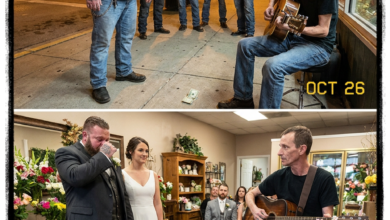
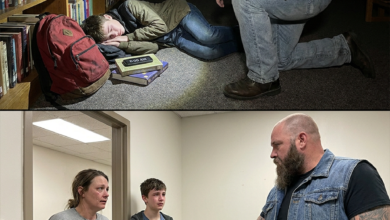
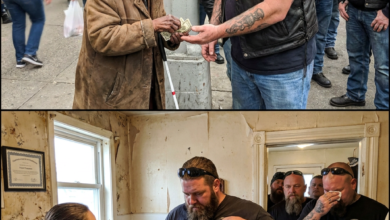
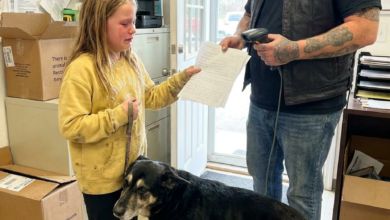
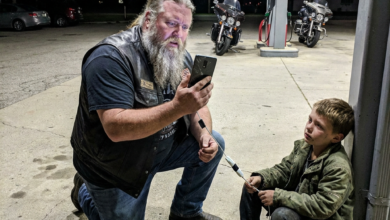
A Ten-Year-Old Bought the Cheapest Meal and Carried Half to a Park Every Day — Then a Biker Recognized the Unemployed Father Waiting There
I did not approach them that first day.
That decision bothered Dean when I reached Iron Harbor Garage twenty minutes later. He stood beside the main lift with his arms crossed over an oil-stained shirt, listening while I described the coins, the divided meal, and Daniel Bennett’s empty briefcase.
“You left them there?” he asked.
“They didn’t need an audience.”
“They need help.”
“Those aren’t the same thing.”
Dean looked toward the office windows. Beyond the dirty glass, eleven men were earning wages because Daniel had once refused to reduce them to a number.
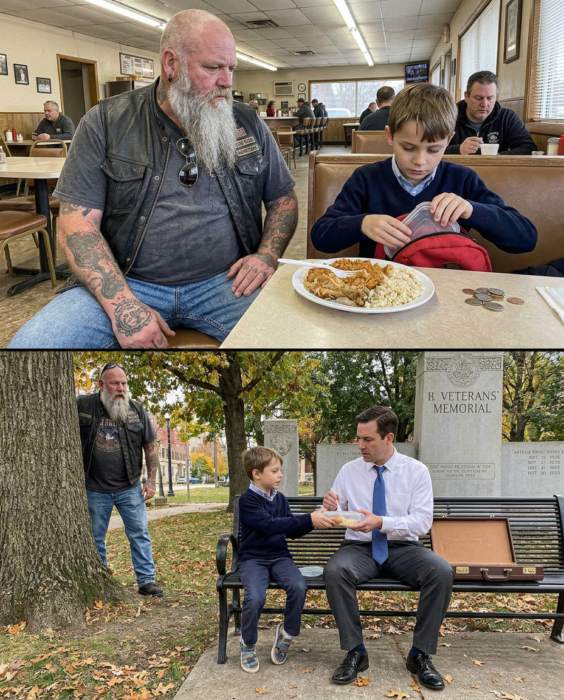
Iron Harbor had nearly disappeared six years earlier.
Our former business partner, Leonard Pike, handled taxes, payroll, and supplier payments. The rest of us handled motorcycles. That arrangement worked until an Internal Revenue Service notice appeared on a Monday morning stating that payroll taxes had not been paid for three quarters.
Pike was gone by Tuesday.
So was $186,000.
We owed suppliers, the government, utilities, and two months on the mortgage. Dean offered to sell the building. I planned to sell my Harley. Three mechanics quietly began applying at dealerships because they had children and could not survive on loyalty.
Every bank saw the same things: missing cash, tax debt, aging equipment, and a motorcycle club operating from the property.
They saw risk.
Some saw the cuts first.
At one meeting, a lending manager glanced at my tattooed hands and asked whether the garage’s “associations” created a security concern. Dean stood so quickly his chair fell backward. Daniel Bennett, then a senior commercial loan officer, picked up the chair before answering.
“Their appearance isn’t on the balance sheet,” he said.
He read everything.
Invoices. Service contracts. Tax correspondence. Payroll history. Customer records. He visited the garage after closing and watched eleven men stay unpaid to finish a delivery fleet repair because the client needed those bikes for a charity ride.
Daniel did not erase our bad numbers. He found the honest ones buried beneath them.
The loan committee rejected the application twice.
On the third review, Daniel attached a written recommendation under his own employee identification. He argued that Pike’s theft was documented, the underlying business remained viable, and eleven families would lose income if the bank treated fraud victims as fraudsters.
His manager warned that another default in Daniel’s portfolio could stall his promotion.
He signed anyway.
The $240,000 restructuring loan paid the tax agreement, stabilized the mortgage, and kept every mechanic employed. Iron Harbor repaid it fourteen months early.
We sent Daniel a plaque.
A plaque.
For years it hung inside his office at First Valley Bank. Then the bank merged with a larger regional company, management changed, and Daniel’s name slowly fell out of our conversations.
We remembered the miracle.
We forgot the man.
In the garage office, Dean called an emergency club meeting. Riders arrived from work wearing construction dust, paramedic uniforms, mechanic shirts, and warehouse badges. The V-twin rumble accumulated outside until tools hanging on the wall began to vibrate.
Sparks, our treasurer, brought the old loan file from the locked cabinet.
Daniel’s signature appeared on page forty-seven.
Beneath it was a handwritten note never shown to us during the approval process: “Character risk assessed through direct observation. Borrowers demonstrate unusual loyalty to employees and customers. I recommend approval.”
Eleven names were listed.
Mine was fourth.
“We owe him,” Mack said.
“Debt doesn’t mean we get to humiliate him,” I replied.
Sparks adjusted his glasses. “What exactly are we proposing?”
Nobody knew.
Writing a check would solve one month and injure something in Daniel that might never heal. Confronting his wife would expose a lie that was not ours to reveal. Following a child again felt wrong.
Then Luis, our bookkeeper, spoke from the office doorway.
Luis was seventy-one and had delayed retirement twice because we could not find a replacement who understood both commercial accounting and the chaos of motorcycle repair. He wanted to leave by Christmas to care for his wife.
“You need a controller,” he said.
Dean frowned. “We’ve interviewed nine.”
“And rejected nine.”
“Eight couldn’t handle the work.”
“The ninth called Grizzly ‘an HR problem’ during the interview,” Luis said.
He was not wrong.
Our controller needed to manage payroll, inventory, taxes, warranties, supplier credit, insurance audits, and the club’s community fund. We needed someone cautious enough to challenge Dean, patient enough to explain numbers to mechanics, and stubborn enough not to judge men by their clothes.
Every eye moved toward Daniel’s signature.
This was not a job invented to rescue him.
It had been waiting.
The question was whether Daniel could accept it without believing we had hired his hunger instead of his ability.
On Friday, I returned to Miller’s.
Noah sat beneath the window and opened his coin pouch. Before Jenny could speak, I slid into the opposite seat.
His hand stopped.
“You followed me yesterday,” he said.
Children always notice more than adults hope.
“Yes.”
“Did you tell my mom?”
“No.”
His shoulders loosened slightly.
“Did you tell my dad?”
“Not yet.”
“Are you going to?”
I looked at the plastic container beside his plate.
“I’m going to ask you why a ten-year-old thinks he has to hold his whole family together.”
Noah stared at me.
Then he divided the chicken.
Noah did not trust me because I had paid for one meal.
He trusted me because I did not touch the plastic box.
We sat across from each other while lunch traffic moved around us. Forks scraped plates. The kitchen bell rang. My leather cut carried the smell of oil and road dust into a room filled with gravy and coffee.
“Dad didn’t do anything bad,” Noah said.
“I didn’t say he did.”
“He lost his job because the new bank company brought its own people.”
“When?”
“June.”
It was now September.
Noah had discovered the truth during summer break. He entered the garage looking for a bicycle pump and found a bank envelope behind a toolbox. Inside were Daniel’s termination letter, insurance documents, and a list of household expenses written in red ink.
The boy understood enough.
Mortgage. Electricity. Food. Medicine.
He also understood that his mother, Sarah, was working extra shifts in the hospital laundry because she believed the family was saving for a new roof. Daniel had not told her the savings were paying bills.
“Why didn’t you show her the letter?” I asked.
Noah looked offended by the question.
“She’d be scared.”
“And you aren’t?”
He pressed the lid onto the container.
“I’m helping.”
There are words children should be allowed to use lightly. Helping should mean carrying groceries or washing dishes for allowance, not concealing a father’s unemployment and rationing chicken.
But I did not tell him that.
At 12:31, Noah stood. This time I walked beside him.
“I don’t want Dad embarrassed.”
“Neither do I.”
“You look like you embarrass people.”
“That’s fair.”
A small smile appeared, then vanished.
At Riverside Park, Daniel was not on the usual bench.
Noah stopped.
The briefcase was there, lying on its side. Papers had spilled across the concrete. One polished shoe was visible behind the bench.
Noah ran.
Daniel sat on the ground with his back against the memorial base, one hand pressed to his forehead. His face was pale, and sweat darkened the collar of his white shirt.
“Dad!”
“I’m all right.”
He was not.
His hands trembled. He had not eaten since Noah’s half portion the previous afternoon. That morning, Daniel had used his remaining cash to purchase a bus pass for a job interview that had been canceled by email while he was already traveling there.
He had walked back to the park.
The heat did the rest.
I called emergency services, though Daniel argued until he tried standing and nearly fell. Noah knelt beside him clutching the plastic container.
“This is because you don’t eat breakfast,” the boy said.
Daniel looked at the box.
Something in his face broke.
“You knew?”
Noah nodded.
“How long?”
“Since July.”
Daniel closed his eyes. His breathing changed, not from the heat but from the knowledge that every lie had been observed by the child he meant to protect.
“Does Mom know?”
“No.”
“Thank God.”
“No,” I said. “Not thank God.”
Daniel looked up at me then. Really looked.
Recognition moved slowly across his face. He saw the long beard, the neck tattoos, the Iron Harbor patch, and perhaps a younger version of me sitting in a bank conference room six years earlier with grease beneath my nails.
“Mr. Hale?”
“Grizzly works.”
“What are you doing here?”
Before I could answer, the ambulance arrived.
Sarah learned the truth in the emergency room.
There was no clean way to tell her. A nurse pulled Daniel’s insurance record and discovered his employer coverage had ended three months earlier. Sarah worked in the same hospital complex. By the time I brought Noah through the doors, she was standing beside Daniel’s bed holding the termination letter he had carried inside his briefcase.
She did not shout.
That was worse.
“You left every morning,” she said.
Daniel stared at the blanket.
“I was looking for work.”
“In a tie?”
“I had interviews.”
“Every day for three months?”
His voice became smaller.
“I didn’t want you afraid.”
Sarah held up a page of overdue notices.
“So you let our son be afraid instead?”
Daniel turned toward Noah.
The boy still carried the lunch box.
Sarah saw it.
“What is that?”
Noah tried to hide it behind his leg. The lid came loose. Half a serving of rice, beans, and chicken spilled across the hospital floor.
Nobody moved.
Sarah looked at the food. Then at her son. Then at her husband.
“You’ve been feeding him?”
Noah’s eyes filled.
“He said the bank was busy.”
Sarah covered her mouth.
Daniel tried to rise from the bed, but the monitor wires caught against his arm. His voice cracked as he apologized—to his wife, to Noah, to the room, perhaps to every version of himself that believed silence was protection.
I stepped into the hallway.
Dean and five brothers waited there. Their boots were muddy from rushing through rain. Sparks held the old loan file under one arm. Luis carried a clean shirt and a folder containing the controller job description.
“We heard ambulance,” Dean said.
“He’s stable.”
“And the family?”
“Not stable.”
We waited until Sarah allowed us inside. Six bikers filled the small room, shoulders nearly touching the curtain rails. Daniel looked from one face to another.
“This isn’t necessary,” he said.
Dean placed the loan file on the bedside table.
“Six years ago, you decided what was necessary for us.”
“That was my job.”
“No,” Sparks said. “Your committee rejected us. Twice.”
Daniel looked at the folder but would not touch it.
Dean explained that Iron Harbor needed a controller. Real position. Real salary. Health insurance. Retirement contribution. Start date negotiable.
Daniel shook his head before Dean finished.
“You followed my son, saw me in a park, and created a job.”
Luis stepped forward.
“The job existed before your pride became inconvenient.”
It was the longest sentence Luis had spoken all year.
Daniel looked at the salary page. His hands began shaking again.
Then he pushed the folder away.
“I can’t accept charity from former clients.”
Dean’s jaw tightened.
“It isn’t charity.”
“It looks like it.”
Sarah stared at him in disbelief.
Noah picked up the empty plastic box.
I knew we had reached the false ending, the place where help arrives but shame bars the door.
Daniel had once risked his reputation for eleven men.
Now he could not risk accepting their faith in him.
Daniel left the hospital that evening with instructions to eat regularly, rest, and schedule follow-up care.
He also left without the job folder.
Dean wanted to return the next morning. Sparks advised waiting. Sarah said nothing while she helped Daniel into their car. Noah sat in the rear seat holding the washed plastic container against his chest.
Before the door closed, he looked at me.
“Make him say yes.”
Children believe large men can move anything.
They are wrong.
Some weight has no handle.
On Saturday, Daniel returned to Riverside Park wearing jeans and a gray sweatshirt. For the first time in three months, he did not put on a tie. I found him on the same bench, feeding crumbs to sparrows.
I sat at the other end.
“You following me again?” he asked.
“Yes.”
“That is unsettling.”
“I hear that a lot.”
For several minutes, neither of us spoke. Traffic crossed the bridge. Somewhere beyond the trees, a Harley accelerated along Riverside Road, its exhaust fading toward the hills.
Daniel said the bank merger had begun a year earlier. New executives consolidated departments, moved commercial lending to Nashville, and eliminated local positions. He received severance, a reference letter, and thirty minutes to clear his desk.
He told Sarah that Friday had been ordinary.
On Monday, he dressed for work.
“Why?” I asked.
“She was already working overtime. Noah needed braces. The roof leaked. I thought I’d find something within a week.”
A week became a month. Each morning made the truth more expensive.
Daniel applied to forty-seven positions. Some considered him overqualified. Others wanted newer software certifications. One employer offered commission-only insurance sales. Another asked why a man who had spent eighteen years at a bank was suddenly available.
He started hearing suspicion inside ordinary questions.
“What did you do wrong?”
Nothing.
That was the cruelty.
“What happened to the plaque we gave you?” I asked.
His mouth tightened.
“I took it home.”
“Where is it?”
“Garage cabinet.”
“So you remember us.”
“I remember every loan.”
“No, you don’t.”
He glanced at me.
“You remember the ones that hurt.”
I opened the old file and showed him his handwritten recommendation. Eleven names. Eleven jobs.
“You wrote that our character mattered more than our appearance.”
“It did.”
“Our controller quit yesterday.”
Daniel turned fully toward me. “Luis quit?”
“Retired. We threw him a party and everything.”
That was not entirely true. Luis planned to retire in December, but after the hospital he had submitted his formal notice effective in four weeks. His wife needed him. We needed a replacement.
I handed Daniel three years of financial summaries with the company name removed.
“Tell me what’s wrong.”
“I’m not interviewing in a park.”
“Then think of it as proving I’m an idiot.”
“That requires no paperwork.”
I liked him more immediately.
He read the first page. Within two minutes, he asked why our parts inventory had risen while service revenue flattened. On page three, he noticed that warranty reimbursements were being recorded as retail income. On page five, he circled a recurring supplier fee Sparks had missed.
His posture changed.
The unemployed man vanished.
The banker returned.
Daniel reviewed the figures for forty minutes. He did not once ask the salary. He asked about controls, vendor terms, payroll dates, expansion debt, and whether Dean still signed blank checks when distracted.
“He stopped,” I said.
“When?”
“When Sparks threatened to break his fingers.”
“Effective governance.”
When Daniel finished, he closed the file.
“You need more than a controller. You need cash-flow forecasting, revised purchasing authority, and separate reporting for the club’s charity fund.”
“So you want the job?”
“No.”
I exhaled through my nose.
He looked toward the memorial.
“Six years ago, I recommended your loan because the business deserved financing. If I accept now, everyone will believe you hired me to repay a favor.”
“Everyone?”
“I will.”
There it was.
The only committee still rejecting Daniel was inside Daniel.
On Monday, Iron Harbor held a formal interview.
Not in the park. Not at his house. At the garage conference table where Daniel had once questioned us. Sparks prepared a structured scoring sheet. Dean invited an outside accountant from our tax firm. Two other shortlisted candidates attended at different times.
No favors.
Daniel arrived in the same white shirt and blue tie he had worn on the park bench. Noah had polished his shoes.
The interview lasted ninety minutes. Daniel challenged our expansion assumptions, identified exposure in our benefits plan, and proposed a repair-order audit that could recover thousands in unbilled labor. When Dean asked how he would handle employees who resisted financial controls, Daniel glanced at me.
“I’ve worked with bankers,” he said. “Mechanics cannot be worse.”
The outside accountant scored him highest.
Unanimously.
We offered the job again.
Daniel stared at the employment agreement. His finger rested above the signature line.
Then the garage door opened.
Noah stood there with Sarah. In his hands was the plastic lunch box.
He placed it on the conference table.
“I don’t want to use this tomorrow,” he said.
Daniel looked at his son.
Noah pushed a pen toward him.
This time, Daniel signed.
The garage erupted.
Eleven grown men shouted loud enough to trigger a car alarm outside. Boots struck concrete. Someone started a Harley in the service bay before Sparks yelled about ventilation. Dean hugged Daniel so hard his tie twisted over one shoulder.
But the real twist came later.
While completing payroll forms, Daniel asked to see the original loan file. He turned to the final page, where his own signature appeared beside an internal approval code.
Then he showed us something none of us knew.
The committee had never approved the full amount.
Daniel had.
First Valley’s regional policy allowed senior officers to issue a limited “character override” when documented community impact outweighed automated risk scoring. Using it placed the loan directly on Daniel’s performance record. If Iron Harbor defaulted, the decision could end his career.
He had not merely recommended us.
He had personally guaranteed the judgment behind us.
Eleven jobs had rested on his name.
Six years later, the man who wagered that name for us had been eating half a child’s lunch in a park because he believed needing help made him less worthy of it.
Dean closed the office door.
Every brother removed his cut.
We placed them on the conference table around Daniel’s plastic box—the symbols people had once used to judge us surrounding the small object that revealed how badly we had failed to see him.
Dean extended his hand.
“No debt between us,” he said. “Just work.”
Daniel shook it.
“Just work.”
That was how he came home.
Daniel’s first week at Iron Harbor was ugly.
He froze discretionary spending, canceled three subscriptions nobody remembered purchasing, and required written approval for special-order parts. Mechanics who had celebrated his hiring began muttering by Wednesday.
By Thursday, he discovered a payroll classification error that had cost the garage nearly $18,000 in unnecessary insurance premiums. The muttering stopped.
Daniel did not need pity.
He needed access.
He reorganized the accounting office, digitized sixteen years of vendor records, and placed a label on every drawer. One drawer remained empty except for Noah’s plastic lunch box.
The box had a cloudy lid, a cracked corner, and a faint orange stain from Miller’s beans. Daniel washed it after the hospital and intended to throw it away. Noah asked him to keep it.
“Why?” Daniel said.
“So you remember I can tell.”
Daniel understood.
The box went into the top drawer.
At home, the truth did not heal as quickly as the finances. Sarah loved Daniel, but she was angry that he had converted their marriage into a stage set: shirt, tie, briefcase, kiss goodbye.
They began counseling through the garage health plan. Daniel learned to say, “I’m scared,” before fear became a lie. Sarah learned that anger and relief could occupy the same room.
Noah stopped leaving school for lunch.
Every Friday, however, he came to the garage after classes and ate with his father. Two complete meals. Two separate containers. No dividing.
Sometimes I joined them.
The club’s debt to Daniel became a source of disagreement. Several brothers wanted to give him a hiring bonus large enough to replace his lost savings. Sparks refused.
“He earned the job,” Sparks said. “If you attach rescue money to it, you poison that.”
Instead, we corrected what the months without work had damaged. The garage advanced Daniel’s first paycheck under the same written policy available to all employees. A community housing program repaired the leaking roof at cost. Sarah added Daniel to her insurance until the garage coverage began.
Help had structure.
That mattered to him.
Three months later, Daniel presented our first complete financial forecast. He stood before men who once feared spreadsheets more than broken bones and explained cash reserves, seasonal revenue, and expansion limits without making anyone feel stupid.
At the end, he displayed a number.
Eleven.
“That was the number of jobs the loan preserved,” he said. “But it wasn’t the full impact.”
He had counted spouses, children, rent payments, school lunches, medical insurance, and local businesses supported by those wages. Forty-one people had depended directly on the garage when Daniel signed the override.
Noah sat in the back beside Sarah.
He understood numbers differently after that.
When Daniel finished, Dean handed him the old plaque from First Valley Bank. The club had retrieved it from his garage, cleaned the dust, and mounted it beside the office door.
Daniel refused to hang it.
“Wrong message,” he said.
The next morning, a new plaque appeared in its place.
It listed all eleven employees whose jobs survived the loan. Beneath their names were the words:
CHARACTER IS PART OF THE BALANCE SHEET.
Daniel allowed that one to remain.
Years passed.
Iron Harbor expanded into the adjacent building, added a restoration department, and opened an apprenticeship program for teenagers who needed work more than lectures. Daniel became chief financial officer in practice, though he preferred “the man who stops Dean buying nonsense.”
He stayed until retirement.
Noah grew up among invoices, engines, coffee, and men who saved their softest voices for children. At fourteen, he worked Saturdays sweeping floors. At sixteen, he learned payroll entry. At seventeen, he helped Daniel build a scholarship fund from the club’s annual charity ride.
The fund supported students studying accounting, finance, or small-business management.
The first recipient was not Noah. Daniel insisted on independent judges.
The second year, Noah applied anonymously with an essay about informal economies inside families—how children notice scarcity, divide resources, and protect adults through silence.
The judges selected him.
At nineteen, Noah entered the University of Tennessee to study finance. His scholarship letter bore the Iron Harbor seal and eleven signatures.
Before moving into the dormitory, he visited his father’s office.
Daniel had retired two months earlier but returned each Tuesday to advise the new controller. His desk was almost empty.
Noah opened the top drawer.
The plastic box was still there.
“You kept it nine years?”
Daniel turned it in his hands.
“It fed me longer than that.”
Noah smiled, but his eyes became wet.
“I lied about eating.”
“I know.”
“I thought you believed me.”
“I needed to.”
That answer contained the whole park bench: a father’s shame, a child’s mercy, and the quiet agreement that allowed both of them to survive until someone finally noticed.
Noah placed the box back inside the drawer.
He did not take it to college.
Some records belong where the debt was repaid.
Every September, Iron Harbor holds what we call the Half-Plate Lunch.
It is not advertised as charity.
Miller’s Diner prepares one full meal for every rider, mechanic, apprentice, bank teller, teacher, and family who attends. Each person buys a second meal for someone facing unemployment. The diner distributes the vouchers privately through the library career center, the hospital, and local schools.
No photographs are required.
No names are announced.
The first year, we funded sixty-three lunches. The ninth year, we funded more than eight hundred and added bus passes, résumé printing, and emergency grocery cards.
Daniel designed the controls.
Naturally.
He insisted that assistance remain simple enough to use without explaining one’s worst day to a room of strangers. “Hunger is already an application,” he told us.
At noon, the riders leave Miller’s and travel slowly past Riverside Park. Engines drop to an idle near the veterans’ memorial. We never stop long. Daniel disliked ceremonies centered on him.
Noah usually stands beside the old bench.
At ten, he had carried half a meal there in a red backpack. At nineteen, he stood in a university jacket holding a scholarship letter. The bench had not changed, except for one small metal plate beneath the seat.
It contained no names.
ONLY THIS:
LEAVE ROOM AT THE TABLE.
Daniel retired from Iron Harbor at sixty-five. The club gave him a watch, a framed ledger, and a restored 1978 motorcycle he claimed he would never ride.
He rode it home.
The plastic container remained in the top drawer of his old desk because the office had become part archive, part meeting room. New apprentices sometimes found it and asked why anyone preserved an ugly food box.
One of us always answered.
“That held half a boy’s lunch.”
Then we told them about the banker who once saw value behind leather cuts, the father who dressed for a job he no longer had, and the child who counted coins carefully enough to keep two people fed.
We never tell it as a rescue story.
Daniel saved the garage first.
Noah saved Daniel quietly.
We only noticed in time to return the favor.
Noah graduated with honors.
Daniel attended in the same blue tie he had worn to the park and to his Iron Harbor interview. The fabric had faded, but he refused to replace it. Sarah sat beside him. Eleven bikers filled the row behind them.
We behaved until Noah’s name was called.
Then the auditorium heard us.
After graduation, Noah accepted a position with a community development credit union that financed small businesses rejected by automated lending systems. On his first day, Daniel gave him a copy of the Iron Harbor loan file.
Page forty-seven was marked.
Character risk assessed through direct observation.
Noah framed that page above his desk.
He also established a rule: whenever a borrower’s numbers failed the standard model, someone had to visit the business before rejecting the application. Not every loan could be approved. But every person had to be seen.
Daniel visited Iron Harbor less often after retirement, though he still arrived on the first Tuesday of each month. His polished shoes had been replaced by comfortable boots. He carried no briefcase.
He always checked the top drawer.
The box remained.
One afternoon, I asked why he did not take it home.
He ran a thumb over the cracked corner.
“Because this is where I stopped pretending.”
Outside, Noah’s car entered the lot. He had brought lunch for his father from Miller’s.
Two full portions.
Daniel closed the drawer and walked out to meet him. Through the office glass, I watched father and son sit at the scarred worktable where eleven mechanics took their breaks.
Neither divided his meal.
Motorcycles rolled in from Riverside Road. Tools struck metal. Dean argued with Sparks over an invoice. Ordinary noise filled the building that should have closed years earlier.
The man responsible sat among us, eating beside the boy who once carried half a lunch through town to keep him alive and dignified.
That old plastic box still rests in Daniel’s drawer.
Not as proof that he was hungry.
As proof that somebody noticed.
Comment LEDGER and follow the page for more biker stories about quiet debts, second chances, and the people hidden behind ordinary moments.
Nobody eats half alone anymore.