A Biker Stopped A Barbershop Auction To Bid On The One Chair Nobody Had Even Put Up For Sale
At a barbershop auction in Erie, a biker bid on a stool nobody had listed. The owner’s daughter wondered what he had come back to buy.
An original fictional story.
Part 1
A BIKER INTERRUPTED A BARBERSHOP AUCTION TO BID ON THE LOW CHAIR EVERYBODY ELSE HAD WALKED STRAIGHT PAST.
“I’ll bid on that.”
Leon Voss was pointing to the squat wooden chair at the window. Nobody had put a number on it. Ruth had left it there because it was the only thing in the shop a man could jump over to get out of the rain. The delivery boys did it all the time, before somebody taught them to use the side door.
The auctioneer looked over his glasses at the chair. “Which lot?”
“It’s not a lot,” Ruth said.
She meant to talk to the auctioneer. Leon was looking at her anyway. He had a straight line of gray through the dark beard under his chin and the kind of tattoos her father used to ask people to explain after he’d finished with the clippers. Out on the street an unbranded cruiser stood where the bread truck used to stop. Through the glass Ruth could see a drop hanging from the handlebar.
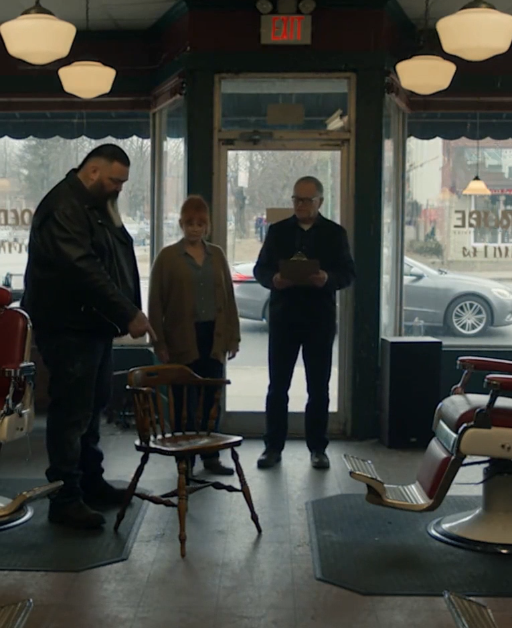
Leon walked around the chair, careful not to put his good boot on the cord leading to the auctioneer’s speaker. Ruth moved between him and the window before she could decide if the money mattered. She had been letting people walk out with her father’s tools for two hours. It was easier when somebody itemized what was leaving.
“That one’s his,” she said.
Leon put the back of two fingers on the low rail. “Mine, too, a little.”
She thought he was offering to tell her some story about why he deserved it. Then he asked if she would turn it around herself. Ruth caught the front and tipped it up on two legs. Underneath were three round depressions, cleanly bored into the wood. She ran her thumb across them. Her father’s router had left a flat crescent at the bottom of each.
Leon took a quarter out of his pocket. He didn’t set it down immediately. A woman waiting to buy the cash register craned her neck to see what he was holding. Ruth could see the shine on the rim where somebody had carried it alongside other things for a very long time.
He put it into the outside recess. It lay flush with the wood.
Ruth remembered there had always been one child at the window when she walked by as a teenager. Her father had kept an eye on the street from the big green chair in the back, almost as if he’d been waiting for that child to get close enough to see.
“He kept one empty,” Leon said.
Ruth’s eyes moved back to the remaining holes.
Part 2
Ruth put her thumb over the recess in the middle. She could feel the low edge through the skin. Her father usually left a little ridge in the wood where he knew he could fit the end of a screwdriver. In this place the edge was clean. He had meant a person to put a finger there and take something out without asking him to move.
“Which one?” she asked.
“The one in the middle.”
“What went in it, then?”
Leon looked at the auctioneer. The man had quietly stood behind the old pedicure stand while Ruth figured out whether she could lower the chair without turning it upside down again. His name was Harold. Ruth had found him through the woman from the fire hall, who told her he wouldn’t throw anything away and wouldn’t keep anything a customer didn’t pay for. He had to get the three fixtures along the back wall out before four. She saw him reach into his shirt pocket with the hand that didn’t hold his clipboard.
“Want me to take the next bid?” he asked.
“Give us a second.”
Harold made a mark on his paper. Then he moved the speaker cord so they would have a clear path to the door. Most of the buyers had come to take one or two things and spend the way out thinking about where to put them.
Leon still had his finger within a fraction of the quarter. He’d pushed it in so its tail pointed toward the front legs. Ruth used to earn quarters opening the side door for her dad’s first customers on Saturdays. She would sometimes get one if she did something worth waking up for. One of the coins spent a long time under her pillow because she didn’t know who had given it to her and couldn’t work out when to wish on it.
“You’d sit here?” she asked.
“If you’d ask your dad he might’ve told you so.”
“I don’t remember you coming in.”
“That might be because I used a different door.” Leon tried what looked at first like the beginning of a smile. “Sometimes I came in when you went out. You used to go get the bread in your dad’s car and leave your own running so the wheel wouldn’t have time to get cold.”
She remembered a lot of trips for bread. She did not remember leaving her own car running all that often. A few winters came to her at once, and she had to think of who had stopped showing up around the time she noticed her father needed more bread than he had people coming in for haircuts.
“Why did he have you come in?” she asked.
Leon reached into the right pocket of his jacket. Nothing in it made a sound when he touched the zipper. He took out a small roll of butcher paper, square at one end, with a narrow strip of masking tape around the middle. Gus had used paper like that on sandwiches for the children when their parents were coming after their shift. The tape looked new. Ruth waited for Leon to tell her who he thought ought to open it.
“There’s a name you might remember before I take this part out,” he said. “Boy used to sit outside, even when your dad had the chair empty for him. Did you know Cory?”
Part 3
Ruth told Harold to call the next lot. She put the chair upright on the floor and nodded toward the front room that had once been an office. There was an armchair, a bench under the window, and the front edge of a mirror too heavy to accept an offer from a man without measuring the width of his car. Leon let her step ahead.
“Cory Daniels?” she said when they were through the door.
“Cory Bell now. He took his stepdad’s name after his mom got married.”
“I remember him coming by. My dad used to let me play checkers if I got back before his ride came.”
Leon put the paper parcel on the bench. It had none of the tight marks he would’ve made on it if he meant it to hold a sandwich overnight. He opened the tape, then used the paper itself to lift up what was inside. It was a narrow strap with five plastic checkers stitched side by side. The end of the strap had a small metal eye.
“Cory’s mother made this,” Leon said. “She used to work at a place that cut belts from a pattern she couldn’t afford to waste. She always brought home something you could put a button through if you had any left you liked. Your dad kept this with her son’s name on it so he could put it on the chair if she had to send somebody to pick him up.”
Ruth remembered the way the checkers sat together, black then red with one of the black ones at a slant. She’d thought he made it himself, because Gus once asked her if he should let Cory take the last Black checker even when the game wasn’t finished. Some of her afternoons had been spent playing a boy who could tell her the other thing she ought to do every time she moved the wrong piece. It took patience to keep playing after somebody found you out in that way. She found it easier to believe Cory waited outside to be alone.
“Why was he getting picked up here?” she asked.
“He got picked up wherever I could tell he was going to wait,” Leon said. “I was supposed to be able to tell you your own part from there, but he told me I should make sure you remembered his name first.”
“Are you related?”
“Hard to say cleanly. We lived together, him and his mom and me, in the place behind the railroad office. Then I found a job getting that big old freight elevator to hold between floors. It wasn’t the kind of job where I could make the last bell at school. His mom had an early shift, and we thought we’d take turns losing a little time at work until a permanent thing came through. One day I ran long and found him eating a sandwich by your dad’s door at six. All the good bread was gone that late.”
“My father sent me for bread,” Ruth said.
Leon was quiet long enough to show he hadn’t been certain she would. “He was good about explaining the shape of a problem to a person whose job was to see it happen without doing much about it. I wanted to wait for him to ask me to bring something to cover the sandwich. He waited for me to ask what he would take.”
“Was it the quarter?”
“That was mine.”
Ruth picked up the strap. The sewing went through two holes in the plastic that looked as if someone had poked them with a hot nail in a room with a window. She could almost hear her dad tell whichever one of them was watching to lower the window before they asked to use the next checker. “There’s another thing in the paper,” Leon said, and unfolded the remaining corner.
Part 4
There was a photograph barely bigger than a postage stamp. In it Cory had a white sleeve over his left arm and a red and black checker strap on the right. He’d been standing somewhere bright enough for the photographer to see both hands. Ruth didn’t recognize the shirt he wore. She recognized the way he’d put his left leg back to keep it clear of somebody he’d asked to stand next to him.
“Where were you then?” Ruth asked.
“Behind the camera. I figured if I put it over long enough I could see who was coming through the door before he did. Your dad took the camera the second time and asked us to sit where we wanted to be found.”
“No one asked me to come back while you were getting the pictures.”
“You had another place to be that day.”
Ruth set the photo on the thin bench and pulled it toward the window with the side of her smallest finger. It was early enough to see a second shadow running off to the right, away from the shape that belonged to Cory, but low enough light that both shadow and photograph had to be moved twice to see how the one lay in the other. Somebody had sat in the low chair with the sun at their back. Looking down so close that she could see where a scratch to the paper went white, Ruth could make out a shoe with a blunt square toe and four old coins along the sole. She used to mark shoes like that as a girl because she couldn’t get the clips off at school after a dance and wanted to figure out which one a parent brought back.
“Is that mine?” she said.
Leon bent near the photo. “Cory wore them one morning. You lent them to him, and they sat wrong on his feet. He said he’d let you have them after he figured out what to wear to something without asking to go home first.”
“I didn’t lend a boy my shoes for something.” Ruth heard herself speak, and then stopped. She’d bought a pair at the school sale to replace the ones she actually lent. The new ones were tighter. It took a whole class period to come up with a reason to take them off where the teacher couldn’t see she’d got the size wrong.
“Why didn’t he tell me?” she said.
“He would have told you when he got them back. He got hung up on the idea you wanted him to use the ones that fit him. He couldn’t figure out how to wear them somewhere if he had to make her drive him two towns over to find a different pair.”
Ruth pulled the paper against the light. “Her?”
“His mom. He was supposed to see her new boyfriend the day we took the picture. He tried to stay in the chair because your dad had said he’d wait for him until he was ready to go. I came late. It was going to be his last afternoon with me before they moved. He thought if he could find something I needed to take apart, I would let him wait for me to finish it.”
She could remember another thing her father had told her about stopping in when there was daylight. They had started a service that would give children a haircut before anybody took a photo with the family. Ruth had never understood whose photograph had been important enough to sell the first pair of shoes. Leon had come in to see whether there was some way to buy Cory’s chair. It had been easier to ask as if he were going to carry it away from her now.
“Did my dad tell you about the empty spot?” Ruth said.
“He got it ready for my quarter every week. The other one was always waiting for a kid who had to make a choice too many people wanted to make for him.”
Part 5
Harold offered them both a cup of coffee from a machine whose pump sounded thin now that most of the chairs had been sold. Ruth told him she thought there was still half a pot in the sink. Then she came out of the office and asked one of the buyers if he had time to help her turn the low chair on its back a second time. He’d already put the hair dryer he bought into a truck. He could have gone. He picked up one end so she could get down to see the underside of the seat without bending over the chair. He put it on the auctioneer’s clean blanket and asked if she would want him to move it after Leon left.
“I might find a place for it myself,” Ruth said. “I think things have changed while I’ve been trying to get this open.”
She’d planned to empty the first room by the time the truck came and to wipe the counters again after the last load. Her father had held on to shelves so deeply scratched that the pads from his old glass jars had almost worn through. Now a customer had paid for one and left it on the counter. She could tell he wanted to pick it up later because he covered it with folded newspaper and left the metal hooks right where he would need them. It was the exact thing she’d almost asked Harold to put on the curb.
“Dad used to get in before the paper came on Saturdays,” she told Leon. “He sat in that swivel chair so he could see three directions from the window. Only it put him too far from the stove to warm his feet. He used to have me put the good socks on when he looked cold, even though I was the one standing next to the stove.”
“He knew how much change you kept in your shoe when you didn’t have a pocket,” Leon said.
“Did he use to check late?”
“He wanted me to notice. The chair’s got room for the same coin he gave you the first time. He told me to move it if you asked him to and not before.”
Ruth put the chair against the wall again. Sitting there beside the window, it would have been a place to hear traffic pass without being seen from where the ceiling dipped down. She knew six children had counted on that because she’d left toys behind the near leg at one time or another. She wanted to see whether the seat was high enough for her to stand up from without pulling on the window ledge. With Leon watching, she found she couldn’t do it. She put her hand on the ledge anyway and stood up.
“Did he ever ask you if I could take over some cuts?” she said. “I wanted to start doing it when I was fifteen. When I asked for practice, he told me to take a class.”
“He asked me if I wanted to sit for you. I said I would if somebody could tell me who was standing behind me when you got too close to an ear. He wanted me to tell you that part. I didn’t come back to ask because he moved the appointment three times. You were taking the night class by the time I found out we’d missed it.”
Ruth knew the thing that would happen if she tried to talk about that year with another person. Some of it had been good. Her father thought the downtown shop had offered her more than enough work for a first semester. She wanted him to ask her to come home after class and do something at his own table. Then they had an argument about which roads stayed open, and she stopped knowing what he thought she ought to try next.
“Cory tried to sit for me,” she remembered. “I got one bit of the right side too short.”
Leon held the photograph to the window. “What do you think his next haircut looked like?” he said.
Part 6
The little receipt under the chair was almost by accident. The head of a screw trapped a gray corner of paper. Ruth went to find a small screwdriver; Harold took one out of his pocket before she reached the counter, as if it was obvious who’d be most likely to hang onto one at an auction. After she unscrewed the near corner of the seat, the paper came off in two pieces. Leon steadied the frame without trying to stop her from reaching around the leg. Ruth teased the thin lines apart with the tip of a finger.
Somebody paid a dollar for a child’s haircut a week before the picture. On the back of the receipt Gus had written down the three times there was enough daylight to come find him. The last time was at four. Next to it he had put eleven, the number Ruth had once said she needed to save for her exam before they would let her work for somebody who paid by the hour.
“Did you pay him?” she said.
“Cory did. He asked if he’d be school-aged enough to pay a dollar for it if it’d get you back to the same spot. I thought he wanted something else out of it. Your dad put a dollar in my hand on the way home. I was the one who needed a haircut before Cory turned up the next day with his new family.”
Ruth stopped working on the screw. “That dollar was for you?”
“For you. I asked your dad the next morning and he showed me where to leave it until you wanted it. The boy thought a man would get to pick the first haircut she took money for. He was proud of the part you did long enough to make you decide not to cut it shorter. That’s about where we were when the job I wanted started at the elevator.”
Leon took the piece of receipt her father had written on. It was light enough that it moved when they both breathed. He took it in both hands and stuck the pieces together far enough to make the time legible. She could see him think about saying one more thing before he decided which word to say first. The back of his forefinger was red where he’d held up the chair until she got the little screw out.
“The one next to mine,” he said. “That’s where your dad wanted me to keep Cory’s money. I didn’t think he was going to ask for it back. I was sure he’d take it from my hand and bring it to you after I got to town. I left the quarter there because I didn’t know where he’d put that receipt. Can you check how tight the other end fits?”
The woman who had looked at the cash register walked past holding it with both wrists bent. Ruth looked up just in time to ask if she could take some of its weight. The woman said she and her husband had it. Then a thought came to her that she asked across the room before she was too far to hear the answer.
“You have another one of those in the thrift shop down the street. Do you know if it has a drawer inside?”
“I’ll have to get you in touch with the man who used to run the thrift shop,” Harold told her.
When the woman had left, Ruth turned back to the window. She put the receipt down in a clean little seam of the chair’s worn upholstery. “Did you keep the center one empty so I’d come back to pick my own customer?”
“Your dad did,” Leon said. “Out of the three of us I couldn’t figure out when I’d be ready to see who it was. Cory told me I ought to wait till you had a spot in the room where you could see everybody at once.”
Part 7
At the next lot Harold sold a standing mirror to a pair of sisters who disagreed about what shade of red the frame was. Ruth turned the little chair so the seat faced the shop. She was looking at the empty space in it when someone came to the side door and asked if he could step inside before he had to give the family in the truck a call. There was an ordinary way to answer when you knew somebody from a time before he was the man he was now. Ruth thought she’d be able to say it as soon as he stepped into the light. First she had to see what he’d been holding against his chest.
Cory Bell brought a little piece of wood with holes along the side. Ten years before he’d bought a scrap bench from a room with three other benches in a row. He’d spent three months replacing the bits of ply somebody had nailed on when the shop owner no longer wanted to get the nails out again. The end ball was the same size as the bottom of the chip the coin ran across. He’d asked Leon to give him a lift to the auction to see if he could get it to fit a piece he thought somebody might still want to put in his shop.
“I wanted to buy a work stool,” Cory said. “He asked if he could find out whether you’d give him the little one before I made it all the way through the door.”
“How was that going to work?”
“Had no idea. He thought he was going to need it for at least fifty dollars. I had a thought about leaving it in this room because I hadn’t asked you if you knew which room I’d been working in.”
His shop was where the thrift store had been. It took up a small place between the storefront and a yard where he’d once measured and marked things to get one afternoon’s privacy. He cut hair before school, too, if a family with one car had to be across town by the end of first period. The waiting area needed a place a small person could sit without being pushed up against the door. There was room for another mirror and a stool. He wanted Ruth to see it before she sold both of her father’s.
“One’s barely a chair,” Ruth said.
“My kid keeps telling me he’ll have an easier time asking where we go after the haircut if there’s someplace beside the door I can take him to.”
“Are you ready to get the place going?”
“I’ve been going two years,” he said. “Your dad knew when I got the door fixed. He called me when he got in touch with the auctioneer to ask me which of the mirrors I wanted. I thought I could choose after I decided which kind of work I’d expect somebody with more experience to do first. I left the long wall clean.”
The empty hole had been her father’s way of giving them a place to put a third coin if they were getting through the second haircut without an argument. Cory had found one outside on the sidewalk on his last afternoon and didn’t know if it would be his turn to put it in. His stepfather had offered to take him out to dinner if he came to the new house directly from school. After the rushed haircut all he wanted was not to walk into the place wearing something he’d borrowed. He bought a paper bag for the shoes and left it at the shop until he came back to get both steps on the same side of the road.
“I should have waited much longer before I took your dollar,” Ruth told him.
“Thought you already gave me a good reason to keep it,” Cory said. He pointed to the chair. “Can we both see how much room we’ve got for it before anybody decides yet?”
Part 8
Ruth went to the end of the window. The street was damp where it had stopped raining just before the sisters left with the mirror. Both of the men had turned away enough times to give her a choice about where to look. She used the last few minutes to make a choice about something neither one of them had brought in.
“Would the window at your place have enough light for this chair?” she asked.
“There’s a clean patch when the blinds come up at noon.” Cory leaned over the back of it. “I’d have to see what kind of shape it’s in under there.”
“Good shape. It has three little hollows I was thinking you might leave like they are.”
“People would probably still put coins there.”
“Some would. I can put a screw in the leg if you take it straight outside.”
Leon began to pull his quarter out of the outside hole. Ruth put her hand over the edge of the seat. It was the one thing from the sale that she wasn’t ready to see someone carry through the door until she’d asked what he was willing to keep with it. Leon found her hand without looking directly at her face. He let the coin stay.
Harold brought her the blank lot card and offered her a marker. On the back she put the name of the barbershop where Cory was working. Then she handed the marker to Cory so he could put whatever else he’d want somebody to know if they showed up on a Friday when the bus would get to the other end of town after the door was closed. He added his own hours and copied the morning shift differently for Saturdays. In the place beside the three little hollows they put the receipt with her father’s writing and packed it under the strip of tape Leon had brought.
A few days later the chair went into Cory’s shop. When he tightened the back screw, the light went through the window and touched the old quarter without quite reaching the empty hole. Cory had a first customer take his place in a borrowed booster. The boy caught sight of the small chair as soon as he had to put his coat somewhere. His mother asked him to move the coat somewhere it would stay upright. He found a hook three feet from the floor and used it.
What Ruth liked best about coming in on Saturdays was that she could see what needed doing from the chair behind Cory’s regular one. She had her license and a reputation by then, along with a wrist that didn’t always want to finish a late cut. She asked him if she’d be able to take one person some mornings and have other people ready to finish on days she got tired before she got to the back of the head. She showed him which scissors she’d bring and looked up when she heard him slide a tall chair into the place he’d meant to keep clear.
The next child in line picked up a quarter to give her. She let him sit in the low chair to do it. He asked if Cory would do his little brother’s hair the next time. He was trying out the thought of putting money in the same spot so he could ask a good question quickly, before someone had a chance to tell him what they thought he’d want.
Cory asked what kind of haircut the little brother might want. He heard him out all the way to the last detail, including how high the brother had put the star on his own front tooth. Ruth slid her own quarter into one of the holes and left it there in case the boy changed his mind about whose turn it would be.