A Biker Moved His Chair Into The School Concert Aisle When A Little Girl Raised Her Hands To Sing
When a biker slid his chair toward a school stage, a mother thought he wanted a better shot. Then she saw what her daughter was waiting for.
An original fictional story.
Part 1
A BIKER SCRAPED A CHAIR ACROSS THE SCHOOL GYM FLOOR JUST AS A LITTLE GIRL RAISED HER HANDS TO SING.
“She needs to see me.”
Glen Rourke turned the chair sideways at the open end of the front row. The scrape made it all the way to the folding stage. At the other end of the aisle, Lydia watched the woman next to her lower her phone and sigh.
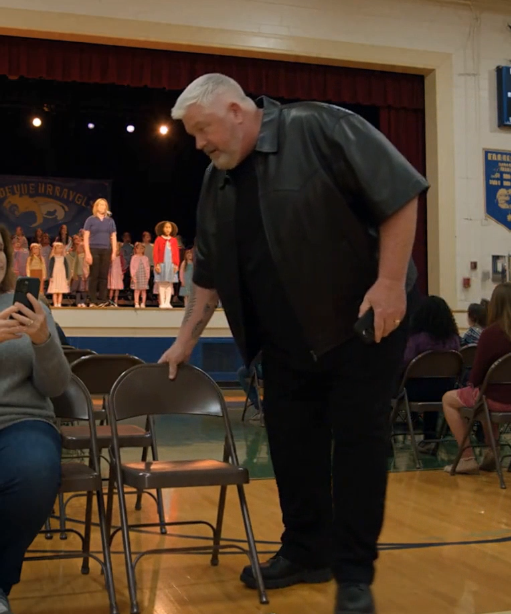
“Sir, everyone needs to see,” the woman said.
Glen looked back. He was a broad man with a softer voice than Lydia had expected from somebody who wore a short-sleeved leather jacket through a Wisconsin park in November. He sat down without answering. The school had asked adults to keep the aisle open. Lydia had been strict about that kind of rule when her daughter was the one responsible for following it. She nearly stood to point out the yellow tape. Then she realized Glen had placed his chair on the proper side of it, where one of the ushers had taped off a space at the end of the row.
He put his phone face down on his knee.
Maggie was in the second row of singers. She’d chosen a red cardigan so her mom could pick her out from the back. On Thursday she’d asked to stay another ten minutes with her teacher. The teacher had said they were going over the opening. Lydia had waited in the parking lot beside a motorcycle with a paper cup in its holder, listening to a voicemail she had been saving from her dad since March.
Onstage, Maggie parted her lips with the other kids. Her eyes went straight to Glen’s hands.
He lifted them, one at a time, and made the small opening motion Lydia knew from the nights she’d gotten up too late to talk at the dinner table. Her dad used to sign one line of a song without even taking off his reading glasses. Sometimes Lydia answered. Sometimes, once she’d turned into a teenager, she pretended to be busy with something on the floor. Part of her had always believed there would be more nights to choose from.
Maggie began to sign the song, falling into time after the first beat. There was no microphone in her hand. Glen watched her face and kept his hands low.
Lydia wanted to look toward the woman beside her and say she understood now. Then Maggie turned her eyes straight to the back row. Before she signed the next line, she used the little sign her family had always used for Grandpa.
Lydia’s hand came up off her lap.
Part 2
With both hands up, Lydia discovered she’d forgotten what to do next.
She had signed the song hundreds of times. In the years she could still talk to her father, the only part she’d been particular about was keeping the signs close to her chest where somebody could read her face at the same time. Now the motions she barely remembered came out bigger than she’d intended. She finished a little late. When she looked at Maggie again, her daughter had already turned to the next line. Her shoulders dropped a fraction. Then she took a fuller breath and kept going.
The woman on Lydia’s left didn’t turn to look at her. Lydia was grateful until she realized the woman had put her phone down too. She was trying to follow what Maggie was doing. One of the other children on the stage made a sign at the same time as Maggie, then another girl. They seemed to have practiced the chorus much more carefully than the rest of the song. Lydia could see the teacher halfway behind the folding curtain with one hand ready at her side.
When it was over, the applause got loud enough to make the edge of the curtain jump. Maggie stood on the flat stage long enough to take one of the bows the class had practiced. She almost missed her place on the way down, then saw a friend point and went right to it. Lydia had a sudden, unimportant desire to tell her she’d stood exactly in the right spot. It would have been easier than saying she wished her father had been there.
Glen stayed seated. Lydia saw him wipe two fingers above his eyes. She took a step toward the end of the row. A father in a green pullover stepped sideways so she could get past. His own child had been in the back row. There were big little favors all over the room if you waited long enough to see them.
“Mr. Rourke?”
He stood on the inside of the tape before he turned to her. “Just Glen.”
“Do we know each other?”
He was a little slower than she expected in answering. “You came to the garage once when I was working on your dad’s car.”
“I used to get a ride from a lot of people.”
“Your dad used to have a green towel between the seat and the door. You put it around his steering wheel so he wouldn’t touch the ice on it when he got in.”
She remembered the towel. It belonged to a set that had been a wedding gift. She remembered setting it up so he would find it his own way, and how careful she had been that he didn’t see her hands had gone red. She did not remember a man in a leather jacket watching. She had never asked her dad if somebody else had turned up at the garage before they got there.
“Did he teach you that song?” Lydia asked.
Glen watched Maggie with her teacher at the other end of the gym. While he was thinking, a silver-haired usher went past and picked up his chair. He went after her to lift the other end and told her there was another chair coming from behind the door. When he came back, Lydia was still standing near the tape.
“He taught me the old version,” Glen said. “I didn’t ask Maggie to do the last sign. She told me she knew one the rest of us didn’t.”
“Did he ever tell you where it came from?”
“I asked him one time. He said there was another person I should ask about it first. I thought you might know who he meant.”
Part 3
On the walk to the lobby Maggie came up to Lydia in her red sweater, sweaty through the cuffs. Three of her friends were holding their paper programs over their faces, trying to see who could tell what was happening at the far end of the room without reading lips. When Maggie got close to her mother, she stopped a few feet away. Lydia tried to find the right thing to say and had the novel experience of finding her daughter already deciding how long she would wait.
“You were good,” Lydia said.
“I left one out.”
“I didn’t notice.”
“I did.”
Lydia held out a hand, low the way she used to do in parking lots as though it mattered where her daughter saw it first. Maggie took it. They walked through the gym doors into the kind of cold that made your whole nose feel too big for your face. There was no snow yet. Somebody had put salt down anyway.
“Where did you practice with Glen?” Lydia said.
“In the music room, with Ms. Bass and Jay and the girls. He knew the version Grandpa sang after the first part. Ms. Bass signed the words she usually uses, then Glen showed us where Grandpa used something else.”
“You could’ve told me.”
“He said I could. I tried in the kitchen but you were listening to the phone.” Maggie could see Lydia remember that night. Her father had been trying to tell her not to drive over until Saturday, because the two of them usually started a fight if she tried to fit a visit in before work. He’d been laughing when he said it. It happened to have been the last message he left. In the months since he died she’d played it a few times a week.
Maggie pulled at the end of her cuff. “I thought maybe you only liked hearing him when nobody else was there.”
She had a child who knew she could ask for what she wanted and had set limits on when she would do it. Lydia was proud of that child. She wished she could have shown her the ability without making her use it on her own mother.
“What’s the sign you added?” Lydia asked.
“Grandpa. The one with the part you make up.”
Lydia nearly corrected her. She had always understood it to be a family name sign, something she’d inherited along with knowing how to tell by the floorboards whether her father was walking toward the front door in work shoes. A family sign could have an ordinary beginning. Lydia didn’t know this one’s. Thinking about it after Glen’s question made it seem unlikely she’d never been curious.
“Do you remember where I showed you?” she asked.
“You didn’t. Grandpa did.” Maggie looked from the door to the dark lot. “He made his hand go like this in the mirror. I watched him over his shoulder when he was fixing my hair.”
“What did he say it meant?”
“He said it meant somebody was going to come back from work and make me a sandwich. I thought you were the one who made it for him.”
There was a little spot of grease on the toes of Glen’s motorcycle boots. He was standing beside the curb, putting some gloves into a pocket of his jacket and taking others out. Lydia could see he was planning to leave them something she wouldn’t have to be ready to explain right away.
“Is the garage still on Linden?” she asked him.
“Turn at the empty lot,” he said. “There’s a place at the front where I keep a chair. I won’t move it unless you ask.”
Part 4
The garage smelled of a room that had been heated before anybody opened the big door: warm dust, a leaking coffee cup and the trace of oil that stayed in an old concrete floor. On Saturday Lydia found the chair propped open next to a red metal bench. Glen was behind it wearing the same short-sleeved jacket as before. Maggie had gone to make pies with her aunt. Lydia had asked if she wanted to come. She said she would the next time.
The first thing Lydia did was see her father’s picture clipped to the side of a cupboard. He was in a ball cap she’d tried to get him to replace every Father’s Day for as long as they both owned phones. He was standing behind a group of much younger men in aprons. Two of them were holding up electric mixers.
“Was that at a cooking class?”
“It was a union picnic. They had some girls from the apprenticeship program teach people to tune a motor without leaving it all over the floor. Your dad taught the girls to make angel food cake.”
“Why?” she said, and began to laugh. “He always bought the boxed mix.”
“He took the boxes out of the trash so he could show them at the next class. He wanted them to know the shortcuts.”
She hung up her coat and took the chair. Glen walked across to the cupboard, pulled the picture out and put it sideways on the bench so the overhead lights wouldn’t shine into it. There at the back, looking out of the photo while the rest of the crowd were cutting their own cake, was a man who had to be Glen. He had thick dark hair. His forearms were unmarked. He was holding a clean plate with the whole center empty.
“Tell me about you,” Lydia said.
“My folks travelled for work. I lived down the road from your dad and his sister for most of high school. Sometimes I lived in their spare room. She worked with my mother. He let me ride in the car on days I was carrying more than I could put on a bus.”
Lydia looked down. “My aunt never mentioned you.”
“Ask her about the birthday cake we put the steering wheel on.”
“Out of fondant?”
“Out of a spare steering wheel. She thought we’d leave it resting on the counter. We thought we could fit it into the middle of the cake if we used a smaller cake as a spacer. I don’t think any one of us ever spoke about it the same way again.”
On one wall the sun had faded everything around a big rectangle, leaving a brighter shape. Glen pointed to a shelf on the floor. The framed print that went on it was a photograph of two hands holding the same wrench. In the glass Lydia could see the little curve on her own head where she had brushed a new spot of gray into the darker hair. She used to think her father never noticed that kind of thing in other people.
“He thought I’d remember you?” she asked.
“He thought I’d call. I think he expected me to stop by before he had to suggest it.”
“When did you last see him?”
Glen checked the kettle behind her. He’d put out two cups before she arrived. One was glazed red with a flake missing above the handle. It looked like the mug she’d dropped on the porch about three days before the garage sent her dad home in another man’s truck.
“It was here,” Glen said. “He left the car for a young woman who hadn’t asked him for it. We thought he’d be back for it once she got it running. I was the one who made him wait.”
Part 5
Lydia had spent most of that last winter asking her father when he needed a ride. At first he’d told her when the car was getting a tune-up. Then he’d have it at the garage again, and the taxi home would come with more bags in the trunk than he’d ever take to a shop. She had pictured a generous excuse for an old man to spend too much time talking to a young mechanic. She hadn’t asked what was inside the bags. The man who’d known the answer had called her back after her father died to say the car was somewhere safe and the two of them should talk.
“My niece Anna was between jobs and trying to take a class she’d already saved half the money for,” Glen said. “Her school and her other job were across town from each other. She needed a way to get there. Your father offered his car for nothing to get it off the street in the snow. She asked what was wrong with it. He said for her it would need a new seat belt and he thought she’d be the right person to replace it under my eye.”
“Why didn’t he have you do it?”
“He wanted her to be able to answer the question next time somebody asked if she could.”
The papers for the car were in a bag with a book on winter driving, two mittens, and the mug in case Lydia had asked where it went. Glen walked around and took the mug off the bench. She could tell the unevenness around the edge came from the pavement outside her front door. She had thought her father never liked it because the handle left no room for his fingers. He’d told Glen to keep it for her if it survived the winter.
“How long after that did you see him?” Lydia asked.
“He stopped by the garage on Tuesday. It was warmer weather. Sun was on the floor. He kept bringing things in even after all he had left to bring me was the towel for the steering wheel.”
“And you asked him to wait?”
“I thought he’d watch us finish something we’d started. I wanted to tell him Anna had passed the first assessment. She was working afternoons; I didn’t know when she’d get out. He was in a hurry to meet Maggie at the music room after school. I told him I’d run her over after he saw the car, like she wouldn’t care how many people were with her when she was trying to do her part. He left before I finished asking.”
Lydia picked up the chipped mug by the rim. The kettle clicked. Neither of them reached for it at first. She had been close to certain her father had spent that Tuesday in his armchair avoiding a call he knew was coming. They’d argued the week before because he wanted her to leave the porch key on the same hook as the kitchen keys. She had taken them home so she could get into the house after his appointments without asking if his fingers were strong enough to work the latch. Her father said he had four hooks for a reason. She’d put the spare key back but never asked what the other hooks were for.
“Did you see Maggie there after school?” she asked Glen.
“No. I went in the next week with the car to congratulate Anna. Maggie was on the curb with your sister. She thought I was coming to drop off somebody who wasn’t with me.”
The text she’d found later on her dad’s phone said, simply, “I’ll sit out front.” She had spent those empty afternoons deciding it must have been an offer meant for her. Maybe he had missed a ride after all. A lot of people had needed him at the end. Lydia began to understand that he’d answered specific people in specific places for specific reasons.
“Did she tell you what they were working on?” she asked.
“Your daughter did,” Glen said. “Your father had promised to introduce her to the woman he learned the song from.”
Part 6
It was a name Lydia had heard before, Marian Field. Her father had taken Lydia to see her once when she was little. There had been a green screen door. Marian had written a dog’s name on a scrap of paper and pushed it to the edge of the table so Lydia could decide if she wanted to ask to pet him. In the kitchen, the dog had rested his head on a mat under Marian’s feet and waited. Lydia had known she’d been invited to do something very specific. She couldn’t remember how she’d known it.
Glen had her number. He did not dial it when Lydia asked to see the card. He put it on the table by the kettle and filled both cups. Lydia folded the card into her hand. There were no instructions on it about when to use the number. When she made the call, she gave her own name and asked if this was a good time. Marian’s answer was a long intake of breath and one full sentence about the dog. He was gone. The green door was brown. She wanted to know if Lydia still had a car that was comfortable enough to sit in.
Lydia went to see her on Sunday, and brought Maggie after asking if she wanted to come. This time she put her phone in the glove box. Marian had a small dog with clean white feet. Maggie sat on the floor with him until he stopped tracking every sound in the hallway. Lydia watched Marian drag a stack of music folders within reach of all three of them.
“I was ready for your dad the first time,” Marian said, “because your aunt told me all he wanted out of a class was to learn one song. He could learn twelve words he already had a tune for. He thought if he asked for twelve he’d look less like a student who needed to come early.”
“What was the song?” Maggie asked.
“The one you sang onstage. His version got pretty far from mine.”
Lydia put both hands in her lap. “Could he sign already?”
“He had some. He was in a class with his sister when she had an evening shift and could afford to give it up. He knew how to introduce himself. He wanted to be able to ask why somebody was looking so lonely. There were easier ways to ask after the song.”
Lydia thought of the shape she’d made at the concert and of her dad looking over his reading glasses. “Was the name sign something you gave him?”
Marian pushed the folders far enough forward to clear her own hands. “The piece you’re asking me about was something you did. He told me he liked the way you did it before you learned what you were meant to do.”
“I don’t remember coming here that often.”
“You didn’t. It was happening at your house. You’d stay awake until your dad got home, and all through that winter you made the same little motion at the kitchen door. He couldn’t tell whether it meant you had run out of patience or you were hungry. He used the thing you did because you did it yourself, and he was waiting for a reason to ask what you meant.”
Lydia had a few vivid fragments that would have fit a number of rooms: a low yellow bulb, a kitchen towel with a tear in it, one dark square on the wall where she’d skinned her shoulder running down the steps in a winter coat. For a moment she didn’t want anybody to lead her any closer. If the memory reached the part where she’d waited, she thought she might also have to remember who had been on the other side of the door. She hadn’t expected a person as old as her father to have once been unsure which of them was supposed to open it. Maggie looked up from the dog with a question. Lydia took the opportunity to make one of her own.
“Why did he tell you it was me?” she said.
Part 7
Marian got up from her chair. The dog turned once and let her take the step closest to the door. When she came back she carried a dark cloth album. Lydia recognized it by the corner, cut one year when her dad had tried to open a box of ornaments with a bread knife. The pictures in it had always come out once in summer and once in winter. It was usually her father’s job to hold the loose ones when she tried to get a different shot onto a page.
It was open to a photograph Lydia hadn’t seen. Her aunt was standing on the back steps in a raincoat. Lydia was in the kitchen doorway, getting ready to go to school. Her right hand was by her heart, held in a shape Lydia recognized. On the other side of the photo her father was opening the screen. The space between the dark door and the storm door was too narrow for both his shoes. He held it against his hip and reached his hand toward her.
“Your aunt brought the pictures over in March,” Marian said. “Your dad wanted to show you the ones you couldn’t figure out when you were a kid.”
“Why didn’t he?”
“He wasn’t good at the kind of question he was hoping you’d ask first. He kept asking you to bring back the car key because he wanted you to go somewhere with it. Then, when you wanted to bring him to a doctor’s appointment, he put all those feelings in the wrong sentence.”
Lydia wished she’d thought of one more thing to say to him before taking the keys home. There were a hundred things she could have said once he was out of his chair. There was the thing she should say to her daughter because it was the kind that could be said in an ordinary voice, while she was ready to look up from the floor.
“I’ve been listening to that message alone,” Lydia said. “I’d like you to come hear it with me sometime. You can tell me which part sounds like Grandpa to you.”
“Can I play the one he sent me?”
Lydia looked at her daughter. “What did he send you?”
Maggie leaned against one arm and explained that she had a video attached to the last message Grandpa sent Grandma’s old tablet. She’d been sending him little recordings of her piano homework, mostly because he asked how far she could get in a song before its end made sense. He’d sent her the sign they’d used in the gym. In the video he offered two different explanations for it. One was that he’d always thought it meant something like “are you coming in soon.” The other was that after they first taught it to Maggie, she’d made it mean “I saved your place.”
“That’s what I said in the concert,” Maggie told her mother. “I was saving his. Then you said it back. I thought maybe you were saving mine.”
Lydia reached down to put a hand in her daughter’s hair. Maggie turned toward her and let her do it for a second, then went with her whole weight into Lydia’s side. It was an awkward angle for both of them. After a moment Lydia put her second arm down. The dog eventually moved because he could see she intended to stay that way for a while. Marian went to get another cup, and at some point she went all the way to the door before she remembered the people in her living room had also asked to see a video.
Lydia asked whether they could come a second time with Maggie’s teacher. Marian said she would like that. She’d wait until someone asked her to explain how she learned the old song. Then she would want to know which version Maggie wanted to use.
Part 8
The second concert was in spring. The chairs were the same brown chairs, with two rubber feet between them that didn’t lie flat. Lydia heard the sound all the way from the far wall when she took a seat near the front. A girl down the row, a little older than Maggie, switched spots with a friend because they were hoping to see the hands of the students over the heads of the person in front. They found a place where both of them could. Lydia thought of the parent who had tried to talk Glen out of a chair the first time and left her phone in her coat pocket.
Glen brought Marian in five minutes before the singing. He carried her album in one hand and had changed into a clean jacket that still smelled faintly of the garage. When he put the album under a chair, he tipped it so nobody could catch a foot on the spine. Maggie ran down from the shallow stage with permission from her teacher. She had a yellow band in her hair this time, the red sweater in a bag to give to a cousin who was learning to ask her for hand-me-downs on her own.
Glen signed hello and asked if she had everything.
Maggie nodded. “Could you sit where she can see you?” she asked him, pointing at the girl who’d changed chairs.
He found a spot at the end of the row. One of the ushers took a chair over. Lydia asked if she could hold the album while Marian got settled. They let the girl with the yellow band make sure both rows were set. Then they watched her find her place on the stage. Her teacher gave the cue this time. Glen kept his hands still in his lap. Nobody in the room needed him to draw attention to the place where the next part was starting.
Afterward they went to the garage. Glen had offered to put the kettle on if anybody needed somewhere warm while they waited to be picked up. Anna pulled a green towel from the driver’s side of the car Lydia’s father had left. Maggie turned it over and recognized the pale shape he’d put on it by washing it around the back of a bowl two summers before the car needed a new belt.
“Should we take a picture?” Anna said. “It looks just about ready to go home.”
Lydia pulled her phone out and asked if they would wait a second. She could take a picture of the towel on its own, or take one that showed Anna holding it. If there were things the other people in the room wanted to add, they had time to get them. She saw Glen’s hand go to the cuff of his jacket. He found the patch of old grease he’d missed at the bottom of his sleeve. After a moment he shrugged and asked where she wanted him.
“Beside Maggie,” Lydia said. “There. Both of you.”
From the phone she could see Marian open the album on the bench. It was the page with the door. Lydia put the phone down for a second, called Anna back before she went to fetch her coat and asked Glen to hold the album so it faced the light. Maggie smiled when she saw what Lydia was doing. The whole afternoon she had been waiting for somebody else to ask for her picture because she had been taught that the end of the song was where her part stopped. Lydia put the camera on a timer. Then she went over to stand with them, just before it took the picture.


