An Old Veteran Aimed a Rifle at Thirty Bikers Entering His Yard—Then Their Leader Called Him by a Rank No One in Town Knew
My grandfather stood barefoot in the rain, aiming an old rifle at thirty bikers entering our yard, while every neighbor watching believed one frightened old veteran was about to start a battle nobody could stop.
I was the woman screaming from the porch.
My name is Maggie Brennan, and my grandfather was seventy-nine-year-old Walter Brennan, a retired Army veteran who lived alone outside Bellford, Kentucky, along a narrow stretch of Route 68. Most people in town called him Mr. Brennan. A few older veterans called him Walt.
Nobody called him Sergeant First Class.
Not anymore.
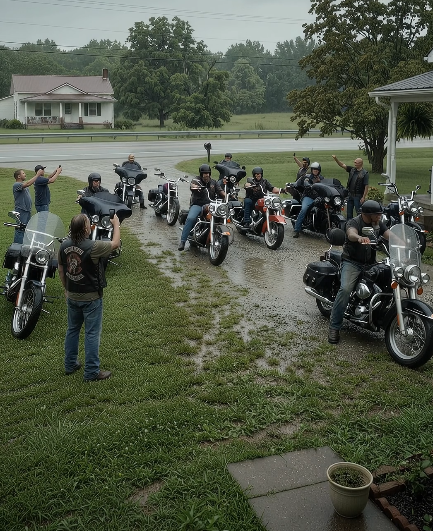
The bikers came around the bend shortly after four on a gray Sunday afternoon. Their Harley engines rolled over the fields in a deep, uneven thunder, growing louder as one motorcycle became five, then twelve, then an entire formation of black machines and leather-clad riders.
Granddad had been asleep in his recliner.
A blast from the nearby quarry had shaken the windows minutes earlier. When the motorcycles followed, something inside him broke loose from the present. He did not see our white farmhouse, the wet maple trees, or me standing beside his old blue truck.
He saw another road.
Another country.
Another column moving toward men he had failed to bring home.
By the time I reached him, he had taken the rifle from the hall cabinet and stepped into the yard. His white undershirt clung to his narrow shoulders. His military dog tags trembled against his chest.
“Turn around!” he shouted.
The lead biker stopped less than fifty yards away.
He was impossible to miss: a fifty-five-year-old Black American man, six-foot-four and broad-shouldered, with a shaved head, long salt-and-pepper beard, tattooed arms, scarred hands, faded jeans, heavy boots, and a weathered black leather vest covered in patches I could not read from the porch.
His name was Jonah “Atlas” Reed.
I did not know that yet.
I knew only that thirty bikers had entered my grandfather’s property and that the largest among them now faced a frightened man holding a weapon.
Neighbors raised phones.
Someone called the sheriff.
One rider reached toward his jacket, but Jonah lifted a hand without turning around. Every biker behind him froze.
Then Jonah switched off his Harley.
The thunder stopped.
One by one, the others did the same until rain became the loudest sound in the yard. Jonah removed his helmet slowly, placed it on the wet gravel, and stepped away from his motorcycle with both hands open.
The other riders copied him.
Thirty helmets touched the ground.
Granddad’s rifle remained raised.
Jonah did not tell him to calm down. He did not call him confused, sick, or dangerous. He looked directly at the old man and spoke as though they were standing in formation.
“Sergeant First Class Brennan.”
Granddad blinked.
Jonah repeated it.
“Sergeant First Class Walter Brennan, Echo Company. This is Staff Sergeant Reed. Your perimeter is secure.”
The barrel dipped an inch.
Nobody in our family had told him Granddad’s old rank. Even I had learned it only by reading the letters hidden beneath his bed.
Jonah took one slow breath.
“Report, Sergeant.”
Granddad’s lips moved.
His hands kept shaking.
Then the oldest biker in the second row removed a folded green scarf from his vest and placed it beside his helmet. Granddad stared at that faded cloth as if someone had opened a door forty-eight years into the past.
The rifle lowered another inch.
“You left that on Hill 241,” Granddad whispered.
Jonah’s expression changed.
“No, Sergeant,” he said. “You tied it around my arm and carried me down.”
That was when I understood these bikers had not come to threaten my grandfather.
They had come because one of them had spent forty-eight years searching for the soldier who saved him—and they were carrying a sealed wooden case bearing six names Granddad still spoke in his sleep.
Granddad did not speak about Vietnam.
That silence was so complete that, as a child, I believed his Army photographs belonged to somebody else. The young man in them stood straight beneath a hot foreign sun, lean and dark-haired, with one sleeve rolled higher than the other. My grandfather moved slowly, wore drugstore reading glasses, and spent his mornings repairing clocks at the kitchen table.
They did not look related.
After Grandma Ruth died, I began visiting every Sunday. Granddad claimed he needed no help, yet unopened mail accumulated beside the refrigerator, expired food remained in the pantry, and he sometimes forgot whether sunset meant breakfast or supper.
His memory was not failing in a simple way.
He remembered every detail from 1971.
He forgot Tuesday.
Certain sounds pulled him backward. Helicopters were worst. Fireworks came next. A diesel engine idling beyond the fence could make him check every window and refuse to sleep until dawn. He called those nights “weather,” even when the sky was clear.
“Bad weather,” he would say.
I learned not to argue.
A counselor at the veterans’ clinic called it post-traumatic stress disorder complicated by age, grief, and increasing isolation. Granddad rejected the term. He said disorders belonged to machinery and tax offices.
He attended two appointments.
Then he stopped.
I found the letters beneath his bed after a winter storm damaged the roof. They were tied with green cord and addressed to families in Ohio, Tennessee, Georgia, Texas, and Louisiana. None had stamps.
Each began the same way:
Your son followed my order. I came home.
Granddad had written different versions for decades but mailed none. Some pages were angry. Others ended in the middle of a sentence. One contained only six names written again and again until the pencil tore through the paper.
Private First Class Lewis Grant.
Specialist Thomas Cole.
Sergeant Martin Velez.
Private Raymond Holloway.
Corporal James Reed.
Medic Anthony Russo.
I asked him who they were.
Granddad took the box from my hands and locked his bedroom door.
For three weeks, he refused my visits.
That was the man the bikers were searching for.
Jonah Reed had spent most of his own adult life believing Walter Brennan died in Vietnam. His father, Corporal James Reed, served under Granddad in Echo Company. Jonah had been six when James deployed and seven when a chaplain came to the family apartment in Cincinnati.
The official letter said James died during an enemy attack while protecting his unit.
It did not say Walter carried him.
It did not say James remained conscious long enough to remove a green scarf from his neck and make Walter promise to give it to his son.
Walter never delivered it.
He woke in an Army hospital weeks later with wounds, infection, and fragmented memories. The scarf had disappeared with his field gear. By the time he returned home, James’s family had moved.
Granddad searched for several years.
Then he stopped.
Or claimed he did.
Jonah grew up with one photograph of his father wearing the scarf. He joined the Army at eighteen, served twenty-four years, and became a Staff Sergeant before an injury ended his career. After returning to Kentucky, he opened a small motorcycle repair shop and founded the Ash Road Veterans Riders.
The club was built from men and women who understood that coming home did not always mean arriving.
Some were combat veterans. Others were spouses, medics, mechanics, and adult children of service members who never spoke about their wars. They escorted funerals, repaired veterans’ homes, delivered groceries, and sat in hospital waiting rooms when families had nobody else.
Jonah never called it charity.
He called it staying on the roster.
Four months before the confrontation in our yard, the club received an old footlocker from the estate of Samuel Pike, a deceased Army supply clerk. Inside were field maps, letters, damaged personal effects, and a faded green scarf tagged with Walter Brennan’s service number.
The scarf carried dark brown stains and one stitched repair.
Wrapped inside it was James Reed’s identification tag.
Jonah sat on the warehouse floor for an hour.
Then he began searching.
Military records showed Walter had survived. An archived newspaper article placed him in Bellford, where he once operated a clock-repair shop with Grandma. Jonah called the number listed online.
Granddad answered.
When Jonah said James Reed’s name, Walter hung up.
Jonah tried again two weeks later.
Granddad told him he had the wrong man.
The club president, Hawk Bell, wanted to leave it there. A survivor had the right not to reopen what nearly destroyed him. Jonah agreed in public and continued gathering the items privately.
He found the six families.
He learned Granddad had written letters but never sent them. He discovered a Silver Star recommendation that had been lost during a records transfer and never processed. Most importantly, he located Anthony Russo, the medic listed among the presumed dead.
Russo had survived under a mistaken identity after evacuation. He lived in a care facility in Nashville and remembered Walter clearly.
“He wouldn’t leave the hill,” Russo told Jonah through a video call. “We had to carry him after he carried everybody else.”
Jonah asked whether Walter had failed his men.
Russo’s eyes hardened.
“He believes he did.”
The Ash Road Riders planned a quiet visit. No news crews. No public ceremony. They would bring the recovered scarf, James’s identification tag, written statements from the families, and a wooden case containing six brass nameplates.
They also planned to offer Granddad one thing he had never received:
Permission to report the mission over.
I knew none of this.
Jonah contacted me through a social-media account I rarely checked. His message landed in a filtered folder and remained unread. He mailed a letter, but Granddad found it first and burned it in the kitchen sink.
The club debated whether to come.
Hawk argued against arriving uninvited with thirty motorcycles. Jonah wanted only six riders, but word spread among the families. Each asked for representation. Several club members had carried letters or photographs from sons and daughters of the fallen.
Thirty became the final number.
Jonah called the Bellford sheriff’s office before the visit. A dispatcher recorded that a veteran motorcycle group planned a peaceful presentation at Walter Brennan’s residence on Sunday afternoon. The note never reached the patrol deputy working our district.
One missed message.
One quarry blast.
Thirty Harley engines approaching together.
The ingredients met in our front yard.
At 3:56 p.m., Granddad was sleeping.
At 4:02, the quarry detonated its weekly charge.
At 4:05, the first motorcycle turned onto our road.
By 4:07, Walter Brennan was no longer in Kentucky.
He was back on Hill 241, waiting for men who had already died.
I saw the rifle before I saw the motorcycles.
Granddad stood beside the porch steps, both hands wrapped around the old wooden stock. His bare feet pressed into wet grass. His eyes tracked something beyond me with a focus I had not seen in years.
“Granddad.”
He did not answer.
Then the Harleys entered the driveway.
The sound filled everything. Deep V-twins rolled against the farmhouse, barn, and low clouds. Black motorcycles turned off Route 68 in pairs, their headlights cutting through rain. From a distance, the leather vests and staggered formation looked less like visitors than an advancing force.
Granddad shouted.
“Turn that column!”
The lead riders slowed.
I ran into the yard, waving both arms. “Stop! Please stop!”
Jonah braked first.
The riders behind him stopped smoothly, but the engines remained running. Their combined rumble shook the windows.
Granddad flinched.
His finger tightened near the trigger.
I screamed at the bikers to leave.
A younger rider in the third row shouted that they should back out. Another warned that sudden movement might make the situation worse. Hawk, riding behind Jonah, told everyone to hold position.
Neighbors emerged onto porches. Mrs. Caldwell lifted her phone. Someone across the road yelled that Granddad had a gun. A pickup stopped near our mailbox, trapping the driveway.
The noise multiplied.
Voices.
Engines.
Rain.
A distant dog barking.
Granddad heard none of it as Bellford.
“Ambush left!” he shouted.
He turned slightly toward the tree line.
Jonah understood before anyone else.
He had seen soldiers lose the present. He had done it himself once in a grocery store after a stack of canned goods fell behind him. For several seconds, fluorescent lights became a transport bay, and his wife’s hand on his shoulder felt like an attacker’s grip.
She learned never to touch him unexpectedly after that.
Jonah lifted one closed fist.
The Ash Road Riders knew the signal.
Engines shut down from front to back.
One.
Three.
Seven.
Thirty.
The final Harley coughed into silence.
Rain returned.
Granddad’s eyes moved between them. Without the engine noise, the yard no longer matched what his memory had built, but the fear remained. His breathing came too fast. The rifle moved in small circles.
Jonah removed his gloves.
He placed them on the fuel tank.
Then he lifted off his helmet with slow, visible movements and set it on the gravel. Hawk did the same. The rest followed until thirty helmets formed a broken black line across the driveway.
No rider approached.
No rider reached inside a vest or saddlebag.
Jonah stood beside his motorcycle with open hands.
“Sergeant First Class Brennan.”
Granddad stared.
I stared too.
“Who told you that?”
Jonah did not look at me.
“Sergeant First Class Walter Joseph Brennan,” he repeated. “Echo Company, Second Battalion.”
Granddad’s lips parted.
The barrel dipped, then rose again.
“You’re not on my roster.”
“Staff Sergeant Jonah Reed.”
“Reed?”
“Yes, Sergeant.”
Granddad’s face twisted. “James is dead.”
“My father.”
That answer reached somewhere the engines could not.
Granddad shook his head violently. “No. No, he was twenty-seven.”
“He was.”
“I left him.”
Jonah’s voice remained steady. “You carried him.”
“I left him!”
“You carried him.”
Granddad’s hands shook harder.
Hawk whispered to Jonah that the sheriff was approaching from Route 68. Sirens could be heard beyond the bend. Jonah knew the sudden lights and commands might collapse the fragile connection.
He told a rider near the mailbox to signal the deputy to stop short and silence the siren.
The rider walked only far enough to be seen, hands raised.
The cruiser slowed.
Deputy Mara Quinn stepped out behind her door and assessed the yard. She knew Granddad from veterans’ breakfasts. She also knew shouting could make him retreat further into the memory.
She stayed near the road.
Jonah continued.
“Status report, Sergeant.”
Granddad looked toward the barn as if checking a perimeter.
“Six down.”
“Names?”
Granddad recited them.
Every one.
Lewis Grant.
Thomas Cole.
Martin Velez.
Raymond Holloway.
James Reed.
Anthony Russo.
Jonah swallowed at his father’s name.
“Russo is alive,” he said.
Granddad’s eyes narrowed.
“Don’t lie to me.”
“He’s alive, Sergeant.”
“I saw him go down.”
“He woke in Japan under another man’s paperwork.”
Granddad’s breathing faltered.
Jonah nodded toward Hawk. The older biker opened one saddlebag slowly and removed a tablet computer. He placed it on the seat, started a prepared video, and stepped away.
Anthony Russo’s face appeared on the screen.
The volume carried through the rain.
“Top,” Russo said, using the old unit nickname. “If Jonah found you, listen to him. You got me off that hill. Took me fifty years to say it because the Army misplaced both of us.”
Granddad stared.
The rifle lowered several inches.
Russo continued. “Mission’s over, Top. You can stand down.”
Granddad whispered, “Doc?”
The video ended.
Silence pressed down.
Jonah did not advance. He asked permission.
“May I step forward, Sergeant?”
Granddad looked confused by the question.
Then he nodded once.
Jonah moved a single pace.
Granddad raised the rifle again.
Every biker stiffened.
Deputy Quinn placed her hand near her holster but did not draw. I started toward Granddad, and Jonah told me gently to stop.
“He needs one voice.”
That hurt.
He was right.
Jonah returned to his position.
“No movement,” he called to the club. “Hold.”
Rain darkened his leather vest. Water ran from his beard. His hands remained visible despite the instinct every body has to protect itself.
Granddad stared at him.
“You brought a column to my house.”
“Yes, Sergeant.”
“Why?”
“To return property.”
“What property?”
Jonah nodded toward the second row.
Hawk retrieved the green scarf.
He did not unfold it. He laid it across his helmet on the gravel.
Granddad saw the faded cloth.
His knees nearly failed.
“You left that on Hill 241,” he whispered.
Jonah shook his head. “You tied it around my father’s arm.”
Granddad’s expression emptied.
Memory arrived in pieces.
James bleeding.
The scarf pulled tight.
Walter carrying him through mud.
An evacuation helicopter that could take only the living.
A medic shouting that James was gone.
Granddad removing the identification tag because he promised to return it.
Then explosions.
Darkness.
The lost footlocker.
Forty-eight years of believing he had abandoned what he actually tried to save.
The rifle barrel dropped toward the grass.
Jonah lowered his voice.
“Sergeant First Class Brennan, your men are accounted for.”
Granddad began crying without sound.
“Request permission to secure your weapon.”
Granddad’s hands would not release it.
Jonah did not step closer.
Deputy Quinn spoke from the road. “Walter, Maggie is on your porch. Your blue truck is behind you. It’s Sunday. You’re home.”
Granddad turned his head.
He saw me.
Not a village.
Not smoke.
Me.
I lifted one hand. “I’m here.”
The rifle slipped from his fingers and landed in wet grass.
Deputy Quinn approached only after Granddad stepped away. She secured it safely and moved it out of reach. Jonah remained still until she nodded.
Then Granddad collapsed to his knees.
Jonah crossed the yard.
He did not grab him.
He knelt several feet away and waited.
Granddad looked at the green scarf, then at the Black man wearing his son’s eyes.
“Reed?”
“Yes, Sergeant.”
“I’m sorry.”
Jonah’s face hardened against tears.
“Not today.”
He placed his fist against his own heart.
“You brought him home.”
We thought that was the end.
The old veteran was safe. The weapon was secured. The bikers had prevented disaster without force.
Then Hawk opened the wooden case.
Inside were six brass nameplates and an Army document bearing a recommendation Granddad had never known existed.
At the bottom was one signature.
James Reed’s.
Granddad spent that night at the county hospital.
Not because he was arrested.
Because his body had endured something his age could no longer absorb quietly. His heart rhythm was unstable, his blood pressure remained high, and he could not always distinguish Jonah from James.
Deputy Quinn documented the event without filing charges. The rifle had not been fired. Nobody had been injured. Jonah and every club member stated that Granddad was experiencing a health crisis, not issuing a calculated threat.
Some neighbors disagreed.
Their videos spread online before sunset. Short clips showed an elderly man pointing a rifle at bikers. Another showed Jonah calling him by rank. None showed the quarry blast, the years of untreated trauma, or the careful silence after thirty engines stopped.
Comments split into camps.
Some called Granddad dangerous.
Others called the bikers reckless for arriving in a convoy.
A few blamed Jonah for not leaving immediately.
The Ash Road Riders received angry calls. One charity canceled an event. Parents complained that armed veterans should not live alone. Strangers identified our address and debated Granddad’s mental health as if he were a public puzzle.
Jonah refused interviews.
“Walter ain’t content,” he said.
The club itself nearly fractured. Denny, the younger rider who had wanted to retreat, argued that Jonah endangered thirty people by holding position. He said they should have backed away and let law enforcement handle it.
Hawk disagreed.
“Backing thirty bikes at once would’ve sounded like movement.”
“Then we should never have gone.”
“Maybe.”
That word mattered.
Brotherhood did not mean pretending the plan had been perfect. They had failed to confirm that I received Jonah’s message. They had underestimated the effect of a full convoy. They had not known about the quarry schedule or Granddad’s recent worsening symptoms.
Their intention was kind.
Their arrival still became a trigger.
Jonah accepted that.
He visited me in the hospital cafeteria and placed the unopened wooden case on the table. Without the Harley, vest, and formation behind him, he looked tired rather than intimidating.
“I should’ve reached you first,” he said.
“You tried.”
“Should’ve made sure.”
I wanted to blame someone.
The quarry. The unread message. Granddad. The Army. Jonah. Myself.
Blame would have been easier than holding all of it at once.
“Why thirty?” I asked.
He opened the case.
Six brass nameplates rested inside red velvet. Beneath each was a letter from a surviving family member. Some thanked Granddad. Some asked questions. One simply said:
We never blamed you.
At the center lay the recovered green scarf, James Reed’s identification tag, and a creased military recommendation dated July 1971.
Jonah handed it to me.
The citation described Hill 241.
Walter Brennan had repeatedly crossed exposed ground to bring wounded soldiers to an evacuation point. He refused extraction until every accessible member of his squad had been accounted for. Even after suffering injuries, he continued directing support and carried Corporal James Reed over part of the descent.
The final paragraph recommended Walter for the Silver Star.
James signed as a witness hours before his death.
The recommendation never reached completion because the unit’s records were damaged and Walter was evacuated under an incorrect service number. By the time the error was found, he had left the hospital and transferred home.
Granddad never knew.
Jonah had worked with a veterans’ legal clinic to reconstruct the record. The Army review remained pending. The bikers did not come to give him a medal that Sunday.
They came to ask whether he wanted the process continued.
“He thinks medals turn dead men into decorations,” I said.
Jonah closed the case.
“Then we don’t ask about the medal.”
“What do you ask?”
“Whether he’ll read the letters.”
Granddad woke the next morning believing he was twenty-four. He asked for his platoon leader and tried to remove the hospital monitor. A nurse called security, but I asked for the veterans’ mental-health specialist instead.
Dr. Elaine Foster arrived within the hour. She spoke calmly, introduced the date, location, and people in the room, and allowed Granddad time to reorient without arguing about what he felt.
By afternoon, he recognized me.
He remembered the rifle.
Shame entered before anything else.
“Did I hurt somebody?”
“No.”
“Could have.”
“Yes.”
“Police?”
“They secured the rifle.”
He turned toward the wall. “Should’ve let them take me.”
“You were sick.”
“Men use that word when they want out of responsibility.”
Dr. Foster answered from the doorway.
“Treatment is responsibility.”
Granddad did not reply.
Jonah visited at six.
He came alone, wearing a plain work shirt. No vest. No club patch. He stopped outside the room until Granddad invited him in.
They studied each other.
Granddad saw James first. Then he saw the years between them.
“You his boy?”
“Yeah.”
“You Army?”
“Twenty-four years.”
“Rank?”
“Staff Sergeant.”
Granddad nodded. “Decent.”
It was the first almost-joke.
Jonah sat.
Granddad asked whether he had pointed the rifle directly at him.
“Yes.”
“Why didn’t you leave?”
“Didn’t think noise and movement would help.”
“That’s not what I asked.”
Jonah considered it.
“My father wrote that you didn’t leave men behind.”
Granddad’s eyes closed.
“Your father died.”
“Still brought him down.”
“Not far enough.”
Jonah placed the green scarf on the blanket.
Granddad touched it with two fingers. The fabric seemed too small to carry forty-eight years, yet there it was—faded, repaired, and marked by a field tag in Walter’s handwriting.
Then Jonah showed him the citation.
Granddad read the first paragraph.
He stopped.
His hands began to shake again.
Jonah did not call him by rank this time.
“Walter.”
Granddad looked up.
“My father’s last signature says what happened. You don’t have to believe the Army. Believe him.”
Granddad read to the end.
A tear struck the page.
He wiped it quickly, angry at the evidence of feeling.
Then he asked for the six letters.
The first came from Lewis Grant’s daughter. She wrote that her mother had received no details about the final mission and spent years believing Lewis died alone. Anthony Russo’s testimony now showed Walter remained with him.
The second came from Martin Velez’s son.
The third from James’s widow, written before she died.
Granddad could not finish that one.
Jonah read it aloud.
Walter, James told me before deployment that if anything happened, you would try to carry the whole war home on your back. Please put down what belongs to all of us.
Granddad pressed both hands over his face.
The retired soldier who once carried men through mud finally allowed somebody else to hold the words.
Jonah sat beside him.
No engines.
No rank.
Just two men breathing in the same room.
Granddad returned home under conditions he chose with Dr. Foster and our family.
The rifle left first.
Deputy Quinn transported it to my uncle’s locked safe. Granddad agreed he would not keep firearms at the farmhouse while his episodes remained uncontrolled. He hated the decision.
He kept it.
That mattered.
I moved into the spare room temporarily. Motion-sensitive lights replaced the dark path between bedroom and kitchen. The quarry added our address to its advance-notification list. Granddad began trauma-focused counseling through the veterans’ clinic and allowed his doctor to review medications that might worsen confusion.
No single change repaired him.
The changes made room.
Jonah visited every Thursday, always alone for the first month. He parked his Harley near the road and pushed it the final distance with the engine off.
The first time, Granddad watched from the porch.
“You look foolish,” he said.
“Quiet, though.”
“Could walk.”
“Could.”
Jonah continued pushing.
They sat at the kitchen table with the wooden case between them. Each week, Granddad opened one letter. Some meetings lasted an hour. Others ended after five minutes.
He spoke about Hill 241 in pieces.
The unit had been ordered to hold a ridge while another group withdrew. Communication failed. Weather prevented immediate air support. When the position became impossible, Granddad organized a descent through broken terrain.
He remembered Lewis Grant singing to keep the wounded conscious.
He remembered Thomas Cole refusing morphine because supplies were low.
He remembered James Reed losing his scarf while dragging another man.
He remembered tying it around James’s arm later.
For years, he believed six men died because he waited too long to withdraw. Anthony Russo’s statement showed the order came from higher command and that Walter repeatedly requested permission to move earlier.
The radio logs, recovered with the footlocker, confirmed it.
Granddad had obeyed an order he argued against.
Survivor guilt had rewritten that as personal failure.
Jonah never told him simply to let it go. That phrase made suffering sound like an object dropped through careless fingers. Instead, he helped Granddad identify which parts were fact, which were responsibility, and which belonged to men far above the hill.
Hawk joined them in the second month.
He arrived in a pickup.
Granddad approved.
Denny came later to apologize for arguing that the club should abandon the visit. Granddad surprised him.
“You were right to question your road captain.”
Denny glanced at Jonah.
Jonah nodded once.
Granddad continued. “Wrong reason, maybe. Right duty.”
That became part of the Ash Road Riders’ new planning policy. Visits involving vulnerable veterans required direct family confirmation, smaller arrival groups, advance coordination with clinicians when appropriate, and alternative plans if unexpected triggers appeared.
The club did not hide its mistake.
It learned from it.
That decision repaired their reputation more honestly than any press statement could. Jonah participated in one local interview only after Granddad agreed. He refused to describe the rifle moment dramatically.
“A veteran experienced a crisis,” he said. “People gave him room.”
The reporter asked whether Jonah considered himself brave.
“No.”
“Then what made thirty riders switch off simultaneously?”
“Training.”
“What made you use his rank?”
“Respect.”
“What made him lower the rifle?”
Jonah looked toward Granddad, sitting beyond the camera.
“He came back.”
The pending Silver Star review concluded ten months later. The Army approved the award based on reconstructed records, witness statements, and James Reed’s signed recommendation.
Granddad refused the ceremony.
The regional veterans’ office offered to present it at a military base. He said no.
They offered the county courthouse.
No.
Saint Matthew’s community hall.
No.
Finally, Jonah asked where the six men would have wanted to be.
Granddad answered without hesitation.
“Home.”
The award was presented in our yard.
No stage.
No reporters.
Only family representatives, the Ash Road Riders, Dr. Foster, Deputy Quinn, and Anthony Russo appearing by video because he could not travel.
The club came in six groups rather than one convoy. Each group parked near the road and pushed the motorcycles onto the grass with engines off.
Granddad noticed.
“Still looks foolish,” he told Jonah.
“Tradition now.”
The military officer read the citation. Granddad stared at the six brass nameplates instead of the medal.
When asked to speak, he stood with one hand on his cane.
“I accept this for men who followed an order I wish I had broken.”
He paused.
“For years, I remembered only who didn’t come home. Turns out home kept their names.”
He sat down.
No applause began until he nodded.
Afterward, the families approached one at a time. James Reed’s granddaughter gave Granddad a photograph of James holding Jonah as a baby. Lewis Grant’s daughter handed him her father’s high-school ring. Martin Velez’s son brought a recording of his mother speaking Walter’s name before she died.
The letters became people.
That was the real revelation.
Granddad had spent half a century imagining six families asking why he returned. None had asked that.
They had wanted to know how their men were remembered.
He could answer.
That evening, after everyone left, Granddad placed the Silver Star inside the wooden case. He did not display it on the wall.
He hung the six brass nameplates instead.
Beneath them, he placed thirty miniature motorcycle helmets carved by a club member.
I asked why thirty.
Granddad looked through the window at Jonah pushing his Harley toward the road.
“Because they knew how to stop.”
The next year, the Ash Road Riders returned on the anniversary of Hill 241.
This time, Granddad knew they were coming.
He stood at the end of the driveway wearing pressed khaki pants, an Army jacket, and the green scarf folded inside one pocket. His hands still trembled, though less than before.
Thirty motorcycles waited beyond the bend.
They did not enter together.
Jonah rode in first.
He shut off his Harley beside the mailbox, removed his helmet, and placed it on the ground. Hawk followed. Then Denny. One by one, the riders rolled into the yard and silenced their engines.
The ritual took twelve minutes.
Granddad watched all of it.
When the final engine stopped, Jonah called across the grass.
“Sergeant First Class Brennan.”
Granddad straightened.
“Staff Sergeant Reed.”
“Request permission for the unit to enter.”
Granddad looked at the helmets, the leather vests, and the men and women who once appeared as an advancing enemy in a memory he could not control.
“Permission granted.”
The club carried six empty chairs onto the lawn. Each brass nameplate rested on one seat. Anthony Russo joined through a tablet placed on the seventh.
Nobody gave a speech about healing.
They ate barbecue.
Granddad complained that the beans were too sweet. Hawk accused him of putting ketchup on brisket. Denny lost three dollars to him in a card game.
Ordinary sounds replaced the old ones.
Laughter.
Forks against paper plates.
Boots in grass.
At sunset, the quarry gave its scheduled warning and conducted a small blast miles away. The windows trembled faintly.
Granddad froze.
Jonah did not touch him.
“Bellford, Kentucky,” he said.
Granddad breathed.
“Sunday evening,” Maggie added.
Granddad looked at us.
“Barbecue’s terrible.”
Hawk smiled. “He’s back.”
The motorcycles departed in pairs. Engines started only after reaching the road. Their rumble faded along Route 68 rather than advancing toward the house.
Granddad remained beside the mailbox until the last taillight disappeared.
Then he picked up Jonah’s forgotten glove.
He knew Jonah had left it intentionally.
Inside the cuff was stitched one word:
HOME.
Granddad carried it to the porch and placed it beside the wooden case.
Every anniversary after that, another rider left a glove.
Granddad never returned them.
Granddad lived four more years.
PTSD did not vanish. Some nights still carried him backward. Treatment helped him recognize the road home sooner, but memory remained capable of opening doors without permission.
He kept going.
He attended counseling. He called Jonah when the weather turned bad inside his head. He recorded the complete story of Hill 241 for all six families and corrected himself whenever guilt tried to replace fact.
The final recording lasted eleven hours.
He ended it with two words.
“Report complete.”
When Granddad died at eighty-three, the Ash Road Riders escorted him along Route 68. There were no surprises this time. The sheriff closed intersections. The quarry suspended blasting. Every family knew the route.
Thirty motorcycles entered our yard before dawn.
One by one.
Each engine stopped.
Each helmet touched the ground.
Jonah stood beside Granddad’s empty porch chair wearing the green scarf around his arm. His beard had gone almost completely white.
The Silver Star rested inside the wooden case. The six brass names remained on Granddad’s wall. We buried him with none of them because he said dead men should not take home what living people still needed.
At the cemetery, a military honor guard folded the flag.
Jonah accepted it for the club and carried it to me.
“He called you Staff Sergeant until the end,” I said.
Jonah looked toward the casket.
“I called him Walter.”
After the service, the bikers remained while everyone else left. They formed a half-circle around the grave but did not start their engines.
Jonah removed his helmet.
“Sergeant First Class Brennan,” he called, voice breaking against the Kentucky hills. “All personnel accounted for.”
Thirty riders answered.
“Report complete.”
Then the Harleys started.
Not together.
One after another, like heartbeats returning through rain.
Follow our page for more unforgettable biker stories about misunderstood veterans, tested brotherhood, quiet courage, and the people who help someone find the present without shaming the past.
The last rider carried him home.