Part 2: An Old Man Mowed the Whole Neighborhood for Free for Years — Then a New Family Accused Him of Trespassing
The police officer who arrived was young enough to be Harold’s grandson.
His name tag read Ellis, and he stepped out of the cruiser with the careful expression of someone hoping a small complaint stayed small.
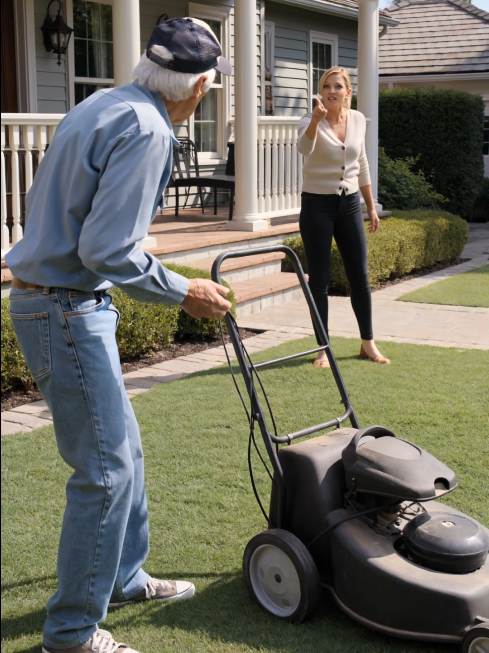
Ryan Miller met him at the curb with his phone still in his hand.
The video was ready.
Melissa stood behind him in a cream sweater, arms folded tight, her face flushed with the kind of fear that quickly becomes anger when there is an audience.
“He came onto our property before sunrise,” Ryan said. “With a machine. We have cameras.”
Officer Ellis looked toward Harold.
The old man stood beside the mower on the edge of the lawn, one hand on the handle and one hand holding his faded cap.
His work shirt was damp at the collar.
His jeans were patched at one knee.
A pair of grass-stained sneakers pointed inward slightly, like even his feet were trying not to take up space.
“Sir,” Officer Ellis said gently, “is this your mower?”
“Yes, officer.”
“And did you enter this property without permission?”
Harold looked at the cut grass, then at the brick house, then at the couple by the driveway.
“Yes.”
Melissa made a small sound of disbelief.
Ryan lifted his phone higher.
“There. He admitted it.”
Harold did not defend himself.
That was the first strange thing.
Most people rushed to explain when police stood in front of them.
Harold only rubbed one thumb over a small silver wedding ring hanging from a chain around his neck.
Mrs. Alvarez, who lived across the street, noticed that.
She was seventy-four, with dark brown skin, silver hair pinned in a bun, and a cane she used only when strangers were watching.
She had watched Harold mow her yard for six years after her hip surgery.
She opened her front door, but did not step out yet.
Not until she saw Officer Ellis reach for his notepad.
Then she came down her walkway slowly.
“Officer,” she called. “That man has permission on my property.”
Ryan turned.
“That’s irrelevant. This is my property.”
“It’s not irrelevant,” Mrs. Alvarez said. “Not on this street.”
Behind her, another door opened.
Then another.
Willow Creek Lane began waking up in a way Ryan and Melissa had not expected.
A Black American man in his sixties named Otis Grant came out holding a manila envelope.
A white woman in her late forties, Sarah Paulson, stepped off her porch with a toddler on her hip.
An older white widower named Mr. Wexler crossed the street in bedroom slippers, carrying something wrapped in a dish towel.
Ryan looked annoyed.
Melissa looked uncertain.
Harold looked at the sidewalk, as if every approaching neighbor made him smaller instead of safer.
Officer Ellis noticed that too.
“Mr. Bennett,” he said, “do you mow several lawns here?”
Harold nodded.
“How many?”
Harold hesitated.
“Depends who needs it.”
Ryan let out a sharp laugh.
“That is not an answer.”
Harold looked at him for the first time.
“It’s the only one I have.”
The quietness of it bothered Melissa more than anger would have.
She had expected excuses.
A confused apology.
Maybe a cranky old man claiming the neighborhood used to be different.
Instead, Harold looked embarrassed, not entitled.
Mrs. Alvarez reached the curb and held up a small photograph.
It showed Harold in younger years, kneeling beside a flower bed while her late husband sat in a wheelchair nearby.
“My Carlos had ALS,” she said. “Harold cut our grass for two summers when I couldn’t leave him alone inside.”
Ryan shifted his weight.
“I’m sorry about that, but this has nothing to do with today.”
Otis Grant stepped forward.
“It has everything to do with today.”
He opened the manila envelope.
Inside were handwritten notes, old thank-you cards, and a grocery receipt from eight years earlier.
“After my wife died,” Otis said, “I didn’t come outside for three months. Harold cut my lawn, trimmed my hedges, and left soup on my porch.”
Harold’s face tightened.
“Otis.”
“No,” Otis said softly. “You don’t get to disappear today.”
That was the second strange thing.
The man everyone said had trespassed seemed more uncomfortable being praised than being accused.
Sarah Paulson bounced her toddler on her hip.
“He mowed mine when my husband was deployed,” she said. “I never asked. I came home from the hospital with a newborn and found the yard done.”
Melissa glanced at the toddler, then away.
Mr. Wexler finally unwrapped the dish towel.
Inside was an old mower blade, rusted along the edge.
“Harold used this when my Martha was dying,” he said. “Wouldn’t take a dime, not once.”
Officer Ellis lowered his pen.
Ryan looked around and saw, for the first time, that this was not a dispute between him and one old man.
It was a history he had stepped into without reading the street.
Still, he tightened his jaw.
“That may be nice,” he said, “but we never gave permission.”
Harold nodded.
“He’s right.”
Everyone turned to him.
His voice was dry and tired.
“I should have asked.”
The admission landed strangely.
It should have made Ryan look right.
Instead, it made Harold look more honest.
Officer Ellis closed his notepad halfway.
“Mr. Bennett, why did you mow this yard?”
Harold looked toward the Miller house, then toward the front window, where a little boy’s face had appeared between the curtains.
The boy looked about seven, with sandy hair and wide eyes.
Harold’s gaze softened so briefly that Melissa almost missed it.
Then he said, “I thought the house was still empty.”
Ryan frowned.
“You thought our cars were decorations?”
Harold lowered his cap.
“No, sir.”
He stopped there.
But Mrs. Alvarez had seen the way he looked at the child.
And she suddenly remembered the small blue bicycle Harold had placed beside his garage two weeks earlier.
The one with training wheels.
The one that did not belong to any grandchild she knew.
Something did not fit.
Not yet.
Officer Ellis asked everyone to take a breath.
That was the polite version.
What he really meant was that the street had become too full of years.
Ryan still wanted a report filed.
Melissa wanted privacy restored.
The neighbors wanted Harold left alone.
Harold wanted the ground to open quietly and let him step inside without bothering anybody.
Then the Miller boy came outside.
His name was Noah.
He wore dinosaur pajamas and held a small inhaler in one hand.
Melissa turned quickly.
“Noah, go back inside.”
But he had already seen Harold’s mower.
“Mom,” he said, “that’s the man from the hospital garden.”
The street went quiet.
Harold closed his eyes.
Ryan looked at his son.
“What did you say?”
Noah pointed at Harold.
“He fixed the flowers outside the kids’ wing.”
Melissa’s face changed.
Their family had moved to Willow Creek Lane for the school district and the hospital nearby.
Noah had spent months in treatment for a rare respiratory condition, in and out of pediatric care.
He had been brave in the way children are brave because they do not know how unfair life can be.
Melissa knelt beside him.
“You know him?”
Noah nodded.
“He never talked loud. He gave the nurses tomatoes.”
A few neighbors smiled through their confusion.
Harold looked at the mower handle like it could save him.
Officer Ellis turned to him.
“Mr. Bennett?”
Harold exhaled slowly.
“I volunteer at the hospital grounds on Tuesdays.”
“You mow there too?” Ryan asked.
“Some.”
Noah stepped closer before Melissa could stop him.
“You put the turtle rock back after the storm.”
Harold nodded, barely.
“Couldn’t leave him upside down.”
That small sentence did what all the neighbor speeches had not done.
It made Melissa see Harold outside the shape of accusation.
Not as a trespasser.
Not as a nuisance.
As a man who noticed a turtle rock in a hospital garden because a sick child might notice it too.
Otis looked at Harold.
“You never told us about the hospital.”
“Wasn’t a secret.”
“That is exactly your kind of secret,” Mrs. Alvarez said.
Officer Ellis asked the question more softly this time.
“Mr. Bennett, is there a reason you started mowing lawns for free?”
Harold’s hand moved again to the wedding ring on the chain.
The whole street seemed to lean closer.
He did not look ready.
But Noah was watching him, and that changed something.
“My wife, Ellen, used to say a messy yard was the first thing people judged,” Harold said.
His voice was thin, but steady enough.
“She got sick the year I retired. Cancer. Fast at first, then slow in all the cruel ways.”
Nobody interrupted.
“Our grass got knee-high that summer. I was inside changing sheets, counting pills, trying to make soup she could swallow.”
He looked toward the Miller lawn.
“One afternoon, I heard a mower outside. Thought I was losing my mind.”
Mrs. Alvarez wiped her cheek.
Harold continued.
“By the time I got to the window, every man on this street was in my yard. Carlos, Otis, Wexler, even young Danny from three houses down.”
Otis lowered his head.
“They cut the grass, trimmed the hedges, fixed the flower bed, and left before Ellen woke up.”
Harold smiled faintly.
“She looked out and said, ‘See, Harry? The world still has hands.’”
That line moved across the street without needing volume.
Harold swallowed.
“After she passed, I didn’t know what to do with my mornings. So I started with Carlos’s yard. Then Otis. Then whoever had too much happening behind closed doors.”
Ryan’s phone slowly lowered.
Harold glanced at him.
“I wasn’t trying to claim your property. I was trying not to miss someone who needed help.”
Melissa looked toward her son’s inhaler.
The sentence found something in her she had been guarding too tightly.
Because the Miller family had needed help.
They had moved into the neighborhood while exhausted, frightened, and proud.
Noah’s hospital bills had swallowed their savings.
Their polished cars were leased.
Their matching porch furniture had been staged by the realtor.
Their life looked neat from the street because Melissa was terrified of looking fragile.
That was one of the smaller twists nobody expected.
The family who accused Harold of crossing boundaries had built their whole month around hiding how close they were to breaking.
Noah tugged at his mother’s sleeve.
“Mom, he’s nice.”
Melissa closed her eyes.
Ryan looked at the neighbors and saw what they had carried out of their houses.
Photos.
Cards.
Receipts.
Old objects.
Proof of a man doing quiet repairs in people’s lives.
But pride is often the last thing to leave a porch.
“You still should have asked,” Ryan said.
The words were true.
They were also too small for the moment.
Harold nodded.
“I know.”
That answer took the fight out of Ryan faster than anger would have.
Then Sarah Paulson spoke.
“She asked him to keep doing it.”
Ryan turned.
“Who?”
Sarah looked at Harold, asking permission with her eyes.
He shook his head once.
But Mrs. Alvarez stepped in.
“Ellen.”
Harold went still.
Sarah adjusted the toddler on her hip.
“Before she died, she made a list. Houses where people might need watching over. Not spying. Just noticing.”
Otis opened the envelope and pulled out a folded sheet.
The paper was old, the ink faded, the edges soft from being handled.
At the top, in careful handwriting, was written: “For Harry, when mornings get too quiet.”
Harold’s face changed.
“Where did you get that?”
“Ellen gave copies to three of us,” Otis said. “She knew you’d pretend you were fine.”
The street held its breath.
Mrs. Alvarez looked at Melissa.
“Your house was empty when Ellen wrote the first list. But that corner yard always mattered to her.”
“Why?” Melissa asked.
Mr. Wexler answered this time.
“Because that was where Ellen lost her son.”
Ryan frowned.
Harold’s hand tightened on the mower handle.
A new silence fell.
Not the uncomfortable kind.
The reverent kind.
Harold spoke because there was no hiding now.
“Our boy, Michael, was nine,” he said. “Long before most of these houses were remodeled. He chased a baseball into that corner lot.”
Melissa placed one hand over her mouth.
“A driver didn’t see him.”
Noah looked confused, but he understood enough to step closer to his father.
Harold kept his eyes on the grass.
“Ellen planted daffodils there every spring after that. When the old house was torn down and this one was built, she asked me not to be bitter.”
His voice almost broke.
“She said, ‘If a family ever lives there again, make sure the yard looks loved.’”
That was the twist that finally undid everyone.
The lawn Ryan called private property had once been the ground where Harold’s family split in two.
And for years, Harold had not treated it like a wound.
He treated it like a place someone else’s child might come home to.
Melissa began crying quietly.
Ryan looked at the stretch of fresh-cut grass near his driveway, suddenly unable to see it as evidence.
Harold put his cap back on.
“I crossed a line today,” he said. “I’m sorry for that.”
He reached for the mower cord.
“I won’t come onto your property again.”
Noah stepped forward.
“Can he still fix the turtle rock?”
Melissa pulled him close and whispered his name.
Ryan said nothing.
But the neighbors heard the answer in what he could not say.
Officer Ellis cleared his throat.
“I don’t see a need for charges if everyone here can agree this won’t happen again.”
Ryan nodded stiffly.
Harold nodded too.
The police cruiser left.
But the neighborhood did not.
Not yet.
Mrs. Alvarez took the folded list from Otis and placed it in Melissa’s hands.
Melissa read the first line again.
“For Harry, when mornings get too quiet.”
Her tears fell onto the paper before she could stop them.
For the first time since moving in, she looked around Willow Creek Lane and saw more than lawns.
She saw people who had been held together by small, repeated acts.
The kind nobody notices until someone tries to stop them.
The Millers did not move away immediately.
Shame does not always pack boxes overnight.
For a while, they tried to make things normal.
Ryan deleted the video, but not before many people had saved it.
Melissa brought store-bought muffins to Mrs. Alvarez, who accepted them with kindness and no performance.
Noah waved at Harold every Thursday morning from the front window.
Harold waved back, but he never crossed the Miller property line again.
He kept his promise.
That was almost harder for the Millers than if he had stayed angry.
Every Thursday, they watched him mow Mrs. Alvarez’s yard, then Otis’s, then Mr. Wexler’s narrow strip near the mailbox.
He moved slower now.
Sometimes a teenager from down the block helped push the mower up the slope.
Sometimes Sarah’s husband brought him lemonade and pretended it was extra.
The street continued around the Miller house like water around a stone.
No one was cruel.
That made the distance more visible.
One Saturday in late spring, Ryan found Noah sitting on the porch steps, staring at a patch of weeds near the corner fence.
“What are you doing, buddy?”
Noah pointed.
“Mrs. Bennett’s flowers used to be there?”
Ryan sat beside him.
“I think so.”
“Can we plant some?”
Ryan looked across the street.
Harold was in his garage, sharpening a mower blade with careful, patient strokes.
For a moment, Ryan seemed ready to call out.
Then he stopped.
Some apologies need more than witnesses.
The next morning, Ryan and Melissa planted daffodils along the corner of their yard.
They did it badly.
The rows were uneven.
The soil clumped.
Noah got dirt on his pajamas, and Melissa laughed for the first time in weeks.
Harold saw them from his porch.
He did not walk over.
He only removed his cap and held it in both hands.
Two months later, the Millers sold the house.
The official reason was Ryan’s job transfer.
Maybe that was true.
Maybe it was only easier to say.
On their last morning, Melissa crossed the street with Noah and a small envelope.
Harold was coiling his garden hose.
She waited until he finished.
“I’m sorry,” she said.
He looked at her kindly.
“I know.”
Melissa handed him the envelope.
Inside was a photograph of the new daffodils blooming along the corner fence.
On the back, in Noah’s uneven handwriting, were five words.
“We kept the yard loved.”
Harold read it twice.
His eyes did not spill over, but they came close.
Noah hugged him around the waist before anyone prepared for it.
Harold stood stiff for half a second.
Then his old hand settled gently on the boy’s back.
“Take care of your breathing,” he said.
Noah nodded.
“Take care of your mower.”
That made Harold smile.
After the moving truck pulled away, Willow Creek Lane felt too quiet for a while.
The new owners arrived three weeks later, a young couple with a baby and no idea why daffodils lined the corner fence.
On their first Thursday morning, Harold walked to the edge of his driveway and looked across the street.
Mrs. Alvarez joined him with two cups of coffee.
“You going to ask this time?” she said.
Harold smiled at the grass.
“I was thinking about it.”
Across the street, the young mother stepped onto the porch, bouncing the baby against her shoulder.
Harold lifted one hand.
“Morning,” he called. “I’m Harold Bennett. I help with lawns around here, but only if folks want me to.”
The woman smiled, tired in the honest way new mothers are tired.
“That might be the nicest sentence I’ve heard all week.”
Harold looked down the street, where Otis was already pulling his mower from the shed, and Sarah’s teenager was carrying a gas can.
The world still had hands.
Later that afternoon, Harold placed the photograph from Noah on the shelf beside Ellen’s picture.
In the photo, the daffodils leaned slightly in the wind, uneven and bright.
Harold touched Ellen’s frame once, then went outside to clean the mower before Thursday came around again.
Follow this page for more heartfelt stories about quiet kindness, misunderstood people, and the moments that bring a neighborhood back together.