Part 2: An Elderly Woman Was Threatened With Police Over an Unpaid Loaf of Bread — Then an Aging Biker Recognized the Teacher Who Had Kept Him Fed
Part 2 — The Name I Hadn’t Said in Years
“Mom? Ruth?”
The woman coming down the aisle had flour on one cuff and fear all over her face. She was carrying a reusable grocery bag and moving fast without quite running, as though she already knew sudden movement might make the situation worse.
“Mom, I was right there. I was helping that gentleman pick up his things.”
The old woman reached for her. Not dramatically. Two fingers extended from the arm of the chair, and her daughter took them before setting anything else down.
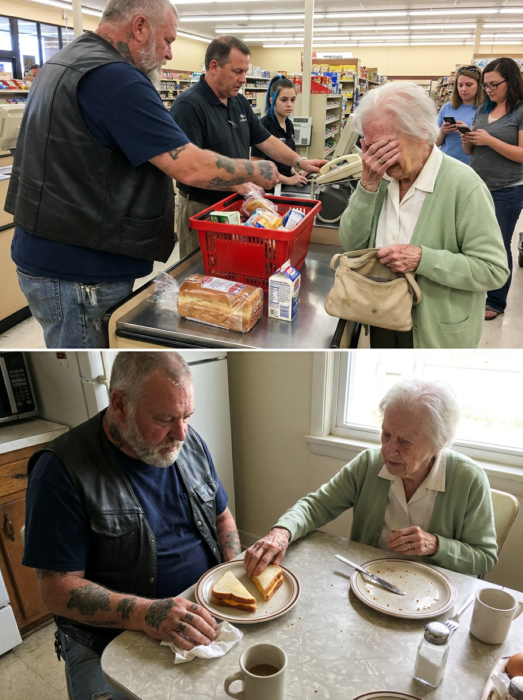
“I paid,” she said.
“I know you were trying to.”
The daughter introduced herself as Janie. Her mother had come shopping with her because choosing groceries was something she still enjoyed. Janie had stopped to help a customer whose basket spilled near the baking supplies; during those few minutes, her mother had gone ahead to the checkout.
The milk had been scanned. The loaf in her handbag had not. When the cashier noticed it, her mother couldn’t explain what had happened, and the manager had come over before Janie heard the raised voices.
“She has memory problems,” Janie said quietly. “Please stop asking her the same question.”
I watched the manager’s face. His certainty didn’t disappear, but something less comfortable moved underneath it. He looked down at the bread, then toward the customers who were still waiting for him to do something worth recording.
Ruth. I had heard the daughter clearly. But it was a common name, and old memories sometimes dragged strangers into clothes that didn’t fit them.
I needed one more piece.
“Excuse me,” I said to Janie. “Did your mother ever teach school?”
Before she could answer, the manager said, “Sir, I need you to step away from my register.”
I did. Two steps. Enough to make clear I wasn’t blocking anybody, not enough to leave the woman alone with him again.
The cashier stood beside the chair. Her badge said Lucy. She looked about nineteen, with a streak of blue in her hair and the tight expression of someone who had asked for help and gotten a bigger problem instead.
“I didn’t say she was stealing,” Lucy said. “I said there was one more item.”
That mattered. I could see it mattered to her that someone heard the difference.
Janie took her mother’s handbag and asked permission before looking inside. There was a wallet after all, tucked beneath the handkerchief. Her mother had forgotten which pocket she used and had been searching the others while the questions piled up.
“I have money,” Ruth said when Janie found it.
Nobody answered fast enough.
“I have money,” she repeated, a little louder.
I had spent years working around machinery. I knew the difference between a noise you could ignore and a noise that meant something inside was coming apart. That sentence hit me like the second kind.
“Ma’am, I believe you,” I said.
She looked at me suspiciously, then down at my boots. I wore steel-toed riding boots because old habits stuck. They were dusty from the shoulder of the highway, and one lace had been repaired with a knot.
Her eyes stayed on that knot.
For a second, I was eight years old again, standing beside a classroom radiator with one wet sock and pretending I wasn’t cold.
Janie finally answered my question. “Yes. Elementary school. For thirty-six years.”
“Which one?”
“Franklin, mostly.”
There it was. Not certainty yet, but close enough that I had to put a hand on the counter.
I hadn’t thought about Franklin in years without stopping the thought halfway through. The building had been demolished, the neighborhood changed, my parents buried. I had learned to keep childhood filed under things that couldn’t be repaired.
The woman in the chair rubbed her thumb across her palm. I remembered chalk dust caught in that same crease. I remembered a hand coming down beside a blue metal lunchbox, never opening it until I nodded.
“What’s her last name?” I asked.
“Whitcomb.”
My mouth went dry.
Mrs. Whitcomb had worn her hair dark and pinned up. This woman’s hair was white and thin enough to show scalp in the overhead light. The younger woman had moved quickly between desks; this one needed her daughter’s hand to feel steady in a chair.
But there was a small crescent-shaped notch in her left eyebrow, and when she frowned, one side of her mouth tucked in before the other.
Time had changed almost everything. It hadn’t changed those.
I wanted to say my name. I wanted recognition, some clean little reunion that would turn the whole rotten afternoon into a scene I could understand.
Instead, she looked at the manager and asked, “Am I allowed to go home?”
That brought me back.
This wasn’t my reunion. It wasn’t my chance to tell an old story before the audience wandered away. A frightened woman was asking whether she could leave a grocery store.
“Yes,” Janie said, with a firmness that made the manager glance up. “We’re settling the bread, and then we’re going home.”
I picked up the loaf and laid it gently in front of Lucy’s scanner.
“Please ring it up.”
The manager started to speak. I held up one hand, low, without pointing.
“After she’s comfortable,” I said. “Whatever else you need to say can wait until she’s comfortable.”
Behind me, somebody muttered that I was making a big deal out of nothing. I turned just enough to see the phone in his hand.
The screen was still aimed at her face.
Part 3 — The Bread Was Still in the Store
“Please stop recording her,” I said.
The man shrugged. “We’re in a store.”
“I know where we are.”
I didn’t reach for his phone. I didn’t touch him. Forty years earlier, I might have mistaken either of those things for helping, and the result would have been one more frightened person and a story about me instead of her.
Janie moved between the camera and her mother. Lucy shifted the chair so Ruth faced the service counter rather than the line. Small movements. No speeches. The kind of help a person could actually use.
A woman near the candy display put her phone in her purse. The man kept his up another second, then lowered it with the irritated expression of somebody who believed embarrassment was a public resource.
I couldn’t make him delete anything. I could stop giving him a clear view.
The manager said, “I have a responsibility here.”
“So do I.”
He looked at me more carefully then. “Are you family?”
That question nearly undid me. I had been handed an easy opening, the sort of opening men in stories filled with one perfect sentence. What came out instead was the plainest truth I had.
“She was my teacher.”
Ruth didn’t react. Janie did. Her eyes moved from my beard to the tattoos above my collar, trying to find a schoolboy somewhere inside the man standing in front of her.
“Ellis Mercer,” I said. “She called me Eli.”
My mother had called me Ellis when she was worried and El when she was tired. Mrs. Whitcomb had been the only person who used Eli, and hearing myself say it made the register seem very far away.
Janie said she didn’t remember the name. I told her that was all right. She would have been a toddler when I sat in her mother’s classroom.
Lucy scanned the bread. The ordinary little beep cut through everything.
I pushed my basket forward and told her to add its contents. Eggs, coffee, oatmeal, chicken, potatoes, apples, a bag of carrots, and two cans of soup. Nothing fancy. Enough food to make the counter look like a place where people bought groceries again.
“I can pay,” Janie said.
“I know.”
That answer seemed to matter to her. I wasn’t arguing that she couldn’t look after her mother. I wasn’t reaching for a story about poverty just because an old woman had been accused of stealing food.
“May I buy these for you both?” I asked.
She looked at her mother before answering. “Would that be all right, Mom?”
Ruth watched Lucy lift an apple from the basket. “Those bruise if you put the cans on top.”
“Then we won’t,” Lucy said.
That was the first time Ruth had been listened to without someone correcting her since I walked over.
Janie nodded. I handed Lucy my card.
The manager said something about an exception, and I heard the old anger begin moving up my neck. Not the useful kind. The kind that wanted an audience of its own.
I put both hands flat on the counter and waited until it passed.
Then I looked at him, and at the two customers still lingering behind him, and kept my voice level.
“She once fed a hungry boy,” I said. “Don’t turn her into a criminal today over a loaf of bread.”
Nobody clapped. I was grateful for that. Ruth was already watching our faces, trying to work out whether something new had gone wrong.
The manager’s ears reddened. He glanced toward Janie, then down at the receipt printer.
“I didn’t know that,” he said.
“You didn’t need to.”
I said it quietly, but he heard.
Mrs. Whitcomb could have been anybody’s teacher or nobody’s teacher. She could have spent her life doing work I knew nothing about. The chair, the lowered voices, the chance to settle a forgotten item without humiliation shouldn’t have depended on what she had done for me.
I didn’t give him that speech. I just took the receipt and waited while Lucy packed the bags.
Ruth watched the bread go into one of them and began crying harder.
For one awful second I thought I had hurt her with the groceries, turned help into another thing she was supposed to understand and couldn’t. I crouched beside the end of the counter, leaving room between us.
“Would you rather we put it back?” I asked.
She shook her head. “He’ll think I took it.”
Janie closed her eyes.
“Dad’s been gone nine years,” she whispered to me.
I didn’t tell Ruth what she ought to remember. Janie sat on the edge of a second chair and took her hand again.
“We paid for it, Mom. Here.”
Lucy slid the receipt into a clear little sleeve from the service desk. Janie laid it on top of the bread where her mother could see it. The paper didn’t fix everything, but Ruth’s breathing slowed.
“It’s ours?”
“Yes. It’s ours.”
The manager stepped aside. He had never actually called the police, and no officer arrived to deliver a tidy ending. There was just a checkout lane, a few bags, and an old woman who wanted to leave.
I carried the groceries only after Janie asked me to. Lucy held the door. Outside, the afternoon had become windy, lifting dust lifting across the parking lot.
My Harley stood two spaces from Janie’s car, its windshield streaked with dead bugs. Ruth looked at it and then at me.
“Is that yours?”
“Yes, ma’am.”
She considered this. “Do you wear something on your head?”
“A helmet.”
“Well,” she said, “see that you do.”
I nearly dropped the potatoes.
She had no idea who I was. She was still trying to keep me safe.
Part 4 — The Blue Lunchbox
Janie didn’t ask for the story in the parking lot. She got her mother settled, checked that her seat belt wasn’t twisted, and gave her a bottle of water from the car.
Then she came around to where I stood with the last bag.
“You really were her student?”
“Second grade.”
She studied me another moment. “Would you mind giving me your number?”
I wrote it on the back of a spare receipt. I didn’t ask where they lived. She had spent enough of the afternoon answering strangers, and whatever happened next needed to be her choice.
She called that evening after her mother was asleep.
“My brother wants to know what happened,” she said. “And I think I’d like to hear about the hungry boy.”
I was sitting at my kitchen table. One chair across from me had belonged to my wife, Louise. Eleven years after her death, I still caught myself buying the coffee she liked and reaching for two mugs.
I told Janie it wasn’t a particularly pretty story.
“Most hungry children don’t get pretty stories,” she said. “Tell me anyway.”
My father lost his job when the machine shop cut its night shift. He found other work eventually, but eventually was a long distance when you were eight and breakfast had been toast without anything on it.
My mother took laundry in. She ironed other people’s shirts until her right wrist swelled and our kitchen smelled permanently of hot cloth. There was food in the house, just not always enough to stretch as far as she tried to stretch it.
She packed my blue metal lunchbox every morning. Some days there was a sandwich. Some days crackers and an apple. Toward the end of the month, she put in a folded napkin and told me she would have something good when I got home.
I learned to open the box with my body turned toward the wall.
At lunch, I pretended to be looking for something inside it. A pencil. A note. Anything that would explain why I wasn’t eating. Then I closed it and said I wasn’t hungry.
Mrs. Whitcomb didn’t challenge me in front of the other children. She asked me to stay behind one afternoon to help sort construction paper.
I thought I was in trouble.
She set a brown paper bag on the desk beside my lunchbox and said, “Would you help me with this too?”
Inside was a sandwich, a hard-boiled egg, and orange slices wrapped separately so they wouldn’t make the bread wet.
She told me she’d packed more than she needed. I knew adults could lie. I just hadn’t understood that sometimes they did it to leave you a little piece of pride.
I ate slowly at first. Then I couldn’t.
She turned toward the windows and watered a plant that was probably already drowning.
I had to stop talking when I reached that part. Janie stayed on the line without filling the silence, and I could hear water running somewhere in her house.
“Every day?” she asked eventually.
“Every school day that year.”
The bags changed. Peanut butter when that was what she had, cheese, leftover chicken, sometimes a piece of cornbread beside a small thermos of soup. There was always enough to get me through the afternoon.
Once my mother found an orange in my coat pocket. I said a friend had given it to me.
The next week, Mrs. Whitcomb spoke to her after school. I waited by the radiator and tried to hear through the door. My mother’s voice rose once, sharp with embarrassment, and then got quiet.
After that, the lunches continued. Nobody asked me to carry explanations between them.
Years later, my mother told me Mrs. Whitcomb had said, “You are working very hard. Let me take one small thing.”
I didn’t know how much that sentence had cost my mother to accept until I became a father myself.
The three taps came from that classroom. Mrs. Whitcomb used them on a desk when she wanted a child to look up without calling attention across the room. Three gentle taps, a pause, a chance to answer privately.
And the sentence about feeling poorly? That came after I nearly fainted during arithmetic.
I had skipped breakfast so my younger brother could have the last cereal. I told her the room was hot. She pulled a chair beside mine and said, “You don’t have to stand if you’re feeling poorly.”
Not why didn’t you eat. Not what’s wrong at home. A chair first, questions later.
Janie was crying by then, quietly enough that she thought I couldn’t hear.
“She never told us your name,” she said.
“There were others?”
“Oh, Ellis.”
That was all she said at first.
Her mother had kept extra mittens, pencils, socks, and lunch money in the same drawer for years. Janie remembered being annoyed as a child when they stopped at the grocery store for another bag of apples on the way home.
“I thought she really liked apples,” she said.
Mrs. Whitcomb hadn’t been wealthy. Her husband repaired school buses. They watched their bills, fixed things instead of replacing them, and still found room for another child’s lunch.
I told Janie I had meant to visit after high school. Then after I got married. Then when I finally got sober and believed I had become someone worth bringing back to that classroom.
By then, the school was gone. I assumed she was too.
“That wasn’t much of a search,” I admitted.
“No,” Janie said, without being cruel. “But you’re here now.”
I looked at the groceries missing from my counter and the empty space where Louise’s mug should have been. For most of my life, I’d pictured gratitude as a speech I would give when I had enough to show for myself.
That evening, I wrote one thing on the calendar beside the phone.
Call Janie Thursday.
Then I put a circle around it.
Part 5 — Forty Seconds That Didn’t Belong to Us
By breakfast, somebody had posted part of the checkout video.
It began with my basket hitting the counter. Not with the repeated questions. Not with Lucy asking to ring up the bread. A stranger had cut forty seconds out of an afternoon and handed them to people who hadn’t been there.
My phone started buzzing before I finished my coffee.
The Salt Creek Riders had a group message for road conditions, funeral arrangements, broken-down bikes, and lies about who made the best ribs. That morning it filled with the video.
One man wanted the manager’s name. Another suggested riding over together so the store would understand how many people cared. Mack, our president, called me instead.
“Tell me what actually happened.”
I did.
He listened without interrupting. Then he asked what the woman and her daughter wanted.
“I haven’t asked yet.”
“Start there.”
That was why Mack was president and I was not. He could leave a good idea alone long enough to find out whether it was good for anybody besides the person having it.
Janie called while I was getting dressed.
“Please don’t share it,” she said before hello.
“I won’t.”
“My mother doesn’t need people recognizing her at the pharmacy.”
She sounded angry. Tired too. I didn’t ask her to be grateful that strangers meant well.
The video had already reached a neighbor, who called to ask whether they needed grocery money. Janie appreciated the concern, but every new explanation made her feel as though her mother’s private life had become an open house.
“She wasn’t hungry,” she told me. “She was confused.”
“I understand.”
“I know you do. I need everybody else to.”
I put that plainly in the club message, without adding details of her condition. No reposting. No visits to the store as a group. No fundraiser in her name. Janie was handling the complaint and would tell us if she needed anything.
A rider named Warren called me.
“We could make something good out of this,” he said. “Get enough money together to feed people all summer.”
“Then let’s feed people.”
“The video would bring in donations.”
“Not ours to use.”
He was quiet, then irritated. We had an actual problem, not a pretend one: the club’s summer meal drive was short of its target, and Warren had already spent three Saturdays asking businesses for contributions.
He had a brother sleeping in a shelter. He wasn’t chasing attention for amusement.
“You want help without letting anybody see why we’re asking,” he said.
“I want to ask without spending her face.”
He hung up.
For a while, I sat on the edge of my bed staring at my boots. I had been good at drawing lines after somebody else had done the work. Warren was the one making calls, hauling tables, getting told no.
So I called him back.
“I’ll take the hardware stores on your list,” I said. “And I’ve got a lift in the garage we can raffle.”
“You use that lift.”
“I’ve got knees. They still bend.”
“Barely.”
He wasn’t wrong.
We didn’t raise a miracle amount. Two businesses gave small checks. One offered bottled water. The lift brought in less than I thought it would, and another rider covered the difference on a food order he could afford.
Warren didn’t apologize with a speech. He took down his repost and came over to help load the lift.
Before he left, he asked whether Mrs. Whitcomb might need her gutters cleaned.
“I’ll ask Janie,” I said.
That was as far as we went.
Meanwhile, Janie met with the store owner, who hadn’t been present that afternoon. I went only because she asked me to describe what I’d witnessed.
Lucy was there. So was the manager, whose name was Paul.
He apologized for threatening to call the police and for continuing to question Ruth after it was clear she was distressed. No sentence about how people were too sensitive now. No request that Janie make the video disappear for him.
“I was worried people would think I wasn’t doing my job,” he said.
“You were worried about the wrong people,” Janie answered.
He nodded.
I didn’t like him all at once. An apology wasn’t a switch. But he sat through her account without interrupting, and when Lucy described what she’d originally asked, he didn’t contradict her.
The owner said the staff would review how to handle confused or distressed customers and offer a quieter place to sort out problems. Janie asked that any apology to her mother happen only if she believed it would help, not just relieve somebody else’s conscience.
The owner agreed.
Outside, Janie leaned against her car and let out a breath.
“I keep thinking I should never have looked away.”
I knew that kind of sentence. Mine had been I should have called, I should have stopped drinking earlier, I should have been a different husband before Louise got sick.
“I don’t think blaming yourself is going to help her shop next week,” I said.
“No.”
“What would?”
She thought about it.
“A shorter trip. A second pair of hands sometimes. Someone who doesn’t take over.”
I could offer that.
I couldn’t undo the years I had spent disappointing people. I had missed my daughter’s high school graduation during the worst stretch of my drinking. Nineteen sober years hadn’t put me back in that auditorium.
They had taught me to arrive when I said I would.
So I asked Janie what day worked for her. She checked her calendar and gave me a time.
Thursday, ten o’clock.
I went home and wrote the time inside the circle.
Part 6 — Four Plates on a Thursday
The first Thursday, I arrived nine minutes early and waited in my truck until ten.
Janie had given me the address. I brought no flowers, no framed photographs, and no club jacket for her mother to wear. Just the list Janie had sent and a pencil because I still liked crossing things off.
Mrs. Whitcomb opened the door with her daughter beside her.
“Are you here about the fence?” she asked.
“No, ma’am. Groceries.”
“Oh. Well, that needs doing too.”
The fence leaned toward the alley. I understood her opinion of it.
We shopped at a different store that morning because that was what Janie chose. Ruth wanted peaches and examined every one in the display before selecting three she considered acceptable.
I held the bag open. She rejected my first choice with a look I remembered from arithmetic.
“Soft on one side,” she said.
“Yes, ma’am.”
She didn’t remember my name. Twice she called me Mr. Miller, who Janie later explained had driven the school bus. I told her she could call me Ellis and left it there.
At checkout, Janie put the groceries on the belt while I stood beside the cart. Ruth held her handbag tight against her ribs. Nobody asked her to explain herself. The cashier told her the peaches looked good.
Her shoulders lowered a fraction.
Afterward, Janie made sandwiches at home, and Ruth insisted we sit at the table instead of balancing plates on our knees. Mine came with a napkin folded beneath one corner.
I looked at it too long.
“You’ve forgotten something?” Ruth asked.
“No, ma’am.”
“Well, eat before it gets stale.”
I did.
Thursday became a habit, though not always a shopping trip. Sometimes Ruth was tired and wanted company while Janie picked up prescriptions. Sometimes she wanted no company at all, and I dropped off what they needed without treating that as rejection.
I called before visits. I learned that a good day didn’t promise a good evening, and a difficult morning wasn’t anybody’s failure. Janie already knew far more than I did; my job was to listen when she explained what helped her mother.
Once I brought an old class photograph a former schoolmate had found.
Janie looked at it privately first. Then we showed it to Ruth while she sat by the window, where the light was better.
“That one’s naughty,” she said, touching a boy near the end of the back row.
It was me.
I laughed so hard I had to take off my glasses.
“Accurate,” I said.
She smiled, pleased with herself, but a minute later she asked whose children they were. The recognition hadn’t lasted, if recognition was what it had been.
I put the photograph away without asking her to try again.
That evening, I called my daughter, Claire. We had been speaking regularly for years, but there were still rooms in our relationship we entered carefully.
I told her about Mrs. Whitcomb and the lunches.
“You never told me that,” Claire said.
“I wasn’t fond of being the kid who needed them.”
“Dad. You were a kid.”
“I know that now.”
She let the silence sit. Then she told me about a neighbor bringing casseroles when my drinking had made our household unreliable, a woman I had barely thanked because accepting help felt like admitting what I was doing.
My teacher’s kindness hadn’t canceled the harm I caused later. It had lived alongside it, waiting for me to become honest enough to look at both.
I told Claire I was sorry again. Not as a request for comfort. Just because the casserole story deserved an answer.
The next Thursday, she asked whether she could come along.
Janie checked with her mother. Ruth said yes, provided we didn’t all stand in the kitchen while she was trying to find the mustard.
Claire brought tomatoes from her garden.
Mrs. Whitcomb inspected them, approved, and handed my daughter a knife. Then she pointed me toward the plates.
For once, I was exactly where I was supposed to be, doing a job small enough that I couldn’t hide inside it.
Four plates. Four napkins.
I set them down and waited for everyone to sit.
Part 7 — Half a Sandwich
By the time cooler weather came, the fence stood straight.
Warren and Mack had repaired it on a morning Janie chose, working quietly while Ruth watched from the back window and offered opinions neither man was foolish enough to ignore.
The meal drive happened without her picture on a poster. The club didn’t break its old record, but the food went where we’d promised it would go. Warren kept the remaining donation envelopes in a biscuit tin and started planning the next collection before we’d finished unloading the first.
At County Line Market, Lucy was still working evenings. I stopped in once for coffee and saw her pull a chair from beside the service desk for a man whose legs were shaking.
There was no announcement. She just got the chair.
Paul nodded at me from the next register. I nodded back. We didn’t pretend to be friends, and he didn’t ask me to say something nice about him online.
The video eventually stopped arriving on my phone. That didn’t mean it was gone. Janie knew that, and I knew it too. We simply stopped letting a stranger’s forty seconds decide what every Thursday was going to look like.
Ruth had harder days as the months passed.
Sometimes she wanted to find her husband. Sometimes she worried that she’d left a classroom full of children waiting. Janie stayed close, and the family kept working with the people already helping with her care.
I was not a cure. I was a man who could carry groceries, sit for an hour, and remember to bring the kind of tea she liked.
One rainy Thursday, Ruth didn’t want to shop. Janie left me with her while she ran errands, and we sat at the kitchen table listening to water tick against the window.
My riding vest hung over a chair. I’d come in the truck because the forecast looked ugly, but the vest still smelled faintly of leather and the garage.
Ruth touched its edge.
“My goodness,” she said. “That’s heavy.”
“Used to feel lighter.”
She looked at me as if that was a ridiculous thing to say. Then she asked whether I’d had lunch.
“Not yet.”
“You’ll get a headache.”
She was tired that day, so I offered to make us something. She considered the question, then told me where the bread was.
I already knew, but I let her direct me.
Two slices each. Butter spread all the way to the corners. Cheese from the lower drawer. No, not that knife; the other one.
I worked slowly enough for her to supervise. She folded the napkins and straightened the salt shaker until it lined up with the edge of the table.
When I set down her plate, she looked at my sandwich.
“That’s not much for a fellow your size.”
“It’s plenty.”
She didn’t believe me. With the same serious expression she’d used over the peaches, she lifted half her sandwich and set it on my plate.
For a moment, I couldn’t move.
She watched my face, puzzled by whatever she found there.
“Do I know you?” she asked.
I could have told her again. The school, the blue lunchbox, the wet sock beside the radiator. All the proof that this mattered.
Instead, I pulled out my chair.
“My name’s Ellis,” I said. “We have lunch together sometimes.”
“Oh.”
She seemed satisfied with that. Outside, tires hissed through rainwater, and somewhere down the street a motorcycle changed gears before the sound faded.
I slid half my sandwich onto her plate.
She looked down, then back at me, and laughed a small, surprised laugh.
I sat across from her and unfolded my napkin.
This time, we both had enough.
Follow our page for more biker stories about old kindnesses, second chances, and the people who remember when the world forgets.