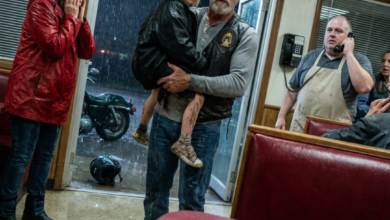
A Ten-Year-Old Girl Poured a Bucket of Water Over Her Entire Class’s Exams and Accepted the Punishment—Then Her Biker Father Discovered Why She Had Tried Twice to Warn the Teacher
Part 2
Nathan did not praise Maddie on the ride home.
He secured her helmet, checked the chin strap and told her they would discuss the consequences after the school completed its first review. Maddie climbed onto the Harley without asking whether she was grounded.
She already knew she was.
Nathan Cole had raised her alone since her mother, Rachel, died in a winter highway collision six years earlier. He repaired motorcycles for a living and shared custody duties with Rachel’s older sister whenever work kept him late.
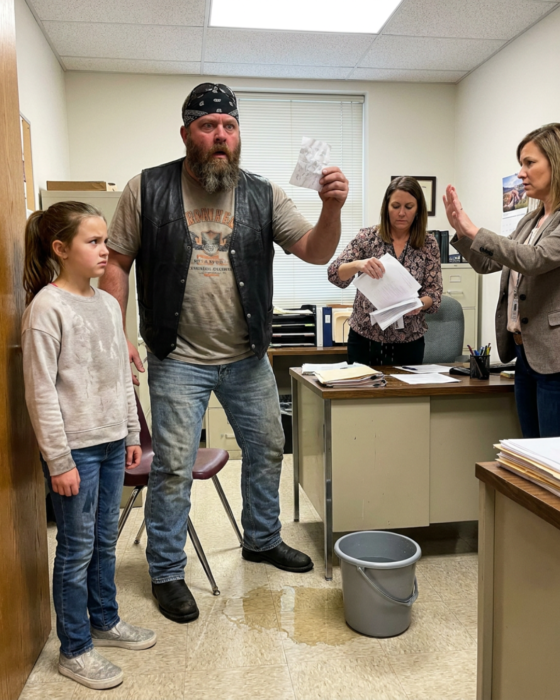
He understood anger better than paperwork.
At seventeen, Nathan had dropped out of high school after punching a student who repeatedly mocked his younger brother. The other boy received stitches. Nathan received an expulsion recommendation and spent years believing adults cared more about a broken nose than everything that happened before it.
He earned his equivalency diploma at thirty-four.
That history made him careful with Maddie.
He refused to teach her that a good reason erased a destructive choice. He also refused to let the destruction become the only thing adults examined.
At home, he placed the school’s disciplinary notice beside the wet answer strip.
“You damaged twenty-five other kids’ work,” he said.
“I know.”
“You scared your teacher.”
“I know.”
“You also may have caught something serious.”
Maddie studied the table. “Does that make it okay?”
“No.”
“Then was I wrong?”
Nathan waited.
“Your method was wrong,” he said. “That doesn’t make your warning false.”
The Iron Oak Riders learned about the incident before dinner. One member had a niece in Maddie’s grade. Another had seen a parent post an angry message accusing Nathan’s daughter of sabotaging the class because she expected to fail.
Bear Lawson, the club president, offered to bring riders to the school-board meeting.
Nathan refused.
Twenty bikers outside an elementary school might feel like support to Maddie. To teachers and children, it could feel like intimidation.
“If this is about fairness,” Nathan said, “then nobody gets frightened into agreeing.”
The club stayed away.
Instead, Bear helped Nathan locate an education attorney who offered one consultation without charge. The lawyer explained that the school could discipline Maddie for destroying the papers while still investigating testing misconduct separately.
Those processes did not cancel each other.
The next morning, Principal Ward placed Maddie on a two-day in-school suspension pending review. She also informed families that the assessment had been invalidated because of a security concern, without identifying accused students.
Ms. Parker requested to speak with Nathan.
She admitted that Maddie had approached her during the exam. Under district rules, teachers were told to minimize disruptions and document suspicious behavior after testing. Parker believed Maddie was distracted by classmates and feared pausing the test would compromise the entire room.
“I should have listened longer,” she said.
Nathan did not rescue her from the admission.
“Yes,” he replied. “You should have.”
Ms. Parker’s eyes filled, but she did not argue.
The evidence trail expanded. The wet answer strip had a faint printer code along its bottom edge. District technicians matched it to a machine in the testing coordinator’s office.
Access records pointed to Marla Vance, a clerical employee responsible for receiving and organizing secure assessment packets.
Vance denied printing the answers.
She claimed someone had used her account.
Then investigators reviewed hallway footage from the evening the file was accessed. A camera showed Vance entering the office after staff had left and departing with a large envelope.
That still did not prove she sold anything.
The proof came from a parent.
After the school announced a security review, one father contacted the district attorney’s office. He admitted paying $400 for what Vance described as “private tutoring materials.”
The packet contained questions identical to three earlier assessments.
He surrendered text messages, payment records and the remaining pages.
Maddie had not exposed a single act of classroom cheating.
She had interrupted a market built for parents.
Part 3
Investigators reconstructed the scheme carefully because accusing children was easier than proving what adults had done.
Marla Vance had access to district assessment files as part of her job. The files were protected, but office personnel could download and print them when assembling packets for teachers.
Vance began by helping one parent whose son risked losing a place in an advanced program. She called the material a “study guide” and accepted cash.
The next request came through that parent.
Then another.
By the fourth examination, Vance had created separate answer packets and sold them to at least nine families. Some paid directly. Others contributed money to a supposed tutoring group.
Not every child understood where the answers came from. Several believed the pages were legitimate practice materials until the examination matched them word for word.
Others knew.
That distinction mattered when the school decided how to respond.
Principal Ward suspended Vance and turned the matter over to district investigators and police. Testing files, printers and electronic records were preserved. Parents were advised not to question children aggressively or coordinate their stories.
Nathan kept Maddie away from social media.
The attention had become cruel.
Some parents called her courageous. Others said she had staged the cheating claim to avoid a poor score. One post included a photograph of Nathan’s motorcycle and described the family as dangerous.
The Iron Oak Riders wanted to answer.
Nathan told them not to.
“No threats. No names. No pictures of parents.”
Bear agreed, though it cost him. One accused parent had mocked the club publicly and claimed Maddie learned vandalism from bikers.
Brotherhood was being tested by the discipline to remain silent.
Maddie completed her suspension in a small room near the school counselor’s office. She worked through normal assignments while the rest of the grade received temporary schedules.
Tessa Nguyen visited during lunch.
She brought two cartons of milk because she did not know what else to bring.
“You ruined the only test I think I did good on,” Tessa said.
Maddie lowered her eyes. “Sorry.”
“But I didn’t have the answers.”
“I know.”
“What if I do worse next time?”
Maddie could not promise otherwise.
That was the cost nobody celebrating her online wanted to discuss. Honest students would repeat an exam under more pressure because of the choice she made.
Tessa sat beside her anyway.
After a minute, she asked, “Did you really hear someone say their mom paid?”
“Yes.”
“My mom couldn’t pay.”
Maddie looked at her.
Tessa’s earlier scores had been strong enough for a partial scholarship to Riverton Preparatory’s summer academy. After the compromised exams, she fell below the ranking cutoff.
The leaked answers had not only elevated cheaters.
They had pushed honest children downward.
District analysts froze every award and placement tied to the four affected assessments. Fourteen students—including Tessa—had been denied scholarships or advanced-program recommendations after suspicious score changes reshaped the rankings.
The district announced that all fifth graders would be offered supervised retesting using newly commissioned materials. Families could decline, but scholarships and placements would not be finalized until the review ended.
Parents erupted.
Those whose children had tested honestly resented the delay. Parents connected to the purchased packets hired attorneys. Several insisted they had believed Vance’s materials were lawful.
Some probably had.
Others had received text messages telling them not to show the packets to teachers.
The false climax arrived when police charged Vance with offenses related to unlawful access, theft and selling secure educational materials. The district fired her after a personnel hearing.
Many families assumed the problem was solved.
Then analysts compared test results from the previous semester.
The pattern extended further than Vance’s first admission.
The fourth exposed exam was not the beginning.
It was merely the fourth one that year.
Earlier benchmark scores had influenced classroom placements, award nominations and scholarship recommendations across the entire grade. Some students spent two semesters believing they were falling behind when the comparison itself was corrupted.
One boy had been removed from an advanced mathematics group.
A girl stopped attending academic club after being told her scores lacked consistency.
Tessa’s mother had taken a second overnight cleaning job because she believed private tutoring was the only way her daughter could compete.
The damage was not limited to numbers.
It had changed what children believed about their own intelligence.
Principal Ward convened an independent review panel. It included district administrators, an outside assessment specialist, a school-board representative and a parent advocate with no child in the affected grade.
Nathan was invited to submit a statement.
He declined to ask that Maddie’s discipline be erased.
Instead, he wrote two separate sentences:
She should answer for destroying the exams.
The adults should answer for making destruction the only warning they heard.
The panel included both sentences in its report.
Then a new problem appeared.
The school could retest academic performance.
It could not retest the confidence some children had already lost.
Part 4
The district scheduled the new assessments six weeks later.
Security procedures changed immediately. Test files were encrypted until printing, two employees had to document access and sealed packets were counted before and after each session. Teachers received a direct procedure for pausing an exam when a student reported a credible breach.
Ms. Parker was not fired.
The investigation found no evidence that she knew about the leaked answers before Maddie spoke. She received a formal reprimand for failing to document the report immediately and completed additional testing-security training.
She also asked to apologize to Maddie.
The meeting occurred with Nathan, Principal Ward and the school counselor present. Parker did not explain away her decision.
“You told me something was wrong,” she said. “I treated you like the problem.”
Maddie stared at her shoes.
“Why?”
“Because stopping the test felt bigger than ignoring one child.”
Maddie looked up. “Then I made it bigger.”
Nobody in the room smiled.
Nathan leaned forward.
“She understands why that was wrong.”
Parker nodded. “And the adults understand why she thought it was necessary.”
That was the closest the story came to a clean answer.
The criminal investigation revealed that Vance earned just over $11,000 selling materials. It was not enough money to explain the risk until investigators examined her personal messages.
Her son had been denied admission to an elite middle-school program years earlier. Vance had convinced herself that academic ranking systems were already unfair and that parents with money always found advantages.
She described the packets as “leveling the field.”
But she did not give them to struggling families.
She sold them to parents who could pay.
Her resentment became the same inequality she claimed to oppose.
Nine families were identified as purchasing material. District officials separated adult conduct from student responsibility. Younger children who reasonably believed the packets were study guides were not punished for intentional cheating. Students shown to have knowingly concealed answer sheets received age-appropriate consequences and counseling.
No child was publicly named.
Nathan insisted on that point during the board meeting.
When one angry parent demanded the cheaters be exposed, Nathan stood at the microphone wearing his plain work shirt rather than his leather vest.
“They’re ten,” he said. “Investigate adults like adults. Teach children like children.”
The room became quiet.
Several parents had expected the tattooed biker to demand punishment.
He demanded proportionality.
The retest produced dramatic changes. Students whose earlier scores had risen unusually fell back toward their established performance. Several students previously ranked lower moved upward.
Tessa scored in the top five percent.
She cried when the counselor handed her the sealed results because she assumed another mistake had occurred.
It had not.
The independent panel recalculated scholarship eligibility and reviewed fourteen students whose opportunities had been affected. Eleven received awards after the retest and a holistic review of grades, teacher recommendations and demonstrated financial need.
Three did not.
The district offered them separate academic support and appeal rights, but investigators refused to promise that correcting corruption would produce a perfect outcome for everyone.
Justice was not a machine that returned every stolen thing.
Tessa received a full scholarship to the summer academy and a continuing tuition grant for the preparatory program. Her mother stopped working the second overnight job.
When Tessa told Maddie, she did not thank her for pouring the water.
She thanked her for noticing.
That distinction mattered.
Maddie’s original disciplinary warning remained in her file. Principal Ward explained that an investigation validating her concern did not automatically excuse destroying property and invalidating honest students’ work.
Nathan agreed.
Maddie did too, though accepting it became harder after reporters praised her.
At the end of the school year, the district review authorized principals to expunge minor disciplinary records when later evidence showed a student had acted in response to a substantiated institutional failure.
Principal Ward opened Maddie’s file.
She removed the warning.
Then she inserted an amended incident statement:
“The student used an unacceptable method after attempting twice to report a verified threat to academic fairness. She accepted responsibility and acted to protect the integrity of her classmates’ work.”
Nathan read it once.
Maddie read only the final line.
“Student acted in defense of fairness.”
She asked whether that meant pouring the water had been right.
Nathan shook his head.
“It means the truth was bigger than your mistake.”
Part 5
Maddie did not become popular after the investigation.
Some students admired her. Others remained angry about retesting. Two children whose parents purchased packets refused to speak to her for the rest of the year.
She accepted that.
Nathan required her to complete twenty hours helping custodial staff and teachers prepare classrooms after school. The district had not demanded it. He did.
She cleaned desks, replaced damaged folders and helped inventory unused testing materials. She was not allowed near secure exams.
The first afternoon, she apologized to Mr. Alvarez, the custodian whose bucket she had taken.
He handed her a mop.
“Water goes on the floor,” he said.
“Yes, sir.”
“Usually after someone makes a mess.”
Maddie understood.
The Iron Oak Riders also learned from the case. They had wanted to arrive as a wall of motorcycles, believing visibility meant protection. Nathan showed them that a frightened school could mistake support for pressure.
Instead, the club funded eleven basic laptop packages for scholarship recipients whose families lacked equipment. The purchases were processed anonymously through the school foundation.
Maddie discovered the donation only when Tessa mentioned receiving a computer.
She confronted Nathan in the garage.
“You said not to fix everything for me.”
“It wasn’t for you.”
“Did the club do it because of what happened?”
“The club did it because eleven kids earned something and some couldn’t use it without equipment.”
Maddie considered the answer.
“Can I help?”
Nathan handed her a stack of protective cases to label.
She checked each name twice.
Vance’s criminal case ended with a plea agreement that included probation after a short custodial sentence, restitution, community-service requirements and a prohibition against working in positions involving secure educational records. The details disappointed people who expected a dramatic punishment.
But the district’s reforms extended beyond one employee.
Testing files gained access alerts. Scholarship decisions could no longer rely heavily on a single assessment. Students received a confidential reporting channel, and teachers were required to document concerns raised during tests before leaving the room.
Ms. Parker placed a small locked box near her desk where students could submit written concerns.
Maddie disliked it.
“People can still ignore a box,” she said.
Parker nodded. “Then the box is only the first step.”
She created a second: every submission generated a receipt reviewed by the counselor.
The system was not perfect.
It was harder to silence.
At the end-of-year assembly, Principal Ward recognized scholarship recipients without mentioning the investigation. Tessa crossed the stage while her mother cried from the second row.
Maddie remained seated.
Nathan watched from the back wall in his leather vest. He did not clap louder than anyone else. He did not point at his daughter or make the moment about her.
Tessa returned to her seat and slipped something into Maddie’s hand.
It was a small laminated card cut from blue paper.
On one side, Tessa had drawn a bucket.
On the other, she had written:
NEXT TIME, USE WORDS.
Maddie laughed for the first time whenever the test was mentioned.
Then she turned the card over and added one sentence beneath Tessa’s:
NEXT TIME, LISTEN THE FIRST TIME.
Both girls signed it.
Part 6
The blue card stayed inside Nathan’s wallet.
He carried it beside Rachel’s photograph and the registration papers for his Harley. Whenever club members told the story as though Maddie had saved the school by dumping one heroic bucket, Nathan corrected them.
“She found the problem,” he said. “She also made a mess.”
That became the version Maddie preferred.
Once a year, the Iron Oak Riders sponsored an academic-supplies drive through the school foundation. No motorcycles lined the elementary-school entrance during class hours. Members delivered boxes after dismissal and left before children arrived the next morning.
Bear complained that anonymous charity lacked style.
Nathan told him fairness did not need an audience.
Tessa thrived at Riverton Preparatory. Three other scholarship recipients joined her there. The remaining seven used their awards for the summer academy, tutoring programs or advanced coursework.
Maddie stayed at the public middle school.
Some adults assumed she would resent Tessa’s opportunity. She did not. She helped Tessa practice for the preparatory school’s interview and rejected every attempt to receive credit.
Ms. Parker kept teaching.
On the anniversary of the incident, she placed an empty gray bucket beside the chalkboard before students arrived. It remained there until lunch.
Then she moved it into the supply closet.
Not as a tribute.
As a reminder.
Principal Ward eventually retired. Before leaving, she gave Maddie a sealed copy of the amended incident report.
“You should not need this,” Ward said. “But institutions forget.”
Maddie looked at the principal.
“Do people?”
“Yes.”
“Then I’ll keep two copies.”
Nathan smiled.
By thirteen, Maddie had joined the student council. Her first proposal created an anonymous appeal process for club selections and academic awards.
She did not overturn a table.
She presented three pages of evidence, waited through questions and revised the proposal twice.
Nathan sat in the last row.
His boots were dusty. His beard had grown grayer. The blue bucket card remained in his wallet.
The girl who once believed destruction was the only way to stop injustice had learned how to make the record impossible to ignore.
Part 7
Three years after the ruined examination, Maddie entered Nathan’s motorcycle shop carrying a sealed envelope.
The Iron Oak Riders were gathered around an old Harley with its fuel tank removed. Tools stopped moving when she placed the envelope on the workbench.
Bear leaned closer.
“What’d you destroy now?”
“Nothing.”
“Disappointing.”
Nathan wiped his hands and opened the envelope. Inside was Maddie’s acceptance letter to the district’s student advisory council.
She had been selected to represent middle-school students on academic-integrity and disciplinary-policy reviews.
Bear read the first paragraph.
“They put the bucket girl on the rules committee?”
Maddie folded her arms. “They put the evidence girl on it.”
Nathan glanced toward the blue card pinned above his workbench. Tessa had made a second copy for the shop.
One side still said NEXT TIME, USE WORDS.
The other said NEXT TIME, LISTEN THE FIRST TIME.
Maddie’s original amended disciplinary statement rested in a drawer beneath it. The warning was gone, but the full incident remained documented—the destruction, the ignored reports, the leaked tests and the corrected scholarships.
Nobody erased the uncomfortable parts.
That was why the record mattered.
Outside, Nathan’s Harley cooled beneath the shop light. Maddie picked up her helmet and asked whether he could drive her to Tessa’s house. The girls planned to work on a scholarship essay together.
Nathan handed her the helmet.
“No buckets?”
“Only footnotes.”
They rode past Millstone Elementary on the way. The old classroom windows were dark, and the chalkboard bucket had long since been replaced.
Maddie looked toward the building but did not ask him to stop.
The school had heard her eventually.
More importantly, it had built a way to hear the next child before the water hit the papers.
Follow this page for more biker stories about misjudged children, stubborn truth and rough-looking parents who demand accountability without teaching their kids to escape responsibility.
Fairness finally had a voice.