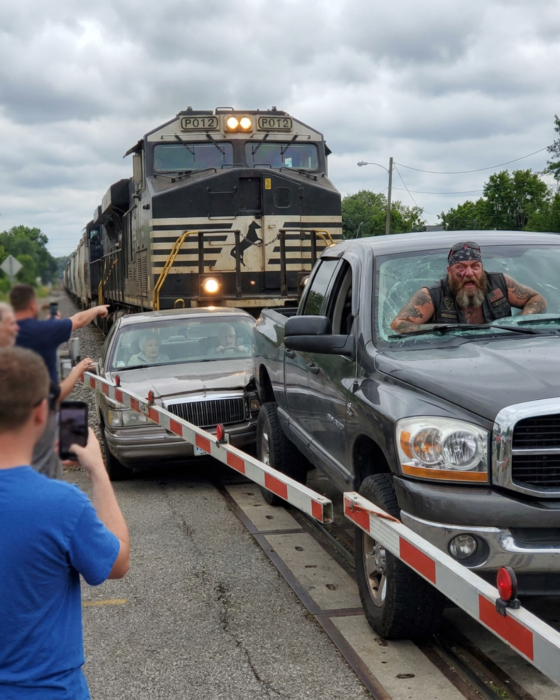
A Biker Rammed His Pickup Into a Sedan Stalled on Railroad Tracks and Everyone Thought He Had Lost His Mind—Five Seconds Later, an Elderly Couple Understood Why He Never Touched the Brakes
Part 2
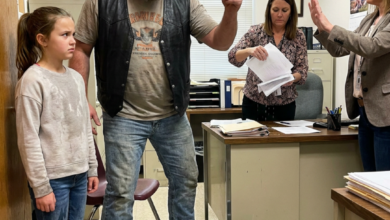
Caleb Danner belonged to the Ash River Riders, although he spent more time repairing motorcycles than riding them.
His shop stood beside State Road 62 in a former tire warehouse with a faded metal roof. On Thursday evenings, the building filled with the smell of coffee, gasoline and hot engine oil while club members worked on bikes belonging to veterans, widows and anyone else unable to afford regular labor rates.
Caleb charged for parts.
He rarely charged for time.
That generosity did not come from a spotless past. At twenty-three, he served six months in county jail after a bar fight. He spent the following decade moving between welding jobs, cheap apartments and relationships he was too angry to keep.
Machines were easier.
A bent frame did not lie about being bent. A failed bearing did not pretend everything was fine.
Caleb eventually learned that people were different. He stopped drinking, opened the shop and became the man younger riders called when their engines—or their lives—made a sound they did not understand.
His knowledge of weight came from years repairing tow trucks and construction equipment. When he saw Walter’s sedan on the tracks, he did not perform a careful calculation.
There was no time.
He recognized three facts: the sedan was light, his work truck was heavy and the train could not stop.
The locomotive engineer later reported seeing the stalled car only after rounding the curve. Emergency braking began immediately, but a loaded freight train required far more distance than remained.
The engineer watched Caleb’s pickup strike the sedan.
For several seconds, he believed three people were about to die.
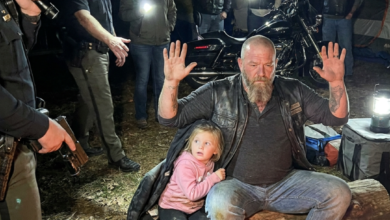
After the train passed, police officers separated Caleb from the crowd and placed him in the back of a cruiser while they investigated. Witnesses had reported reckless driving and a deliberate collision.
Caleb cooperated.
The crossing camera showed the sequence from above: Walter’s sedan entered while the lights were off, stalled across the rails, and remained there when the warning system activated. Caleb arrived after the barrier began descending.
He had driven around the arm.
He had crossed the center line.
He had rammed another vehicle.
Those facts remained true even after officers understood why.
A state trooper told Caleb the decision could have killed someone if the sedan turned sideways or the pickup became disabled.
“I know,” Caleb said.
“Would you do it again?”
Caleb looked at Evelyn’s folded wheelchair being removed from the sedan.
“Yes.”
The trooper wrote no immediate citation. The case required review, and emergency necessity would be considered. That was not the same as declaring every part of Caleb’s response safe.
Paramedics examined him beside the road. He had a cut above his eyebrow, bruising across his chest and pain in his left wrist. He declined hospital transport after signing a refusal form.
Walter and Evelyn were taken to a nearby emergency department for precautionary evaluation.
The sedan was totaled.
Caleb’s pickup appeared repairable only from a generous distance. The radiator support had folded, the front bumper curved inward and the frame rails required measurement before anyone could decide whether the truck would ever drive straight again.
Bear Lawson, president of the Ash River Riders, arrived with a flatbed trailer. He looked at the truck and then at Caleb.
“You finally found something harder than your head.”
“Barely.”
Bear expected Caleb to be angry about the damage.
Instead, Caleb stood beside the tracks and watched the crossing equipment return to silence. There was no sensor detecting the stalled sedan. The lights and gates warned road traffic, but the train crew received no automatic alert that a vehicle remained between the rails.
The system had worked as designed.
Its design had no way to see the people trapped inside.
Before leaving, an officer handed Caleb the cream anniversary envelope recovered from Walter’s car. Inside was a reservation card from Marlowe’s Grill.
The dinner was scheduled for six-thirty.
It was already after seven.
Caleb assumed the celebration had been canceled.
Then his phone rang.
Walter was calling from the hospital.
“The doctor says we can leave,” the old man said. “Forty people are still waiting.”
Caleb looked at his torn shirt and blood-spotted jeans.
Walter continued.
“They know we survived. What they don’t know is who brought us back.”
Part 3
Walter and Evelyn’s daughter collected them from the hospital. Caleb planned to ride back to his shop in Bear’s tow truck, clean his cut and begin calling salvage yards.
Walter had a different plan.
He refused to get into his daughter’s minivan until Caleb agreed to follow them to the restaurant.
Caleb tried three excuses.
His clothes were dirty.
His club brothers were waiting.
The restaurant reservation had nothing to do with him.
Walter rejected each one.
“The reason for the dinner is sitting beside me,” he said. “You put her there.”
Bear heard that and pushed Caleb toward the tow-truck passenger seat.
Marlowe’s Grill stood in an old brick building near the river. Walter had taken Evelyn there in 1965, when it was a lunch counter with red vinyl stools and milkshakes served in metal cups.
The business had changed owners twice, expanded into the neighboring storefront and replaced most of the furniture.
One original booth remained.
Their family reserved it every anniversary.
Forty people waited inside: three children, seven grandchildren, great-grandchildren, cousins and two friends who had attended the wedding sixty years earlier. Gold paper decorations hung along the private dining room. A cake remained uncut beneath a photograph of Walter and Evelyn as newlyweds.
When the couple entered, applause began.
Then the family noticed the hospital wristbands.
The room changed.
Questions collided. Children cried. Walter’s oldest son demanded to know why nobody had called sooner. Evelyn kept repeating that they were safe.
Caleb remained near the entrance, prepared to leave before attention turned toward him.
Walter stopped him.
“This is the man who hit our car.”
Silence replaced the questions.
A grandson stepped forward with anger on his face.
Walter raised one hand.
“And thank God he did.”
Witness video had already reached the family. They watched it together on a phone passed around the room—the stalled sedan, the falling barrier and Caleb’s pickup accelerating into the impact.
The video ended as the train entered the frame.
Nobody spoke for several seconds.
Evelyn’s granddaughter walked toward Caleb and hugged him without asking. Caleb held his arms awkwardly at his sides, unsure where to place tattooed hands around someone sobbing against his torn work shirt.
More family members followed.
He endured three hugs, then stepped backward.
“Food’s getting cold,” he said.
That saved him from a fourth.
The restaurant manager found Caleb a clean button-down shirt from the kitchen office. It was one size too small across his shoulders, so he left the top buttons open. His black leather vest covered most of the damage.
He was seated at the family table between Walter’s grandson and a six-year-old great-granddaughter who asked why his knuckles had letters tattooed across them.
“Poor decisions,” Caleb answered.
She examined them.
“They’re spelled right.”
The meal continued unevenly. Laughter returned, but every train horn in the distance quieted the room.
Caleb learned that Walter and Evelyn met when she spilled a milkshake on his only good shirt. He married her eighteen months later. They raised three children, survived a factory closure, two surgeries, Evelyn’s stroke and the death of their youngest son.
The anniversary represented more than endurance.
It represented sixty years of choosing the same person through changing bodies and changing luck.
After dinner, Walter stood with one hand on the table. He was still unsteady, and his son moved to help, but Walter shook him off.
He raised his glass toward Evelyn first.
“Sixty years ago, I married that woman.”
Evelyn smiled.
Walter turned toward Caleb.
“Today, a stranger gave her back to me one more time.”
No one applauded immediately.
The words settled too heavily.
Caleb looked down at his hands.
Then Evelyn lifted her glass.
“He gave me Walter too,” she said. “That man would’ve stayed in the car with me.”
Walter’s mouth trembled.
The room rose around them.
Caleb remained seated until the six-year-old beside him pulled his sleeve and whispered, “You’re supposed to stand when everybody cries.”
He stood.
Later, Walter offered to pay for the pickup.
Caleb refused before hearing the amount.
“The truck was mine,” he said. “The choice was mine.”
Walter argued.
Caleb refused again.
He allowed the family to pay the towing charge because Bear threatened to leave the wreck at the restaurant otherwise. Nothing more.
The following morning, Red River Auto called Caleb’s shop. The body shop had inspected the truck.
Repairs would be expensive, but the frame could be saved.
Caleb told them to prepare an estimate.
The manager paused.
“Estimate’s already approved.”
“By who?”
“Customer asked us not to say.”
Caleb looked toward Bear.
Bear lifted both hands.
It was not the club.
Walter’s family had reached the garage before Caleb did.
And they had not merely paid a deposit.
They had settled the entire repair bill under one condition: Caleb could not receive a refund.
Part 4
Caleb drove to Red River Auto and demanded the payment be returned.
The manager refused.
“The family paid us directly,” he said. “They purchased repairs. You’re not a party to their payment agreement.”
Caleb threatened to tow the truck elsewhere.
The manager pointed toward the stripped front end. “Bring a very large bucket.”
Caleb called Walter.
The old man answered on the second ring.
“You went behind my back.”
“I went around it. Same thing you did with the crossing gate.”
“That’s different.”
“Not from where I was sitting.”
Caleb had no reply that did not sound like pride.
Walter’s children had divided the cost. The grandchildren covered replacement parts. The great-grandchildren contributed twenty-three dollars and a jar of coins.
Evelyn paid for a new front grille herself.
Caleb eventually accepted the repair, though he insisted on paying for upgraded brakes and replacing several unrelated worn parts.
His refusal had been genuine.
So was the family’s need to repay something.
Meanwhile, the crossing incident triggered separate reviews by county transportation officials and the regional freight operator. The signals and gates had activated within required timing. The train crew followed emergency procedures.
No single employee had failed.
The danger came from the geometry of the crossing.
A curve and tree line limited how soon train crews could see a stalled vehicle. The road rose sharply before the rails, increasing the chance of long or low vehicles becoming stuck. Drivers waiting behind the crossing had no direct emergency telephone box, only a small identification sign that witnesses struggled to read from a distance.
Most critically, the location lacked automatic obstacle detection.
Officials initially proposed new warning signs and pavement markings. Caleb attended the public meeting with Walter and Evelyn.
He did not speak until a consultant described the incident as an “unlikely convergence of mechanical failure and mobility limitations.”
Caleb stood.
The room noticed his size before it heard his voice.
“You’re describing them like weather,” he said. “An old car stalled. An old woman couldn’t run. Neither is unlikely.”
A county board member explained that advanced sensors were expensive and not standard at every rural crossing.
Walter raised his cane.
“So is a funeral.”
The remark entered the official record.
The Ash River Riders wanted to fill the next meeting with motorcycles. Caleb permitted members to attend but forbade club colors and engine demonstrations. The issue needed engineers, disability advocates and residents—not a show of intimidation.
Twenty-one riders arrived in ordinary shirts.
Evelyn spoke from her wheelchair. She described watching the barrier trap Walter’s door and realizing her mobility made every escape plan slower.
The meeting changed after that.
A disability-access advocate pointed out that emergency guidance often assumed occupants could leave vehicles quickly and move across uneven gravel. A railroad engineer explained how obstacle-detection radar and cameras could alert dispatchers, notify train crews earlier and help authorities respond.
Funding still took months.
The final project combined multiple changes: roadway grading to reduce the hump, brighter crossing illumination, improved emergency-location signs and a detection system capable of identifying a vehicle remaining within the rail corridor after warning activation.
The system could not guarantee that every train would stop in time.
It could provide seconds that had not existed before.
During the review, investigators discovered two earlier reports of vehicles scraping or stalling at the crossing. Neither resulted in injury. Both were logged as minor roadside incidents and never connected to the crossing design.
Caleb’s collision was not the first warning.
It was the first one loud enough to damage two cars.
The county approved the upgrades after Walter’s family submitted the witness footage and the locomotive’s forward-camera recording. The freight operator contributed funding, while state safety grants covered part of the installation.
Caleb declined interviews.
Walter accepted them all.
Whenever a reporter called Caleb a hero, Walter corrected the word.
“He was a mechanic,” Walter said. “He saw a problem nobody else could solve in time.”
That explanation suited Caleb better.
The truck returned six weeks later with a new front end, straightened frame and a grille chosen by Evelyn. She selected the plainest one available because Caleb rejected anything decorative.
The body-shop manager handed him the keys.
Inside the glove box was the family’s repair receipt and a photograph from the anniversary dinner.
Forty people filled the frame.
Walter and Evelyn sat in the center.
Caleb stood at the edge, still wearing the undersized restaurant shirt.
On the back, every family member had signed a name.
The youngest great-grandchild added five uneven words:
THANK YOU FOR CRASHING THE PARTY.
Part 5
The crossing upgrades were completed the following spring.
Caleb attended the final inspection without telling the club. Walter and Evelyn arrived anyway, driven by their daughter.
The detection equipment looked unimpressive—small sensors, cameras and metal cabinets beside the track. There was no monument and no plaque naming the people whose collision forced the review.
Caleb preferred it that way.
A technician demonstrated how the system recognized an object remaining inside the crossing zone. An alert appeared at the control point, and emergency procedures began before a train entered the limited sight line.
Walter watched closely.
“So it tells them before they can see?”
“That’s the idea,” the technician replied.
Walter placed one hand on Caleb’s shoulder.
“We could’ve used that.”
Caleb nodded.
The system was not magic. Operators still needed to respond. Train speed, weight and distance still controlled whether a locomotive could stop. Public-safety officials emphasized that drivers should never assume technology could compensate for unsafe behavior.
But a stalled vehicle would no longer remain invisible between the gates.
The police review cleared Caleb of criminal intent. Prosecutors declined charges after reviewing necessity, video evidence and the immediate threat to life.
His insurance claim was more complicated.
The carrier initially categorized the collision as intentional damage, which limited coverage. Caleb submitted witness statements, police reports and the crossing footage. Months of appeals followed.
By the time the insurer approved part of the loss, Walter’s family had already paid the body shop.
Caleb donated the insurance reimbursement to a regional mobility program providing wheelchair-accessible transportation for older adults. He did not announce it.
Walter discovered the donation because Evelyn used that program for a medical appointment.
She called Caleb from the van.
“You’re getting sneaky.”
“You started it.”
The Price family continued inviting him to Sunday meals. He attended irregularly at first, usually arriving late and leaving before dessert.
Evelyn changed that by assigning him a chair.
The chair sat between Walter and the youngest great-grandchildren. Whenever Caleb tried to leave early, Evelyn hung her purse over its back and claimed she could not reach it.
No one argued with her.
The Ash River Riders adopted Walter and Evelyn without formal discussion. Members repaired their porch ramp, replaced a loose bathroom rail and drove Walter to the grocery store when his replacement car required service.
Walter paid them in pie.
He refused to call the motorcycles noisy after Bear reminded him that freight trains were louder.
The crushed sedan was not repaired. Its rear end had absorbed too much force, and the insurance company declared it a total loss.
Walter asked to keep one piece.
The salvage yard removed the bent trunk emblem. He mounted it beside the anniversary photograph in his garage.
Caleb kept something too.
Red River Auto saved the pickup’s damaged grille. He hung it on the wall of his motorcycle shop, dents still folded inward from the collision.
Visitors assumed it was a warning about careless driving.
Caleb rarely corrected them.
To the club, the metal represented something else: the distance between recognizing danger and acting before certainty arrived.
Bear once asked whether Caleb truly calculated the vehicle weights in those final seconds.
“No.”
“But you said the truck was twice as heavy.”
“I knew that before.”
“So what did you calculate?”
Caleb looked at the crushed grille.
“How long it would take to get two people out.”
“And?”
“Too long.”
There had been no elegant plan.
Only one terrible option that ended better than waiting.
Part 6
Every anniversary after that, Walter and Evelyn returned to Marlowe’s Grill.
The guest list became smaller. Some relatives could not travel each year, and the celebration no longer required forty chairs.
Caleb’s chair remained.
On their sixty-first anniversary, he arrived on his Harley instead of the repaired pickup. Walter examined the motorcycle and announced that it lacked enough metal to push anything useful.
Caleb offered him a ride.
Evelyn forbade it.
The cream-colored anniversary envelope from the crossing became part of the table ritual. Walter kept it despite the dirt and the tire mark across one corner. Inside, he stored the first restaurant receipt, the hospital wristbands and a copy of the crossing-upgrade notice.
At the sixty-second dinner, Walter’s hands shook too much to lift his glass safely.
Caleb steadied the bottom without taking it from him.
Walter repeated the toast, though the words changed slightly.
“Sixty-two years ago, Evelyn chose me,” he said. “Two years ago, Caleb made sure she didn’t have to choose whether to leave me behind.”
Evelyn frowned.
“There was no choice. I was staying.”
“That’s why he needed the truck.”
The family laughed.
Caleb looked toward the original red vinyl booth, where the couple had shared their first date. The upholstery had been repaired so many times that almost none of the original material remained.
Yet everyone still called it the same booth.
The repaired pickup was like that.
So was a marriage.
So, perhaps, was a man.
Parts were replaced. Damage remained in records and memory. The name stayed.
Whenever Caleb crossed County Road 16, he slowed before the rails. The new sensors watched the empty crossing. Bright signs displayed the emergency location clearly.
He never trusted the system completely.
He trusted that it could give the next stranger more than five seconds.
Part 7
On Walter and Evelyn’s sixty-fifth anniversary, the family reserved Marlowe’s private room again.
Walter was ninety-one. Evelyn was eighty-nine. Her wheelchair had changed twice, but the blue dress from the railroad crossing still hung in her closet.
Caleb arrived carrying the damaged pickup grille.
He had removed it from his shop wall that morning.
The family had created a display beside the anniversary photographs: the bent sedan emblem, the cream envelope and the picture of forty relatives surrounding the stranger who arrived with blood above his eyebrow.
Caleb added the grille without explaining.
The youngest great-granddaughter—now eleven—read her old handwriting on the photograph and groaned.
“I spelled crashing wrong.”
Walter leaned closer. “Message was accurate.”
Dinner moved slowly. Walter tired before dessert, and Evelyn needed help repositioning her chair. Nobody hurried them.
When the toast came, Walter could not stand.
He raised his glass from the chair.
“Sixty-five years ago, I married her.”
Evelyn reached across the table.
Walter looked at Caleb.
“Five years ago, he returned both of us to this table.”
Caleb lowered his eyes.
Outside, a freight horn sounded from the far side of town. Conversation paused for a moment, then resumed when the sound faded.
After dinner, Caleb drove the Prices home in the repaired pickup. Evelyn sat beside him while Walter occupied the back seat and complained about every turn.
At County Road 16, the warning lights were dark. The track lay empty beneath the upgraded sensors.
Caleb stopped anyway.
He looked left.
Then right.
Only after he was certain did he cross.
Walter touched the back of Caleb’s seat.
“Still counting five seconds?”
Caleb watched the rails disappear in the mirror.
“Always.”
The pickup continued toward the Prices’ home, its frame straight but its history permanently bent around one decision.
Follow this page for more biker stories about impossible seconds, misunderstood choices and rough-looking strangers who sacrifice what they own to protect people they have never met.
Some collisions give life back.