Part 2: A Stepmother Was Hated by a Boy for Six Years Because She “Wasn’t His Real Mom” — Then One Night, Her Blood Saved His Life
Rachel Morgan had entered the Hale house quietly.
Not with big promises.
Not with painted-over grief.
Just two suitcases, a box of books, and a careful way of closing doors softly because Ethan’s mother used to slam them playfully on Saturdays.
His mother, Laura, had died when Ethan was six.
A sudden aneurysm, one ordinary morning, while the coffee maker still hissed on the kitchen counter.
By the time Rachel met David two years later, the house still had Laura everywhere.
Her blue raincoat hung in the hall closet.
Her handwriting labeled spice jars.
Her gardening gloves rested in a basket near the back door, stiff from old soil.
Rachel never moved them.
That was the first thing Ethan hated her for.
He wanted her to either disappear completely or commit a crime obvious enough for him to punish.
Instead, she respected the ghosts.
She dusted around Laura’s photograph.
She washed Ethan’s baseball uniform without removing the little stitched patch his mother had sewn inside the collar.
She learned which cereal he liked, then pretended not to notice when he dumped it out because she bought it.
At school events, Rachel stood near the back.
At parent nights, she let David sign the forms.
When teachers called her Mrs. Hale, she corrected them gently.
“Rachel is fine.”
People thought she was distant.
They did not see what she did after midnight.
She checked Ethan’s backpack for forgotten permission slips.
She wrote reminders on sticky notes and placed them where David would find them, so Ethan could believe his father remembered alone.
She kept a small folder in the kitchen drawer labeled “E.”
Inside were dentist records, school calendars, allergy forms, and a copy of Ethan’s birth certificate.
On one page, circled in red ink, was his blood type.
AB negative.
Rare enough that the pediatrician had said, “You should always know this.”
Rachel knew it.
Ethan never knew she knew.
On the day he turned ten, Rachel baked a chocolate cake with white frosting because Laura used to make the same one.
Ethan stared at it for several seconds.
Then he pushed his chair back.
“She made it better.”
David flinched.
Rachel lifted the cake knife and set it down slowly.
“I believe you.”
That answer made Ethan angrier than tears would have.
He wanted proof she was trying to replace his mother.
But Rachel kept refusing to step into the space he guarded.
One winter, Ethan caught the flu so badly he shook under three blankets.
David had an overnight shift at the factory after layoffs cut his team in half.
Rachel sat outside Ethan’s bedroom door with a thermometer, medicine, and a plastic bowl.
He would not let her in.
So she stayed in the hallway.
At 2:13 a.m., he opened the door just wide enough to slide the bowl back out.
He never thanked her.
But the next morning, the medicine cup was empty.
That was the kind of reveal life gives quietly.
Not the kind anyone claps for.
Years passed in small refusals.
Ethan grew taller, sharper, and better at pretending he did not need anyone.
Rachel grew more patient, though patience cost more than people admitted.
When he was twelve, he found an envelope in her nightstand while looking for phone charger batteries.
Inside were letters.
Not sent.
All addressed to him.
One began, “Dear Ethan, I know loving you does not make me your mother.”
Another said, “I will never ask you to call me anything you are not ready to say.”
He read three lines, felt something twist in his chest, and shoved the envelope back where he found it.
That evening, he was crueler than usual.
“You act nice because Dad is watching,” he said.
Rachel stood at the sink, rinsing a coffee mug.
Her hand trembled once.
Only once.
Then she said, “Your father isn’t home.”
Ethan had no answer.
He went upstairs and slammed his door.
The next morning, his favorite hoodie was folded outside his room, washed and warm from the dryer.
He left it there until school.
Then he wore it.
The night of the accident, rain came down in thin silver lines.
Ethan had argued with Rachel after dinner because she told him not to ride his bike near Miller Creek.
He said she was not allowed to make rules.
She said his father would say the same thing.
He said, “You always hide behind him because you know you’re nothing here.”
Rachel’s face went pale.
Still, she reached for the keys.
“I’ll drive you to Tyler’s.”
He grabbed his bike helmet instead.
The door slammed hard enough to shake Laura’s photograph on the hallway table.
Twenty-two minutes later, Rachel’s phone rang.
A stranger said there had been an accident.
She drove through red lights with one hand over her mouth.
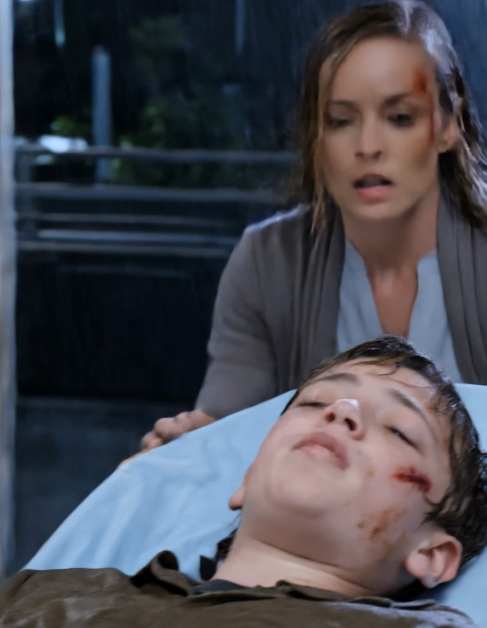
And when she reached the hospital, Ethan was already being taken behind double doors.
Emergency rooms turn ordinary people into witnesses of how little control they ever had.
Rachel stood beneath white lights, rainwater dripping from her cardigan, while nurses moved around her with practiced urgency.
She could hear Ethan somewhere behind the doors.
Not clearly.
Only fragments.
A moan.
A monitor.
A doctor calling for imaging.
The stranger who found him waited near the wall, holding Ethan’s cracked bicycle helmet.
He was a Black American delivery driver in his forties named Marcus Bell, still wearing his reflective vest and soaked baseball cap.
“He came out from the shoulder too fast,” Marcus said. “Car swerved, didn’t hit him full, but he went down hard.”
Rachel nodded, though most of the words did not reach her.
“Was he conscious?”
“For a minute,” Marcus said. “He kept saying, ‘Don’t call Rachel.’”
That pierced her more cleanly than she expected.
She thanked Marcus anyway.
A nurse asked Rachel for Ethan’s full name, date of birth, allergies, and emergency contacts.
Rachel answered every question without hesitation.
The nurse looked up.
“You’re his mother?”
Rachel swallowed.
“I’m his stepmother.”
The word seemed too small for the years inside it.
When David finally called from the airport in Denver, his voice broke apart through bad service.
“I’m trying to get a flight back,” he said. “Rachel, tell me he’s alive.”
“He’s alive,” she said, because that was the only piece she could safely give him.
Then Dr. Abrams came into the hallway.
She was a white American woman in her fifties with gray hair tied tightly at her neck and the blunt tenderness of someone who had said hard things too often.
“Ethan has internal bleeding,” she said. “We’re preparing for surgery.”
Rachel gripped the edge of the chair.
“Do whatever he needs.”
“We are,” Dr. Abrams said. “But we need blood available now. His type is AB negative.”
Rachel looked up.
“I’m AB negative.”
The doctor paused.
“You’re sure?”
“Yes.”
“Do you have documentation?”
Rachel opened her purse with shaking hands and pulled out a worn donor card.
Marcus Bell, still standing nearby, watched silently as the story shifted.
Dr. Abrams took the card.
“You donate regularly?”
Rachel nodded.
“Every eight weeks, when I’m eligible.”
The doctor glanced at the card dates.
Then her expression changed.
“Most of these donations went to the pediatric reserve program.”
Rachel looked toward the double doors.
“Yes.”
“Why?”
Rachel’s voice dropped.
“Because Ethan is AB negative.”
The hallway became very still.
The nurse holding the clipboard looked down, then away.
David, still on speakerphone, had gone silent.
Rachel pressed the phone tighter to her ear.
“David?”
His voice came through rough and broken.
“You’ve been donating for him?”
Rachel closed her eyes.
“For kids like him.”
That was true.
It was also not the whole truth.
The whole truth was that six years earlier, after a pediatrician explained Ethan’s rare blood type, Rachel had gone home and searched donor registries until dawn.
She had learned how rare compatible emergency supply could be in smaller hospitals.
She had signed up the next week.
The first time she donated, she nearly fainted in the parking lot.
She never told David because she did not want him to feel indebted.
She never told Ethan because love announced too early can sound like a demand.
So she kept going.
Through flu seasons.
Through arguments.
Through birthdays when Ethan would not look at her.
Through the year he removed her from his school emergency contact list and wrote “Dad only” in crooked black ink.
Every eight weeks, Rachel sat in a vinyl chair at the blood center, squeezed a foam ball, and watched dark red life move through a tube.
A technician once asked if someone in her family needed blood.
Rachel had answered, “Maybe someday.”
Now someday had arrived wearing rain and mud.
Dr. Abrams gave instructions quickly.
Rachel followed a nurse into a side room.
As she lay on the donor bed, she stared at the ceiling tiles and listened to the muffled rhythm of the emergency department.
Her sleeve was rolled up.
Her arm was cleaned.
A needle slid in.
She did not look away.
Not because she was brave.
Because Ethan was behind those doors, and for once there was something she could give that he could not refuse.
After the first unit was drawn, a nurse urged her to sit.
Rachel tried to stand too fast and swayed.
Marcus Bell stepped forward and caught the back of the chair.
“You okay, ma’am?”
Rachel gave a thin smile.
“I’m not the one who needs people worrying.”
Marcus looked at her carefully.
“Maybe both things can be true.”
That was another small twist.
A stranger who had heard Ethan reject her was the first person that night to say she deserved care too.
Hours stretched.
David arrived just before surgery ended, still in his work shirt, face gray with fear.
He found Rachel in the waiting room wrapped in a hospital blanket, pale and hollow-eyed.
For a moment, he simply stared at her.
Then he knelt in front of her chair.
“Why didn’t you tell me?”
She looked past him toward the operating doors.
“Because I didn’t want love to become another thing Ethan felt forced to accept.”
David bowed his head.
“I should have seen more.”
Rachel touched his shoulder.
“You were grieving too.”
Those four words carried more forgiveness than either of them deserved, and more truth than either could argue with.
At 3:41 a.m., Dr. Abrams returned.
The surgery had worked.
Ethan was critical, but stable.
David cried openly.
Rachel covered her mouth with both hands and made no sound at all.
The next afternoon, Ethan woke in the ICU.
His face was bruised.
His left arm was wrapped.
Machines breathed rhythm around him.
David sat on one side of the bed.
Rachel sat farther away, near the window, because old habits survive even emergencies.
Ethan turned his head slowly.
His eyes found his father first.
Then Rachel.
For a moment, fear crossed his face.
Then memory.
Then shame, though he was too weak to name it.
Dr. Abrams came in to check his chart.
“You had a very close call,” she said. “You needed surgery and blood quickly.”
Ethan’s voice was barely there.
“Dad?”
David took his hand.
“You’re okay.”
The doctor looked toward Rachel.
“Your stepmother was a direct match. Her donation helped us move fast.”
Ethan blinked.
His eyes returned to Rachel.
She looked down at her hands.
He remembered the hallway outside his room when he had the flu.
The chocolate cake.
The hoodie folded warm by his door.
The letter he had found and pretended not to read.
The way she had never stolen his mother’s place, even when he used that empty place like a shield.
His lips trembled.
“You gave me blood?”
Rachel stood slowly.
“Only what they needed.”
That answer broke something in him.
Not loudly.
Not all at once.
But enough for his hand to move across the blanket, searching the space between them.
Rachel froze.
Ethan could barely lift his fingers.
Still, he tried.
She crossed the room and placed her hand near his, careful not to assume too much.
He hooked one finger around hers.
It was the smallest contact they had shared in years.
David turned toward the window, crying quietly.
Ethan looked at Rachel with wet eyes and whispered, “You stayed?”
Rachel bent closer.
“I’ve been staying.”
He closed his eyes.
This time, he did not let go.
Recovery did not turn Ethan into a different boy overnight.
Real love is rarely that convenient.
He still woke angry sometimes.
He still missed his mother in sudden, sharp ways that made the room feel too small.
He still said Rachel’s name more often than anything softer.
But something had shifted.
The first morning home from the hospital, Rachel placed a glass of water and pain medicine beside his bed.
Usually, she would leave before he opened his eyes.
This time, he was awake.
“Thanks,” he said.
It was one word.
It sounded awkward.
Rachel stood in the doorway holding the empty tray.
“You’re welcome.”
Neither of them knew what to do after that.
So she left gently, and Ethan stared at the ceiling as if one word had worn him out.
A week later, he asked for the chocolate cake.
Not directly.
He stood in the kitchen while Rachel measured flour and said, “Did you ever write down that recipe?”
Rachel looked at him.
“Your mom’s recipe?”
He nodded.
Rachel opened the old tin box near the stove and took out a card in Laura’s handwriting.
“I saved it.”
Ethan touched the card with clean fingers, as if it might tear from being remembered.
“You didn’t throw her stuff away.”
“No.”
“Why?”
Rachel’s answer came slowly.
“Because loving your father never meant erasing who loved you first.”
Ethan looked away before she could see his face clearly.
But he stayed in the kitchen while she baked.
At school, rumors spread about the accident.
Some said Ethan almost died.
Some said his stepmother saved him.
Some said more than they knew.
Ethan did not correct every version.
But when a boy in science class joked that Rachel was “basically a spare mom with a blood bag,” Ethan stood up so fast his chair scraped the floor.
“Don’t talk about her like that,” he said.
The teacher froze.
So did Ethan.
It was the first time he had defended her in public.
That afternoon, he came home embarrassed and quiet.
Rachel already knew.
Teachers call about things like that.
She did not mention it until dinner.
“I heard you had a hard moment today.”
Ethan pushed peas around his plate.
“I didn’t hit him.”
“I heard that too.”
“He was being stupid.”
Rachel nodded.
“People are sometimes.”
Ethan almost smiled.
David watched them from the other end of the table, afraid to breathe too loudly.
Months passed in small repairs.
Ethan began leaving his laundry basket outside his door instead of hiding clothes until they soured.
Rachel began knocking once and waiting, because trust still needed a door.
David started telling stories about Laura without looking guilty afterward.
Rachel listened.
Sometimes Ethan listened too.
On the anniversary of Laura’s death, Ethan expected Rachel to disappear into careful silence like she usually did.
Instead, she placed a small bouquet of white daisies on the kitchen table.
“Your dad said these were her favorite,” Rachel said.
Ethan looked at the flowers.
Then at Rachel.
“Do you want to come with us?”
The question seemed to surprise him as much as it surprised her.
“To the cemetery?” she asked.
“If you want.”
Rachel nodded once.
“I would.”
At the grave, Ethan stood between his father and Rachel, hands in the pockets of his jacket.
The wind moved through the trees.
David spoke softly to Laura, telling her about school, surgery, recovery, and the way Ethan had started eating too much cereal again.
Rachel did not speak.
She had never needed the grave to make promises.
Before they left, Ethan removed one daisy from the bouquet and held it awkwardly.
Then he turned to Rachel.
“You can put one down too.”
Her hand trembled when she took it.
Not much.
Just enough for Ethan to notice.
On his fourteenth birthday, Rachel baked the chocolate cake again.
This time, Ethan stayed at the table.
David lit the candles.
A few relatives sang too loudly.
When the song ended, Ethan looked at the cake and said, “She still probably made it better.”
The room tightened.
Rachel smiled softly.
“I hope so.”
Ethan swallowed.
“But yours is close.”
It was not Mom.
It was not a speech.
It was a bridge laid carefully across six years of hurt.
Later that night, Rachel found a folded note outside her bedroom door.
The handwriting was Ethan’s, uneven but deliberate.
“I don’t know what to call you yet. But I know what you did. Please don’t leave.”
Rachel sat on the edge of the bed and read it three times.
Then she opened the drawer where the old unsent letters were kept and placed his note on top.
Not to replace them.
To answer them.
Down the hall, Ethan’s door was almost closed.
For the first time since she moved into that house, a thin strip of light remained visible beneath it.
Rachel walked over, paused, and knocked once.
“Goodnight, Ethan.”
A long silence followed.
Then his voice came back, soft and tired.
“Goodnight, Rachel.”
After another pause, he added one more word.
“Stay.”
She leaned her forehead lightly against the doorframe and closed her eyes.
“I will.”
Follow this page for more heartfelt stories about family, second chances, and the quiet love people often understand too late. 🌿