A Sponsor Left Twenty Children at the Gate After Calling Their Broken Van “Not Worth Fixing” — Then a Biker Asked Where They Were Supposed to Be
Part 2 — The Ceiling Was Supposed to Be Trees
The picnic had begun on a Tuesday, in the way important things often begin in a children’s home: with a small question asked while somebody else was clearing breakfast.
“Can we eat somewhere the ceiling is trees?”
June asked it. She was nine, had been with us seven weeks, and ordinarily limited her questions to practical things: where clean socks went, whether a bedroom door could stay open, what happened if a toothbrush fell on the floor. I looked up from the cereal bowls and said we could try.
She shook her head. “I mean really go.”
Westbank House was not a warehouse of abandoned children. It was three ordinary cottages sharing staff, a kitchen, an office, and a yard. The children had different histories, different families, and different plans. Some still spoke to parents every evening. Some had relatives working toward bringing them home. None needed a stranger to announce that we were now their family.
What they needed that month was a Saturday beyond the fence.
My colleague Luis knew a city park with a shaded pavilion, walking paths, a small pond, and playground equipment accessible from the parking area. We checked permission, staffing, medications, weather, and transportation. There would be ten children and two staff members in each twelve-seat van, with the restraints each child needed already fitted. It was not glamorous planning. It was how a pleasant afternoon got a chance to remain pleasant.
Martin Bell, a local business owner who occasionally funded activities, offered to cover picnic supplies and the pavilion reservation. We thanked him. He liked to attend departures, usually carrying a camera and asking children whether they were excited. I had asked him before not to photograph anyone without the appropriate permission. That Saturday, he promised he would only wave us off.
For eleven days, the children planned.
Owen, twelve, wanted to identify every bird by the pond, though he identified most birds as ducks. Tasha packed a paperback she had already read three times. Six-year-old Eli practiced opening his juice carton so he would not have to ask in front of the older children. His brother Marcus quietly put a spare straw in his own pocket.
June drew the route.
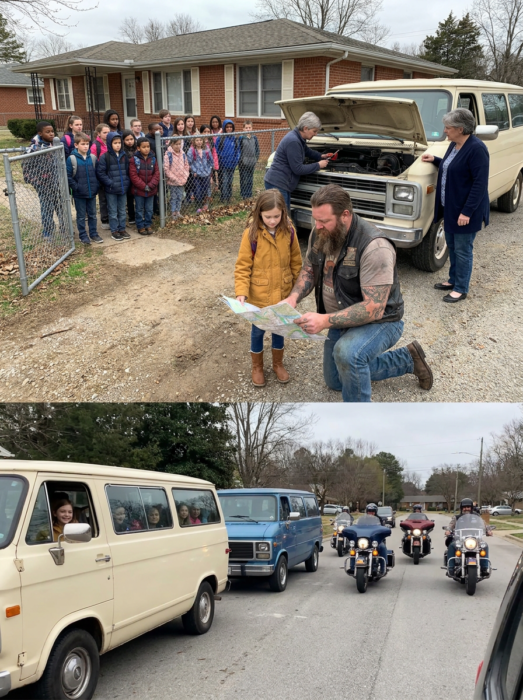
She borrowed a park brochure from my desk and copied its paths onto lined paper. She added the footbridge, the swings, the drinking fountain, and a tree she decided would be ours. Beneath the drawing, she wrote two names: June and Nora.
Nora was her younger sister, living with a relative in another town while adults worked through arrangements neither child controlled. Their contact was scheduled, supported, and important. June intended to tell her everything at their next call.
“I’ll remember it for both of us,” she said.
Friday night, backpacks stood against bedroom doors. Luis inspected the vans, filled the tanks, and checked the tires and restraints. The older cream-colored vehicle had passed its scheduled fleet inspection three weeks earlier. It was worn, not neglected. The roof lining sagged in one corner. The sliding door required a firm hand. It had also carried children to school, doctors, family visits, and ordinary places where their lives happened.
On Saturday morning, its starter failed.
The first attempt gave a click. The second gave several. Luis stopped, lifted the hood, and called the fleet shop. Closed until Monday. Their emergency contractor could attend, but not soon enough to promise the trip.
We were still discussing options when Martin arrived.
He looked at the cream van, then at his watch.
“How old is this thing?”
I told him.
He made the face people make when an expense belongs to someone else’s budget. “At some point you’re throwing good money after bad.”
“We need a diagnosis first.”
“You have to know when something isn’t worth fixing.”
He said it beside the open gate.
All twenty children were standing there.
I asked whether he could help us authorize an emergency replacement vehicle. He said that was more than he had committed to, which was true. Then he said we should make better plans, which was not useful. His phone rang. He stepped aside to answer it, returned, and told me to contact him when we had a workable proposal.
The SUV backed out.
Its tires made almost no noise.
The silence afterward was worse.
Eli asked whether we could walk. The park was several miles away, beyond roads unsuitable for twenty children on foot. Owen said the blue van worked. Luis explained that it could not safely take everyone and that leaving half the group behind would also leave us without the staff coverage we needed.
No child volunteered to be the half left behind.
Nobody should have had to.
We brought chairs and water toward the porch while I called two rental companies. One had no suitable vehicle. The other could not complete the arrangements that morning. Our director kept searching from home.
June folded her map.
“I knew,” she said.
I asked what she knew.
She shrugged. “Nothing.”
That word stayed with me while I prepared to say we would eat lunch inside. I had done this work long enough to understand that disappointment did not always look like crying. Sometimes it looked like twenty children making themselves smaller so no adult would have to manage their feelings too.
Then the first Harley passed the gate.
The rider turned his head.
A second later, his left hand rose.
Part 3 — Wrong Part Was Not the Same as No Part
The motorcycles did not sweep into our driveway.
They continued to the gravel turnout, slowed, and parked. That small piece of judgment mattered. We had children near the gate, a narrow entrance, and an old van with its hood raised. A dozen men charging in to help would have given me another problem.
There were twenty-four riders. Their engines settled into silence, leaving cooling metal to tick beneath the morning birds. The smell of warm leather and fuel drifted across the road.
Bear approached alone.
He took off his sunglasses before speaking, and he stayed on the public side of the gate until I invited him in. He wore a faded charcoal shirt under his vest, jeans bleached at the knees, and boots repaired across one toe. The skull ring on his right hand had lost a dark stone from one eye.
“Anyone hurt?”
“No. Just disappointed.”
He looked at the children. “Those can both count.”
I explained the starter and the failed calls. Bear listened without nodding through the parts he thought he already knew. When I finished, he turned and lifted two fingers.
A woman with close-cropped gray hair came across carrying a tool case.
“This is Tess. She runs a repair shop. I’m good at lifting things and taking instructions.”
“Only one of those,” Tess said.
Luis laughed. It was the first easy sound an adult had made since the van failed.
Tess asked permission to inspect it. Luis handed over the service folder and explained exactly what happened when he turned the key. She checked the battery and connections, ran her tests, then crouched beside the engine compartment with a lamp.
The children were moved to the porch, clear of the work. Nobody complained. Watching a stranger investigate a possible way out was better than staring at a closed gate.
Bear stood beside me.
“Where were you folks headed?”
I named the park.
“How far?”
“Six miles.”
He nodded. Across the road, a rider with a white beard was looking at his phone. Another had already loosened his vest against the heat. I asked whether they had somewhere to be.
“Lunch out west. A ride afterward.”
“You’ll miss it.”
“Maybe.”
I disliked that answer. Children heard maybe as a door opening, and sometimes as one closing. Bear seemed to read my face.
“We’re finding out what’s wrong,” he said. “That’s all I’ve promised.”
Tess straightened and gave us the diagnosis: the starter assembly needed replacing. The battery was sound. She called her parts supplier with the vehicle details, then called her shop to arrange for the right equipment.
“Can it be done here?” Luis asked.
“If the part is right, and if I can work safely. Otherwise we tow it.”
No one said it would take ten minutes.
Bear walked back to the turnout and spoke with the club. I could not hear the discussion, but I saw it become one. Hands moved. A man pointed at his watch. Another rider held up a phone with what looked like a reservation.
For a moment, I braced for the familiar withdrawal.
Their plans mattered too.
One of the women sat on a low wall and made calls. The man with the reservation stepped away, spoke into his phone, then returned and shrugged. A rider who needed to be home by evening studied the route with another member.
They did not solve it by pretending nobody had obligations.
They rearranged what they could.
Two riders left to collect parts in Tess’s shop pickup. Another made the call to cancel the lunch booking. Those who had brought snacks offered them to our staff first, so we could check allergies before anything reached a child.
Tess returned to the van.
Bear returned to the gate.
“We can stay.”
Owen asked whether they were a gang.
“A club,” Bear said.
“What’s the difference?”
“Mostly how many meetings you have to attend.”
Tess called him over before he could elaborate.
For the next hour, hope became a difficult thing to supervise.
Every movement beneath the hood drew attention. A tool falling onto concrete made Eli stand. The parts pickup arriving brought all twenty children back to the porch rail. When Tess opened the box and frowned, June’s shoulders dropped before anyone explained anything.
The supplier had sent the wrong assembly.
I heard myself say, “Of course.”
Bear looked at me, not accusingly. Just enough that I remembered who could hear.
Tess closed the box. “Wrong part is not the same as no part.”
She called the supplier again.
Luis took the children inside for water and a bathroom break. June stayed beside me until I asked whether she needed anything.
“You can stop,” she told Bear.
He lowered himself onto the curb so she did not have to keep looking up.
“Stop what?”
“Trying. We won’t make trouble.”
He rested his forearms on his knees.
“I didn’t think you would.”
“You look busy.”
“I was. Plans changed.”
She rubbed a thumb over her folded map. “Because of us.”
“Because we chose to stop.”
I watched her examine the difference.
Bear did not reach for her, ask for a hug, or insist she smile. He sat there while Tess arranged the correct part. After a while, June sat on the porch step, several feet away, and unfolded the map.
He asked to see it.
She passed it through the rail.
He studied the paths, the tree, the two names. “You draw a good bridge.”
“I copied most of it.”
“Still had to draw it.”
When the replacement arrived, Tess worked without an audience crowding her. Then she asked Luis to sit in the driver’s seat.
The starter turned.
The engine caught.
For one second, nobody believed it.
Eli shouted first. Owen jumped so high his backpack slid off one shoulder. I put a hand against the gate because relief arrived faster than my balance.
Tess raised a finger.
“Let me finish checking.”
So we waited again, this time with an engine running.
Part 4 — No Toll for a Princess
Tess did not let us load the children the moment the engine ran.
She checked her work, let the van idle, shut it off, restarted it, and took a short test drive with Luis. He completed our usual departure check again. I called the director with the repair details and the changed schedule. We still had enough time for the park. We had simply lost the morning.
The sandwiches were still in their coolers.
The children were still in their coats.
That second fact undid me a little.
Even after we brought them inside, they had kept their jackets on. They were ready to leave at the first possible second, as though removing a sleeve might cancel the trip again.
I told them they could put the jackets in their backpacks.
“We’re going.”
They cheered. Then, almost immediately, several looked at Tess for confirmation.
She gave them a thumbs-up.
Bear stood by the gate and watched the children begin the familiar loading routine. They knew their assigned vehicles and seats. Marcus helped Eli with his backpack. Tasha asked whether she could sit by a window if nobody else wanted it. June waited until everyone ahead of her had moved.
I thanked Bear.
He nodded toward the road.
“What route are you taking?”
I told him.
He looked toward his club, then back at me. “Would you mind company?”
I assumed he meant a ride along, maybe one or two motorcycles following to make sure the repair held.
“How much company?”
He smiled for the first time.
“All of us, if that’s something you want.”
My instinct was to say yes before the children heard. My responsibility was to ask questions first.
Nobody would ride on a motorcycle. Our staff would remain the drivers and supervisors. The riders would use the normal lanes, stop at lights, and keep enough distance that no child felt surrounded. No blocking intersections. No slowing other traffic into a performance. If the group separated, it would meet at the park.
Bear agreed to every condition.
“Honor guard,” he said. “Not a motorcade.”
Our director approved the arrangement. I told the children the motorcycles would travel ahead of and behind our vans, if they wanted that. Owen asked whether they could do sirens.
“They don’t have sirens,” I said.
“Can they make siren noises?”
Tess shook her head. “Not the sort you’d want.”
We laughed.
June stood at the cream van’s open side door, staring at the motorcycles. Bear was checking with the road captain when she tugged lightly at his sleeve. She waited until he looked down.
“How much for the middle?”
He bent closer.
“The middle?”
“Between the bikes.”
She opened her palm.
Three quarters and a small blue button lay against her skin. She had found the button weeks earlier and called it her emergency coin, despite knowing perfectly well that it could buy nothing.
Bear looked at the money, then toward me.
I had seen children hide food. I had seen them offer to wash dishes after being given a second helping. I had heard them bargain for things most adults handed their own children without thinking.
I still was not ready for that open palm.
June continued before either of us answered.
“If it’s extra, I can go in the back one. Or you can just ride with the other kids.”
The lot went quiet in a small circle around us.
Not the whole world. Just the people close enough to hear.
Bear lowered one knee onto the concrete. His leather creaked. With his head beneath hers, the enormous man suddenly looked less like somebody guarding a gate and more like somebody making room for an answer.
“No,” he said gently. “Princesses don’t pay a toll to travel through their own kingdom.”
June looked past him toward the road.
“It’s not my kingdom.”
“The park belongs to you as much as it belongs to anybody.”
“All of it?”
“Your fair share. Including the swings.”
A corner of her mouth moved.
“What about boys?”
“Princes don’t pay either. Neither does anybody who doesn’t want a title.”
Owen, already belted into the blue van, shouted that he wanted to be a dragon.
Bear considered this seriously.
“Dragons have to keep their seat belts on.”
The laughter arrived all at once.
June closed her hand around the coins. Bear did not take them for a souvenir. He did not ask her to spend them on something cheerful to complete the moment. They were hers.
She climbed into the van.
Then she turned and asked a smaller question.
“Are you coming back with us?”
“Yes,” Bear said. “To this gate.”
He checked with me before making the promise. I nodded.
That was when she put the money away.
We loaded all twenty children. Luis drove the cream van, with me in the front passenger seat managing directions and the attendance sheet. Our colleagues Dana and Mel drove and supervised the blue van. Each child had a seat, a belt, and someone who knew them.
Four motorcycles departed ahead of us. The remaining riders followed the vans with ordinary road spacing. From outside, it must have looked like two worn passenger vans traveling with friends.
Inside, it felt like a state occasion.
Eli waved through the closed window. Tasha lowered her book and did not lift it again. Marcus narrated every motorcycle color to his brother. June kept turning between the view ahead and the mirror at the back.
At the first red light, half the riders stopped behind another vehicle.
Owen sounded the alarm.
“We lost them!”
“No,” I said. “They know where we’re going.”
Bear’s motorcycle waited with the rear group. He had insisted on that position so the children could look back and find him.
When the light changed, the riders rejoined us gradually.
Nobody raced.
Nobody needed to.
We passed a laundromat, a tire store, a woman unloading groceries, and a man watering a thin strip of grass outside his apartment. Ordinary streets became something the children could announce to each other as if they were crossing a country.
June pressed her folded map to her knee.
“Miss Ellen?”
“Yes?”
“Can we put this road on it too?”
I looked at the line of motorcycles reflected in the mirror.
“Yes,” I said. “We can put the whole way on it.”
Part 5 — The Map With Two Names
At the park, the riders went into the public parking area and shut their engines off before the children stepped down.
That silence held a different meaning from the one outside our gate.
There were birds in it.
Wind moving through leaves.
Someone bouncing a basketball beyond the path.
For half a second, the children stood with their backpacks on, waiting for the next instruction. Then Eli saw the playground and made a noise I had never heard from him before.
Not a word.
Pure direction.
“First, count,” I called.
Twenty.
Then bathrooms, water, and a reminder of the boundaries we had agreed on. We were still responsible for an ordinary group outing. The motorcycles had not made head counts unnecessary.
Bear waited while our staff settled the children beneath the pavilion.
A city employee had kindly moved our reservation to the later slot when I called. The scheduled nature talk was over, but the park had not closed. Trees did not require an appointment. Neither did a pond full of birds Owen continued to call ducks.
The riders asked what needed doing.
We gave them jobs that did not separate children from staff: carry coolers, wipe tables, fill cups, move the picnic supplies. Tess sat beside the cream van for a while and listened to the engine on its final restart before she was satisfied.
Nobody asked the children to line up and thank the club.
Instead, the children began assigning their own business.
Marcus wanted to know which motorcycle was fastest. June asked whether Bear could help her find the bridge on the map. Tasha discovered that one rider had read her book and immediately wanted to discuss the ending.
Luis stayed with June and Bear while I unpacked lunch.
The bridge was hardly a bridge at all, just a short wooden crossing over a drainage channel lined with reeds. June stood in the middle and looked at it for a long time.
Then she opened her backpack and took out two sheets of paper.
One map was finished.
The other was nearly blank.
“Nora doesn’t know which tree,” she explained.
She wanted to make her sister a copy, including the part she could not have drawn from a brochure: what the place actually felt like.
Bear held the extra paper against the rail while June drew. Luis helped her spell pavilion. The wind kept lifting one corner, so Bear anchored it with his enormous palm.
When they returned, June asked whether she could take a fallen leaf home.
I said yes, one that was already on the ground.
She selected a broad green leaf with a small hole near the stem and placed it between the maps. Then she stared at her sandwich without eating.
I sat beside her.
“What’s wrong?”
“Nora didn’t get the motorcycles.”
“No.”
“She doesn’t get the bridge.”
“She can see your drawing when you talk.”
June moved the leaf gently with one finger.
“Is it mean if I had fun?”
The question stopped me.
On the other side of the table, Bear lowered the cup he was holding. He did not answer for me. That restraint was another thing I came to appreciate about him.
“No,” I told June. “Having something good happen to you doesn’t take anything away from your sister.”
She looked uncertain.
“You can wish she were here and still enjoy being here.”
After a while, she took a bite.
Bear moved to the next table and sat with his back against a post. His size made the bench look temporary. I joined him once the children were occupied with lunch.
He stared at the two vans.
“I knew the coats,” he said.
I waited.
“Had one zipped to my chin once. A place outside Muskogee. I was ten.”
He had lived in several temporary homes before an aunt could take him. One spring, staff promised a trip to a lake. The driver never arrived. The children waited in their coats until noon, then were told to put everything away.
“What happened afterward?” I asked.
“Nothing. That’s the part.”
No catastrophe. No event anyone else remembered. Just a child who stopped packing early for things.
Bear pressed a thumb into a groove in the picnic table.
“Later, I got good at leaving first. Jobs. Relationships. Anything I could pretend I hadn’t wanted.”
There had been drinking. A theft conviction in his twenties. A stretch of his life he described without blaming the child he had been for the choices the adult made.
The club had helped him stay sober. Tess gave him work when other employers would not. Years later, he bought a small fabrication shop and hired people who needed the same chance.
He had not told most riders about the lake.
“Didn’t think it counted as a story.”
I looked toward June, who was explaining the map to Tasha.
“It counted to you.”
He nodded.
That was all he needed to say.
After lunch, the children did not spend the whole afternoon adoring bikers. They played. They argued over whose turn it was. One child spilled juice. Another needed a quiet bench away from the noise. Tess lost a footrace to a seven-year-old and disputed the start.
Bear stood beside the swings under our staff’s supervision and asked each child before offering a push. He accepted no as easily as yes.
June eventually chose the swing nearest him.
“Not too high.”
“You tell me.”
She did.
At three, clouds thickened over the far side of the park. We called everyone together and began packing. I expected resistance after the delayed arrival.
There was some.
But when I said the riders were coming back to the house with us, June went straight to the van.
This time, she did not ask whether the return journey cost extra.
Part 6 — The Promise After the Picnic
On the drive home, the vans became quiet for a better reason.
Eli fell asleep with his mouth open. Tasha finally returned to her book. Marcus held his brother’s backpack so it would not slide onto the floor. June watched the motorcycles in the mirror until her head settled against the seat.
Bear followed us all the way to Westbank House.
He did not peel off at the turn for the highway. He did not wave from a distance and leave the final minutes to somebody else. He rode through the gate after our vans had parked and waited while we counted the children back inside.
Twenty.
The same number that had stood at the fence.
But no longer the same afternoon.
Before leaving, Tess gave our director a written account of the repair and arranged a full follow-up check at her shop. The starter and labor would be covered by donations the riders chose to make among themselves. She had written down the actual cost, not an inflated number designed to make the favor look larger.
“This isn’t a new van,” she told me. “Don’t let anybody sell you a miracle. It still needs its normal maintenance.”
We shook hands over a schedule.
That was the beginning of the most useful thing they did.
The following Tuesday, Tess’s shop completed the follow-up. The next month, the club contributed to a small transport reserve managed by Westbank’s director. There were receipts, spending limits, and no promises of endless money. When repairs exceeded the reserve, our staff still had work to do.
What changed was that we had one more person to call before a bad morning became a cancelled day.
Martin called on Monday.
He had heard we reached the park. Someone from a neighboring business had seen the motorcycles returning and told him.
“Glad you found a solution,” he said.
“So are we.”
He asked whether there were photographs he could use in a post about the outing.
I said our children’s privacy came first. There was a photograph of the repaired van, if he wanted that, and an accurate account of who had done the work.
The line became quiet.
Then he said, “I meant the vehicle, Ellen. When I said it wasn’t worth it.”
“I know you did.”
I let him sit with what the children might have heard.
He sent a brief apology addressed to our staff. I did not turn it into a lesson the children had to witness, and I did not tell them he was a monster. Adults can be careless without becoming villains. They can also be asked to do better without children being responsible for their redemption.
Bear never asked whether Martin apologized.
He asked whether the van started.
The riders did not post the children’s faces. Their club page showed a closed tool case beside a clean repair invoice, with our identifying information covered. The caption thanked Tess and the members who changed plans.
That was enough.
June spoke to Nora during their next scheduled call. She held the map close to the camera and described the bridge, the swing, the leaf, and the motorcycles.
“They were with both vans,” she explained. “Nobody had to be the one who didn’t get them.”
I stayed nearby, pretending to organize paperwork.
Nora asked whether June had been a princess.
June considered it.
“A little,” she said. “But you don’t have to be one. You can just go.”
After the call, she put the leaf back between the two maps. The second drawing would go to Nora through the arrangements already in place.
She kept the first.
For the first time since arriving, she pinned something above her bed that showed a place she had been, rather than somewhere she was waiting to go.
Part 7 — A Road That Stayed on the Map
A month later, we planned another park trip.
No sponsor came to watch us leave. No line of motorcycles waited at the gate. We had fruit, sandwiches, two working vans, four staff members, and weather that seemed willing to cooperate.
It was an ordinary outing.
I had come to understand how much work ordinary could require.
The evening before, June found me checking the permission folder.
“Are the motorcycles coming?”
“Not this time.”
She nodded, but stayed beside the desk.
“They’re doing their own ride,” I explained. “We don’t need them to get there.”
“I know.”
She pulled her map from her pocket. The paper had softened along every fold. A new road ran across the bottom, linking a square labeled home to the park.
Twenty-four small circles marked the first journey.
“I put them here,” she said. “So they don’t have to come every time.”
The next morning, I expected her to be waiting in her coat before breakfast.
Instead, she was wearing pajamas and arguing with Tasha about who had used the last clean spoon. Her backpack stood by the door, but she had not been guarding it.
That small change made me pause.
Children should be allowed to waste a little time before something good happens. They should not have to hold themselves ready for hours in case happiness arrives and leaves without them.
At nine, Luis started the cream van.
The engine caught immediately.
No cheers followed. Nobody jumped. The children kept talking, because a vehicle starting had begun to mean what it should mean: we were leaving, not being rescued.
As I walked toward the gate, a pickup stopped at the curb.
Bear leaned across the passenger seat and held up a small bag.
“Tess forgot to send this back.”
Inside were our spare key and a maintenance card. He was on his way to the shop, wearing his vest over a clean T-shirt. His motorcycle was at home with a rear tire waiting to be changed.
June saw him from the van window.
“Bear!”
He came closer, stopping outside the open door.
“Morning, Your Highness.”
She rolled her eyes, pleased despite herself.
“We know the way now.”
“I figured.”
She showed him the map. He studied the new road, then handed it back.
“Looks right.”
He did not ask for a photograph or a hug. He wished the children a good day and returned to his truck.
June settled into her seat. The three quarters were still in her backpack, inside a small zippered pocket with the blue button.
She had not paid them to anyone.
I checked her belt, closed the door, and climbed into the front passenger seat. Luis asked if we had everybody.
I counted the faces.
Twenty.
June unfolded her map, put one finger on the line leading away from Westbank, and smiled at the child beside her.
This time, the gate was simply open.
Follow our page for more biker stories about ordinary promises, unexpected kindness, and the people who turn a cancelled day into something worth remembering.