Part 2: A Single Elderly Woman Was Sued by Her Neighbors for Feeding Too Many Stray Cats — Then a Local Reporter Uncovered the Truth Behind Her Yard
The reporter’s name was Megan Price.
She was thirty-two, sharp-eyed, and known around Bellweather County for asking questions people hoped she would skip.
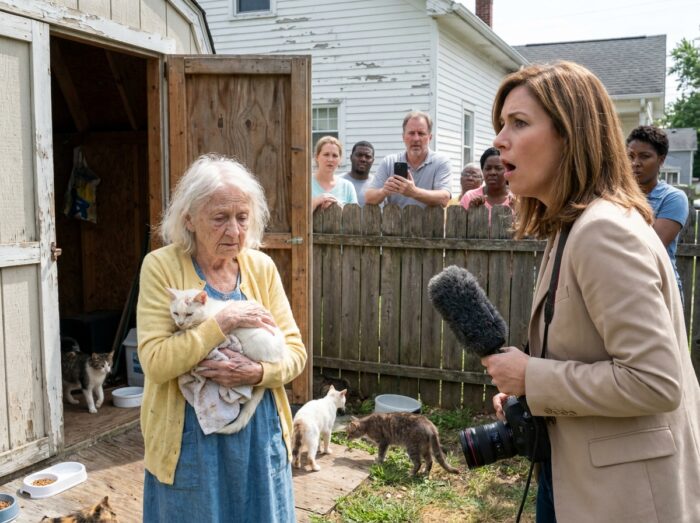
Her editor had sent her to Maple Street for a simple neighborhood dispute.
Too many cats.
Too many complaints.
One lonely woman refusing to stop.
The kind of story that filled three minutes before the weather report.
Megan parked outside Clara’s small white house just before noon, when the light was bright enough to show every peeling board on the porch.
A handmade sign near the steps read, “Please drive slow. Little paws crossing.”
Someone had spray-painted the word “crazy” across the bottom in red.
Clara had scrubbed most of it away.
Not all.
Megan noticed that first.
She also noticed the porch rail had been repaired with mismatched wood, the flowerpots were cracked but watered, and the mailbox leaned like it had survived more than one angry shove.
Clara opened the door before Megan knocked twice.
She was smaller than expected, with soft white hair pinned loosely behind her ears and a face marked by years of sun, worry, and long silences.
Her cardigan was yellow, her hands were clean, and there was a fresh bandage around her thumb.
“Mrs. Bell?” Megan asked.
“Clara is fine.”
Megan lifted her camera bag slightly.
“I’m from Channel 8. I called about the interview.”
“I know,” Clara said. “You said you wanted both sides.”
It was not an accusation.
That made Megan feel worse.
Inside, the house smelled faintly of lavender soap, old wood, and cat food warming in a pan.
There were cats inside too, but not many.
Three, maybe four.
One gray tabby slept on a folded towel near the heater.
A black cat with one cloudy eye watched Megan from beneath a chair.
Another, orange and heavy, limped across the kitchen with the confidence of a retired mayor.
Megan had expected chaos.
She found labels.
Small containers.
Medication bottles.
A whiteboard on the wall with times written in careful handwriting.
“Boots — antibiotic, 7 a.m.”
“Rosie — soft food only.”
“Little June — check paw.”
Megan glanced at the board, then at Clara.
“You keep records?”
Clara folded a dish towel.
“They forget what hurts. Somebody has to remember.”
It was the first sentence that did not fit the story Megan had been sent to tell.
Outside, a car slowed near the curb.
A woman inside lifted her phone and recorded through the window.
Clara saw her.
She did not move toward the curtain.
Megan noticed the old woman’s jaw tighten, then relax.
“Does that happen a lot?” Megan asked.
“More since the lawsuit.”
“Does it bother you?”
Clara looked toward the sleeping gray cat.
“It bothers them.”
Megan turned on the small camera, expecting Clara to defend herself, maybe cry, maybe say people were cruel.
But Clara did none of that.
She answered plainly.
Yes, there were many cats.
Yes, she fed them.
Yes, some neighbors were upset.
Yes, she understood why.
That surprised Megan most.
“You understand why they’re upset?”
Clara nodded.
“Of course. Nobody wants noise under the deck at midnight. Nobody wants paw prints on a clean car.”
“Then why not stop?”
Clara did not answer.
Instead, she opened a drawer and took out a stack of receipts bound with a rubber band.
Megan expected pet store receipts.
There were some.
But there were also veterinary invoices.
Spay and neuter surgeries.
Vaccinations.
Deworming treatments.
Emergency care.
One bill was nearly eight hundred dollars.
Another was over twelve hundred.
Megan frowned.
“These are all yours?”
“I paid what I could,” Clara said.
“With your own money?”
Clara gave a small shrug.
“Whose money would it be?”
Before Megan could ask another question, a crash came from outside.
Both women turned.
A metal bowl had fallen near the shed.
Clara moved faster than Megan expected, grabbing a small towel from the counter and hurrying toward the back door.
In the yard, a skinny white cat was caught beneath an overturned crate, panicking.
Clara knelt slowly in the grass despite the stiffness in her knees.
Her voice changed.
Not sweeter.
Lower.
Steadier.
“Easy, Pearl. Nobody’s angry.”
The cat hissed and swiped.
Clara did not flinch when claws opened the bandage on her thumb.
She only covered the cat gently with the towel and freed one trapped paw.
Megan kept filming, but the lens felt too cold for what she was seeing.
Clara whispered, “There you go, baby. You don’t have to run from every hand.”
Across the fence, Mr. Dalton, the neighbor leading the lawsuit, shouted from his deck.
“That one tore up my patio screen last week!”
Clara looked up.
“I know, Ron. I ordered you a new roll.”
He stopped.
“What?”
“It’s on my porch. I was going to bring it over after lunch.”
Megan turned the camera toward him.
Mr. Dalton’s face changed instantly.
He disappeared inside.
That was the second thing that did not fit.
A reckless old woman did not keep receipts.
A selfish neighbor did not buy replacement screen for the man suing her.
And someone who wanted attention did not look so tired when the camera found her.
Then Megan saw the padlock on the shed.
It was new.
Heavy.
Clara noticed her looking.
“Not today,” Clara said softly.
“What’s in there?”
Clara picked up the metal bowl.
“The part nobody ever asks about.”
Megan did not push at first.
Good reporters knew when silence had weight.
She followed Clara through the yard as the old woman checked the feeding stations one by one.
There were not random piles of food scattered everywhere, as neighbors had described online.
There were raised wooden platforms to keep bowls off wet ground.
There were small insulated boxes tucked beneath shrubs.
There was a handwritten chart clipped inside a plastic folder near the porch.
Each cat had a description.
Gray male, left ear tipped.
Black female, healed eye injury.
Calico, pregnant when found, kittens placed with foster.
Megan touched one of the charts.
“You’re doing trap-neuter-return?”
Clara looked surprised.
“You know what that is?”
“My sister works at a rescue.”
Clara’s shoulders lowered slightly.
“Then you know feeding is only part of it.”
That was the first time she sounded relieved.
For weeks, people had shouted the word “feeding” like it was the whole crime.
Nobody had asked why so many cats kept appearing on Maple Street after dark.
Nobody had noticed the empty house three blocks away where renters had left six cats behind.
Nobody had seen the cardboard box dumped behind the pharmacy with kittens too young to open their eyes.
Nobody had followed Clara’s old station wagon to the low-cost clinic two towns over, where she waited in line before sunrise with traps covered in towels.
Megan recorded quietly as Clara opened the trunk of that wagon.
Inside were clean traps, folded blankets, gloves, canned food, and a plastic bin labeled “night rescues.”
“Do you have help?” Megan asked.
“Some people used to help.”
“Used to?”
Clara looked toward the fence.
“Before it became embarrassing.”
The words landed softly.
That made them hurt more.
A breeze moved through the yard, carrying the smell of cut grass and warm dust.
Near the shed, the skinny white cat Clara called Pearl watched from beneath a hydrangea bush.
“Why won’t you open the shed?” Megan asked.
Clara pressed her palm against the locked door.
“Because once people see it, they will decide what kind of woman I am all over again.”
Megan lowered the camera.
“What kind do you think they decided you are now?”
Clara smiled without humor.
“Dirty. Lonely. Stubborn. Maybe touched in the head.”
She looked down at her taped thumb.
“They’re not entirely wrong about lonely.”
Megan waited.
Clara reached into her cardigan pocket and pulled out a small brass key.
Her hand shook before she put it in the lock.
The shed door opened with a scrape.
Megan expected cages.
Maybe clutter.
Maybe proof the neighbors were right.
Instead, she found a tiny, handmade recovery room.
Not fancy.
Not perfect.
But clean.
There were shelves lined with labeled towels, heating pads, medicine syringes, washable mats, kitten formula, and old laundry baskets turned into recovery beds.
A small fan hummed in the corner.
A lamp warmed a box where three kittens slept against a stuffed rabbit.
On the wall were photographs.
Dozens of them.
Cats in carriers.
Cats after surgery.
Cats curled in blankets.
Cats held by smiling families on porches and couches.
At the center of the wall was a photo of a young woman in scrubs, holding a black kitten against her cheek.
Her smile was bright enough to make the shed feel different.
Megan pointed gently.
“Who is she?”
Clara touched the edge of the photo.
“My daughter, Annie.”
The name changed the air.
Clara had not mentioned a child.
No neighbor had either.
“She was a vet tech,” Clara said. “She could calm a feral cat faster than anyone I’d ever seen.”
Megan saw an old newspaper clipping tucked beneath the photo.
“Local Animal Clinic Worker Killed in Highway Crash.”
The date was eight years earlier.
Clara did not hide it.
“She was bringing three kittens to a foster home when a truck crossed the median,” Clara said.
Megan’s grip tightened around the camera.
“The kittens survived?”
Clara nodded.
“All three.”
She pointed to three framed photos on the wall.
One cat sat on a little boy’s bed.
One slept beside an elderly man in a recliner.
One was held by a bride in her wedding dress.
“Annie had a notebook,” Clara said. “She wrote down every stray colony she wanted to help.”
Clara opened a plastic container and removed a worn spiral notebook with a sunflower sticker peeling from the cover.
The pages were filled with names, maps, notes, sketches of feeding spots, vet appointment numbers, and small hearts beside cats marked “safe.”
“She wanted to open a shelter,” Clara said. “Not a big one. Just a place where sick strays could heal before going somewhere better.”
Megan could barely speak.
“So you built this?”
Clara looked around the little shed.
“I built what I could afford.”
That was the main twist, but not the last.
Megan noticed a row of envelopes in a shoebox on the shelf.
Each had a name.
Dalton.
Hanley.
Pruitt.
Greene.
The same names on the lawsuit.
“What are those?” Megan asked.
Clara hesitated.
Then she opened one.
Inside were photos of cats that had been removed from those neighbors’ yards over the years, along with notes and veterinary records.
Mr. Dalton’s crawlspace had once held a mother cat and five kittens.
Mrs. Hanley’s garage had trapped a sick tom for three days.
The Pruitts had called animal control about crying under their deck, but Clara got there first because the shelter was full.
“You never told them?” Megan asked.
“They didn’t ask.”
“But some of these cats came from their properties.”
“Yes.”
“And now they’re suing you for having them?”
Clara closed the envelope slowly.
“They saw the ending, not the beginning.”
For a moment, Megan forgot she was working.
The story had turned under her feet.
The woman blamed for bringing stray cats into the neighborhood had spent years quietly cleaning up the abandonment other people ignored.
She had trapped, treated, paid, buried, fostered, and rehomed animals nobody wanted to admit had been left behind.
And she had done it under the name of a daughter the town had almost forgotten.
A soft cry came from the kitten box.
Clara stepped over and adjusted the towel.
One of the kittens had a twisted front paw.
“Will that one make it?” Megan asked.
Clara brushed one finger along its tiny head.
“Annie used to say making it means different things for different souls.”
She lifted the kitten carefully.
“This one eats. That’s today’s miracle.”
Megan filmed that.
Not as evidence.
As witness.
When the story aired that evening, the town expected a nuisance report.
They got Clara’s shed.
They got Annie’s notebook.
They got the envelopes with familiar names.
They got footage of Clara’s taped thumb opening a can with slow, patient hands.
They got Mr. Dalton, caught on camera, learning Clara had bought him new patio screen.
And they got Clara’s answer when Megan asked why she endured being called names instead of explaining.
Clara looked into the yard, where Pearl finally stepped into the sunlight.
“Because if people were busy hating me,” she said, “they were at least looking this way. And sometimes looking is the first step before helping.”
The clip spread across town before midnight.
By morning, someone had left cat food on Clara’s porch.
Then blankets.
Then a check in a plain envelope.
Then a note from Mrs. Hanley that said, “I didn’t know about the garage cat. I’m sorry.”
By noon, the mayor called.
By evening, Megan returned with her camera and found twelve people in Clara’s front yard, asking where to start.
Clara stood on the porch in the same yellow cardigan, one hand pressed to her mouth.
For the first time in weeks, nobody was filming her to shame her.
They were waiting for instructions.
The lawsuit did not vanish overnight.
Paperwork rarely moves as quickly as hearts do.
But Mr. Dalton withdrew his name first.
He arrived at Clara’s porch two days after the broadcast with a box of screws, two rolls of screen, and a face that looked older than it had the week before.
“I fixed my patio myself,” he said.
Clara nodded.
“All right.”
Then he held out the second roll.
“Figured yours could use some.”
It was not a perfect apology.
But it was a door opening.
Mrs. Hanley came next, carrying towels washed and folded so neatly they looked new.
She had spent years complaining about paw prints on her flower bench.
Now she stood in Clara’s kitchen, staring at Annie’s notebook on the table.
“My sister had a cat like this,” she said, touching one page.
Clara did not say anything.
She simply poured coffee.
Within a month, Bellweather had changed in ways nobody planned.
A retired carpenter designed a proper recovery shelter behind Clara’s house, with insulated walls, washable floors, and separate spaces for kittens, injured cats, and new arrivals.
The high school shop class built feeding stations.
The local vet clinic offered reduced-cost spay and neuter days in Annie’s name.
Megan ran follow-up stories, but Clara never became comfortable on camera.
She always stepped aside when volunteers lifted lumber, painted trim, or carried supplies across the yard.
“This was Annie’s dream,” she would say.
But everyone could see her hands in it.
The new shelter opened on a cool Saturday morning in October.
There was no ribbon big enough to make Clara feel official, so the mayor handed her a pair of small silver scissors and let her cut a strip of yellow fabric from Annie’s old scrub top.
Clara held the fabric for a long moment before cutting it.
Nobody rushed her.
Pearl, the skinny white cat with the once-trapped paw, sat near the doorway in a soft blue collar.
She had stopped hiding beneath the hydrangea bush.
That day, she allowed Mr. Dalton to scratch her chin.
He looked startled by the privilege.
“She knows,” Clara said.
“Knows what?”
“Who’s trying.”
He nodded as if that answer had weight.
The shelter was named Annie’s Porch.
Not Annie’s Rescue.
Not Annie’s Memorial.
Clara said her daughter never liked places that sounded too grand.
A porch was where someone sat with you before you were ready to come inside.
That winter, the cats on Maple Street became fewer.
Not because Clara had stopped caring.
Because the work had finally become shared.
Some cats were adopted.
Some were treated and returned safely.
Some simply stopped being invisible.
On the first snowy evening of the year, Megan visited without a camera.
She found Clara sitting in the shelter doorway, wrapped in a brown coat, watching Pearl sleep beside three recovering kittens.
A small heater hummed behind them.
Outside, the old maple trees held snow on their branches like folded hands.
“Do you ever miss the quiet?” Megan asked.
Clara smiled.
“This is quiet.”
A kitten stirred.
Pearl opened one eye, then tucked her chin back down.
Megan looked at the wall where Annie’s photograph now hung above the supply shelves.
Beside it was a new photo.
Clara stood in front of the shelter with half the town around her, looking uncomfortable and happy at the same time.
Mr. Dalton was in the back holding a bag of cat litter.
Mrs. Hanley held Pearl.
No one in the photo looked perfect.
That made it feel honest.
Before Megan left, Clara walked her to the gate.
There was a new sign there now, hand-painted by Vanessa Reed’s art students.
It read, “Annie’s Porch — For the ones still learning to trust.”
Clara touched the sign once with her fingertips.
Then she looked toward the street where neighbors used to slow down just to judge her yard.
A car passed.
The driver waved.
Clara lifted her hand, small and gentle, as snow began to settle on the porch rail.
Behind her, from inside the shelter, came the soft sound of kittens eating.
It was not loud.
It was not grand.
But for Clara Bell, it sounded like something finally being understood.
Follow this page for more heartfelt stories about ordinary people, quiet kindness, and the moments that change a whole town. 🐾