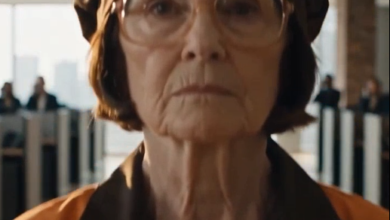
Part 2: A Mother Was Asked to “Keep Her Voice Down” in a Fancy Restaurant Because of Her Work Clothes — Then Her Daughter’s Words Made the Whole Room Go Silent
Part 2
Before that night, Grace Bennett had practiced being two different girls.
At school, she was Grace Bennett, scholarship finalist, debate captain, honors student, the kind of girl teachers trusted with keys to the auditorium and younger students asked for help with essays. She wore secondhand blazers so carefully pressed that nobody noticed the cuffs had been altered, and she wrote thank-you emails with the polish of someone who had learned early that opportunity often came dressed as scrutiny.
At home, she was Gracie, the only child of Maria Bennett, a woman who worked housekeeping at the Fairmont Suites near the airport and cleaned two private homes on Wednesdays when her knees allowed it.
Their apartment sat over a laundromat in a brick building where the pipes clicked at night and the kitchen window faced a parking lot. Maria called it “cozy” because she believed children remembered the tone more than the square footage. Grace called it home, though she had learned not to invite classmates over after one freshman-year birthday party when a girl from the suburbs looked at the pullout couch and asked, with real curiosity, “Is this where your mom sleeps?”
Maria had smiled as if the question did not cut.
Grace had never forgotten.
For years, Maria’s work uniform had been a fact of life: blue dress, white name tag, black shoes, hair pinned up before dawn. It carried the smell of bleach, hotel soap, and the faint lavender detergent Maria bought when it was on sale. When Grace was little, she used to run into her mother’s arms after school without noticing any of it.
Then she grew older.
She noticed everything.
She noticed the way cashiers spoke slower to Maria when she wore the uniform. She noticed the way building doormen assumed Maria was there to clean, even when she was dropping off paperwork for Grace. She noticed how teachers praised Grace for being “resilient” in a tone that made poverty sound like a disease she had survived.
Maria noticed too, but she carried it differently.
She did not bend under shame. She moved through it like bad weather, inconvenient but not worth surrendering to.
“People see what they know how to see,” she once told Grace while soaking her feet in a plastic tub after a twelve-hour shift. “That does not mean they are seeing the whole person.”
Grace pretended not to hear.
She was sixteen then, and sixteen can love a mother deeply while still wishing the world would stop being given reasons to misunderstand her.
The first small twist came with the Westbridge Scholarship.
Westbridge College was private, selective, and expensive enough that Grace almost closed the website after seeing the tuition. But her English teacher, Mrs. Holloway, made her apply, then made her apply for the scholars program too. The program covered nearly everything for ten students and invited finalists to an awards dinner at The Alder Room, the nicest restaurant in the city.
When the invitation arrived, Grace read it three times.
Maria read it once, then sat down at the kitchen table like her knees had suddenly given out.
“Dinner included?” she asked.
Grace laughed. “Mom.”
“I’m serious. These places charge twelve dollars for lettuce if they put it in a tall pile.”
Maria said it jokingly, but Grace saw her thumb rub the edge of the invitation, careful not to crease it.
The dinner allowed each finalist to bring one parent or guardian.
Grace knew immediately who she would bring.
But she also knew what her mother would worry about.
That night, Maria opened the hallway closet and pulled out a black dress wrapped in plastic from a discount store bag. It had been purchased five years earlier for a funeral and worn twice since. She held it against herself in the mirror.
Grace watched from the doorway.
“You should wear it,” Grace said.
Maria tilted her head. “It’s a little tight now.”
“It looks fine.”
Maria smiled too quickly. “Everything looks fine when your daughter loves you.”
Over the next week, Grace saw small signs that something was wrong.
Maria picked up extra shifts. She stopped buying coffee at the gas station. She repaired the heel of her black shoes with glue instead of replacing them. Twice, Grace found her mother asleep at the kitchen table with her hand still wrapped around a pen, a list of numbers in front of her.
When Grace asked, Maria said she was planning bills.
That was not a lie.
It just was not the whole truth.
The second twist came the afternoon of the dinner.
Grace had a senior showcase at school the same day, then a scholarship interview, then barely an hour to get home and change. She came through the apartment door at 5:42 p.m. carrying her navy dress in a garment bag Mrs. Holloway had lent her.
Maria was not home.
There was a note on the counter.
Baby, I am running late. Put on the dress. I will meet you there. I promise.
Grace called.
No answer.
She called again.
Maria answered on the third try, breathless, with traffic noise behind her.
“I’m coming, mija.”
“Where are you?”
“On the bus.”
“Mom, you’re not dressed?”
A pause.
“I’m dressed enough.”
Grace closed her eyes. “What does that mean?”
“It means I am on my way.”
Grace wanted to argue, but the line crackled and Maria’s voice softened.
“Don’t be late because of me. Walk in like you already belong there.”
That sentence stayed with Grace all the way downtown.
The Alder Room looked more like a movie set than a restaurant. Dark wood walls. Tall flowers. Men in suits opening doors. A hostess who smiled with perfect teeth while scanning the guest list.
Grace arrived alone.
Every other finalist seemed to arrive with parents who looked prepared for the room. Fathers in jackets. Mothers in silk blouses. One family brought flowers. Another brought a professional camera. Grace sat at table seven with a glass of water she was afraid to drink too quickly.
At 7:12, Maria appeared at the entrance.
In her work uniform.
Grace saw her before anyone else did.
Maria stood near the hostess stand with one hand smoothing the front of her blue dress, trying to make it less wrinkled by will alone. Her hair was pinned back, but strands had escaped around her temples. Her face was clean and tired. Her name tag was still clipped to her chest because she had forgotten to remove it.
For one second, Grace felt relief.
Then she felt fear.
Not fear of Maria.
Fear of the room.
She watched people notice.
The hostess looked confused. A waiter stepped forward as if to redirect Maria toward the service hallway. Maria held up the invitation with both hands, and the hostess’s expression changed from confusion to polite surprise.
Grace stood quickly.
“Mom,” she said, crossing the room.
Maria’s face lit up so fully that the whole restaurant seemed less cold for half a second.
“My girl,” she whispered.
Grace hugged her tightly.
Maria smelled like bleach and rain.
Grace should have held on longer.
Instead, she pulled back too quickly because she could feel people watching.
Maria noticed.
Of course she noticed.
Mothers notice the exact second their children become aware of other people’s eyes.
But she did not show it. She only touched Grace’s cheek with two fingers and said, “You look beautiful.”
They walked to the table.
That was when Maria laughed at the little congratulatory card, a soft, delighted laugh that rose out of her like a bird escaping a closed room.
And that was when the manager approached.
“Ma’am, we do ask guests to keep their voices down.”
Grace felt the room tighten around them.
Maria’s hand moved to her name tag.
She tried to remove it, but the clasp stuck.
The manager continued, “This is a private academic dinner. Are you with the service staff, or are you seated here?”
Every small humiliation in Grace’s life seemed to gather under that chandelier.
The girl who had asked about the couch. The teacher who praised resilience. The parents who said Maria was “so hardworking” in the same tone they used for janitors they never learned to name.
Grace expected her mother to defend herself.
Maria did not.
She simply opened her purse and took out the folded invitation, but her hands were trembling too much to unfold it cleanly.
A white envelope slipped out with it.
It fell beneath the table.
Grace bent to pick it up.
On the front, in Maria’s handwriting, were the words: For the application fee, if they ask again.
Grace stared at it.
Inside was cash.
Small bills.
A lot of them.
Suddenly, the week of extra shifts made sense. The repaired shoes. The skipped coffee. The lists at the kitchen table. The black dress left in the closet because there had been no time, no energy, no extra bus fare to go home and change.
Grace rose slowly with the envelope in her hand.
And this time, she did not sit back down.
Part 3
The manager’s expression changed when he saw the invitation, but not enough.
That was the part Grace remembered later.
He became apologetic in the way people become apologetic when they have been caught being impolite, not when they have fully understood the person they wounded. He nodded, adjusted his jacket, and said, “Of course, ma’am. My apologies for the confusion.”
Confusion.
Grace hated that word in that moment.
There had been no confusion. There had been a uniform, a name tag, a tired woman, and a room full of people who accepted the first story their eyes offered them.
Maria touched Grace’s wrist gently.
“It’s fine,” she whispered.
Grace looked at her mother.
Fine was the word Maria used for swollen ankles, overdue electric bills, rude guests at the hotel, and birthdays when she pretended a grocery store cupcake was exactly what she wanted. Fine was not a truth. It was a bridge Maria built so other people could cross discomfort without getting their shoes wet.
But Grace had just seen the envelope.
She had just seen the cash.
She had just watched her mother shrink in a room Maria had helped her enter.
“It isn’t fine,” Grace said quietly.
Several people at the table heard her.
Mrs. Holloway, seated two tables away with another student’s family, turned her head.
The scholarship director, Dr. Elaine Whitaker, paused mid-conversation near the front podium.
The manager took a careful step back. “Miss, I truly meant no offense.”
Grace felt her heart beating in her throat. She was not a dramatic girl. She hated public attention when it was not attached to an assignment or debate round. But some moments do not ask whether a person is ready. They ask whether silence is still possible.
Grace lifted the envelope.
“Do you know what this is?”
Maria’s eyes widened.
“Gracie,” she said softly, warning and pleading at once.
Grace did not look away from the manager.
“This is my application fee money. My transcript fee money. My bus fare. My lunch money when I told her I wasn’t hungry because I didn’t want her to know I needed it.”
The room went still.
Maria closed her eyes.
Grace turned slightly, not speaking to one person now but to the whole table, maybe the whole room.
“My mother came straight from cleaning hotel rooms because she didn’t want me walking into this dinner alone.”
The pianist’s hands slowed.
A fork touched a plate somewhere with a small, bright sound.
Grace swallowed hard.
“She missed her chance to change because her last room took longer. A guest left it destroyed, and if she walked out early, she would lose the shift. If she lost the shift, we couldn’t cover the last fee.”
The manager looked down.
But the redemption did not belong to him.
It belonged to Maria, though Maria looked as if she wanted to disappear.
Grace had spent years thinking her mother’s uniform made them visible in the wrong way. Now she saw that the uniform had been carrying her life forward, one cleaned room, one aching mile, one swallowed insult at a time.
The third twist surfaced when Dr. Whitaker approached.
She was a Black American woman in her early sixties with silver-streaked hair, a calm face, and the kind of presence that quieted rooms without asking permission. She looked at Maria’s name tag, then at Grace.
“Maria Bennett?” she asked.
Maria nodded, embarrassed. “Yes, ma’am.”
Dr. Whitaker’s face softened. “Fairmont Suites, airport location?”
Maria seemed startled. “Yes.”
The room listened.
Dr. Whitaker turned toward the scholarship committee table. “When my husband was hospitalized last winter, I stayed at that hotel for twelve nights. There was a housekeeper who left extra tea bags by my sink after she heard me coughing. She folded a towel under the door because the hallway draft was cold. She never knew my name.”
Maria’s lips parted.
Dr. Whitaker smiled faintly. “But I remembered hers.”
Grace looked at her mother.
Maria looked down at her shoes.
That was how Maria lived. Leaving tiny acts of care in places where no one would know to thank her.
The fourth twist came from the envelope.
Mrs. Holloway stepped forward, her eyes wet, and said, “Grace, may I?”
Grace handed it to her.
Inside were not only bills. There were receipts, folded carefully: testing fee, college application fee, bus pass refill, used laptop repair, dry cleaning for Grace’s navy dress.
At the bottom was one small receipt from a pawn shop.
Grace recognized the item description before her mind accepted it.
14k wedding band.
She looked at Maria’s left hand.
Bare.
The ring had been gone for months. Grace had assumed her mother had stopped wearing it because cleaning chemicals irritated her skin.
“Mom,” Grace whispered.
Maria shook her head once. “Not here.”
But it was already here.
It had been here all along.
Maria had sold the last physical piece of Grace’s father, a man who died when Grace was seven, not because she loved him less, but because their daughter’s future had asked for one more impossible thing.
Grace pressed the envelope against her chest.
The anger drained from her face, leaving only grief and awe.
“You sold Dad’s ring?”
Maria’s mouth trembled.
“He would have sold it himself,” she said.
That sentence moved through the room differently than any accusation could have.
A woman at the next table covered her mouth.
One father stared into his wine glass.
The manager stood completely still, the polished professional mask gone from his face.
Grace remembered her father mostly in pieces: his laugh, his red toolbox, the way he danced badly in the kitchen with Maria on Sunday mornings. She remembered Maria keeping his ring on a chain after it no longer fit her finger, touching it sometimes when bills came or when Grace won something at school. Grace had thought that chain meant Maria was holding on.
She had not realized letting go could also be love.
The fifth twist came when Maria finally spoke.
Not loudly.
Not defensively.
She simply looked at Grace and said, “I did not bring you here so you could fight for me.”
Grace wiped her cheek with the back of her hand. “Then why did you bring me?”
Maria glanced around the room, then back at her daughter.
“So you could sit in a place like this and know you did not sneak in.”
Silence fell so completely that even the kitchen noise behind the swinging doors seemed far away.
Grace understood then that her mother had not been ashamed of the uniform.
She had been afraid Grace would be.
And Grace had been, in small ways, which hurt more than if she had meant to be cruel.
Dr. Whitaker stepped beside Maria.
“Mrs. Bennett,” she said, “your daughter is a finalist tonight because of her own work. But I suspect she learned endurance from watching you.”
Maria shook her head, uncomfortable with praise. “She did the studying.”
“And you made sure she had light to study by,” Dr. Whitaker said.
The scholarship dinner had a schedule. There were supposed to be speeches, a slideshow, a plated salad, then the awards announcement after dessert. But schedules become fragile when truth enters the room carrying a cracked pair of work shoes.
Grace looked at the small microphone near the podium.
She did not ask permission because her whole life had been built around asking permission carefully, politely, correctly.
She walked to it.
Maria reached for her, but Mrs. Holloway gently touched Maria’s arm.
“Let her,” she whispered.
Grace stood behind the microphone in her navy dress, the envelope still in her hand, her mother’s name tag catching chandelier light from across the room.
“My essay for this scholarship was about ambition,” Grace began. “I wrote about college, law school, community work, and all the things students are supposed to say when adults ask where they see themselves in ten years.”
A few soft laughs moved through the room, uneasy but kind.
“But I left out the person who taught me ambition before I even knew the word.”
She looked at Maria.
“My mother cleans rooms most people leave without thinking about. She makes beds she will never sleep in, scrubs bathtubs for guests who will never learn her name, and comes home with hands so sore she sometimes opens jars with a towel wrapped around the lid.”
Maria’s face crumpled.
Grace kept going.
“She has been asked to move carts out of the way, to use service entrances, to wait, to hurry, to be quiet. Tonight, someone asked if she belonged here.”
Grace lifted the envelope.
“She belongs in every room her sacrifice paid for.”
That was the sentence.
Not shouted. Not polished. Not rehearsed.
Just true.
The room did not clap at first.
It could not.
People were too busy looking at Maria, really looking this time. Not at the uniform. Not at the name tag. Not at the scuffed shoes. At the woman whose life had been mistaken for background noise by people who enjoyed clean rooms, pressed sheets, and silent service.
Then Dr. Whitaker stood.
Mrs. Holloway followed.
The scholarship committee rose next, then the students, then the parents, until the entire Alder Room was standing around Maria Bennett, who looked terrified, humbled, and heartbreakingly small beneath all that attention.
Grace left the microphone and walked back to her mother.
Maria whispered, “You shouldn’t have done that.”
Grace took her rough hands.
“Yes,” she said. “I should have done it sooner.”
Part 4
The dinner resumed eventually, though it never returned to what it had been.
People spoke more softly after that, not because a manager asked them to, but because the room had been rearranged from the inside. The flowers were still tall, the plates still expensive, the chandeliers still warm above their heads, yet something had shifted in the way guests looked at the workers moving between tables.
They noticed hands.
That was what Grace noticed most.
A waiter balancing six plates with a wrist brace peeking from his sleeve. A busser clearing glasses so quietly that people had barely seen him before. The older woman near the kitchen doors who refilled water and smiled whenever someone thanked her, as if thanks was still surprising.
Maria noticed too, and it embarrassed her.
She did not want to become a lesson.
She only wanted to eat dinner with her daughter without her shoes becoming evidence.
When the awards announcement came, Grace did not expect to win. After everything that had happened, winning seemed almost too neat, and life had rarely been neat enough to trust. She sat beside Maria, their shoulders touching, while Dr. Whitaker read the names of the Westbridge Scholars one by one.
The fourth name was Grace Bennett.
For a second, Grace did not move.
Maria did.
She stood so quickly her chair scraped the floor. Her hands flew to her mouth. Then she turned to Grace with a sound that was half laugh, half prayer, and pulled her up.
The room applauded again, but this time Grace heard only her mother’s voice.
“You did it, baby.”
Grace shook her head, tears spilling freely now.
“We did.”
Maria closed her eyes at that.
Onstage, Dr. Whitaker handed Grace the scholarship folder. Then, in a move that was not part of any program, she placed a second envelope in Maria’s hands.
Maria looked startled.
“What is this?”
“A reimbursement from the scholarship foundation,” Dr. Whitaker said gently. “Application expenses, testing fees, transportation costs. We should have offered it earlier. Tonight reminded us why details matter.”
Maria held the envelope like it was too heavy.
Grace saw the wedding ring receipt in her mind.
Later, in the restroom, Maria stood before the mirror trying to fix her hair with wet fingers. Grace leaned against the counter, still holding the scholarship folder.
“I’m sorry,” Grace said.
Maria looked at her through the mirror.
“For what?”
“For being embarrassed sometimes.”
Maria’s face softened in a way that hurt.
“Oh, Gracie.”
“I was. Not because of you. Because of how people looked at us. But I still let it become about you.”
Maria turned from the mirror.
She took Grace’s face in both hands, the way she had when Grace was a little girl with fever-bright eyes.
“You are a child learning how to stand in a hard world,” Maria said. “Do not punish yourself for wobbling.”
Grace cried then, not dramatically, but with the quiet exhaustion of someone who had held pride and shame in the same body for too long.
Maria held her in the restroom of a restaurant that had almost made her feel invisible.
Outside, someone knocked gently and asked if everything was all right.
Maria and Grace looked at each other and laughed through tears.
“Yes,” Maria said. “Everything is becoming all right.”
The story moved through the city faster than either of them wanted.
A parent had recorded Grace’s speech, though no one posted it until Grace agreed. When it appeared online, people argued in the comments the way people always do. Some defended the restaurant. Some criticized the manager. Some told their own stories of mothers in uniforms, fathers in work boots, grandparents with lunch pails, people who stood behind the clean surfaces of other people’s comfort.
The Alder Room issued an apology.
It was formal and careful.
Maria read it once and set it aside.
“What do you think?” Grace asked.
Maria was at the kitchen table, rubbing lotion into her hands.
“I think an apology is a door,” she said. “People still have to walk through it.”
A week later, the manager came to the Fairmont Suites.
His name was Andrew, and without the restaurant lighting and black suit, he looked younger than Grace had realized. He stood near the housekeeping office holding a small box and looking deeply uncomfortable.
Maria could have refused to see him.
She almost did.
Then she wiped her hands on a towel and stepped into the hallway.
Andrew apologized without notes. He said he had made an assumption. He said he had confused polish with worth. He said his mother had worked in a cafeteria when he was young, and he hated that he had become the kind of man who might have made her feel small.
Maria listened.
When he finished, she did not rescue him from his shame.
She also did not crush him with it.
She only said, “Next time, ask the name on the reservation before you ask the person to shrink.”
Andrew nodded, eyes wet.
“Yes, ma’am.”
The box held Maria’s wedding ring.
Grace had told Dr. Whitaker about the pawn receipt, and Dr. Whitaker had quietly found the shop owner, who still had it in the back safe because, as he said, “Some things look like people might come back for them.”
Maria opened the box at the kitchen table that night.
For a long time, she did not touch the ring.
Then she slipped it onto the chain around her neck, where it had always belonged, resting close to her heart but no longer carrying the same weight.
Grace watched the motion.
“Dad would be proud of you,” she said.
Maria smiled faintly.
“He was always proud of us.”
In August, when Grace left for Westbridge, Maria drove her in a borrowed minivan with two suitcases, three boxes, a laundry basket full of towels, and enough snacks to feed an entire dorm floor. Grace tried to carry the heaviest box, but Maria took it from her automatically.
“Mom.”
“What?”
“I can carry things.”
Maria looked at her over the box.
“I know.”
They climbed the stairs together because the elevator line was too long. Parents passed them in the hallway carrying lamps, mini-fridges, new comforters, and plastic bins labeled by category. Maria wore jeans, a white blouse Grace had bought her with money from a summer tutoring job, and the same black shoes, polished until they almost looked new.
At the dorm room door, Grace paused.
It was small, bright, and bare, with two beds, two desks, and a window overlooking a courtyard where students were already laughing like they had belonged there for years.
Maria set the box down.
For a moment, neither spoke.
Then Grace reached into her backpack and pulled out the little card from The Alder Room, the one that said “Congratulations, Westbridge Scholars.” She had kept it.
She taped it above her desk.
Maria laughed softly.
Not too loud.
Grace turned.
“Louder,” she said.
Maria blinked.
“What?”
“Laugh louder.”
Maria stared at her daughter, then laughed again, fuller this time, warm and surprised and unashamed. A girl passing in the hallway smiled without knowing why.
Grace hugged her mother there, between the desk and the bare mattress, holding onto the woman whose hands had cleaned rooms, packed lunches, sold a ring, counted bills, and carried her toward a door neither of them could have opened alone.
That evening, after Maria drove home, Grace found something tucked into the side pocket of her suitcase.
A folded note.
Baby, walk in like you already belong there. And when you forget, call me.
Under the note was twenty dollars in small bills.
Grace sat on the dorm bed and laughed through tears, because even after everything, Maria had found a way to leave her with more than she had taken for herself.
Months later, when Grace returned to The Alder Room as a guest speaker for the next scholarship dinner, Maria came with her.
This time, she wore the black dress from the closet, altered by a neighbor who refused to take money. The wedding ring rested on its chain. Her hands were still rough. Her shoes still pinched a little. But when she entered the room, she did not look down.
Andrew, still the manager, met them at the door.
“Good evening, Mrs. Bennett,” he said. “Your table is ready.”
Maria nodded.
“Thank you, Andrew.”
Grace watched the exchange and felt something quiet settle in her chest.
Not victory.
Something better.
Room.
At dinner, Maria laughed when the soup spoon was smaller than expected. This time, no one asked her to lower her voice.
And if anyone turned to look, they saw what had always been there: a mother beside her daughter, not sneaking into a beautiful room, not borrowing dignity from the chandelier light, but carrying her own.
Follow this page for more heartfelt stories about family, quiet sacrifice, and the people we learn to see more clearly with time. 🌷