Part 2: A Little Girl Sat Alone in the Cafeteria All Through Fourth Grade — Until a New Boy Sat Beside Her and Changed Both Their Lives
PART 2
Willow Creek Elementary was the kind of school where the front office smelled like copier paper, crayons, and hand sanitizer.
The hallways were lined with bright bulletin boards.
Perfect attendance stars.
Math challenge winners.
Paper snowflakes with names written in careful marker.
Ella Parker’s name rarely appeared anywhere except the attendance sheet.
Her teacher, Mrs. Bell, worried about her in the quiet way good teachers worry after school hours.
Ella completed assignments.
She never interrupted.
She followed directions so carefully that careless adults called her easy.
But easy children can disappear in plain sight.
Mrs. Bell noticed the lunchbox first.
It was always packed.
Turkey sandwich cut in triangles.
Apple slices.
Pretzels.
Sometimes a small note from home folded inside a napkin.
Ella never read the notes in the cafeteria.
She tucked them into the front pocket of her backpack and touched the zipper twice after closing it.
One Tuesday, Mrs. Bell found a note on the classroom floor.
It must have slipped out during reading groups.
The handwriting was adult and slightly shaky.
“Eat three bites for me, sweetheart. Mom.”
Mrs. Bell stood there longer than she meant to.
Ella’s mother had died the previous spring.
A car accident on a wet road outside town.
Everyone at school had known for two weeks, then the year ended, summer came, and sympathy quietly packed itself away.
By fourth grade, most children remembered only that Ella had become strange.
Her father, David Parker, did his best.
That was the phrase people used when they did not know what else to say.
He packed the lunchbox every morning because Ella’s mother used to.
He wrote notes because Ella’s mother used to.
He bought the same brand of apple slices, though they cost more, because grief makes small details feel like bridges.
But Ella could not eat them.
Opening the lunchbox felt like opening a room where her mother was still alive for one second, then gone again.
So she opened it.
Looked.
Closed it.
Threw most of it away before anyone could ask.
When Tyler Reed arrived midyear, he brought his own silence.
He was ten, Black American, with serious dark eyes, close-cropped hair, and a habit of pulling his sleeves over his hands.
His records said he had transferred from Dayton.
They said his grandmother was his emergency contact.
They said nothing about why he flinched when cafeteria trays crashed too loudly.
On his first day, Mrs. Bell assigned him the desk beside Marcus, a cheerful boy who asked three questions before Tyler had taken off his coat.
Where are you from?
Do you play soccer?
Why did you move?
Tyler answered the first two.
On the third, he looked at the pencil groove carved into his desk and said, “My grandma’s house has a blue porch.”
Marcus blinked.
That was not an answer.
Tyler did not offer another.
At lunch, the class moved in its usual wave toward the cafeteria.
Tyler held his tray carefully.
Chicken nuggets.
Mashed potatoes.
Milk.
A cookie wrapped in plastic.
He stood at the edge of the room and watched the tables sort themselves.
Sports boys.
Popular girls.
Minecraft boys.
Quiet readers.
Children who had already learned that belonging requires timing.
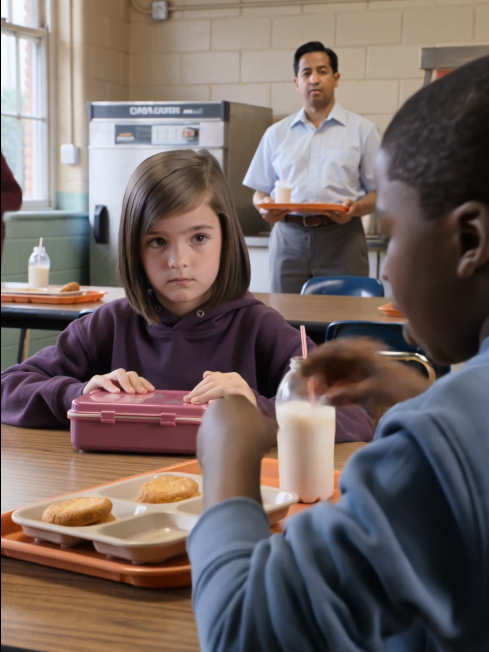
Then he saw Ella.
One small girl.
One unopened lunchbox.
One empty seat that everyone treated like caution tape.
Tyler walked toward her.
The cafeteria lowered by a few degrees.
Ella did not look up when he sat.
Tyler ate two nuggets.
She opened the lunchbox.
Closed it.
He watched without staring.
That was his first kindness.
Most children his age noticed too loudly.
After several minutes, he broke his cookie in half and slid one piece toward her.
Ella stared at it.
“I don’t eat cookies from strangers,” she said.
Tyler nodded.
“Good rule.”
She looked up, surprised.
He took his half and ate it.
Then he left hers there.
The next day, he sat with her again.
This time, he brought his own lunch from home in a brown paper bag.
Peanut butter sandwich.
Orange.
A folded napkin.
He placed the napkin between them.
On it was one sentence written in blue marker.
“You don’t have to talk.”
Ella read it.
Then she pushed it back.
“I can talk.”
“I know,” Tyler said.
“Then why did you write that?”
“Because people ask questions like talking is rent.”
Ella looked at him longer than she had looked at any classmate all year.
That was the first crack in her wall.
Not friendship yet.
A crack.
PART 3
For two weeks, Tyler sat beside Ella without making her perform gratitude.
That mattered more than anyone understood.
He did not ask why she never ate.
He did not ask why the purple hoodie sleeves were stretched from being pulled over her hands.
He did not ask why she saved every note from her lunchbox but ignored the food.
He simply showed up.
On the third Friday, Ella opened her lunchbox and found a note from her father.
“Mom would be proud of one bite.”
Her face changed.
Tiny, but Tyler saw it.
Her hand closed too quickly around the napkin.
She stood, grabbed the lunchbox, and walked toward the trash can.
Tyler followed, not close enough to crowd her.
Ella dropped the sandwich into the garbage.
Then she stopped.
Her shoulders began shaking.
Kids near the tray return stared.
One girl whispered, “She’s crying over a sandwich.”
Tyler turned and looked at her.
Not mean.
Just steady.
“She’s crying because something hurts.”
The girl looked away.
Ella wiped her face angrily.
“I hate lunch,” she said.
Tyler nodded.
“I hate Thursdays.”
That answer confused her enough to pause.
“Why Thursdays?”
He looked toward the windows.
“My mom’s court day was Thursday.”
Ella did not know what to say.
Tyler seemed to regret saying it, but he kept going because truth, once opened, sometimes needs air.
His mother had not died.
That was the first twist that separated his grief from Ella’s.
She was alive, in recovery, trying to rebuild a life after addiction, missed rent, and a boyfriend who made the apartment feel unsafe.
Tyler lived with his grandmother now.
He loved his mother.
He was angry at her.
He missed her.
He did not know where to put all three feelings during math class.
“She calls on Thursdays if she remembers,” Tyler said.
Ella stood beside the trash can, clutching the empty lunchbox.
“And if she doesn’t?”
“Then Grandma makes pancakes for dinner.”
“That doesn’t fix it.”
“No.”
He looked at her.
“But it gives your mouth something warm to do.”
For the first time in months, Ella almost smiled.
Mrs. Bell saw them from the cafeteria doorway.
She did not interrupt.
The next week, something shifted.
Ella still did not eat much.
But she stopped throwing everything away immediately.
Tyler began bringing two napkins.
One for himself.
One for what he called “table notes.”
They wrote small things.
Not diaries.
Not confessions adults would turn into meetings.
Just facts.
“My mom liked yellow raincoats.”
“My grandma hums when she lies about not being worried.”
“My dad burns toast and says it is rustic.”
“My mom calls when she can. I pretend I don’t wait.”
The notes stayed in Ella’s lunchbox.
Then in a pencil case.
Then, one day, Ella wrote a note without being asked.
“I think eating means she is really gone.”
Tyler read it twice.
Then he wrote back.
“I think answering the phone means I forgive her, but Grandma says no. It just means I answered.”
Ella folded the napkin very carefully.
That afternoon, Mrs. Bell called both guardians.
Not to report trouble.
To invite them to a quiet meeting.
David Parker arrived in work boots and a jacket with sawdust near the cuffs.
Tyler’s grandmother, Ruth Reed, arrived in a blue coat and carried a purse large enough to survive any emergency.
At first, both adults looked worried.
Parents and guardians often do when schools call without explanation.
Mrs. Bell placed the napkin notes on the table only after asking the children’s permission.
Ella sat beside her father, eyes lowered.
Tyler sat beside Ruth, one sleeve pulled over his thumb.
David read Ella’s sentence about lunch.
His face folded inward.
“Oh, Ellie,” he whispered.
Ella looked angry and scared at once.
“I didn’t want to hurt your feelings.”
David pressed both hands together.
“I thought the notes helped.”
“They do.”
“Then why—”
“Because they sound like her.”
That truth filled the room.
David looked at the floor.
“I was trying to keep your mom in your lunchbox.”
Ella’s eyes filled.
“I know.”
Ruth read Tyler’s note about phone calls.
Her jaw tightened, not with anger at Tyler, but with pain for him.
“You can answer and still be mad,” she said.
Tyler looked up.
“You sure?”
Ruth nodded.
“I do it every time your aunt calls.”
The children laughed softly, and the adults did too because relief sometimes enters through the smallest door.
The school counselor helped create a lunch plan that did not make Ella feel watched.
David stopped writing notes every day.
Instead, he packed one blank napkin with a tiny yellow star drawn in the corner, a quiet sign that her mother’s love did not require her to eat through pain.
Ella began taking one bite.
Not every day.
Some days grief won.
But some days, she took one bite and slid the rest toward Tyler, who accepted without comment.
Tyler, meanwhile, stopped pretending Thursdays were normal.
Mrs. Bell let him keep a small card in his desk.
“Phone call day. Feelings are allowed.”
He hated the card.
He used it anyway.
The friendship changed the classroom before anyone fully noticed.
Marcus asked to sit with them one day and brought a ridiculous joke about a dinosaur eating homework.
Ella told him the joke was terrible.
He looked delighted.
A girl named Sophie asked Ella if she could see the table notes.
Ella said no.
Then, a week later, she said Sophie could write one if it was not nosy.
By April, the far cafeteria table had five regulars.
They called it the quiet table, though it was not always quiet anymore.
The rule was simple.
No forced questions.
No laughing at lunches.
No calling silence weird.
Mrs. Harris, the cafeteria aide, began placing an extra box of tissues near the window without mentioning why.
Principal Grant noticed the table.
He wanted to make a program out of it.
Mrs. Bell gently stopped him.
“Some things work because adults do not put banners over them.”
He listened.
The biggest change came at the spring open house.
Students displayed projects about “Someone Who Changed My Year.”
Most children chose parents, coaches, celebrities, or pets.
Ella chose Tyler.
Tyler chose Ella.
Neither knew until the boards were set up side by side.
Ella’s board had a drawing of the cafeteria window, a brown paper bag, and a cookie broken in half.
Her title read: “The Boy Who Didn’t Ask First.”
Tyler’s board showed a pink lunchbox with silver stars.
His title read: “The Girl Who Saved Me a Seat Without Knowing It.”
Parents walked past and slowed.
David read both boards and cried quietly beside the cubbies.
Ruth put one arm around him without asking permission.
Tyler’s mother came that night too.
That was a twist nobody expected.
She arrived late, nervous, wearing clean jeans and a gray sweater, her hair pulled back, recovery meeting coin tucked in her pocket.
Tyler saw her from across the room and froze.
Ella noticed his hand closing.
She did not ask if he was okay.
She simply moved one step closer.
His mother approached slowly.
“Hi, baby.”
Tyler’s face shook.
“You came.”
“I said I would.”
“You say that sometimes.”
His mother flinched.
Then she nodded.
“I know.”
No one rescued the moment.
No one made it pretty.
Then Tyler pointed to the board.
“This is Ella.”
His mother looked at the drawing.
Then at the small girl beside him.
“Thank you for sitting with my son.”
Ella considered that.
“He sat with me first.”
Tyler’s mother smiled through tears.
“Then thank you for staying.”
Ella nodded once.
That was enough.
PART 4
By the last week of fourth grade, Ella still sat near the cafeteria windows.
But she did not sit alone.
The table had become a strange little island of children who did not fit neatly anywhere else.
Marcus with his terrible jokes.
Sophie with her quiet drawings.
A boy named Ben who stuttered less when nobody finished his sentences.
Tyler with his Thursday card folded soft at the corners.
Ella with her lunchbox open more often than closed.
On the final Friday, David packed a turkey sandwich, apple slices, pretzels, and one blank napkin with a yellow star.
Ella opened the box.
She looked at the sandwich.
Then at Tyler.
“My mom used to cut triangles.”
Tyler looked at his own sandwich.
“My grandma cuts squares because she says triangles waste emotional energy.”
Ella laughed.
It startled her.
The sound came out rusty from underuse, but real.
Mrs. Bell heard it from three tables away and turned toward the milk cooler so nobody would see her cry.
At dismissal, Tyler handed Ella a folded napkin.
She opened it in the hallway.
“Summer is long. Friends can still count if they don’t sit at the same table.”
Ella looked up.
“I know that.”
“I know you know. I wrote it for me.”
She folded it and tucked it into her lunchbox.
Over the summer, they saw each other twice at the library and once at the town pool, where neither of them swam very much.
Tyler’s mother came to one library afternoon and sat with Ruth while the children built a crooked tower of books.
She stayed the whole hour.
Tyler did not hug her when she left.
But he waved.
That was something.
Ella and David began making lunch together on Sundays.
Not like before.
Not trying to recreate her mother exactly.
They made new things badly at first.
Peanut butter rolls.
Cheese stars.
Apple boats with pretzel masts.
One Sunday, David burned grilled cheese so badly the smoke alarm screamed.
Ella opened a window and said, “Rustic.”
David stared at her.
Then they both laughed until the kitchen felt less haunted.
On the first day of fifth grade, Ella wore her purple hoodie again.
But the sleeves were not pulled over her hands.
Tyler arrived with a new backpack and the same serious eyes.
They entered the cafeteria together without discussing it.
Their table by the windows was still there.
For a moment, Ella looked at the empty seats.
She remembered a whole year of eating beside absence.
Then Tyler placed his tray down.
“Still available?”
Ella opened her lunchbox.
Inside was a note from David.
Not in her mother’s voice.
In his own.
“New year. Same brave girl. One bite if you can.”
Ella read it without hiding.
Then she placed it between her and Tyler.
He nodded toward it.
“That’s a good one.”
“Yeah.”
She picked up half her sandwich.
Across the cafeteria, other children were finding their places again, testing old groups, measuring new shoes, pretending summer had made them different.
At the window table, two children sat with their lunches, their losses, and the friendship that had taught them silence did not have to mean alone.
Ella took one bite.
Tyler did not clap.
He did not smile too big.
He just opened his milk carton and said, “My grandma says fifth grade is when people get dramatic.”
Ella chewed, swallowed, and looked around their table.
“Then we should be ready.”
Outside, a delivery truck passed, rattling the windows the way it always had.
This time, Ella did not flinch.
Follow this page for more heartfelt stories about quiet friendships, hidden grief, and the small kindnesses that change a child’s world. 🌿