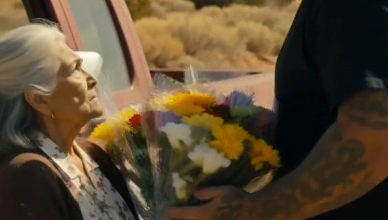
A Homeless Boy Called a Biker “Dad” at a Gas Station — Then a Twelve-Year-Old Dog Tag Brought a Missing Brother Home
The homeless boy called me “Dad” in front of forty strangers, but it was the battered dog tag swinging from his fist—not the word—that made my blood turn cold.
I had stopped at Harlan’s Fuel & Diner outside Winslow, Arizona, because my Harley was running hot and my right hand had started cramping around the throttle. Twelve years of riding that stretch of Interstate 40 had taught me every ugly seam in the asphalt, every broken vending machine, and every gas station where the coffee tasted like something wrung from an old shop rag.
That morning, the desert wind smelled of gasoline and dust.
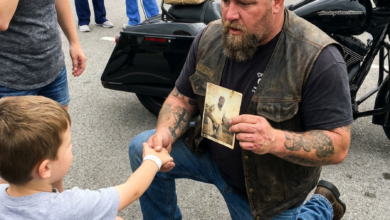
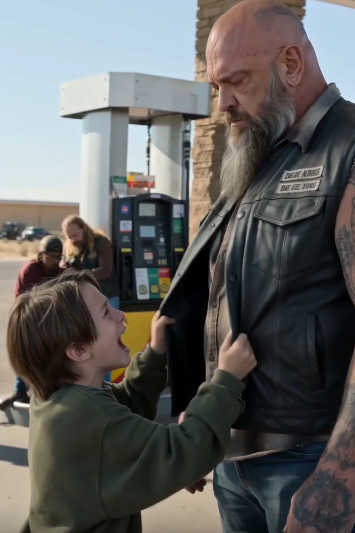
My name is Dean “Rook” Mercer. I was fifty-six, six-foot-five, two hundred eighty pounds, with a shaved head, a gray beard hanging halfway down my chest, and enough ink across my arms and knuckles to make nervous parents pull their children closer. My black leather cut had no bright colors and no friendly slogans. Just faded stitching, road grime, and one empty rectangular space over my heart where I had removed my younger brother’s name twelve years earlier.
People noticed me.
They usually stepped aside.
The boy did the opposite.
He came running between two fuel pumps in shoes held together with silver tape, wearing an oversized green sweatshirt despite the Arizona heat. He could not have been older than ten. His hair had been cut unevenly, probably with kitchen scissors, and his thin face carried the careful expression of a child who had already learned that adults could disappear without warning.
He grabbed the back of my leather cut with both hands.
“Dad!”
Every conversation around us stopped.
A woman beside a minivan stared at me. A trucker lowered his coffee. The cashier leaned across the counter behind the glass, already reaching toward the telephone. I looked down at the boy, and he looked up at me with brown eyes so familiar that for one impossible second the pumps, cars, wind, and highway all seemed to slide away.
“I’m not your dad, son,” I said.
He tightened his grip.
“Yes, you are.”
His voice did not sound confused. It sounded desperate.
A young woman wearing a gas-station apron rushed outside and told him to leave me alone. She said his name was Eli and that he had been sleeping behind the abandoned tire shop with his mother. She reached for his shoulder, but he ducked away and pressed himself against my side as though my scarred hand and black leather could protect him.
Then something slipped from beneath his sweatshirt.
A metal chain.
A dog tag.
It struck my silver belt buckle with a small, sharp click.
I knew the dent in its lower corner. I knew the shallow groove across its face. I knew the tiny hole beside the stamped blood type because I had made that hole myself with a drill press in our father’s garage when my little brother Danny wanted to wear the tag on a key ring after leaving the Army.
Danny Mercer had vanished twelve years earlier near Gallup, New Mexico.
No body. No motorcycle. No goodbye.
Only a burned saddlebag found near an empty service road and a bloodstained bandanna that the sheriff’s department said was not enough to prove anything.
I crouched in front of Eli.
My knees cracked. The chain rattled between us.
“Where did you get this?”
The boy closed his fingers around the tag and looked toward the desert behind the tire shop. Fear moved across his face before he could hide it.
“My mom said never show anybody.”
“What’s your mom’s name?”
He swallowed.
“Rebecca.”
That name meant nothing to me. Yet when he turned the tag over, I saw three letters scratched into the metal beneath Danny’s service number.
R-M-C.
Raven Mountain Crew.
The old name of the riding club Danny had belonged to before half its members scattered, one died in prison, and the rest swore they had no idea where my brother went.
A faded blue sedan rolled slowly past the station entrance.
Eli saw it.
His whole body stiffened.
The car did not stop, but the driver turned his face toward us. Eli shoved the dog tag into my palm, then whispered six words that cut deeper than “Dad.”
“He said they’d come back for us.”
I closed my fist around the metal. Behind me, my Harley’s cooling engine clicked beneath the desert sun. Across the forecourt, strangers were still watching, waiting to learn whether I was the boy’s father, his danger, or the only man he believed might listen.
I stared at my brother’s name.
Then I looked at the cashier.
“Call my brother’s old crew.”
The cashier’s name was Marisol Vega. She had worked the morning shift at Harlan’s for nine years and had learned to judge trouble by the way it entered the parking lot. Loud trouble slammed doors. Drunk trouble stumbled. Dangerous trouble usually smiled.
I did none of those things.
I stood beside pump six with my brother’s dog tag buried in my fist while Eli leaned against my leg. Marisol later told me the boy looked like a sparrow hiding beside a fence post. She also admitted that she had already dialed the first two digits of the sheriff’s number before she heard me ask for Danny’s old crew.
“You know them?” she said.
“I knew what they used to be.”
That answer did not comfort her.
Raven Mountain Crew had never been a large club. We were eight working men with secondhand Harleys, cheap tools, bad knees, and a rule that nobody rode home alone after dark. The newspapers once described us as a motorcycle gang after three members escorted a battered woman to court. The photograph showed eight bearded men outside the courthouse, so the headline wrote itself. Nobody mentioned the woman won her restraining order.
Danny loved the club more than I did.
He was seven years younger, lean where I was broad, quick with a joke, and incapable of passing a stranded motorist without stopping. After two Army deployments, he returned with a scar beneath his ribs and a habit of sitting where he could see every exit. He could fix a carburetor by sound. He could also spend an hour repairing a child’s bicycle without accepting a dime.
He had demons.
We all did.
Mine were anger and bourbon. Danny’s were sleeplessness and the belief that every person in trouble was somehow his responsibility. After our mother died, he started riding farther west, sleeping in roadside motels, calling me at strange hours just to hear a familiar voice.
His final call came from Gallup at 2:13 in the morning.
He said, “Rook, I found something I can’t leave.”
I asked what.
He answered, “A family.”
Then the line went dead.
For twelve years, that word had lived beneath my ribs.
A family.
The police checked hospitals, shelters, morgues, county jails, border crossings, impound yards, and ravines. The Army circulated his photograph. We rode every frontage road between Albuquerque and Flagstaff. We taped flyers inside diners until the sun bleached his face pale and rain loosened the corners.
Nothing.
After three years, the official searches stopped.
After five, Raven Mountain Crew cracked apart.
Our president, Victor “Saint” Alvarez, insisted Danny had chosen to disappear. Our treasurer, Malcolm “Mack” Dorsey, said the club’s money could not keep funding searches. Two members agreed with Saint. Two sided with me. One walked away without choosing.
I put Saint through a wooden table.
That ended the meeting.
It nearly ended me too.
I spent eleven months in county prison for assault, came out sober, and found the Raven Mountain clubhouse empty. The sign had been removed. The windows were boarded. My brother’s patch still hung inside because nobody had the courage to touch it.
I took the patch down myself.
That was the empty rectangle over my heart.
At Harlan’s, I handed the dog tag back to Eli because he was watching it like it was the last solid thing in his life. His fingers closed around it immediately.
“Take me to your mom,” I said.
Marisol stepped between us. She was five-foot-two, but she planted her shoes on the concrete as if she outweighed me.
“You’re not walking off with that child.”
“Good.”
She blinked.
“You come too.”
We crossed behind the abandoned tire shop together. Eli kept one fist hooked into my cut. A hot wind pushed wrappers through the weeds, and somewhere beyond the building, an air conditioner coughed inside an old motel that had been condemned after a roof fire.
Rebecca and Eli had made a shelter beneath a loading awning using a blue tarp, flattened cardboard, and a grocery cart. There were two blankets, three bottles of water, canned beans, a library book about desert animals, and a red plastic truck with one missing wheel.
Everything was neat.
That hurt worse.
A woman lay against the cinder-block wall with a damp cloth across her forehead. She was perhaps thirty-four, though hunger had placed extra years around her eyes. Her blond hair was tied with a shoelace. One sleeve covered her left hand even in the heat.
When she saw me, she tried to stand.
She failed.
Eli ran to her.
“I found him.”
Rebecca’s face emptied.
“No,” she whispered.
I stopped several feet away and crouched so I would not tower over her. Leather creaked across my shoulders. The dog tag hung from Eli’s neck, flashing in the narrow strip of sunlight.
“Did Danny Mercer give you that?”
Her eyes moved to the blank place on my vest.
“You’re Dean.”
Nobody outside the old crew called me Dean.
I felt Marisol step closer behind me.
“How do you know my name?”
Rebecca studied my face, particularly the broken bridge of my nose and the small white scar through my left eyebrow. Danny had the same scar on the opposite side. We got them on the same afternoon when a barn loft collapsed during a stupid childhood dare.
“He had a photograph,” she said. “Two brothers beside a red motorcycle. You were holding a wrench. Danny was bleeding from his lip.”
That photograph had sat inside Danny’s wallet.
It had never been released publicly.
My hands began to shake.
“Where is he?”
Rebecca looked at Eli. The boy sat beside her, shoulders pulled inward, protecting the dog tag beneath his sweatshirt.
“I don’t know anymore.”
Those four words opened the old wound exactly where it had closed.
Marisol brought water and food from the station. I called the county outreach office, then an old friend named Carla who managed a small motel and owed me nothing except the memory of Danny repairing her radiator during a snowstorm. She agreed to give Rebecca and Eli a room for three nights.
Rebecca resisted until I told her she could lock the door from the inside.
Only then did she accept.
While Marisol helped her stand, I noticed the faded scars around Rebecca’s covered wrist. Not fresh. Not accidental. She saw me looking and pulled the sleeve lower.
“Danny got us away once,” she said quietly. “He told me if anything happened, I should find the man with a rook tattoo on his right hand.”
I turned my fist over.
The black chess piece on my skin had blurred with age.
Eli touched it with one finger.
“That’s why I called you Dad,” he said. “Mom told me my dad looked like you.”
The sentence landed strangely. Not because Eli believed I was his father.
Because Rebecca had not said Danny looked like me.
She had said Eli’s father did.
And for the first time, I understood that finding my brother might mean discovering exactly what he had been running from.
The old crew did not arrive together.
Mack came first in a dented plumbing van because arthritis had taken him off two wheels. He climbed out wearing work pants and an oxygen tube, still six feet tall but hollowed by age. He looked at the dog tag, sat down on the curb, and pressed both hands against his face.
Luis “Preacher” Moreno arrived twenty minutes later on a black Road King. Then Amos Bell. Then Curtis Vann. Their V-twins rolled across the desert one at a time, deep and uneven, until Harlan’s windows trembled.
Saint arrived last.
Of course he did.
Victor Alvarez was sixty-two now. His beard had gone white, his shoulders had narrowed, but he still wore the old Raven Mountain colors beneath a brown riding jacket. The sight of that patch woke something ugly in me.
We had not spoken since the courtroom.
He killed his engine beside mine. Silence spread outward from the bike.
“Rook.”
“Saint.”
His eyes found Eli through the motel window. The boy stood behind the curtain, staring at the row of motorcycles.
Then Saint saw the dog tag in my hand.
He went pale.
Not surprised.
Afraid.
I crossed the distance before anyone could stop me. My fist caught the front of his jacket, and I drove him backward against his saddle. Leather snapped tight between my knuckles.
“You knew.”
Saint did not fight.
“Not enough.”
“You knew something.”
“Let him go,” Preacher said.
I ignored him.
For twelve years, I had imagined finding the person who hid the truth. In those fantasies, I never hesitated. But Saint was older now. So was I. The rage that once carried me through a table could no longer disguise itself as loyalty.
Eli was watching.
I released him.
Saint straightened his jacket and took a long breath.
“Danny came to me three weeks before he vanished,” he said. “He told me he was helping a woman leave a man named Owen Pike.”
Rebecca flinched from the motel doorway.
Saint continued. “Pike ran stolen vehicles across state lines. Mostly pickups, sometimes motorcycles. Danny thought he was also using young women to register the vehicles under clean names. Rebecca had done paperwork for him.”
“I didn’t know what the papers were,” she said. “Not at first.”
Her voice barely carried over the warm evening wind.
She had met Pike when she was eighteen and living outside Gallup. He offered her work, then a room, then control disguised as protection. By the time she understood the business, he had her identification, her bank account, and photographs he used to frighten her into silence.
Danny found her at a roadside diner.
Eli was not born yet.
“She had a split lip,” Saint said. “Danny asked one question too many.”
That sounded like my brother.
Danny moved Rebecca to a church safe house near Holbrook. He gathered copies of registration papers and wrote down license plates. He told Saint he intended to deliver everything to a state investigator.
Saint told him to walk away.
“You ordered him to abandon her?” I asked.
“I told him we were riders, not detectives.”
“You were president.”
“I was scared.”
Saint said it without defense. That was the first honest thing I had heard from him in twelve years.
Pike had connections. A deputy cousin. A tow-yard owner. Men who knew empty desert roads better than any patrol officer. Saint had two young daughters then. Mack’s wife was pregnant. Raven Mountain Crew liked to call itself a brotherhood, but when one brother asked them to step into real danger, most of them discovered where their bravery ended.
Danny refused to stop.
Three weeks later, he disappeared.
“You told the police none of this,” I said.
Saint’s jaw flexed.
“I gave an anonymous statement.”
“You hid your name.”
“Yes.”
“You hid Rebecca.”
“Yes.”
“You let them say Danny ran.”
His eyes lowered.
“Yes.”
My boots scraped across the pavement. Preacher moved between us, not aggressively, just enough to remind me that fists would not recover a missing man.
Rebecca brought out a stained envelope.
Inside was a photograph of Danny sitting on a motel bed with newborn Eli in his arms. My brother looked older than I remembered. His beard was short. A purple bruise darkened one cheek. Yet he was smiling at the baby as though the room contained nothing else.
The date printed on the back was ten years earlier.
Two years after Danny supposedly vanished.
My heart struck hard against my ribs.
“He survived,” I said.
Rebecca nodded.
“For a while.”
She told us Danny had staged the burned saddlebag near Gallup to make Pike believe he had died. He cut contact with everyone, even me, because Pike watched our houses and followed Saint’s daughters to school. Danny changed his name to Daniel Reed and worked seasonal construction across northern Arizona.
He and Rebecca lived as a family.
Not legally. Quietly.
Eli was born in a motel outside Kingman. Danny cut the cord with shaking hands because they had been too afraid to go to a hospital until the last possible hour. On the birth certificate, the father’s line was left blank.
“Was Danny his father?” I asked.
Rebecca looked at the boy.
“No.”
Eli stared at the concrete.
“Pike was.”
The gas station seemed to lose every sound except the buzzing fluorescent sign.
Danny knew.
He stayed anyway.
He raised Eli for seven years, teaching him to tie his shoes, change a bicycle tube, make scrambled eggs, and knock twice before entering a room. He kept the dog tag around his neck. When Eli asked why, Danny said it reminded him that a man’s name should mean something.
Then, three years earlier, Danny left their apartment in Flagstaff to meet a man who claimed to have proof that Pike had returned to trafficking stolen vehicles.
He never came home.
Again.
This time Rebecca did not contact police. She believed Pike was watching. She and Eli moved from motel to shelter, shelter to campground, always leaving when a blue sedan appeared nearby.
The sedan we had seen that morning.
Saint turned toward the highway.
Mack opened the van’s rear door and pulled out a steel lockbox. Inside were old club ledgers, road maps, receipts, photographs, and Danny’s black notebook.
My anger shifted toward him.
“You had that?”
“Danny mailed it to me two days before he vanished the first time,” Mack said. “Told me not to open it unless Saint gave the word.”
“And Saint never did.”
“No.”
Mack’s voice broke on the single syllable.
He set the notebook in my hands. The cover smelled of oil and dust. Danny’s handwriting filled most of the pages: plate numbers, dates, fuel stops, initials, routes. Near the back, one page had been torn out.
Eli looked over my arm.
“My dad had that page.”
Everyone turned.
“The torn one?” I asked.
He nodded. “He put it in my red truck.”
The toy truck with the missing wheel was still beneath the tarp behind the tire shop.
Rebecca closed her eyes.
“We left it there.”
Then headlights swept across the forecourt.
The faded blue sedan entered from the highway.
It moved slowly past the pumps, circled once, and stopped beside the abandoned tire shop.
Two doors opened.
Saint reached for his phone. Preacher moved toward Rebecca and Eli. Amos quietly stepped between the motel room and the parking lot, his boots square on the asphalt.
Nobody drew a weapon.
Nobody needed to.
Seven old men and five motorcycles formed a wall.
A tall man stepped from the driver’s side of the sedan. Gray shirt. Baseball cap. Phone raised, recording. A younger man climbed out on the passenger side and began shouting that Rebecca had stolen property from his family.
Eli gripped my vest.
The tall man smiled at him.
“There you are.”
Rebecca’s breathing quickened.
“That’s Owen Pike.”
I could have crossed the pavement in four strides.
Instead, I placed my hand over Eli’s fist.
“Stay behind me.”
Pike kept recording as he approached, narrating that a dangerous motorcycle gang had abducted his son. The performance was smooth. Practiced. He said he was a concerned father. He said Rebecca was unstable. He said the bikers had threatened him.
Then county patrol cars turned into the station.
For one fragile second, I believed the truth had arrived with them.
But the first deputy who stepped out looked at Pike and called him Uncle Owen.
Deputy Cole Pike was thirty-five, clean-shaven, broad through the shoulders, and angry before anyone spoke. He ordered us away from Rebecca and Eli. His partner, a young deputy named Hannah Price, kept one hand near her radio and watched everyone carefully.
Owen held out his phone.
“These men took my boy.”
Eli whispered, “He’s not my dad.”
Cole did not appear to hear him.
Rebecca tried to explain, but Owen spoke over her. He presented a photocopy of Eli’s birth certificate and pointed to an amended father entry bearing his name. He also produced family court papers granting him temporary custody.
Everything looked official.
That was the trap.
Cole ordered Rebecca to place her hands behind her back for questioning regarding custodial interference. Eli screamed and grabbed her sweatshirt. When I stepped forward, three hands stopped me—Saint on my shoulder, Preacher against my chest, Mack gripping my belt from behind.
“Don’t give Pike the picture he wants,” Saint murmured.
He was right.
I hated him for being right.
Deputy Price crouched beside Eli. She asked whether he knew Owen. The boy shook his head so hard the chain slapped against his neck. Owen called that coaching. Cole told Price they could sort it out at the station.
Then Owen noticed the dog tag.
His expression changed for less than a second.
I saw it.
So did Price.
“That doesn’t belong to him,” Owen said.
He reached toward Eli.
I stepped between them.
Cole put a hand on my chest and ordered me back. I raised both palms. Every camera in the forecourt turned toward us—Owen’s phone, the station security cameras, Marisol’s device, and three strangers filming from their vehicles.
“I’m backing up,” I said. “Ask him how he recognizes that tag.”
Cole’s face hardened.
“What?”
“He says it doesn’t belong to the kid. Ask him whose it is.”
Owen laughed. Too quickly.
“Some piece of junk Rebecca stole.”
“You didn’t call it junk,” Price said. “You called it ‘that.’”
Silence.
A tiny crack.
Marisol came through the station door carrying a printed page. Harlan’s security system had automatic plate recognition because fuel thieves frequently drove away without paying. The blue sedan’s plate belonged to a vehicle reported scrapped eight months earlier.
Cole told her to return inside.
Price took the paper.
Owen’s younger passenger began drifting toward the sedan. Amos moved sideways, blocking the clearest path without touching him.
Saint called the Arizona Department of Public Safety contact who had once investigated Danny’s disappearance. The number was disconnected. Mack called a retired state investigator named Renee Caldwell, whose business card had been tucked inside Danny’s notebook.
She answered.
That saved us.
Caldwell remembered Danny Mercer. More importantly, she remembered Owen Pike. Her original inquiry had been closed after evidence vanished from a county property room. The deputy responsible for the log had been Cole’s father.
Price heard the entire call on speaker.
Cole ordered her to ignore it.
She did not.
She asked dispatch to verify the custody order directly with the court. Owen objected. Cole became louder. Price became calmer.
The order number belonged to an unrelated divorce case in Tucson.
The amended birth certificate had never been filed by the state.
Owen’s documents were false.
Cole looked at his uncle. For the first time, he seemed less angry than frightened.
Owen moved.
Fast.
He grabbed Eli’s dog-tag chain and pulled. The chain broke, but I caught Eli before he fell. Price seized Owen’s wrist and ordered him to the ground. Cole froze between family loyalty and the badge on his chest.
The younger man ran toward the sedan.
Preacher stuck out one boot.
The man tripped over it and landed on both knees, cursing. Preacher raised his hands with an innocent expression.
“Bad pavement.”
Even Saint almost smiled.
Price called for additional units and separated everyone. Cole surrendered his radio after she warned him that interference would be documented. No dramatic confession followed. Men like Owen rarely confess when the truth first corners them. They complain. They threaten lawsuits. They repeat their version louder, believing volume can rebuild a collapsing lie.
But the trunk of the sedan finished what his voice could not.
Price obtained Owen’s consent to search after he insisted the vehicle contained nothing illegal. Inside, she found multiple license plates, stamped title forms, two prepaid phones, and a canvas duffel filled with personal documents belonging to other people.
At the bottom lay a black leather vest.
Danny’s vest.
The left shoulder was torn. Road dust had worked deep into the seams. His Raven Mountain patch remained stitched across the back, faded but unmistakable.
I knew every crease.
Danny had worn it the night we rode through freezing rain to our mother’s funeral. He had worn it when he held my head above a barroom sink after I split my eyebrow. He had worn it in the last photograph taken before he disappeared.
I reached for it.
Price stopped me gently.
“It’s evidence.”
“Is he dead?”
“I don’t know.”
Owen laughed from the back of the patrol car.
That sound broke whatever restraint I had left.
I walked toward him.
Saint blocked me.
“Move.”
“No.”
“He knows.”
“Then keep him alive enough to speak.”
The other men gathered behind Saint. Twelve years earlier, they had chosen fear. This time, they chose the harder thing.
They stood against me.
Not Owen.
Me.
Brotherhood did not always mean helping a man throw the punch he wanted. Sometimes it meant taking the punch yourself, holding him upright, and refusing to let grief turn him into the very excuse his enemy needed.
My fists opened.
Barely.
Eli stepped beside me carrying the broken chain. The dog tag was gone.
We searched the pavement beneath the pumps, around the patrol cars, and beside the sedan. Nothing. Owen claimed he had dropped it. Price checked his pockets. Empty.
Then Marisol reviewed the station footage.
The younger man had picked it up while everyone watched Owen.
He had hidden something beneath the rear tire before attempting to run.
Price found the dog tag pressed into a crack in the asphalt. Beneath it lay a small brass key wrapped in black electrical tape.
The tape matched residue on the back of the tag.
Rebecca stared.
“I never knew that was there.”
Neither had Eli.
The key bore the number 214.
Mack opened Danny’s notebook and turned to the final page. Beneath a list of fuel stops, Danny had written three words:
Locker. Meteor City.
Meteor City was an abandoned roadside trading post roughly forty miles east.
The building had been closed for years.
But the bus depot beside it still maintained rental lockers.
Night had already settled over the desert. Additional deputies took Owen, Cole, and the younger man away. Price told us to wait for investigators.
I looked at Saint.
He looked at the row of motorcycles.
Twelve years before, the crew refused to ride when Danny needed them.
This time, five engines started at once.
Deputy Price followed us in her patrol vehicle because evidence could not legally be recovered by a group of emotionally compromised bikers in the middle of the night.
Those were her words.
Mack rode in the passenger seat because his van had begun leaking coolant. Rebecca and Eli stayed with Marisol at the motel under protection from another deputy. Before we left, Eli placed the dog tag in my hand.
“You take it.”
“It belongs to you.”
“He wanted you to find the key.”
That stopped me.
“How do you know?”
Eli looked down at his taped shoes.
“Because he said if the rook ever came, it meant he couldn’t finish.”
I closed my fingers around the tag.
The ride east took forty-eight minutes. Heat lifted from the interstate in dark waves while trucks pushed hot wind across our lanes. Saint rode to my left, half a bike length behind. Preacher and Amos followed. Curtis brought up the rear.
It was the old formation.
Danny’s space remained empty.
At the abandoned trading post, broken dinosaur statues stood against the starlight, their paint peeled white by years of sun. The bus depot next door consisted of a waiting room, two vending machines, and a narrow corridor containing thirty metal lockers.
Number 214 was at knee level.
The brass key turned.
Inside sat a coffee tin, a disposable camera, three cassette tapes, a stack of receipts, and a sealed envelope with my name written across the front.
DEAN.
Not Rook.
Dean.
My brother’s handwriting leaned left when he was tired. These letters leaned so far they nearly fell.
Price photographed everything before allowing me to open the envelope. Inside were four pages and another key card.
I read the first line aloud.
“Brother, if a kid named Eli gives you my tag, believe him before you believe anyone wearing a uniform.”
Price absorbed that without flinching.
Danny wrote that Owen’s vehicle operation was larger than anyone suspected. Stolen vehicles were moved through towing companies in Arizona and New Mexico, assigned altered titles, then sold through small lots. Rebecca had unknowingly processed dozens of registrations. When she tried to leave, Owen threatened her unborn child.
Danny helped her escape.
He also discovered someone inside local law enforcement was warning Owen whenever investigators approached. That was why he staged his first disappearance. He believed my temper made me easy to provoke and easier to frame. If I knew he lived, I would come looking. Owen would follow me straight to him.
Danny knew me well.
Too well.
For two years, he collected evidence while moving Rebecca and infant Eli between towns. He sent pieces to Mack, Saint, and a federal post-office box under different codes. But Saint, afraid for the crew’s families, never passed along the final address. Mack never opened the lockbox. The federal parcel was returned after an addressing error.
A whole chain of men had each failed by one small act.
Together, those failures cost twelve years.
Danny did not condemn them in the letter.
That somehow made it worse.
The third page explained why Eli called me Dad. Danny had shown him the photograph of us beside the red motorcycle and taught him my full name, my nickname, and the rook tattoo.
“If you ever see this man,” Danny wrote, “he is not your father by blood. Call him Dad anyway. It is the fastest way to make Dean Mercer stop walking.”
Preacher gave a rough laugh that turned into a cough.
Saint looked away.
Danny had been right.
The fourth page contained the location of a storage unit in Flagstaff and a message written in block capitals:
DO NOT BRING THE CREW UNLESS THEY COME FOR THE BOY. IF THEY COME FOR ELI, IT MEANS OWEN FOUND REBECCA. THEN BRING EVERY BROTHER WHO STILL REMEMBERS WHAT THE WORD MEANS.
Below that, he had added:
Rook, I’m sorry. I chose keeping them alive over letting you know I was.
I read the sentence three times.
The key card opened unit 62 at a storage facility near the old rail yard. State investigators met us there before sunrise. Inside were boxes of copied titles, photographs, recorded conversations, payment ledgers, and names spanning two counties.
There was also a narrow cot.
A coffeemaker.
Three clean shirts.
And twelve years of birthday gifts wrapped for Eli.
One for each age from birth to twelve, though Eli was only ten.
Danny had prepared ahead.
On a shelf rested two carved wooden motorcycles. One had ELI burned into the side. The other bore no name.
Beside them sat a framed photograph of Rebecca and Eli sleeping together on a couch. Danny was visible in the reflection of a dark window, holding the camera.
No recent photographs showed him.
The disposable camera from locker 214 contained thirty-seven exposures. A lab in Flagstaff processed them under police supervision. Most documented vehicles and meetings. The final three changed the investigation.
The first showed Owen outside the storage facility.
The second showed Deputy Cole exchanging an envelope with him.
The third showed Danny reflected in the side mirror of a tow truck, photographing them.
The date was six months earlier.
Danny had been alive six months ago.
The state formed a joint investigation. Owen’s phones led to properties, vehicles, forged records, and financial accounts. Cole was suspended and later charged with evidence tampering and conspiracy. Other victims came forward after Rebecca agreed to give a statement.
Yet none of it told me where my brother was.
For three days, I lived inside the storage unit. I read every receipt. Smelled every shirt. Ran my fingers over every tool. Danny had labeled his boxes with the same black marker he used in our father’s garage.
On the fourth morning, Eli arrived with Rebecca.
He walked slowly between the shelves, touching the gifts but opening none. At the cot, he found a paperback book about chess. A rook had been drawn inside the cover.
He handed it to me.
The middle pages had been hollowed out.
Inside lay a cheap mobile phone with a dead battery.
We charged it.
There was one saved audio file.
Danny’s voice filled the storage unit.
Older. Weaker. Still his.
“If you’re hearing this, I missed the handoff. Don’t assume I’m dead. Owen likes cages more than graves. Check where the ravens lose their wings.”
Saint gripped a shelf.
I turned toward him.
“What does that mean?”
His face showed recognition.
“Raven Mountain wasn’t named after a mountain,” he said. “It was named after a salvage yard.”
The crew’s first unofficial clubhouse had been a back room at Raven Wing Aircraft Salvage outside Kingman. It closed fifteen years earlier after a fuel fire. The land was later purchased through a shell company.
One of Owen’s companies.
Price called the state team.
They told us to stay where we were.
We did.
For nine minutes.
Then Eli opened the first birthday package. Inside was a child-sized leather vest with no club patches, only a small black rook sewn over the heart.
He held it against his chest.
“Bring him home,” he said.
Saint picked up his helmet.
This time, nobody needed to call the old crew.
Authorities reached the salvage yard before us.
That detail matters.
We did not storm the property. We did not break through gates, wave weapons, or pretend old bikers were above the law. We stopped half a mile away at a highway pullout while state vehicles moved past with their lights dark.
Waiting was harder than riding.
The desert before dawn can make every small sound feel personal. Cooling pipes ticked. Chains settled. Saint smoked half a cigarette without inhaling. Preacher paced between the bikes. I stood beside the guardrail holding Danny’s dog tag so tightly that its edge cut a red line into my palm.
At 5:42 a.m., Price called.
They had found someone alive.
No identification yet.
I tried to mount my Harley, but my boot missed the peg. Curtis caught my elbow and said nothing. The crew formed around me—not celebrating, because alive could mean many things, and not mourning, because we finally had reason not to.
An ambulance emerged from the salvage road twenty minutes later.
We followed it to Kingman Regional Medical Center.
Rebecca and Eli arrived with Marisol shortly after sunrise. Eli wore the little vest Danny had made him. It was too large and hung almost to his knees.
A doctor met us in a private waiting area.
The man recovered from the salvage property was severely dehydrated, underweight, and suffering from an untreated fracture in his left leg. He had scars suggesting long restraint, though the doctor used careful language because the criminal investigation had only begun.
“Is it Danny?” I asked.
The doctor looked at the number of people behind me.
“He identified himself as Daniel Mercer.”
My knees weakened.
I sat because the alternative was falling.
Danny had been held intermittently at different properties after Owen discovered him gathering evidence. He escaped twice. The first time, he placed the storage-unit materials and recorded the message. The second time, six months earlier, he took the photographs found on the disposable camera.
Each time, Owen found him again.
Owen kept him alive because several encrypted files required Danny’s passwords. Danny provided false passwords, delayed, lied, and endured. When the police entered the salvage yard, they found him in a locked maintenance room behind stacked aircraft panels.
Price later told me his first question was not whether Owen had been arrested.
It was, “Did the kid reach the rook?”
The hospital allowed only one visitor initially.
I told Rebecca to go.
She shook her head. “He asked for you.”
“I lost twelve years. You lost them beside him.”
“And Eli needs to know you came back out.”
She was right.
Again, I hated the person who was right.
I entered alone.
My brother looked small in the hospital bed. Danny had never looked small. Even when he was fourteen and I was already grown, he occupied rooms with restless energy, tapping fingers, bouncing knees, scanning exits.
Now his gray hair reached his shoulders. His beard had been cut unevenly. Purple shadows surrounded his eyes. One leg was supported in a brace, and thin medical tubing ran beneath his nose.
I stopped at the doorway.
His eyes opened.
They were the same eyes Eli had raised toward me at the gas station.
Danny studied my beard.
“Hell, Dean,” he whispered. “You got old.”
I laughed once.
Then no sound came.
I crossed the room and took his hand. His fingers felt light, but the grip was still his: thumb across the first knuckle, two squeezes, the signal we had used since childhood when words would make things worse.
I squeezed twice.
He looked at the empty rectangle on my vest.
“You took me off.”
“I couldn’t carry a ghost.”
“Fair.”
That was all.
Bikers are supposed to have speeches for moments like that. We do not. Real men who have spent half their lives avoiding grief rarely become poets when grief finally sits upright and says their name.
I lowered my forehead to his hand.
Danny let me.
After a while, he asked about Eli.
“He found me.”
“Called you Dad?”
“Across a whole gas station.”
A faint smile touched his mouth.
“Knew it would work.”
“You turned a child into a trap for my attention.”
“You ignore phones.”
“You could’ve told him to call me Uncle.”
“You’d have kept walking.”
He was still my little brother.
Rebecca entered next. Danny’s face changed when he saw her. Nothing theatrical happened. She approached the bed, placed one hand against his cheek, and closed her eyes.
Eli remained in the doorway.
Danny saw the vest.
His breathing hitched.
“Too big,” he said.
Eli crossed the room.
“You said I’d grow into it.”
“I guess I did.”
The boy stopped beside the bed. For all the courage that carried him across a gas station, he suddenly looked ten again.
“Are you my dad?”
Danny’s eyes moved toward Rebecca, then back to Eli.
“If you’ll still have me.”
Eli climbed carefully onto the edge of the bed and wrapped both arms around him.
The machines continued their quiet rhythm.
I stepped outside.
Through the window, I watched Rebecca hold Danny’s hand while Eli rested his head against his chest. Saint stood behind me in the corridor. He removed the Raven Mountain patch from his jacket with a small folding knife and laid it on a chair.
“I don’t deserve this,” he said.
“No.”
He nodded.
“But Danny might need you anyway.”
Saint’s jaw trembled.
That was his second chance.
Mine was waiting behind the glass.
Danny spent eleven weeks recovering.
His fractured leg required surgery. His body carried damage that would not disappear with food, sleep, or the arrest of Owen Pike. Some nights he woke believing he was still behind the aircraft panels. Some mornings he could not tolerate a locked door.
He never described everything.
Nobody asked him to.
The evidence from the storage unit and salvage yard connected Owen to a long-running vehicle-title operation, unlawful confinement, document theft, intimidation, and multiple acts of corruption. More victims were identified. Deputy Cole accepted a plea agreement and testified against his uncle.
Justice came in paperwork, hearings, delayed court dates, and quiet phone calls.
It did not roar.
Danny moved into a small ground-floor apartment in Winslow because Eli wanted to remain near Marisol and the library where he had begun spending afternoons. Rebecca found work at a dental office. A nonprofit helped the family replace identification documents and secure stable housing.
The old crew repaired the apartment.
Mack handled plumbing from a folding chair. Preacher painted the kitchen twice because the first yellow was “too much like mustard.” Amos built a ramp for Danny’s walker. Curtis found a used table. Saint arrived every morning at seven and accepted whatever task Danny gave him without complaint.
Forgiveness did not happen in one scene.
It came as work.
Saint tightened cabinet hinges. Danny handed him screws. Some days they spoke. Some days they did not. Six months passed before Danny called him brother again.
I slept on their couch for the first three weeks.
Eli still called me Dad when he wanted my immediate attention. When he wanted money, permission, or an answer Rebecca had already refused, he called me Uncle Dean.
The kid adapted fast.
On Danny’s first day strong enough to leave the apartment without a walker, we took him back to Harlan’s Fuel & Diner. Marisol had saved the security video from the morning Eli ran across the pumps. She played it on a tablet while Danny watched.
There was Eli, all elbows and taped shoes, grabbing a giant biker’s vest.
There was me turning around.
There was the dog tag striking my buckle.
Danny watched the clip twice.
Then he wiped his mouth with one hand and looked through the window toward pump six.
“Good plan,” he said.
“Terrible plan.”
“Worked.”
I could not argue.
We did not rebuild Raven Mountain Crew as it had been. Some things should not return unchanged. The old patch remained in a drawer, along with the failures tied to it.
Instead, we started a roadside assistance group called The Empty Space.
No territory. No ranks. No demands for loyalty stronger than conscience.
Once a month, we rode Interstate 40 carrying water, tire kits, prepaid motel vouchers, and contact cards for shelters and legal aid. Every formation left one position open near the front.
Danny’s position.
Even after he recovered enough to ride again, he refused to fill it.
“That space isn’t mine,” he said. “It’s for whoever didn’t make it home yet.”
A year after the gas-station morning, seven Harleys pulled into Harlan’s before sunrise. Danny rode a restored Heritage Softail fitted for his injured leg. Eli sat on the stationary bike while we parked, wearing his small vest, which finally fit his shoulders.
Rebecca brought coffee.
Marisol brought a cake decorated like Interstate 40, though the road curved so badly that Preacher said it looked like a snake avoiding taxes.
Saint stood apart until Danny called him over.
Then Danny took his original Raven Mountain patch from a saddlebag. He did not sew it back onto his vest. He folded it once and placed it in Saint’s hands.
“Keep the part we got wrong,” Danny said. “Remember the part we fixed.”
Saint pressed the patch against his chest.
No speech.
Just two old men beneath a gas-station sign while the desert changed from black to blue behind them.
Eli came to me holding the dog tag. The broken chain had been replaced, but the dent, groove, and tiny drilled hole remained. He lifted it over his head and placed it in my palm.
“Whose is it now?” he asked.
I looked toward Danny.
My brother was laughing at something Rebecca had said. His laugh was rougher than before. Slower. Alive.
“Yours,” I told Eli.
He shook his head.
“Ours.”
He closed my fingers around it, exactly as I had done at pump six one year earlier.
The engines started one by one.
Danny took the left side. I rode the right. Between us, we left an open stretch of pavement wide enough for one more motorcycle, one more lost brother, or one frightened child still searching for the person who would stop walking when he called.
Eli raised his hand as we pulled away.
The dog tag rested over his heart.
The empty space rode with us.
Follow our page for more unforgettable biker stories about broken roads, tested brotherhood, and the quiet people who refuse to leave anyone behind.