A Broker Forced an 82-Year-Old Woman Out of the Home She Sold for Almost Nothing—Then a Biker She Sheltered 30 Years Earlier Brought a Lawyer, the News, and Every Piece of Furniture Back
Part 2 — The Empty Living Room on Larkin Street
I had not heard anyone call me Raymond since my mother died.
Most people knew me as Hammer, a name earned through twenty years of repairing motorcycles with fists too large for delicate work and a patience too short for bolts that refused to move. By the morning I returned to Larkin Street, even I had begun to think of Raymond Dawson as somebody who no longer existed.
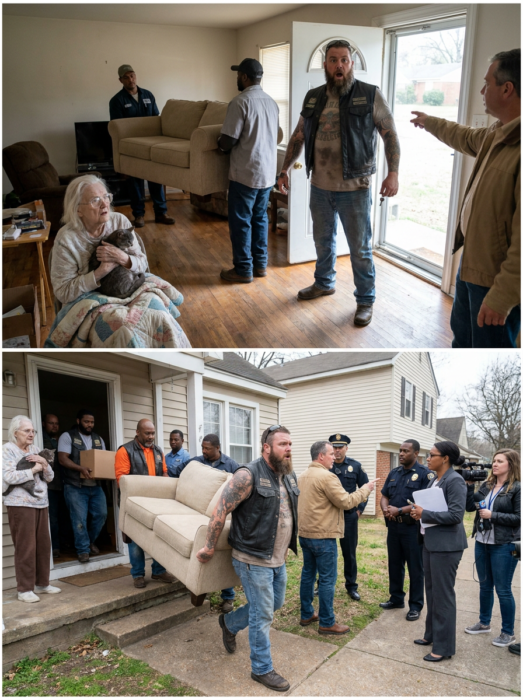
I was delivering furniture that day because Preacher, president of the Iron Saints, had volunteered our club for a neighborhood assistance program. The city warehouse collected tables, beds, chairs, and dressers from estate clearances, then sent them to families rebuilding after fires, evictions, or domestic violence.
The work was quiet, useful, and usually uncomplicated.
We had one table scheduled for Claire Bennett, who lived next door to the small white house where I had once slept in a detached garage.
I did not recognize the street immediately.
Thirty years changes a neighborhood without entirely replacing it. The grocery store had become a pharmacy. The laundromat was now a payday lender. Two maple trees were gone, the sidewalks had buckled, and the narrow drainage ditch where I once found a broken bicycle frame had been covered with concrete.
Then I saw Eleanor’s garage.
The siding was yellow instead of green, but the window above the workbench remained crooked. I had repaired that window twice. The first repair failed during a storm. Eleanor made me redo it and refused to praise the second attempt because, as she said, “A window staying in its frame is the minimum expected of a window.”
That was Miss Ellie.
She never confused kindness with lowered expectations.
I was carrying Claire’s table across the lawn when two men brought a dresser from Eleanor’s house. A third mover wheeled out cardboard boxes marked with black numbers. The front door stood open, exposing pale rectangles on the walls where framed photographs had been removed.
I looked through the doorway.
Eleanor sat on the hardwood floor with a gray cat in her lap.
She appeared smaller than I remembered. Her white hair had been gathered loosely at the back of her neck, and thick glasses magnified eyes that could no longer focus on the room around her. She wore a blue cardigan despite the heat.
A man in a tailored tan jacket stood beside her.
That was Grant Pike.
“We have a schedule,” he told the movers. “Everything needs to be out by noon.”
Eleanor asked where she was supposed to go.
Pike gave the answer people use when they want cruelty to sound administrative.
“Your relocation arrangements aren’t our responsibility.”
I set down the table.
Preacher saw my face and asked what was wrong.
I did not know yet.
Then I saw the brass key hanging from a hook beside Eleanor’s kitchen door.
I crossed the yards.
Pike met me at the porch.
“This is private property.”
“Who owns it?”
“My company.”
“Since when?”
“This morning.”
Behind him, Eleanor turned toward my voice. The cat raised its head and stared at me with cloudy green eyes.
I walked past Pike and knelt.
“Miss Ellie?”
She did not respond immediately.
Thirty years earlier, I had hair past my collar, no beard, and forty fewer pounds. Time had deepened my voice. Cigarettes and winter air had roughened it. I did not expect her to recognize anything.
So I removed the key from the chain inside my vest.
I had carried it through three apartments, two marriages that never happened, one jail cell, seventeen years of sobriety, and enough highway miles to wear out four motorcycles.
The key served no practical purpose. Eleanor had changed the garage lock years earlier. I kept it because it had once opened the only place in Memphis where I was allowed to sleep without somebody kicking me awake.
I placed it in her hand.
Her thumb traced the worn teeth.
Then she touched the small notch I had filed into the head after repeatedly confusing it with the house key.
“Raymond?” she whispered.
“Yes, ma’am.”
Her face folded.
The cat hissed when I moved closer, so I stopped and let Eleanor decide the distance. She reached for my beard, touched it once, and laughed through her tears.
“You grew all that to hide your chin.”
“Didn’t work.”
“No. You still have the same chin.”
Pike interrupted.
“This reunion can happen elsewhere. Mrs. Bell transferred ownership voluntarily.”
Eleanor’s hand tightened around my key.
“I thought he was helping with the roof.”
Pike opened his folder.
“You signed a purchase agreement.”
“What purchase agreement?”
The question changed the room.
One mover stopped beside the doorway. Another lowered a box. Preacher came onto the porch, followed by Rook and Boone, but I signaled for them to remain outside.
I asked Eleanor to tell me exactly what had happened.
Three weeks earlier, Pike had knocked on her door after noticing a city notice regarding overgrown brush and a small delinquent tax balance created by a clerical error. He said his company helped older homeowners repair properties and settle municipal problems.
He returned twice with documents.
The print was small. Eleanor told him she could not read it.
According to her, Pike summarized each page aloud. He described a repair authorization, an agreement allowing contractors onto the property, and paperwork permitting him to negotiate the tax dispute.
He placed adhesive flags beside signature lines.
A mobile notary arrived during the final visit. Eleanor asked whether she should call her niece in Nashville. Pike said delays could cause the city to seize the house.
So Eleanor signed.
That morning, Pike arrived with movers and told her the sale had closed. The money had not yet reached her bank. He instructed her to pack medication, clothes, and the cat because the house needed to be vacant immediately.
“I thought I had time,” she said. “I thought I still owned it.”
Pike corrected her.
“You were given every opportunity to review the agreement.”
I asked for a copy.
“You aren’t her lawyer.”
“No.”
“Then you have no standing here.”
“That true, Miss Ellie?”
She turned her blurred gaze toward me.
“I don’t know what standing means.”
“Means whether you want me to stay.”
She took my wrist.
“Stay.”
That was enough to keep me in the room, but not enough to let me interfere with property legally. Thirty years earlier, I might have thrown Pike off the porch and learned the consequences later.
Eleanor had taught me something better.
When I lived in her garage, she kept a telephone list taped beside the workbench: plumber, electrician, doctor, church, animal clinic, police, and one lawyer.
“You call people who know the right tool,” she used to say. “Anger’s only a hammer. Most problems aren’t nails.”
I took out my phone.
This time, the first tool was an attorney.
Part 3 — Eleven Weeks in a Garage
Before I tell you what the lawyer found, you need to understand why I still carried Eleanor’s key.
In January 1996, I was twenty-six years old and had been homeless for four months.
I did not look like the men people imagined when they heard that word. I had work boots, a winter coat, and a motorcycle that ran on good days. What I lacked was an address, steady employment, and enough honesty to admit that drinking had become more important than either.
I slept beneath an overpass near Summer Avenue because the concrete blocked some wind. During daylight, I walked to repair shops asking for work. At night, I hid my tools beneath my coat and pretended the traffic above me was rain.
The motorcycle broke down behind Bell’s Market during a cold snap.
It was not Eleanor’s market. The matching name was coincidence. She had gone there for canned soup and cat food. When she came around the back of the building, she found me crouched beside the bike with bleeding knuckles and half a bottle of whiskey in my jacket.
She did not ask if I was homeless.
She asked why I was trying to remove a seized bolt with the wrong wrench.
I told her to keep walking.
She set down her grocery bag.
“That bolt isn’t impressed by your attitude.”
I remember looking at her shoes. Brown leather, polished, sensible. The shoes of someone who expected to return to a warm home.
“I’ve got it,” I said.
“You’ve rounded it.”
“I said I’ve got it.”
“And I said you’ve rounded it.”
She walked away.
I assumed that was the end.
Twenty minutes later, Eleanor returned in an old station wagon carrying penetrating oil, a socket set, and a thermos of coffee. Her husband, Harold, had died the previous year. The tools had belonged to him.
She watched me free the bolt.
Then she asked where I planned to sleep.
I lied.
She recognized the lie and did not embarrass me by naming it.
“You can use my garage tonight,” she said. “There’s no plumbing, and the heater smells like burned dust. The house remains locked.”
I followed her home.
The detached garage contained a workbench, Harold’s tools, a lawn mower that would not start, boxes of Christmas decorations, and a folding cot. Eleanor plugged in a small heater and gave me two quilts.
“One night,” she said.
I remained eleven weeks.
The arrangement was never sentimental. Eleanor established rules on the first morning. No alcohol. No strangers. No entering the house without permission. I had to seek work every weekday and contribute when I could.
She gave me breakfast through the kitchen door.
Eggs, toast, black coffee.
When I tried calling it charity, she took the plate away.
“It is breakfast,” she said. “Don’t make food responsible for your pride.”
I repaired Harold’s mower. Then the garage shelves. Then the loose gutter, the back gate, and a neighbor’s carburetor. Eleanor began sending people to me with broken machines. Some paid five dollars. Some paid twenty. One man paid with a winter coat.
Eleanor placed an empty coffee tin on the workbench.
“Rent,” she said.
I put money in when I had it.
She never counted in front of me.
The hardest rule was opening the garage door every morning.
During my first week, I kept it closed because I was ashamed of neighbors seeing the cot. Eleanor knocked once.
“You planning to repair engines in the dark?”
“I don’t want people staring.”
“Then give them something worth seeing.”
“I’ve got nothing.”
She pulled the door upward herself.
Cold light entered the garage.
“You’re alive,” she said. “Start there.”
That sentence became the first honest thing anyone had said to me in months.
I found work at a motorcycle repair shop on Lamar Avenue. The owner allowed me to sleep in the storage room after the second week, but I stayed with Eleanor until I could afford a rented room because I had promised not to trade one temporary floor for another.
On my final morning, I cleaned the garage, folded the quilts, and placed forty dollars in an envelope inside the coffee tin.
Eleanor gave me the brass key.
“I changed the lock,” she said.
“Then why give me this?”
“So you remember what doors are for.”
I asked when she wanted the rest of the rent.
“When you have a door,” she said, “open it for somebody else.”
For several years, I visited every few months. Then work carried me west. I joined the Iron Saints. I spent years believing movement counted as progress.
Christmas cards changed addresses. Phone numbers changed. Pride made every silence longer.
Eventually, Eleanor and I lost contact.
I still opened doors.
The Iron Saints helped stranded riders, veterans, runaways old enough for adult shelters, and families whose belongings had burned. I told myself that fulfilled my debt.
It did not.
A debt is something you settle.
What Eleanor gave me became an obligation to continue.
Thirty years later, I found her sitting on the floor because someone had used small print, false urgency, and her failing eyesight to take the only door she had left.
I called Maya Bennett.
Maya was an elder-law attorney and the daughter of Preacher’s late riding partner. She had spent childhood weekends around the Iron Saints clubhouse, doing homework at a table surrounded by men who could rebuild transmissions but not help with algebra.
She answered on the second ring.
“Who’s been arrested?”
“Nobody.”
“Then why are you calling?”
I explained.
Her voice changed.
“Send me every page you can photograph. Include signature pages, addenda, disclosure forms, settlement statements, and anything about possession.”
Pike objected when Eleanor gave me the folder.
Maya heard him over speakerphone.
“Mr. Pike,” she said, “Mrs. Bell has requested legal assistance. Preserve all records and instruct your movers to stop until we establish whether you have lawful possession.”
Pike laughed.
“You’re giving instructions from a telephone.”
“I’m giving notice. The instructions will come from a judge.”
We photographed the documents on Eleanor’s kitchen counter.
The purchase price appeared on page six.
Forty-two thousand dollars.
The county assessor valued the property at $231,000. Comparable homes had sold for more than $260,000. The contract also charged Eleanor a $6,500 acquisition fee, a $4,800 cleanout fee, and $3,200 for “expedited occupancy transfer.”
She was expected to receive less than $28,000 for a mortgage-free home where she had lived forty-seven years.
Maya found the first contradiction on page eleven.
The primary agreement granted Eleanor thirty days after closing to surrender possession.
Pike produced a separate waiver claiming she had agreed to leave immediately.
The signature was wrong.
So was the middle initial.
Eleanor Mae Bell had signed her authentic documents E. M. Bell. The waiver read Eleanor N. Bell in handwriting without her upward arthritic slant.
Maya became quiet.
“That page may be forged.”
Pike stepped toward the phone.
“Careful.”
Maya answered, “I am being very careful.”
Then she told me to call the police, Adult Protective Services, and the moving company’s dispatch office.
I also called the local news.
Pike stared at me.
“You think motorcycles and cameras invalidate a contract?”
“No,” I said. “Evidence might.”
Part 4 — The Men Who Wanted to Use Their Hands
The Iron Saints reacted exactly as I expected.
Boone wanted to block the moving truck.
Rook wanted to put Pike’s car on wheel dollies and roll it into the street.
Preacher, who was usually the calmest among us, asked whether Pike could be persuaded to leave before he developed a personal understanding of property displacement.
I told them no.
“Everybody stays off him,” I said. “Nobody blocks anything. Nobody touches his car, his papers, or his people.”
Boone looked through Eleanor’s doorway.
“He’s throwing an old woman out.”
“And he wants us angry.”
“I am angry.”
“Be useful anyway.”
That was not easy.
Men like Pike knew how we looked. He saw black leather, tattoos, gray beards, heavy boots, and motorcycles lined beside the curb. If one of us raised a voice or laid a hand on him, he could change the story from suspected elder fraud to biker intimidation.
So we gave him no such story.
Preacher positioned two members near the truck only to record what remained inside. Rook photographed Eleanor’s belongings. Boone wrote down the movers’ names and company number. Two others helped Claire bring Eleanor water and locate her medications.
Every action occurred in public.
Every hand remained visible.
The first police cruiser arrived at 11:26.
Officer Daniel Ruiz stepped out with one hand near his belt. A second officer moved toward the bikers while Ruiz asked who had called.
Pike answered before I could.
“I did. These men are trespassing and preventing a lawful property transfer.”
“We called too,” I said.
Ruiz looked from me to Eleanor, who was still sitting with Mabel in her lap.
“Ma’am, are you safe?”
“I don’t know,” she said.
It was the most honest answer available.
Ruiz entered the house and listened to everyone separately. Pike showed him the recorded deed and purchase agreement. Maya spoke through my phone, explaining that fraud allegations required civil proceedings but immediate removal raised a separate possession issue.
“This agreement says thirty days,” Ruiz said.
Pike produced the waiver.
Ruiz compared signatures.
“I’m not a handwriting expert.”
“You don’t need to be,” Maya replied. “You need to prevent an escalating self-help eviction while the court reviews possession.”
The moving company’s dispatcher called next.
Once informed that the occupant disputed authorization and police were present, the company ordered its crew to stop. The foreman looked relieved. He told Ruiz that Pike had repeatedly instructed them to move faster and leave Eleanor’s items at a commercial storage site.
Pike’s certainty began to crack.
Then Leah Torres arrived from Channel Eight with a camera operator.
She did not ambush Eleanor. She first asked whether Eleanor wanted her story recorded. Eleanor looked toward me because she could not clearly see Leah’s face.
“What happens if I say yes?” she asked.
“People will know what happened,” Leah said.
“What happens if I say no?”
“We leave.”
Eleanor stroked the cat’s back.
“Stay.”
Leah interviewed her in the living room. Eleanor explained her eyesight, the city notice, Pike’s promise to arrange repairs, and the pages he had summarized without enlarging them.
Pike stood on the porch, demanding that his company’s name not be broadcast.
Leah asked him whether Eleanor had independent counsel.
“No legal requirement.”
“Was an accessible large-print copy provided?”
“She could have requested one.”
“She says she told you she couldn’t read the print.”
“She signed.”
“Did you tell her the estimated market value?”
“She sold voluntarily.”
“Did you create the same-day waiver?”
“My office prepared standard documents.”
“Why does it contain the wrong middle initial?”
Pike ended the interview.
At 12:08, Maya arrived carrying a laptop bag and wearing courtroom shoes unsuitable for Eleanor’s uneven walkway. She reviewed the original papers, took a sworn statement from Eleanor, and connected remotely with another attorney preparing an emergency petition.
The requested order was narrow.
It did not declare the sale void on the spot. Courts require evidence, notice, and process. The petition asked a judge to preserve the status quo, prevent transfer or alteration of the property, stop removal of Eleanor’s possessions, and recognize her contractual right to remain while the fraud claim was investigated.
That distinction mattered.
We were not taking justice into our hands.
We were protecting Eleanor long enough for justice to use its own.
While Maya worked, I examined the garage.
Pike had ordered movers to clear it after finishing the house. Boxes remained stacked beneath the workbench. The crooked window was still there. So were faint marks on the concrete where my motorcycle tires had rested.
My old cot was gone.
The coffee tin was not.
It sat behind paint cans on the highest shelf, rusted along the bottom and covered with dust. My name had been written across its lid in Eleanor’s careful hand.
RAYMOND.
I carried it into the house.
Eleanor touched the lid and smiled.
“I wondered when you’d find that.”
“What is it?”
“Your rent.”
I opened the tin.
Inside were eleven envelopes—one for each week I had stayed in her garage. Some contained five dollars. Some contained ten. The final envelope held the forty dollars I left on my last morning.
She had saved every cent.
Beneath the envelopes lay three newspaper clippings about charity rides organized by the Iron Saints and two postcards I had sent from Arizona.
“You never spent it,” I said.
“It wasn’t rent.”
“You called it rent.”
“You needed to believe you weren’t receiving charity.”
I looked at the old woman whose home had nearly been purchased for less than one fifth of its value.
“You could use it now.”
“It belongs to the boy in the garage.”
“He’s fifty-six.”
“Then he waited too long.”
That was when Maya called us back into the living room.
The judge had signed a temporary emergency order.
Pike could not remove Eleanor, alter the property, dispose of her belongings, or record further transfers until a hearing. The agreement’s thirty-day possession clause remained enforceable unless another court ruled otherwise.
The order did not end the case.
It opened the door.
The moving foreman asked Eleanor what she wanted done with the items already loaded.
She looked at me.
“Can they come home?”
I turned toward the Iron Saints.
Twenty-three club members had arrived by then. Some came directly from work in mechanic shirts. Others still wore reflective highway vests. Nobody had been summoned to fight. They had come because Preacher sent a message saying an old woman needed her house put back together.
I lifted one end of Eleanor’s sofa.
Pike stepped in front of the truck.
“If you carry that inside, I’ll sue every one of you.”
Maya held up the signed order.
“Move away from my client’s property.”
Pike looked at the police, expecting support.
Officer Ruiz read the order and nodded toward the house.
“Keep the walkway clear.”
I placed the sofa against my shoulder.
“Where do you want it, Miss Ellie?”
“Under Harold’s picture,” she said.
The picture had already been packed, but we remembered the pale rectangle on the wall.
I carried the sofa inside.
Behind me, the Iron Saints formed a line.
Furniture began moving the wrong way.
Part 5 — Putting a Life Back in Its Proper Rooms
We treated every object as evidence of a life, not cargo.
Rook brought in the dining chairs one at a time and checked their legs for damage. Boone carried boxes marked KITCHEN, though Eleanor could no longer read the labels. Preacher returned a cedar chest to the bedroom and waited while Claire verified its contents against the inventory.
Nobody shouted.
The only sounds were boots on floorboards, cardboard sliding across wood, the moving truck’s metal ramp, and Mabel’s occasional complaint whenever someone passed too close.
The cat refused to leave Eleanor’s lap.
Mabel was seventeen, thin beneath her gray coat, with one torn ear and the superior expression of an animal who had survived long enough to disapprove of everyone. She watched twenty-three bikers restore the room as though supervising poorly trained employees.
We returned the sofa first.
Then the end tables.
Then Harold’s photograph, which Eleanor asked us to hang above the sofa at exactly the height it had occupied before.
I measured the pale marks.
“Half an inch left,” she said from across the room.
“You can’t see it.”
“I lived with that picture forty-two years. Half an inch left.”
She was right.
A small crowd gathered outside. Some neighbors filmed on phones. Others brought water and sandwiches. One man who had never spoken to Eleanor offered space in his refrigerator for her medication while the kitchen was restored.
The story spread after Channel Eight broadcast a live report.
Within an hour, two callers contacted the station claiming Pike’s company had approached their elderly relatives with similar offers. By evening, five people had described nearly identical methods: code violations exaggerated into threats of seizure, “assistance agreements” concealing purchase language, rushed notarization, and sales priced far below market value.
Maya asked Leah not to call Pike guilty before evidence was reviewed.
Leah used precise words: allegations, disputed signatures, suspected deceptive practices.
Precision protected Eleanor better than outrage.
Pike remained across the street speaking into his phone. At one point, he attempted to approach the house with a man he described as his attorney. Maya met them on the sidewalk.
The man was not an attorney.
He worked for Pike’s investment company.
Officer Ruiz instructed both to remain outside.
Before leaving, Pike pointed at me.
“This woman will spend everything she has defending a contract she signed.”
I set down a box of dishes.
“That your plan?”
“It’s reality.”
“No,” Maya said from behind me. “It’s the pressure you’re counting on.”
Pike smiled.
“You doing this pro bono forever?”
Maya did not answer.
She did not need to.
By then, the Memphis Area Legal Services elder unit had agreed to join the case. A state consumer-protection attorney had requested the documents. Adult Protective Services opened an investigation. A title company placed a hold on disbursement after learning the transaction was disputed.
The money had not moved.
Neither would Eleanor.
At sunset, we finished restoring the last room.
Not everything returned perfectly. A lamp had broken in the truck. One table was scratched. Eleanor’s sewing supplies had been packed into three separate boxes. We documented all of it.
Claire prepared soup in Eleanor’s kitchen. Maya enlarged the emergency order and taped a copy near the front door. Officer Ruiz gave Eleanor his card with the telephone number written in thick black marker.
I carried the rusted coffee tin into the garage.
Eleanor followed slowly, one hand resting on Claire’s arm, Mabel now wrapped in a blanket against her shoulder.
The garage smelled of dust, old wood, dry leaves, and faint traces of motor oil buried beneath thirty years of paint.
My workbench was still there.
Harold’s socket set remained in the bottom drawer. Some pieces were missing, but the wrench Eleanor carried behind the grocery store on the night we met lay exactly where I remembered.
She touched the cot’s old location with the toe of her shoe.
“You were very loud when you slept,” she said.
“Never snored.”
“The windows rattled.”
“Bad windows.”
“I made you repair them.”
“Twice.”
“You did a poor job the first time.”
The club gathered at the entrance, but nobody stepped inside. They seemed to understand that the garage belonged to two versions of us: the old woman who had offered shelter without humiliation and the frightened boy who had not yet learned the difference.
Eleanor still held my brass key.
I asked why she had kept the duplicate near her kitchen.
“In case you came back.”
“That lock was changed.”
“You might not know.”
“What if I tried the old key?”
“Then I would hear you at the door.”
For thirty years, I had believed the key existed only to remind me of kindness.
To Eleanor, it had remained an invitation.
She opened the coffee tin and removed my final rent envelope. The forty dollars inside had yellowed along its folds.
“You need this more than I do,” I said.
“No.”
“You almost lost your house.”
“Almost is not the same as lost.”
“The case isn’t finished.”
“Neither are you.”
She pushed the envelope into my vest.
“Use it to open another door.”
I wanted to argue, but Eleanor had defeated my arguments when I was twenty-six and had gained three decades of practice since.
So I accepted it.
The hearing occurred twelve days later.
Pike’s attorney argued that Eleanor had signed a binding contract, that inadequate price alone did not prove fraud, and that buyer’s remorse could not invalidate a sale. Maya did not rely on the price alone.
She presented Eleanor’s ophthalmology records, evidence that Pike knew about her impaired vision, text messages promising “repair support,” the inconsistent possession documents, the suspect waiver signature, and testimony from the mobile notary.
The notary admitted Pike had summarized the agreement himself. She also admitted she had not verified whether Eleanor could read the pages and had left before the supposed occupancy waiver was signed.
That meant she could not have notarized it.
Yet her stamp appeared at the bottom.
Pike blamed an office error.
Then Maya produced metadata showing the waiver file had been created two hours after the notary left Eleanor’s home.
The judge extended the order.
The title remained frozen.
A forensic document examiner later concluded the waiver signature was probably traced from another page. Investigators found the same notary stamp on additional documents connected to Pike’s purchases.
This was no longer only Eleanor’s case.
Pike’s company had purchased seven properties from owners over seventy-five during the previous eighteen months. Four sales involved prices below forty percent of assessed value. Three owners said they believed they were signing loan or repair agreements.
One man had already moved into assisted living because he thought challenging the company was impossible.
After Eleanor appeared on television, he called Maya.
So did the daughter of another homeowner.
Predatory schemes depend on people suffering separately.
Eleanor’s story made them visible to one another.
Part 6 — The House Was Not Saved by Motorcycles
People later said the Iron Saints saved Eleanor’s house.
Preacher corrected them whenever he heard it.
“The lawyer saved the house,” he said. “The old lady saved the biker.”
He was partly right.
Motorcycles did not cancel a deed. Tattoos did not change contract law. Twenty-three angry men could not legally restore a title, and had we used intimidation, we might have damaged Eleanor’s case.
What the club provided was time, witnesses, labor, and the refusal to let her face a complicated system alone.
Maya provided the law.
Leah provided public scrutiny.
Officer Ruiz preserved the peace without deciding that wealth, paperwork, or appearance automatically determined who deserved to be believed.
Eleanor provided the courage to say she had been deceived.
That courage was not automatic.
For several weeks, she blamed herself.
“I signed,” she told me one afternoon. “Nobody moved my hand.”
“You couldn’t read the pages.”
“I should have called someone.”
“He told you there wasn’t time.”
“I should have known.”
I remembered saying similar things in her garage thirty years earlier. I should have kept my job. I should have stopped drinking. I should have known better than to trust certain people. Shame creates the illusion that every harm could have been avoided if the victim had simply been smarter.
Eleanor had not accepted that excuse from me.
I refused to accept it from her.
“Being trusting isn’t permission to lie to you,” I said.
She looked toward my voice.
“Did you practice that?”
“For thirty years.”
“It still sounds rehearsed.”
The civil case ended seven months later.
Faced with the signature analysis, witness testimony, disputed notarization, and state investigation, Pike’s company agreed to rescind Eleanor’s sale before trial. The deed was voided. The title returned to her name without a lien.
The court ordered the company to pay her legal costs and compensate her for damaged property. Separate regulatory and criminal investigations continued. Pike surrendered his real-estate license while disciplinary proceedings were pending.
Two other homeowners recovered their properties.
Another received restitution after the company had already resold his house.
Not every loss could be reversed, but Eleanor’s open door had become an exit for people she had never met.
She did not celebrate by holding a press conference.
She made chicken and dumplings for the Iron Saints.
Twenty-three bikers attempted to fit inside a house designed for six people. Boone sat on the floor. Rook ate on the stairs. Preacher shared a dining chair with Mabel until the cat claimed the entire seat.
Eleanor asked each man his real name.
Club names did not satisfy her.
Preacher became Thomas. Boone became Eric. Rook became Caleb.
When she reached me, she smiled.
“Raymond has always been Raymond.”
Nobody in the club forgot that.
For weeks afterward, grown men with tattoos and criminal records I did not ask about called me Raymond whenever they wanted to become temporarily uninvited from my garage.
The house needed repairs.
The roof problem Pike had used to gain Eleanor’s trust was real, though not urgent enough to justify his warnings. The gutter sagged. The front steps were unstable. The garage wiring belonged to another century.
The Iron Saints organized a work weekend.
We did not call it charity.
Eleanor would have objected.
She supervised from a lawn chair with Mabel on her lap and paid us with sandwiches. She rejected three roofing nails because she disliked the way Preacher placed them. She made Boone repaint a railing after finding a thin patch.
Her eyesight was poor.
Her standards remained perfect.
I used the forty dollars from the rent envelope to buy a new brass lock for the garage.
When the repairs were finished, I installed it on the side door. The lock came with two keys.
I placed one inside my vest.
I hung the other beside Eleanor’s kitchen door.
Part 7 — The Door She Left Open
Eleanor lived in the house for four more years.
During that time, the garage became part of a small community program operated through the legal-aid office and the Iron Saints. We stored donated furniture there. Maya held monthly sessions helping elderly homeowners recognize predatory contracts. Leah returned once a year to report on deed fraud and consumer protections.
Eleanor attended every session.
She sat beside the workbench beneath an enlarged sign reading nothing more complicated than: Take papers home. Call someone. Never sign because you are frightened.
Mabel attended too, although her contribution consisted mainly of sleeping on legal folders.
Eleanor eventually placed the house in a protected trust prepared by Maya. Claire became her medical proxy. I became the person responsible for the garage, a decision Eleanor announced without asking whether I agreed.
“You already have a key,” she said.
“That isn’t how legal appointments work.”
“I have a lawyer.”
Maya nodded.
“She does.”
Mabel died at nineteen.
We buried her beneath the maple tree beside Harold’s old workshop. Eleanor stood with one hand on my arm while Preacher dug the grave. She said Mabel had tolerated us better than expected.
Eleanor died the following winter, peacefully, in the bedroom where we had returned her cedar chest and rehung Harold’s photograph.
At her memorial, Claire gave me an envelope.
Inside was the original garage key and a note written in letters so large Eleanor could read them herself:
RAYMOND—A DOOR IS ONLY USEFUL IF SOMEONE CAN OPEN IT. KEEP DOING THAT.
The house did not pass to me.
Eleanor had other plans.
Under the trust, it became temporary housing for older people displaced by fraud, fire, or unsafe living conditions. Residents could remain while legal aid helped them recover property, obtain benefits, or find permanent homes.
The garage became a repair shop where Iron Saints restored donated wheelchairs, walkers, bicycles, and small engines.
We named nothing after Eleanor because she had specifically forbidden it.
Everyone called the place Miss Ellie’s House anyway.
On the first morning a resident arrived, I stood beside the garage door with the new brass key in my hand. Her name was Dorothy. She was seventy-six and had spent three weeks in a motel after a contractor made her house uninhabitable, took her deposit, and vanished.
Dorothy asked how long she could stay.
“Until there’s somewhere better,” I said.
She asked what she owed.
I thought of a coffee tin filled with unopened rent envelopes.
“When you have a door,” I told her, “open it for somebody else.”
Then I raised the garage door.
Cold morning light crossed the concrete. Behind me, motorcycles waited beside stacks of donated furniture. Inside the house, Claire had coffee ready. Maya was reviewing Dorothy’s documents at the kitchen table.
The original brass key remains inside my vest.
Sometimes I take it out and run my thumb over the notch filed into its head by a homeless twenty-six-year-old who believed a locked door proved the world had finished with him.
He was wrong.
Years after Eleanor’s case, people still remembered the photograph of me carrying her sofa back into the house while Grant Pike stood on the sidewalk holding a contract. Viewers often assumed that was the moment everything changed.
It was not.
The important moment happened thirty years earlier, when a widow looked at a freezing stranger behind a grocery store and returned with a socket wrench.
Eleanor once explained it more simply.
During the last television interview she agreed to give, Leah asked what she had thought when twenty-three bikers began moving her furniture back into the house.
Eleanor took my hand.
“Thirty years ago, I opened my garage for a homeless boy,” she said. “Today, that boy opened my house again.”
Then she corrected herself.
“No. He opened it for everyone.”
The garage door is still open.
Follow our page for more unforgettable biker stories about quiet debts, unexpected family, and rough-looking riders who remember every door once opened for them.