Part 2: A Group of Bikers Surrounded a Man on a Bridge at Midnight — But When Police Arrived, They Realized the Riders Had Formed a Circle to Keep Him Alive
PART 2 — THE MAN IN THE BROWN COAT
Andrew did not look dangerous.
He looked finished.
There is a difference, though most people do not notice until they have stood beside someone who has run out of the strength to pretend. His coat was thin. His hair was damp from fog. His hands had the gray stiffness of someone who had been outside too long and inside his own pain even longer.
I kept my voice low.
“Andrew, I’m Officer Whitfield. I’m not here to rush you.”
He closed his eyes.
“Everyone rushes.”
Caleb gave me a small look, the kind that said, Careful. He’s been answering when we don’t push.
So I did not push.
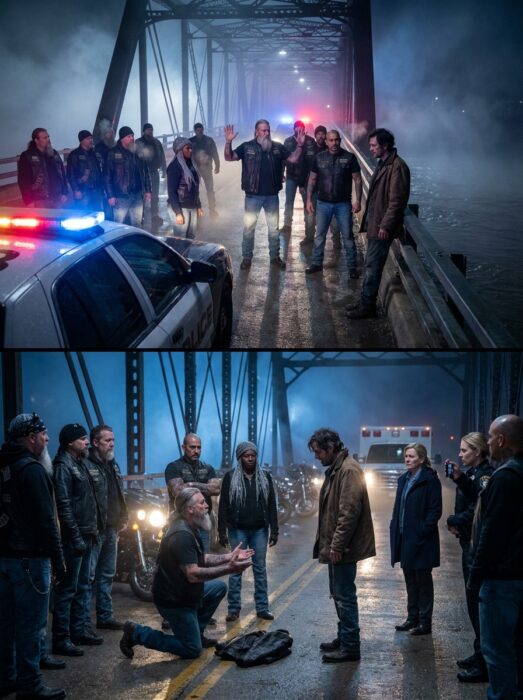
I stood near the bikers, far enough not to crowd Andrew, close enough to act if the moment turned. The woman with silver braids introduced herself as Denise “Mama D” Carter, retired Army nurse, fifty-six years old, club road captain, and apparently the person who had been doing most of the talking before I arrived.
“Andrew,” she said gently, “the officer is here now. That means more help, not less.”
“I don’t want help.”
“I know.”
“Then why are you all still talking?”
Denise’s answer was quiet.
“Because silence gets too loud sometimes.”
Andrew’s jaw tightened.
That answer reached him.
I could see it.
Not enough to bring him away.
Enough to keep him listening.
Caleb stood slightly to the right, never blocking Andrew’s view of the open walkway, never stepping in too close. Every biker in the circle seemed to understand the same rule without speaking: no sudden moves, no grabbing, no dramatic speeches, no crowding him with heroics.
They were not trained professionals.
But they were careful.
More careful than most people would have been.
I asked Caleb how they found him.
He kept his eyes on Andrew while answering.
“We were riding back from a memorial dinner. Saw a car stopped with hazards on, door open. Then we saw him walking up here alone. Something didn’t feel right.”
“You followed him?”
“At a distance.”
Denise added, “We asked if he needed a phone. He told us to disappear.”
“And you stayed.”
Caleb nodded.
“My brother said the same thing once.”
That sentence sat between us.
I did not ask more.
Not then.
The crisis team was ten minutes out. Fire and EMS were staging nearby with lights off, per my request. We needed calm, not spectacle. The worst thing we could do was turn Andrew’s pain into a scene.
I radioed dispatch.
“Confirm crisis response ETA.”
“Seven minutes.”
Seven minutes can feel like forever on a bridge.
Wind moved through the steel beams with a low moan. The river below was black except where the city lights broke across it. Behind us, traffic had slowed. A few drivers rolled down windows, trying to see. One person lifted a phone.
A young Latino biker named Mateo Ruiz stepped in front of the camera angle, not aggressively, just blocking the view with his body.
Caleb saw it and gave him a small nod.
That mattered too.
They were protecting Andrew from becoming someone else’s midnight video.
PART 3 — WHAT THE CALLERS MISUNDERSTOOD
The callers were not bad people.
They saw what most people would have seen: leather vests, motorcycles, a man cornered near a bridge rail, and fear filling in the missing pieces. Fear often writes its own story before truth has time to speak.
I knew that better than anyone.
I had done the same.
When I first stepped out of my cruiser, I saw bikers surrounding a man.
Now I saw a living shield.
They had formed a loose half-circle, leaving Andrew space to breathe but not enough space to disappear into the darkness without someone noticing. Caleb kept his hands visible. Denise kept her voice steady. Mateo kept traffic back. A white biker in his sixties named Hank “Bones” Riley stood near the parked motorcycles and spoke softly into the phone with dispatch, repeating updates.
“No weapons. No contact. Male is standing. He is responding sometimes. Please tell the crisis clinician he keeps saying he is tired.”
That detail hit me.
He keeps saying he is tired.
Not dramatic.
Not movie-like.
Just tired.
So many crises begin there.
With exhaustion that people dismiss until it becomes danger.
Andrew suddenly spoke.
“My wife left.”
No one answered too fast.
That was good.
Sometimes people rush to fill pain with clichés.
Denise waited.
Then she said, “That hurts.”
Andrew laughed once, bitter and broken.
“Hurts?”
“Yeah,” she said. “That word’s too small, but it’s the one we’ve got.”
He turned his head slightly.
“My son won’t answer my calls.”
Caleb’s face changed, but his voice stayed calm.
“How old?”
“Sixteen.”
“Sixteen-year-olds can be cruel without meaning to be permanent.”
Andrew swallowed.
“He hates me.”
Denise said, “Maybe. Or maybe he’s scared and doesn’t know where to put it.”
Andrew looked down.
Every person on that bridge became more still.
I spoke softly.
“Andrew, I’d like you to take one step toward my voice.”
He stiffened.
Caleb raised one finger slightly, not to stop me, but to warn me.
Too soon.
I understood.
I changed direction.
“No hurry,” I said. “Just stay with us.”
Andrew’s shoulders shook.
“Why?”
Caleb answered.
“Because tonight is not the whole story.”
Andrew whispered, “Feels like it.”
Caleb’s voice roughened.
“I know.”
That was the first time Andrew looked directly at him.
“You don’t know.”
Caleb took a slow breath.
“My younger brother stood on a bridge outside Toledo eleven years ago. He told everyone to leave too.”
Andrew stared.
“Did he live?”
Caleb’s face tightened.
“No.”
The wind seemed to stop.
Denise looked down.
Mateo closed his eyes.
Caleb continued, carefully, with no performance in it.
“I can’t change that night. But I can stand here for this one.”
Andrew’s expression broke open for half a second.
Not saved.
Not healed.
But no longer completely unreachable.
PART 4 — THE CIRCLE
Later, people online would call the bikers heroes.
Caleb hated that.
He told me heroes sounded too clean for what happened that night. No one made a speech. No one lifted Andrew in a dramatic rescue. No one conquered grief with a leather vest and a strong jaw.
They stood in the cold and refused to leave.
That was all.
That was everything.
Denise asked Andrew about small things. Not his whole life. Not the full weight of what had brought him there. Small things that could keep one thin thread tied to the world.
“Do you have a dog?”
“No.”
“Cat?”
He shook his head.
“Coffee or tea?”
He frowned, almost offended by the normal question.
“Coffee.”
“Black?”
“Too bitter.”
Caleb said, “Finally, something we can agree on. Black coffee tastes like burned regret.”
Andrew blinked.
Then, to my shock, he almost smiled.
Almost.
Denise saw it too and kept going.
“Cream?”
“Yeah.”
“Sugar?”
“Two.”
Mateo called softly from behind us, “That’s dessert, not coffee.”
Andrew’s mouth moved again, not quite a laugh, but near enough that every biker on that bridge seemed to breathe for the first time in minutes.
I learned later that this is part of crisis work too: bring the mind back from the cliff of forever into ordinary detail. Coffee. Weather. A name. A breath. The next thirty seconds.
We were buying time with gentleness.
The crisis clinician arrived at 12:36 a.m.
Her name was Dr. Elaine Porter, a white American woman in her early fifties wearing a navy coat over scrubs, with short brown hair and a calm face that made the whole bridge feel less sharp. She approached slowly beside me, hands visible.
“Andrew,” she said, “I’m Elaine. I’m going to stand over here with Dana, okay?”
Andrew did not answer.
But he did not tell her to leave.
That was enough.
Dr. Porter spoke with him for a long time.
Caleb and Denise stayed where they were.
When Andrew’s knees began to tremble from cold and adrenaline, Caleb placed his jacket closer on the pavement but still did not touch him.
“It’s there if you want it,” Caleb said.
Andrew looked at the jacket.
Then at Caleb.
“If I take it, you’ll come closer.”
“No,” Caleb said. “If you take it, you’ll be warmer.”
Andrew waited as if testing the words for traps.
Then he reached down and picked up the jacket.
Every officer, medic, biker, and clinician on that bridge pretended not to react too strongly, because sometimes hope is fragile enough that applause can scare it away.
He put the jacket around his shoulders.
That was the first step.
Not away from danger yet.
But toward being cared for.
PART 5 — THE STEP BACK
The actual step happened almost forty minutes after the first 911 call.
It was not dramatic.
Most important things are not.
Andrew had been talking with Dr. Porter about his son. Not everything. Just enough. He said the boy’s name was Ethan. He said he had missed a game because he was working. He said after the separation he kept saying the wrong things. He said he had sat in his car for two hours before walking onto the bridge.
Dr. Porter did not correct his life.
She did not promise easy repair.
She only said, “You don’t have to solve all of that tonight. Tonight, we only have to get you through tonight.”
Andrew whispered, “And tomorrow?”
“Tomorrow gets a team too.”
He shook his head.
“I don’t have a team.”
Denise answered before anyone else could.
“You do right now.”
Andrew looked at the circle of bikers.
“You don’t even know me.”
Caleb said, “Didn’t know my brother’s last words were coming either. Doesn’t mean I get to ignore yours.”
That sentence moved him.
I saw it happen.
His eyes dropped from the river to the bridge deck.
His feet shifted.
Dr. Porter kept her voice steady.
“Andrew, I’d like you to step toward Caleb’s jacket.”
He was already wearing it.
That confused him just enough to break the frozen pattern.
He looked down at the jacket around his shoulders.
Then he stepped back.
One step.
Small.
Unsteady.
But real.
No one rushed him.
No one grabbed him.
No one cheered.
Then another step.
Caleb moved only when Andrew moved far enough that the danger behind him was no longer immediate. Even then, he did not touch him. He simply stood closer, like a wall made human.
Andrew’s face crumpled.
“I’m so tired.”
Denise’s voice softened.
“I know, baby.”
He folded forward, not falling, just bending under the weight.
That was when Dr. Porter reached him.
“Can I take your arm?”
Andrew nodded.
The nod was tiny.
It was also the loudest yes I had ever seen.
She guided him toward the waiting ambulance. Officer Reed from county mental health arrived just then with blankets. EMS checked him gently. Andrew did not fight them. He did not speak much either.
Before he stepped off the bridge, he turned back toward the bikers.
“Why did you surround me?”
Caleb looked at the circle they had made.
Then at Andrew.
“We didn’t surround you to hurt you.”
His voice broke slightly.
“We surrounded you so you’d know you weren’t alone, and so you’d stay safe until the people who knew how to help could get here.”
Andrew stared at him.
Then he whispered, “Thank you for not leaving.”
Caleb nodded once.
“Thank you for staying.”
PART 6 — THE PHOTO THAT LIED
The photo hit social media before the truth did.
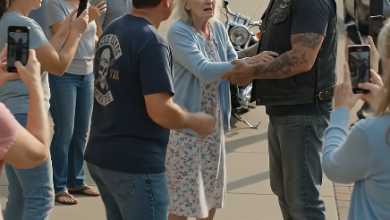
Someone from a stopped car had taken it early, before I reached the bridge, before the crisis team arrived, before Andrew took the step back. It showed fifteen leather-vested bikers standing around one man near the rail.
The caption said:
“Biker gang cornering man on Carson Bridge. Where are the police?”
By morning, thousands of people had shared it.
Comments came fast.
People called them thugs.
Predators.
Cowards.
Exactly what society expected them to be.
Then my department released a statement. Carefully worded. No private details. No name. No sensationalism.
It said a group of riders had encountered a person in crisis, maintained distance, contacted emergency services, created a safety buffer, protected the individual from traffic and onlookers, and remained until trained responders arrived.
I did something I normally avoided.
I commented under the original post from my official account:
“I was the first officer there. They were not attacking him. They were keeping him alive.”
The tone changed.
Not instantly.
The internet hates being corrected.
But slowly, people began apologizing.
Some meant it.
Some only wanted to be seen meaning it.
Caleb did not care.
When a local reporter asked for an interview, he refused at first. Then Denise convinced him that if the story helped one person call for support instead of filming a crisis, it was worth discomfort.
They agreed to speak without naming Andrew.
On camera, Caleb looked exactly like the man people had feared: gray beard, black vest, scarred hands, tired eyes.
The reporter asked, “What do you say to people who thought your group looked threatening?”
Caleb answered, “They weren’t wrong to call for help. If you see something that worries you, call. But don’t assume you know the story just because leather is involved.”
Denise added, “And don’t film someone’s worst night for entertainment.”
That line spread farther than the original photo.
Good.
It should have.
PART 7 — THE NEXT BRIDGE
Two months later, Andrew came to the station.
He did not want attention, so I met him in a small conference room with Dr. Porter and Caleb. He looked better. Not fixed. People are not machines. But present. His hair was trimmed. His hands were steady. He carried a paper coffee cup.
Cream.
Two sugars.
He handed Caleb his jacket back.
Caleb took it and said, “You could’ve kept it.”
Andrew shook his head.
“I needed to return something.”
Caleb looked at him.
“The jacket?”
Andrew swallowed.
“The night.”
No one spoke for a moment.
Then Andrew said his son had visited him. Only once so far. It was awkward. Hard. Imperfect. But he came.
Caleb nodded.
“Tomorrow got a team, huh?”
Andrew smiled faintly.
“Yeah.”
Before he left, he asked if he could shake Denise’s hand. Denise ignored the hand and hugged him carefully after asking permission. He cried into her shoulder for three seconds, then stepped back embarrassed.
Denise only said, “You’re allowed.”
The next year, the Iron Harbor Riders started something they called The Circle Ride. Not a rescue service. Not a replacement for trained crisis support. They were careful about that. They partnered with local mental health organizations, learned basic crisis-response awareness, funded hotline cards for bars and garages, and raised money for mobile crisis teams.
Their motto was simple:
Stand close enough to care. Stay far enough to keep them safe. Call the people trained to help.
Caleb kept his brother’s photo inside his vest.
Denise kept emergency blankets in her saddlebag.
Mateo kept blocking cameras when needed.
And I kept remembering that first call.
A group of bikers surrounded a man on a bridge.
It sounded like danger.
It was actually a circle of strangers refusing to let one man disappear into the worst moment of his life.
I have worked many calls since then.
Some end well.
Some do not.
The ones that end well often share the same quiet ingredient: somebody stayed. Not with perfect words. Not with magic. Not with promises that pain would vanish by morning.
Just presence.
A human barrier against isolation.
A voice saying, “Stay with us.”
A jacket placed nearby.
Coffee questions in the cold.
A circle that looks frightening from far away until you get close enough to see the truth.
Caleb told me once he still dreams of the brother he lost.
“I couldn’t make a circle that night,” he said.
Then he looked toward Carson Bridge.
“So I make them now.”
I think about Andrew whenever I cross that bridge.
I think about the photo that lied.
I think about how easy it is to mistake rough people for cruel people, and quiet protection for threat.
Most of all, I think about what Caleb said when Andrew asked why they stayed:
“We didn’t surround you to hurt you. We surrounded you so you’d know you weren’t alone.”
Some stories are not about heroes arriving with answers.
Some are about broken people recognizing the edge in another person’s eyes and choosing to stand there until help comes.
That night, fifteen bikers formed a circle on a cold bridge.
Not to trap a man.
Not to shame him.
Not to become famous.
They stood there because one man had reached the end of his strength, and strangers in leather decided his story was not allowed to end alone.
Follow the page for more unforgettable biker stories about misunderstood strangers, quiet courage, and the kind of brotherhood that shows up in the darkest places just to say: you are not alone.