Part 2: A Group of Bikers Suddenly Appeared at a Small Playground and Stood Still Watching a Boy Being Bullied — No One Understood What They Were Doing
The first sign that something was different came from the lead biker’s eyes.
He wasn’t watching the bullies the way angry adults usually do, with immediate outrage and a reflex to step in. He was watching Noah. Studying him. Counting something invisible in the boy’s shoulders, his breathing, the set of his jaw, the way his hands moved when the backpack spilled.
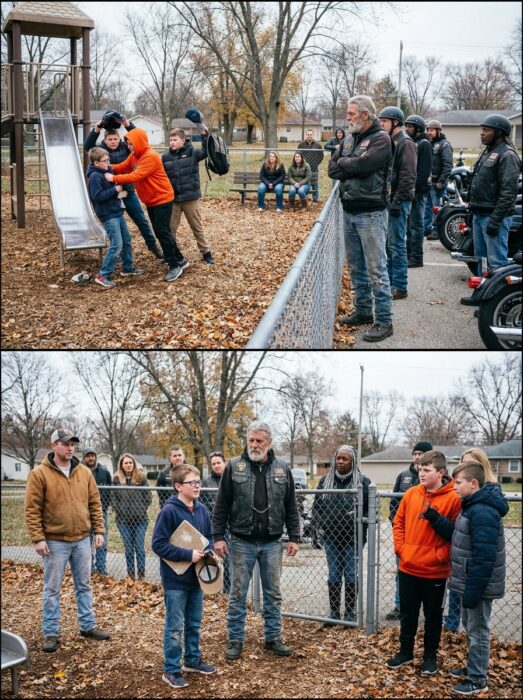
When Noah bent down, he did not scramble.
He picked up the notebook first.
Not the hat.
Not the sandwich.
The notebook.
That tiny choice landed somewhere inside the biker hard enough to show.
The man beside the gray-haired rider noticed it too. He was a stocky Black biker in his sixties with a Vietnam veteran patch and a cane strapped to his saddlebag. “Same look?” he murmured.
The gray-haired biker nodded once. “Same.”
That meant nothing to the parents near the benches, but it meant everything to the other riders.
Still they held their ground.
The mother in the green parka stormed closer to the fence. “If you people are enjoying this, you need to leave.”
The Black woman biker finally answered, voice calm, not loud. “Ma’am, we’re not enjoying anything.”
“Then why are you standing there?”
The woman’s eyes stayed on Noah. “Because if we move too early, they learn the wrong lesson.”
That only made the adults angrier.
It sounded cold.
Detached.
Almost arrogant.
Meanwhile the tallest bully kicked Noah’s sandwich farther into the mulch and said something too low to hear. Noah’s ears went red. One of the other boys laughed and waggled the cap in front of him like bait.
Noah still didn’t cry.
He took his notebook, slid it under one arm, and stood up straighter than before.
The lead biker pushed off his bike by half an inch.
Not enough to intervene.
Enough to confirm he was tracking every second.
A little girl on the swings whispered to her grandmother, “Why won’t the motorcycle people help him?” The grandmother had no answer. Most adults there didn’t. They could only see a child cornered and a line of intimidating strangers refusing the obvious act of rescue.
Then came the second clue.
The bullies began circling wider now, more performative because they had an audience. The tallest one, a heavy-set twelve-year-old in an orange hoodie, held Noah’s cap up like a trophy and shouted, “Tell everybody what your dad is!”
Noah’s whole face changed.
Not into fear exactly.
Into something older.
The parents nearby heard it and assumed the usual ugly possibilities. Jail. Drugs. Deadbeat. The oldest biker by the curb, the one with the gray beard and weathered face, closed his eyes once as if the words struck somewhere private.
“What did he say?” asked the mother in the parka.
The Black woman rider answered without looking away from the playground. “He asked the wrong question.”
Again, it sounded cryptic.
Again, it sounded unbearable.
The father near the swings took out his phone as if he might call someone, then hesitated because what exactly did he say? That a group of bikers was standing near a playground watching a bullying incident too calmly? The whole thing felt socially wrong before it felt legally clear.
Noah finally spoke then.
Quietly.
But firmly.
“Give me my stuff back.”
The three older boys laughed.
The tall one shoved the cap into Noah’s chest, then yanked it away again at the last second. Another boy poked two fingers into Noah’s notebook pages and bent the cover. Still the bikers did not move. Still the adults felt their own helplessness growing into disgust.
Then Noah did something none of the onlookers expected.
He stopped backing up.
He planted his shoes in the mulch, squared his shoulders, and said, louder this time, “I said give me my stuff back.”
The whole playground paused.
Even the swings.
Even the parents.
The lead biker stepped forward one full pace for the first time.
Now people thought the intervention was coming.
Now they braced for shouting.
Maybe violence.
Instead, the biker called out only one sentence, and he said it to Noah, not the bullies.
“Eyes up, kid.”
Noah looked through the fence at him.
Recognition flashed there.
Not of the man himself.
Of the instruction.
The bullies sensed the shift and got crueler. The tallest one shoved Noah in the shoulder and sneered, “Or what?”
Noah’s voice shook, but only around the edges. “Or you do it in front of everybody.”
The gray-haired biker’s jaw moved once.
The Black woman beside him folded her arms tighter and muttered, “There it is.”
The parents were now fully confused.
What did that mean?
Why did the bikers care whether the child stood up verbally first?
How did the boy seem to understand the lead biker’s tone at all?
The answer began in a detail almost no one there knew.
On Noah’s bent spiral notebook, just visible when he clutched it tighter, were the letters K.M. written in black marker in the bottom corner. Not Noah’s initials. Someone else’s. The lead biker saw them and looked like a man who had been kicked in the chest by memory.
The next clue came from the church parking lot behind the swings.
A rusted pickup truck pulled halfway in, then stopped. The driver inside watched but didn’t get out. The gray-haired biker noticed immediately. So did the Black woman. So did the cane-patch veteran.
Now the scene shifted again.
Because suddenly it became clear the bikers weren’t only watching the boys.
They were waiting on the man in the truck.
And whatever they expected him to do was important enough to let the entire playground misjudge them for three unbearable minutes.
The gray-haired biker’s name was Russ Calloway, and he had seen that exact shape of fear before.
Not in playgrounds first.
In barracks.
In courthouse halls.
At kitchen tables after funerals.
He had seen boys learn too early that humiliation grows when adults rescue them before anyone witnesses what caused it. He had also seen something worse: grown men sitting in trucks or behind fences, sending other kids forward to do the first layer of cruelty while they stayed technically clean.
Russ knew the pattern because twenty-two years earlier, it happened to his younger brother Kenny.
Kenny Calloway was thirteen, bookish, skinny, and too polite for the neighborhood they grew up in. Their father drank hard and mean after the factory layoffs, and everybody in town knew enough to gossip but not enough to help. The local boys used Kenny like a public joke because he flinched easy and apologized even when he had done nothing wrong. Russ, older by nine years and already in the Army by then, came home on leave once to find three boys pushing Kenny near the schoolyard while a grown man sat in a truck nearby, smirking.
That man was the father of one of the bullies.
Russ broke one nose and scared the others half to death. It felt righteous for fifteen minutes. Then he got hauled off, Kenny got branded a snitch, and the torment worsened in every private place Russ couldn’t guard. Two years later Kenny was dead by his own hand, leaving behind one notebook full of song lyrics and the sentence Russ had never escaped:
I wish somebody had made them say it in front of the right adults.
That sentence changed Russ permanently.
It did not make him softer.
It made him exact.
He spent the rest of his life intervening differently. Not passively. Not lazily. Precisely. He volunteered with veterans’ youth outreach after retirement. He worked with school counselors when boys in rough neighborhoods needed witnesses instead of just avengers. He learned that if you save a child from a single scene without exposing the structure around it, the scene just moves somewhere darker next time.
So when his riding group stopped for coffee near the church and he heard raised voices at the playground, he recognized the geometry instantly. A smaller boy cornered. Three older ones performing cruelty. Adults uneasy but not committed. And, most important, a truck idling at the edge like the real authority in the bullying wasn’t childhood at all.
Then Russ saw the initials K.M. on Noah’s notebook and realized the boy was carrying someone else’s old things.
Maybe a sibling.
Maybe a father.
Maybe a dead brother.
Either way, not random.
That was why he waited.
He needed Noah to do one thing before adults flooded in and turned the whole story into generic playground chaos. He needed Noah to make the bullies commit themselves in the open, with words and posture clear enough that the watching adults, and whoever sat in that truck, could never later claim it had just been rough play.
That was the lesson Noah would never forget.
Not that big men can save you.
That truth, once spoken aloud in the open, can corner cowards faster than fists.
The truck door opened.
A man stepped out.
Mid-forties. White. Carhartt jacket. Ball cap. Thick wrists. The tall bully in the orange hoodie glanced that way immediately, and Russ knew he had been right. Authority had entered. Not help. Ownership.
The man didn’t come hurrying to stop the boys. He came slow, like a man approaching a dog fight he expects to enjoy. He stopped just outside the mulch and said, with a smile too easy for the moment, “What’s the holdup?”
That chilled the playground worse than the weather.
Because now every adult there could see it.
The tallest bully wasn’t acting alone.
He was performing for someone.
Noah’s face went white when he saw the man. The lead bully straightened proudly and said, “He won’t say it.”
Russ stepped through the gate at last.
The change in the air was immediate.
The parents gasped.
The bullies flinched.
The man by the mulch line turned, annoyed first, then wary when he saw Russ up close.
Russ walked only as far as Noah’s side. Not in front of him. Beside him. That mattered.
“What’s he supposed to say?” Russ asked.
The man in the Carhartt jacket answered too quickly. “Nothing. Kids messing around.”
Russ didn’t even look at him. He looked at the tallest boy. “I asked him.”
The boy tried to smirk and failed.
Noah clutched the notebook tighter. Russ saw the initials again. K.M. Kenny Michael. Not a coincidence. The old pain rose so suddenly in Russ that he tasted metal for a second, but he kept his voice level.
“What do they want you to say, son?”
Noah’s answer came out ragged and angry all at once. “They want me to say my dad was a coward.”
Every person on the benches heard it.
And now the story broke wide open.
The father in the truck shifted first. Too late. The woman in the green parka went still with one hand over her mouth. The grandmother by the swings sat down hard. One of the other bikers, the Black woman named Janice, moved inside the gate and stood near the children on the equipment so no one bolted without hearing the next part.
Russ crouched just enough to bring his face closer to Noah’s level.
“Was your dad military?”
Noah nodded. Hard.
“Was his last name Keene?”
Another nod.
Russ closed his eyes once.
Kenny Michael was not the initials.
Kyle Matthew was.
Kyle Keene.
Russ had known him.
Fifteen years earlier in Afghanistan, Kyle Keene had pulled Russ out of a burned Humvee after an IED hit the convoy. Russ carried the scar under his left shoulder blade because Kyle Keene reached back into smoke for him when everybody else thought the vehicle was already done. Kyle died seven months later on a different deployment. Russ had gone to the funeral. He had met Kyle’s pregnant wife for exactly four minutes in a church hallway and then spent years thinking about the infant son who would grow up hearing two versions of courage: the real one, and whatever local cruelty decided to make of it later.
Noah was that son.
The father in the Carhartt jacket, whose name turned out to be Darren Pike, had been one of the loudest men in town after Kyle’s death, always talking about “what really happened over there,” because men who resent sacrifice often compensate by mocking it. His boy had grown up hearing the poison. Today he brought it to the playground.
Russ rose slowly.
Every inch of him suddenly looked bigger.
“You bring your son here to spit on a dead soldier?” he asked.
Darren shrugged with fake ease. “Maybe I bring him here to learn not every uniform means hero.”
That was the sentence that finished him.
Not because it was loud.
Because it was heard.
Janice looked at the parents. “You all hearing this?”
They were.
Every one of them.
The father who had earlier said boys would sort it out stepped forward now. “Hey. No. That’s enough.” The grandmother near the swings said, “That child’s father died serving.” The woman in the green parka rounded on Darren with the kind of fury only delayed decency knows how to produce.
The bullies started shrinking before anyone even touched them.
That was the lesson Russ had waited for.
Let them say it openly.
Let the grown world hear it clearly.
Let cowardice lose its camouflage before punishment begins.
Then, and only then, Russ took Noah’s cap from the tallest boy’s hand and handed it back.
The boy surrendered it instantly.
No bravado now.
No audience left.
Janice retrieved the backpack. The Vietnam-patch rider picked up the smashed sandwich and quietly handed Noah five dollars from his own shirt pocket for a replacement without making a show of it. Another biker, a broad Latino man named Reyes, took out his phone and said to Darren, calm as winter, “Say that line again for the school board if you want.”
Darren stepped back.
Then another step.
The police were called, but by then the real intervention had already happened. Not in the official sense. In the moral one. The entire park had seen a child nearly publicly broken over the memory of a father who died honorably, and they had seen the adult hand behind it too.
No one would later be able to say it was horseplay.
No one would say boys will be boys.
No one would say the biker gang overreacted.
Because Russ had forced the scene into truth before he forced it into order.
Then came the part no one expected.
Noah, still clutching the cap and notebook, looked up at Russ and asked, “Did you know him?”
Russ took a long breath before answering.
“Your father saved my life,” he said.
Noah stared at him.
The whole playground did.
Russ reached into the inside pocket of his cut and pulled out a worn metal challenge coin rubbed thin at the edges. He had carried it for fifteen years. On one side was the unit insignia. On the other, faintly scratched by hand, two initials: K.K.
“Your dad gave me this three days before he died,” Russ said. “Told me if I made it home first, I owed him one favor.”
Noah’s lip trembled. “What favor?”
Russ looked at the bullies, then at the gathered parents, then back at the boy.
“To make sure nobody teaches his son to bow his head for the wrong reason.”
That broke the playground open in the only way worth breaking it: not into chaos, but into witness. Noah cried then, finally, not from humiliation, but from the unbearable collision of grief and recognition. Russ did not hug him immediately. He waited. Noah stepped into him first.
That choice mattered too.
By the time the police finished taking statements, the afternoon had gone gold around the edges.
Children who had been herded away earlier returned to quieter games under closer watch. Parents stood in small knots speaking in the low, shame-thick voices adults use when they realize they have mistaken patience for indifference and wisdom for cruelty. Darren Pike left red-faced and loud at first, then smaller as official words like harassment, school complaint, and veteran defamation began attaching themselves to the day in ways even he understood would follow him home.
His son cried too.
Not because anyone struck him.
Because for once he saw his father lose control of the story.
That mattered more than Russ yelling would have.
Noah sat on the edge of the merry-go-round wrapped in Janice’s riding jacket because the weather had gone colder and adrenaline burns off fast in kids. Russ sat a few feet away, not crowding him. The challenge coin rested in Noah’s hand so tightly his knuckles stayed white around it for several minutes.
The notebook with K.M. on the cover turned out to be his father’s old field journal, or what was left of it—a few copied pages his mother had kept and Noah had started carrying after classmates began repeating ugly things they heard at home. Inside the first page, in Kyle Keene’s block handwriting, was a line Russ had not seen in fifteen years:
If fear comes, stand straight first. Speak after.
Russ looked at that line and laughed once through his nose, low and broken by memory. “Yeah,” he said. “That sounds like him.”
Noah looked up. “You told me that.”
Russ nodded.
The boy stared at the notebook again, then at the challenge coin, then at the playground where everybody now seemed to be moving differently around him. More carefully. More honestly. “Why didn’t you stop them right away?”
It was the question every adult had wanted answered too.
Russ did not insult him with a child’s version.
“Because if I saved you too early,” he said, “they would’ve said it was a misunderstanding. Kids playing rough. You being sensitive. Your dad’s name would’ve still been dragged through the dirt tomorrow.” He paused, making sure Noah stayed with him. “I needed them to do it in front of the right witnesses. And I needed you to hear your own voice before mine took over.”
Noah considered that the way children sometimes do when they are being told something painful but true.
“I was scared.”
“I know.”
“You were just standing there.”
“I know that too.”
Noah swallowed. “I thought maybe you weren’t going to help.”
That one cost Russ more.
He looked out over the mulch, the bent swing, the church lot, the patch of fading sky over the backstop fence. “When I was your age,” he said quietly, “somebody helped my brother too fast and not deep enough. The wrong people got to keep lying after. I didn’t want that for you.”
Noah didn’t answer for a long moment. Then he tucked the coin into the front pocket of his hoodie and said the kind of thing children say when they are closer to wisdom than comfort.
“They won’t do it again in public.”
Russ gave the smallest smile. “No. They won’t.”
Janice returned with two hot chocolates from the church ladies who had heard enough of the story by then to start treating the bikers like weathered relatives instead of threatening strangers. One went to Noah. One to Russ. The Vietnam-patch rider handed Noah a fresh sandwich in a paper bag from the gas station. No one made a joke about it. Some hungers should be met plainly.
Then Noah’s mother arrived.
She came running from the gravel lot behind the baseball field, hair half loose, work apron still on over jeans, terror already all over her face because a neighbor had called without context and there is no kind way to hear your child’s name and the word playground in the same breath. She reached Noah, checked his face, his arms, his glasses, the coin in his pocket she didn’t yet understand, and then she saw Russ.
For one second she only stared.
Then she said, “Russ?”
He stood up slowly.
She knew him from the funeral. Or rather, from the years after, in fragments. A card on the first anniversary. A quiet donation when Noah needed school clothes in third grade and no sender name was listed. A porch drop-off of canned goods during the pandemic from “one of Kyle’s old guys.” She had never connected all those things to the same face because life had kept happening too fast.
“You’re the one,” she said softly.
Russ shrugged once. “There were a few of us.”
She looked around at the riders, the jackets, the graying heads, the scarred hands carrying coffee and patience and hard-earned restraint. Then she looked back at her son, who now held himself just slightly differently than he had an hour earlier.
Noah reached into his pocket and gave her the coin.
“He knew Dad,” he said.
That did it.
She cried.
Of course she cried.
Not loudly.
Not dramatically.
The way working women cry when the day finally hands them one more thing than pride can carry.
Russ looked away to give her dignity. Janice did too. That was another lesson the bikers knew better than many civilians: mercy often requires looking aside at the right moment.
The school got involved by Monday. The park district too. Darren Pike’s son and the other two boys faced consequences, yes, but more important than punishment was exposure. The story had witnesses now. Teachers heard it. Coaches heard it. The church pastor who oversaw the field heard it. Lies that travel well in private rot fast in daylight.
Russ came by Noah’s house once the next week with a small metal display stand for the challenge coin and a photocopy of one page from Kyle’s old personnel file—just enough to show Noah the handwriting on the commendation note matched the journal. Nothing grand. No speeches. Noah put the coin beside his bed. His mother put the page in a cheap frame from Walmart. Janice later mailed a new baseball cap because the old one still smelled faintly of mulch and bad memory.
The final moment came two Sundays later.
There was another game at the same field. Same church lot. Same small playground behind it. The weather had turned colder, the trees barer, the light lower. Russ and two other bikers rode by on purpose but slower this time. Noah was there near the swings, backpack on, cap pulled down, hot chocolate in hand.
He saw them.
He stood straight before he waved.
That was the part Russ noticed first.
Not the wave.
The posture.
Noah held the gaze of every kid nearby, including the three who had bullied him, and he did not shrink. He didn’t act tough either. He just remained exactly his own size in full view of the world.
Russ lifted two fingers from the handlebar in return. Janice smiled behind him. The bikes rolled on without stopping because some rescues are best honored by not hovering after they work.
Later that night, Noah’s mother found him asleep with the coin under his pillow and the old notebook open to the page that read: If fear comes, stand straight first. Speak after. She closed it gently and left the bedroom door cracked.
Out on the road, somewhere beyond the church lot and the baseball fence and the little playground where a boy learned the difference between being saved and being seen, Russ rode with the granulated ache of memory sitting lighter in his chest than it had in years. He had not given Kenny back the life he lost. He had not erased what men like Darren Pike passed down to their sons.
But he had stopped it once.
Clearly.
Publicly.
At the right time.
And for one child, on one cold Indiana afternoon, that was enough to change the shape of the future.
Follow the page for more emotional, cinematic stories about misjudged people, quiet courage, and the moments that leave a mark long after the engines fade.