A Biker Was Tackled for “Stealing” a Poor Widow’s Handbag Inside a Bank—Then the Escalator Stopped and the Truth Shamed Everyone Watching
Part 2
My name is Hank “Mack” Mercer, and at the time I was president of the Iron Harbor Riders. We were not an outlaw club, though our appearance rarely encouraged strangers to ask for clarification.
We escorted veterans’ funerals, delivered winter coats, and drank terrible coffee in a garage that smelled permanently of gasoline and welding smoke. We also argued about dues, forgot birthdays, and had members who could repair a transmission but could not operate the club printer.
Cal Danner had ridden with us for eleven years.
He was not gentle in appearance or speech. He had served in the Navy, spent two decades maintaining conveyor systems at a bottling plant, and lost part of the hearing in his right ear when a bearing assembly exploded beside him.
That mattered.
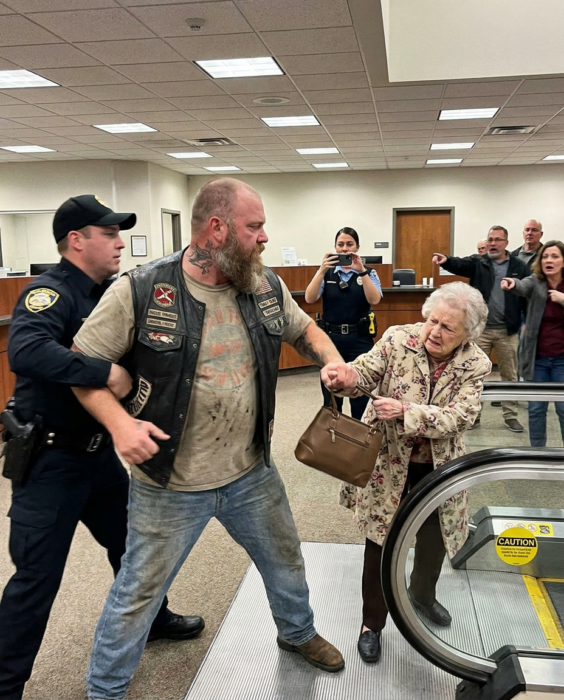
Cal could not always hear someone speaking from his right side, but he could feel abnormal vibration through a floor before most people noticed a sound. He later told the police that when we entered the bank, he felt the escalator shudder through his boots.
At first, he thought it needed maintenance.
Then he saw Evelyn’s strap.
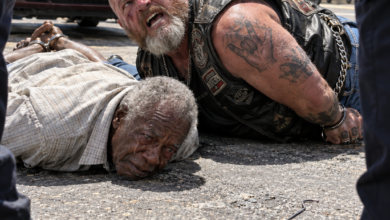
By the time I reached him, the security guard—Dale Watkins, fifty-six—had Cal’s left wrist bent behind his back. Dale was doing what his training told him to do. He had heard a scream, seen a large man seize an elderly woman’s bag, and reacted before he understood the machinery.
That did not make him cruel.
It made him fast and wrong.
“Ease up,” I told him. “His shoulder’s bad.”
“Step back.”
“Look at the escalator.”
“Step back now.”
Cal turned his bleeding face toward me. “Don’t start anything, Mack.”
That was Cal. Pinned to a bank floor, falsely accused of robbery, and still worried that twenty leather-covered men might turn a misunderstanding into a riot.
Only six of us were inside, but another fourteen waited across the street at the diner. They could see people gathering near the bank windows. Phones had already come out.
I called our road captain and said, “Stay where you are.”
He asked why.
“Because right now, we look guilty.”
Evelyn stood beside the stopped escalator, holding her wrist against her chest. Red marks circled the skin. A teller brought her a chair, but Evelyn would not sit until someone promised Cal would be allowed to breathe.
“He wasn’t taking it,” she said. “The machine had it.”
The young employee with the phone replied, “Ma’am, you’re upset. Let security handle this.”
Evelyn looked at her as if she had been corrected by a teacher.
“I’m sorry,” she whispered.
There it was again.
She apologized whenever another person failed her.
Dale finally followed my gaze toward the escalator. A torn strip of purse strap protruded from beneath the metal comb plate. The machine smelled hot, and its yellow safety teeth had been pulled out of alignment.
His posture changed.
Not much. Just enough.
He removed his knee from Cal’s back but kept one hand on his wrist until police arrived. Cal did not resist. He rolled onto his side and spat a small amount of blood into a handkerchief.
Dale stared at the eagle patch on the back of Cal’s cut.
“You ride an Electra Glide?” he asked.
Cal looked at him. “Used to.”
“I had a Shovelhead before the Army.”
It was an awkward thing to say while a man lay bleeding at his feet, but I understood what Dale was doing. He was telling Cal that beneath the uniform there was a piece of common language.
Cal answered, “Then you know better than to trust only one mirror.”
Dale’s face tightened.
“I know.”
Officer Park arrived with another patrol officer and an emergency medical technician. She had been told there was an attempted robbery in progress, so she entered with one hand near her holster.
Then she recognized Cal.
Two years earlier, her seventeen-year-old nephew Jonah had rolled a pickup on Route 119. Cal had reached the wreck before the ambulance. Fuel was leaking, and Jonah was trapped by his seat belt, bleeding heavily from his thigh.
Cal crawled through the passenger window, cut the belt with a rescue hook, and held pressure on the wound for fourteen minutes. He had burned his forearm when the engine compartment ignited.
The scar was still visible.
Officer Park looked from Cal to the torn strap, then to Evelyn.
“What happened?”
For once, Evelyn did not apologize first.
“That man saved my hand.”
The security video was reviewed in a glass office while paramedics examined both of them. The first angle showed what everyone believed: Cal lunging and taking the bag.
The second angle, from a ceiling camera near the escalator, showed the buckle being pulled into the machine. It showed Evelyn’s arm snap backward. It showed Cal grabbing the bag less than a second before she lost her footing.
The bank manager, Stephen Cole, watched the footage twice.
On the second viewing, he sat down.
No one charged Cal. Dale gave a statement acknowledging that he had misread the incident. He also insisted on driving Cal to urgent care for the shoulder he had aggravated.
Cal refused.
“Check her wrist first.”
Evelyn heard him. Her eyes filled, but she turned her face toward the window so nobody would see.
That should have been the end: a dangerous accident, an understandable mistake, apologies, incident reports.
Then Jo Alvarez picked up one of the papers that had fallen from Evelyn’s bag.
Jo was sixty-three, a retired county social worker, and the only member of our club who carried reading glasses in a hard case marked with a sticker of a flaming skull. She unfolded the paper, read the first page, then checked the postmark on the envelope.
“Mack,” she said quietly, “this expires Friday.”
Evelyn was not merely carrying paperwork.
She was carrying the difference between remaining in her apartment and losing the money that kept its heat running.
And the bank had just sent her away.
Part 3
The packet belonged to Kentucky’s senior assistance system. It combined Evelyn’s annual SNAP recertification with an application for winter utility support and a county supplement that helped low-income seniors cover prescription copayments.
The bank did not approve those benefits.
Its job was smaller.
Evelyn needed an employee to verify her account balance, stamp one page, and help transmit the completed packet to the county office. First County Bank advertised that service for elderly customers every Tuesday from nine until noon.
A printed sign still stood beside the customer-service desk.
SENIOR PAPERWORK ASSISTANCE — TUESDAYS.
It was Tuesday.
Evelyn had arrived at 9:40.
The employee told her the service was unavailable because two staff members had called in sick. That might have explained a delay. It did not explain why no one offered to book another appointment, call the county, or tell her that the deadline was three days away.
Jo sat beside Evelyn and opened the packet across a small consultation table.
“Did somebody help you with any of this?”
“A woman at church read the first pages,” Evelyn said. “She had to go care for her husband.”
“Do you have family nearby?”
Evelyn hesitated. “No one who comes.”
It was not bitterness. That made it worse.
She lived alone in a rented duplex off Turner Mill Road. Her husband had died from a stroke. Their only daughter had moved to Oregon fifteen years earlier and had not spoken to Evelyn since an argument over the sale of the family farm.
Evelyn received Social Security and a small widow’s pension. After rent, utilities, and medication, she had approximately eighty dollars left for food and transportation.
Her checking account held nine dollars and fourteen cents.
That was why the handbag contained no money.
“I brought two peppermints,” she told us, “in case the walk made me dizzy.”
Jo stopped writing.
I watched her remove her glasses, clean them with the hem of her shirt, and put them back on. That was what Jo did when she was angry enough to choose every word carefully.
“You walked from Turner Mill?”
“Yes.”
“That’s almost three miles.”
“The bus doesn’t come before ten now.”
“Why didn’t you wait for it?”
“I thought arriving early might make me less trouble.”
Across the lobby, the young employee still held her phone. She had recorded most of the takedown and had sent the clip to a coworker before the second camera angle was reviewed.
Within forty minutes, a version appeared online under the caption: BIKER TRIES TO ROB GRANDMA INSIDE BANK.
It ended before the escalator stopped.
That was our next problem.
The short clip showed Cal snatching the bag, Evelyn spinning, and Dale taking Cal down. It did not show the torn strap or hear Evelyn explaining what happened.
Someone identified Cal from the patch on his vest. The club’s public page began receiving messages. A few threatened to contact our employers. One claimed the club used funeral escorts to identify vulnerable elderly people.
Cal read none of them.
He was watching Jo work through Evelyn’s packet.
The bank manager approached carrying a first-aid kit and two written incident forms. His tie had loosened, and sweat darkened the collar of his shirt.
“Mrs. Brooks, we’re sorry about the escalator,” he said. “Our insurance carrier will contact you.”
Evelyn immediately replied, “It wasn’t your fault.”
Cal looked up.
“Yes, it was.”
Those were the first sharp words he had spoken.
Cole stiffened. “The equipment is inspected monthly.”
“I’m not talking about the machine.”
He pointed toward the forms.
“She asked for help.”
Cole glanced at the assistance sign. “We’re short-staffed.”
“So was she.”
Nobody answered that.
Officer Park asked the employee who had filmed the incident to preserve the full recording. The employee said she had only captured twenty-two seconds.
A customer standing near the ATM contradicted her.
“You were filming before he moved,” the man said. “You were filming the bikers.”
The employee’s face changed. She had recorded Evelyn asking for assistance, the refusal, the accident, and the immediate aftermath. But she had shared only the portion that made Cal appear guilty.
Why?
She said she had panicked.
Maybe she had. Ordinary people rarely understand how much harm a cropped video can do until the harm has acquired names and faces.
Officer Park requested the complete file for the incident report. The employee hesitated long enough for everyone to notice.
Meanwhile, Jo discovered another complication. Page seven required a current account certification, and Evelyn’s bank profile listed an address she had left eighteen months earlier. The mismatch would likely trigger an automatic rejection.
“Did anyone tell you to update this?” Jo asked.
“I tried,” Evelyn said. “They said I needed two pieces of mail. My bills come to a post-office box because someone steals things from the porch.”
Cole heard her and asked a clerk to pull the account notes.
There were three prior visits recorded. Each time, Evelyn had attempted to change the address. Each time, she had left without completing the process because the proof she carried was considered insufficient.
Three visits.
Nobody had explained that her lease and government benefit letter would satisfy the requirement together.
Both were in her handbag.
Jo placed them side by side.
The room became very quiet.
Cole assigned a senior banker to certify the account and update the address. He offered to fax the packet immediately.
But Jo did not hand it over.
She checked the transmission number printed on the cover sheet and frowned.
“That number’s disconnected.”
Cole called it.
A recording confirmed it.
The packet Evelyn had received contained an outdated fax number. If the bank had simply stamped and sent it, the documents would never have reached the county office.
Evelyn would have assumed she had failed again.
Jo called a former colleague at the Department for Community Based Services. After thirteen minutes on hold, she reached a case supervisor named Brenda Shaw, who confirmed the correct secure-upload address.
Then Brenda asked for Evelyn’s case number.
Jo read it aloud.
There was a pause.
“That case was marked incomplete last month,” Brenda said.
“Why?”
“We requested a missing bank verification.”
“She never received that request.”
“It was mailed.”
“To which address?”
Brenda read the old one.
Every small failure had connected to another: an uncorrected address, a paper packet with an obsolete number, a service desk without enough staff, and a woman trained by years of embarrassment to assume the mistake must belong to her.
Jo completed the forms with Evelyn, line by line. Cole stamped the banking page himself. Officer Park photographed the packet for the record, and Brenda stayed on the phone until the upload arrived.
At 12:16, she confirmed receipt.
Evelyn’s benefits would not be terminated while the review was pending.
Everyone exhaled.
We thought that was the false ending.
Then Brenda asked Evelyn whether her electricity was currently connected.
Evelyn lowered her eyes.
“Until tomorrow morning.”
Part 4
The disconnection notice was folded inside a pharmacy receipt at the bottom of the handbag.
Evelyn had not mentioned it because she believed the bank employees had already spent too much time on her. The overdue amount was $186.42. Her utility assistance had lapsed during the address error, and the electric company had scheduled shutoff for Wednesday.
The temperature that night was expected to fall below freezing.
Cole offered to pay the balance personally.
Evelyn refused.
“No charity,” she said, almost sharply. “I only need my papers fixed.”
It was the first time we heard pride rise through her apologies.
Jo understood. She called the utility company with Evelyn’s permission and asked for a medical hardship hold because Evelyn used refrigerated insulin. That should have been documented in her case, but it was not.
The representative requested a physician’s certification.
Evelyn had one.
It was dated six weeks earlier and had never been entered because it had been mailed to the wrong processing center.
Another paper. Another door.
Jo transmitted it from the bank manager’s office. The disconnection was suspended for thirty days, enough time for the county benefit to be processed.
No one handed Evelyn cash.
No one posed for a photograph.
She received what she had requested from the beginning: time, explanation, and a fair chance to complete the process.
While Jo handled that, I walked across the street to the diner and told the waiting riders what had happened. Most wanted to enter the bank and stand beside Cal.
I said no.
Twenty bikers filling a lobby already under police review would not help Evelyn. Instead, I asked our treasurer to bring the club’s document scanner from the garage and told two members to contact the local senior center about transportation.
When I returned, Cal was seated beside Dale, the security guard.
Someone had cleaned the blood from Cal’s chin. An ice pack rested against his shoulder. Dale had removed his security jacket and folded it across his lap, revealing an old Army unit tattoo on his forearm.
They were talking about motorcycles.
Dale had sold his Shovelhead when his daughter was born. He had always planned to buy another bike after she finished college, but then his wife became ill, and plans became bills.
“I should’ve looked before I hit you,” Dale said.
“You had half a second.”
“I had enough time to shout.”
Cal adjusted the ice pack. “Shouting wouldn’t stop the escalator.”
Dale looked toward Evelyn.
“No. It wouldn’t.”
He submitted a statement accepting responsibility for using force after the immediate danger had passed. Cal refused to file an assault complaint, though Officer Park explained twice that the decision belonged to him.
“Man did his job,” Cal said.
“He made a mistake,” Park replied.
“So did everybody except the lady.”
That sentence traveled through the lobby.
Cole heard it. The employee who had filmed heard it. So did the customers who had stepped away from Cal but never approached Evelyn.
The complete phone video was finally transferred to police. It began nearly a minute earlier than the viral clip. In it, Evelyn asked for help twice. The employee told her to come back another week.
Then, after Evelyn turned away, the employee pointed her camera toward our group and whispered to someone beside her, “Watch the big one.”
The big one was Cal.
She filmed him because he frightened her.
When he saved Evelyn, the recording became proof of the story she already expected to see.
The bank placed the employee on administrative leave pending review. Cal asked Cole not to fire her.
That surprised us.
“She needs to learn to look longer,” he said. “Firing her lets her leave before she does.”
Cole did not promise an outcome. He promised the full video would be preserved and included in the bank’s investigation.
Officer Park then told us why she remembered Cal so clearly.
Her nephew Jonah had been unconscious when Cal pulled him from the overturned truck. The family had tried to find the rescuer afterward, but the highway report identified him only as “an unidentified motorcyclist.”
Park recognized the scar on his arm and the silver skull ring from a photograph taken by a paramedic.
“You left before they could get your name,” she said.
“The ambulance needed room.”
“My sister has wanted to thank you for two years.”
Cal looked uncomfortable. Praise always made him search for a mechanical problem to solve.
“Kid alive?”
“He starts college next fall.”
“Then we’re square.”
Officer Park laughed once, though her eyes had filled. “You don’t get to decide that for his mother.”
She called her sister from the lobby. Cal refused to speak at first, but Park placed the phone in his hand.
We heard only his side.
“Yes, ma’am.”
“No, ma’am.”
“Wasn’t anything.”
Then he turned toward the window and lowered his voice.
“I’m glad he made it.”
The call lasted less than a minute. When Cal returned the phone, his jaw was clenched hard enough to show beneath his beard.
Twist followed twist that morning, but the most painful one arrived quietly.
A paramedic examined Evelyn’s wrist and found no fracture. While removing her damp shoe to check a scraped ankle, he exposed a sock wrapped in plastic grocery bags.
Both soles had split.
She had lined them to keep out the rain.
I asked what size she wore.
Evelyn pulled her foot back. “These are fine.”
“They’re cutting you.”
“I can glue them.”
Cal watched me. He knew the expression on my face.
“Don’t make it charity,” he said.
So I did not.
I asked Evelyn whether she would accept an exchange.
“For what?”
“Your damaged bag and shoes for a ride home and replacements. We need both for the escalator report.”
That was only partly true. The bank’s insurer needed photographs, not ownership. But Evelyn considered the proposal because it sounded like a transaction instead of pity.
Finally, she nodded.
I drove to a shoe store with Dale. We returned with waterproof walking shoes, thick socks, and a plain brown handbag with a short strap that could not trail behind her.
Evelyn touched the shoes as if they were too expensive to exist.
Then she looked at my boots.
“They cost less than those,” I lied.
Dale looked away so she would not see him smile.
Before Evelyn could put them on, the bank manager approached with another discovery. The escalator’s maintenance report showed that the comb plate had been flagged six weeks earlier for intermittent vibration.
The repair had been deferred until the next scheduled service.
The bag had not caught because Evelyn was careless.
The machine was already waiting to catch something.
First County Bank shut down both escalators immediately.
And the story everyone had filmed as a robbery became something else entirely: a rescue inside a building where almost every safeguard had failed at once.
Part 5
By late afternoon, the edited clip accusing Cal had been viewed more than eighty thousand times. The full video had not yet been released because it was evidence in the bank’s internal review.
The truth moved slower than the accusation.
It usually does.
Cal’s employer received calls. The funeral home we had planned to escort contacted me to ask whether the club was “involved in an incident.” Our public page filled with insults from people who had watched twenty-two seconds and believed they had witnessed the whole morning.
Cal told me not to respond.
“They’ll find another thing tomorrow.”
Evelyn disagreed.
She was sitting in the bank manager’s office wearing her new shoes. The old pair rested inside an evidence bag beside the torn purse strap.
“They are saying you stole from me,” she said.
“Doesn’t matter.”
“It matters to me.”
Her voice was still soft, but the apology had disappeared from it.
Officer Park asked Evelyn whether she would provide a recorded statement. She agreed, provided nobody made her stand in front of cameras.
A local reporter arrived after hearing the police dispatch. The bank declined an interview, but Evelyn allowed the reporter to record her voice while pointing the camera at the destroyed strap and stopped escalator.
She described the pull on her wrist.
She described Cal’s hands tearing the bag free.
Then the reporter asked whether Cal had frightened her.
“Yes,” Evelyn said.
Cal looked down.
She continued, “I was frightened because they knocked down the man saving me.”
That sentence changed the direction of the story.
Officer Park’s department issued a short statement confirming that no robbery had occurred and that video showed a bystander intervening in an escalator entanglement. The reporter obtained permission to air the ceiling-camera segment showing the strap disappear.
By evening, local stations were playing the two clips together.
First: the apparent theft.
Then: the angle that revealed the danger.
People who had called Cal a predator began calling him a hero. He disliked both labels.
“I grabbed a bag,” he said. “That’s all.”
Jo corrected him. “You noticed a woman nobody else was looking at.”
That landed harder.
The bank’s review did not end with the escalator. Cole examined the Tuesday assistance program and found that staffing shortages had caused it to be canceled five times in three months without notifying customers.
Fourteen elderly clients had visited on canceled days.
Eight had deadlines associated with benefits, housing, or insurance.
The bank contacted each of them and arranged appointments with trained staff and county representatives. It also changed the program so cancellation required a manager to provide rescheduling, transportation information, and direct referral—not simply send people away.
The employee who recorded the incident was not fired.
She received a suspension and was required to complete privacy, bias, and emergency-response training. More importantly, she later met Evelyn privately and apologized without a camera present.
Evelyn did not excuse what she had done.
But she accepted the apology.
“You thought his clothes told you what kind of man he was,” Evelyn said. “People look at my clothes and think I’m too foolish to understand anything. We both know how that feels now.”
I learned those words from the employee herself months later. She had begun volunteering twice a month at the assistance desk.
Not every failure requires a villain.
Sometimes it requires someone willing to stay after being shown what they did.
The county approved Evelyn’s recertification nine days later. Her food benefits continued without interruption, the heating grant covered her outstanding utility balance, and the prescription supplement was reinstated retroactively.
Jo did more than complete one packet. She organized monthly paperwork sessions at our clubhouse with two other retired social workers, a legal-aid volunteer, and a county benefits clerk who attended remotely.
We called it Tuesday Table.
No roaring engines. No dramatic logo.
Just folding tables, coffee, pens, scanners, and people who understood that one unchecked box could remove heat from a house.
Dale, the security guard, became the program’s first volunteer driver. He used an old minivan rather than a motorcycle because many clients had walkers or oxygen tanks.
Three months after the incident, our club helped him locate a reasonably priced used touring bike. We did not buy it for him. Dale was stubborn, and Evelyn had taught us something about dignity.
We found the listing, inspected the bike, negotiated the price, and let him pay for it himself.
The first place he rode was Evelyn’s duplex.
He brought groceries and repaired the loose handrail beside her steps.
Cal came too, although his shoulder still hurt from the takedown. He replaced a porch bulb and adjusted a kitchen cabinet door that would not close.
Neither man mentioned the bank floor.
Evelyn served instant coffee in cups that did not match. Above her table hung a photograph of her late husband wearing railroad overalls. Beside it was a smaller picture of a young Evelyn standing next to a secondhand motorcycle.
“You rode?” Dale asked.
“Until I married a man who was scared of them.”
Cal almost smiled.
The story still had one unresolved piece: Evelyn’s daughter in Oregon.
Jo found a current telephone number in the emergency-contact section of an older benefits file. She did not call without permission.
For four weeks, Evelyn said no.
On the fifth Tuesday, she brought the number herself.
“You can sit beside me,” she told Jo. “But I’ll speak.”
The first call went to voicemail.
So did the second.
On the third week, her daughter answered.
Evelyn said only, “I’m not calling for money.”
Then she listened.
We never learned everything said during that conversation. It did not produce an instant reunion. Old hurt does not disappear because a biker ripped a purse from an escalator.
But her daughter called back the following Sunday.
At Christmas, a package arrived containing photographs of two grandchildren Evelyn had never met.
The following spring, her daughter came to Kentucky.
That was the consequence nobody could have planned. Saving Evelyn’s wrist preserved more than bone. Completing her papers stabilized her home. Stabilizing her home gave her enough breath to reopen a door she had left closed for fifteen years.
Cal had thought he grabbed a bag.
He interrupted a chain of disappearances.
Part 6
A year after the incident, First County Bank invited Cal to attend the reopening of its renovated lobby. The escalators had been removed and replaced with a wide staircase and an accessible elevator.
Cal refused the invitation twice.
Evelyn accepted for him.
She arrived wearing the waterproof shoes I had bought. They were scuffed now, especially at the toes, but still solid. Dale drove her, and Jo carried a folder containing three new benefit applications from other seniors who needed help after the ceremony.
Cal stood near the same place where he had been tackled.
He wore the same leather cut. The bloodstain had been cleaned from the collar, but one scrape remained across the shoulder where it struck the marble.
The bank offered to display a plaque praising his quick action.
He asked them not to.
“Put the assistance hours up there,” he said. “Big enough for old eyes.”
They did.
The sign listed operating hours, a telephone number, transportation options, and instructions for requesting help if staff shortages occurred. Underneath was a holder containing printed cards in large type.
Evelyn inspected it like a building official.
Then she asked the manager, “What happens if two people call in sick?”
Cole answered, “We contact the county partner and reschedule everyone before they leave.”
“What if somebody cannot come back?”
“We arrange remote help or transportation.”
“What if they apologize for bothering you?”
Cole paused.
“We tell them they are not a bother.”
Evelyn nodded. “That one matters.”
Tuesday Table continued at our clubhouse. In the first year, volunteers helped seventy-three people complete benefit renewals, utility applications, disability appeals, and transportation requests.
Not all were approved.
Reality did not bend simply because bikers sat beside them. Some applications required records people did not possess. Some agencies took weeks to respond. One appeal failed even after Jo spent fourteen hours assembling it.
But nobody left because a form made them feel stupid.
That became the rule.
Cal rarely helped with paperwork. His handwriting looked like damaged electrical wiring. Instead, he repaired walkers, replaced rubber tips on canes, tightened wheelchair bolts, and watched for trailing straps near moving equipment.
The first Tuesday of each month, Evelyn sat beside the entrance with peppermints in a glass bowl.
She greeted every visitor.
When someone apologized for needing help, she said, “Save your apology. We have enough paper already.”
Officer Park occasionally stopped by in uniform. Her nephew Jonah visited during college breaks and finally met Cal properly. He brought the torn seat-belt section that paramedics had returned after the crash.
Cal would not accept it as a keepsake.
“Throw it away,” he said. “You got out.”
Jonah did.
The old handbag remained with the bank’s insurer for months, then was returned to Evelyn. She did not use it again. She hung the torn strap on a nail near her kitchen door.
Not as a reminder of danger.
As a reminder to look twice.
The phone video also remained online. Some copies still carried the original false caption, even after corrections appeared. Cal never tried to remove them all.
“You can’t chase every lie,” he told me. “You build something the lie can’t explain.”
Tuesday Table was that thing.
So were Dale’s rides.
So was the large-print sign in the bank lobby.
And so was Evelyn, walking into the clubhouse in those waterproof shoes, no longer lowering her eyes whenever she asked a question.
Part 7
Evelyn died four years later, peacefully, after a short hospitalization. Her daughter was with her.
So were Jo and Cal.
At the funeral, the pastor read from a note Evelyn had written and left inside the brown replacement handbag. Most of it concerned practical matters: who should receive her dishes, where she kept her lease, and which neighbor had agreed to take her houseplants.
One paragraph was for our club.
She asked that Tuesday Table continue.
She also left Cal the torn strap from her old bag.
He carried it home folded inside his vest.
The next Tuesday, he fastened it beneath the edge of the paperwork table, where visitors could see the worn brown material and the teeth marks left by the escalator.
He did not attach an explanation.
When people asked, he told them, “That strap taught us to look longer.”
First County Bank eventually expanded its assistance program to three branches. Dale remained a volunteer driver until his knees made climbing into the minivan difficult. The younger riders then took over the route.
The employee who had recorded Cal became coordinator of the bank’s senior-assistance desk. She kept the unedited video—not to show visitors, but to train new employees about incomplete evidence and the cost of watching without helping.
Cal still hated being called a hero.
He said machines created simple problems. Something moved where it should not move, heated when it should not heat, or pulled when it should release. People were harder because they often mistook shame for silence and silence for consent.
On the fifth anniversary of the incident, we met outside the bank before Tuesday Table. Rain darkened the pavement, much as it had that morning.
Cal stood beside his Road King holding Evelyn’s torn strap.
Officer Park asked what he remembered most: the guard’s tackle, the stopped escalator, or the accusation.
Cal shook his head.
“The way she kept saying sorry.”
Then he looked toward the bank’s assistance sign, where an elderly man and his wife were already waiting for the doors to open.
“That’s the part we fixed.”
Before her death, Evelyn had said something to Cal that he never repeated publicly. Jo and I heard it because we were standing beside her hospital bed.
She held his scarred hand and spoke slowly.
“You didn’t steal my purse, Cal. You stole me away from one more day of humiliation.”
Cal looked down at their joined hands.
Then he answered in the only way he knew.
“We’re square, ma’am.”
Outside, rain tapped against the hospital window.
Tuesday Table opened the next morning.
Tell us what dignity should look like, then follow the page—there are more biker stories hiding behind the moments people misunderstand.