A Thirteen-Year-Old Burned Every Family Photograph in Her Yard—But Kept Three Inside Her Jacket, and the Biker Next Door Saw What Her Mother Had Refused to Believe for Far Too Long
Part 2
The Hale family lived across from me in Riverside, Ohio, three streets from Route 4. Lauren and Ava moved there after Lauren’s divorce, when Ava was five. Their first winter in the house, the furnace failed during a cold snap, and Lauren came to my garage because she saw the light under the door.
She was afraid to knock.
My club’s motorcycles lined the driveway, and the garage smelled of oil, coffee and wet leather. Half a dozen large men were arguing over a stripped bolt. Lauren expected to be told to call someone else.
Instead, Otis drove to the hardware store, Mack found the failed igniter, and I kept Ava busy sorting washers by size. By midnight, the furnace was running.
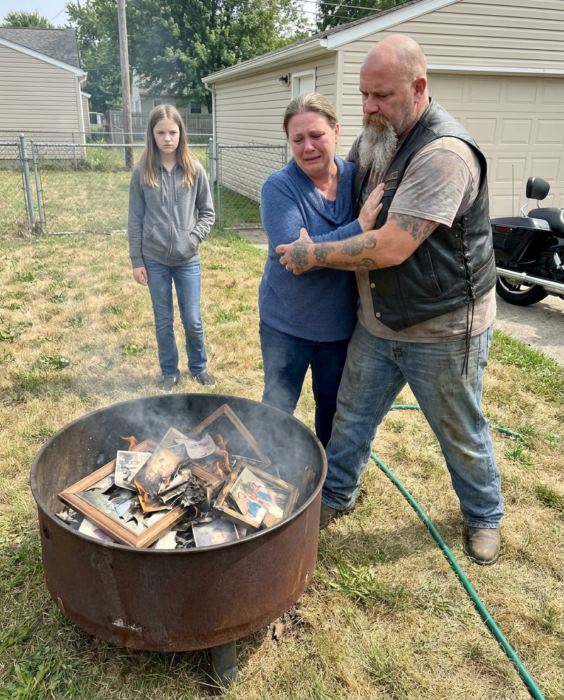
After that, Ava stopped being afraid of us.
She sat on my porch while I cleaned spark plugs. She named every motorcycle, usually incorrectly. She believed my black Road King was called a “Road Queen” and refused correction.
When she turned ten, I gave her a small toolbox. Lauren laughed because Ava already owned more sockets than she did shoes.
I knew Lauren as a hardworking mother who took double shifts at a dental office, paid bills late but paid them, and never missed Ava’s school concerts. I had never seen her strike or threaten her daughter.
That made what happened harder, not easier.
People can love a child and still fail to hear her.
I understood that because of my younger sister, Elise. When we were teenagers, she tried to tell relatives that an older family friend frightened her. The adults demanded details she could not provide without shame. When her story changed around the edges, they called the whole thing a lie.
I believed her, but I believed her badly.
At nineteen, I found the man outside a tavern and attacked him. I spent eleven months in county jail. He told everyone my violence proved our family was unstable, while Elise was forced to answer even more questions.
My rage had made me feel useful.
It had not made her safer.
Elise survived those years, but she carried them. She died at thirty-four after a long struggle with addiction. I kept one photograph of us inside the inner pocket of my riding vest—not as a demand for revenge, but as a reminder that the loudest reaction is not always the most protective one.
That was why I called professionals from Lauren’s yard.
Officer Lena Ortiz arrived first. She did not pick up the photographs immediately. She asked Ava whether she was safe, whether Scott had access to the house and whether she needed medical care. Then she contacted a detective trained in child-abuse cases and the county’s on-call investigator.
Ava was not asked to provide a full account in the yard. Officer Ortiz explained that repeated questioning can confuse memory and cause additional distress. She wrote down only what was necessary to address immediate safety.
Scott did not live with them. Lauren gave the officers his phone number and address. She also admitted he had been invited to lunch the following day.
That visit was canceled.
Lauren agreed in writing that Scott would have no contact with Ava while the case was reviewed. She surrendered the spare key he once used when feeding their dog. Police documented the three photographs and placed them in a protective sleeve.
The original box had been destroyed, but the fire did not erase everything. Most of the family photographs existed elsewhere—in relatives’ albums, old phones, cloud storage and social-media archives.
At that point, however, nobody knew whether those other images would matter.
The county investigator arranged a forensic interview for Ava at a child advocacy center on Monday. Lauren was told not to rehearse questions or ask Ava to repeat the account at home.
That instruction nearly broke her.
She wanted answers immediately. She wanted Ava to tell her exactly what had happened and why she had waited.
Ava gave her one answer.
“I didn’t wait. You did.”
I watched Lauren fold over in the kitchen chair.
I wanted to comfort her, but this was not the moment to rescue the adult from the consequence of what she had dismissed. I made coffee, set it on the table and remained quiet.
Outside, the first Harley arrived.
Mack killed the engine and walked toward the house with his jaw locked. Behind him came five more members of the Black River Riders. Someone had told them a child in our neighborhood had been harmed.
Mack asked for Scott’s address.
I refused.
He asked again.
I stepped between him and his motorcycle.
“If you ride over there,” I said, “you help his defense and hurt the girl.”
The engines ticked as they cooled. Leather creaked. Nobody spoke.
Brotherhood had reached its first test.
Part 3
Mack had two daughters. That was why anger reached him before judgment.
He said men like Scott depended on everyone remaining polite. He believed a line of motorcycles outside the man’s house might frighten him into confessing or leaving town.
I told him fear could make Scott destroy evidence, coordinate stories or accuse Ava’s supporters of intimidation. Any confrontation could complicate the investigation.
“We don’t get to make ourselves feel better at her expense,” I said.
Mack struck the side of my garage with his palm.
Then he handed me his keys.
The six club members moved their motorcycles into my driveway and went home in two pickup trucks. Nobody rode to Scott’s house.
That decision never appeared in a newspaper. It was still one of the most important things the club did.
On Monday morning, Lauren drove Ava to the child advocacy center. A victim advocate met them at the door. Ava spoke privately with a trained forensic interviewer while a detective and child-protection investigator observed from another room.
Lauren was not permitted to watch.
Neither was I.
I sat with her in a waiting area beneath a broken wall clock that remained seven minutes slow. A vending machine hummed beside us. Lauren held a cup of coffee for nearly an hour without drinking it.
“I thought I knew my family,” she said.
I did not answer.
“He helped me after the divorce. He brought groceries. He fixed Ava’s bicycle.”
Good deeds do not erase harmful acts, and harmful people do not always appear harmful in every setting. That contradiction was what Lauren could not accept.
She had mistaken familiarity for safety.
When the interview ended, Ava came out carrying a small stuffed fox provided by the center. She looked exhausted but steadier. The advocate told Lauren that Ava had given enough information for the investigation to continue.
No one said the case was proven.
No one promised an arrest.
The three photographs helped establish dates and showed a repeated pattern of proximity. Yet investigators made clear that photographs capable of innocent interpretation could not carry a criminal prosecution alone.
Ava’s words mattered.
So did corroboration.
The detective began contacting adults who had hosted the three gatherings. She collected full digital versions of the photographs, identified everyone present and reviewed where Ava had slept or spent time during each event.
At the wedding, Scott had volunteered to watch the younger children during the reception.
At Christmas, he had driven several children to see neighborhood lights.
At the lake reunion, he had been assigned one cabin near the teenagers.
Each fact was ordinary alone.
Together, they showed access.
Scott denied wrongdoing. Through an attorney, he described himself as affectionate and claimed Ava had become angry when he disciplined her. He pointed to years of smiling family photographs as evidence that everyone trusted him.
That argument nearly worked on Lauren emotionally.
For several days, she moved between belief and denial. She would say Ava deserved complete support, then ask whether a misunderstanding could have grown in the girl’s mind. She never said this directly to Ava after the investigators warned her of the damage, but Ava sensed it.
Children notice when adults believe them conditionally.
Under the safety plan, Lauren’s sister Denise stayed at the house for several weeks. Ava began individual therapy with a trauma specialist. Lauren started separate counseling because the center advised that joint sessions should wait until Ava felt safe enough to choose them.
The club offered money immediately.
Lauren refused.
She said she did not want the neighborhood to know, did not want Ava treated as a charity case and did not want motorcycle-club members discussing her daughter’s private life.
She was right to set those boundaries.
So the club did nothing publicly. No fundraiser. No photographs. No social-media posts. Denise received grocery cards without names attached, and the therapy clinic later received payments through our existing community-assistance fund.
Then the investigation turned.
A seventeen-year-old cousin named Beth received a call from the detective because she appeared in the background of the lake photographs. Beth asked to speak without her parents.
She disclosed that Scott had also made her uncomfortable years earlier. She had never told police because she believed nobody would choose her over an admired relative.
But Beth had kept a voicemail.
In it, Scott did not describe any act. He told her to stop “making ordinary affection sound dirty” and warned that speaking would tear the family apart.
The voicemail did not prove everything either.
But it showed pressure, blame and prior concern.
Three days later, another relative—a ten-year-old girl—told her school counselor she no longer wanted to attend gatherings where Scott was present. Her disclosure was reported independently, and she was interviewed by trained professionals.
The case was no longer centered on three photographs.
It involved three children whose accounts overlapped in ways they had never coordinated.
When the detective informed Lauren, she went into the bathroom and became physically ill.
Ava stood outside the closed door.
She did not comfort her mother.
Not yet.
Part 4
The arrest came seven weeks after the fire.
Police did not arrive with sirens. Scott was taken into custody after meeting investigators with his attorney. The prosecutor later filed multiple charges based on the children’s accounts, the timeline, witness statements, the saved voicemail and additional evidence gathered during the investigation.
The court issued no-contact orders.
Then the family split apart.
Some relatives supported the children immediately. Others insisted Scott had been targeted by an unstable teenager. One aunt called Lauren and asked whether losing “the whole family” was worth pursuing a case that might be difficult to prove.
Lauren ended the call.
For the first time, she chose her daughter before family peace.
But one correct decision did not repair the first failure.
Ava would not hug her. She stopped calling from friends’ houses when she needed a ride and asked Denise, not Lauren, to attend early therapy appointments. She locked her bedroom door at night.
Lauren accepted it.
Her therapist helped her understand that demanding quick forgiveness would merely ask Ava to take care of her mother’s pain. So Lauren stopped saying, “I’m sorry you felt unheard,” and learned to say what had actually happened.
“You told me. I did not believe you. That was my failure.”
She said it once during a therapist-guided session.
Ava stared at the floor.
Lauren did not add excuses.
That restraint became the first small piece of repair.
The Black River Riders faced another test when Scott’s supporters began posting accusations online. They named me, published a photograph of my motorcycle and claimed the club had manipulated Ava.
Several brothers wanted to respond.
Otis, our president, asked what Ava wanted.
She wanted silence.
So we remained silent.
We turned screenshots over to the detective when threats crossed legal boundaries, but we did not argue with strangers. We did not ride past homes. We did not wear club cuts to court unless Ava’s advocate said our presence would help rather than intimidate.
Most days, helping looked painfully ordinary.
Mack repaired Lauren’s back fence so Ava could sit outside without feeling watched. Denise drove her to counseling. Otis arranged payment directly with the licensed clinic. I checked the mailbox when Lauren received letters from angry relatives.
Nobody called us heroes.
Good.
The case took more than a year to reach trial. Delays frustrated Ava, especially when defense motions required hearings she did not understand. Her advocate explained each step and prepared her without coaching her testimony.
The three original photographs were admitted as contextual evidence. Investigators had obtained higher-quality copies from relatives, complete with dates and surrounding sequences. The images showed that Ava’s discomfort did not begin after the accusation; her body was already angling away years earlier.
Still, the prosecutor never pretended a photograph could show everything.
The strongest evidence was the consistency of the children’s separate disclosures, the access Scott had at the identified events, Beth’s saved voicemail and testimony from adults who remembered changes in the children’s behavior afterward.
Ava testified through procedures designed to reduce unnecessary trauma. I will not repeat what she said. Those words belonged to her and the court.
I waited outside with Lauren.
Her hands shook so badly that she spilled water across the bench. When Ava emerged, she walked past both of us and went directly to her advocate.
Lauren started crying.
I said, “Let her choose.”
She nodded and remained seated.
The jury returned guilty verdicts on multiple counts. Sentencing occurred weeks later. Scott received a substantial prison term and restrictions intended to protect children after any future release.
There was no celebration in the courthouse.
A conviction did not restore Ava’s childhood. It did not unburn the photographs or erase the years she had spent questioning her own memory.
Beth cried in a stairwell.
The third child’s parents left through a private exit.
Lauren stood several feet from Ava and asked, “May I come closer?”
Ava thought about it.
Then she held out one hand.
Not an embrace.
A hand.
Lauren took it.
That was the false ending people prefer: the offender convicted, the mother forgiven, the family healed.
Real repair was slower.
It took another year before Ava agreed to sit through an entire joint therapy session. It took months before she allowed Lauren to enter her bedroom without knocking twice. Some weeks they moved forward. Other weeks a careless sentence reopened everything.
The club kept paying the therapy bills.
No conditions. No deadline. No expectation that Ava appear at events or thank anyone.
When Lauren tried to reimburse the fund, Otis returned her check.
“This isn’t a loan,” he said. “Let the kid keep the future.”
Part 5
The burned photographs returned to the story after the trial.
Ava had told her therapist that destroying them brought relief for one afternoon and regret afterward. She did not regret eliminating Scott’s face. She regretted losing pictures of her grandmother, her first bicycle, her parents’ wedding and a dog that had died when she was eight.
The fire had given her control.
It had also taken memories that belonged to her.
Lauren wanted to replace the albums, but she refused to begin without Ava’s permission. Instead, she wrote one careful message to relatives, former neighbors, old classmates and family friends.
She did not ask anyone to choose sides.
She asked whether they possessed copies of photographs from Ava’s childhood. She requested digital files and explained that Ava would decide which images, if any, entered a new album.
The response was larger than expected.
A former neighbor found photographs from a block party. Lauren’s college roommate had wedding pictures stored on an old laptop. Ava’s elementary-school secretary located class-event images that families had been allowed to keep. Denise contributed birthday photographs from years Lauren thought were gone.
More than four hundred images arrived over five months.
Some included Scott.
Those went into a separate encrypted folder maintained by Lauren and never shown to Ava unless she requested them. Potentially relevant materials remained available to authorities, but the family album would not become another place where Ava had to encounter him.
Every Sunday afternoon, Ava reviewed a small batch with her therapist’s approval.
She made three piles.
Keep.
Not now.
Never.
Lauren did not question the choices.
One photograph showed six-year-old Ava asleep across two chairs at a wedding, wearing one shoe. Scott appeared at the far edge. Lauren offered to crop him out.
Ava said no.
Not because she wanted him included, but because she did not want the photograph altered into a lie. She placed it in the “Never” pile and chose another image from the same night.
That distinction mattered.
The new album was not designed to pretend Scott had never existed. It was designed to give Ava authority over which moments remained within reach.
She selected a picture of Lauren helping her ice a birthday cake, one of Denise teaching her to swim and another of me pretending to let her repair the Road King with a plastic wrench.
The photograph of me surprised Lauren.
In it, I looked exactly like the man strangers feared: sleeveless shirt, tattooed arms, long beard, dark glasses. Ava was five, sitting safely on an overturned bucket beside me.
On the back, she wrote:
“Scary isn’t the same as dangerous.”
She placed that picture near the front.
The three photographs she had saved from the fire were not included. After the trial, police returned the originals according to evidence procedures. Ava chose to store them in an archival envelope inside a locked box held by Lauren.
She did not want to destroy them.
She did not want to see them.
Keeping them was no longer about persuading her mother. It was about remembering that, at thirteen, she had believed herself even when no one else did.
Lauren’s recovery was different. She had to confront why disbelief had felt easier. Scott had helped her after her divorce, loaned her money and presented himself as the dependable relative. Believing Ava meant accepting that Lauren had repeatedly invited danger into their home.
Denial protected Lauren’s image of herself.
It did not protect Ava.
Two years of therapy did not return them to the relationship they had before. That was not the goal. Their therapist helped them construct something more honest, with rules Ava could enforce.
No forced affection.
No secret visits from relatives.
No one entered Ava’s room without permission.
If Ava said someone made her uncomfortable, Lauren listened first and investigated second.
Their reconciliation came through small actions rather than a dramatic speech. Lauren waited outside therapy without demanding a report. Ava began asking her for rides again. One evening, she fell asleep on the sofa and did not wake when Lauren covered her with a blanket.
Lauren sat on the floor nearby and cried without touching her.
Trust returned by inches.
Part 6
The new album took eleven months to complete.
Ava chose a plain navy cover without decorative writing. She rejected anything labeled “Family Memories” because, as she told me, family was no longer a word other people got to define for her.
The first page held no photograph.
It contained an empty transparent sleeve.
Lauren initially thought they had forgotten to fill it. Ava said the space was intentional. It represented all the photographs that had been destroyed, all the memories nobody had captured and all the parts of her story she did not owe anyone.
The remaining pages held 186 pictures selected from the four hundred submissions.
There was Lauren in a hospital bed holding newborn Ava. Denise at a school play. Ava’s father teaching her to tie a fishing knot before the divorce. Neighbors eating burned hamburgers at a block party. Members of the Black River Riders delivering winter coats without wearing club colors.
Scott appeared nowhere.
Once a year, on the anniversary of the backyard fire, Ava and Lauren add one new photograph. Nothing grand. One year it was a picture of two coffee cups beside a half-finished puzzle. Another year it showed Lauren sitting in the passenger seat while Ava practiced driving in an empty parking lot.
The ritual was not about replacing the past.
It recorded the life they were building after being forced to face it.
I was invited to join one of those evenings. Ava handed me the three protected photographs in their archival sleeve and asked whether I remembered my first question.
“Why those three?” I said.
She nodded.
“What would you ask now?”
I looked at the new album.
“Which one comes next?”
For the first time, she smiled while holding the evidence.
Then she locked it away and chose a photograph of herself standing beside my Harley, both hands greasy from helping replace a battery.
That picture entered the album.
The three others did not.
Part 7
Ava is eighteen now.
She is studying social work at a community college outside Dayton. She says she does not know whether she will work with children because she refuses to let the worst thing that happened determine every choice she makes.
Lauren respects that.
They still attend occasional therapy sessions together. Repair did not end when the bills reached a certain number or when the court case closed. Some injuries become manageable because people stop demanding that they disappear.
The Black River Riders paid the last scheduled therapy invoice shortly after Ava’s eighteenth birthday. Otis mailed the receipt to Lauren with no note.
A week later, Ava came to our clubhouse carrying the navy album.
She placed it on the same scarred table where Mack had once demanded Scott’s address. The men who had wanted revenge gathered around quietly while she turned the pages.
Nobody asked about the three missing photographs.
Mack stopped at the picture of five-year-old Ava beside me and read the sentence on the back.
“Scary isn’t the same as dangerous.”
He cleared his throat and walked toward the coffee machine.
Ava added one final photograph that afternoon. It showed Lauren and her standing in the rebuilt backyard beside a young maple tree planted where the old fire pit had been removed.
They were not hugging.
They stood shoulder to shoulder, each holding one end of a garden spade.
It was better than a posed embrace.
It was true.
When Ava closed the album, a motorcycle started outside. The V-twin rumble passed through the clubhouse walls, low and steady. She carried the book beneath one arm and walked out with her mother.
The three photographs remained locked away.
The other 186 went home with her.
This time, she chose the frame.
Follow the page for more powerful biker stories about protection, difficult truths and the quiet people who stand beside vulnerable children when believing them matters most.