A BIKER TORE DOWN A SHOP’S BANNED-CUSTOMER SIGN—THEN THE OFFICER RECOGNIZED THE BOY IN THE OLD PHOTO
A BIKER RIPPED A BANNED-CUSTOMER SIGN DOWN IN FRONT OF A COP, AND THE GROCER CAME AROUND THE COUNTER.
“He stole from me!”
Pete Foley had one hand on the register drawer when he said it. A roll of pennies had split, and a few rolled out from beneath his palm. The first one hit the floor. He left the rest where they were.
It was the Saturday the little Missouri grocery was celebrating seventy years in business. Pete had set up a folding table with photographs under the front windows. The balloon strings snagged on the corner of the cake box every time the door opened. Somebody had baked a pie in the shop kitchen and left it to cool beside the bread slicer, and until Leon Hayes came in, the warm smell of apples had made Pete feel the morning was going pretty well.
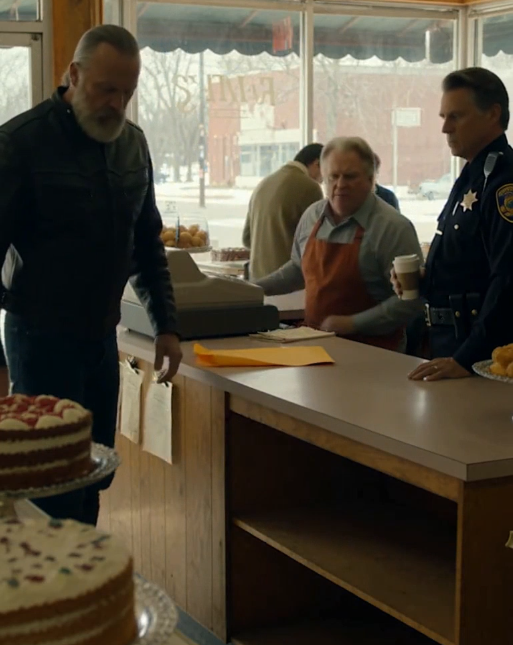
He’d hired Leon to mount the anniversary photographs because the biker had painted both versions of the store’s sign. They trusted him with the keys. A week earlier Pete had covered a stain on the back wall with a weathered notice he’d found in the office, and later clipped a small photograph to it. It showed a teenager running across the old parking lot with that big Foley’s grocery sack on his arm. Pete had put the display between the picture of the first register and the clipping about the time a delivery truck got stuck in the ice. He’d figured people would remember.
Now Leon’s leather jacket was brushing the balloons as he stood with the notice in his hand. People were shuffling toward the wall to see what he’d taken. Officer Noah Price, who’d come in for coffee before his shift, set his cup on a nearly empty shelf.
Leon looked past Pete to Officer Price. He put the crumpled notice on the counter and took a plain envelope out of his jacket.
“I found the whole picture,” he said.
He spread a larger print over the notice. It was the same parking lot and the same winter sky, only the frame went farther to the left. Pete could see a green awning he hadn’t replaced until the year after he took over. An older woman in a blue sweater stood in the open doorway, holding the other handle of the grocery bag.
Officer Price leaned in over the counter. He stared for a second at the boy’s coat, at a square of yellow fabric where the elbow had been patched. Then he raised his eyes to the woman’s hand.
His mouth had gone slack. He looked more like somebody just woken up than a man in uniform.
“She packed it for me.”
Part 2
Leon lifted his hand from the print, which was curled at the corners like an old postcard and kept trying to pull itself shut.
Pete looked at the older woman again. There was a little gold cuff at her wrist. When the elastic on the uniform sweaters went, his aunt Helen tacked it in place with a couple of bright stitches. You could see a line of gold between her blue sleeve and her white skin. He thought of how frequently he’d opened a cupboard and found a needle parked in precisely the place he’d reach without looking.
“You can have a look,” Leon told him, “if you bring it over by the light.”
The cop stayed where he was. There was a pencil scratch on the front of his name badge Pete had noticed a hundred times, the way you notice something missing from a brick wall. He’d never imagined him going up and down the street in a coat with a yellow patch from a school bus reflector.
Pete picked up the picture. He meant to tell the people on the baking aisle they could get on with their shopping. Nobody there was holding groceries. A woman who came for milk every Saturday had moved back far enough to let him pass if he needed to.
“When was it?” Pete asked. He had been looking for a date on the envelope because dates were numbers you could sort, and he needed something to do while everybody watched him.
“December,” Officer Price said. “A Tuesday. School got out early.”
The store was open then from seven in the morning until seven at night. Pete had worked from a quarter to eight to ten at night the week before the photograph was taken. There were separate boxes in the register for change because Aunt Helen still had rules about which bills went on top. He was nineteen. The first day she’d left him to close on his own, he’d carried the deposit envelope home in his trousers while a butcher paper grocery sack wandered all over the neighborhood.
He had never spoken to the boy. He would remember that much out loud in front of everybody, if it came to it. He’d heard the bag, then the crack a swinging door made when it caught the wind, then seen the boy run, already too far to hear the one thing Pete yelled after him. Later that night the drawer came up short. Pete had been so pleased with himself for figuring out what happened that he drove back after supper and put up a notice for the staff in the stockroom. His handwriting was still there on the corner of the photocopy.
He took down the matching little print and set it beside the one Leon brought. They were from exactly the same angle. The new one showed a long hand at the inside of the bag, pulling its two handles together so the boy could lift it. Pete recognized the gesture from every time his aunt had wrapped a steak. She did it before she let go.
There was a paper crack behind them. The woman who came for milk moved a balloon so it would stop catching in the overhead fan.
“There’s a bench by the flour,” Pete said.
Noah nodded once. He pulled out a chair for Pete at the counter and sat down beside him instead. There was something easier about facing the same way. They could both see the little yellow knees in the overlarge pants Aunt Helen had rolled up on the boy.
Part 3
Leon brought out a second picture. It was a line of paper sacks on the old stainless-steel table, each one rolled down for easy carrying. Next to them was a thermos with a pump top like the one the store had kept until the glass broke. On the back of the print was a date, initialed by a man who had volunteered to take photographs for the church pantry drive.
The man had brought a shoebox of negatives to the anniversary committee. Leon got them two days before the opening. He’d sat overnight trying to get the old scanner to recognize the strip that included the parking lot. He was sure there was a little more photograph than he’d seen Pete pin up. Aunt Helen had been standing in the doorway every time a child left with a bag that month.
“You knew the whole time?” Pete asked him.
“I knew she gave people food,” Leon said. “I didn’t know what picture you had out front until I brought your last frame this morning.”
Pete could feel eyes moving to him even though only the three of them could hear much. He could put the photocopy back in the office. He could shut the store for the afternoon and tell people the new compressor was overheating. Last winter the compressor really had overheated, and everyone had been very kind about it.
Noah said, “Do you still have that blue sweater?”
Pete had a bag of Helen’s clothes at home under the bed. Every year he bought a better bag for the Goodwill trip he never took. “I could look.”
“The week after that,” Noah said, “she left an empty sack on the mailbox hook at the back door. She said if I had to leave before the bread was cool, there’d be a place to put the bag down where the rain wouldn’t get it. She never wanted anybody to walk home carrying it under their coat.”
Pete thought of the bakery on school days. By three in the afternoon there wouldn’t be enough full loaves left to build a display. The imperfect ones went into a low drawer, rolled in waxed paper so small hands could carry them without the paper tearing. He could recall making an inventory list after he took over and being surprised that the drawer was in the way because it never closed. He’d given the cabinet away.
Noah reached over to touch the two photographs at their edges. In the small one the bag looked held tight against his chest. In the larger one the heel of his shoe was already off the ground and his aunt had extended her fingers farther to get it to him in time. He’d run straight for the corner because there was a bus that went past his mother’s building every half hour but took forty-five minutes to come back the other way. His mother had one evening a week off from the laundry. December was the only time of year they could miss that bus and still both eat before dark.
“She’d told me to run,” Noah remembered. He gave the smallest laugh. “I was always late.”
Pete found his glasses in the top pocket of his apron. Under his aunt’s cuff, almost behind the sack, he could make out one of the checks she’d sewn onto the side of her sweater. He felt the sharp wave of relief that came on mornings he’d gotten something wrong at the bank and the clerk told him they’d fix it.
What came right behind it felt like standing home alone with the phone still in his hand.
Part 4
At lunch Pete took the original notice out of its sleeve. The pinholes ran across the top like a small uneven seam. He’d printed it as big as their old receipt printer could manage, then copied two underlines by hand. Underneath he had written what you were supposed to do if you saw the kid come back. He remembered bringing coffee to the stockroom specifically to watch the older employees read it.
Noah waited at a table by the bread slicer. He’d gone out to make a call about being a few minutes late. He’d come back without the cap he ordinarily wore in the cold, taking a second to wipe his boots on the mat on a day when there wasn’t anything on them. In another twenty minutes he’d drive to the station. Pete had a sudden fear that after he drove away, they could both go back to being courteous to each other every Saturday.
“You’re in the picture,” Pete said. “I need to ask what you want me to do with it.”
Noah looked toward the window. Children had covered its low edge in small handprints waiting for people inside to buy them cookies. “I’d like a copy for Mom,” he said. “Just one with all of it in.”
Pete began to say he’d frame the new one for the wall. He caught himself halfway through the first word. The old habit of presenting a solution as if he were doing somebody a favor was one he’d learned at the same register where he got cash back whenever he made a mistake.
“Can I put any of it on the wall?” he asked.
“Maybe. What would you write?”
“I had it wrong.”
Noah watched him carefully and waited.
“I let people here think a kid stole a bag his family needed,” Pete said. “I put the notice up again long after I should’ve asked. They saw it before you got here. I’ve got to take care of that.”
Noah folded the paper napkin under his coffee. “The summer we moved, my aunt sent me back to buy a small carton of milk for her coffee. They told me the store was closing early. Nobody kicked me out or anything. I walked past the front the next day on the way to the bus and I could see it was still open at the same time.”
Pete had no memory of having said that to anybody. He looked at the old directions in his own handwriting. He had never checked whether anybody had followed them. There wasn’t a single change to the fact of what he’d done.
“I was grown by the time I told Mom,” Noah said. “She used to take an extra block home to get here. It was embarrassing to think I’d made her walk farther for a carton of milk.”
Pete pulled out a chair at last. A draft slipped under the dining room door while he sat down. There was no excuse he could offer that would take distance out of a walk somebody had made home with groceries.
“I’m sorry,” he said.
Noah nodded after a bit. He took his napkin with him and put it in the wastebasket. Before he picked up his cap from the shelf by the door, he went back to the front table and looked at the picture of the street with all the snow in it. For the first time that morning, Pete noticed he wasn’t looking at the boy. His eyes moved out past her elbow, to the road he’d taken home.
Part 5
On Monday morning Pete found the old till notebook. He went looking for the drawer discrepancy because for years he had remembered it in the smallest possible frame: a kid taking food and money in one trip on the one evening Aunt Helen had trusted him to close by himself. He thought that if he had a good reason to have thought it at first, there might still be some part of that night he could stand to remember.
The entry did show the shortage. The next morning, one page over, it also showed fifteen dollars in coin change exchanged with the delivery man before the bank run. Wide in the margin was a set of initials in Pete’s handwriting. They matched the initials on the cash drawer count. He left the book open for several minutes on the broad window ledge, where he had a better chance of resting his eye on it without squinting. He had signed both sides of the mistake.
Later Leon came in for detergent. Pete showed him the notebook. Leon looked from one page to the next, the same way he’d looked at the pieces of photograph.
“Did she see the notice?” Pete asked him.
“I don’t know,” Leon said. “You’d have to ask somebody who was here every day.”
Pete put out a call to a former cashier, Colleen, who first asked if he was trying to get her to cover a shift. He explained the picture. She didn’t remember the notice itself. The only thing that stuck with her was that Helen started walking a particular set of groceries out the back herself and refused to let anybody else stand by the door. It wasn’t a good time for cash in the store and several people had begun asking why certain things could go out unpaid. Helen showed them the accounts they were responsible for and told them they could come and talk to her privately about hers. “She had a row going on with everybody,” Colleen said. “Some people only remember the meals because she made a point of picking the fight before she handed the meals over.”
There was a long pause. In the telephone silence, Pete could hear Colleen moving something metal on a stove. She asked if he remembered when she’d insisted on paying for a ham Aunt Helen had given her for her sister’s wedding. He didn’t. “She forgot a decimal,” Colleen told him. “Pure convenience, of course. Charged me two dollars and ninety cents.”
Pete went to the bank and had to buy some old rolled quarters because nobody kept them loose behind the counter anymore. On the drive home he thought about how angry Helen had been the night he was meant to close, when she caught him bringing the deposit envelope through the back door instead of putting it in the outside drop. She’d made him take it straight back, and he’d thought she was telling everybody he couldn’t be trusted with money. He didn’t remember her telling anybody but him.
In the afternoon he stood beside the space where the photograph had been. The bigger board was blank there, and before he did much more than sweep under the table, a customer stopped to ask if part of the display had fallen down.
“I took it down,” he said. “The notice was mine. It was wrong about a kid my aunt was helping.”
The man stopped. “I probably shouldn’t have laughed at that yesterday.”
Pete swept a paper plate out from under the table. “I shouldn’t have given you a reason.”
Part 6
On Wednesday Noah came in with his mother. Pete had seen her only in the last few years, stopping by for a half loaf and a bag of tea after an appointment. He had last watched her in the old parking lot entirely by accident, leaning over the trunk of a neighbor’s car so the groceries wouldn’t tip. She wore reading glasses on a cord now. She bought the same tea and set it on the counter with the little paper list of things she had a right to take out of the store.
Noah introduced her as Mrs. Price, then shook his head at himself because neither of them had said anybody’s first name since they met. She held out a hand from inside a mitten. “I’m Gloria,” she told Pete.
They walked together to the front display after the line at the register died away. Pete had printed a single sheet in large, even type. The new text gave Helen’s name, identified the bags as groceries she packed for neighbors, and said he’d made and later displayed a warning accusing a child in error. He didn’t put Noah’s name on it. He carried two copies in case one was forgotten in the car. Without saying much, Noah stood beside his mother watching her read all the way through the text. He’d already seen it on his phone that morning and asked Pete to change the word donations to groceries.
“They were pretty good apples,” Gloria said.
Pete tried to find which part of the paper she’d reached. She had gone over to the display table and brought in an apple from its lopsided center. Noah picked another up by its stem. “You knew those were in the bag?” he asked her.
She looked at him. “Who do you think put the first ones in there?”
All those Tuesday mornings, it turned out, Gloria had taken a ride from somebody at work to the store to take fruit down the row and help Helen split a sack into smaller bunches. She sorted the half-damaged apples for pie, passed the rest to the families whose children picked up after school, then waited for the man from the laundry to swing back around. On this particular afternoon she had asked Helen to make up a bag for her and go easy on the fruit because Noah walked home a good way from the bus.
“I thought you thought I paid for it,” Noah said.
“I thought you knew.” His mother pressed the base of the apple against a place on the table to see if it would sit straight. “I wondered why you always wanted to be away from the window when we ate them.”
Noah laughed before the thought got all the way to him. “I thought you’d think I stole those too.”
Gloria’s face set. She had been smiling only a second earlier and Pete could see it take all her attention to hold still. She watched her son for longer than he’d thought she would. Then she reached up to get a loose thread off his shoulder.
“Did you really think I’d let you walk out of there hungry?” she said.
Noah put the apple down. He looked over at the entrance, then moved a chair out from behind the display so his mother could sit. She took it without saying anything and made him sit down right beside her.
Part 7
Pete found Helen’s blue sweater on the first try when he looked. He took it into the store in a canvas bag so he wouldn’t have to tell each person who came in the door the entire story. He could tell them the little part that mattered. His aunt was handing the food out. The photograph he’d displayed misleadingly had once been personal. The owner who posted the sign wanted them to know that it had been his own mistake.
He pulled it out to show Gloria on the next Wednesday. She put a finger on the cuff.
“Oh, she did mine this way too,” she said. “I told her red thread and she told me to come back with red thread.”
Gloria hadn’t brought the red thread back. She’d spent years looking at the yellow thread in the cuff thinking it was improvised. Now she borrowed Pete’s phone to take a photograph of both sleeves, talking as easily as if she’d been in Aunt Helen’s office switching shifts twenty years ago. Pete watched her move to the window so there was enough light to show the stitches. He hadn’t expected the sweater to be something anybody knew so well.
That afternoon Leon came to hang the corrected display. He didn’t tack up a notice the way he used to at the gas station when it had three sets of keys people had left in the same day. He sat with Gloria on opposite sides of a little table and marked the place on a clean grid where each picture would go. They put up the sacks at the stainless steel table, the surviving photograph of Aunt Helen in the doorway, and a photocopy of one of the lists from the pantry drive. Names of recipients were out of view. Gloria preferred the visible part because you could see where Helen divided which food went in which bags by sheer estimate. Leon lined it up neatly so the shift of the columns was clearer.
Noah came by with the new print when they had nearly finished. He held it up to the light with his back to the front doors. “You can use it,” he told Pete at last. “Use my name if you want. But can we put my mother’s in there too?”
Under the print, in a short line Gloria designed with a ruler, they added that she had packed groceries with Helen that winter. Noah suggested they put the town pantry’s collection date on a small sign beside the register for people who wanted to pick up an extra item. Gloria told him to find an address where somebody actually answered the door when someone rang the bell, because there was often enough to carry on a Tuesday.
When the photographer for the local history committee came back to check names, Pete picked up the original notice from the office. He gave it to the man with the new explanation attached. In the archive, somebody would be able to see the notice as it was handed to the public and the correction Pete had made a little late. The man said they’d give the two things the same record number so it would take effort for somebody to separate them again.
Gloria watched him slip them into one sleeve. She looked at her son. “Can we take your picture outside, too?”
Noah took his coat off the hook. They stood under the new awning while Pete lifted Noah’s phone. The photographer kindly held the door until Pete had found the button, and he managed to take a picture in which both of them were looking at him.
Part 8
Come January, the display stayed put. Pete took the balloons down and left the apron Aunt Helen had worn on busy days folded in the case beside the photos. Several people came to the store wanting to tell him they’d remembered the day through someone else’s account. Pete stopped trying to head them off at the register. When he needed to make a correction, he made it in time to save another person the trouble of learning two versions later.
On Tuesday afternoons Noah sometimes stopped for coffee before he went to work. He could spare five minutes most days. In the five minutes Pete learned that the patched coat had come from a lost and found box at the school. Gloria had done the yellow elbow herself one evening while Noah slept. She chose the color because he wanted to work with the buses and had already asked so insistently about getting a reflective patch nobody had the energy to tell him no. Noah’s last winter in that coat he held his arm out to see it shine every time a car went past. Pete pointed to the photograph, then to the little shoulder seam. He’d never noticed the boy had been holding his arm up a bit.
Leon brought a motorcycle into the lot one clear January day. Pete looked up from the bread counter where he’d weighed something twice before he got the amount Gloria had asked for. They’d all seen each other on the through road a hundred times that month without stopping. When he came in, Leon was halfway out of his jacket and holding a little piece of mail in one hand.
One of the pantry volunteers had recognized the coat in the new photograph because her son had worn it before Noah. She sent the name of the teacher who ran the lost and found. Noah wanted to write the teacher back, and Leon knew Pete would get to the shop before he got over that side of town.
Pete left the mail by the register for him. He thought about the chances he’d had to learn the kid’s name and how easily a label had let him think he’d already learned enough. He put the cap back on a glue stick Gloria had left open, fetched her order from the cooler, and sent word that it was ready whenever she had time.
He was ringing up coffee and pie that afternoon when Noah came in with a young man who’d been working odd jobs down the block. Noah needed an extra pair of hands carrying a couple of bags out to the pantry association’s van. Pete had something left to do at the register, so he asked if the young man would wait one minute. He watched the boy thinking over whether he had time.
“I’ll make it,” the boy said. “If I hurry.”
When Pete looked down to finish ringing up the coffee, the boy was already in the doorway. Noah had one hand on the bag. The boy took the other handle, adjusted his grip, and turned with him to carry it out.
Pete kept his hand on the register a little longer than he needed to. He heard the bell and thought of Helen watching the school bus roll past at a distance. If a photograph in your own family has two versions, try asking somebody who was there what happened just beyond the frame. You might still have time to carry the whole version home.


