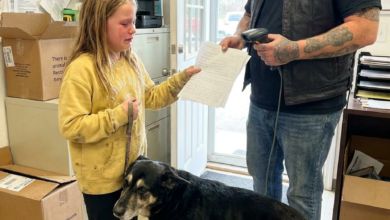
A Biker Threw an Old Man’s Medicine Into the Fire—and the Labels Revealed Who Had Been Slowly Stealing His Life
The biker had barely stepped onto my grandfather’s porch when he seized every bottle beside the old man’s chair and threw them into the fire, while my mother screamed that he was killing the only person our family had left.
I remember the sound more than anything else.
Plastic rattling inside his fist. Glass striking brick. My grandfather wheezing behind me while orange flames climbed around capsules, tablets, and paper labels bearing his name.
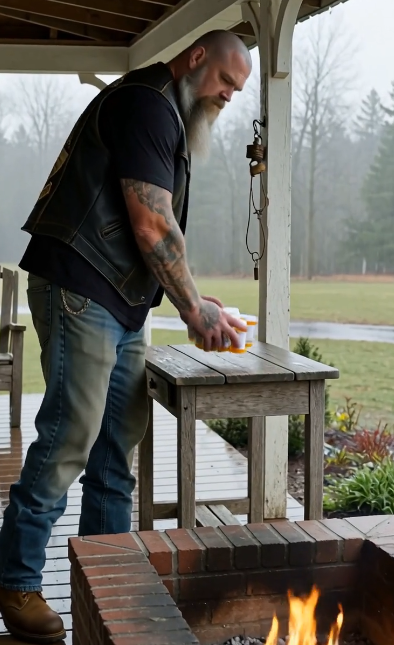
Then my mother hit the biker across the face.
Dean Mercer did not lift a hand to stop her. He stood six-foot-five in worn motorcycle boots, shoulders filling the doorway, his gray beard hanging over a weathered black leather cut. Blue ink wrapped both forearms. An old burn scar crossed three knuckles. Behind him, his Harley’s V-twin ticked as it cooled in the October rain.
“You monster,” my mother whispered.
Dean watched the medicine burn.
“Maybe,” he said. “But he doesn’t swallow another one.”
My name is Claire Dawson, and until that afternoon, I had seen Dean only twice along Route 50 outside Beckford, Ohio. Both times, he looked like the kind of man a sensible woman would avoid at an empty gas station: shaved head, scarred hands, chain wallet, faded jeans, and a silver ring shaped like a skull.
My grandfather, Walter Briggs, was eighty-one. He had buried his wife, survived two heart procedures, and outlived every man from the machine shop where he had worked. Six months earlier, however, he had begun fading in ways none of us could explain. His hands trembled. His words tangled. He slept through meals and sometimes stared at me as if he recognized my voice but could not find my name.
His caregiver, Evelyn Price, told us that age could turn quickly.
We believed her.
Evelyn was calm, organized, and always ready with a folder. She drove Granddad to appointments, sorted his weekly medication, and reminded us that missing even one dose could be dangerous. Whenever his condition worsened, she had a polished explanation waiting before anyone asked.
Then Dean arrived.
He had met Granddad three weeks earlier at Rosie’s Diner, where Walter had wandered in wearing bedroom slippers and asked whether the Korean War had ended. Dean bought him coffee, called the number inside his wallet, and waited until Evelyn came.
She disliked him immediately.
Dean disliked the bottles in her handbag.
That rainy afternoon, I found him kneeling beside Granddad’s chair with one prescription bottle held close to the window. He rolled a white tablet between his thumb and forefinger, smelled it, scraped its edge with a pocket magnifier, and quietly asked Evelyn when the pharmacy had changed manufacturers.
She told him to leave.
He asked again.
My mother entered as Evelyn shouted that a violent stranger was interfering with medical care. From the kitchen, I heard Granddad cough. Dean’s face changed—not with panic, but recognition. He swept eleven bottles from the table, crossed the porch, and cast them into the brick fire pit.
Chaos followed.
My uncle reached for Dean’s vest. Evelyn called emergency services. Mom struck him, and I screamed that Granddad needed those pills.
Dean took every accusation without stepping back.
Then he reached through the heat with a pair of iron tongs and pulled one half-burned bottle from the coals. Its label curled away from the plastic, exposing another strip of paper underneath.
Two patient names.
Two different dosage instructions.
And beneath both labels, scratched into the bottle by hand, were three tiny letters Dean said he had seen on counterfeit field supplies seventeen years earlier.
Evelyn stopped talking.
For the first time since I had known her, our caregiver looked afraid.
Dean turned toward me, rain running from his beard, and said the six words that divided our family’s life into before and after:
“Check who profits when Walter dies.”
Three weeks before the fire, Dean “Rook” Mercer had ridden into Beckford carrying more ghosts than luggage. I learned that later, after I stopped seeing only the leather cut and started noticing the man inside it. He had spent twenty-two years riding with the Iron Lanterns, a veterans’ motorcycle club whose members met at an old feed warehouse beside Route 50. They fixed roofs, escorted funeral processions, and rarely explained themselves to outsiders.
Dean had once been a battlefield pharmacy technician attached to an Army surgical unit. He never called himself a medic because, according to him, that title belonged to the people who ran toward gunfire with bandages. His job had been quieter. He tracked medications, inspected seals, calculated doses, caught contaminated supplies, and made sure exhausted doctors did not receive the wrong ampoule at three in the morning.
Quiet work still killed people when it went wrong.
A roadside blast ended Dean’s deployment in Afghanistan. He came home with damaged hearing in his left ear, scars across his hands, and a habit of examining every bottle before swallowing anything. He also came home without his younger brother, Nathan, whose pain medication had been diluted and relabeled somewhere along a broken military supply route.
Nathan survived the explosion.
The false medication finished what the blast had started.
Dean had reported the irregular markings before his brother died, but the investigation moved slowly through contracts, manifests, and offices filled with people who spoke in passive sentences. By the time anyone confirmed that bottles had been reused and labels layered over one another, Nathan’s coffin was already underground in Chillicothe.
After that, Dean left pharmacy work.
He repaired motorcycles instead.
The Iron Lanterns knew part of the story. Their president, Samuel “Hawk” Bell, had served in the same region, though not in Dean’s unit. Hawk knew why Dean never accepted loose tablets, why he checked expiration seals twice, and why the sight of adhesive residue beneath a pharmacy label could turn him silent.
But Beckford knew none of that.
To us, he was just a biker drinking black coffee at Rosie’s.
Granddad entered the diner on a Tuesday morning wearing slippers, an undershirt, and my late grandmother’s brown winter coat. He sat across from Dean without asking and placed two nickels on the table.
“Phone call to Dayton,” Granddad said.
Dean looked at the coins, then at Rosie, who stood behind the counter holding a coffeepot in both hands.
“Walter?” she asked gently. “Do you know where you are?”
Granddad told her it was 1963.
Some customers stared. Others turned away because confusion in an old man makes people uncomfortable, especially when they recognize their own future inside it.
Dean slid his coffee across the table.
“Long night?” he asked.
Granddad took the mug but did not drink. His fingers trembled so badly that coffee spilled into the saucer. Dean steadied it with both hands, careful not to grip Granddad’s wrist.
“Something like that,” Granddad said.
Inside his wallet, Dean found my mother’s number and a card identifying Evelyn as his caregiver. Mom was teaching and could not leave immediately, so Evelyn arrived first. She entered smiling, apologized to everyone, and placed a soothing hand against Granddad’s shoulder.
The smile disappeared when she saw Dean.
“He gets confused if he misses his medication,” she explained.
Dean looked at the handbag hanging from her arm. Several prescription bottles pressed against the leather.
“Which one did he miss?”
Evelyn’s smile returned, thinner this time. “That’s private.”
“Fair enough.”
Dean let them leave, but he watched Evelyn guide Granddad to the car. She moved with practiced tenderness whenever someone was looking. Once Granddad’s head dipped below the window, she shoved his shoulder hard enough to make him strike the doorframe.
Dean saw it.
So did Rosie.
Neither could prove what it meant.
That evening, Dean mentioned the encounter at the Iron Lanterns’ warehouse. Hawk told him to call adult protective services if he believed the old man was in danger. Dean had already done so. The agency took the report and explained that Walter had family, professional care, and documented cognitive decline.
On paper, everything appeared proper.
Dean hated paper that appeared proper.
Two days later, he saw Granddad again at a gas station. Evelyn was inside paying while Walter sat alone in her car, knocking weakly against the passenger window. Dean approached, expecting confusion.
Granddad pointed toward the glove compartment.
Inside was a folded insurance statement Evelyn had apparently overlooked. Dean did not remove it, but the visible page showed a recent change in beneficiary status and a policy value of $750,000.
Evelyn returned before he could read more.
She accused him of harassing her patient and photographed his motorcycle plate. Dean backed away, yet Granddad kept watching him through the glass, one palm pressed flat against the window.
That was the second time Dean noticed the old man’s pupils.
They were too small.
His breathing was too shallow.
His confusion came in waves rather than remaining constant, and between those waves his eyes sharpened with desperate awareness.
Dean knew medication could do that.
The question was whether anyone else wanted to know.
He called my mother the following morning. She listened politely for less than a minute before explaining that Evelyn was licensed, Granddad’s doctors knew his condition, and the family had already spent months adjusting prescriptions.
Dean asked whether the deterioration began before or after Evelyn took control of the weekly pill organizer.
Mom ended the call.
I would have done the same.
We were tired. We felt guilty. Evelyn gave us permission to believe that hiring her had been an act of love rather than a surrender made by frightened people. Dean threatened that belief, and his appearance made dismissing him easy.
Still, he kept returning to Rosie’s.
He asked no questions about Granddad. He simply sat where he could see the highway and waited.
On the third Thursday, Walter came through the door again.
This time, he was barefoot.
He staggered directly to Dean’s booth, curled his fingers around the biker’s leather sleeve, and whispered, “They changed the colors.”
Then his knees folded.
Dean caught him before his head struck the tile. As he lowered Granddad, a small plastic medicine cup rolled from the old man’s coat pocket. Three tablets lay inside: one white, one pale blue, and one yellow with a shallow split down the middle.
Dean stared at the yellow tablet.
The prescribed drug listed on Granddad’s emergency card was not manufactured in that color or shape.
Not anymore.
He slipped none of the pills into his pocket. He photographed them beside the card, sealed the cup inside an unused diner bag, and handed it to the paramedics. At the hospital, however, the cup vanished before anyone logged it as evidence.
Evelyn said Walter must have picked up random vitamins at home.
The emergency physician accepted that explanation.
Dean did not.
Outside the hospital, Hawk waited beside two idling Harleys. He told Dean the family had threatened to seek a restraining order. Another club member, Luis “Preacher” Ortega, reminded him that good intentions did not give them legal authority to enter a man’s home.
Dean knew they were right.
He also remembered Nathan’s last night, when nurses increased a dose because the mislabeled medication appeared weaker than expected.
“Brother,” Hawk said, “you can’t save the dead twice.”
Dean fastened his helmet.
“No,” he answered. “But Walter’s still breathing.”
The V-twins rolled into the Ohio dusk, their low thunder following Route 50 past cornfields gone brown with October. Dean rode at the front, but he did not feel free.
He felt late.
The day of the fire began with Granddad trying to write my name.
I had stopped by before work and found him at the kitchen table, gripping a pen between both hands. The paper held a shaky C, followed by several dark loops cut through so many times that the page had torn.
Evelyn stood behind him.
“He had a difficult night,” she said.
Granddad looked up at me. For one clean second, his expression became the one I remembered from childhood—the man who taught me to change a tire, who hid peppermints in his shirt pocket, who claimed every thunderstorm over Beckford was bowling night in heaven.
Then his eyelids sagged.
“What did he take?” I asked.
“His prescribed morning medication.”
She showed me the organizer. Every compartment was labeled in neat block letters. I felt reassured by the order of it.
That was the trap.
Evelyn encouraged me to leave for work. She said Granddad needed rest and reminded me that overstimulation worsened dementia. As I bent to kiss him, his hand closed around my wrist.
“Colors,” he murmured. “Wrong colors.”
I thought he was talking about the leaves outside.
At eleven, Dean entered Miller’s Pharmacy carrying photographs of the tablets from Rosie’s. The pharmacist, Jordan Miller, knew him from motorcycle charity rides but refused to discuss Walter’s prescriptions without authorization. Dean did not ask for private records. He asked a narrower question.
“Does this pill match anything your store dispenses in that bottle?”
Jordan studied the image.
His answer was no.
Dean showed him a close photograph of the yellow tablet. Jordan said it resembled a strong sedative used in veterinary procedures, though an image alone could not establish identity. The blue tablet could have been a potent pain medication. The white one carried a partial imprint inconsistent with Walter’s documented heart medicine.
Then Dean showed him the underside of a label photographed through Evelyn’s open handbag at Rosie’s.
Jordan’s face tightened.
Pharmacy labels were printed on stock with faint repeating security marks. The label in Dean’s image had none. Worse, the bottle shape had not been used by Miller’s Pharmacy for nearly two years.
Someone had placed a convincing homemade label on an old container.
Jordan contacted the sheriff.
Deputy Thomas Keene listened, took notes, and explained the problem: photographs raised concern but did not justify a forced search. The original pill cup had disappeared. Walter’s family supported the caregiver. His doctors had documented natural decline. Evelyn had no criminal record.
Dean asked how long a laboratory test would take if he obtained an intact pill legally.
Keene told him not to obtain anything illegally.
At noon, Evelyn called my mother and said Granddad had become agitated. She claimed he struck her and refused medication. Mom asked me to return to the house while she contacted his doctor.
When I arrived, Granddad was slumped in his recliner on the enclosed porch. A space heater glowed beside him despite the mild day. Evelyn held a bottle and complained that he had spat out his pills.
I found one against the collar of his shirt.
It was green.
The medication chart taped to the refrigerator described that dose as a small white tablet.
I finally heard his warning.
Wrong colors.
I texted Dean because his number remained in my recent calls. I did not tell Mom. I did not call the police. I wrote only: The pill is green. How fast can you get here?
His reply came in ten seconds.
Don’t give him anything. Open the door.
The Harley reached our road before I heard the sirens Evelyn had requested. Its engine struck the quiet first, a deep mechanical pulse growing through the trees. Dean turned into the driveway, gravel cracking beneath his tires, and stopped beside Granddad’s rusted truck.
Evelyn stepped onto the porch.
“You need to leave.”
Dean removed his helmet. “Show me the bottle.”
“You have no authority.”
“Neither does a false label.”
She tried to close the door. Dean placed one boot against the threshold—not kicking, not charging, simply preventing it from shutting. I should have been afraid. Instead, I looked at Granddad struggling to stay conscious and felt relief.
Dean entered.
His leather cut creaked when he knelt. He checked Granddad’s pulse, watched his breathing, and lifted one eyelid. Then he asked me when the last dose had been given.
Evelyn answered for me.
Dean ignored her.
“Claire.”
“I don’t know. She said this morning.”
He picked up the green tablet with a tissue, examined its imprint, and swore under his breath. Then he scanned the porch table. Eleven prescription bottles stood beside an insurance folder and a glass of grapefruit juice.
“Where’s the original packaging?” he asked.
Evelyn folded her arms. “Those are the original containers.”
“No.”
One word.
Certain.
He twisted open the first bottle and smelled it. He checked the cotton, the tablet dust caught inside the cap, and the adhesive edge of the label. The second bottle carried a label placed slightly crooked over another. The third listed a dosage format Miller’s Pharmacy did not use.
He moved faster.
Plastic clicked. Caps struck wood. Granddad coughed, and Dean’s scarred hands began to shake—not from uncertainty, I realized later, but from memory.
Evelyn reached for the bottles.
Dean swept them away.
My mother and uncle arrived at that exact moment. They saw a giant tattooed stranger looming over Granddad, medicine clenched in his fist, Evelyn pleading for him to stop.
Context disappeared.
My uncle grabbed Dean’s shoulder. Dean turned, and the movement threw him against the porch rail. Mom shouted that she had called the police. Evelyn cried that Granddad would die without his medication.
Dean looked at the bottles.
Then at Granddad.
Then at the fire pit beyond the porch, where Evelyn had been burning fallen branches.
He made a decision none of us understood.
He carried every bottle outside and threw them into the flames.
Mom screamed.
I froze.
My uncle charged him again. Dean allowed himself to be shoved but kept his body between the family and the fire. Caps popped in the heat. Labels blackened. Tablets scattered among glowing wood.
“You’re killing him!” Evelyn cried.
Dean pointed toward Granddad. “Those are.”
Mom slapped Dean so hard that his lip split against a tooth.
He did not touch her.
The sirens grew louder. Evelyn moved toward the gate, quietly at first, but Dean noticed. He stepped sideways and blocked the path without grabbing her.
“Stay,” he said.
She called him insane.
“Probably.”
The first sheriff’s cruiser stopped in the driveway. Deputy Keene exited with one hand near his holster and ordered everyone apart. Dean raised his palms. My uncle began shouting. Mom rushed to Granddad. Evelyn launched into a polished account of unlawful entry, destruction of medication, and threats.
Dean let her speak.
As the fire consumed the evidence, anger climbed Keene’s face.
“What did you do?” he demanded.
Dean took iron tongs from beside the pit and reached into the flames. He retrieved a bottle whose outer label had curled away cleanly, revealing the hidden paper beneath.
“Made this visible.”
Keene stared.
The top label named Walter Briggs and described heart medication. The lower label named Raymond Price and listed a strong opioid dosage.
Price.
Evelyn’s surname.
Dean turned the bottle. Three hand-scratched letters appeared near the base: NCP.
He explained that counterfeit suppliers sometimes marked reused containers by batch before adding false labels. NCP had been associated with a network that diverted medication through private-care channels years earlier.
Evelyn denied everything.
Then Granddad stopped breathing.
Mom screamed his name. Dean crossed the yard in three strides, lowered the recliner, opened Granddad’s airway, and began assisted breathing while Keene called for paramedics. My uncle stood uselessly beside him. I did too.
Evelyn backed toward her car.
Rosie’s waitress pulled into the driveway behind the ambulance, trapping her.
She had come because Dean asked her to bring the diner’s security drive—the recording that showed Evelyn removing the sealed pill cup from a paramedic’s supply bag while everyone watched Granddad.
The ambulance crew pushed us aside. They administered a reversal medication, supported his breathing, and loaded him onto the stretcher.
Granddad’s chest rose.
Once.
Again.
Still, the false climax belonged to Evelyn. She was handcuffed beside her car while our neighbors gathered along the road, and we assumed the danger had ended.
Dean knew better.
He looked at the insurance folder on the porch.
One page was missing.
And the beneficiary listed on the remaining copy was not Evelyn Price.
It was my mother.
At Beckford County Hospital, Granddad survived the first night.
The doctors found multiple substances in his blood: a sedative, an opioid, and a drug that lowered blood pressure. None matched the schedule his cardiologist had approved. The combination explained his confusion, shallow breathing, falls, tremors, and episodes of near unconsciousness.
It did not explain the insurance papers.
My mother, Susan, stared at the beneficiary form as if it were written in another language. Her signature appeared at the bottom. She swore she had never seen it.
Uncle Robert believed her.
Deputy Keene did not have that luxury.
The policy had been increased four months earlier. Granddad’s house had been used as collateral for premium financing. The payout would transfer to Mom upon his death, and a secondary authorization allowed funds to enter a family trust managed by Robert.
Our family suddenly looked less like frightened relatives and more like conspirators.
Evelyn asked for a lawyer.
Dean sat alone in the waiting room with dried blood on his lip. Hospital security had ordered him to leave twice, but Granddad regained consciousness long enough to whisper his name.
“Rook.”
That bought him a chair.
Mom approached Dean after midnight. Her anger had burned down to shame. She asked how he recognized the medications.
He told her about Nathan.
Not all of it. Dean did not speak in speeches. He described the counterfeit supply chain, the double labels, and the letters scratched into reused bottles. Then he said Nathan’s name once and stared at the floor.
Mom sat beside him.
“I hit you.”
“Yeah.”
“I thought you were hurting my father.”
“Yeah.”
“I’m sorry.”
Dean rubbed the split inside his lip with his tongue. “Be sorry later. Find who had your signature.”
That question took us to Granddad’s home office.
Keene permitted Mom and me to enter with an investigator while Dean waited outside. We searched filing drawers, tax folders, and a locked metal box beneath the desk. The key hung where Granddad had always kept it, taped behind a framed photograph of Grandma.
Inside the box, we found copies of his original will, bank statements, and handwritten notes documenting payments to Evelyn. Most looked ordinary. One notebook did not.
Granddad had recorded every medication change by date and color.
March 14: round white became long blue. Evelyn says manufacturer changed.
April 2: two yellow at night. Sleeping through breakfast.
May 19: Susan says I sound drunk. Evelyn says dementia.
June 7: insurance man came. I did not invite him.
The final clear entry had been written six weeks earlier:
If I forget, find the man with the rook. He noticed.
Dean wore a chess-rook pin inside his leather cut, a gift from Nathan.
Granddad had understood more than we knew.
Beneath the notebook lay a digital voice recorder. Most files contained reminders Granddad made for himself: lock the back door, feed the cat, call Claire on Sunday. The final recording began with Evelyn’s voice.
She was not alone.
A man told Granddad that Susan needed him to sign documents protecting the house from medical debt. Evelyn repeatedly assured him that it was a family trust. Granddad asked why the page mentioned life insurance.
The man became impatient.
Then Uncle Robert spoke.
“Just sign it, Dad.”
My mother folded against the desk.
Robert had been involved.
Keene found him before sunrise at a motel thirty miles east. He denied knowing about the medication swaps. He admitted arranging the policy and forging Mom’s signature, but claimed Evelyn had promised it was a legal estate strategy. His construction company was failing. He owed more than $300,000 and believed Granddad had only months to live from natural causes.
Evelyn had offered a solution.
Robert insisted he never asked her to hasten the death.
That distinction meant little to me.
Yet even this was not the deepest turn.
The lower label on the burned bottle belonged to Raymond Price, Evelyn’s late husband. Public records showed Raymond had died two years earlier while receiving home care from Evelyn. His death produced a large insurance payout, though no investigation followed because he had terminal cancer.
Dean asked the laboratory to compare Walter’s blood results with preserved samples from Raymond’s autopsy. Keene initially said such samples might no longer exist.
They did.
The same unprescribed drug combination appeared in both men.
Evelyn had rehearsed this before.
She found vulnerable patients through a private caregiving agency. She learned their finances, separated them from family by describing ordinary concern as “overstimulation,” and slowly altered medication until natural illness seemed to accelerate. Insurance documents followed. Sometimes she was beneficiary. Sometimes she used indebted relatives who could be blamed if questions arose.
Robert had not invented the plan.
He was her cover.
The caregiver’s real profit did not come solely from the payout. She had created a shell company that charged “consulting fees” to the trust after death, allowing her to extract most of the money while the named beneficiaries absorbed suspicion.
When investigators searched her storage unit, they found empty prescription containers, sheets of counterfeit pharmacy labels, insurance forms, and medication taken from at least seven former clients.
They also found a photograph of Dean.
It had been taken outside Rosie’s Diner.
Written across the back were the words: FORMER PHARMACY—REMOVE VARIABLE.
Dean had not stumbled into Evelyn’s plan unnoticed. She researched him after their first meeting and understood exactly what he might recognize.
The missing pill cup at the hospital had not vanished through luck. Evelyn stole it because she knew he was right.
Then Keene discovered a message on her phone sent to an unknown number the morning of the fire:
Mercer won’t stop. Move Walter tonight. Make it look like he wandered.
Evelyn planned to give Granddad a final combination, leave him near Route 50, and let cold weather finish the story. His documented confusion would explain everything.
Dean’s arrival had not merely exposed an insurance fraud.
It had interrupted the last day of Granddad’s life.
Hawk came to the hospital after dawn with six Iron Lanterns. They did not crowd the room. They lined the corridor, leather shoulders against pale walls, coffee cooling in their hands.
Dean told them the truth about Nathan’s medication for the first time.
He expected silence.
Instead, Hawk removed his club pin and placed it in Dean’s palm.
“Should’ve trusted your eyes sooner,” he said.
Dean closed his fingers around it.
“You trusted my brakes,” he replied.
For their kind of friendship, that was forgiveness.
Inside Granddad’s room, machines marked each breath. He opened his eyes as the bikers prepared to leave and lifted two fingers weakly toward Dean.
“Colors,” Granddad whispered.
Dean leaned closer.
“Told you.”
“You did.”
Granddad looked toward the corridor where the Iron Lanterns stood. “Loud friends.”
“The worst.”
A tired smile moved beneath the oxygen line.
For the first time in six months, my grandfather knew exactly where he was.
Granddad remained hospitalized for eleven days. The first three were mostly sleep. During the next four, the fog began to lift in small, almost painful increments.
He remembered my name.
Then Mom’s.
He asked why Grandma’s chair had been moved, forgetting she had died five years earlier. The grief returned fresh when we told him, but the doctor said this was not a setback. His mind was emerging from chemical sedation into the imperfect landscape of age.
Granddad did have mild cognitive impairment.
Evelyn had used that truth as camouflage.
A geriatric specialist reviewed every diagnosis in his file. Several descriptions of “rapidly advancing dementia” came directly from Evelyn’s reports rather than independent testing. She scheduled appointments after administering the strongest combinations, ensuring physicians saw Walter at his worst.
Once the false medications cleared his system, his tremor diminished. His speech steadied. He still misplaced words, tired easily, and sometimes confused dates, but he was not the helpless man she had constructed on paper.
The labels told their own story.
Investigators determined that Evelyn collected legitimate bottles from deceased or transferred clients. She removed loose medication, replaced it with tablets selected to mimic common side effects of aging, and printed new labels using stolen software credentials from a small pharmacy where she had worked briefly.
She expected families to read names, not tablets.
That expectation nearly worked.
The three letters scratched beneath the burned bottle connected Evelyn to a regional diversion scheme supplied by a man who once distributed counterfeit medication to overseas contractors. Dean had seen NCP markings during his deployment, although the initials did not represent a formal company. They were warehouse shorthand: North Central Processing.
That detail reopened part of Nathan’s case.
The same distributor who sold reused containers to Evelyn had worked through a chain of subcontractors tied to the diluted pain medication that reached Dean’s surgical unit seventeen years earlier.
When Keene told Dean, the big biker sat very still.
For years, he had believed Nathan’s death disappeared into a filing cabinet because no one remained to answer for it. Now one thread had surfaced in an old man’s house in Ohio.
Dean did not smile.
He asked whether the evidence would hold.
It did.
Federal investigators joined the case. The distributor, now living under another name in Indiana, was arrested. Records recovered from his property documented shipments to private caregivers, illegal clinics, and intermediaries who exploited medicine shortages.
Nathan’s file was reopened.
I expected Dean to speak of justice. He did not. He rode to his brother’s grave, cleaned mud from the marker, and left a white pharmacy label beneath a stone.
On it, he had written: I finally found the route.
Back in Beckford, our family faced its own truth.
Robert accepted a plea agreement requiring him to testify against Evelyn. He had forged signatures, concealed debt, and facilitated insurance fraud. Whether he understood the medication plan from the beginning remained disputed, but the voice recordings showed that he ignored Granddad’s resistance because he needed money.
Mom visited him once in county jail.
She returned without telling us what they said.
Granddad refused to visit.
“Blood gets you a chair,” he told me. “It doesn’t let you sell the table.”
That sounded like him.
Evelyn was charged in connection with Walter’s poisoning, Raymond’s death, financial exploitation, identity theft, medication diversion, and several other cases. Families from three counties came forward after seeing her arrest on the news. They brought stories that matched ours: rapid confusion, new insurance paperwork, missing bottles, and an attentive caregiver who always had an answer.
Dean attended no hearings unless subpoenaed.
He hated the courthouse. Too many polished shoes. Too many doors closing softly.
Instead, he helped Granddad come home.
The house could not return to what it had been. Evelyn had turned familiar rooms into evidence, and Robert’s betrayal lived in every drawer. Mom wanted Walter to move into assisted living, but he insisted on remaining where he had planted apple trees with Grandma.
Dean proposed a compromise.
The Iron Lanterns installed new locks, bathroom rails, porch lighting, and a camera at the medication cabinet. Miller’s Pharmacy began dispensing sealed daily packets printed with tablet photographs and descriptions. A visiting nurse came through the county hospital, and no single caregiver controlled appointments, medicine, and finances.
Granddad approved every change except the bathroom rail.
“Makes me look old,” he complained.
Dean stared at him. “You’re eighty-one.”
“Rude.”
“Accurate.”
They became friends in the awkward way some older men do—without announcing it. Dean stopped by on Tuesdays carrying coffee from Rosie’s. Granddad criticized the Harley’s noise. Dean criticized Granddad’s instant coffee. They played chess on the porch and accused one another of cheating.
Granddad called him Rook because of the pin.
Dean called him Pills until Mom made him stop.
One afternoon, I asked Dean why he threw the bottles into the fire instead of handing them to police. It was the question everyone in Beckford debated after the story appeared in the newspaper. Some called him reckless. Others said the heat saved Walter.
Dean considered his answer.
“The labels were layered with different adhesives,” he said. “I needed the top one to shrink faster than the bottom. Heat reveals layers.”
“You knew that would happen?”
“I hoped.”
“That’s not the same thing.”
“No.”
He looked toward Granddad, who was asleep in his chair with a legitimate medication packet sealed beside him.
“I knew what swallowing them would do.”
That was Dean: confidence from a distance, doubt up close. The fire had destroyed part of the medicine, but one bottle, several labels, and tablets recovered from the pit remained testable. More importantly, it stopped Evelyn from administering another dose before authorities arrived.
He had gambled.
Granddad lived.
Dean still carried the cost of that gamble in private. For weeks, he woke hearing Mom scream that he was killing Walter. He told Hawk that if Granddad had died during the respiratory crisis, everyone would have remembered the biker throwing medicine into flames, not the caregiver changing what was inside.
Hawk asked whether he would do it again.
Dean watched the warehouse door vibrate with the idle rumble of seven motorcycles.
“Sooner,” he said.
The club’s role changed after that.
The Iron Lanterns partnered with Miller’s Pharmacy and the county aging office to create a volunteer program called Check the Colors. Members delivered locked medication organizers, drove isolated seniors to independent pharmacy reviews, and taught families to compare pill imprints rather than trusting labels alone.
The name came from Granddad.
He attended the first workshop in a pressed blue shirt, sitting beside Dean beneath a banner he complained was hung crooked. Forty-three families came. So did television reporters, which made Dean stand at the back near the exit.
When a journalist asked why a motorcycle club cared about prescription safety, Hawk gave the microphone to Walter.
Granddad tapped it twice.
“Because everybody saw leather,” he said. “One man saw the pill.”
The room became quiet.
Dean looked down at his scarred hands.
Mom cried openly. I did too.
Dean did not.
But later, as the Harley engines started outside and the sound rolled across the community-center parking lot, I saw him press two fingers against the rook pin inside his vest.
The small gesture lasted less than a second.
It contained seventeen years.
Winter arrived early that year. Salt whitened Route 50, and the fields around Beckford flattened beneath gray skies. Dean continued visiting every Tuesday unless ice made the road unsafe.
When he could not ride, he drove an old pickup that smelled of gasoline, leather, and coffee.
Granddad mocked him for it.
“Thought bikers rode in anything.”
“Thought old men knew when to shut up.”
Neither meant harm.
Their chessboard stayed on the enclosed porch where the bottles had burned. Mom removed the fire pit, but Granddad made her return it. He said objects should not be blamed for what people put inside them.
Every Tuesday followed the same pattern. Dean brought two coffees. Granddad checked the cup lids because Dean had taught him that trust and inspection could live together. Then Dean examined the sealed medicine packets while Granddad read each label aloud.
Name.
Date.
Tablet color.
Tablet shape.
Dosage.
At first, the ritual felt clinical. Later, it became ordinary, like checking the weather before a ride.
Granddad’s memory never returned completely. Some mornings he called me by Mom’s name. Once, he waited near the front window because he believed Grandma was walking home from church. Yet his decline slowed, and the wild swings disappeared.
He remained himself.
That mattered more than perfection.
Evelyn eventually pleaded guilty to avoid multiple trials. The court imposed a sentence long enough that she would be an old woman before becoming eligible for release. Several surviving families spoke at sentencing. Dean did not.
He mailed the judge one photograph.
It showed eleven burned bottles arranged on an evidence table, their labels peeled back like layers of old skin.
Robert received a shorter sentence for cooperation. Granddad removed him from the will but left one handwritten letter with his attorney. I never read it. Robert did, years later, under supervision.
He wept afterward.
Granddad did not take him back.
Forgiveness, Dean once said, was not the same as returning keys.
The Check the Colors program spread beyond Beckford. Motorcycle clubs from Kentucky, West Virginia, and Indiana requested the training guide. Pharmacists volunteered at senior centers. Families learned to photograph pills after each refill and question unexplained changes.
Dean refused to appear on the brochures.
Granddad secretly put his picture on the website.
When Dean discovered it, he threatened to replace Granddad’s chess pieces with bottle caps. Granddad told him that would improve his game.
They were good for each other.
One spring afternoon, almost a year after the fire, Granddad asked Dean to take him for a ride. Mom objected immediately. Dean did too.
Granddad waited until they finished arguing.
“I didn’t survive all that medicine just to die bored.”
Dean inspected an old sidecar at the Iron Lanterns’ warehouse, replaced its restraints, added a high-backed seat, and asked Granddad’s physician for written clearance. He prepared as if transporting a head of state.
The ride lasted twelve miles.
They traveled slowly along Route 50, followed by twenty-seven Iron Lanterns. Granddad wore goggles over his glasses and a borrowed leather jacket that hung loose from his shoulders.
People stood outside Rosie’s as they passed.
I watched from the parking lot.
The motorcycles did not sound threatening that day. They sounded measured—each V-twin holding the same steady beat, each rider maintaining enough distance to protect the fragile passenger at the center.
Dean turned into the diner lot.
Granddad climbed out with help, pushed away the waiting wheelchair, and walked six steps to the booth where they first met.
Two nickels lay on the table.
Rosie had placed them there.
Granddad touched the coins and remembered.
“Phone call to Dayton,” he said.
Dean sat across from him. “Rates went up.”
Granddad smiled.
For a little while, nothing hurt.
Granddad lived another four years.
Not forever.
Long enough.
He saw me marry. He held my daughter when she was born and called her by the correct name on his third attempt. He spent Tuesday afternoons losing chess games to Dean, although both men continued accusing the other of cheating.
His final illness was honest.
Cancer appeared in his lungs and did not pretend to be dementia, age, or a caregiver’s concern. The doctors explained every medication directly to him. Miller’s Pharmacy sealed each dose. Dean inspected the packages without apology.
Near the end, Granddad chose hospice at home.
One cold evening, I found Dean beside the porch fire. A single empty prescription bottle rested in his hand. The label bore Granddad’s name, the correct medicine, the correct dose, and the correct date.
He turned it beneath the light.
“No second label,” I said.
“No.”
“No wrong color.”
“No.”
He placed the bottle beside the chessboard rather than in the flames.
Granddad died before sunrise with Mom holding one hand and Dean holding the other. The house was quiet except for the clock above the kitchen door.
At the funeral, ninety-one motorcycles lined Route 50.
No engines started until the hearse moved.
Dean rode beside us on his black Harley, the rook pin fastened outside his cut for everyone to see. At the cemetery, he placed two nickels and one white chess piece on the casket.
Then he stepped back.
The following Tuesday, a Harley stopped outside the empty house. Dean carried two coffees onto the porch and set one across from Walter’s chair. He checked the sealed lid, opened the chessboard, and moved a single black rook forward.
One square.
Every year on that date, he does the same.
The engine cools. The leather creaks. Two cups steam beside an unfinished game, and the final correct bottle catches the morning light without burning.
Follow our page for more unforgettable biker stories about fierce appearances, quiet courage, tested brotherhood, and the lives changed when one rider refuses to look away.
The colors never lied again.