Part 2: A Biker Read Bedtime Stories Out Loud Through a Locked Bedroom Door for 22 Nights — On Night 23, the Door Opened.
I want to tell you who Aviana was when I delivered her to that front porch in September, because the rest of this story does not make sense without her.
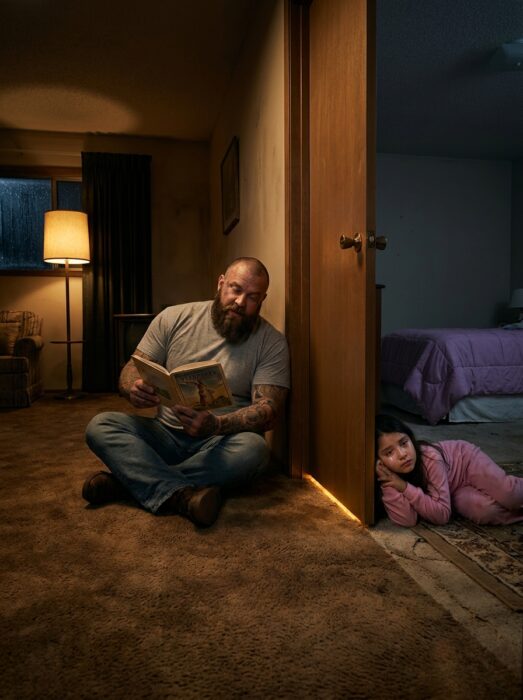
She was twelve years old. She was small for her age — the medical file said malnutrition during the first three years of her life had affected her growth, and she had stayed small. She had dark brown hair she cut herself with kitchen scissors when she was upset, which made it uneven in the back. She had brown eyes that did not look at adults if she could help it. She was Latina on her mother’s side, white on her father’s side, and she had been told different things about both of them by different caseworkers over nine years.
What I knew, from her file, was that her biological mother had lost custody when Aviana was three. That her biological father had never been in the picture. That her first foster placement had been with a great-aunt who died when Aviana was five. That the second through eighth placements had all ended in different ways — one couple divorced, one foster mother got cancer, one home was closed after another foster child reported abuse, one placement had ended because Aviana herself had asked to be removed.
The intake form for placement nine — the Reinhardt home — had a single line at the bottom in red, in Aviana’s own handwriting, that I had asked her to fill in.
It said: I dont talk to grown ups anymore. Please dont make me.
I had passed that note to Axel and Maria the week before, with the rest of her file.
Maria had cried, reading it. Axel had read it twice, folded it in half, and slid it into the inside pocket of his cut without a word.
The day I drove Aviana to their house, she sat in my passenger seat with her duffel bag at her feet and her arms wrapped around herself. She had not eaten in eight hours. I had bought her a McDonald’s chicken nugget meal at the drive-through and she had not touched it.
I rang the doorbell at 2:14 p.m. on a Sunday afternoon.
Maria opened the door. She did not bend down to Aviana. She did not say hi sweetheart. She did not try to hug her. She had clearly been coached — by me, by a previous social worker, possibly by Axel — that none of those things were what this 12-year-old needed.
What Maria did was hold the door open and say, in a normal adult voice: “Aviana, I’m Maria. This is our house. Your room is the second door on the right. Bathroom is across the hall. Dinner is at six. You don’t have to come if you don’t want to. I’ll save you a plate.”
She stepped back. She did not block the doorway. She did not stand too close.
Aviana walked past her without making eye contact. She went down the hallway. She went into the second door on the right. She closed it.
I heard the click of a lock.
Axel was standing at the back of the entryway in a clean t-shirt — not his cut, not his work shirt, just a clean grey t-shirt — and a pair of jeans and his tattoos and his beard. He had not moved when Aviana walked past him. He had not spoken. He had simply nodded at me, once, and then looked toward the closed bedroom door.
He said, very quietly: “Maria. We do it the way we said.”
Maria nodded.
I left at 2:38 p.m. That night, at 8:30, Axel sat down on the living room carpet six feet from a closed bedroom door with a copy of Charlotte’s Web, opened it to chapter one, and started reading.
Maria called me three days later to tell me what he was doing. She said it like a confession. She said: “I think my husband has lost his mind. But I also think it’s working.”
I told her not to interrupt.
I noticed, on the third home visit, that Axel had a small hardcover green book in the inside pocket of his cut, where Aviana’s note had been folded. I could see the corner of it sticking out.
It was old. The corners were soft from years of being held.
I did not ask. He did not offer.
It would be six months before I knew what it was.
Night twenty-two was a Tuesday in early October.
It had been raining for three days. Boulder gets that kind of rain in fall — slow, steady, cold — and the house was quiet in the way old houses are quiet on rainy nights, with the gutters running and the furnace clicking on and off.
Aviana had not eaten dinner with them in twenty-two nights. Maria had set a plate at the table every single night anyway. Axel had eaten his dinner at the table, in his clean grey t-shirt, talking to Maria about her shift, talking about the diesel job he was working on — talking, deliberately, the way two adults talk in a normal house with a normal kid in the next room.
The kitchen was directly next to Aviana’s bedroom. The wall was thin. She heard everything.
By night twenty-two, Maria had figured out — by the sound of small footsteps after they cleared the table — that Aviana was coming out of her room every night around 9 p.m., when she thought they were both in bed, to take whatever Maria had left on the counter for her. A plate covered with foil. A glass of milk. Sometimes a small wrapped sandwich.
She would take it back to her room. Eat alone. Wash her own dish in the bathroom sink and put it back on the kitchen counter at 4 a.m.
Maria had not mentioned this to Aviana. She had just kept making dinner for three.
On night twenty-two, Axel had started reading The Velveteen Rabbit. It was a thin book. He was halfway through it when the rain picked up outside.
I know all this because Axel told me later, sitting on his back porch, holding a coffee mug that said World’s Okayest Dad that Maria had bought him as a joke six years before they ever became foster parents.
He said: “I got to the part where the boy gets sick, ma’am. And the rabbit’s got to be burned. And the kid behind the door — I heard her. I heard her crying.”
He paused. He looked at his coffee.
“Not loud. Quiet. Trying to hide it.”
He kept reading. He did not stop. He did not knock. He did not call out.
He read all the way to the end of the book. The Velveteen Rabbit takes about twenty-three minutes to read out loud.
When he finished, he closed the book. He sat on the carpet in the silence. The rain was loud on the roof.
Then, very softly, he heard the click of a lock.
The bedroom door opened.
He did not turn around. He did not look up. He stayed exactly where he was, cross-legged on the carpet, with the closed book in his lap.
She walked out, in her socks, in pajamas Maria had bought her that she had not worn before that night. She walked across the living room. She sat down on the carpet beside him — not touching him, six inches of space between them, but on his side now, not on the other side of the wall.
She did not say anything.
He did not say anything.
He picked up the next book in the stack — Maria had organized them in a small basket — James and the Giant Peach. He opened it to chapter one.
He read for forty-five more minutes.
Aviana sat there the entire time. She did not move. She did not speak. When he reached the end of chapter four, he closed the book. He stood up — slowly, the way you stand up around a deer at a waterhole — and walked into the kitchen.
He did not say goodnight.
She walked back to her bedroom. She closed the door. She did not lock it.
That was the thing he told me on the porch with shaking hands.
“Ma’am, she didn’t lock the door.”
I have been a caseworker for sixteen years. I have heard about a thousand small breakthroughs. I have never heard a man describe one with the kind of reverence Axel Reinhardt used for the absence of the click of a lock.
I thought, that night, that this was the climax. That the months ahead would be slow gentle progress. Aviana sitting on the carpet. Aviana sitting on the couch. Aviana eating at the table. The story neatly bending toward ordinary family life.
I was wrong about what the story was.
The real climax was six months and one courtroom away.
On the second Tuesday of April — six months and twelve days after Aviana first walked into that house — we had a hearing in front of Judge Patricia Yamamoto in Boulder County family court.
The hearing was about whether to extend the foster placement, terminate parental rights of the biological mother (who had not contacted the system in two years), and begin formal proceedings toward adoption.
I was there. Maria was there in a soft blue dress. Axel was there in a clean dark button-down shirt with his cut folded neatly in his lap because the bailiff had told him he could not wear it in the gallery. His tattoos were covered. His beard was trimmed. He had bought a new pair of boots for the hearing, and they squeaked when he walked.
Aviana was there. Twelve years and seven months old now. She had grown two inches in six months. Her hair had been cut by Maria and was even in the back. She was wearing a green dress with small white flowers on it. She was holding a small stuffed pig she had named Wilbur, after the pig in the first book Axel had read to her through the door.
Judge Yamamoto is a small Japanese-American woman in her sixties with steel-grey hair and the gentlest voice I have ever heard from a bench. She had reviewed the file. She had seen the home reports. She had read the recommendations from both me and the GAL.
She looked at Aviana over her reading glasses. She said, in her quiet voice:
“Aviana, I want to ask you a question. I want you to know you don’t have to answer it if you don’t want to. There is no wrong answer. Do you understand?”
Aviana nodded.
“Sweetheart, do you want to keep living with the Reinhardts?”
Aviana looked at the stuffed pig in her lap. She looked at Maria in the gallery. She looked at Axel, who was sitting beside Maria, who was, by then, already trying not to cry and failing.
Then she looked at the judge.
She said, very clearly, in a voice that filled the courtroom:
“Yes, ma’am. Because Mr. Axel reads books out loud every night. And he never makes me listen. He just reads. And I get to choose. And nobody ever let me choose anything before.”
The courtroom went completely still.
Judge Yamamoto did not move. She set down her pen.
She looked at Axel.
Axel was twenty rows back in the gallery, two-hundred-and-twenty pounds, in a button-down shirt, with his folded leather cut on his lap. He had his enormous tattooed hands pressed flat over his face. His shoulders were shaking. He was not making a sound, but he was crying — the kind of crying a man does when something has been waiting forty years to come out of him.
The judge waited. The bailiff did not move. Maria put one small hand on Axel’s back and left it there.
After a full minute, Axel lowered his hands.
Judge Yamamoto said, very gently: “Mr. Reinhardt. Is there something you would like to add?”
Axel’s voice came out broken. He stood up in the gallery, the way a man stands up at his own wedding.
He said: “Your honor. Ma’am. I don’t know how to be a dad. I never had one. I been in eleven homes by the time I was seventeen. Not one of them ever read me a book. Not one.”
He took the small green hardcover book out of the inside pocket of his folded cut. He held it up.
It was The Velveteen Rabbit.
“Except for one teacher, ma’am. Fifth grade. Mrs. Cole. Cottonwood Elementary, in Pueblo, Colorado. She read this book to her class out loud, twenty minutes a day, the whole spring semester of 1989. I was ten years old. I was in the seventh foster home by then. And I sat in the back of that classroom, and I listened, and I did not say one word.”
He looked at the book.
“She let me keep it at the end of the year, your honor. It’s the only thing I own from being a kid.”
He looked at Aviana, then.
“I don’t know how to be a dad, your honor. I just know how to read out loud. And how to hope.”
The seeds were everywhere. I just had not put them together.
The F-O-S-T-E-R tattooed across the knuckles of Axel’s right hand, in faded blue prison-style ink. I had thought, the first time I met him, that it was a club thing. A patch reference. A motorcycle club nickname.
It was not. He had tattooed it himself, with a sewing needle and ballpoint pen ink, in the bedroom of the eleventh foster home, the night before he aged out of the system at seventeen. He told me later it was a reminder. Foster. That he had been one. That he was not going to forget what it was like.
He had spent the next twenty-eight years working as a diesel mechanic, riding with the Front Range Brotherhood MC, marrying Maria, building a life — and the entire time, the word had been on his right hand, where he could see it every time he held a wrench.
The small green hardcover book of The Velveteen Rabbit in his cut. It had been there for thirty-five years. He had carried it through three motorcycles, two arrests, a bar fight in Colorado Springs that had nearly killed him in 2002, and his entire marriage. Maria had told me, on the porch the day after the hearing, that she had found it once when they were dating, asked him about it, and he had said just an old book and put it back in the cut, and she had not asked again.
She had not, until that morning in court, known what was inside it.
There was an inscription on the inside cover, in a careful schoolteacher’s hand from 1989. It said: To Axel — Real isn’t how you are made. It’s a thing that happens to you. — Mrs. Cole, May 1989.
The line was from the book itself. It was the line about love. About becoming real.
Axel had been carrying it on his chest for thirty-five years.
The reason he had read out loud at full volume to a closed bedroom door for twenty-two nights — the reason he had refused to knock, to ask, to push — was that he had been the kid behind the door once. Eleven different doors, in eleven different houses, between the ages of five and seventeen. He knew, the way only a former foster kid can know, that what Aviana needed was not adult interest. Not adult attention. Not adult help.
What she needed was a choice.
She needed to be able to choose, for the first time in her short life, to come out of a room. To sit on a carpet. To listen to a story. To trust an adult.
Axel had given her exactly that, by giving her absolutely nothing else.
He had read the books at full volume because he wanted her to be able to hear. He had sat six feet from the door because he did not want to crowd her. He had not addressed her, not knocked, not invited — because every adult in her life had addressed her, knocked, invited, and every single one of those adults had eventually disappeared.
He had been, for twenty-two nights, the first adult who had not asked her for anything.
That, in the end, had been the only thing she had ever needed.
That was eighteen months ago.
The adoption was finalized in November of last year. Aviana Marie Reinhardt is fourteen years old now. She is in eighth grade at Casey Middle School in Boulder. She got straight A’s last semester, except in Spanish, which she is failing on purpose because she thinks the teacher is unfair.
She still has Wilbur. He sits on her bed in her own room — not on the floor, not in a sheet, but in the actual bed Maria bought her with the purple comforter, which she now sleeps in like a normal child.
The reading has not stopped.
Every night at 8:30, Axel sits down on the living room carpet — even now, even with two normal couches in that room — opens a book, and reads out loud. They are well past children’s books now. They have read To Kill a Mockingbird and The Outsiders and A Tree Grows in Brooklyn and The Hate U Give. Last month they started East of Eden. Aviana has informed Axel, with the particular dignity of a fourteen-year-old, that they are going to take East of Eden slow because it is important.
She does not sit on the carpet anymore. She sits on the couch. Maria sits next to her with knitting. Sometimes the dog — they got a dog last summer, a 60-pound mutt named Charlotte — sleeps across both their laps.
Axel still reads at slightly-too-loud volume. He does not notice he is doing it. Aviana has stopped correcting him.
The small green hardcover Velveteen Rabbit now lives on Aviana’s bookshelf, on the top shelf, where she can see it from her bed.
She reads it every year on the night before her birthday. Out loud. To herself.
I drove past the Reinhardts’ house last week on my way to another placement. Their porch light was on.
Through the front window, I could see the silhouette of a 220-pound bald man on the carpet with a book in his hands, mouth moving, and a 14-year-old girl on the couch behind him with a dog asleep across her legs.
I did not stop. Some scenes you don’t interrupt.
A man who had never been read to was reading.
A girl who had never been chosen had chosen.
That’s how it works.
❤️ If this story moved you, please follow our page for more real stories about the men everyone misjudges and the children who finally find a home that doesn’t end. We post a new one every week.