A Biker Parked in the Same Walmart Handicap Space Every Morning for a Year—Then I Saw Who Arrived Thirty Seconds Later
Part 2
I am Melissa Grant, the woman who slapped Wade Callahan’s motorcycle seat.
That detail stayed with the story after my post spread. People called my confrontation brave, rude, understandable and unnecessary, often within the same thread.
Wade called it Tuesday.
He did not embarrass me after Arthur entered the store. He could have shown me the disability plate, described his injuries or asked why I believed his body owed me visible proof.
He did none of that.
Instead, he moved his coffee from one hand to the other and asked whether I wanted to sit down.
I declined because shame makes people insist they are fine.
The parking lot was slick from overnight rain. Wade leaned against the Harley, taking pressure off his right leg. Once I knew to look, the pain became obvious.
His hip remained slightly turned. He placed most of his weight through the left boot. When he stepped across a painted line, his right foot dragged for half an inch.
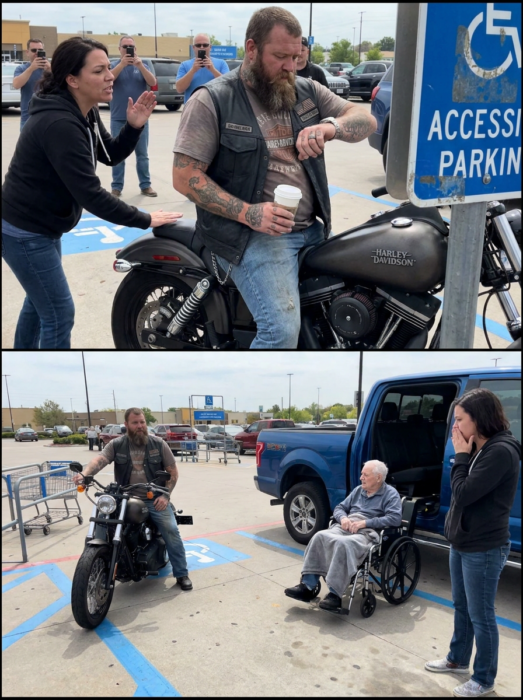
I had interpreted endurance as health.
Wade had been parking there legally.
The disability plate had been issued after his highway collision. Medical records later described pelvic fractures, nerve damage and chronic weakness. He could ride because the motorcycle had been modified and because riding required a different range of motion than walking.
Bodies are not courtroom exhibits.
The fact that Wade could stand did not prove he could cross a large parking lot without pain.
I apologized.
He shrugged.
“You were protecting somebody who isn’t here anymore.”
The accuracy of that sentence unsettled me. My father had died eighteen months earlier. Since then, every illegally occupied accessible space felt like a personal insult delivered after he could no longer receive it.
I asked how Wade knew.
He nodded at my car.
A folded wheelchair ramp remained attached near the rear door even though I had not removed it after Dad’s death.
Wade noticed.
That was the contradiction at the center of him. He looked like a man who ignored everyone, yet he saw details most of us passed without registering.
Arthur returned from the store twenty minutes later with groceries balanced across his lap. Wade loaded the bags into the blue pickup without asking.
Arthur handed him a coffee.
They spoke about weather, road salt and the price of canned peaches.
Nothing in their conversation suggested a hidden history.
Before leaving, Arthur pointed at me.
“She the parking police?”
Wade answered, “Volunteer division.”
Arthur laughed.
I deserved it.
After the truck left, I asked Wade when the ritual began.
A year earlier, he had stopped at Walmart for chain lubricant and saw Arthur pushing his wheelchair from the distant edge of the lot. Rainwater collected in shallow depressions, and the chair’s small front wheels repeatedly caught.
Wade offered help.
Arthur refused.
“I can push my own chair.”
Wade watched him reach the entrance after nearly ten minutes.
The following week, Wade saw him fall.
Arthur’s front caster struck broken pavement. The chair stopped, but his body continued forward. He caught himself with both hands, injuring one shoulder.
Two shoppers helped him back into the seat.
An illegally parked sedan occupied the nearest accessible space. No placard. No disability plate. Its driver emerged from the store carrying cigarettes and apologized by saying he had been inside only briefly.
Wade memorized Arthur’s arrival time.
The next morning, he parked his Harley in the closest space at eight. Because Wade possessed a valid disability plate, he was entitled to use it.
At 9:15, Arthur’s blue pickup turned into the lot.
Wade moved.
He repeated the process the following day.
Then the next.
At first, Arthur assumed coincidence. After several weeks, he understood that Wade was holding the space but did not know why.
“You don’t have to do this,” Arthur told him.
“I’m already here.”
That was not entirely true.
Wade worked as the night dispatcher for a towing company and finished at seven. Instead of riding home to sleep, he bought coffee and waited in the Walmart lot.
He completed paperwork from his phone. Sometimes he dozed against the handlebars. In winter, he waited inside an old pickup while another club member parked a licensed motorcycle in the space under Wade’s disability registration and remained with it.
The club rotated only when weather made the Harley unsafe.
Their rule was simple: the space stayed legally occupied, and it became available when Arthur arrived.
The brotherhood knew Wade was helping a veteran.
They did not know the reason.
When I asked Wade whether Arthur had saved him, he touched the saddlebag.
Inside was a folded copy of the highway incident report, a newspaper clipping about Arthur’s later accident and the remains of a bloodstained shirt sealed in plastic.
Arthur had left the shirt with paramedics.
Wade had kept it for five years.
He still had not told the man who once wore it.
Part 3
Wade’s crash occurred on a windy October afternoon five years earlier.
He was riding north on Interstate 65 after delivering a repaired generator control panel. Traffic moved slowly near a construction merge. A box truck entered his lane without seeing the Harley.
Wade struck the truck’s side and then the concrete median.
His motorcycle broke beneath him.
A metal bracket cut deeply into his upper thigh. His pelvis fractured when he hit the pavement, and the rear tire of the truck passed close enough to tear his boot.
Arthur Boone was driving two vehicles behind.
He had retired from the Army after serving as a combat medic and later worked as a warehouse safety coordinator. When he saw Wade slide, he pulled onto the shoulder, activated his hazard lights and ran back.
The traffic had not fully stopped.
Arthur stepped between lanes anyway.
He found Wade conscious but disoriented, attempting to stand despite the pelvic injury. Blood had soaked his jeans and pooled near the barrier.
Arthur removed his overshirt, folded it and pressed it against the wound. He instructed another driver to call 911 and asked a third to warn traffic.
Wade tried to push him away.
“My bike.”
Arthur leaned harder on the wound.
“Bike’s not bleeding.”
Those were the first words Wade remembered clearly.
For eleven minutes, Arthur maintained pressure and kept Wade talking. He asked his name, whether he could breathe and whether he knew where he was.
Wade remembered Arthur’s broken nose, faded medic tattoo and voice.
He did not remember answering.
Paramedics arrived and replaced the shirt with medical dressings. Arthur gave a statement to state police, then left before Wade entered surgery.
Doctors told Wade the pressure likely reduced blood loss enough to matter. He spent weeks hospitalized and months in rehabilitation.
He asked for the person who helped.
The incident report listed Arthur Boone—first aid rendered prior to EMS arrival.
Wade found a disconnected phone number and an outdated address. A thank-you letter returned unopened.
Life moved.
A year later, a local news story reported that Arthur had lost both legs in an industrial loading accident. A trailer shifted during unloading, pinning him before coworkers could activate emergency equipment.
Wade recognized the name and face.
He attended a public fundraiser but remained near the back. Arthur sat beneath fluorescent lights while strangers thanked him for military service, asked intrusive questions and called him inspirational.
Wade left without speaking.
“I watched him get turned into a lesson for everybody in the room,” Wade told me. “Didn’t want to add another debt.”
He donated anonymously to the rehabilitation fund.
Arthur later moved into an accessible apartment near Bowling Green and regained independence. He drove an adapted pickup, cooked for himself and refused assistance until circumstances made refusal impractical.
The Walmart parking lot became one of those circumstances.
Its nearest accessible spaces remained crowded during morning shopping. Some vehicles displayed valid permits. Others did not. Enforcement relied on police availability and reports from staff or customers.
Arthur complained once.
Management placed warning signs.
The problem returned.
He began parking in the outer lot to avoid circling. On dry days, he managed. In rain or heat, the two-hundred-yard trip became difficult. The pavement sloped toward drainage grates and contained cracks that caught the wheelchair’s casters.
The first fall bruised his elbow.
The second injured his shoulder.
That was when Wade intervened.
For a year, the ritual worked imperfectly. Some shoppers still parked illegally in other spaces. Wade could protect only one.
His club suggested occupying all unauthorized spaces with licensed riders.
Wade refused.
“We’re not the law.”
A store employee suggested photographing violators for social media.
Wade refused again.
Public shaming could misidentify people with invisible disabilities, just as I had misjudged him.
His solution remained narrow.
Hold one space.
Move at 9:15.
Drink coffee.
Then I confronted him, and the story escaped the boundaries he had carefully maintained.
I posted that evening.
I wrote about my anger, his silence, Arthur’s arrival and the interstate rescue. I did not use Arthur’s surname until Wade confirmed he had spoken with him.
That confirmation did not happen.
I had made another assumption.
Wade had told me the history privately. He had not given permission for it to become public.
I deleted the post after twenty minutes.
It was too late.
Someone had copied it.
By midnight, local pages were sharing the story of the biker who guarded a handicap space for the veteran who saved him.
Arthur’s daughter saw it.
She called her father.
The next morning, Arthur arrived at Walmart ten minutes early.
Wade was waiting.
So was I.
Arthur rolled down from the truck lift holding a printed copy of the accident report.
He stopped in front of Wade.
“You the rider under the box truck?”
Wade looked at me first.
I wanted the wet pavement to open beneath me.
Then he looked at Arthur.
“Yeah.”
Arthur studied his face, searching through five years of blood, helmets and highway noise.
“I asked your name.”
“Didn’t answer right.”
“You kept saying something about the bike.”
“Sounds like me.”
Arthur held up the report.
“You sat here a year because I put pressure on a wound?”
Wade shifted weight from his damaged leg.
“You ran into traffic.”
“That was stupid.”
“Worked.”
Arthur’s mouth tightened.
He was not grateful.
He was angry.
And for the first time, Wade’s quiet repayment had created a debt Arthur never asked to receive.
Part 4
Arthur told Wade to stop holding the space.
Not politely.
“I didn’t help you so you could waste a year sitting in a parking lot.”
Wade’s expression hardened.
“Wasn’t wasted.”
“You finish work at seven.”
“So?”
“You need sleep.”
“I sleep later.”
Arthur struck one wheel rim with his palm.
“I am not your assignment.”
The word hit Wade.
He had spent a year believing silence preserved Arthur’s dignity. Arthur heard something different: a man organizing his life around a debt Arthur did not remember creating.
I stood between them without belonging there.
The entire situation had become public because I needed strangers to validate my change of heart. The original post praised Wade, but praise can expose people as surely as criticism.
I apologized to both men.
Arthur turned toward me.
“You tell everybody I’m helpless?”
“No.”
“You told them I fell.”
“I did.”
He rolled away.
Wade watched him enter the store without following.
The closest space remained empty.
For the first time in a year, their ritual had failed even though the space was available.
Wade left before Arthur returned.
That afternoon, I visited the store manager, Patricia Owens. I showed her the photographs I had taken over the previous month of vehicles parked without visible permits, blocking access aisles or stopping across curb ramps.
Patricia did not defend the problem.
She explained the limits. Store employees could request compliance, but they could not determine whether a permit was fraudulent from appearance. Towing required procedures, and police responses varied with more urgent calls.
Still, the store had options it had not used consistently.
Patricia reviewed security footage. It confirmed the morning pattern and documented repeat unauthorized vehicles.
She contacted the city accessibility coordinator and local police.
They organized a two-week enforcement campaign focused on plates, permits and access aisles—not on judging drivers by how they walked. Officers issued citations where legally justified. The store added clearer signs stating that unauthorized vehicles could be cited or towed.
Camera coverage shifted toward the accessible area.
An ADA parking assessment found the lot technically met the minimum requirement based on its size, but morning demand regularly exceeded capacity. Walmart management approved six additional accessible spaces near the entrances, including van-accessible aisles.
The changes did not happen because a viral post magically transformed a corporation.
They happened because Arthur, Wade, store employees, disability advocates and city officials documented a repeated problem and followed it through meetings most people would never watch.
Arthur attended the first meeting.
Wade did not.
Arthur asked for smoother pavement routes, better drainage near curb cuts and enforcement that did not harass people with invisible disabilities.
He specifically mentioned Wade.
“The big fool looks healthy,” Arthur said. “He isn’t.”
That sentence reached Wade through Patricia.
The next morning, Wade returned at eight.
He did not park in the accessible space.
He chose an ordinary space near the cart return and leaned against the Harley with coffee. The closest blue space remained open.
At 9:10, a sedan without a permit pulled into it.
Wade did nothing.
He had promised Arthur he would stop acting as guard.
At 9:15, Arthur’s pickup arrived.
The sedan remained.
Arthur parked farther away.
Wade’s hands closed around the coffee cup.
This was the brotherhood’s hardest test because several club members were watching from across the lot. They wanted to confront the driver.
Wade ordered them to stay back.
Arthur lowered from his lift and began pushing across the lot.
Halfway, the sedan’s driver returned carrying a television mount. He saw Arthur, looked at the accessible sign and understood.
“I was only inside five minutes,” he said.
Arthur continued rolling.
Wade’s jaw worked.
He did not move.
Then the driver called Arthur a name.
Wade took one step.
Arthur raised a hand without turning.
Wade stopped.
Store security arrived, documented the plate and requested police response. The driver left before officers arrived, but management issued a trespass warning when he returned days later.
Arthur reached the entrance under his own power.
Wade remained near the motorcycle.
It looked like he had done nothing.
In reality, he had allowed Arthur to choose how the situation would be handled.
Later that morning, Arthur rolled back outside with two coffees.
He handed one to Wade.
“I don’t need a bodyguard.”
“Got it.”
“I might need somebody to complain with.”
Wade accepted the cup.
“Can do that.”
That was the beginning of their friendship.
Not the rescue.
Not the guarded parking space.
The argument after the secret became public.
Part 5
The accessible-parking changes took three months.
New pavement markings appeared first. Then cameras were adjusted, signs replaced and six additional spaces created after construction work modified the curb approach.
One access aisle had previously drained toward a low spot. The store resurfaced it.
Arthur tested the slope in his wheelchair before the contractor finished.
He rejected the first attempt.
“Water’ll sit there.”
The contractor checked.
Arthur was right.
They corrected it.
Wade attended the final inspection, but he stayed near the back. His own leg hurt badly that morning, and the irony was not lost on anyone.
Patricia offered him a chair.
He refused.
Arthur rolled beside him.
“Sit down before I run you over.”
Wade sat.
The viral story continued spreading. People praised his year-long routine and criticized me for confronting him. Others defended me because accessible-parking abuse is common.
Wade rejected both simplified versions.
“She was wrong about me,” he said. “She wasn’t wrong about the problem.”
That sentence became the center of the follow-up I eventually wrote—with permission from Wade and Arthur.
I described Wade’s valid disability plate. I explained that invisible disabilities do not require public proof. I also explained that valid users sometimes protect one another because enforcement systems fail.
The post reached more people than my first one.
Comments included veterans, wheelchair users, parents of disabled children and people living with chronic pain. Many described being accused of fraud because they could stand, walk briefly or drive motorcycles.
Arthur read some of them.
He disliked the praise directed at him.
“I used a shirt,” he said. “Paramedics did the work.”
Wade answered, “Bike wasn’t bleeding.”
Arthur stared at him.
Then he laughed because he finally remembered saying it.
That memory changed something.
Arthur began recalling the crash in pieces: Wade’s torn helmet, one boot missing and a hand repeatedly reaching toward the destroyed Harley.
“You asked if the bike was okay six times.”
“Was it?”
“No.”
“Bad day.”
Arthur remembered Wade’s eyes but not his face. Blood and dirt had covered much of it, and Wade’s beard had been shorter.
The accident report connected the rest.
Wade returned Arthur’s sealed overshirt.
Arthur held the plastic bag for a long time.
“I wondered where this went.”
“Ambulance gave it to me.”
“You kept a bloody shirt five years?”
“Wasn’t mine.”
“That makes it stranger.”
Arthur took the bag home.
A week later, he returned with the shirt washed and repaired. The original stain had not disappeared completely. A darker shadow remained in the fabric.
He folded it across Wade’s motorcycle seat.
“You keep it.”
Wade shook his head.
Arthur insisted.
“Use it to wipe the chrome.”
Wade looked horrified.
Arthur smiled.
“Now we’re even.”
They were not even.
That was the point.
Friendship began when they stopped counting.
Wade no longer arrived at eight to guard the space. He slept after his night shift and returned at 9:15, when Arthur came for groceries.
Sometimes Arthur parked in the closest space.
Sometimes another permitted driver needed it first, and Arthur used one of the six new spaces.
Wade parked in ordinary motorcycle parking unless his leg required otherwise. On severe-pain mornings, he used an accessible space without apology.
Nobody at the store questioned him now.
That created an unexpected problem.
People recognized Wade from the story and assumed every large tattooed rider with an accessible permit deserved special trust. Wade corrected them.
“Check the plate, not the beard.”
The store’s enforcement policy followed the same principle.
Visible permits and plates were verified. Access aisles remained clear. Employees did not demand medical histories or decide who looked disabled enough.
The cameras documented violations rather than bodies.
City police conducted periodic patrols and issued substantial statutory citations when evidence supported them. Repeat offenders faced towing or trespass action under store policy.
Accessible parking became available more consistently.
Not perfectly.
No parking lot becomes fair because of one story.
But Arthur stopped calculating whether his shoulders could survive two hundred yards before buying groceries.
That mattered.
The person most changed by the story may have been me.
I had inherited my father’s anger without his patience. He used to tell me that disability was not a costume and access was not a reward for looking sick.
I thought I understood.
Then I judged Wade by the exact standard my father warned against.
I visited Dad’s grave and told him what happened, though speaking to granite felt foolish.
The next morning, I found Wade at Walmart.
I apologized again.
He handed me a coffee.
“You planning to hit the bike?”
“No.”
“Then we’re improving.”
Arthur arrived and parked beside us.
For the first time, all three of us laughed without anyone being corrected.
Part 6
The morning coffee continued.
At 9:15, Wade arrived from home instead of his night shift. Arthur rolled down from the truck lift. I joined them on Tuesdays when work allowed.
Nobody guarded a parking space anymore.
The store provided a small bench near the covered entrance after Patricia noticed Wade struggled to stand still. Arthur complained that the bench was installed crooked.
It was level.
He complained anyway.
The Black River Saints began volunteering with a local adaptive-driving program. Their mechanics helped with nonmedical vehicle maintenance, battery checks and lift inspections under qualified supervision.
Wade insisted the club not turn Arthur into its poster veteran.
Arthur agreed to participate only if he could insult everyone equally.
He excelled.
Once a month, riders met wheelchair users in the store lot to identify access problems from seated height. They discovered cart corrals, snow piles and delivery pallets often blocked routes despite spaces remaining technically open.
A painted symbol alone was not enough.
The route had to work.
Wade’s own condition worsened during winter. Nerve pain increased, and he occasionally used a cane.
Arthur never offered sympathy.
He held the automatic door and said, “Move faster.”
Wade answered, “Trying.”
That was the kind of assistance both men accepted.
The old accident shirt eventually returned to Arthur. He cut a small square from an undamaged section and stitched it inside Wade’s leather vest.
Not where anyone could see.
When I asked why, Arthur said, “He likes carrying old things.”
Wade pretended not to hear.
The blue parking space nearest the entrance remained only a parking space. Other permitted drivers used it. Sometimes it sat empty.
Wade no longer needed to control who arrived next.
The system had finally begun doing what one injured biker had tried to accomplish with coffee, a motorcycle and seventy-five minutes of stubbornness.
Part 7
Two years after my confrontation, Wade and Arthur still meet at 9:15.
The time survived even after the reason disappeared.
Wade drinks black coffee. Arthur adds enough sugar to alarm his cardiologist. They sit on the bench near the grocery entrance and criticize passing motorcycles, truck tires and shopping-cart alignment.
I occasionally bring pastries.
Arthur claims they are too dry and eats two.
The six additional accessible spaces remain near the entrance. Camera coverage includes the access aisles. Signs direct customers to report misuse without confronting drivers or evaluating disabilities by appearance.
Citations still occur.
So do mistakes.
But Arthur has not been forced to cross from the far edge of the lot in more than a year.
Wade’s Harley still carries its disability plate. He uses accessible parking when pain requires it. On easier days, he chooses ordinary motorcycle spaces.
He owes nobody an explanation.
The sealed accident report remains in his saddlebag. Inside his vest rests the small piece of Arthur’s repaired shirt.
Arthur knows now.
That did not end the ritual.
It made the coffee honest.
Sometimes strangers recognize them and request photographs. Wade refuses. Arthur occasionally agrees if they donate to the adaptive-driving program.
One morning, a woman confronted a young driver who stepped from a car displaying a disability permit. Wade approached before the argument escalated.
He did not defend the driver’s medical eligibility because he did not know it.
He pointed at the valid permit.
“That’s what you check.”
The woman backed away.
Wade returned to the bench.
Arthur handed him coffee.
Five years before the parking ritual began, Arthur ran into highway traffic and removed his shirt for a stranger bleeding beneath a truck.
He did not ask whether the biker deserved saving.
One year later, Wade saw Arthur fighting two hundred yards of broken pavement and answered in the only quiet way he understood.
He held a space.
Then the space brought them together.
At 9:15 each morning, the blue pickup and black Harley still arrive from opposite ends of the lot.
Neither man waits alone anymore.
Now they save each other a coffee.
Follow our page for more unforgettable biker stories about invisible wounds, misunderstood kindness and the quiet ways rough-looking strangers remember those who once stopped to help.