A Biker Deliberately Crashed His $40,000 Harley Into a Stranger’s Moving Minivan—Then Everyone Saw What Was Strapped Inside
Part 2
My name is Rachel Bell, and until September 17, I thought seizures announced themselves.
My older sister had epilepsy as a teenager. She described lights around objects, numb fingertips and a few seconds of warning. When I experienced my first seizure at thirty-two, there was no useful warning—only the metallic taste, the caught zipper and a missing stretch of time in which my daughter rolled toward a lake without me.
We lived outside Ashford, Missouri, where Willow Bend Reservoir occupied an old limestone quarry west of town. The marina road crossed a ridge before dropping toward the public launch. Locals knew the hill. Visitors often did not.

That Tuesday was warm for September, but a cold front had darkened the water and pushed paper cups across the overlook lot. Nora and I had stopped because she was restless after a pediatric appointment. I planned to let her eat crackers at a picnic table before driving home.
I left her buckled because I only needed the diaper bag.
The sheriff’s mechanical inspection later found no defect in the minivan’s brakes. The gear selector had not fully entered Park. It was an older vehicle without an automatic Park function when the driver’s door opened.
That mattered because some people initially blamed the manufacturer.
Others blamed me.
Both reactions arrived before I could stand without assistance.
I spent one night in the hospital. Doctors believed dehydration and an undiagnosed neurological condition had lowered my seizure threshold. They suspended my driving privileges, started medication and scheduled further tests.
Nora was evaluated in the same emergency department. Her safety seat was replaced because any seat involved in a collision is treated as compromised. Other than mild harness redness, she had no injury.
Caleb Maddox was not so fortunate.
His left forearm had fractures in two places. A plate and seven screws stabilized the bone. His shoulder was reduced under sedation, and doctors kept him overnight because cracked ribs can hide breathing complications.
I first saw him the following afternoon.
Bear filled the hospital doorway despite wearing a thin blue gown and an immobilizer. His shaved head showed a line of staples above his ear. Tattoos disappeared beneath bandages, and his beard still held tiny silver flecks from the shattered Harley.
My husband, Daniel, stepped between him and Nora.
Daniel knew the man had saved her, but gratitude does not instantly erase the protective response triggered by seeing an injured stranger enter your child’s room.
Bear stopped.
“Fair enough,” he said.
He placed Nora’s stuffed rabbit on the visitor chair. A deputy had found it beneath the minivan’s second-row seat. One ear was marked with grease from Bear’s glove.
“I figured she’d want this.”
Nora reached for it.
That was our first meeting.
Bear asked whether she had been hurt. When we said no, his shoulders lowered slightly. Then he looked at me.
“I’m sorry I hit your van so hard.”
The absurdity of that apology almost made me laugh. Instead, I began crying, which embarrassed both of us.
“You saved her.”
He looked away. “Bike did most of it.”
Only later did I understand that sentence.
Bear owned Maddox Steel and Recovery, a welding and towing shop behind a truck stop on Highway 36. He had ridden motorcycles since his teens and belonged to a twelve-member club called the Black River Milemen.
The Milemen were not criminals, though some members carried old convictions and none worked hard to appear harmless. They escorted funeral processions, repaired veterans’ wheelchair ramps and sometimes settled clubhouse arguments with language that emptied nearby restaurant booths.
Bear had started the club’s tradition of paying for infant safety seats after one member’s granddaughter survived a rollover. Every December, they delivered new seats to the county health office without photographs or club banners.
That detail did not appear in early news reports.
The reports focused on the forty-thousand-dollar motorcycle.
A claims adjuster valued the customized Road Glide at $39,870 before the collision. Its paint was deep black with a narrow copper line along the tank. The seat had been hand-stitched. Small scratches on the right saddlebag had been deliberately preserved instead of repaired.
The motorcycle was registered to Caleb.
But it had belonged to his son.
Evan Maddox bought it at twenty-six after finishing a five-year apprenticeship as an industrial electrician. Bear had criticized the price, helped negotiate the financing and then spent three weekends installing parts Evan had ordered anyway.
Their relationship had not been simple.
Bear’s wife, Colleen, died from an aneurysm when Evan was fourteen. Bear responded by working longer hours and speaking less. Evan responded by becoming louder, faster and harder to reach.
They loved each other through machinery because engines gave them a language grief could not interrupt.
Evan died at twenty-eight when a utility truck crossed the center line during heavy rain. He was driving home from a night shift in his pickup. The Harley remained locked in his garage.
After the funeral, Bear brought it home on a trailer.
He cleaned it.
Covered it.
And could not ride it.
The club’s mechanic, Luis Ortega, kept the battery charged. Once a month Bear started the engine with the garage door open, listening until the motor reached temperature. Neighbors said the sound lasted eleven minutes, never twelve.
On the first anniversary of Evan’s death, Bear finally rode the Harley.
He followed the route Evan used on Sunday mornings, ending at Willow Bend. Then he parked it again for a year.
The second anniversary was the day he met us.
And by the time Daniel and I learned what the motorcycle meant, an insurance company had already declared it a total loss fit only for salvage.
Part 3
Bear remembered seeing my minivan near the top of Mariner Hill Road because the rear hatch was raised.
He also remembered seeing me fall.
At first, he assumed I had tripped. He slowed the Harley and looked toward the lot, but then the minivan began moving backward. Its driver’s door remained open, grazing a wooden trash enclosure before swinging partly closed.
The first person to react was a fisherman named Pete Harmon.
Pete dropped his cooler, ran beside the van and caught the door handle. For three steps, he stayed with it. Then the grade increased, and his boots slipped on loose gravel.
He let go before the rear tire could pull him under.
“Child!” Bear heard him shout.
Bear accelerated alongside the passenger side. Through the rear glass, he saw Nora’s safety seat, but because it faced backward, he could not immediately see whether it was occupied.
Then Nora lifted her rabbit.
That small movement decided everything that followed.
Bear rode ahead and looked for an obstacle capable of stopping the van. The lower parking area held two pickups, but both were occupied and moving away. Landscaping stones were too low. A light pole stood beyond the van’s current path, but striking it head-on could collapse the front of the vehicle and still leave it rolling toward the water.
The boat ramp offered no barrier.
Only water.
Bear tried the driver’s door first. He brought the Harley close enough that his left highway peg scraped the minivan’s rocker panel. With one hand on his handlebars, he reached across with the other.
The door swung outward.
He caught its upper frame for half a second, but the van drifted right. His front tire touched the curb, and the Harley bucked beneath him. If he held on, he would fall between the vehicles.
He released it.
A phone video captured Bear pulling ahead and looking back. That was the moment many viewers later interpreted as hesitation.
It was calculation.
He had welded enough damaged vehicles to understand angles. A direct rear impact would add speed. Hitting the driver’s side could rotate the van toward the ramp. Striking the passenger side behind the front wheel might turn its nose across the slope and force the tires into the softer grass.
The Harley was not large enough to stop the minivan.
It might be heavy enough to change where it stopped.
Bear backed off approximately forty feet. Witnesses heard the engine climb. Several believed he had panicked and twisted the throttle by mistake.
Pete shouted for him not to do it.
Bear did it.
The front wheel struck behind the minivan’s passenger tire. The motorcycle folded sideways, but its momentum pivoted the van just enough. Instead of following the road toward the ramp, the minivan climbed over the drainage curb and entered the grass at an angle.
Bear separated from the motorcycle.
His shoulder struck first. Then his helmet. He rolled twice and stopped near a storm drain while pieces of chrome scattered across the road.
The minivan continued.
Its open door tore through a low hedge. One rear tire sank into soft ground where marina workers had repaired an irrigation pipe. The added resistance rotated the vehicle again.
It stopped sideways.
Four meters from the embankment.
For a few seconds, nobody moved. The Harley’s damaged engine continued running, producing a harsh metallic knock. Steam rose from the minivan’s front corner, and its horn sounded continuously because the impact had jammed the steering wheel.
Then everyone shouted at once.
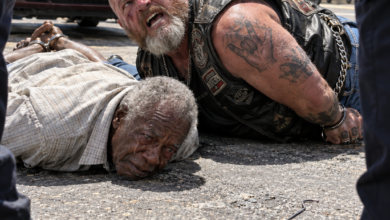
Pete and another man ran toward Bear. They had seen an intentional collision but not the child. When Bear tried to rise, they pushed him down, fearing he was intoxicated or disoriented.
His left arm folded beneath him.
He made a sound Pete later described as “one breath being torn in half.” Then he used his right arm to roll toward the van.
“Baby in back,” he said.
Pete did not understand.
Bear struck the pavement with his fist.
“There’s a baby in that van.”
They released him.
Bear got one boot beneath him, stood for less than a second and collapsed. He began crawling. His leather vest scraped the road, leaving black marks behind him.
The motorcycle lay six feet away.
He never turned toward it.
At the minivan, marina employee Dana Wilkes reached the passenger door but found it locked. Bear told her to use the broken front window, but the glass had cracked without opening. Pete retrieved a small rescue hammer from the marina store and broke the passenger window while another bystander covered the opening with a jacket.
Bear directed them toward the child-lock release.
His voice remained steady even though his face had gone gray.
“Don’t pull the seat yet,” he said. “Unclip the base. Keep her strapped.”
The advice came from the club’s car-seat donation program. Bear had attended installation training two years earlier because the county nurse refused to accept seats without someone learning how to use them.
The seed nobody noticed had become the instruction that brought Nora out safely.
Dana climbed through and released the seat base. She passed the entire carrier through the side door to Pete. Nora screamed when strangers lifted her, but she remained secure.
Bear touched two fingers to her shoe.
Then he asked where her mother was.
People had been so focused on the moving van that nobody had checked uphill. The raised rear hatch was still visible above the hedge. A woman ran toward it and found me on the pavement, still convulsing.
The 911 call changed from collision to two simultaneous medical emergencies.
An off-duty respiratory therapist protected my airway until paramedics arrived. Another bystander moved Nora into the marina store, away from leaking fluids and shattered glass. Bear remained on the road because every attempt to stand increased the pain in his ribs.
A deputy asked whether he had been drinking.
“No.”
“Medication?”
“No.”
“Why did you ram the vehicle?”
Bear looked toward the marina store.
“Couldn’t catch it.”
The deputy followed his gaze and saw Nora through the window.
That was the moment the crowd’s understanding shifted. Phones lowered. Pete removed his cap and apologized for pinning Bear to the ground.
Bear did not answer.
He was staring at the Harley.
The motorcycle’s tank had torn partly free. The copper pinstripe was crushed inward, and fuel dripped into the gutter. The custom front wheel had split. Evan’s right saddlebag lay open, its contents scattered across the road.
Among them was a funeral card.
A Polaroid photograph of Bear and Evan beside the same motorcycle had landed faceup in a shallow puddle. The image showed Evan laughing, one hand covering the camera because he apparently had not wanted the picture taken.
Bear tried to crawl toward it.
His injured arm failed.
Pete retrieved the photograph and placed it inside Bear’s vest.
That small act broke something the impact had not.
Bear closed his eyes.
“Not today,” he whispered.
Nobody understood what he meant until Luis Ortega arrived from the club and saw the date on the deputy’s report.
September 17.
Luis looked at the motorcycle. Then at Bear.
“Oh, brother,” he said.
It was Evan’s anniversary ride.
Part 4
I learned about the date from Daniel while doctors were examining Nora.
Daniel had gone to the crash site to retrieve my purse and speak with deputies. He returned carrying the stuffed rabbit, my medication bottle and an expression I had never seen on him.
“The bike belonged to his son,” he said.
At first, I assumed he meant Bear had borrowed it.
Daniel shook his head. “His son died two years ago. Today’s the day.”
The room seemed to narrow around Nora’s hospital bed.
Until that moment, I had understood Bear’s act as a financial sacrifice. Enormous, yes—but measurable. An insurer could assign a value. Parts could be ordered. Money could change hands.
Grief does not use those numbers.
Bear’s motorcycle was moved from the road by his own towing company because he refused to let a salvage contractor handle it. Luis loaded the pieces individually. The bent fuel tank received two straps even though it could not roll or fall.
Deputies found the folded funeral card inside a waterproof pouch. The photograph survived because Pete had recovered it quickly.
The keychain marked EVAN was scratched but intact.
At the hospital, Bear asked a nurse to place all three items in the cabinet beside his bed. He would not take pain medication until someone confirmed the motorcycle had reached his shop.
That stubbornness caused an argument with Luis.
“It’s metal,” Luis told him. “You’re breathing. Take the damn medication.”
Bear stared at the wall.
“It was his.”
Luis lowered his voice. “And you used it the way he would’ve.”
Bear did not answer.
The club learned the full story over the next day. Some members called the collision the only possible choice. One, a mechanic named Ray, asked whether Bear could have laid the bike down in front of the van instead of striking it.
Bear reacted badly.
“You think I had a committee meeting?”
The room went quiet.
Bear apologized ten minutes later, but the question remained because trauma makes people search for alternate endings. If there had been a safer option, perhaps Evan’s motorcycle could have survived. Perhaps Bear could have avoided surgery. Perhaps no one needed to lose anything.
The sheriff’s reconstruction closed that door.
Based on slope, vehicle weight, tire marks and security footage, investigators estimated the minivan would have reached the water in five to seven seconds. Laying the Harley down would likely have allowed the van’s tires to climb over it. A rear impact would not have changed the direction enough.
Bear’s angled collision created the only significant lateral force available.
It did not guarantee safety.
It merely changed the odds.
The soft irrigation trench played a role. So did Nora’s properly installed safety seat. So did Pete’s rescue hammer, Dana’s decision to remove the entire carrier and the respiratory therapist who reached me.
Bear rejected any version that turned him into the only rescuer.
“Whole bunch of people finished it,” he said. “I just moved the van.”
But he had moved it at a cost the report could not calculate.
The insurance policy presented another complication. Evan’s motorcycle had comprehensive coverage, but Bear had listed an annual mileage estimate far below the actual figure after transferring the title. The company did not accuse him of fraud, yet the custom work required documentation, and several receipts remained in Evan’s name.
The adjuster eventually offered $31,600 after deductibles and depreciation.
Bear refused the payment.
He believed accepting it would require surrendering the wreck to the insurer. The tank, engine casing and frame section carrying Evan’s engraved initials would be sold as salvage.
The adjuster offered to let him buy the remains back.
Bear still refused.
“He doesn’t want money,” Luis explained to us. “He wants the pieces.”
That was when Daniel and I tried to intervene.
We had limited savings, a mortgage and medical bills already arriving. Still, the motorcycle had been lost because of our family. Daniel suggested a fundraiser. My parents offered to refinance a small rental property. A local dealership proposed donating a replacement Harley.
Bear rejected all three.
“You can’t replace somebody else’s miles,” he said.
The dealership owner pushed. “Then let us build a tribute.”
Bear’s jaw tightened.
“No tribute bike.”
The word tribute made the machine sound finished, as though Evan had become a theme for paint and chrome. Bear did not want a display piece. He wanted his son’s motorcycle, damaged truth and all.
The Black River Milemen gathered in Bear’s shop on the Sunday after his surgery. They spread every recoverable component across two long worktables.
The frame was bent beyond safe repair. The forks were destroyed. The front wheel had split, and the right-side engine case was cracked.
Ray, the mechanic who had questioned Bear’s decision, examined the wreck for three hours. He removed his glasses, wiped them with his shirt and said the sentence everyone had been avoiding.
“We can’t rebuild this bike.”
Bear nodded once.
Then Ray placed his palm on the dented tank.
“But we might build from it.”
The proposal divided the club. Some argued that using a replacement frame and engine would create a different motorcycle. Others believed refusing to rebuild would turn Evan’s last machine into boxes of damaged parts.
Bear ended the argument.
“Keep the tank,” he said. “Keep his initials. Use whatever’s safe.”
Luis asked what they should do with the large dent created when the tank struck the minivan.
Bear looked at Nora’s greasy stuffed rabbit on the office shelf. We had given it to him after buying her an identical replacement, believing he might want the object connected to the rescue.
“Leave it.”
The dent would remain.
Not hidden.
Not polished away.
The damage was now part of the motorcycle’s history.
Part 5
The rebuild took eleven months.
The Milemen worked after closing time on Tuesdays and Sundays. They located a compatible frame with a clean title, rebuilt a used engine and transferred every safe piece from Evan’s motorcycle.
Nobody accepted wages.
A retired painter recreated the black finish and copper pinstripe. When he reached the fuel tank, Bear stopped him from filling the crushed section.
The painter sealed the bare metal against rust and shaped the copper line around the dent. From one angle, it looked like the stripe had been forced to change direction and continued anyway.
The broken EVAN keychain was embedded beneath the clear coat on the tank’s left side. It remained small enough that most people would miss it.
Bear wanted it that way.
My family participated only where he allowed us. Daniel organized meals for the mechanics. I kept a record of donated parts because Bear’s insurance and the replacement-frame paperwork required accurate receipts.
Nora visited the shop twice.
The first time, she was frightened by the grinder noise and hid behind Daniel’s leg. Bear immediately shut the entire bay down. Twelve bikers stood motionless while a two-year-old decided whether they were safe.
Bear crouched despite the stiffness in his repaired arm.
Nora stared at his beard, then offered him the clean replacement rabbit.
Bear accepted it with both hands.
The second visit came near Christmas. She walked directly to the motorcycle and touched the tank’s sealed dent.
“Car boo-boo,” she said.
Bear nodded. “Big one.”
“Bear fix?”
“Trying.”
The words circulated through the shop for months. Whenever a bolt seized or a part failed to align, Luis would say, “Bear fix?” and the men would return to work.
Meanwhile, my own recovery moved less visibly.
Medication controlled the seizures, but state law and my neurologist required a seizure-free period before I could drive again. Daniel changed shifts to handle daycare. My mother stayed three nights each week.
I became afraid of parked vehicles.
I checked the transmission four or five times, pulled the parking brake until my wrist hurt and refused to sit in a car facing downhill. If Nora made a sound from the back seat, I sometimes had to stop and breathe.
Bear understood without my explaining.
Two years after Evan’s death, he still opened the garage expecting to see his son bent over a workbench. He knew that survival did not remove the moment before it.
“You keep trying to prevent the same thing,” he told me. “Even when it can’t happen the same way.”
That was the longest statement about grief I ever heard from him.
Seven months after the crash, I discovered I was pregnant.
The news frightened me more than it pleased me. My medication had to be reviewed, my neurologist coordinated with an obstetrician, and Daniel worried that sleep loss might increase seizure risk.
Bear drove me to one appointment when Daniel’s truck failed.
He did not offer advice. He waited in the parking garage with a paper cup of bad coffee and held the elevator when I returned.
The baby was a boy.
Daniel and I discussed names for weeks. We did not want to turn our child into repayment, and we knew using Evan’s name without permission could feel like taking part of a family history that was not ours.
So we asked.
Bear was tightening a bolt on the rebuilt Harley when Daniel said, “We’re thinking about Samuel Evan Bell.”
The wrench stopped.
Bear did not look up.
“You don’t owe me that.”
“We know.”
“You sure?”
I said, “Nora has a brother because she came home that day. We want him to carry the name, but only if it doesn’t hurt you.”
Bear set down the wrench.
“It’ll hurt,” he said.
My stomach tightened.
Then he looked at us.
“Doesn’t mean don’t do it.”
Samuel Evan Bell was born healthy the following February. Bear waited outside the room with the Milemen because he considered himself neither family nor entitled to enter.
Daniel brought him in.
Bear held Samuel awkwardly against his uninjured side, although his arm had healed months earlier. He looked at the baby’s hospital bracelet.
SAMUEL E. BELL.
His thumb covered every letter except the E.
“Hey, little man,” he whispered.
Samuel opened his eyes, sneezed and grabbed one strand of Bear’s beard.
Bear laughed.
It was the first sound our children heard from him that contained no grief behind it.
The Harley was completed three months later. The state inspection confirmed that the replacement frame, brakes and safety equipment met road requirements. The title listed the motorcycle as reconstructed.
Bear disliked that word.
Luis did not.
“That’s what all of us are,” he said.
On the first test ride, Bear traveled only around the industrial block. The dented tank reflected broken pieces of sky. The engine note was not identical to Evan’s old one, and Bear knew it.
He returned to the shop and shut it off.
The club waited.
Bear removed his helmet.
“She’s different.”
Nobody argued.
Then he looked at the tank.
“But she remembers.”
The rebuilt motorcycle’s first long ride was scheduled for September 17.
The third anniversary.
Bear planned to ride alone.
The club had other ideas.
Part 6
At seven that morning, Bear opened his garage and found eleven motorcycles waiting on the street.
No banners. No cameras. No matching memorial shirts.
Just the Milemen.
Ray carried coffee. Luis held the stuffed rabbit with the grease mark on its ear. They had attached it temporarily behind the rebuilt Harley’s windshield, where Bear could see it but road wind could not take it.
Bear looked irritated.
“You boys lost?”
Luis started his engine.
The others followed.
The V-twins settled into a low, uneven rumble that reached our house three blocks away. Daniel, Nora, Samuel and I were already waiting beside the driveway because Luis had warned us.
Bear led the group along Evan’s old route.
They passed the industrial plant where Evan had completed his apprenticeship, the diner where father and son argued over pancakes and the gas station where Evan once called Bear at midnight because he had forgotten his wallet.
Then they climbed Mariner Hill Road.
The marina had installed wheel stops, additional warning signs and a guardrail near the embankment. The irrigation trench that helped stop my minivan had been filled and reseeded.
Nothing about the place looked dramatic.
That made it harder.
Bear stopped where the impact occurred. He set the Harley on its stand and walked to the grass. His repaired arm still did not straighten completely.
Nora carried a small bunch of grocery-store daisies. She placed them beside the road, then touched the dented fuel tank.
“Bear fixed,” she said.
She was nearly four and remembered none of the crash. She knew only the story we had told her carefully: the van moved, Bear helped and many people brought everyone home.
Bear knelt.
“Club fixed,” he corrected.
Nora shook her head. “Everybody fixed.”
That answer silenced twelve men.
We ate lunch at the marina picnic tables. Bear did not stay apart as he had the previous year. He held Samuel while Daniel cut sandwiches and showed Nora how to skip flat stones from the safe side of the shore.
Before leaving, I asked what he believed Evan would say about the rebuilt bike.
Bear considered the question.
“He’d complain about the engine.”
I laughed.
Then Bear added, “After that, he’d ask if the little girl was okay.”
Nora was chasing bubbles near the picnic table. Samuel slept against Bear’s vest, one hand resting over the pocket containing Evan’s funeral card.
Bear looked from one child to the other.
“He’d be good with the trade.”
The rebuilt Harley started on the second attempt. Its rumble crossed the water while the dented copper stripe caught the flat afternoon light.
Every September 17 afterward, Bear rode to our house before visiting the reservoir.
He no longer made the anniversary journey alone.
Part 7
Five years have passed since the minivan rolled down Mariner Hill Road.
Nora is seven now. She knows Bear wrecked a motorcycle to save her, but she does not yet understand what that motorcycle carried before the collision. Someday she will.
Samuel Evan is four. He calls Bear “Uncle Bear” and believes the dent in the Harley’s tank was made by a giant.
Bear has not corrected him.
The photograph of Bear and Evan still travels in the saddlebag. The funeral card remains sealed in its pouch, and the EVAN keychain lies beneath the tank’s clear coat.
The grease-marked rabbit rides behind the windshield every September.
My seizures remain controlled. I drive again, though I still engage the parking brake on level ground. The minivan was repaired and later sold. I could never trust its silence after that day.
Bear never accepted repayment.
Instead, he asked Daniel and me to help the Milemen expand their safety-seat program. Each year, the club buys seats for families referred by the county health office. Bear teaches installation using the same large hands that once frightened everyone at the marina.
He always checks the harness twice.
At Willow Bend, the guardrail carries no plaque. Bear refused one. He did not want a roadside monument marking the place where my daughter nearly died or where Evan’s Harley was destroyed.
The evidence rides with him.
Every anniversary, the reconstructed motorcycle turns into our driveway shortly after eight. Nora runs outside first. Samuel follows, shouting his own middle name as though it belongs to both him and the machine.
Bear drinks coffee on our porch. He rarely talks about the collision. Before leaving, he lets the children place one hand each on the dented tank.
Then he rides toward the reservoir.
The black paint shines. The engine carries a different note. The copper line bends around the scar without ending.
Bear once told me he had only one thing heavy enough to redirect my minivan.
He was wrong.
He also carried a father’s willingness to lose the last thing he could touch so another parent would not lose her child.
When I reminded him of that, he shook his head.
“Evan would’ve made the same call.”
Then he lowered his visor and rode away, the rabbit trembling behind the windshield and two children waving from our driveway.
The dent always comes back home.
Follow our page for more unforgettable biker stories about misunderstood choices, quiet sacrifices, and the rough-looking strangers who arrive when one impossible decision remains.