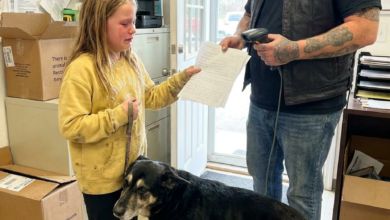
A Biker Cut a Blind Woman’s Guide Dog Loose on Route 66—Then the Dog Ran Toward the One Person She Couldn’t Hear Leaving
The biker cut my guide dog’s lead in the middle of a crowded Route 66 sidewalk, and the last sound I heard before strangers grabbed him was my daughter screaming as the dog ran away from me.
I am blind.
That matters because everyone else saw what happened before I understood it.
My name is Elena Carter, and the golden retriever at my left side was Nora, the guide dog who had given me back grocery stores, school pickups, unfamiliar sidewalks, and the ordinary dignity of choosing where my own feet went. Her harness was not a convenience. It was the line through which she told me about curbs, doorways, stairs, branches, and the thousand silent obstacles sighted people never have to name.
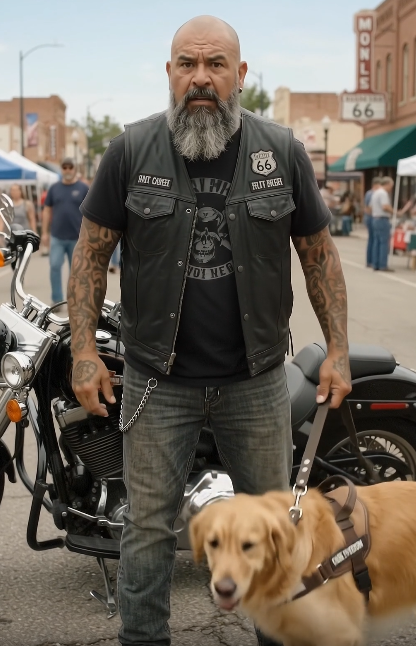
The man who cut it looked like the kind of stranger mothers warn children about.
Gabriel “Brick” Torres was a forty-eight-year-old Latino American biker, six-foot-four and nearly three hundred pounds, with a shaved head, a thick salt-and-pepper beard, tattooed arms, scarred knuckles, heavy motorcycle boots, faded jeans, and a black leather vest that creaked when he moved.
His Harley idled beside Miller’s Diner.
I knew none of that then.
I knew only the low pulse of the engine, my six-year-old daughter Sophie humming beside me, and Nora’s leather lead resting securely in my hand.
We were waiting near the corner of Second Street in Santa Rosa, New Mexico, during the annual Route 66 Family Festival. Music played from storefront speakers. Vendors shouted over one another. Children dragged balloons through the crowd. The air smelled of roasted corn, hot asphalt, gasoline, and rain that had not yet fallen.
Sophie let go of my coat.
I did not feel it.
A parade drum covered the sound of her shoes moving away. Her silver pinwheel slipped from her hand, rolled off the curb, and stopped beyond the painted line where a delivery van was slowly turning into the side street.
Nora noticed.
She refused my command to move forward.
Then she twisted hard inside her harness.
I thought she had been startled by the motorcycle.
Gabriel saw everything.
He saw Sophie step down from the curb. He saw Nora turn toward her instead of guiding me ahead. He saw the lead pulled tight between a trained dog trying to reach a child and a blind mother who did not know her daughter had moved.
He shouted something.
I could not hear him over the drums.
Then metal snapped near my hand.
The tension vanished.
Nora ran.
I screamed her name.
Someone yelled that the biker had cut a blind woman’s guide dog loose. Two men seized Gabriel against the diner wall. A woman wrapped both arms around me while I fought to understand where Nora had gone and why Sophie was crying from somewhere ahead.
Gabriel did not struggle with the men holding him.
He pointed toward the street.
“Watch the dog!”
Nora reached Sophie before the van did.
She moved across my daughter’s path, pressed her body against Sophie’s legs, and guided her backward onto the curb. The van stopped several yards away after a festival marshal raised both arms.
Nobody was struck.
Nobody fell.
For several seconds, however, the crowd continued blaming Gabriel because outrage had already chosen its direction.
Then Nora returned.
Her nails clicked across the pavement. Sophie’s small fingers were tangled in the dog’s harness handle. Nora placed my daughter against my knees before pressing her nose into my shaking hand.
Only then did I realize the biker had not set my guide dog free from me.
He had set her free to reach my child.
The cut lead fell near Gabriel’s boots. When police released him, he picked up both pieces, examined the worn stitching near the clasp, and asked me a question no one else had thought to ask:
“What happens next time they need opposite directions?”
Three weeks later, Gabriel returned carrying a handmade double lead built with my mobility instructor, Nora’s trainer, and a child-safety specialist. But stitched beneath its leather handle was a name that revealed why he had been watching Sophie so closely before she ever stepped off that curb.
People often describe blindness as darkness.
That has never been accurate for me.
I lost most of my vision at twenty-nine after an autoimmune illness damaged both optic nerves. Light remained, along with vague contrast and the occasional moving shape, but faces disappeared first. Printed words followed. Curbs became guesses. Every glass door looked like open air until it proved otherwise.
The worst part was not darkness.
It was dependence arriving in places where I had once moved without thought.
My husband, Daniel, tried to help. He read labels, drove me to appointments, and walked half a step ahead while pretending not to guide me. Yet every kindness carried fear beneath it. We had a two-year-old daughter. Daniel worried that my changing vision made me unsafe around stairs, traffic, hot stoves, playground gates, and every other object parents spend their lives imagining as danger.
Then Daniel died.
A drunk driver crossed the center line on Interstate 40. Sophie was four. I was thirty-three and still learning to use a white cane without apologizing when it struck someone’s shoe.
Family offered to take us in.
I refused.
Not because I was brave.
Because being blind had already taken enough decisions from me.
Nora entered our lives eighteen months later. She came from a guide-dog program in Arizona, trained in obstacle avoidance, traffic awareness, curb work, and intelligent disobedience—the skill that allows a guide dog to refuse a handler’s command when moving would be unsafe.
She was calm, serious, and unimpressed by my anxiety.
Our first solo route together was three blocks from the training center to a coffee shop. I cried when we reached the door, not because the journey was dramatic, but because nobody had held my elbow.
Nora gave me movement without making me feel managed.
Sophie loved her in a different way. To me, Nora was a working partner. To Sophie, she was warmth on the kitchen floor, soft ears beneath the breakfast table, and a patient audience for stories involving dragons who preferred peanut butter.
We had rules.
No petting in harness.
No feeding from the table.
No calling Nora away while she worked.
Sophie followed most of them.
The harder rule was staying connected to me in crowds. At six, she wanted to walk independently. I needed reliable contact because a child’s footsteps could disappear beneath traffic, music, or conversation.
We tried holding hands.
That worked until she needed both hands for a drink or backpack.
We tried a child wrist link.
Sophie hated it and called it a baby bracelet.
We tried attaching a small bell to her backpack. In busy places, the sound vanished among keys, carts, dishes, and other children.
Our mobility instructor, Linda Park, suggested a structured family-orientation plan: Sophie would hold a fabric loop attached to my belt while Nora worked on my left. It gave us three points—dog, mother, child—but only if Sophie kept hold of the loop.
At the festival, she did not.
Gabriel Torres noticed us fifteen minutes before the incident.
He sat outside Miller’s Diner with three members of the Desert Lantern Riders. Their Harleys stood along the curb, engines off then, chrome cooling beneath the New Mexico sun.
According to Gabriel, Nora caught his attention first.
His late younger sister, Marisol, had used a guide dog.
Marisol lost her vision in a workplace chemical accident at twenty-six. Gabriel became the older brother who attended every appointment whether invited or not. He read about blindness, installed rails she did not request, and tried to rearrange her apartment until she threatened to strike him with her cane.
“You keep turning my home into your fear,” she told him.
That sentence changed him.
He learned to ask before helping.
Marisol later received a guide dog named Juniper. Gabriel understood the harness rules, the difference between a guide dog and a pet, and why nobody should interfere with the working team.
He also understood intelligent disobedience.
Juniper once refused to guide Marisol across a parking-lot exit because an electric car was approaching silently. Gabriel had laughed afterward and called the dog stubborn.
Marisol corrected him.
“Stubborn is refusing without reason. She saw what I couldn’t.”
Gabriel remembered that when Nora stopped at the festival curb.
His own past complicated the memory.
At thirty-one, Gabriel had served three years in prison for auto theft. He did not hide it. Addiction and debt pulled him into a chop-shop operation, and he kept working after understanding exactly what it was.
Prison ended the operation.
It did not fix him.
Marisol did that slowly, with boundaries harder than any cell door. She refused to lend money, refused his excuses, and offered rides only to treatment, work, or their mother’s house.
Gabriel became sober.
He learned leatherwork in a vocational program and later opened Torres Saddlery and Cycle on old Route 66. He made motorcycle seats, tool rolls, riding gloves, and custom straps for adaptive equipment.
The Desert Lantern Riders gave him a probationary patch after he spent two years repairing bikes for charity rides without asking to join. Brotherhood did not erase his past. It gave him people who expected more from his future.
Marisol died from an infection eight years before the festival.
Juniper retired with Gabriel.
On the dog’s final day, Gabriel removed the harness and let her run across Marisol’s backyard. He kept the old leather handle above his workbench.
That was why he watched Nora.
He noticed the harness angle change when Sophie released my coat.
He noticed the dog’s head turn toward the curb.
He noticed my hand continue forward because I believed Nora was preparing to guide me.
And he noticed something everyone else missed.
The small connecting strap between Nora’s harness handle and working lead had begun to fray.
Not enough to fail that afternoon.
Enough to inspire the question he asked later.
What happens when one dog must choose between two people moving in opposite directions?
Gabriel did not have an answer.
Then Sophie’s pinwheel rolled into the street.
Nora decided before any human did.
The festival crossing was managed, but not closed.
Vehicles were allowed through slowly when marshals signaled. The delivery van that afternoon was moving below the posted festival limit. Its driver was not reckless. He entered the turn after receiving a wave from a volunteer who had not seen Sophie step away from me.
That distinction mattered later.
In the moment, all I heard was noise.
A drumline approached from the west. A vendor rang a brass bell near the diner. People shouted greetings. Nora’s harness shifted against my hand.
“Forward,” I told her.
She refused.
“Forward, Nora.”
Her body turned sharply right.
That was wrong for our route. I corrected my position and repeated the command. Nora pulled harder. The leather lead went tight enough to press against my palm.
I thought the motorcycle engine had startled her because one Harley had started beside the diner.
Gabriel understood the dog was not trying to flee.
She was trying to reach something.
He followed her line of attention and saw Sophie beyond the curb.
My daughter was not standing in the center of the road. She had taken only two small steps off the sidewalk, reaching toward the fallen pinwheel. Yet the van’s wide turn would cross that space within seconds.
Gabriel shouted, “Let the dog go!”
The drums swallowed his voice.
He ran toward us.
From the crowd’s perspective, a giant tattooed biker charged a blind woman and her guide dog. A festival volunteer stepped between us. Gabriel moved around him. Another man grabbed his vest.
Nora lunged again.
I held the lead because every part of my training said never release my working dog in a crowded street.
Gabriel saw the contradiction.
Nora needed freedom.
I needed connection.
There was no time to explain.
A leatherworker carries cutting tools. Gabriel had a small strap cutter clipped to his belt for trimming cord and emergency material. He drew it, hooked the stretched secondary lead, and cut once.
The sound was small.
The absence of tension was enormous.
Nora ran.
I lost the harness handle and shouted her name.
Two bystanders tackled Gabriel against the diner wall. His shoulder struck brick. The tool fell and slid beneath a table.
“Watch the dog!” he yelled.
A woman named Carla Ruiz caught me before I stumbled from the curb. She told me Nora was in the street. I tried to move toward her, but Carla held my shoulders and said Sophie’s name.
I stopped fighting.
“Where is she?”
Carla did not answer quickly enough.
That silence emptied me.
Nora crossed behind the festival marshal and reached Sophie from the side. She did not jump, bite clothing, or drag her. She performed a body block similar to one she had practiced around unexpected obstacles during training.
Her shoulder pressed against Sophie’s knees.
Sophie stepped backward.
Nora turned with her.
The van driver saw the dog’s golden coat and stopped several yards away. Brakes hissed. The marshal raised both arms. Nobody was struck.
The danger passed.
The misunderstanding did not.
The men restraining Gabriel forced his hands behind him. Someone accused him of trying to steal Nora. Another shouted that he had endangered a disabled woman. Phones appeared instantly.
Gabriel did not defend himself.
He continued pointing toward Sophie.
Nora guided my daughter back by remaining between her and the curb. Sophie found the harness handle and followed it, crying. When they reached me, Nora pressed her nose into my palm.
I touched Sophie’s hair.
Then her face.
Then both shoulders.
My knees gave way.
We sat on the sidewalk together, Nora wedged between us.
The crowd finally understood enough to release Gabriel.
He remained against the wall, breathing heavily. One cheek had scraped brick. His vest hung crooked where a seam had torn.
A police officer arrived and collected the cutter.
The officer asked whether Gabriel had deliberately severed a guide-dog lead.
“Yes,” he said.
The crowd murmured again.
The officer asked why.
Gabriel pointed toward Sophie.
“Dog knew.”
That was all.
The van driver gave a statement. The marshal admitted he had not seen Sophie. Several videos showed Nora pulling toward the child before Gabriel moved.
Still, people debated whether he should have acted. A guide dog is protected and highly trained. Interfering with one can create serious danger. Cutting equipment without the handler’s consent was an extreme decision.
I agreed.
I was also holding my living daughter.
Both truths remained.
When the officer returned the two pieces of lead, Gabriel asked permission to examine them. I nearly refused. Then I remembered his question.
What happens next time?
He traced the leather with his thumb.
“Strap was wearing near the stitch line,” he said.
“It passed inspection last month.”
“Not blaming you.”
“It sounds like you are.”
“No.”
His voice softened.
“Blaming the design.”
Nora stood between us, calm now. Gabriel did not touch her. He spoke my name after Carla told it to him and described exactly where he stood.
“Elena, I’m six feet in front of you. Hands down. Cutter’s with the officer.”
That detail mattered.
He gave me space inside a crowd that had forgotten I needed information, not grabbing.
I asked how he knew Nora wanted Sophie.
“My sister had a guide dog.”
“Where is she?”
“Gone.”
The word carried weight.
Then Sophie spoke.
“Mr. Biker?”
Gabriel crouched but stayed back.
“Yeah?”
“Why did you break Nora?”
He looked at the severed lead.
“I didn’t break her.”
He paused.
“I trusted her.”
That should have been the ending.
A biker acted. A dog reached a child. Everyone went home.
Instead, the video spread online with the first ten seconds removed. It began when Gabriel drew the cutter. Thousands of strangers saw a tattooed man sever a blind woman’s guide-dog lead and watched two bystanders restrain him.
They did not see Sophie.
They did not see Nora’s refusal.
By morning, Gabriel’s shop windows were covered in accusations.
And the Desert Lantern Riders had to decide whether protecting their club’s reputation mattered more than standing beside a brother whose most important action looked indefensible without the missing seconds.
The first viral clip lasted nineteen seconds.
Its caption read:
BIKER ATTACKS BLIND WOMAN’S SERVICE DOG AT FAMILY FESTIVAL.
The camera angle showed my white cane, Nora’s harness, Gabriel’s cutter, and the lead falling loose. It showed men grabbing him. It ended before Nora reached Sophie.
By midnight, the clip had more than two million views.
Gabriel received threats.
His shop lost appointments. A nonprofit canceled an order for adaptive motorcycle seats. The Desert Lantern Riders’ social page filled with accusations that the club protected dangerous men.
Club president Samuel “Hawk” Bell called an emergency meeting.
Several riders wanted Gabriel’s patch suspended until investigators completed their review. Denny Cross argued that the club had worked years to earn trust from veterans’ groups and disability organizations. One unexplained video could destroy those relationships.
Gabriel removed his vest.
He placed it on the warehouse table.
“If it helps, take it.”
Hawk did not touch it.
“Did you have another choice?”
“Probably.”
“What?”
“Didn’t find it in time.”
That was Gabriel’s answer to most questions.
He refused to make himself heroic. He had used a tool near a working dog and a blind stranger without consent. He understood why people reacted.
He also knew waiting would have prevented Nora from reaching Sophie.
The club voted not to suspend him.
Two members resigned.
Brotherhood cost something.
The full video appeared the next afternoon. Carla Ruiz had filmed from across the street. Her recording began before Sophie left my side and continued until the van stopped.
She sent it to police.
Then to me.
I could not watch it, so Linda, my mobility instructor, described every frame. She told me when Sophie released my coat, when Nora turned, when Gabriel pointed, and when the van entered.
“What do you see in Nora?” I asked.
Linda paused.
“Decision.”
That word settled the argument for me.
I recorded an audio statement.
“My guide dog was not stolen, attacked, or deliberately endangered. Nora identified that my daughter had moved into an unsafe area. Mr. Torres cut a secondary lead after warning us and after Nora repeatedly attempted to reach Sophie. His action allowed Nora to perform the response that brought my daughter back to the curb.”
I did not call him a hero.
I added that nobody should imitate the action casually, interfere with guide dogs, or treat mobility equipment as optional. This had been a rare emergency witnessed in seconds, not a general example of how strangers should help blind people.
The statement spread with the full video.
Public anger reversed almost as quickly as it began.
That made me uneasy.
Yesterday’s monster became today’s savior because the crowd discovered one additional angle. Gabriel remained the same complicated man in both stories. The internet simply changed costumes around him.
Reporters arrived at his shop.
He locked the door.
I visited three days later with Sophie, Nora, and Linda.
The shop smelled of leather, motor oil, coffee, and cedar shavings. Wind chimes made from old motorcycle keys hung near the entrance. Gabriel announced himself from across the room before approaching.
“Ten feet ahead. Behind the workbench.”
He had remembered.
Nora guided me to a chair. Sophie stayed close enough that her sleeve touched mine.
Gabriel placed the cut lead on the table.
He had not repaired it.
Instead, he had mapped its points of tension with raised tape markers Linda could explain to me by touch. The lead connected me to Nora’s working harness, but Sophie’s loop connected only to my belt. If Sophie released it while Nora needed to guide me elsewhere, the dog had no independent physical channel to reach her without pulling me along.
Linda warned that guide-dog equipment could not simply be redesigned by a leatherworker.
Gabriel nodded. “That’s why you’re here.”
He proposed no device.
He asked questions.
How much tension could the harness accept without confusing Nora’s cues? Where could a child link attach without compromising the dog’s movement? Should it connect to me rather than Nora? What quick-release features were required? Would Sophie tolerate a waist belt better than a wrist strap? How could tactile markers allow me to confirm both connections?
Linda contacted Nora’s program.
The program’s equipment specialist joined by video.
A child-safety occupational therapist named Dr. Priya Shah visited the following week. She rejected Gabriel’s first three sketches.
The first risked twisting the guide handle.
The second could tangle near my legs.
The third transferred too much force through Sophie’s backpack.
Gabriel tore each drawing in half.
No ego.
Just paper.
The final concept was not truly a double guide-dog leash. That phrase became the shorthand Sophie used. Technically, it was an independent dual-connection family mobility system.
Nora’s certified harness and working lead remained unchanged.
A separate soft leather belt fit around my waist. One short tactile loop linked my hand to Sophie’s side connection when she walked beside me. A second lightweight safety line attached between our belts using approved breakaway hardware, preventing accidental separation without pulling Nora or interfering with her work.
Gabriel added a third feature.
A small sliding leather tab shaped like a heart rested beneath my thumb. When both family connections were secure, the tab aligned with a raised stitch. I could verify by touch that Sophie remained linked without asking every thirty seconds.
The outside looked simple.
The inside carried months of consultation.
But the hidden name beneath the handle had nothing to do with engineering.
During our fourth workshop, I touched a line of tiny stamped letters.
MARISOL.
Gabriel went quiet.
Sophie asked who she was.
“My sister.”
“Was she blind like Mommy?”
“Yeah.”
“Did she have a dog?”
“Best dog I knew.”
I asked why he stamped her name there.
Gabriel rested both hands on the bench.
“Last day I saw her, she asked me to fix a loose strap on Juniper’s harness bag. I said I’d do it tomorrow.”
His voice roughened.
“She died that night.”
The strap had not caused her death.
He knew that intellectually.
Grief did not care.
For eight years, every frayed edge had looked like a promise delayed.
When he saw Nora pulling against worn stitching while Sophie moved toward the road, he did not see only one emergency. He saw every tomorrow that had failed to arrive.
That was why he acted so fast.
Not recklessly.
Not perfectly.
Personally.
I placed my hand over the stamped name.
“You didn’t save Sophie because you failed Marisol.”
Gabriel said nothing.
“You saw my daughter because your sister taught you how to look.”
His breathing changed.
Across the workshop, Nora lay beneath the bench with her harness removed. Juniper’s old guide handle hung above Gabriel’s tools.
Two dogs.
Two sisters.
One piece of leather between them.
The finished system took four months.
Dr. Shah tested the breakaway hardware under controlled conditions. Linda practiced routes with me. Nora’s program evaluated whether any component altered her harness cues or movement.
It did not.
Sophie chose yellow stitching because she said black leather looked “too serious.” Gabriel complained that yellow thread showed every mistake.
“That’s why I picked it,” she said.
He laughed.
The first public test took place on the same block where the festival incident occurred. The street was quiet. No parade. No crowd. No van turning through drums and shouting.
Linda walked behind us.
Gabriel waited near Miller’s Diner.
I fitted my waist belt, found the raised heart beneath my thumb, and confirmed Sophie’s connection. Nora stood harnessed at my left.
“Forward.”
We moved.
Nora guided around a sidewalk sign. Sophie walked at my right. The safety line created no pulling sensation unless the distance between us exceeded the intended range.
Halfway to the corner, Sophie stopped deliberately.
The line gave a gentle cue at my waist.
I stopped.
“Still here,” she said.
We continued.
At the curb, Nora halted. I located the edge with my foot. Traffic passed. She waited until the route was clear, then guided us across.
No one applauded.
Thank God.
It felt ordinary.
That was the success.
The Desert Lantern Riders joined us at the diner afterward. Two members who had resigned appeared near the entrance but did not approach. Hawk asked whether they wanted their patches back.
Gabriel answered before he could.
“Ask the table.”
Brotherhood had been damaged because they chose reputation over a member before understanding the facts. Returning required more than regret. The riders apologized to me first, then to Gabriel.
Denny admitted he had wanted the club to release Gabriel immediately because disability organizations were condemning them.
“I thought protecting the patch protected all of us.”
Gabriel touched the cut seam on his vest.
“Patch is supposed to tell people what we stand for.”
Denny nodded.
“Got it backward.”
The table voted to let them return as prospects rather than full members. They accepted.
The incident changed the club.
The Desert Lantern Riders partnered with a disability-access organization to offer transportation support, repair mobility-equipment bags under professional guidance, and teach riders how to assist without grabbing, guessing, or treating disabled people as passive cargo.
Their first lesson came from me.
I stood in the warehouse surrounded by twenty-seven bikers and asked them what they should do when encountering a blind person who might need help.
Three shouted answers.
“Ask.”
“Introduce yourself.”
“Give directions.”
I shook my head.
“First, stop making it a test you need to pass.”
The room became quiet.
I explained that assistance begins with information and consent. Identify yourself. Describe immediate hazards clearly. Ask what is needed. Do not grab a blind person, cane, harness, wheelchair, or dog without permission—except in a genuine time-critical emergency where waiting would clearly increase harm.
Gabriel sat at the back.
He did not use his story as a loophole.
The club invited guide-dog trainers, occupational therapists, and disability advocates to continue the program. Their warehouse gained tactile floor markings and high-contrast signs. Members removed clutter from walkways and learned that accessibility was less about dramatic rescue than reliable design.
Sophie became their fiercest inspector.
She found boxes left in paths.
She rejected buckles that pinched.
She informed Hawk that the bathroom soap dispenser was too high for children.
Hawk lowered it.
Nora became honorary road captain without ever riding a motorcycle.
The club commissioned no patch for her because working-dog programs discourage distractions. Instead, Gabriel made a small brass tag for her off-duty collar:
SHE KNEW FIRST.
I could read it through raised letters.
The original cut lead remained in Gabriel’s shop. He mounted both halves on wood beside Juniper’s handle. Beneath them, he placed no dramatic quote.
Only the date.
People offered to buy replicas of the double system after photographs appeared online. Gabriel refused to sell them independently. Each setup required professional assessment because bodies, dogs, children, and mobility needs differ.
He licensed the leather pattern to Nora’s guide-dog organization for testing and broader development. Any proceeds from his custom outer components supported equipment grants for blind parents.
That choice surprised me less than it surprised the town.
Gabriel had spent years making beautiful leather seats for people who wanted motorcycles to feel personal. Now he made handles that almost nobody noticed.
He preferred the second work.
“Seats get photographed,” he said. “Good straps disappear.”
Six months after the festival, the city installed improved crossing controls at Second Street. Audible pedestrian signals were added. The curb ramp was rebuilt. Festival traffic procedures changed so delivery vehicles could not enter active pedestrian zones during parades.
The van driver, Marcus Lee, attended the safety review.
He carried guilt even though he had been moving slowly and stopped in time. Sophie gave him a yellow pinwheel.
“You didn’t hit me,” she said.
Marcus knelt near her.
“I’m glad.”
“Nora stopped you.”
Marcus looked toward the dog.
“Nora stopped everybody.”
That included me.
For months, I replayed the moment Sophie released my coat. I questioned whether blindness made me inadequate as a mother. People online sharpened that fear, asking why a blind woman brought a child into a festival and why Sophie was not attached more securely.
Dr. Shah helped me name what those questions implied.
Sighted children slip away from sighted parents.
Good parents miss moments.
Disability did not create every risk.
Design, noise, crowds, and ordinary human limits met at one curb.
My responsibility was not to become perfect.
It was to respond.
We practiced. We changed equipment. We talked openly with Sophie. We kept going outside.
That final part was hardest.
The first crowded event after the incident was Santa Rosa’s holiday market. Music played. Vendors shouted. Children moved everywhere.
I almost turned around.
Sophie found the raised heart tab beneath my hand.
“Both connected,” she said.
Nora waited.
I gave the command.
“Forward.”
We entered the crowd together.
Gabriel began meeting us at Miller’s every Saturday morning.
He always arrived first. I recognized his Harley by its low idle and a small metallic rattle near the left saddlebag that he claimed was intentional.
“It is not,” I told him.
“Character.”
“Loose bracket.”
“Character bracket.”
Sophie sided with him.
We sat in the same booth near the window. Nora rested beneath the table, out of the aisle. Gabriel drank black coffee. I ordered cinnamon tea. Sophie constructed impossible pancake towers and fed none to the dog, though Nora monitored every bite.
The dual lead hung beside me.
Its yellow stitching softened with use. The raised heart grew smoother beneath my thumb. Gabriel inspected the leather only after asking.
He never cut anything again.
At noon, the Desert Lantern Riders often gathered outside for their weekly charity route. They started their engines one at a time so Nora could adjust to the sound. The first few weeks, she lifted her head whenever the V-twins rumbled.
Later, she slept through them.
Gabriel kept Marisol’s name hidden beneath the handle. He said it was not meant for strangers. Sophie knew where the letters were and touched them before busy crossings.
One Saturday, she asked whether Marisol could see us.
I prepared for Gabriel to avoid the question.
He considered it.
“My sister would tell me to stop hovering.”
Sophie nodded seriously. “Mommy says that too.”
“I like your mother.”
“I know.”
The annual festival returned.
City officials offered us a place on the main stage to retell the story. I declined. Gabriel declined more loudly.
Instead, we volunteered at the accessibility tent. Linda demonstrated guide-dog etiquette. Dr. Shah checked child mobility equipment. The club distributed water and kept motorcycles away from pedestrian bottlenecks.
At 2:00 p.m., Sophie dropped another pinwheel.
This one landed on the sidewalk.
She stopped.
The safety line gave a gentle cue.
I felt the heart tab shift.
“Sophie?”
“Still here.”
She picked up the pinwheel and placed her hand against mine.
Nora waited.
Across the street, Gabriel’s boots stopped moving.
He had been watching.
Of course he had.
But he did not intervene.
That mattered too.
Trust sometimes means acting.
Sometimes it means knowing you are no longer needed.
Nora retired when she was ten.
Her pace slowed first. Then stairs became difficult. Her guide-dog program helped match me with a younger dog named Atlas while Nora remained with our family as a beloved retired companion.
Gabriel hated the new dog’s name.
“Only one Atlas I respect,” he said, referring to Jonah Reed from a neighboring veterans’ club.
Sophie ignored him.
By then, she was eleven and no longer needed the family safety line. She kept the yellow-stitched lead inside her backpack anyway. Not from fear.
Memory.
Nora spent retirement sleeping in the patch of sunlight near our kitchen door. Gabriel built her a low leather-trimmed bed, which she abandoned for an old blanket within twenty minutes.
He called her ungrateful.
She snored.
When Nora died two years later, we buried her beneath a cottonwood tree behind Gabriel’s shop. Guide dogs do not save people every day in dramatic streets. Mostly, they guide their handlers through ordinary life—one curb, doorway, bus stop, and grocery aisle at a time.
Nora gave me thousands of ordinary days.
One extraordinary moment happened to be witnessed.
Gabriel placed the cut lead inside the grave.
I stopped him.
“That belongs on your wall.”
He looked at the two old pieces.
“Why?”
“Because that’s where everyone chose the wrong story first.”
He returned them to the shop.
We buried Nora with her brass tag instead.
SHE KNEW FIRST.
Today, the double lead hangs beside my front door. Sophie has outgrown it, but the leather remains strong. Yellow thread runs along both sides, imperfect enough to prove Gabriel made it by hand.
Marisol’s name remains beneath the handle.
Nora’s name is now stamped beside it.
Sometimes visitors ask why I keep equipment we no longer use. I tell them it connected three people who needed different kinds of freedom at the same time.
On Saturday mornings, Gabriel still parks outside Miller’s Diner. His beard is grayer now. His boots sound heavier. Atlas guides me to the booth while Sophie walks ahead, old enough to choose her own distance.
Before every busy crossing, my thumb still searches for a raised heart that is no longer there.
Then Sophie calls back.
“Still here, Mom.”
The Harley starts.
The dog steps forward.
Nobody is left behind.
Follow our page for more unforgettable biker stories about misunderstood protectors, tested brotherhood, quiet courage, and the small acts of care that keep families moving forward together.
Three paths. One home.