A Biker Broke Into a Nursing Home and Carried a 91-Year-Old Woman Away—Then Police Found Fourteen More Victims Inside
Part 2
My name is Erin Walsh. I was a deputy with the Vanderburgh County Sheriff’s Office when Cedar Hollow reported Rose Lawson missing.
The call reached us at 12:13 a.m.
The facility administrator described an armed biker who had forced entry, assaulted a door and abducted a vulnerable resident. The word armed came from a staff member who saw a tool clipped to Daniel’s belt. We later identified it as a folding utility knife he used at work. He never displayed or touched it inside the building.
That distinction was not available to us during the initial response.
The administrator also stated Rose lacked the capacity to consent to leaving. Her son Gerald possessed guardianship, and Daniel had been prohibited from visiting after allegedly causing emotional distress.
Under those facts, we had to treat the removal seriously.
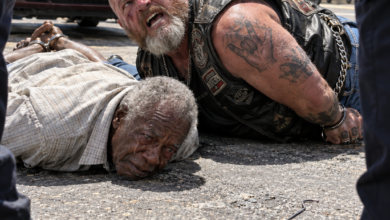
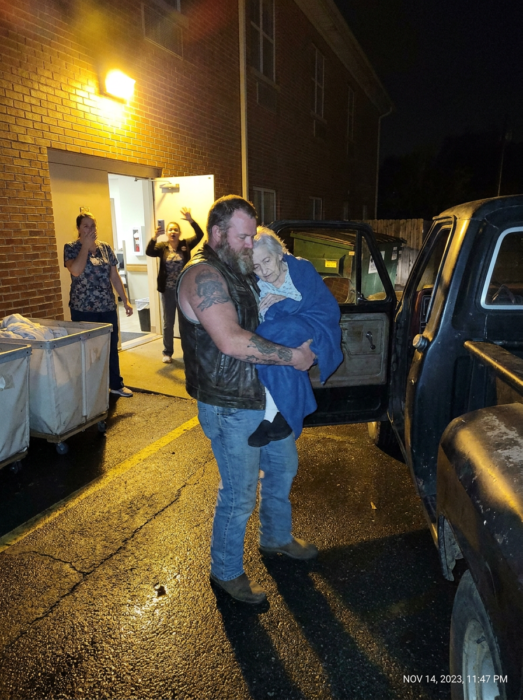
The security footage showed Daniel climbing the wall and entering through a rear service corridor. Eleven minutes later, he emerged carrying Rose beneath a blanket.
The image looked terrible.
Daniel was enormous. Rose appeared almost child-sized in his arms. Elena followed several steps behind, crying and holding the door, but the camera did not record audio.
The pickup left before officers arrived.
A neighboring agency located it on County Road 300. When the deputy activated emergency lights, Daniel continued toward Deacon Valley General.
That became the “police chase” shown on morning television.
It was not a high-speed pursuit. Daniel remained near the speed limit, activated his hazard lights and drove in the right lane. He did not weave, run traffic signals or force other motorists aside.
He simply did not stop.
The deputy later admitted that he could see an elderly woman slumped against blankets in the passenger seat. Daniel had one hand on the wheel and the other supporting her shoulder whenever the road straightened.
Dispatch received Daniel’s 911 call after the pursuit began.
“My grandmother’s barely breathing,” he said. “I’m going to Deacon Valley. Send whoever you want there.”
The dispatcher told him to pull over for an ambulance.
Daniel looked at Rose.
“She doesn’t have time for another transfer.”
He was not medically qualified to make that judgment, and continuing created risks. But the emergency department was four miles ahead, and responding units adjusted. Deputies followed rather than attempting a forced stop.
Daniel entered the hospital driveway at 12:31.
He parked beneath the ambulance canopy, carried Rose inside and placed her on the first available stretcher. Then he returned to the waiting room and sat down.
He never tried to escape.
My partner cuffed him while I spoke with the charge nurse. Daniel did not protest until an officer removed his leather vest.
“Keep that where I can see it.”
“Why?”
“My grandma gets cold. That vest was around her.”
The officer set it on the chair beside him.
Inside an inner pocket, we found cinnamon candy, an old Polaroid and eight visitor stickers from Cedar Hollow. The most recent sticker was dated eight months earlier.
Daniel had saved every one.
Rose was not just a relative he suddenly remembered. He had visited twice a week for almost three years after she entered care.
He trimmed her nails because she disliked the facility clippers. He brought family photographs and washed her hair in the bathroom sink when staffing shortages delayed showers.
Then Gerald obtained an order restricting him.
Gerald told the court Daniel’s club connections created danger and that his visits agitated Rose. He cited one incident in which Daniel shouted at an aide over an unchanged bed.
What the guardianship petition did not mention was why Daniel shouted.
Rose had been left in wet clothing for hours.
Daniel filed a complaint with the facility. Cedar Hollow responded that the issue had been investigated and corrected. Shortly afterward, Gerald barred him from visiting.
Daniel contacted Adult Protective Services twice. Both referrals were screened using information supplied by Cedar Hollow and Gerald. Staff reported Rose was stable, cared for and distressed by Daniel’s presence.
Without current photographs or direct access, his claims appeared to be part of a family dispute.
Daniel considered challenging the guardianship, but the retainer quoted by an attorney exceeded what he could afford. His welding shop had lost a major contract, and he was paying his daughter’s community-college tuition.
He backed away.
That decision haunted him.
Every Sunday, he rode his Harley past Cedar Hollow without entering. Sometimes Rose’s window curtains were open. Sometimes they were not.
Members of his club offered to accompany him inside.
Daniel refused.
“Bunch of leather vests won’t make them listen better.”
He tried official channels instead.
Then Elena’s message arrived.
The photograph showed something no complaint summary could explain away. Daniel called the facility, 911 and Gerald. Only the facility answered.
They refused access.
By the time he reached Cedar Hollow, Rose’s breathing appeared shallow. Elena said she had stopped responding normally after the evening meal.
Daniel climbed the wall.
That act remained unlawful.
What we had to determine was whether it was the act of a kidnapper—or an emergency intervention after every lawful door had stayed closed.
Part 3
Rose’s examination changed the case within an hour.
She weighed seventy-six pounds. A nutrition assessment documented severe muscle loss. Her blood tests showed dehydration, anemia and evidence of infection. The pressure injury on her lower back was classified as stage four.
The physician photographed and documented it for treatment and the abuse investigation.
Those images never belonged on television.
When a reporter later requested them, the hospital refused. Daniel did too. He wanted the public to understand what had happened without turning his grandmother’s body into proof for strangers.
The medical team began fluids carefully because aggressive correction can be dangerous in severely frail patients. They treated the infection, consulted wound specialists and admitted Rose to intensive care.
Her chart from Cedar Hollow told another story.
At 6:00 p.m., staff had recorded that she ate seventy-five percent of dinner.
Elena had photographed the untouched tray at 8:40.
At 10:00, a care aide documented that Rose was repositioned, comfortable and conversing.
Security video showed no aide entering her room between 8:12 and Daniel’s arrival after midnight.
At 11:30, the electronic chart listed her water intake.
Her pitcher was dry.
These were not merely mistakes made during a busy shift. Entries appeared under employee logins belonging to people who were not working that night.
The records had been populated in advance.
Adult Protective Services requested immediate access to Cedar Hollow. State health regulators assembled an inspection team. Our department obtained authority to preserve surveillance footage, staffing schedules, care logs and financial records before they could disappear.
Cedar Hollow’s administrator insisted Rose was an isolated case.
Elena’s fourteen photographs contradicted him.
She had documented residents with unchanged bedding, untouched food, visible dehydration signs and call buttons placed beyond reach. She also photographed medication carts left unsecured and staffing boards showing fewer aides than Cedar Hollow reported to regulators.
Not every photograph proved abuse.
Together, they demanded investigation.
At 8:15 that morning, five ambulances arrived at Cedar Hollow alongside inspectors, police and Adult Protective Services. The facility attempted to call additional workers and move residents into common areas before entry.
Inspectors were already inside.
Four residents required immediate hospital transport. Ten others were transferred over the next forty-eight hours after evaluations found untreated infections, dehydration, medication discrepancies or unsafe conditions.
One man had been described as refusing food.
At the hospital, he told a speech therapist that swallowing hurt.
No one at Cedar Hollow had requested the ordered evaluation.
Another woman’s chart stated she rejected family visits. Her daughter showed investigators seventeen unanswered messages and receipts for certified letters.
The facility had turned isolation into documentation.
Meanwhile, Daniel sat in our interview room with an untouched cup of coffee. We had removed the handcuffs after confirming his identity and the medical emergency, but he remained under investigation for trespass, property damage and interference with custodial authority.
“Do you understand you could have called an ambulance?” I asked.
“I did.”
“You entered before one arrived.”
“They told dispatch she was fine.”
“You could have waited for deputies.”
Daniel stared at the table.
“I waited eight months.”
His voice did not rise.
That made the sentence heavier.
We reviewed his entry. He had damaged a service-door frame and crossed restricted property. He carried Rose away without the legal guardian’s authorization.
But Rose herself had asked to leave.
Her medical condition indicated immediate danger.
Daniel went directly to a hospital, notified 911 and remained available. He neither concealed Rose nor attempted to profit from removing her.
The county prosecutor deferred charging decisions while the investigation continued.
News coverage did not wait.
By breakfast, Daniel’s face appeared across local television beneath words such as BIKER ABDUCTS 91-YEAR-OLD and POLICE PURSUIT ENDS AT HOSPITAL.
Cedar Hollow issued a statement describing him as an estranged relative with a history of aggression.
The statement did not mention Rose’s condition.
The Black River Saints gathered outside the sheriff’s office. They arrived on twelve Harleys, but Daniel called Luis Ortega from the interview room and told him to send everyone home.
Luis refused.
“We’re not breaking anything.”
“Then don’t crowd the cops.”
“We’re across the street.”
Daniel rubbed his eyes.
“Stay there.”
The club’s test was restraint. A public confrontation could support Cedar Hollow’s description of Daniel as threatening. So the riders stood beside their silent motorcycles, drank gas-station coffee and answered no reporters.
Elena faced a different danger.
Cedar Hollow fired her by email while she sat in our interview room. The message accused her of privacy violations, falsifying allegations and assisting an unlawful removal.
She read it twice.
Then she asked if she could call her husband.
“I told him I might lose the job,” she said. “I didn’t tell him we might lose the insurance.”
Daniel heard her from the next room.
He asked to speak with her.
We allowed a brief meeting with investigators present. Elena apologized for waiting three days after discovering Rose’s condition before sending the photograph.
Daniel shook his head.
“You sent it.”
“I should’ve called sooner.”
“You sent it.”
She began crying.
Daniel looked toward me, uncomfortable with tears. Then he took the old Polaroid from his vest pocket and placed it before her.
The photograph showed Rose younger, standing beside a motorcycle with both hands on her hips.
“That lady raised me,” he said. “You gave her back.”
Elena replied that Daniel had carried her out.
He tapped the phone containing the fourteen photographs.
“I got one woman to a hospital. You opened fourteen doors.”
That afternoon, Gerald Lawson arrived with guardianship papers and demanded that Rose be returned to Cedar Hollow once medically stable.
The hospital refused pending protective review.
Gerald threatened litigation.
Then financial investigators examined Rose’s pension account.
What they found moved the case beyond neglect.
Part 4
Rose received a pension from her late husband’s railroad work, Social Security and a small survivor’s benefit. Combined, the payments were enough to cover Cedar Hollow’s fees with several hundred dollars remaining each month.
Gerald controlled the accounts as guardian.
For eight months, he had transferred the remaining funds into a personal account labeled “care reimbursement.” The withdrawals totaled more than eighteen thousand dollars.
Some expenses might have been legitimate.
Many were not.
Investigators found payments for Gerald’s truck, home electronics and a vacation rental. Meanwhile, Cedar Hollow had sent notices claiming Rose lacked money for supplemental nutrition, upgraded wound supplies and private transportation to appointments.
Gerald had signed forms declining those services as unnecessary.
He also communicated directly with the facility whenever Daniel filed complaints.
Emails showed Gerald asking Cedar Hollow to document Rose as distressed after Daniel’s visits. One administrator replied that such notes could support a permanent restriction.
The notes appeared three days later.
Gerald told investigators he believed Daniel wanted control over Rose’s money. Daniel’s financial records showed the opposite. He had paid for clothing, toiletries and uncovered dental care during the years he was allowed to visit.
He never sought reimbursement.
The court suspended Gerald’s guardianship within forty-eight hours and appointed an independent emergency guardian while Rose remained hospitalized.
Daniel did not receive authority immediately.
Being the rescuer did not erase his unlawful entry or guarantee he was suitable to manage an elderly adult’s medical and financial affairs. The court ordered a background check, home assessment and review of his relationship with Rose.
Daniel resented the delay.
“They let Gerald steal from her for months.”
The court-appointed attorney agreed the system had failed, but she told him what nobody else wanted to say.
“Your anger does not replace procedure.”
Daniel stood and paced.
For a moment, the old image returned: a huge biker, fists closed, jaw tight, ready to break another door.
Then he opened his hands.
“What paperwork?”
That question changed the hearing.
Daniel completed guardianship training, disclosed his finances and agreed to independent account monitoring. His home required modifications because Rose would need a hospital bed, accessible bathroom equipment and skilled home-health visits.
The Black River Saints offered labor.
The court initially hesitated because the club’s presence had been portrayed as intimidating. Daniel provided names, contractor licenses and background information for every member entering the house.
Nobody argued.
They widened the bathroom doorway, built a ramp and converted Daniel’s dining room into a bright bedroom overlooking the porch. Licensed professionals inspected the work.
Daniel did not want Rose hidden in a back room.
“She likes seeing who comes through the front door.”
At the hospital, Rose improved slowly. Antibiotics controlled the infection. Wound specialists treated the pressure injury. A dietitian introduced food carefully because her body could not safely tolerate rapid nutritional changes.
She remained weak.
Some days she recognized Daniel immediately. Other days she believed he was his father.
Daniel never corrected her harshly.
“If she calls me Frank, I’m Frank.”
One afternoon, Rose asked why he had stopped visiting.
Daniel knelt beside the bed.
“Gerald put my name on a list.”
“You could’ve climbed something.”
Daniel looked at Elena, who had come to provide another statement.
“That’s what she told me.”
Rose studied Elena.
“The cleaning lady?”
“Yes, ma’am.”
Rose reached from beneath the blanket. Elena took her hand.
“Good girl,” Rose said.
Elena turned away because she could not answer.
The regulatory investigation expanded. Cedar Hollow had maintained two sets of staffing records—one reflecting actual shifts and another prepared for inspection. Supply invoices showed management ordering additional food and wound-care materials immediately before scheduled reviews, then returning unused items afterward.
The facility owner blamed individual nurses.
Several nurses produced emails showing they had reported unsafe staffing and been told to “chart expected care” if workloads prevented completion.
Responsibility was not equal.
Some employees had neglected residents. Some falsified records. Others had protested quietly and been ignored. Investigators separated those actions rather than treating every worker as the same.
The owner and administrator faced criminal charges connected to neglect, record falsification and obstruction. Gerald was charged separately with exploitation of a protected adult.
Cedar Hollow’s license was suspended.
The building closed.
The fourteen residents in Elena’s photographs were transferred to hospitals, rehabilitation centers or new care homes. Two had no reachable family and required court-appointed advocates.
Daniel visited each one.
He did not present himself as their savior. He brought Elena, because the residents knew her yellow cleaning cart and quiet voice.
One woman recognized Elena and began crying.
“I thought you quit.”
“They fired me.”
The woman touched her hand.
“Same thing there.”
That sentence stayed with Elena.
She had lost her job for taking photographs. Yet the residents assumed she had simply disappeared like every other worker who had tried to care and then vanished.
Daniel’s club began raising money for Elena’s legal expenses and lost wages. The campaign exceeded its goal.
The remaining money created a larger question.
What could they build that would not repeat Cedar Hollow?
Part 5
The Black River Saints knew motorcycles, welding and benefit rides.
They did not know elder care.
Their first meeting about opening a new facility lasted twenty minutes before Elena stopped them.
“You cannot fix this with a ramp and a coffee pot.”
Several riders bristled.
Elena continued.
“You need licensing. Nurses. Medication systems. Dietary plans. Background checks. Inspections. Emergency staffing. If you make it about feeling good, you build another place that looks kind and fails at night.”
Daniel watched the room.
“She’s right.”
That ended the argument.
The club did not open a nursing home alone. It partnered with a regional nonprofit that operated two licensed adult-care residences. The riders raised funds to renovate a former hospice building with twelve private rooms, while the nonprofit handled clinical operations, licensing and professional staffing.
Elena enrolled in healthcare administration courses using money from the fundraiser. She spent months working under an experienced facility director before becoming operations manager of the new residence.
The club named it Rose House.
Rose objected.
“Sounds like I died.”
Daniel told her the alternative name was Brick’s Old-People Garage.
She accepted Rose House.
The facility included ordinary safeguards Cedar Hollow had treated as inconveniences: unrestricted access to the state ombudsman, visible complaint information, electronic records that could not be pre-charted, family communication logs and unannounced overnight audits.
Call buttons remained within reach.
Water pitchers received time labels.
Meal refusals required follow-up rather than automatic documentation.
The residents’ council met without management present.
Elena insisted on one more rule: cleaners, kitchen workers and maintenance staff could report concerns directly to the safeguarding officer without passing through supervisors.
“The person emptying trash sees things,” she said.
No one disagreed.
Daniel’s case remained unresolved while Rose recovered. The prosecutor eventually declined kidnapping charges, citing Rose’s expressed wish to leave, the immediate medical danger, Daniel’s direct travel to the hospital and his cooperation afterward.
He accepted responsibility for trespass and damage to the service door under a deferred misdemeanor agreement. He paid restitution, completed community service and remained subject to no-contact restrictions with former Cedar Hollow administrators during the investigation.
Daniel never called the outcome unfair.
“I broke in,” he said. “I’ll pay for the door.”
Then he added, “They can pay for what was behind it.”
The court granted Daniel guardianship after an independent review. Rose moved into his home four months after the rescue.
She entered through the ramp built by the club, sitting in a wheelchair beneath a blue blanket. Twelve bikers lined the driveway but kept their engines off because loud noise confused her.
Elena walked beside her.
Inside, Rose inspected the converted dining room. She criticized the curtain color, asked why the hospital bed faced the wrong direction and ordered Daniel to move a framed photograph three inches to the left.
He obeyed every instruction.
Her recovery remained incomplete. She could not regain all the weight she had lost, and the pressure injury required months of treatment. Yet she began eating eggs, soup and peach slices.
She sat on the porch each afternoon.
Daniel arranged his towing schedule around home-health visits. Club members rotated grocery deliveries but signed in like every other visitor because the guardian agreement required accurate records.
No one received exceptions for wearing a patch.
Gerald’s case ended with a plea involving financial exploitation. He was ordered to repay funds, prohibited from managing another vulnerable adult’s finances and placed under supervised release after serving a custodial sentence.
Rose never asked to see him.
She sometimes asked where he was.
Daniel answered carefully.
“Getting help with the money he took.”
She would nod.
Then she changed the subject.
The Cedar Hollow owner’s prosecution lasted longer. Former employees testified about understaffing, falsified charts and preparations staged for inspectors. Elena testified for two days.
Defense attorneys questioned why she had taken photographs instead of immediately calling 911.
She answered honestly.
“I was afraid.”
They asked whether fear excused delay.
“No.”
They asked whether Daniel pressured her to gather evidence.
“No. He didn’t know my name.”
Then the attorney displayed the security image of Daniel carrying Rose through the rear exit.
“Did you help this man abduct a resident?”
Elena looked at the photograph.
“I helped a grandson take a dying woman to a hospital.”
The owner was convicted on multiple counts connected to neglect and fraudulent documentation. The facility’s corporate license was revoked, and the property could not reopen under the same management.
News stations returned to Daniel.
They wanted the line about being called a kidnapper.
He gave them a different one.
“My grandmother weighed under seventy-seven pounds when I carried her out. The person who saved her was a cleaner who risked her paycheck to send one picture.”
Elena watched the interview from Rose House.
She did not feel like a hero.
She felt like someone who had finally stopped waiting for permission.
Part 6
Rose lived with Daniel for three years.
Their days were not sentimental all the time.
She complained about his coffee, his beard hair in the sink and the sound of motorcycles arriving before breakfast. Daniel complained that she hid medication beneath napkins and fed toast to a stray cat despite denying it.
They argued.
That was part of being alive.
Every Wednesday, Elena visited after work. She brought Rose House menus and asked Rose to criticize them. Rose took the responsibility seriously.
“Too much chicken.”
“There are two chicken meals.”
“Two too many.”
Elena adjusted the next menu anyway.
The fourteen residents photographed at Cedar Hollow had different outcomes. Some returned to family homes. Others entered long-term care. Several remained medically fragile because neglect had gone unaddressed for too long.
Eleven survived the first year.
The new residence reserved two subsidized rooms for adults without family advocates. The Black River Saints funded them through an annual ride, but the riders never entered resident areas without invitation.
The club learned that protection could look like restraint.
Daniel kept the newspaper page that called him an elderly kidnapper. Rose wanted to throw it away.
He folded it into a drawer beside the old visitor stickers.
“Why save trash?” she asked.
“So I remember how quick people name the wrong thing.”
On the second anniversary of her rescue, Rose returned to Deacon Valley General for a routine appointment. The emergency nurse who had first treated her came downstairs.
She could not believe the woman in the wheelchair was the same patient.
Rose weighed ninety-four pounds. Her color had returned. The wound had healed, leaving a scar she permitted no one to photograph.
Before leaving, Daniel rolled her through the waiting room where police had handcuffed him.
Rose looked at the chair.
“You sat there?”
“Yes.”
“Like a criminal?”
“Pretty much.”
She tapped his hand.
“You always did look suspicious.”
Daniel laughed loudly enough to turn heads.
At home, Rose kept the yellow cleaning cloth Elena had used on her final night at Cedar Hollow. Elena had washed it and tried to discard it, but Rose asked to keep it.
It hung from a hook beside Daniel’s leather vest.
One belonged to a cleaner.
One belonged to a biker.
Both had opened the same door.
Part 7
Rose died at ninety-four in Daniel’s home.
Not in a neglected bed.
Not behind a restricted visitor list.
Her hospital bed faced the porch exactly as she demanded. Daniel sat beside her, and Elena stood near the window. Several club members waited outside with their engines silent.
Rose had been awake that morning.
She drank two sips of coffee, complained it was weak and asked whether the stray cat had eaten. Then she held Daniel’s scarred hand until she fell asleep.
Her funeral procession passed the former Cedar Hollow building.
The sign was gone. Weeds had grown through the parking lot. Daniel did not slow down.
At Rose House, residents placed fourteen small lamps along the entrance walkway—one for each person in Elena’s photographs. No names appeared because their stories remained their own.
Elena became the facility’s permanent administrator after completing her certification. She kept her old cleaning badge framed inside her office, not on the public wall.
Daniel continued serving on Rose House’s community board, though he attended meetings in work shirts instead of leather because Rose once told him the vest made folding chairs squeak.
He still carried the eight visitor stickers.
The night of Rose’s funeral, I asked whether he regretted ignoring our lights during the drive to the hospital.
He thought about it.
“I regret making your job harder.”
“That isn’t what I asked.”
“No,” he said. “I don’t regret getting her there.”
Then he nodded toward Elena.
“But don’t tell the story like I did it alone.”
The first act of courage happened before Daniel climbed the wall. It happened when an underpaid cleaner stood beside a dying woman, raised a phone and chose evidence over silence.
Daniel carried Rose through the door.
Elena made sure he knew which door to open.
The newspaper called him a kidnapper. The court called his entry trespass. Rose called him late.
All three descriptions contained pieces of truth.
Only one mattered to him.
For three more years, every evening at six, Rose sat on Daniel’s porch beneath his leather vest and watched the motorcycles turn into the driveway.
She was home.
Follow our page for more unforgettable biker stories about misunderstood rescues, quiet whistleblowers and ordinary people who risk everything when vulnerable lives are hidden. Some doors must be opened.