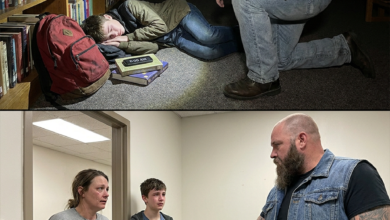
Part 2: A 7-Year-Old Boy Was Dragged Out of a Store for Not Having Enough Money — Then a Biker Stepped In and Snatched the Item Back From the Clerk, Leaving Everyone Stunned
The first thing people noticed was the boy’s silence.
Children who are caught stealing usually deny.
Children who are embarrassed usually hide.
Children who are scared usually cling to the nearest excuse.
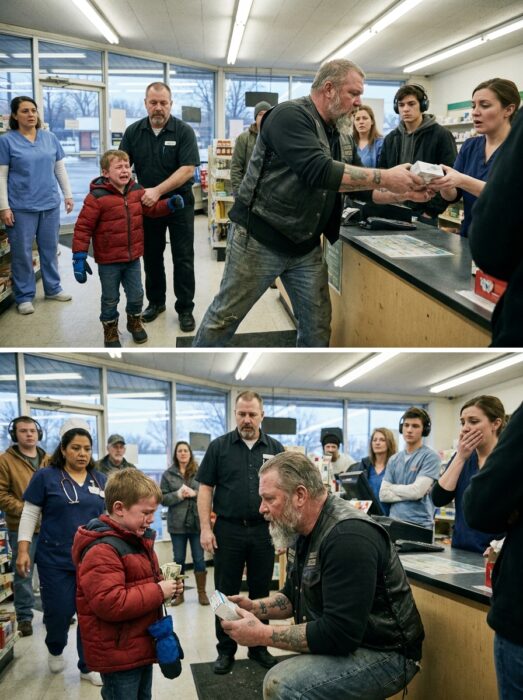
This boy didn’t do any of that.
He just stood there, chest heaving under the red coat, staring at the little white box in the biker’s hand as if the whole store had narrowed down to that one rectangle of cardboard and the few terrible minutes he had left to get it.
The assistant manager recovered first.
“Sir, you can’t just take product from behind the register,” he said, trying to sound official now that the child was no longer in his grip. “Either pay for it or put it down.”
The biker didn’t look at him.
He crouched instead, bringing himself level with the boy. That motion changed something immediately. A violent man towers when he wants control. This one lowered himself until he was eye to eye with a seven-year-old whose face was wet and white with panic.
“What’s your name, buddy?” he asked.
The boy swallowed twice before answering. “Eli.”
The biker nodded once. “Eli who?”
“Turner.”
The name seemed to land somewhere inside the man.
Not fully.
But enough to catch.
“Who needs this, Eli?”
The boy’s lower lip shook. “My grandma.”
A customer in line exhaled softly.
Donna’s expression shifted by half an inch.
The manager still crossed his arms.
The biker kept his voice steady. “Where is she?”
“At home.”
“With who?”
Eli blinked fast, and now the details people had ignored began quietly rising to the surface. The child’s jeans were too short at the ankle. His red jacket was zipped wrong by one tooth. One cuff was damp. There was dirt on one knee and a dark smudge across the back of one hand like he had been opening old drawers or digging through clutter. He did not smell like trouble. He smelled like cold wind, pennies, and somebody’s house that had gone too long without proper heat.
“She’s on the couch,” he whispered. “She said not to call nobody.”
That sentence bent the room slightly.
Not enough to fix anything.
Enough to disturb it.
The biker glanced at the box again. Then at the child’s handful of money still trembling on the counter. Then at a folded prescription slip sticking halfway out of Eli’s pocket.
“Can I see that?” he asked.
The manager jumped in before the child could move. “Absolutely not. You’re not family. You’re not staff. You’re not even part of this.”
That should have escalated things.
Instead, the biker stood slowly, not puffing up, not posturing, just carrying an exhausted kind of control that made the store feel smaller around him.
“You’re right,” he said. “I’m not staff.”
The manager mistook that for retreat and reached for the box.
The biker pulled it back.
Too fast.
Donna flinched.
A woman in line gasped.
The man near the greeting cards muttered, “This is insane.”
The biker finally looked at the manager fully. His eyes were pale, tired, and far more alert than people first assumed.
“What’s insane,” he said, “is that none of you noticed he came in here alone with a diabetes supply box and counted change like a man racing a clock.”
That line did more than shouting would have.
Because it was precise.
Grounded.
Observed.
He had noticed the box type, the way Eli counted, the urgency in the child’s face, the absence of adult accompaniment, the fact that the boy hadn’t asked for candy or a soda or even sympathy. He had come straight to the pharmacy counter and gone straight to panic when he came up short.
Donna, who had spent twenty-two years behind that register and had seen every kind of scam customers could invent, looked at Eli again as if she were seeing him for the first time.
“Sweetheart,” she said more gently now, “where’s your grandmother’s insulin?”
Eli pointed toward the box in the biker’s hand. “That’s not the insulin. That goes on the pen.”
Donna froze.
That was not a sentence most seven-year-olds improvise.
The biker nodded once, very slightly, as if some private suspicion had just been confirmed. He held out his palm to Eli.
“The paper.”
Eli pulled the folded slip from his pocket and handed it over.
The manager opened his mouth to object again, but Donna took the paper first. Her eyes ran over the prescription label, then back to the boy, then down to the address written in shaky blue ink at the top.
“North Cherry, apartment 3B,” she read aloud. “That’s walkable from here.”
The biker’s jaw tightened. “In this weather?”
Eli nodded. “I ran.”
There was another silence after that.
Not dramatic.
Embarrassed.
The woman in scrubs near the line finally stepped out and asked the obvious question none of them had asked soon enough. “Honey, where’s your grandma’s insulin pen?”
Eli looked at the floor. “She got the medicine yesterday. But she dropped the last needle and bent it. She tried to use it anyway and it hurt and then she got real sweaty.”
Donna closed her eyes for a second.
The biker didn’t.
He went sharper.
“When was that?”
Eli’s answer came instantly. “Before dark.”
That meant recent.
Too recent.
Maybe ongoing.
A detail surfaced then that made the biker’s whole face go still. Around Eli’s wrist was a faded hospital bracelet twisted backward under the sleeve, the name almost rubbed off. Not his. Adult size. Probably reused to hold papers or emergency numbers because poor families turn everything into utility eventually.
The biker reached very slowly and turned it enough to read the print.
Marjorie Turner. Type 1 diabetes. Emergency contact line blank.
Now the manager looked less angry than uncomfortable.
The biker asked one more question, almost too softly.
“Why didn’t you call 911?”
Eli’s answer broke the store open.
“Because Grandma said if the ambulance comes again, they might take the house.”
No one spoke after that.
Not Donna.
Not the manager.
Not the customers who had watched a child being pulled by the arm because he had come up short on the one thing keeping an adult at home alive.
The truth still was not fully laid out.
But it was close now.
And the biker, who had looked like a threat five minutes earlier, was the only person in the room already moving toward what had to happen next.
His name was Wade Mercer, and the reason he noticed insulin pen needles faster than the rest of the store had nothing to do with medical training and everything to do with grief.
His wife, Darla, had lived with diabetes for twenty-six years.
He learned the rhythm of the disease the way some men learn hymns or tool sizes—through repetition, fear, devotion, and the small rituals that become marriage when one person’s body requires precision and the other person chooses to care enough to memorize it. He knew the sound of a blood sugar crash in the middle of the night before she said a word. He knew which juice brand she could keep down when she was nauseated. He knew how a kitchen counter looked after the thousandth injection and why the box of needles mattered as much as the medicine itself.
Then Darla died.
Not from diabetes.
From a stroke three winters earlier.
But after she was gone, Wade never lost the reflex. He still noticed supply boxes in other people’s carts. Still checked expiration dates for strangers without meaning to. Still looked at small pharmacy purchases and saw the private war hiding inside them.
That was why Eli caught his attention before the scene turned ugly.
Wade had seen the child at the counter while grabbing coffee. He saw the crumpled bills. Saw the little box. Saw the way Eli kept glancing not at candy racks or snacks, but toward the clock over the lottery machine. He knew that look. Not childish impatience.
Countdown panic.
He might have stepped in earlier if the manager hadn’t grabbed the boy.
That was the line.
Wade could tolerate rudeness.
He could tolerate policy.
He could even tolerate suspicion.
He could not tolerate a frightened child being physically hauled away from the thing an adult needed to use medicine.
So he crossed the floor.
That was the part everyone saw and judged.
What they didn’t see was what came before it. The tiny cues. The prescription paper. The drugstore lighting reflecting off tears the child kept trying to rub away before adults noticed. The specific box design. The hospital bracelet around the boy’s wrist. The exact kind of desperation children learn only when they have already spent too much time around illness.
Once Donna verified the product and the script, the whole pace of the story changed.
“Frank,” she said to the assistant manager, voice sharper now, “ring it up.”
Frank stared at her. “He doesn’t have enough.”
“I know that,” she snapped.
Wade took out his wallet.
Frank still hesitated, clinging to store rules because rules feel safer than human judgment when judgment has already failed. “If this is tied to an active prescription, we may need—”
Wade cut him off, but not loudly. Quietly. Worse.
“You can finish that sentence later,” he said. “Right now, tell me whether the address is four minutes away or six.”
Donna answered before Frank could. “Five if you run.”
“I did run,” Eli whispered.
Wade turned to him. “You did good.”
The boy’s face crumpled at that simple sentence.
No one else in the store had said he did good.
They had said he was short.
They had said he was holding up the line.
They had dragged him.
They had watched.
Wade paid for the box, then swept the scattered coins and crushed bills from the counter and folded them back into Eli’s mittened hand.
“Keep that,” he said.
Eli shook his head violently. “No, I gotta pay.”
That line hit every adult nearby with almost physical force.
Because it meant the boy had not come in hoping someone would rescue him. He had come trying to do it correctly. Honorably. The way children do when they have been raised by people too proud to ask for help until help is nearly too late.
Wade closed Eli’s fingers over the money. “You can pay me later by listening.”
The woman in scrubs, who had stayed silent too long and knew it, stepped forward. “I’m a nurse. If you want, I can come.”
Frank finally found the part of himself that had a pulse. “I’ll call 911.”
Eli went pale at once. “No, please—”
Wade knelt in front of him again. “Buddy, listen to me. If your grandma is sweating and couldn’t use her pen, we don’t guess. We don’t wait. We get there and we get help if she needs it.” He paused, then added in the plainest, gentlest way possible, “Keeping her alive matters more than whether she’s embarrassed.”
That sentence had been waiting in Wade for years.
Maybe since Darla.
Maybe since before.
Eli stared at him for a second, then nodded once, small and scared.
What happened next unfolded with the ugly beauty real emergencies often have. No music. No speech. Just movement. Donna grabbed a juice bottle, a small pack of crackers, and the pharmacy contact sheet. The nurse in scrubs—Monica Reyes, Latina, thirty-eight, pediatric floor—called ahead as Frank finally reached dispatch with a voice that sounded ashamed of how long it had taken him to become useful.
Wade picked Eli up.
Not because the boy asked.
Because speed mattered.
For one heartbeat the whole store looked stunned again, as if the biker had crossed back into violence. But Eli’s arms went around Wade’s neck instantly, no resistance at all, because frightened children know the difference between force and shelter faster than adults do.
Wade carried him out into the freezing Indiana dark.
Monica followed.
Frank followed.
Donna came too, still wearing her reading glasses chain and store apron.
The address was five minutes away in theory. Four with urgency. It was in a crumbling brick fourplex behind a laundromat, up one rusted outdoor staircase that shook under grown weight. Apartment 3B had a porch bulb burned out and a Christmas wreath still hanging in January because grief and poverty both make small chores feel ridiculous.
Inside, they found Marjorie Turner half-conscious on the couch, gray-faced, drenched in sweat, one slipper off, insulin pen on the floor beside her and no working needle attached. The apartment was painfully clean in the way homes of proud poor people often are—bleach smell, hand-folded towels, dishes washed and drying, furniture old but covered carefully to hide its age. There was no extra food on the counter. No husband. No daughter. Just framed school photos of Eli and a church calendar turned to last month.
Monica was at Marjorie in seconds.
Wade set Eli down and moved only where told.
That, too, mattered.
The man who had looked so menacing in the store became all obedience now. Juice cap off. Pillow adjusted. Front door open for EMS. No dramatics. No hero posture. Just work.
Marjorie came around enough to focus on Eli first.
“Oh, baby,” she whispered. “I told you not to—”
Wade looked away when he heard that.
Not because he judged her.
Because he understood her too well.
Shame makes sick people dangerous to themselves.
Pride does it slower.
When paramedics arrived, the apartment tightened with motion. Questions. Blood sugar check. Vital signs. Medication history. Marjorie tried to refuse transport, then tried to apologize for the mess, then cried when Monica found only one can of soup in the cupboard and half a loaf of bread in the fridge. Eli stood by the table gripping the pharmacy box Wade had paid for like it was the last solid thing in the room.
Then came another twist none of them expected.
One of the paramedics, a Black man in his forties, paused while checking Marjorie’s med bag and said, “Ma’am, who’s your prescriber now? This refill note is two months old.”
Marjorie shut her eyes.
Monica answered quietly for her. “She’s stretching supplies.”
Marjorie’s face gave her away before her mouth did.
She had been using fewer needles than prescribed. Reusing what she could. Making medicine last longer than it should because Medicare gaps, co-pays, heating bills, and rent don’t care whether a body needs precision. She had sent Eli because there was no one else and because seven-year-olds, when loved by struggling adults, often become little couriers of impossible problems.
Eli had not come to buy a random medical item.
He had come trying to stop the collapse of the only grown person holding his world together.
That was the moment the story fully reversed.
Frank, the manager who had grabbed him, stood in the tiny kitchen with his store badge still clipped on and looked like a man seeing his own hands for the first time. Donna started quietly opening cabinets and making a list in the back of her receipt book. Monica arranged follow-up numbers. The paramedics convinced Marjorie to go in. Wade found Eli’s shoes, zipped his coat correctly, and tucked the paid-for needle box into the med bag without saying anything about what it cost.
At the hospital, Wade stayed.
He didn’t have to.
Nobody asked him to.
But he stayed anyway, sitting in the family waiting area with Eli asleep across two chairs, using his rolled-up leather vest as a pillow. At some point after midnight, Donna came with a grocery sack. Frank came later with a store gift card and an apology he could barely get through. Monica came off shift and returned in regular clothes carrying a blanket and two sandwiches. Somewhere between one bad hour and the next, a circle formed around Marjorie and Eli that had nothing to do with obligation and everything to do with the fact that one rough-looking man had refused to let policy be the last word spoken over a child’s fear.
That was Wade’s redemption.
Not that he paid.
Not that he shouted.
Not even that he was right.
It was that he saw the emergency inside the embarrassment and moved before the room gave itself permission to care.
Marjorie stayed in the hospital overnight and part of the next day.
It was not the kind of crisis that makes the news or even the kind that leaves a dramatic scar. It was the quieter emergency poor families know too well—the one that grows in skipped supplies, stretched doses, postponed refills, and the lonely arithmetic of deciding which necessity can be delayed one more week without killing anyone.
But this time someone noticed before the cost turned final.
By noon the next afternoon, a social worker had helped straighten out the refill issue. Monica had made sure Marjorie was connected to a patient-assistance program she should have been told about months earlier. Donna had organized a small employee collection without calling it charity. Frank had driven over after his shift with a space heater from his own garage because the apartment’s front room felt colder than it should have. None of it was cinematic. All of it mattered.
Wade said almost nothing through any of it.
That became part of the story too.
People expected loud men in leather to take credit for intervention. Wade didn’t. He filled out forms when asked. Drove Eli home from the hospital cafeteria once when the child got sleepy and needed his own bed before visiting hours ended. Fixed the loose chain on Marjorie’s front door because it hung crooked and bothered him. Replaced the dead porch bulb. Tightened the handrail on the stairs. Tiny repairs. The kind you do when you don’t know how to fix the big thing but cannot bear to leave the small thing broken.
When Marjorie came home, she moved carefully, one hand still bruised from the failed injection attempt, face pale with exhaustion and the humiliation of having been seen at such a low point. Wade was on the porch when Frank drove her back. Not inside. Not presuming.
Just there.
Eli ran up the steps ahead of her. “He paid for the thing, Grandma.”
Marjorie stopped short.
Then she looked at Wade, at the old tattoos, the vest, the heavy shoulders, the face most people mistrusted before listening, and she did what proud women sometimes do when gratitude arrives dressed in a form they don’t know how to handle.
She straightened.
“I’ll pay you back.”
Wade nodded once. “I figured you’d say that.”
That nearly made her smile. Nearly.
He handed her a folded store receipt with the cost circled. Then, beneath it, another piece of paper—Monica’s neat handwriting listing the new program numbers, follow-up instructions, and clinic contacts. Marjorie stared at the second paper longer than the first.
“People shouldn’t have to build a whole rescue team for a box of needles,” she said quietly.
Wade leaned one shoulder against the porch rail he had already tightened. “No,” he said. “But since they do sometimes, it’s better when the team shows up.”
There was no lesson in that.
Only fatigue.
And truth.
A week later, Eli appeared at Harper’s Pharmacy again.
That alone changed Donna’s heartbeat.
But this time he was holding Marjorie’s hand, shoelaces tied, jacket zipped straight, and carrying an envelope made from folded notebook paper. Inside were eight dollars in wrinkled ones and coins taped to an index card. On the card, in blocky child handwriting, were the words:
FOR THE BIKER. I STILL OWE TWO DOLLARS.
Donna laughed so hard she had to take off her glasses.
Wade came in ten minutes later by coincidence or instinct—nobody ever knew which—and Donna slid the envelope across the counter without explanation. He opened it, read the card, and stood there a moment too long with his jaw set the way older men do when feeling gets too close to the surface.
Eli watched him carefully. “I’m gonna pay the rest.”
Wade folded the money back into the envelope and tucked it into the boy’s jacket pocket.
“You already did,” he said.
Eli frowned. “How?”
Wade looked toward Marjorie, who stood by the blood pressure machine pretending not to listen. “You got her through the night.”
That was the kind of sentence Eli might not understand yet but would probably carry for the rest of his life.
After that, things changed in ordinary ways.
Frank never grabbed another child by the arm in that store. Donna started keeping a small notebook beneath the counter with local emergency resource numbers, just in case. Monica checked in twice a month on Marjorie even when she didn’t technically have to. The apartment stayed warm through February because Frank’s space heater turned into a church utility fund once Mrs. Hensley from three doors down found out and got offended nobody told her sooner. And Wade, who still rode the same old motorcycle and still looked like the kind of man polite people crossed parking lots to avoid, started stopping by on Thursdays with groceries he pretended were “too much for one person anyway.”
Marjorie always paid him back in portions.
That mattered to her.
He let it.
Sometimes she sent banana bread instead of cash.
Sometimes canned soup.
Once, in March, she sent him home with Darla’s favorite kind of sugar-free pudding because Eli had overheard him mention his wife and remembered.
That was the moment Wade had to sit in his parked bike for ten full minutes before starting the engine.
By spring, Eli no longer looked afraid when adults asked questions. He looked careful, which is not the same thing, but it is a start. Marjorie’s prescriptions stabilized. The porch rail held firm. The dead bulb stayed replaced. Harper’s Pharmacy & Market went back to selling frozen burritos and cough drops under bright miserable lights, but there were now a few people inside who looked up faster when children came to the counter alone.
And on one damp evening in April, Wade stood outside the store with a black coffee while Eli proudly counted exact change beside Marjorie at the register. Not for emergencies this time. Just milk, bread, and dish soap.
When they came out, Eli ran ahead and stopped near Wade’s bike.
“Grandma says I still owe you.”
Wade raised an eyebrow. “Does she now?”
Eli nodded solemnly, then pulled something from his coat pocket.
It was two dollars.
And a wrapped peppermint.
Wade took both like they were legal tender from a king.
Marjorie shook her head from behind the grocery cart, embarrassed and grateful in equal measure. “He insisted.”
Wade unwrapped the peppermint, popped it into his mouth, and looked at the little family winter had nearly broken.
“Tell your grandma,” he said, “we’re even.”
Marjorie’s eyes filled before she could stop them.
Eli grinned.
The store doors sighed open behind them.
Traffic moved.
Nothing grand happened.
But some moments do not need grandeur. Only witness.
Wade put on his gloves, kicked the engine to life, and rode off into the Indiana dusk with two dollars less pride in his pocket and one peppermint dissolving slowly under his tongue. Behind him stood a boy who had tried to save his grandmother with change and courage, and a woman who had almost been lost to silence because asking for help felt more expensive than getting sick.
Follow the page for more emotional, cinematic stories about misjudged people, quiet kindness, and the moments that change how we see each other.