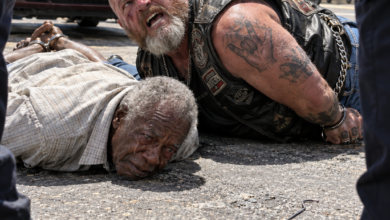
A 6’4″ Biker Lifted His Fallen Harley Off a Trapped Boy—Then the Family Learned Why His Garage Was Empty Months Later
Part 2
Brick had bought the Road King fourteen years before the accident from a retired electrician in Morristown. It was already used, with a scratched saddlebag and a dent in the fuel tank that caught the light at certain angles.
He paid for it in installments.
Every Friday for eleven months, he drove an old Ford pickup to the seller’s house and handed over cash inside a white envelope. When the final payment was made, Brick rode the Harley home through freezing rain because the truck could not carry it.
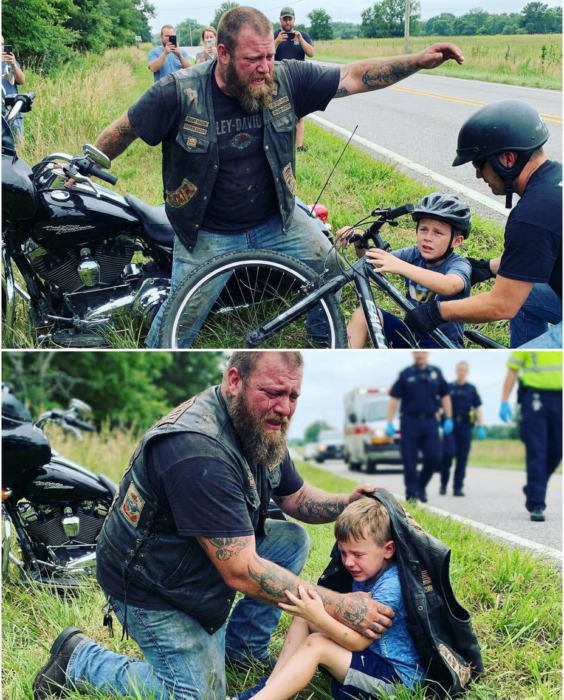
That motorcycle became the fixed object in a life that rarely stayed fixed.
Brick’s father had left when he was nine. His mother worked night shifts at a textile plant, and Brick learned early that large boys were often expected to behave like grown men before anyone taught them how.
At seventeen, he dropped out of school.
At nineteen, he was arrested after a bar fight and spent ninety days in county jail. He never hid it, but he did not polish it into a legend either.
“I was drunk,” he once told a young prospect who had begun bragging about fights. “I hurt somebody. There’s no patch for stupid.”
After jail, Brick became a welder. He spent twenty-six years building railings, farm gates, and industrial frames. The work bent his back and thickened his hands, but it gave him one thing he trusted: a measurable result.
A weld held or it did not.
People were harder.
Brick married once. The marriage lasted eight years. His wife wanted children; Brick did too, though he could never say it without looking at the floor. They tried fertility treatments until the cost became impossible, then stopped speaking about it.
The silence damaged them more than the failure.
After the divorce, his former wife kept the house. Brick kept the Harley, his tools, and one yellow coffee mug with a broken handle.
He moved into a small rental above an auto-parts store. When that building was sold, he slept temporarily in the rear room of our clubhouse garage.
“Temporarily” became three years.
He paid rent to the club even when we told him not to. He repaired every rider’s exhaust brackets, replaced locks, and built storage shelves from scrap steel. On winter mornings, he arrived before everyone else and started the heater.
That was his language.
Brick did not say he cared. He made sure the room was warm.
The morning of the crash, five of us were traveling to a charity breakfast in Kingsport. We were not speeding. A state investigator later downloaded data from a nearby delivery van’s dashboard camera and estimated Brick’s speed at forty-seven miles per hour in a fifty-five zone.
The dog appeared less than two seconds before the collision.
It was a young brown hound mix named Rusty, owned by a family living beside the highway. A storm had loosened one section of their backyard fence during the night. Rusty squeezed through, chased a squirrel across the yard, and ran onto the pavement.
Brick had three choices, none good.
Hit the dog head-on.
Lay the motorcycle down deliberately.
Or swerve toward the opposing lane, which appeared empty until the curve revealed Eli.
Brick swerved.
The dog escaped untouched.
That fact made Brick angrier than if the animal had died. Not because he wanted it hurt, but because the clean brown dog trotting back toward its yard made the cost on the road feel impossible to explain.
Eli had been riding to a convenience store two miles from home. His mother had asked him to buy milk and eggs. His bicycle was secondhand, his helmet was three years old, and his rear reflector was cracked.
None of that caused the crash.
The highway patrol report stated that Brick crossed the center line while taking evasive action. No alcohol, drugs, excessive speed, or phone use was involved.
The deputy issued no reckless-driving citation, but civil responsibility remained with Brick and his insurer.
Brick did not argue.
At the hospital, a state trooper asked whether he wished to revise his statement after speaking to an attorney. Brick was sitting in a wheelchair with his right leg immobilized and his swollen left hand resting on a pillow.
“No.”
“You understand the statement may affect liability?”
“Yes.”
“The dog entered your lane.”
“My bike entered the kid’s.”
The trooper closed his notebook.
“That’s unusually clear.”
“Shouldn’t be.”
Eli’s father, Daniel Turner, was less clear. He had watched his son disappear through operating-room doors and had just been told that surgeons were concerned about internal bleeding near the spleen.
Daniel blamed Brick.
He blamed the dog’s owners.
He blamed himself for asking Eli to ride to the store.
Then he blamed Brick again because that was the only blame with a face sitting thirty yards away.
The punch at the roadside had split Brick’s lip. At the hospital, Daniel walked into Brick’s treatment bay and said he was not sorry.
Brick nodded.
“I wouldn’t be either.”
Daniel expected anger. Instead, Brick asked the question he had repeated since the ambulance doors closed.
“Can he move his toes?”
Daniel did not know.
For the first time, his rage faltered.
Eli’s mother, Rachel, arrived from her shift at a nursing home still wearing navy scrubs. She had been told only that there was an accident. Nobody had explained that the man with blood on his face had lifted the motorcycle off her son.
She looked at Brick’s vest folded inside a clear hospital belongings bag.
“Why do you have Eli’s clothes?”
A nurse answered.
“That’s not his vest. The rider covered him with it.”
Rachel stared at Brick.
He looked away.
Then a surgeon entered the waiting room and announced that Eli needed immediate surgery.
The Turners had no active health insurance.
Rachel’s employer coverage had ended when her hours were reduced six weeks earlier. Daniel’s new construction job offered insurance only after a ninety-day waiting period.
The hospital would operate regardless; this was an emergency. But financial counselors warned the family that surgery, imaging, hospitalization, and rehabilitation could leave them owing more than they earned in several years.
Brick heard that conversation through a partially closed curtain.
He said nothing.
But that evening, from his hospital bed, he asked me a strange question.
“What’s the Road King worth if it’s repaired?”
Part 3
Eli’s surgery lasted almost four hours.
Doctors repaired a torn blood vessel near his pelvis, stabilized his lower leg, and monitored his spleen without removing it. The motorcycle had not crushed him evenly; the crash bar and folded bicycle frame created small gaps that prevented the full weight of the engine from settling across his abdomen.
Those inches mattered.
So did Brick’s lift.
A trauma surgeon later told us that pulling Eli free without controlling his neck and pelvis could have worsened the bleeding. We had been lucky. Brick had held the motorcycle up while I dragged the boy by his jacket, an action that no training manual would recommend unless remaining trapped posed a greater immediate threat.
At the roadside, we did not have the luxury of a manual.
We had a boy losing sensation in his foot.
Brick’s own injuries were worse than they first appeared. The fibula fracture was stable enough to avoid surgery, but his knee ligaments were badly torn. Two bones in his left hand were fractured, and the deep cut across his palm required twenty-three stitches.
The doctor ordered him to remain overnight.
Brick discharged himself after six hours.
He said he could recover at the clubhouse. In truth, he wanted to remain close to Eli’s hospital without occupying a room he believed someone else needed.
That logic was wrong. Hospitals do not reassign orthopedic beds based on one stubborn biker’s guilt.
But guilt does not ask permission from logic.
We brought him back the next morning because his leg had swollen inside the brace. While a nurse scolded him, Brick asked whether Eli had awakened.
“He did,” she said.
“Talking?”
“A little.”
“Feet?”
“He moved both.”
Brick closed his eyes.
That was the nearest I had seen him come to crying.
Rachel later told us Eli’s first clear question after surgery was not about his bicycle or the crash.
“Where’s the vest?”
A nurse retrieved it from the belongings bag. It was heavy black leather, oversized on Eli’s thin hospital frame, with our club name across the back and a small memorial patch sewn near the heart.
The nurse laid it over his blanket.
Eli touched the scratches on the collar.
“Did he stay?”
Rachel asked who.
“The big man.”
She did not know how to answer.
Brick had stayed at the hospital, but not inside Eli’s room. He sat near a vending machine at the end of the surgical floor, his injured leg stretched across a second chair, drinking coffee that had gone cold.
Daniel found him there.
For several minutes, neither spoke.
Then Daniel said, “They told me what you did.”
Brick studied the coffee lid. “Wasn’t enough.”
“You got the bike off him.”
“I put it there.”
The two statements existed together.
That was the part people struggled to understand after the story spread. They wanted Brick to be either the villain who hit a child or the hero who saved one.
He was both responsible and brave.
One truth did not erase the other.
Daniel lowered himself into the chair opposite him. His hands were trembling, and there was dried grass on one knee of his jeans from the crash site.
“I shouldn’t have hit you.”
Brick shrugged. “You get one.”
“One?”
“Second costs you.”
It was a rough joke, barely a joke at all, but Daniel exhaled for the first time since arriving.
Then he noticed Brick’s swollen leg.
“You lifted that motorcycle on this?”
Brick did not answer.
Daniel covered his face with both hands.
Brick looked toward the surgical doors. “Don’t do that here. Kid might wake up.”
The highway patrol investigation continued. The dog’s family provided photographs of the damaged fence and veterinary records identifying Rusty. The delivery-van camera confirmed the dog’s movement and Brick’s speed.
There was no evidence of reckless riding.
Still, Brick’s insurance company informed him that his minimum liability coverage might not cover all of Eli’s expenses. The policy limit was twenty-five thousand dollars for bodily injury to one person.
Eli’s first hospital bill exceeded that before rehabilitation began.
The Turners applied for the hospital’s financial-assistance program. Rachel collected pay stubs, tax returns, rent receipts, and the termination letter from her former insurance plan.
The hospital discounted part of the balance.
A large amount remained.
Brick asked for copies of every bill connected to the crash. The hospital could not give them to him without the family’s authorization, so he requested that his insurer communicate directly with the Turners.
Then he did something none of us understood.
He told the insurance adjuster he did not want to dispute reasonable liability.
The adjuster warned that cooperation did not require surrendering every defense.
Brick responded, “I’m not buying a defense from a kid in a wheelchair.”
The club hired an attorney to advise him. The attorney explained that admitting moral responsibility was different from signing away legal rights. Brick listened and followed the process, but he refused any strategy that implied Eli caused the collision.
Some members thought he was being manipulated by guilt.
Our treasurer, Walt, argued that Brick should preserve enough money for his own recovery. He could not weld with a crushed hand or stand all day with torn knee ligaments.
“You sell your stuff,” Walt told him, “and you’ll still owe more.”
Brick stared at the Harley’s damaged frame in our garage.
“Then I’ll owe less.”
“You’re not hearing me.”
“I am.”
“You lose the bike, you lose work, you lose the room—what exactly do you have left?”
Brick pointed toward Eli’s vest, which the hospital had temporarily returned for cleaning.
“He has that.”
At first, we thought Brick was talking about the leather.
He was not.
He meant Eli still had a future capable of carrying it.
Three weeks after the crash, Brick began physical therapy. Eli started his own rehabilitation at the same medical complex on different days.
They did not meet.
Brick deliberately scheduled appointments to avoid him.
When I asked why, he said, “Boy needs to learn to walk without seeing the thing that hit him.”
That sounded protective.
It was also cowardice, and Brick knew it.
Then Eli sent him a note.
It was written in pencil on hospital stationery.
YOU SAID YOU WOULDN’T LEAVE.
Brick read it twice.
On the back, Eli had drawn a crude motorcycle with one wheel much larger than the other. Beneath it, he had written:
I MOVED MY TOES.
Brick folded the note along its original crease and placed it in the inside pocket of his work shirt.
The next afternoon, he went to Eli’s room.
He carried no flowers and made no speech.
Eli looked at the brace on Brick’s leg.
“You broke yours too?”
“Yeah.”
“Did I do that?”
“No.”
“Then who did?”
Brick pulled a chair beside the bed.
“Same idiot who hit you.”
Eli stared at him.
Then, unexpectedly, the boy laughed.
It hurt, so he stopped quickly. But something changed in the room.
Brick stayed twenty minutes.
Before leaving, he promised to return after Eli’s next therapy session.
He kept that promise.
What none of us knew was that he had scheduled an appointment with a motorcycle dealer for the following morning.
Part 4
The Road King could not be sold in its damaged condition. The front forks were bent, the right saddlebag was crushed, and the engine guard had twisted against the frame.
Brick’s comprehensive coverage paid for repairs after deducting the collision portion attributed to the accident. The insurer offered to declare the motorcycle a total loss, but its value sat close enough to the repair estimate that Brick was allowed to choose.
He chose repair.
We assumed that meant he intended to ride again.
Instead, he had the motorcycle restored so it would bring a higher sale price.
That was the first part he hid.
The second part was harder.
Because Eli’s medical information was private, Brick could not simply appear at the billing office and demand to know the balance. He asked the hospital financial counselor whether an unnamed third party could place money into a patient account without receiving medical details.
The counselor said yes, provided the payment was processed as a gift and carried no conditions.
Brick requested only the account number.
Rachel had written it on a reimbursement form sent to his insurer. Brick obtained it through the liability claim, confirmed the hospital’s payment procedure, and asked that his name not appear on statements sent to the family.
The billing department could record it as third-party assistance.
He sold the repaired Road King for $17,800.
It was worth more to him, but sentiment does not appear on a dealer’s appraisal sheet.
Brick placed $15,000 into Eli’s hospital account. He used the remaining money to pay his insurance deductible, replace the prescription glasses broken in the crash, and purchase a used cane.
He kept none for another motorcycle.
That still did not cover everything.
Eli’s family faced travel costs, Daniel’s lost workdays, physical-therapy copayments, and a custom brace not fully included in the hospital assistance package.
Brick sold his professional welding toolbox for another $4,600.
The box contained tools accumulated over twenty-five years—some new, some inherited, some ground by hand to fit jobs no manufacturer anticipated.
The club discovered the missing box before we discovered the missing bike.
When Walt confronted him, Brick said he had loaned it to another welder.
“That’s a lie,” Walt replied.
“Then stop asking questions you know the answer to.”
I was angry.
Not because Brick wanted to help Eli, but because he had injured himself, lost work, and refused help while dismantling the few stable pieces of his own life.
“You think punishment is the same as responsibility,” I told him.
Brick’s jaw tightened. “Kid’s family is drowning.”
“So you jump in with a broken leg?”
“Somebody has to.”
“You already lifted the bike.”
“I also dropped it.”
That was the wall we kept hitting.
Every act of rescue led Brick back to the original harm.
Eli improved. After six weeks, he moved from a wheelchair to parallel bars. He hated therapy and occasionally refused to participate, particularly when pain medication made him nauseated.
Brick learned about those refusals from Rachel.
He began attending one session each week, not as a coach but as another injured person doing the same humiliating work.
When Eli was asked to take five steps between the bars, Brick stood nearby practicing controlled bends with his braced knee.
Neither praised the other.
They complained.
“This hurts,” Eli said.
“Yeah.”
“I hate that answer.”
“Still true.”
“What if I fall?”
Brick tightened his grip on the rail.
“Then we’ll both know how.”
Eli took five steps.
Brick completed three bends.
At the next appointment, they did more.
Daniel remained suspicious of Brick’s involvement. Gratitude had not erased the image of his son beneath the Harley. Some days he could speak calmly to Brick. Other days he could not look at him.
That inconsistency was honest.
One afternoon, Daniel watched Brick help Eli adjust a wheelchair footrest. Afterward, he followed Brick into the parking lot.
“You don’t get to become his father because you feel guilty.”
Brick stopped.
“Not trying to.”
“He talks about you.”
“I can quit coming.”
Daniel expected resistance. Brick’s immediate willingness unsettled him.
Before Brick reached the exit, Daniel called after him.
“I didn’t say quit.”
Their relationship never became easy. It became workable.
That mattered more.
Three months after the accident, the Turners received an updated hospital statement showing a large third-party payment. Rachel assumed it came from a charity connected to the hospital.
The financial counselor would not identify the donor.
“He requested privacy.”
Rachel asked whether the donor was an organization.
The counselor chose her words carefully.
“It was not processed through one of our regular funds.”
That was all she could say.
Rachel began writing thank-you letters addressed simply to THE PERSON WHO HELPED ELI. She left them with the billing office, hoping one might be forwarded.
None were.
Brick had asked for no correspondence.
Then Eli was discharged from intensive therapy. He could walk with a forearm crutch, though he tired quickly and still had a slight turn in his left foot.
The leather vest had remained in the Turner home through his recovery. Rachel had cleaned it carefully with products recommended by a leather shop, though one area near the lower seam still bore a dark stain from roadside mud.
Eli refused to mail it.
“He gave it to me,” he insisted.
“He covered you with it,” Rachel said. “That doesn’t mean forever.”
“He said take it.”
“We should at least ask.”
So the family drove to our clubhouse on a Saturday afternoon.
They expected motorcycles lined outside.
There were nine.
Brick’s Road King was not among them.
Eli noticed first.
“Where’s his bike?”
Nobody answered quickly enough.
Brick stepped from the garage wearing an old denim jacket. Without the leather cut, he looked strangely unfinished. His cane clicked against the concrete, and his left hand remained stiff from the fractures.
Eli held up the vest.
“I brought it back.”
Brick looked at it for several seconds.
“Does it fit?”
“It’s huge.”
“Good. Means you’ve got room.”
Rachel noticed the empty area inside the garage. The floor beneath it was cleaner than the surrounding concrete, marking the exact shape where the Road King had stood for years.
Daniel asked the question.
“Where is it?”
“Sold it.”
“Why?”
“Wasn’t riding.”
That might have worked if Walt had not entered carrying coffee.
He heard Brick’s answer and stopped.
Walt had promised not to expose him. But he looked at Eli’s crutch, at Rachel’s worn nursing shoes, and at the vest in the boy’s hands.
Then he looked at Brick.
“You going to keep lying to them?”
The room changed.
Brick’s grip tightened around his cane.
Rachel reached into her purse and removed the hospital statement showing the anonymous payment.
The amount was $15,000.
Daniel looked from the statement to the empty floor.
“No,” he whispered.
Brick said nothing.
And silence answered for him.
Part 5
Rachel placed the statement on our workbench.
“Did you pay this?”
Brick studied the paper as if he had never seen it.
“No name on there.”
“That isn’t what I asked.”
Eli watched from beside his father. He was old enough to understand the number but not yet old enough to understand what a fourteen-year-old motorcycle could mean to a man who owned almost nothing else.
Daniel understood.
“You sold the Harley.”
Brick shifted his weight onto the cane.
“Bike was metal.”
“It was your bike.”
“Still metal.”
“And your tools?”
Brick looked toward Walt.
Walt raised both hands. “Don’t blame me because you’re bad at lying.”
Rachel’s face tightened. “How much?”
“Enough.”
“How much did you give?”
“Doesn’t matter.”
“It matters to us.”
Brick finally looked at her.
“That’s why I didn’t tell you.”
Rachel began crying, not loudly. She turned away and pressed her fingers against her mouth.
Brick looked immediately uncomfortable. He could face a sliding motorcycle more easily than another person’s tears.
Daniel was not crying.
He was angry again.
“You think this makes us even?”
“No.”
“You think selling your things makes what happened disappear?”
“No.”
“Then what were you trying to do?”
Brick glanced at Eli.
“Keep the crash from taking more than it already did.”
That was the closest he came to explaining himself.
Daniel stepped outside.
I followed because I was not sure whether he intended to leave or break something. He stood beside the club’s motorcycles with both hands on his hips, staring toward the highway.
“He hit my boy,” he said.
“I know.”
“He saved him.”
“I know.”
“He paid bills I couldn’t pay.”
“I know.”
“What am I supposed to do with all three?”
I had no answer.
Some stories become popular because they allow people to divide the world cleanly. Innocent child. Guilty rider. Heroic rescue. Secret sacrifice.
Living through it was messier.
Brick had made a defensive decision in less than two seconds. That decision placed his motorcycle in Eli’s path. He then used everything he had—his body, his property, and months of painful work—to limit the damage.
None of it restored Eli’s unbroken leg.
None of it made Brick’s actions meaningless.
Daniel returned to the garage after ten minutes. He picked up the hospital statement and folded it once.
“We’re paying you back.”
“No.”
“We’ll make payments.”
“No.”
“You don’t decide whether I owe you.”
Brick’s expression hardened. “You don’t owe me for your kid getting hit by my bike.”
“That payment covered more than your insurance responsibility.”
“Then call it interest.”
Daniel stepped closer.
Eli interrupted them.
“Stop.”
Both men turned.
The boy leaned on his crutch, holding Brick’s vest against his chest.
“You keep talking like I’m not here.”
Nobody spoke.
Eli looked at Brick first.
“Did you sell your motorcycle because of me?”
“Because of me.”
“That’s not what I asked.”
Brick’s eyes moved toward the floor.
“Yes.”
“Do you miss it?”
A long pause.
“Every morning.”
It was the first fully honest answer he had given about the sale.
Eli absorbed it. Then he held out the vest.
“You should take this back.”
Brick did not reach for it.
“Why?”
“Because you sold the bike. You should still have the biker part.”
That broke something open in the room.
Brick turned toward the tool wall. His shoulders rose once, then settled. When he faced Eli again, his eyes were wet but steady.
“Vest isn’t the biker part.”
“What is?”
Brick tapped two fingers against Eli’s crutch.
“Getting back up.”
Eli kept the vest.
The Turners did not repay the money. Brick would not accept it, and their attorney advised that an informal repayment arrangement could complicate the closed liability claim.
Instead, Daniel proposed something Brick could tolerate.
He would help rebuild Brick’s welding tools.
Daniel worked construction and knew contractors retiring from the trade. Over the next six months, he collected duplicate clamps, grinders, squares, hammers, and welding leads.
Some were battered.
Brick preferred those.
Eli contributed twelve dollars from birthday money toward a new leather welding glove. Brick tried to refuse until Eli reminded him that gifts were apparently allowed when delivered without permission.
“That’s what you did,” the boy said.
Brick took the glove.
The club found a larger solution.
We converted an unused storage bay behind the clubhouse into a small welding shop. Brick could not stand for full shifts yet, so we installed an adjustable stool, rolling worktable, and foot controls he could operate without twisting his injured knee.
Brick objected to every expense.
We ignored him.
The shop began taking small jobs—trailer repairs, railings, broken farm gates—and Brick returned to earning money before he could walk without a cane.
Eli spent Saturdays there learning how to clean metal and measure twice before cutting.
He was not permitted near live welding at first. Brick made him wear safety glasses even when sweeping.
“Nothing’s happening,” Eli complained.
“That’s when eyes get stupid.”
The dog’s family also came to the garage.
Rusty’s owners had repaired the fence immediately, but guilt kept them from contacting anyone until the highway patrol completed its investigation. They brought a handwritten apology and offered money toward Eli’s expenses.
Daniel initially refused to meet them.
Rachel accepted the letter.
Weeks later, Eli asked to see Rusty.
The dog approached him cautiously, head low, and sniffed the metal crutch. Eli scratched behind its ears.
Brick stood twenty feet away.
Rusty saw him, pulled backward, and began trembling.
Brick did not approach.
That was another consequence no one expected. The dog feared the man who had broken his own body to avoid killing it.
Eli sat on the grass and waited until Rusty relaxed.
Then he called Brick closer.
One step.
Then another.
Eventually, the dog smelled Brick’s scarred hand.
Brick whispered, “You caused a lot of paperwork.”
Eli laughed.
The sound did not hurt anymore.
Part 6
Nine months after the crash, Eli returned to cycling.
His physical therapist approved short rides on level pavement, but Rachel could not bear the thought of him near traffic. The family bought a used stationary bicycle instead.
Eli hated it.
“It goes nowhere,” he told Brick.
“Safe places usually don’t.”
“That’s supposed to convince me?”
“No.”
Brick had not replaced his Harley. He could have purchased a cheap motorcycle once the welding shop began producing income, but he did not.
Part of the reason was physical. His knee remained unstable, and his left hand lacked full grip strength.
Part was fear.
He admitted that only once, while we sat outside the garage listening to rain strike the metal roof.
“I see the bicycle every time I close my eyes,” he said.
“You also see yourself lifting the bike?”
“No.”
That told me everything.
Guilt had preserved only the impact, not the rescue.
Eli changed that.
He asked Brick to accompany him on his first outdoor ride. Brick said he could not run beside a bicycle. Eli proposed the paved greenway along the Holston River, where Brick could walk slowly while Eli circled back.
They began with half a mile.
Eli wore a new helmet. Brick carried the old cracked one, which the Turner family had kept after police released it. At the halfway marker, Eli stopped.
“Why’d you bring that?”
Brick turned the helmet over in his hands.
“Reminder.”
“Of what?”
Brick touched the split shell.
“That it worked.”
For months, he had looked at the helmet and seen only violence. Eli saw protection. The crack meant the equipment had absorbed force that might otherwise have reached his skull.
Another object changed meaning.
That became a pattern between them.
The vest had begun as emergency warmth. It became proof that Brick stayed.
The empty garage had looked like punishment. It became Eli’s paid rehabilitation.
The damaged hand looked like loss. It later guided Eli’s first welding bead across scrap steel.
One year after the accident, Eli completed a five-mile charity ride on the greenway. Brick did not ride. He stood at the finish line wearing the denim jacket, leaning lightly on his cane.
Eli crossed wearing the leather vest over a sweatshirt.
It still hung nearly to his knees.
Local reporters attended because the hospital had heard about the event. They wanted a photograph of Brick and Eli beside a motorcycle.
There was no motorcycle.
The absence became the image.
A boy standing beside the man who hit him. An oversized vest. A cane. A bicycle. An empty parking space behind them.
One reporter asked Brick whether he regretted selling the Harley.
“Yes.”
The answer surprised her.
“Would you do it again?”
“Yes.”
Both statements were true.
The Turner family later helped Brick find another motorcycle, but they did not buy it. They knew he would reject that.
Daniel located an older Road King owned by a retired firefighter who could no longer ride. The price was low because the machine needed electrical work and had not run in two years.
Brick and Eli rebuilt it together.
They worked slowly. New wiring. Cleaned fuel system. Repaired brakes. Fresh tires.
Eli painted a small number 8 beneath the seat where no casual observer would see it.
Eight inches.
The height Brick had lifted the fallen Harley.
When the rebuilt motorcycle finally started, its V-twin caught after three turns and settled into a rough, familiar pulse. Brick stood beside it with one hand on the handlebar.
He did not ride that day.
He shut the engine off and listened to the sudden quiet.
Eli asked, “Scared?”
“Yeah.”
“Me too.”
They waited.
Then Brick started it again.
Part 7
Brick’s first ride after the accident happened fourteen months later on the closed service road behind our clubhouse.
He wore a knee brace beneath his jeans. His left glove had an extra strap sewn across the palm because his grip still weakened without warning.
Eli stood near the garage in the oversized vest.
Daniel stood beside him.
Nobody cheered when Brick released the clutch. We knew noise would turn the moment into a performance, and Brick had already endured enough people turning his worst day into something easily understood.
He rode to the end of the service road.
Stopped.
Turned around.
Came back.
One mile, perhaps less.
When he shut off the engine, Eli walked over and placed his hand on the fuel tank. Brick glanced at Daniel before asking the boy whether he wanted to sit on the parked motorcycle.
Daniel hesitated.
Then he nodded.
Brick held the handlebars while Eli climbed carefully onto the seat. The boy’s injured leg bent almost normally now, though cold weather still made the joint ache.
“Heavy,” Eli said.
“Not all at once.”
Brick showed him how the machine balanced around its center. He explained that lifting the full motorcycle straight upward would be almost impossible, but rolling it against a tire or crash bar changed the load.
“So you didn’t bench-press six hundred pounds?” Eli asked.
“No.”
“People online said you did.”
“People online weren’t in the ditch.”
Eli considered that.
“How much did you lift?”
Brick looked at him, then at the old number painted beneath the seat.
“Enough.”
The vest eventually fit.
Not perfectly, but enough that Eli could wear it without the shoulders sliding past his arms. Rachel added a small cloth patch inside the lining rather than on the outside.
It carried no club logo.
Only the date of the accident and four words:
HE STAYED UNTIL I STOOD.
Brick never asked Eli to remove it.
Years later, Eli began volunteering at bicycle-safety events organized through the county recreation department. Brick inspected helmets and repaired damaged chains while Daniel fitted reflective lights.
Rusty’s family attended too. The dog grew old and calm, and Brick became the only visitor Rusty allowed to touch his front paws.
The original cracked helmet hangs in Brick’s welding shop.
The first Harley is gone. Its next owner lives somewhere in North Carolina, unaware that the motorcycle’s sale once paid for a boy’s rehabilitation.
Brick does not track it.
Some machines belong to the part of your life that has already done its work.
Before every club ride, Brick now walks around the motorcycles checking straps, tires, lights, and escape paths. Younger riders tease him for taking too long.
He lets them.
Then he looks toward the highway, where a boy once lay beneath six hundred pounds of steel, wrapped in a vest that smelled of gasoline and road rain.
Brick still remembers Eli’s first question.
Am I dying?
He remembers his own answer too.
No. You’re staying.
And he was right.
Share what you would call Brick—guilty, heroic, or both—then follow the page for more biker stories people almost misunderstood.