Part 2: A 6-Year-Old Was Too Scared to Speak in Court — Then She Looked at the Biker in the Front Row.
The first hour, none of them came inside.
That was the rule, Bear explained later. BACA does not enter a child’s home until the child invites them. They stand outside. They wait. They let the kid see them through the window for as long as the kid needs.
My sister offered them coffee at the door. Bear shook his head. “Ma’am, we’re good. We’ll be right here.” Then, quieter: “She’s gotta come to us. That’s how it works.”
So eight grown men stood on a suburban lawn in Tucson, in 102-degree August heat, sweating through black T-shirts under leather cuts, drinking water from bottles they’d brought themselves, and not moving.
Lily watched from the curtain for forty-three minutes. I timed it.
Then she opened the front door.
She didn’t come out. She just stood in the doorway in her bare feet and her purple T-shirt, holding a stuffed horse named Apple by one leg, and looked at them.
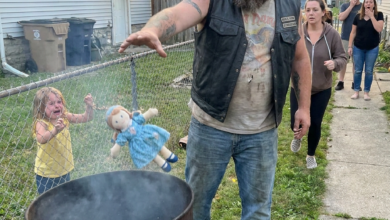
Bear did the same thing he’d done at the curtain. He raised one massive tattooed hand. Held it there. Didn’t move toward her.
Lily took one step onto the porch.
The other seven men, without a word, all sat down. On the lawn. On the driveway. On the porch steps. They made themselves smaller. Bear stayed standing because he was the one she was looking at, but he sat down on the bottom porch step, which still put him a head taller than she was.
She walked to him. Slowly. One step every couple seconds. Apple the horse trailing behind her like a pull-toy.
When she got to him, she stopped about two feet away.
He didn’t reach for her. He didn’t speak first. He waited.
She said, in a voice almost too small to hear: “Are you here for me?”
Bear’s voice came out the way I imagine boulders sound when they talk.
“Yes, ma’am. We are.”
She thought about that. Then she said: “Why?”
“Because you got somethin’ hard to do,” Bear said. “And nobody should do hard things by themselves.”
She looked at the seven men sitting on her lawn. She looked back at Bear.
“All of you?”
“All of us. From now until you tell us we can go home. And maybe a while after that.”
She held out Apple the horse to him. He took the stuffed animal in his enormous tattooed hand like it was a live grenade — careful, two fingers, like he was afraid of bending it. He looked at the horse. He looked at her.
“Apple,” she said. “He’s brave.”
“He sure is, ma’am.”
“You can hold him.”
“I’d be honored.”
She climbed up onto the porch step next to him. Not in his lap. Just next to him. Their shoulders almost touched. She was the size of one of his thighs.
Then she said the thing that made my sister, watching from the doorway, sit down on the floor and cry into her own hands.
“You smell like my grandpa.”
Bear closed his eyes for a second. When he opened them, he said, “Lotta us smell like somebody’s grandpa, ma’am. It’s the leather.”
She nodded seriously. Then she leaned her small purple shoulder against his enormous tattooed one.
The other seven men on the lawn pretended not to be watching. I noticed the one closest to me — younger guy, maybe thirty, road name Diesel, sleeves of ink, a daughter’s name across his throat — was wiping his eyes with the back of his wrist.
Bear sat there with that stuffed horse in his hand for two hours.
Lily fell asleep against his arm at one point. He didn’t move. He sat in the August sun with sweat running down his temples into his beard and a six-year-old asleep on his shoulder and a stuffed horse named Apple in his lap.
That was Monday.
Tuesday was court.
The Pima County Courthouse in downtown Tucson is a beige stone building with a domed ceiling and bad acoustics. We arrived at 8:30 a.m. for a 9:00 hearing. The eight bikes pulled up in formation behind my sister’s Honda Civic. They parked in a perfect chrome line at the curb in front of the courthouse, and every single person on that sidewalk stopped what they were doing to watch.
Bear got off his bike first. Walked to our car. Opened the back door for Lily.
She climbed out holding Apple the horse with one hand and Bear’s enormous index finger with the other. The other seven formed a loose half-circle around her — not threatening, not crowding, just present. A wall between her and the world.
We walked into that courthouse like a parade.
The bailiff, a heavyset Latino man in his fifties with kind eyes, took one look at the eight cuts coming through his metal detector and his hand drifted toward his radio. Then he saw Lily in the middle of them, gripping Bear’s finger. He saw the stuffed horse. His hand came back down.
“Front row, gentlemen,” he said. “I’ll save you the seats.”
The defendant was already in the courtroom when we walked in. He was wearing a cheap grey suit. Clean-shaven. Hair combed. He looked, from the back, like somebody’s accountant. He turned his head when he heard us come in.
He saw Lily.
He smiled at her. Small. Familiar. The kind of smile that said remember me.
I watched Lily’s body go rigid. I watched her hand tighten on Bear’s finger so hard her knuckles went white. I watched her start to shake.
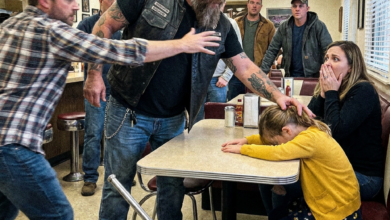
Bear did not react. Did not look at the defendant. Did not change his expression. He just very gently knelt down — 280 pounds of ex-Marine going to one knee on the courthouse floor — and put his face level with hers.
He said, very quietly: “From right now until you walk out that door, that man cannot touch you. He cannot hear you unless you let him. He cannot see you unless you let him. You’re gonna sit on that stand. You’re gonna look at the judge or you’re gonna look at me. You don’t have to look at him. Not once. Not ever again.”
She was nodding without realizing she was nodding.
“And if you get scared up there, baby girl — and you might — you find my eyes. You look at me. I’ll be right here in this front row. I’m not goin’ anywhere. You hear me?”
“Yes,” she whispered.
He held out his enormous tattooed hand. She put her tiny one in it. He folded his fingers over hers — gently, the way you’d hold a bird.
Then he stood up. He walked her to the witness stand. He helped her up onto the chair. He set Apple the horse in her lap. He walked back to the front row and sat down directly in her sightline.
The judge entered. The court was called to order. The DA stood up.
“Lily, can you tell the court your name?”
Lily opened her mouth.
Nothing came out.
The DA waited. Lily’s lower lip started to tremble. Her eyes drifted — without her meaning to — toward the defense table. Toward him.
Her whole body locked.
You could feel the entire courtroom hold its breath. The defense attorney was already half-rising, already preparing to move for a mistrial, already knowing that a six-year-old who freezes on the stand is a six-year-old whose case falls apart.
I thought, sitting in that gallery, that we had lost.
I thought he was going to walk.
Bear, in the front row, did not say anything.
He did not whisper. He did not make a hand signal. He did not stand up.
He just very, very slowly nodded his head.
One time.
A small, deep, deliberate nod, the kind a man gives another man when something hard needs to be done. The kind a marine gives another marine before they go through a door.
Lily saw it.
Her eyes locked on his. The whole courtroom, the defendant, the judge, the lawyers — for that one second, none of them existed. There was a six-year-old girl on a witness stand, and there was a 280-pound biker in the front row, and there was one slow nod between them.
She nodded back.
She turned to the microphone. She wrapped both her small hands around Apple the stuffed horse. She took one breath.
And then she spoke.
She told the court her name. She told the court her age. She told the court, in the careful clear voice of a six-year-old who has been preparing for this for months, what the man at the defense table had done to her. She told all of it. She did not skip a single piece. She did not cry. She did not look at him. Once. Not one time.
Every time her voice started to waver, she looked at Bear in the front row. He nodded. Slow. Once. Every time.
The defense attorney cross-examined her for forty minutes and tried every trick they teach in law school to break a child’s testimony. He could not break her. She kept looking at Bear. Bear kept nodding.
When she was done, the judge — a sixty-something white woman with reading glasses on a chain — said, very quietly, “You may step down, sweetheart.”
The jury was out for less than three hours.
Twenty-five years. The maximum sentence under Arizona law.
The defendant did not look at Lily as they led him away. He looked at Bear.
Bear looked back. Not angry. Not triumphant. Just — present. Witnessing.
It was, somehow, worse than anger.
We came out of the courthouse into hot August sun and a small crowd of local reporters with cameras. The eight bikers formed up around us automatically. Bear took Lily’s hand again.
Halfway down the courthouse steps, Lily stopped walking.
She let go of Bear’s hand.
She walked back up two steps so she was eye-level with him. She set Apple the horse very carefully on the stone railing. She put her two small hands on either side of Bear’s bearded face — she had to stretch up on her toes to reach — and she pulled his face down toward hers.
Then she kissed him on the forehead. Very serious. Very careful. The way a queen might knight a soldier.
She said: “I’m not scared anymore.”
Bear had stood through three combat tours. Bear had carried a wounded squadmate for two miles in Fallujah. Bear had buried a brother from his unit two years ago and not shed a tear at the funeral. Bear, by his own admission, had not cried since his mother’s funeral in 2004.
Bear cried.
Not pretty. Not quiet. He sat down hard on the courthouse step and he put his enormous tattooed hands over his face and he sobbed. The kind of sobbing that comes up from somewhere very deep and very old, where it has been waiting forty years.
The other seven bikers formed a circle around him. Backs to him. Facing outward. Blocking the cameras. Two of them were crying too, openly, and didn’t care who saw.
Lily climbed into Bear’s lap. She put her small arms as far around his neck as they would go. She didn’t say anything. She just held on.
My sister was standing next to me with her hand over her mouth. I was not in much better shape myself.
I did not understand, in that moment, why a 280-pound ex-Marine had broken open like that on a courthouse step. I thought maybe it was the relief. I thought maybe it was the verdict. I thought maybe a man can only carry a little girl’s terror for forty-eight hours before something gives.
I was wrong.
The reason was older than me. Older than my sister. Older than Lily’s whole life put together.
The next morning, before he and the other seven rode out, Bear came back to my sister’s house alone.
He sat at her kitchen table. He drank a cup of coffee, black. He set a creased photograph on the table between them.
It was a black-and-white school picture from the late 1970s. A small boy, maybe six years old, missing a front tooth, with a serious expression and a bowl haircut. He was wearing a striped T-shirt.
“That’s me,” Bear said. “Spring of 1984. Three weeks before I sat where Lily sat yesterday.”
He told my sister the rest of it in a voice flat as an old highway.
His mother’s boyfriend. Eighteen months. Bear had been six. He had sat on a witness stand in a courthouse in Bakersfield, California, in front of twelve strangers, and he had been told to tell them what had happened. There had been no BACA in 1984. No bikers in the front row. No one to nod for him.
He had frozen. He had not been able to speak.
The man had walked.
The man had come back to their apartment that same night.
“I do this now,” Bear said, “because nobody did it for me.”
He folded the photograph. Put it back in the inside pocket of his cut, over his heart.
“That picture’s been in my vest since the day I joined BACA. I look at him before every kid we take. I tell him — not this one, brother. Not this one.“
He drank the rest of his coffee.
He stood up.
“Tell Lily I’ll be at her birthday party in November. Bear don’t miss birthdays.”
He walked out my sister’s front door. The Harley fired up in the driveway, that low rolling thunder. He pulled out onto Speedway Boulevard heading east, toward the chapter house on the other side of town.
We watched him until the taillight disappeared.
That was nineteen months ago.
Lily is almost eight now. She sleeps through the night. She takes horseback riding lessons every Saturday morning at a stable outside Tucson, and her instructor — a tough sixty-year-old woman who’s seen everything — said last spring that Lily is the most fearless little rider she’s worked with in years.
Bear came to the seventh birthday party in November. So did Diesel, and Ghost, and a younger guy named Prospect who had his road name two months later. Three Harleys lined up in front of my sister’s house. Three enormous men sitting cross-legged on her living room floor playing tea party with seventeen first-graders and a stuffed horse named Apple. Diesel let a six-year-old paint his fingernails sparkly purple. He wore the polish for a week.
Bear comes once a month, even now. Sometimes he just sits on the porch with my sister and drinks coffee. Sometimes he and Lily ride bikes — Lily’s purple bike with the tassels, Bear walking beside her holding the back of the seat the way fathers do.
Apple the stuffed horse rides on Bear’s gas tank when Lily isn’t using him, strapped down with a small bungee cord. Bear says it’s good for the horse to see the country.
There’s a small framed photograph on Lily’s nightstand now. She picked it out herself. It’s the courthouse step, the day of the verdict — somebody from the local news caught it before the seven turned their backs to block the cameras.
A 280-pound biker, sitting on a stone step, weeping into his hands.
A six-year-old girl in his lap with her arms around his neck.
Lily kisses the picture every night before she turns off the light.
She told me last summer, when I was visiting, what she was thinking when she did it.
“He nodded for me, Aunt Mara. So I had to nod for him.”
I asked Bear once, on his last visit, what the photograph in his vest is for.
He’d been sitting on my sister’s porch. The Harley was cooling at the curb. Lily was inside doing homework with a glass of milk.
He thought about it for a long time.
Then he said, “So the kid in the picture knows I came back for him.”
He finished his coffee. He stood up. He clapped me once on the shoulder — the kind of clap that almost knocked me off the porch — and he walked to his bike.
The engine fired up. That low rolling thunder.
He lifted two fingers off the bars without looking back.
A biker’s wave.
He rode east on Speedway, toward the next kid who needed a nod.
❤️ If this story moved you, please follow our page for more real stories about the men everyone misjudges and the children they quietly carry. We post a new one every week. And if you want to learn more about the real organization that does this work, look up Bikers Against Child Abuse — BACA. They are not fiction. They show up.