A Tattooed Old Biker Grabbed a Teen’s Phone After He Knocked a Pizza Box Into the Rain — Then Everyone Learned Whose Final Meal Was Inside
PART 2 — MISUNDERSTANDING GETS WORSE
By the time the police officer arrived, Mason Trent’s video had already gone through three group chats, two school parent threads, and one local community page.
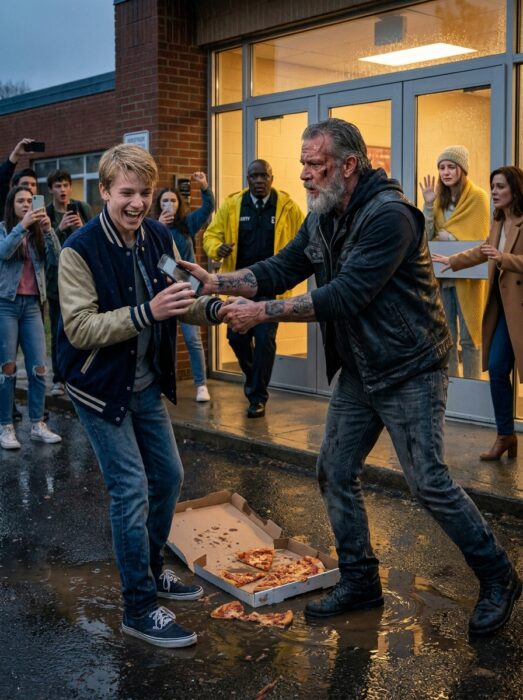
The first clip was only fourteen seconds long. It began exactly where it needed to begin if the world wanted a villain. Ray Maddox, soaked in rain and leather, grabbed Mason by the varsity jacket and took his phone. Mason stumbled against the column. Girls screamed. A pizza box lay ruined on the pavement. Someone shouted, “He’s attacking him.” The clip ended before Ray let go.
That was all people needed.
The caption wrote the judgment for them.
Old biker delivery guy assaults Westbrook student after pizza prank.
It did not show Mason blocking the path. It did not show Mason’s foot striking the box. It did not show the thin girl in the doorway with the yellow blanket, or the way Ray’s face had broken when she whispered the wrong name. It did not show the receipt, soaked nearly unreadable, folded in Ray’s fist like a piece of someone’s heart.
Officer Dana Whitfield, a white American woman in her early forties with dark hair tucked under her police cap and patient, tired eyes, stepped into the school courtyard without rushing. Rain ran off the brim of her hat. She looked first at the students, then at Mason, then at Ray, then at the ruined pizza. Good officers learn early that the loudest story is rarely the first truth.
Claire Trent reached her before anyone else could.
“My son was attacked,” she said. “That man grabbed him and stole his phone.”
Mason stood beside her, rubbing the front of his jacket as if Ray had bruised him badly. He was not hurt. He was humiliated. To a boy like Mason, whose world had always softened around him, humiliation felt like injury.
Ray remained near the pizza box, silent. His leather vest dripped onto the sidewalk. His hands were open now, except for the phone in one and the wet receipt in the other. The skull tattoo on his right forearm looked darker in the rain, and the scar across his left eyebrow made his expression seem harsher than it was.
Officer Whitfield asked, “Whose phone?”
“Mason’s,” Claire said.
“Why do you have it?” the officer asked Ray.
“Evidence,” Ray said.
Claire gave a bitter laugh. “Evidence of what? A pizza?”
Ray did not answer.
That silence made him look guilty.
Darnell Price, the security guard, stepped carefully between them. He was Black American, forty-eight, broad but not nearly as broad as Ray, wearing a navy school security jacket and the expression of a man trying to protect both a student and the truth without losing his job.
“I saw him holding the boy,” Darnell said. “But I didn’t see what happened before that.”
Mason snapped, “He came at me out of nowhere.”
A few students nodded too quickly.
Not because they had seen it. Because belonging to Mason’s circle had always been easier than standing outside it.
Near the school doorway, Emma Callahan still stood wrapped in the yellow blanket. The nurse from the school’s event room, a Black American woman in her fifties named Patrice Howard, had one steady hand behind Emma’s back. Emma was sixteen, white American, small from months of illness, with soft brown eyes, a knit cap covering the hair treatment had taken, and the stunned look of someone who had been waiting for something precious and watched it hit the ground.
Patrice whispered, “Emma, let’s sit down.”
Emma did not move.
Her eyes stayed on Ray.
“Why did you call him Riley?” Patrice asked softly.
Emma blinked, as if she had forgotten she said it aloud. “I didn’t mean to.”
Ray heard her. His shoulders tightened.
Mason saw Emma watching and rolled his eyes. “Great. Now he’s got sick kids involved.”
Ray turned toward him then.
Not fast. Not violently.
Just enough that Mason stopped talking.
Officer Whitfield noticed the shift. “Mr. Maddox, I need you to give me the phone.”
Ray held it out immediately. “Don’t let him delete it.”
Mason’s face changed.
It was quick, but not quick enough.
Claire saw it too, and irritation flickered in her eyes. Not suspicion yet. Just the annoyance of a mother realizing her son might have been less innocent than the version she had already defended.
Officer Whitfield took the phone. “Passcode?”
Mason folded his arms. “I don’t have to.”
“You don’t have to,” she said. “But if this contains video of what happened before the alleged assault, refusing to preserve it may make things more complicated.”
Mason looked at Claire.
Claire’s confidence wavered.
A white American school administrator named Dennis Hargrove hurried outside under a black umbrella. He was in his late fifties, thin, nervous, and wearing a gray suit that looked too expensive for his courage. “Officer, I’m sure we can handle this internally. Mason is one of our student ambassadors.”
Ray let out one low sound.
Not quite a laugh.
More like disbelief with teeth.
Dennis looked at him with the careful contempt people use when they want to seem professional. “Sir, you are a delivery driver on school property. You do not get to decide how we handle our students.”
Ray looked down at the receipt in his hand. The ink had started to bleed. He unfolded it and read the line again, though he already knew every word.
For Emma. Like her dad promised.
Then he looked at Dennis.
“I’m not here for your student,” he said. “I’m here for hers.”
He nodded toward Emma.
The courtyard went still in a different way.
Emma’s face crumpled, but no one knew why.
PART 3 — FIRST HIDDEN CLUE
The first hidden clue came from the pizza shop.
Rocco’s Pizza sat five blocks from Westbrook Academy in a narrow brick storefront between a laundromat and a barber shop. It was not fancy. The red sign buzzed in damp weather, the counter leaned slightly to the left, and the delivery map on the wall had been taped together so many times it looked like a battlefield. But everyone in the neighborhood knew Rocco’s made the kind of pizza people ordered when they wanted comfort more than style.
Officer Whitfield called the shop from the courtyard while Darnell kept the students back.
The owner answered on the second ring.
Rocco Benedetti was a fifty-eight-year-old Italian American man with a gravelly voice, a white apron, and a temper that usually stayed behind the pizza oven until someone insulted his drivers. When Officer Whitfield explained the situation, his tone changed from irritated to alarmed.
“That order was not for the school,” Rocco said.
Whitfield put him on speaker.
Claire folded her arms. Mason looked at his shoes. Ray stared into the rain.
Rocco continued, “That was a personal order. Special. Paid in advance. Ray was doing me a favor.”
Dennis Hargrove frowned. “Then why was it delivered here?”
Rocco hesitated. “Because Miss Callahan asked to meet in the nurse’s room after the banquet. She wanted one last Westbrook memory.”
Emma closed her eyes.
The phrase one last made the adults look at her differently, though nobody was ready to understand it yet.
Patrice Howard guided Emma to a bench under the awning. The girl sat slowly, blanket pulled around her shoulders, rain misting the toes of her sneakers. She looked less like a dramatic figure now and more like what she was: a sick teenage girl who had tried to attend one school event and was already paying for it with exhaustion.
Ray finally spoke into the phone. “Rocco, don’t say more.”
His voice had changed.
It was not commanding now. It was pleading.
Rocco went quiet.
Officer Whitfield looked at Ray. “Why?”
Ray’s eyes moved toward Emma. “Because it’s hers to tell.”
That was the first moment the crowd began to doubt its own story.
A man who wanted to play victim would have explained everything loudly. A man trying to protect a girl’s dignity would hold back even when silence made him look worse.
Marisol Vega, a Latina American waitress from Rocco’s, arrived ten minutes later in a green raincoat, carrying a thermal bag hugged against her chest like an infant. She was twenty-seven, dark-haired, sharp-eyed, and out of breath from running half the way. Behind her came Rocco himself in a soaked apron, holding a second pizza box above his head under a plastic sheet.
“I made another one,” he said, stepping into the courtyard. “Same order. Half pepperoni, half pineapple, extra basil, crust brushed light because she said her dad hated dry crust.”
Emma pressed a hand over her mouth.
Ray turned away.
Claire looked confused. “Her dad?”
Mason whispered, “This is crazy.”
Rocco heard him. “You knocked over a pizza made for a girl in hospice care, kid. Crazy is a polite word.”
A hard silence followed.
Hospice care. The phrase did not shout. It did not need to. It moved through the courtyard like cold water under a door.
Emma looked down, cheeks flushing with humiliation. She had not wanted the word spoken in front of classmates. Her illness had already taken hair, energy, privacy, and ordinary plans. Now it was taking the last fragile wall between her and their pity.
Ray saw her shrink.
His face darkened.
Not at Rocco, exactly. At the moment itself. At the way truth, even necessary truth, can bruise when it lands in public.
Emma whispered, “Please don’t make everyone look at me.”
That sentence hit harder than any accusation against Ray had.
Darnell immediately turned to the students. “Phones down. Now.”
Some obeyed.
Some did not.
Mason’s friend, a Black American boy named Jalen Reed, seventeen, lowered his phone slowly. He had been laughing earlier, but now his face looked sick. His mother had died of cancer when he was twelve. The word hospice had opened a door in him he had not expected to find in a school courtyard.
He looked at Mason. “Bro, what did we just do?”
Mason snapped, “I didn’t know.”
Ray looked at him. “You didn’t ask.”
The line cut through the rain.
Marisol handed the thermal bag to Ray, but he did not take it immediately. His hands were wet, dirty from the pavement, and trembling slightly. He looked at Patrice.
“Can she eat?” he asked.
Patrice checked Emma’s face, then the small medical bag at her side. “A little. If she wants.”
Emma looked at the second pizza box. Her eyes filled.
Then she said something that confused everyone except Ray.
“Did he write the lid?”
Rocco swallowed.
Ray closed his eyes.
Marisol slowly lifted the plastic sheet from the box. On the cardboard lid, written in black marker before the rain could touch it, was one sentence.
For my girl, from Dad’s favorite liar.
Mason frowned. “What does that even mean?”
Ray’s voice came out rough.
“It means I kept a promise I had no business surviving.”
PART 4 — TRUTH BEGINS TO TURN
The truth began turning on Mason’s phone.
Officer Whitfield did not need to force drama out of the footage. Once Mason unlocked the device under his mother’s glare and the officer’s instruction not to delete anything, the full video did what full truth often does: it made everyone smaller.
It started before the viral clip.
Mason and his friends stood under the awning, laughing at the rain, filming girls leaving the banquet, mocking teachers, calling passing cars “mid” and “broke” as if cruelty were just another language of status. When Ray’s Harley rumbled into the curb lane, Mason zoomed in on him immediately.
“Look at this,” Mason said in the recording. “Sons of Arthritis delivering pizza.”
His friends laughed.
The camera followed Ray as he lifted the red insulated bag and checked the receipt twice, shielding it from rain with one huge hand. He was not bothering anyone. He was not performing. He was an old biker in a storm, carrying a delivery carefully because it mattered to him.
The video caught the next part clearly.
Mason stepped in front of him.
Ray moved right. Mason moved right.
Ray moved left. Mason blocked him again.
Then Mason said, “Say something scary, pizza grandpa.”
Ray tried to pass.
Mason kicked the box.
There was no accident. No misunderstanding. No playful bump. The foot moved deliberately. The pizza fell. Steam vanished into rain. Students laughed. Emma appeared in the doorway at almost the same moment, fragile and stunned, just in time to watch the box hit the pavement.
Then Ray grabbed Mason’s jacket.
From the cropped clip, it looked like attack.
From the full clip, it looked like grief reacting faster than words.
The awning crowd went silent as the footage played.
Claire Trent’s face lost color.
Mason looked younger now, not because he was innocent, but because consequence had stripped away performance. He stared at the ground, jaw clenched, refusing to cry because boys like him often mistake tears for losing. His friends stood around him, no longer united by laughter.
Emma watched only the first few seconds, then turned away.
She had already lived it.
She did not need the replay.
Ray stood beside the second pizza box, hands at his sides. He did not look triumphant. He did not ask Mason to apologize in front of everyone. He did not say, “See?” He only glanced at Emma every few moments, as if checking whether the truth was hurting her more than the lie had.
Officer Whitfield handed Mason’s phone back to Claire after documenting the video. “This needs to be handled by the school and by parents. Mr. Maddox should not have grabbed your son, but your son created the incident and then allowed a misleading clip to spread.”
Claire’s lips parted.
For a moment, she seemed ready to argue.
Then she looked at Emma.
The fight drained out of her.
“I’m sorry,” Claire said, though she said it first to the officer, not yet to Emma or Ray. Shame often reaches the safest target before the person who deserves the apology most.
Dennis Hargrove cleared his throat. “Westbrook Academy will address the student conduct.”
Darnell looked at him sharply. “And the phones?”
Dennis blinked.
Darnell’s voice hardened. “They filmed a sick student and a delivery worker being humiliated on school property. That needs addressing too.”
Several students lowered their eyes.
Emma pulled the yellow blanket tighter. She was embarrassed by pity, angry at the attention, and still hurt that people had laughed before they understood. She had a right to all of it. Being sick did not make her automatically forgiving. It did not turn pain into a lesson for other people to feel better about themselves.
Ray seemed to know that.
He approached only halfway and stopped.
“Emma,” he said, “you don’t have to eat out here.”
Her eyes lifted.
“I wasn’t going to,” she whispered.
“I know.”
“You were late.”
Ray accepted the hit. “I know.”
“My pizza fell.”
“I know.”
She looked at Mason, then at the students, then back at Ray. “Everybody saw.”
Ray’s jaw tightened. “Yeah.”
For the first time, anger entered her voice. “I didn’t want everybody to know.”
The courtyard went quiet.
Ray did not defend himself with the second pizza, the promise, or the rain. He did not say he had tried. He did not say Mason was to blame. He only looked at her like a soldier receiving orders from someone he respected.
“You’re right,” he said. “I’m sorry.”
Emma blinked.
She had expected apology from Mason, maybe from the school, maybe from adults trying to smooth things over. She had not expected Ray to apologize for the part he could not control simply because she had been hurt by it.
That made her eyes fill again.
Rocco stepped forward gently. “Miss Emma, I can bring it to the nurse’s room. Nobody else needs to see.”
Emma looked at the pizza box.
Then at the writing on the lid.
For my girl, from Dad’s favorite liar.
Her voice trembled. “He really used to call you that?”
Ray looked at the rain beyond the awning.
“Every time I said I wasn’t scared,” he said.
That was the first piece of the deeper truth.
PART 5 — BIKER’S PAST / DEEPER TWIST
Ray Maddox had once been the youngest man in his unit and the loudest liar in every room.
Not dishonest in the cruel way. More in the way frightened men joke too quickly so fear does not find a chair. He said he was fine when he was not. He said he was not scared when everyone could see his hands shaking. He said the food was decent, the weather was nothing, the mission was routine, the pain in his leg was just a bruise, and the letter from home had not made him cry. He lied so often about his own fear that his closest friend, Staff Sergeant Riley Callahan, started calling him “my favorite liar.”
Riley was a Black American man from Louisville, tall, calm, with a gentle voice and a laugh that made younger soldiers feel less doomed. He had a daughter named Emma back home, a baby then, round-cheeked and serious-eyed in every photo. Riley kept her picture tucked inside a plastic sleeve behind his identification card. He told stories about her first steps, first tooth, first time she threw mashed peas at the wall like an act of protest.
Ray listened to those stories during the worst months of his life.
He was twenty-three then. He had tattoos half-finished, anger fully formed, and no real family waiting except a brother he barely spoke to and a mother whose love had been swallowed by pills, men, and apologies. Riley became what some people become in hard places: not a replacement for blood, but something steadier in the moment. A brother chosen under pressure.
There was one pizza story Riley told more than any other.
Before deployment, he had taken toddler Emma to Rocco’s Pizza on Bardstown Road. She had eaten only pineapple off her slice, then yelled “more yellow” until the owner brought a little bowl of pineapple chunks just to make her stop charming the dining room. Riley said when he got home, he was going to take her there every birthday until she was too cool to be seen with him.
“If I don’t make it,” Riley once told Ray during a night neither man slept, “you take her. Not some sad ceremony. Not speeches. Pizza. Half pepperoni, half pineapple. Extra basil because I’m classy. Light crust because dry crust is disrespectful.”
Ray told him to shut up.
Riley smiled. “See? Favorite liar.”
Riley did not come home.
The details did not need to be replayed in anyone’s courtyard. It was enough that one day there had been two men sharing bad coffee and future plans, and the next day Ray was the one carrying a letter he had never wanted to deliver. He survived with a scar on his thigh, a ringing in one ear, and a guilt so large it seemed to ride behind him on every motorcycle he owned.
For years, he kept his distance from Emma.
That was his first failure.
He sent birthday cards without return addresses. He mailed grocery gift cards to Riley’s widow when he heard she was struggling. He paid Rocco to send anonymous pizza vouchers every year on Emma’s birthday. But he did not show up in person because he believed his face would bring only the worst day of Riley’s life into their living room.
Then Riley’s widow, Denise Callahan, died when Emma was thirteen.
Cancer, quick and merciless.
Emma moved between an aunt’s apartment, school programs, and the fragile network of adults who loved her but could not erase the absence piling up around her. Ray attended the funeral from the back of the church and left before anyone could ask who he was. Emma saw him anyway. A large man in leather standing near the exit, crying into his helmet.
Later, she found one of Riley’s old letters.
In it, her father had written about Ray.
He called him brave when he stopped lying.
That sentence stayed with Emma.
She eventually found Ray through Rocco, because old pizza men know everything and pretend they do not. At first she sent a note through the shop: Are you Dad’s favorite liar? Ray sat behind Rocco’s kitchen for twenty minutes holding the paper before he could breathe right.
After that, they built a strange, careful friendship.
Not father and daughter. Not uncle and niece. Something harder to name. A living witness and the child of a dead friend. Ray took her to Rocco’s on Riley’s birthday the first year. She ordered pineapple and pretended not to cry. He told her stories about Riley that did not sound like memorial speeches: how he burned coffee, hated wet socks, sang badly, and once mailed home a postcard with nothing but “your dad is still handsome” written on it.
Emma loved those stories because they gave her back a human father instead of a framed hero.
Then Emma got sick.
At fifteen, the diagnosis came with long hallways, specialists, treatment plans, and adults lowering their voices. Ray wanted to help too much and knew too little. He rode her to appointments when she was strong enough. He sat in waiting rooms with his helmet in his lap. He delivered pizza when she could not leave the house. He learned which days she wanted stories and which days silence was kinder.
When the doctors shifted from cure to comfort, Emma asked for one strange thing.
She wanted to attend the Westbrook Academy banquet for one hour.
She had been on scholarship there before illness pulled her away from normal life. She wanted to see the building again. She wanted to wear something besides pajamas. She wanted Rocco’s pizza in the nurse’s room afterward because her father had loved the place, and because Ray had promised Riley half pepperoni, half pineapple long before Emma knew how to say either word.
The doctors allowed a narrow window with restrictions.
No crowding. No long exposure. No public drama. No stress if possible.
Ray almost laughed when Patrice told him that last part. No stress if possible. As if life had ever obeyed a medical note.
But he promised.
He promised Emma, Rocco, Patrice, and the ghost of Riley Callahan that the pizza would arrive hot, quiet, and on time.
Then Mason Trent kicked it into the rain.
Ray did not grab the boy because of pride. He did not snatch the phone because he hated being mocked. He had been mocked by better men, meaner men, drunker men, and strangers in nicer shoes for forty years. He grabbed the phone because it showed Emma’s face. He grabbed Mason because the boy was stepping toward the receipt, laughing, about to smear mud over the only written note Ray had from that final order.
And maybe, beneath all of that, he grabbed him because for one terrible second, he was twenty-three again, watching something promised to Riley become impossible to protect.
PART 6 — PUBLIC REVERSAL / EVIDENCE
The full story did not become public all at once because Emma did not want to become a lesson.
That was the first boundary everyone had to learn.
Westbrook Academy wanted to issue a statement. Claire Trent wanted to arrange an apology in front of the courtyard. Dennis Hargrove wanted something polished enough to calm parents and protect the school’s reputation. Rocco wanted to yell at every teenager under the awning until his blood pressure became a medical event. Ray wanted to disappear, deliver the second pizza, and never hear the word viral again.
Emma wanted the nurse’s room.
So that was where the truth went first.
Patrice Howard led Emma inside through a side hall, away from the students and parents. Rocco carried the second pizza. Ray followed three steps behind, his boots squeaking on the polished school floor. Darnell walked with them, not as security now, but as a witness making sure no one else shoved a camera into the girl’s last normal hour.
The nurse’s room had soft lamps, a cot with a clean blanket, a sink, a locked medicine cabinet, and one small round table Patrice had covered with a paper cloth. She had placed two paper plates, napkins, and a little vase of silk daisies near the window. It looked humble and careful. That made Ray’s chest hurt more than a banquet hall would have.
Emma sat slowly.
The yellow blanket slipped around her shoulders.
Ray placed the pizza box on the table but did not open it. “You want me to go?”
Emma looked at him. “No.”
He nodded.
She touched the writing on the lid.
For my girl, from Dad’s favorite liar.
Her lips pressed together.
Rocco turned away and pretended to check the napkins.
Patrice checked Emma’s breathing, then gave her space. Darnell stood near the door, back straight, jaw tight, still furious at what the students had done but wise enough not to put that fury in Emma’s room.
After a moment, Claire Trent appeared in the hallway with Mason beside her.
Ray stepped toward the door.
Emma lifted one hand. “Let them come in.”
Ray stopped.
He did not like it. Anyone could see that. But he had spent years learning that protecting someone did not mean deciding every hard thing for them. He stepped aside.
Mason entered looking smaller than he had outside. Without the laughing group around him, without the rain and phones and varsity confidence, he was just a seventeen-year-old boy who had done something cruel and was beginning to understand that cruelty does not stay small because you meant it as a joke.
Claire stood behind him, pale and stiff.
Mason looked at Emma. Then at Ray. Then at the pizza box. His mouth opened twice before words came.
“I’m sorry,” he said.
Emma looked at him for a long time. “For what part?”
The question surprised him.
“I,” he started, then stopped. “For kicking it.”
She waited.
“For filming him.”
She still waited.
“For making people look at you.”
Her eyes filled, but her voice stayed steady. “That’s the part I hated most.”
Mason looked down.
Claire covered her mouth.
Ray stared at the floor because if he looked at Mason too long, he might forget the boy was still a boy.
Emma said, “I don’t forgive you yet.”
Mason nodded. “Okay.”
“But you can help fix one thing.”
He looked up.
“Delete the video from everywhere you sent it,” she said. “And tell them why without using my diagnosis like gossip.”
Mason swallowed. “What do I say?”
Emma touched the pizza lid again. “Say you laughed before you asked.”
That sentence became the official reversal more than anything the school could write.
Mason posted it with the full beginning of his video, after Officer Whitfield and the school blurred Emma’s face and removed identifying medical details. The caption was not polished. That made it better.
I laughed before I asked. I kicked a pizza delivery from a man who was keeping a promise. I made a sick classmate feel watched when she wanted privacy. I was wrong. Delete the first clip if you shared it.
It did not fix everything.
Some students mocked the apology. Some adults turned it into a debate about kids these days. A few strangers tried to dig for Emma’s identity until Westbrook parents, for once, did something useful and shut it down. The school suspended Mason from student ambassador duties and required restorative meetings with Darnell, Patrice, and the scholarship office. None of it felt dramatic enough for the internet, but real accountability often looks like paperwork, awkward rooms, and long silences.
Inside the nurse’s room, Emma ate two small bites of pizza.
That was all.
But she smiled at the pineapple.
Ray noticed.
So did Rocco.
Emma leaned back, exhausted, and said, “Tell me the wet socks story.”
Ray closed his eyes briefly.
Riley’s wet socks story had become her favorite. It involved a training exercise, a flooded tent, and her father swearing he would rather fight a bear than spend one more hour with cold feet. Ray told it badly on purpose because Riley had told it badly too. Emma laughed once, softly, and the room seemed to shift around that sound.
Mason heard the laugh from the hallway.
That was the moment he cried.
Not when he got caught. Not when he apologized. When he realized the thing he had almost ruined was not pizza. It was a dead father becoming real again for two bites and one story.
Ray stepped into the hallway after Emma fell asleep on the cot.
Mason stood there with his hands in his pockets, face blotchy, eyes wet.
“I didn’t know,” Mason whispered.
Ray looked at him. “Most harm starts that way.”
Mason nodded.
Ray handed him the wet receipt, now sealed in a plastic sleeve Patrice had found. “Read it.”
Mason read the back.
For Emma. Like her dad promised.
His face folded.
Then Ray said the line that would stay with him longer than punishment.
“Next time you see somebody doing a job in the rain, assume there’s a reason they kept going.”
PART 7 — EMOTIONAL PAYOFF / FINAL TWIST
Emma died nine days later.
Not in the school courtyard. Not in the rain. Not in the middle of the viral story strangers wanted to own. She died at home on a quiet Tuesday morning, with her aunt beside her, Patrice holding one hand, and Ray sitting near the window with his helmet in his lap. Rocco had delivered a small box the night before, not pizza this time, just garlic knots because Emma said they smelled like better days.
The news did not go online immediately.
That mattered.
For once, the people around Emma let a girl be a girl before making her a story. Her aunt called the school. Patrice called Rocco. Ray rode to an empty parking lot and sat on his Harley for an hour under a gray sky, one hand on the gas tank, the other holding the folded pizza receipt. He did not cry loudly. He had never been good at loud grief. He simply sat there while traffic moved around him and the world continued with its ordinary cruelty of not stopping.
The funeral was small.
Emma had requested no speeches about bravery. She said bravery was a word adults used when they did not know what else to say to sick kids. She wanted music her father used to play, daisies on the table, and Rocco’s pizza afterward for anyone who could handle pineapple without making a face.
Ray wore his leather vest over a clean black shirt.
The vest looked wrong in the church until people understood it had been Riley’s first, passed to Ray after deployment, patched and repaired over the years until it carried both men’s miles. On the inside lining, hidden where nobody could see unless Ray opened it, Riley had written Emma’s baby initials in black marker years ago.
E.C.
Emma Callahan.
Ray stood at the back because that was where he knew how to survive funerals.
Mason Trent came with his mother.
Nobody had asked him to. In fact, Claire had hesitated for days, unsure whether their presence would comfort anyone or reopen harm. Mason insisted. He wore a dark suit that looked borrowed from a future he had not earned yet. His blond hair was combed badly. His eyes stayed red through the service.
Afterward, in the church basement, people gathered around folding tables. There were paper plates, coffee urns, a bowl of pineapple chunks Rocco placed beside the pizza like an apology and a joke at the same time. Ray stood near the wall, holding a paper cup he never drank from.
Emma’s aunt, a white American woman in her late forties named Karen Callahan, approached him with a small envelope.
“She left this for you,” Karen said.
Ray looked at the envelope but did not take it.
Karen understood. She placed it against his chest until his hand finally closed around it.
Inside was a photo.
Riley in uniform, young and laughing, holding baby Emma in one arm and a pizza slice in the other. On the back, in Emma’s careful handwriting, she had written:
He kept the first promise. You kept the last one.
Ray’s knees nearly failed.
He sat down hard in a metal folding chair.
Rocco took the cup from his hand before it spilled. Patrice turned away, wiping her eyes. Karen placed one hand on Ray’s shoulder, not to hold him up exactly, but to remind him he was not alone in the room.
Then Mason walked over.
He looked terrified.
Ray saw him and began to stand, but Mason shook his head.
“I need to give you something,” the boy said.
He reached into his suit pocket and pulled out a laminated card. It was the original delivery receipt, or what remained of it, dried carefully, flattened, sealed between two sheets. The ink had blurred at the edges, but the words on the back could still be read.
For Emma. Like her dad promised.
“I asked Patrice if I could help preserve it,” Mason said. “She said only if Emma’s aunt agreed. Mrs. Callahan said yes.”
Ray stared at the card.
Mason’s voice shook. “I know it doesn’t fix what I did.”
“No,” Ray said.
Mason nodded, accepting it.
“But it means you remembered,” Ray added.
That broke the boy.
He cried then, not like a child trying to escape punishment, but like someone who had finally understood that one careless moment can step on years of love. Claire stood behind him with tears on her face. She did not rush to save him from the discomfort. That was her growth, small but real. She let him feel what he needed to feel.
Ray took the laminated receipt.
For a while, he said nothing.
Then he reached into his own vest and pulled out something wrapped in a blue bandana.
It was a military coin, worn smooth at the edges, with Riley Callahan’s initials scratched faintly on one side. Ray had carried it for years. Through rain, rides, funerals, bad nights, and the day he delivered Emma’s final pizza. He turned it over in his palm, then placed it on the table beside the receipt.
Mason looked confused.
Ray said, “Riley gave me this after I lied and said I wasn’t scared.”
“What did he say?”
Ray’s mouth trembled into the smallest smile. “He said, ‘Keep this until you tell the truth faster than fear does.’”
Mason looked down.
Ray slid the coin toward him.
Mason stepped back. “I can’t take that.”
“You’re not keeping it,” Ray said. “You’re carrying it until you earn where to pass it.”
Mason stared at him.
“That means what?” Claire asked softly.
Ray looked toward the pizza boxes, toward the pineapple, toward the photo of Emma smiling beside her father. “It means every Friday after school, Mason rides with Rocco’s delivery van. No filming. No jokes. He carries meals to people who can’t come get them. Sick folks. Elderly folks. Families who need one warm box and don’t need to be made into content.”
Mason swallowed.
“You don’t have to,” Ray said. “But if you do, you carry the coin. When you understand why the job matters, you give it to somebody else who needs to learn.”
Karen looked at Ray with surprise.
Patrice smiled through tears.
Rocco wiped his face with his apron and muttered something in Italian that sounded like both grief and approval.
Mason picked up the coin.
This was not a perfect redemption. He was still the boy who kicked the box. He was still the reason Emma’s last school memory had been bruised by embarrassment. One kind gesture did not erase that. But it gave him a road to walk that was harder than apology and more useful than shame.
The first Friday, Mason delivered with Rocco.
No phone.
No varsity jacket.
Just jeans, a raincoat, and the coin in his pocket.
At the first stop, an elderly Black American woman with arthritis opened the door slowly and thanked him for carrying the box all the way to the kitchen table. At the second, a young Latino father holding a sleeping baby paid in change and looked embarrassed until Mason said, “You’re good, sir,” the way Rocco had taught him. At the third, they brought a small cheese pizza to a house with a medical ramp, and Mason held the box with both hands as if it might contain more than dinner.
By the fourth stop, he understood why Ray had kept walking in the rain.
Not fully.
Enough to begin.
Weeks later, Westbrook Academy started a quiet meal fund in Emma’s name. No cameras. No student ambassadors smiling beside boxes. No charity photos. Just prepaid orders from Rocco’s delivered to families on hard days. Emma’s aunt insisted on the rule. Ray enforced it with one sentence.
“If the meal needs a camera, it isn’t for them.”
The line became known around town.
Ray still delivered sometimes.
Not because he needed the money. Not because he had nothing else to do. Because some promises do not end when the person you promised is gone. They change shape. They become Friday meals, sealed receipts, pineapple in a separate cup, a coin in a teenager’s pocket, and an old biker riding through rain with his shoulders hunched against weather and memory.
One year later, on the anniversary of Emma’s final pizza, Mason found Ray outside Rocco’s, sitting on his Harley under the same kind of cold rain.
Mason was eighteen now, still young, still learning, but different in the eyes. He handed Ray a pizza box. On the lid, written in black marker, were the words:
For the next promise.
Ray looked at it.
Then at Mason.
The boy took Riley’s coin from his pocket and placed it in Ray’s palm.
“I think I know who needs it next,” Mason said.
Across the street, a new delivery kid stood under the awning, a skinny Black American fifteen-year-old named Andre, holding his first insulated bag, looking nervous about riding with Rocco in the rain. Mason nodded toward him.
“He’s scared,” Mason said. “But he’s trying to act like he isn’t.”
Ray closed his fingers around the coin.
For a moment, Riley was there. Emma too. Not as ghosts exactly, but as the kind of love that keeps moving through people long after the bodies are gone. Ray looked down at the pizza box, at the rain beading on the cardboard, and then at the road shining black under the streetlights.
He thought of Mason laughing before he asked.
He thought of Emma eating two bites and smiling at pineapple.
He thought of Riley calling him his favorite liar.
Then Ray stood, handed the coin back to Mason, and nodded toward Andre.
“You give it to him,” Ray said. “Promises mean more when they come from somebody who learned the hard way.”
Mason walked across the street.
Ray watched him go.
The rain kept falling, steady and cold, but the old biker did not move toward shelter. He picked up the pizza box, held it close beneath his vest, and looked once toward the gray sky as if reporting to an old friend.
“I got it there,” he whispered.
Then he smiled, rough and brief, and carried the next warm meal into the rain.
Follow this page for more unforgettable biker stories about misunderstood heroes, quiet kindness, and the rough-looking people who notice what everyone else misses.