A 290-Pound Biker Held a Tiny Pink Umbrella Over His Five-Year-Old Daughter for 45 Minutes—Then the Audience Learned What One Inch of Sunlight Could Do
Part 2
I had met Wade only twice before the recital.
The first time, he attended parent-teacher conferences wearing work boots, a plain charcoal shirt, and a leather vest he had not realized carried a streak of yellow road paint near the pocket. Other parents gave him room in the hallway.
June did the opposite.
She held one of his tattooed fingers and skipped beside him.
During our conference, Wade sat in a chair built for elementary students. His knees rose almost level with the table, and his shoulders hid half the bulletin board behind him.
I told him June had an unusually accurate ear for pitch.
He stared at me.
I thought he had not understood.
Then he asked, “That means she’s good?”
“It means she hears when a note is slightly wrong.”
“Gets that from her mother.”
He looked toward the classroom door, where his wife, Mara, waited with a small insulated bag containing June’s medication and cold packs.
Mara laughed. “He sings like somebody dropped a toolbox.”
Wade did not argue.
June had begun singing before she spoke in full sentences. According to Mara, she hummed along with the washing machine, copied the microwave’s finished-cycle tone, and turned every bedtime phrase into a melody.
At three, she developed unexplained red welts after ten minutes at a playground. Her pediatrician first suspected contact dermatitis. The family changed detergent, soap, fabric softener, and sunscreen.
Nothing fixed it.
During another outing, June began crying within minutes of leaving the car. Her exposed cheeks and hands burned, though the day was not especially hot.
A pediatric allergist later diagnosed solar urticaria, a rare condition in which certain wavelengths of light trigger an abnormal reaction in the skin. June’s episodes included burning, hives, swelling, and, during stronger exposure, dizziness and nausea.
The condition did not mean she could never go outdoors.
It meant going outdoors required planning.
UPF clothing.
Broad-spectrum mineral sunscreen.
Shade that moved with her.
Medication available under medical guidance.
Short exposure windows and immediate retreat if symptoms appeared.
Wade treated every outing like a pre-ride inspection. He checked sleeves, hat, gloves, medicine, water, and the position of the sun. He installed UV film on the family car and made removable shades for its side windows.
Inside his Harley’s right saddlebag, beside tools and a tire-pressure gauge, he carried a pink emergency pouch.
The pouch held June’s sunscreen, antihistamine, two cooling cloths, and a folded list of her symptoms.
Our second meeting occurred at a spring concert inside the auditorium. June sang with the kindergarten choir while Wade sat in the final row because his shoulders blocked anyone behind him.
When the children finished, he clapped once, hard, then stopped as if embarrassed by the sound.
June saw him anyway.
Her whole face changed.
That moment stayed with me when we had to relocate the year-end recital.
A plumbing failure had damaged the auditorium ceiling. The district closed the room while contractors tested for mold and replaced insulation. The cafeteria was unavailable because another school used it for summer meals.
The courtyard became our only practical option.
We scheduled the recital for 9:30 a.m., expecting lower temperatures. Then three things went wrong.
A bus transporting children from our partner preschool arrived forty minutes late. Our sound equipment overheated and shut down during testing. Finally, a volunteer accidentally erased the order of performances, forcing us to reconstruct it while families waited.
By the time the first choir sang, it was after eleven.
The temperature had climbed to 93 degrees and was still rising.
I should have stopped the program.
I didn’t.
Parents had taken time off work. Children wore costumes. Judges from the local arts council had arrived. We had water, emergency staff, and shade for much of the audience.
I kept telling myself we could finish quickly.
That was my mistake.
Wade and Mara had made their own difficult decision. They could have withdrawn June, but she had already missed two birthday parties, a zoo trip, field day, and an outdoor class photograph because of her condition.
Every precaution, however necessary, sounded to a five-year-old like another version of no.
No playground at noon.
No walking to the ice-cream truck.
No sitting beside the uncovered window.
No singing outside.
The morning of the recital, June placed her shoes beside Wade’s boots and said, “I don’t want the sun to pick everything.”
Wade knelt in front of her.
“I can’t make it stop being hot.”
“I know.”
“I can’t promise it won’t hurt.”
“I know.”
“What can I do?”
June brought him the pink umbrella.
“Hold my sky.”
That was why he came.
Not because he believed the umbrella alone made the situation safe. June wore protective layers beneath her dress, sunscreen had been reapplied, her mother carried medication, and both parents had agreed to remove her immediately if symptoms appeared.
The umbrella was the final moving barrier.
The problem was geometry.
The temporary stage stood eighteen inches above the courtyard lawn. June’s choir position placed her several feet from its edge, beyond the small umbrella’s reach.
Wade asked whether she could stand closer.
A volunteer objected because the front row had already been taped into position.
I told the volunteer to move the marker.
That solved one problem.
Then a judge complained that Wade would appear in photographs.
Wade heard her.
“I can move between songs.”
But if he moved, the shade moved.
Mara looked at me. Her face said what she was too polite to say aloud: You either understood the accommodation or you did not.
I told Wade to stay.
Ten minutes later, angry parents began demanding that he sit down.
And instead of explaining immediately, I asked him to lower the umbrella.
Part 3
Wade’s refusal embarrassed me.
That is difficult to admit, but it matters.
I stood beside a microphone in front of families who expected me to control the event. A massive biker had answered my instruction with one word—no—and dozens of eyes turned toward me to see what I would do.
Authority can make good people defend the wrong thing simply because they announced it publicly.
I nearly did.
“Mr. Halvorsen,” I said, “we discussed your daughter’s accommodation, but you cannot prevent other families from seeing.”
“Move them sideways.”
“That isn’t practical.”
“Neither is her skin.”
The father in the second row laughed, assuming Wade was making a joke.
Wade did not look at him.
Mara approached and quietly reminded me that June’s reaction could begin within minutes. She showed me the medical plan again. Direct exposure might cause hives and severe burning; widespread reactions could produce dizziness or breathing symptoms requiring emergency care.
My stomach dropped.
I had read the words.
I had not imagined the experience.
That difference nearly ended June’s performance before it began.
We shifted two rows of chairs several feet to the right. It took less than three minutes. The parents who had complained could now see around Wade, though a few continued filming him.
The program resumed.
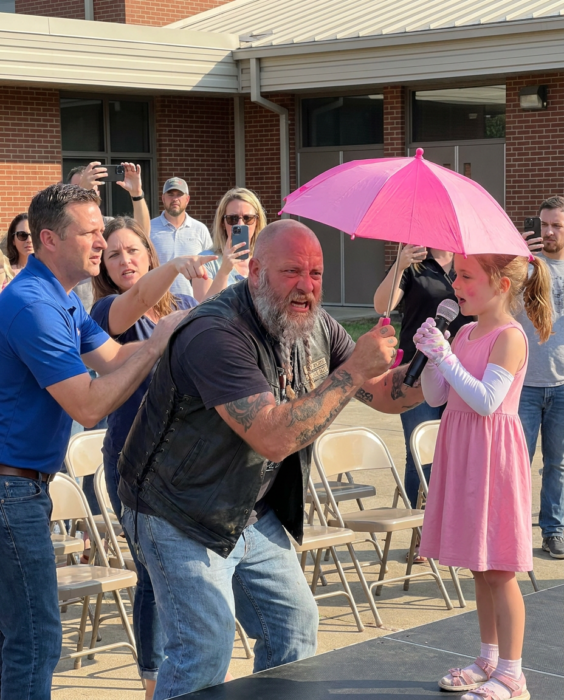
June stood beneath the umbrella wearing white UV sleeves, thin gloves, opaque tights, and a wide fabric band covering the back of her neck. Mara had applied sunscreen to the remaining exposed areas.
Wade held the umbrella with his right arm extended over the low stage.
The pose looked easy for the first few minutes.
It was not.
A child’s umbrella has a short handle. To position it above June without standing on the stage, Wade had to lift his shoulder, straighten his elbow, and angle his wrist inward. He could not rest the handle against his body because that moved the shade behind her.
The sun moved.
So did he.
During the opening chorus, June stepped right. Wade tracked her.
During the rhythm exercise, she stepped back. He leaned forward.
When the children turned toward the piano, the shadow slid across the stage, and Wade rotated the umbrella before direct light reached her cheek.
He was not simply holding it overhead.
He was steering a patch of shade.
By fifteen minutes, sweat had soaked the back of his shirt. The leather vest trapped heat against his body, but he would not remove it because the pockets carried June’s backup medication and emergency card.
Mara offered him water through a straw while he kept both hands raised.
He took one mouthful.
That was all.
The recital slowed again when a speaker cable failed. Children whispered. Parents checked watches. I cut one group number, but June’s solo remained near the end because judges had arranged scoring sheets in the original order.
Wade could have asked us to move it.
He did not.
June had worked for her assigned place in the program, and he did not want her remembered as the child everyone rearranged the recital around.
That choice was loving.
It was also stubborn.
At twenty-two minutes, I saw his right hand open and close around the umbrella handle. His fingers were cramping. The small silver skull ring had turned red-hot in the sun, so Mara pulled it free and placed it in her pocket.
Wade switched arms.
The transition took less than a second.
The pink shadow barely moved.
A woman behind me stopped recording and handed her phone to her husband. Then she stepped beside Wade.
“I can hold it awhile,” she offered.
“No, ma’am.”
“Your arm is shaking.”
“She watches my boots.”
I did not understand until Mara explained.
June had practiced this system with her father. If the shadow shifted unexpectedly, she looked toward Wade’s boots. He used their position to signal whether she should step left, right, forward, or back.
Another adult might hold the umbrella.
Only Wade knew the movements June had rehearsed.
That was the second reversal of the morning. What looked like control was actually a private safety language between father and daughter.
When June’s solo began, the courtyard finally quieted.
Her song was called “Little Bird at the Window.” It had three short verses, each rising slightly higher than the one before. June’s voice trembled on the first note.
Wade mouthed the words.
She saw him.
Her shoulders lowered.
The second verse came out stronger. A breeze moved her dress and tugged the umbrella. Wade tightened his grip.
During the third verse, the portable sound system gave a brief squeal. Several children flinched. June did not.
She continued.
Then the wind changed direction.
The damaged umbrella rib flexed, the canopy tilted, and a narrow line of direct sunlight crossed June’s right cheek.
She missed half a word.
Wade moved instantly, stepping so close to the platform that his chest struck its edge. The shade returned, but June’s skin had already begun turning pink beneath her eye.
Mara opened the cooler.
I stopped the backing track.
June shook her head.
“No. I’m not done.”
Mara checked her breathing and asked about burning. June held up two fingers—the family’s scale for mild pain. Wade kept the umbrella fixed while Mara pressed a cold cloth gently against the exposed area.
The other children waited.
Nobody complained now.
After less than a minute, Mara asked whether June wanted to leave.
June looked at Wade.
He did not tell her what to choose.
That may have been the most important thing he did all day.
He protected her without taking ownership of her courage.
June returned to the microphone.
The music restarted from the beginning of the third verse.
This time, every adult in the courtyard watched the edge of the pink shadow.
She finished the song.
There was no immediate roar. The first sound was Wade releasing a breath.
Then the applause came.
It rose hard enough to startle the children, but Wade never lowered the umbrella. The recital was not finished, and June still stood on the stage.
Her classmates joined her for the closing number.
Wade’s arm continued shaking.
A father near the front removed his own wide-brimmed hat and stood beside Wade, holding it over the biker’s exposed neck. A mother raised a folded program to shade his wrist.
One by one, people who had complained began protecting the man who was protecting the child.
Then Wade’s knees softened.
Mara saw it before I did.
“Bear?”
“I’m good.”
He was not.
His face had become pale beneath the sunburn, and sweat no longer ran from his forehead.
Heat exhaustion was becoming a real danger.
Mara told him to sit.
Wade looked at June.
The final song had forty seconds remaining.
“Not yet.”
Part 4
The school nurse reached Wade with an instant cold pack and placed it against the side of his neck. Another parent held water near his mouth.
Wade took a drink without lowering either arm.
June kept singing.
The situation had become its own quiet emergency: the child at risk from sunlight and the father at risk from heat, each trying not to frighten the other.
I considered stopping the performance.
Mara shook her head once.
She knew both of them better than I did.
“Forty seconds,” she said.
A parent moved a large golf umbrella over Wade. Another parent held a beach towel between him and the western sun. Within moments, shade covered his back and head without interfering with the small pink umbrella above June.
The audience had become a human canopy.
Wade’s job did not change.
He kept his daughter’s circle aligned.
When the final note ended, June remained still until Mara signaled that a covered path had been created. Parents raised umbrellas, jackets, recital programs, and even a folded picnic blanket between the stage and the shaded walkway.
June walked through the makeshift tunnel.
For the first time that morning, Wade lowered the pink umbrella.
His arm did not come down normally. The muscles had cramped in the raised position, and Mara had to guide his wrist slowly toward his side.
He grimaced.
June saw him.
“Daddy, did it hurt?”
“No.”
Mara gave him a look.
Wade corrected himself. “A little.”
The school nurse led him beneath the covered walkway, removed his leather vest, and began cooling him with wet towels. His blood pressure was low, his pulse fast, and the skin across his scalp, shoulders, and forearms had burned visibly.
We called paramedics for evaluation.
Wade objected.
The nurse answered with the same tone he had used on me.
“No.”
He sat.
That drew a tired laugh from several parents, including Wade.
June’s cheek reaction remained limited to a small patch. Mara gave the medication previously prescribed for mild symptoms and continued cooling the area. Her breathing stayed normal, and the hives began fading.
The plan had worked.
Not perfectly.
But safely enough.
The judges met beneath a canopy while paramedics examined Wade. Their original categories included Best Ensemble, Best Rhythm, Best Costume, and Best Performance.
June had not scored highest in every technical category. An older student had better pitch control. Another group executed more difficult choreography.
Still, all three judges independently wrote the same observation on their scoring sheets:
She stopped, recovered, and finished.
They awarded June Best Performance.
When I announced her name, Wade was seated in a folding chair beneath the walkway with a cold towel over his head. He stood anyway.
The paramedic pushed him back down.
June carried the small ribbon to him and placed it against his vest.
“You won too.”
Wade smiled. “I didn’t sing.”
“You knew all the words.”
The judging chair, Mrs. Delaney, approached me with an idea. She had taken a photograph before the wind gust—a wide image showing June singing inside the pink shade while Wade stood below her in full sun.
The arts council traveled with a small photo printer for participant certificates. They printed the picture, placed it in a simple black frame, and wrote a temporary card.
The award was not planned.
It was not part of any official scoring guide.
But before families left, Mrs. Delaney asked Wade to come forward.
He refused until June took his hand.
The two walked together toward the stage: June carrying the pink umbrella, Wade moving stiffly with both arms lowered.
Mrs. Delaney spoke into the microphone.
“We give children prizes for standing in the light. Today, we want to recognize the man who became someone else’s shade.”
She presented the framed photograph.
On the card beneath it were three words:
BEST STAGE LIGHT.
At first, Wade thought it was a joke. Then he looked closely at the picture.
June was singing.
The umbrella cast a clean round shadow over her face and shoulders. Wade stood beneath the stage, uncovered, his eyes fixed on her rather than the camera.
Behind him, several parents appeared irritated. One was pointing. Another held a phone.
The photograph captured the moment before anyone understood.
Wade pressed his thumb against the frame.
His beard moved once.
Then this enormous man, whose expression frightened strangers in parking lots, covered his face with one hand and cried.
Not dramatically.
Not for the cameras.
He turned away, but June wrapped both arms around his waist and held on.
The audience rose.
There was applause, but it was different from the applause after her song. Less polished. Uneven. Some people clapped while crying; others remained quiet because shame had found them first.
The father who had shouted at Wade approached.
His name was Kevin Marsh. He had grabbed Wade’s vest when the biker moved toward the stage.
“I thought you were making it about yourself,” Kevin said.
Wade wiped his face with the back of his wrist.
“I was.”
Kevin looked confused.
Wade pointed toward June.
“She’s my whole self.”
That line appeared in several posts about the recital. People treated it as if Wade had prepared something profound.
He had not.
It was simply the shortest explanation he had.
The online videos changed too. The first clips had captions mocking the “giant biker with a princess umbrella.” Later uploads explained June’s condition and showed parents building the shade corridor.
Within two days, one recording had been watched hundreds of thousands of times.
That attention produced another problem.
Strangers accused the school of endangering June. Others accused Wade and Mara of allowing a medically fragile child to perform for attention. Some claimed solar urticaria was invented because they had never heard of it.
Wade read three messages.
Then he shut off his phone.
Mara did not.
She spent an evening trying to defend their decision until June asked why people were angry about her song.
Mara deleted the post.
The family had allowed June to take a planned, limited risk, using protective clothing, medication, shade, and an exit strategy discussed with her clinician. It was not a decision strangers could understand from a forty-second video.
But the criticism forced the school to confront something important.
June should never have needed her father’s arm to serve as infrastructure.
Our accommodation had depended on one man refusing to lower an umbrella.
That was not a system.
That was luck wearing motorcycle boots.
Part 5
The district reviewed the event.
No one lost a job, including me. But the review concluded that we had treated June’s medical plan as information rather than an obligation requiring concrete arrangements.
“Access to shade” was too vague.
A covered walkway twenty yards away did not protect a child standing on an exposed stage. A canopy ordered but not safely installed did not count as accommodation. An early schedule did not help when delays pushed the program toward noon.
The district rewrote the plan.
Future outdoor events involving students with photosensitivity required a verified covered performance area, a designated indoor alternative, medical staff access, and authority for the student or parent to stop participation without penalty.
More importantly, the child would not be asked to choose between safety and belonging.
June’s next performance happened indoors.
Wade still brought the umbrella.
He placed it beneath his seat, just in case.
The framed Best Stage Light photograph went home with the Halvorsens. Mara hung it above the kitchen table, where Wade pretended not to notice it.
But the image revealed details no one had seen during the recital.
His right hand was already swollen around the handle.
A cooling cloth protruded from his vest pocket.
The top of his ears had turned red.
And on the inside edge of the pink umbrella, written in black marker, were the words:
DADDY HOLDS THE SKY.
June had written them the night before.
The letters were crooked and reversed in places. Wade had seen them only after opening the umbrella at school.
Mara later told me that was why he refused every offer to replace it with a larger umbrella. The bigger ones offered better coverage, but June had chosen that one, practiced with it, and written her promise inside.
Still, Wade understood its limitations.
He never romanticized what happened.
When people praised him for holding the umbrella forty-five minutes, he usually said, “Should’ve had a canopy.”
When they called him heroic for accepting a sunburn, he answered, “Sunburn was stupid.”
He did not want his pain to become proof of his love.
Love was the planning.
The pain was what happened when planning failed.
At home that evening, Wade’s sunburn continued deepening across his scalp, arms, neck, and upper back. He had worn his leather vest over a T-shirt, but the open sides left strips of skin exposed.
Mara sat him on the bathroom floor because his shoulders hurt too much for him to reach the tub comfortably. She applied cool compresses, then a fragrance-free moisturizer recommended by the nurse.
June sat outside the door singing her recital song to herself.
Mara rubbed lotion across the back of Wade’s neck.
“You’re an idiot,” she said.
“So I’ve heard.”
“You could have let somebody else hold it.”
“She watches my boots.”
“You could have worn a hat.”
“Forgot.”
“You could have removed the vest.”
“Medicine was in it.”
“You could have drunk more water.”
Wade said nothing.
That silence was an admission.
Mara worked moisturizer into the red skin along his shoulder blades. Her anger softened but did not disappear.
“You don’t have to hurt yourself to prove you love her.”
“I know.”
“Do you?”
He turned carefully.
For a moment, the intimidating biker looked less like the man from the viral photograph and more like a tired father who had spent years negotiating with something he could not punch, repair, or frighten away.
“I can’t make the sun stop,” he said.
Mara waited.
“I can stand between.”
That was the sentence June later repeated as, “Daddy said he can help me not have sun.”
The shorter version spread online.
The real version mattered more.
Wade could not erase June’s condition. He could not promise every field trip, playground, or recital would become safe. He could only learn the risks, carry the medication, position the shade, and listen when she said what parts of childhood were worth attempting.
June’s courage did not come from pretending sunlight could not hurt her.
It came from knowing someone would believe her when it did.
Two weeks after the recital, Kevin Marsh—the father who had shouted—visited our school carrying a check and a proposal. His company installed commercial awnings.
He offered labor at cost if the parent association could raise money for materials.
Wade refused to let the project become a monument to him.
“No names,” he said. “No picture.”
The parent association agreed.
By the following spring, the school courtyard had a permanent UV-rated canopy covering the stage and accessible seating beside it.
The first child to perform beneath it was not June.
It was a third-grade boy undergoing treatment for lupus, whose medication made him sensitive to sunlight.
That was the final reversal.
The shade built because of June protected a child her family had never met.
Wade attended that performance from the last row.
The pink umbrella remained closed beneath his chair.
Part 6
June continued singing.
At six, she joined a small indoor children’s choir. At seven, she performed at a library where staff covered the skylights during rehearsal. At eight, she sang the national anthem before a minor-league hockey game.
Wade attended every performance.
He always sat in the back.
He always carried the pink umbrella.
The repaired silver rib eventually snapped again, and the fabric faded from bright pink to dusty rose. Mara bought a newer UV-rated umbrella, but Wade kept the original one in his truck.
“Emergency spare,” he said.
Nobody believed that was the only reason.
The Best Stage Light photograph changed too. At first, it represented his sacrifice. Over time, Wade began seeing the mistakes surrounding it: the uncovered stage, the late schedule, the irritated parents, and his own refusal to drink enough water.
He used the photograph differently.
Once a year, he spoke at the district’s staff training for outdoor activities. Wade hated public speaking, so he kept his remarks brief.
He would place the pink umbrella on a table and say:
“A medical accommodation that depends on a parent’s arm is not an accommodation.”
Then Mara explained the practical details.
Ask the family what shade means.
Confirm the space before the event.
Provide an indoor alternative without making the child feel punished.
Keep medicine accessible.
Know when to stop.
Let the child participate in decisions appropriate to their age.
Wade answered questions only when necessary. When someone asked whether he would repeat the recital exactly as it happened, he said no.
“I’d bring a tent.”
The room usually laughed.
He did not.
The Iron Lantern Riders became involved after the original video spread. Several members had teased Wade when he first carried the pink umbrella strapped to his Harley.
After learning why, they built portable shade frames for community events. Each frame folded flat enough to travel in a pickup and could be anchored without dangerous ropes crossing walkways.
They painted them plain gray.
June objected.
“Shade shouldn’t be boring.”
So one support on every frame was painted pink.
At the club’s annual charity ride, Wade’s brotherhood surprised June with a covered platform near the registration area. She sang before the motorcycles departed.
Thirty-eight engines remained silent until she finished.
Wade stood below the platform with the umbrella closed against his leg.
Halfway through the song, a cloud moved away from the sun. Direct light approached the edge of the canopy but did not reach June.
Wade’s hand tightened around the umbrella.
June noticed.
She touched the microphone and said, “It’s okay, Daddy. The roof has me.”
He released the handle.
That small movement meant more than the original forty-five minutes.
At the recital, Wade had protected his child alone.
Years later, he could trust the world around her to hold part of the weight.
Part 7
The pink umbrella now hangs inside the Iron Lantern Riders’ clubhouse.
Not above the bar.
Not in a glass case.
It hangs beside the first-aid cabinet, where riders keep sunscreen, cooling packs, bottled water, and emergency contact cards for family events.
The repaired rib is still visible.
So are June’s uneven words beneath the fabric:
DADDY HOLDS THE SKY.
Wade never accepted the phrase completely.
“No,” he told her when she was older. “I held one little piece.”
June answered, “It was my piece.”
There was no reply to that.
By age ten, she had learned to manage much of her condition herself. She checked UV forecasts, packed protective clothing, reminded adults when her medication needed to remain cool, and told teachers clearly when an activity was unsafe.
Wade was proud of that independence.
It frightened him too.
Protection is simple when a child fits inside a tiny circle of shade. It becomes harder when she walks beyond it.
At a later indoor recital, June performed the same song she had sung at five. Her voice was stronger now, her breathing controlled, the high notes clean.
Mara sat beside Wade in the final row.
When June reached the third verse—the point where sunlight had crossed her cheek years earlier—Wade’s right hand lifted unconsciously, as if it still held the umbrella.
Mara took that hand and lowered it gently to his knee.
The auditorium roof held.
The curtains held.
The school’s plan held.
Wade did not have to.
After the performance, June found him in the lobby and presented a folded program. Inside, she had drawn the old photograph: herself beneath the pink umbrella, her father standing below.
This time, she added dozens of smaller figures around them holding pieces of shade.
“Who are they?” Wade asked.
“Everybody who learned.”
He looked at the picture for a long time.
Then he folded it carefully and placed it inside his vest, beside the faded sunflower patch she had chosen for him years before.
Outside, the afternoon sun lay hard across the parking lot. June put on her hat, gloves, and UV jacket without being reminded.
Wade opened the pink umbrella.
She smiled.
“I can carry it now.”
He gave it to her.
If this father’s quiet strength stayed with you, follow the page—more biker stories are waiting behind the moments strangers almost judged too quickly.