Part 2: A 280-Pound Tattooed Biker Wore Cat Ears and Painted Whiskers to His Four-Year-Old Daughter’s Tea Party — And Her Giggle Became the Last Sound Their Family Could Never Let Go
PART 2 — THE GIRL WHO MADE A BIKER SOFT
Before Lucy became sick, Mason believed he understood fear.
He had been raised by a father who considered tenderness an invitation for disappointment. Mason joined the Army at nineteen, served overseas, and learned to continue functioning while exhausted, frightened, or grieving.
Later, motorcycles gave him another kind of structure.
The Iron Lanterns were not an outlaw club. They were mechanics, veterans, warehouse workers, nurses, contractors, and grandparents who rode together and raised money for families facing medical emergencies.
Mason earned the road name Bear because of his size and because, as Deacon liked to say, he looked dangerous from far away and needed snacks before becoming friendly.
Then Lucy arrived.
She was born after three miscarriages and a pregnancy filled with careful optimism. Mason attended every appointment but refused to purchase baby furniture until the doctor said we were safely beyond the highest-risk months.
Even then, he assembled the crib without discussing why his hands shook.
When the nurse first placed Lucy against his chest, Mason held her as though someone had handed him a flame.
“She’s too small,” he whispered.
“She is exactly the right size,” I told him.
“What if I drop her?”
“You won’t.”
“How do you know?”
“Because you look more frightened than she does.”
Lucy opened one eye and gripped the edge of his beard.
Mason laughed.
From then onward, his beard belonged partially to her.
She held it while falling asleep, decorated it with plastic clips, and once hid crackers inside it during a long church service.
Mason never complained.
He attended imaginary restaurants where every meal consisted of wooden vegetables. He permitted Lucy to place stickers over his tattoos and called the resulting artwork temporary improvements.
At three, she discovered cats.
We could not keep a real one because I was severely allergic, so Lucy collected stuffed cats instead. She named every one, organized them according to personality, and held tea parties where Mason was expected to speak for whichever cat she placed in his hands.
He gave them all deep voices.
Lucy objected.
“Girl cats don’t talk like that.”
“They do in Oklahoma.”
“No.”
Mason adjusted immediately.
The toughest man I knew spent entire evenings practicing tiny cat voices because his daughter laughed when he failed.
That laughter changed after she became ill.
The first signs seemed ordinary. Lucy stumbled frequently, complained that one eye hurt, and began waking nauseated. Her pediatrician ordered additional tests after noticing a weakness on one side of her body.
The scan revealed a rare and aggressive brain tumor.
There are moments when life divides itself into before and after without asking permission.
The doctor continued speaking, but I remember only fragments.
Location.
Treatment options.
Specialists.
Clinical trials.
Uncertain outcome.
Mason sat beside me with both hands locked around his knees. He asked practical questions about surgery, transportation, insurance, and timelines.
He did not ask whether Lucy might die.
Neither did I.
Saying the question aloud seemed capable of making it real.
For fourteen months, our lives became hospital rooms, medications, scans, waiting areas, and hope recalculated according to each new result.
Lucy endured radiation and multiple rounds of treatment. Some weeks she played normally. Other weeks she could barely lift her head.
Mason shaved his own hair when hers fell out.
He allowed her to draw matching whiskers on both their faces before appointments.
He slept upright beside her hospital bed because the chair would not recline beneath his weight.
Whenever nurses apologized for waking him, Mason answered:
“She wakes up here. I wake up here.”
The disease progressed despite everything.
Eventually, the oncology team spoke with us about comfort rather than cure.
Mason listened without blinking.
Afterward, he walked into the hospital parking garage and struck a concrete pillar with both palms until one began bleeding.
Deacon found him there.
“You need to stop,” Deacon said.
“I’m not hurting anybody.”
“You’re hurting somebody she needs.”
Mason looked at his damaged hand.
For the first time, he admitted the truth.
“I can’t fix this.”
Deacon stood beside him.
“No.”
“What am I supposed to do?”
“Be her father.”
Mason shook his head.
“That’s not enough.”
“It may be the only thing nobody else can do.”
From then forward, Mason stopped measuring his worth by whether he could defeat the disease.
He began asking another question:
What can I give Lucy today?
Sometimes the answer was pain medication administered on time.
Sometimes it was silence.
Sometimes it was a kitty tea party.
PART 3 — THE TEA PARTY MISSION
Lucy’s request arrived shortly after the palliative-care nurse asked whether there were experiences our family still wanted to create.
The nurse expected answers such as visiting the zoo, spending time near the ocean, or seeing extended family.
Lucy wanted Mason to become a cat.
The request delighted her but terrified him.
Not because of the costume.
Mason understood the party might become a memory we would have to survive afterward.
The night before, I found him sitting alone at the kitchen table with the pink cat ears between his hands.
“You don’t have to do this if it’s too much,” I said.
He looked at me.
“She asked.”
“She will understand if you’re tired.”
“No, she won’t.”
His voice was not angry.
“She is four. She should not have to understand why her father is too sad to play.”
I sat beside him.
“What if tomorrow is difficult?”
“Then we make the difficult parts quiet.”
“What if she cannot stay awake?”
“We have tea while she’s awake.”
“What if she doesn’t laugh?”
Mason stared at the ears.
“Then she gets a father wearing cat ears who loves her anyway.”
That answer became our plan.
We invited only people Lucy knew well. No one could bring cameras except me. Nobody was permitted to post photographs without our permission.
The day would belong to Lucy, not to strangers who might transform her illness into inspiration.
Scout decorated the room while Lucy slept. Deacon built a wider wooden chair disguised beneath pink fabric because the children’s chair could not safely support Mason.
Mason refused to use it.
“Sir Fluffington sits where the other cats sit.”
“The other cats are stuffed,” Deacon said.
“They have better posture.”
“You’ll break the furniture.”
“Then Sir Fluffington will apologize.”
Mason squeezed himself onto the tiny chair.
It creaked but survived.
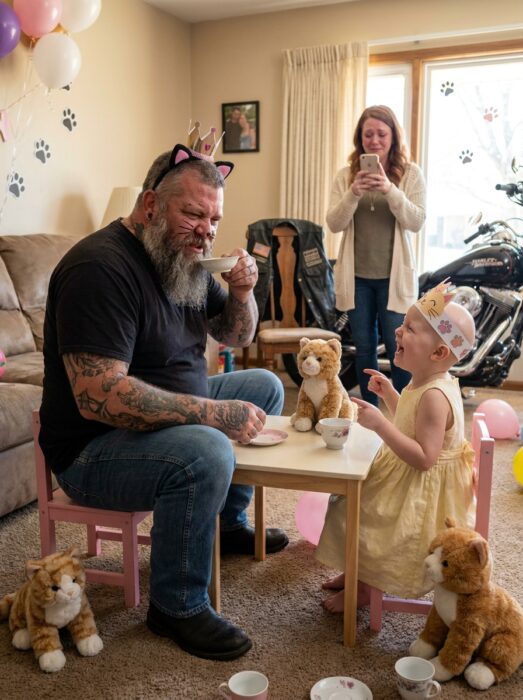
The party began with formal introductions. Lucy presented her stuffed cats one by one. Mason bowed to each and accidentally knocked his crown against the teapot.
She giggled.
He pretended not to understand how cups worked.
Another giggle.
Then he attempted to lick his hand and clean his beard like a cat.
“Daddy, no!”
“Who is Daddy?”
“You!”
“I see no fathers here. Only cats.”
“You’re the biggest cat ever!”
Mason placed both paws against his chest.
“I am delicate.”
Lucy laughed so hard she spilled apple juice across the table.
Nobody moved immediately.
We were afraid that reacting too quickly might remind her that adults were constantly monitoring her body.
Mason simply dabbed the juice with his tail.
“My dignity is absorbent.”
Even Deacon laughed at that.
Lucy’s joy spread through the room, but beneath it, every adult carried the same awareness.
We were memorizing her.
The curve of her cheek.
The missing front tooth.
The way she leaned to one side when tired.
The tiny pause before laughter became sound.
At one point, Lucy’s eyelids began closing. Mason lifted her from the chair and settled her against his chest without removing the costume.
She touched one of the fuzzy ears.
“You look silly.”
“I have been informed.”
“I like silly Daddy.”
“Regular Daddy filed a complaint.”
She smiled.
“Can Silly Daddy stay?”
“As long as you want.”
The other guests quietly left the room. I remained near the doorway, still recording because neither of them appeared aware of the phone.
Lucy rested her head below Mason’s beard.
“Daddy?”
“Yes, kitten?”
“Will you remember my party?”
Mason closed his eyes.
“Every second.”
“What if you forget?”
“I won’t.”
“Promise?”
Mason looked toward me.
We had learned to be careful with promises. We could not promise she would recover, that treatment would not hurt, or that we would never be frightened.
This promise was different.
“I promise.”
Lucy played with one of the painted whiskers on his cheek.
“Remember my laugh too.”
Mason’s face almost broke.
He held her closer.
“I will carry it everywhere.”
The phone captured those words.
For weeks afterward, I could not listen to them.
PART 4 — THE MONTH AFTER THE PARTY
Lucy’s health declined more quickly after the tea party.
Her speech became softer, and long conversations exhausted her. Some days she communicated through nods, hand squeezes, and expressions only Mason and I understood.
The cat ears remained on her bedside table.
Whenever Mason entered her room, Lucy pointed toward them.
He would place them over his hair and say, “Sir Fluffington reporting for duty.”
Sometimes she smiled.
Once, she managed a tiny laugh.
But the full, bright giggle from the party never returned.
We did not know that at the time.
Families living beside terminal illness rarely recognize the final occurrence while it is happening.
The final walk.
The final complete sentence.
The final request for a favorite meal.
Only later does memory place a border around the moment and say:
Nothing happened like that again.
Hospice care moved into our home gently. Nurses taught us how to manage medications, recognize discomfort, and make decisions based on Lucy’s peace rather than our panic.
Mason struggled with every new piece of equipment.
The oxygen concentrator felt like surrender.
The hospital bed replacing Lucy’s ordinary bed felt worse.
He insisted on surrounding it with her blankets, stuffed cats, and drawings so the room would still belong to her.
At night, he sat beside the bed and told stories about Sir Fluffington’s adventures.
The royal cat repaired motorcycles.
The royal cat fought dragons using muffins.
The royal cat traveled to a kingdom where every child received unlimited ice cream and nobody needed medicine.
Lucy listened with her eyes closed.
During the final week, Mason stopped riding completely. He said he could not risk being farther away than the garage.
Members of the Iron Lanterns brought groceries, handled phone calls, maintained the yard, and waited nearby without entering unless invited.
They understood that support can become another burden when grieving families must entertain the people trying to help them.
On Lucy’s final evening, rain tapped softly against the bedroom window.
She had slept most of the day. Shortly before midnight, her eyes opened.
Mason sat on one side of the bed while I sat on the other.
Lucy looked toward the cat ears.
Mason reached for them.
His hands shook as he placed them over his head.
“Sir Fluffington is here.”
Her eyes moved toward the whiskers that were no longer painted on his cheeks.
I found my eyeliner and drew them carefully.
Mason leaned close.
“Better?”
Lucy blinked once.
That was our signal for yes.
He placed his hand beside hers.
She was too weak to grip it fully, so he curved his fingers around her palm without squeezing.
“I remember your laugh,” he whispered.
Her eyes remained on his face.
“I’m carrying it.”
Lucy died shortly before sunrise, with the cat ears still on her father’s head.
Mason did not cry immediately.
He remained seated beside her, holding her hand as the room changed from a place where our daughter was dying into a place where she had died.
The hospice nurse entered quietly.
Mason asked one question.
“Do I have to move yet?”
“No,” she said.
He stayed for another hour.
Then he removed the cat ears and placed them beside Lucy’s crown.
PART 5 — THE HOUSE WITHOUT HER SOUND
Grief altered the acoustics of our home.
After Lucy died, every room sounded wrong.
The refrigerator seemed louder. Floorboards creaked without being covered by her footsteps. The Iron Lanterns’ motorcycles arrived and departed with a heaviness they had never carried before.
But the worst sound was silence near the staircase.
Lucy used to call for Mason whenever she heard his boots near the door.
“Daddy’s home!”
After the funeral, he still paused each time he entered, waiting for the call his body expected.
It never came.
Friends told us to preserve memories. The advice was kind but unnecessary. Memory had invaded everything.
Her cup remained near the sink.
Cat stickers covered Mason’s toolbox.
Purple frosting was still frozen inside a container nobody could throw away.
The tea-party video remained on my phone.
For seventeen days, neither of us watched it.
Then, at two in the morning, I woke and found Mason missing from bed. Light came from the garage.
He sat on the concrete floor beside his motorcycle, wearing Lucy’s pink cat ears.
My phone was in his hand.
The video played quietly.
Lucy laughed as Sir Fluffington attempted to sit on the tiny chair.
Mason replayed that section.
Again.
Again.
Again.
I sat beside him.
He did not look at me.
“I forgot the sound,” he whispered.
“You didn’t.”
“For a second, I couldn’t hear it in my head.”
“That happens.”
“What kind of father forgets his daughter’s laugh?”
“A grieving one.”
He pressed the phone against his chest.
“I promised to carry it.”
“You are carrying too much.”
His face tightened.
“If I stop listening, it feels like she gets farther away.”
I understood the fear because I shared it.
But we also knew we could not turn Lucy’s laughter into a task we had to complete correctly.
We made multiple copies of the video. One remained on a secure drive, one with my sister, and another inside a digital archive recommended by the hospice bereavement counselor.
Then we stopped treating the phone as though one accidental deletion could erase our child.
A therapist helped Mason understand that remembering Lucy did not require reopening the wound every night.
Some nights, he listened.
Other nights, he allowed silence.
Healing did not mean the video became less important. It meant the recording stopped being the only doorway through which he could reach her.
Mason began remembering sounds the camera had never captured.
Lucy humming while coloring.
Her mispronunciation of “motorcycle.”
The whisper she used when telling secrets to stuffed animals.
Gradually, memory expanded beyond the final month.
One afternoon, Deacon visited and found Mason repairing the broken wooden chair from the tea party.
“What are you doing with that?” he asked.
“Fixing it.”
“For what?”
Mason sanded one cracked leg.
“I don’t know yet.”
A week later, the hospice invited our family to participate in a memorial fundraiser for pediatric palliative-care services.
Mason initially refused.
He did not want Lucy’s story displayed to strangers or reduced to a photograph beside a donation jar.
Then the organizer explained that the event would fund ordinary moments for seriously ill children—birthday decorations, transportation, family photographs, art supplies, and experiences chosen by the children themselves.
Mason looked toward the repaired chair.
“Do kids like tea parties?”
The organizer smiled.
“Some do.”
“Do any of them like cats?”
“Almost certainly.”
That was how Lucy’s Royal Cat Tea began.
PART 6 — SIR FLUFFINGTON RETURNS
The first memorial tea party took place eleven months after Lucy died.
Mason nearly canceled it that morning.
He stood inside our bedroom holding the cat ears and told me he felt as though wearing them for another child would betray Lucy.
“They were hers,” he said.
“The ears were yours.”
“You know what I mean.”
I did.
“What did Lucy ask you to remember?”
“Her laugh.”
“Did she ask you to make sure nobody else laughed?”
Mason looked down.
Grief often tells us that love must remain exclusive to stay loyal. In reality, the love we received from someone can become the language through which we care for others.
Mason placed the ears on his head.
We hosted the event inside the children’s hospice family center. No reporters were invited. Families controlled whether photographs were taken, and no child’s medical condition was discussed publicly.
The Iron Lanterns arrived wearing cat ears attached to their helmets.
Deacon’s ears were black. Scout wore leopard spots. Moose had somehow purchased ears with flashing lights and was ordered to disable them before they caused a sensory emergency.
Mason wore Lucy’s original pink pair.
Ten children attended with parents and siblings.
Some used wheelchairs. One communicated through an eye-gaze device. Another child slept through most of the party while his sister drank tea beside him.
Mason did not expect anyone to react like Lucy.
That mattered.
These children were not replacements or opportunities for him to repeat a perfect memory.
They were themselves.
A five-year-old girl named Olivia stared at Mason’s whiskers.
“You look bad,” she said.
Mason nodded.
“I had an inexperienced makeup artist.”
I raised my hand.
Olivia considered him.
“Can you meow?”
Mason produced the deep, solemn meow Lucy had loved.
Olivia laughed.
The sound struck him physically.
He stepped backward.
For one moment, I thought he would leave.
Then Olivia pointed toward the repaired tea-party chair.
“You don’t fit.”
“I am extremely delicate.”
“No, you’re huge.”
Mason lowered himself carefully.
The chair survived.
Olivia laughed again.
Mason’s eyes filled, but he remained seated.
He did not mistake her laughter for Lucy’s.
He allowed both sounds to exist inside him.
After the party, Mason went alone to the small memorial garden behind the hospice. I found him sitting beneath a tree with the cat ears in his lap.
“Too much?” I asked.
“Yes.”
“Do you regret it?”
“No.”
He touched one fuzzy ear.
“Her laugh didn’t get smaller because another kid laughed.”
“No.”
“It felt like Lucy made room.”
That became our annual tradition.
Each year, the event funded additional experiences chosen by families. The Iron Lanterns repaired wheelchairs, transported relatives, assembled toys, and performed every task under the direction of trained hospice staff.
Mason remained Sir Fluffington.
His whiskers grew less crooked because my makeup skills improved.
He considered that disappointing.
PART 7 — THE TREASURE INSIDE THE LAUGHTER
Seven years have passed since Lucy’s tea party.
Mason is sixty-two now. His beard has become almost entirely silver, one knee makes crawling like a cat increasingly difficult, and the original pink ears have been repaired three times.
They remain inside a small wooden box beside Lucy’s paper crown.
The tea-party video is still with us.
We do not watch it every day.
Some months pass without either of us pressing play. Then a birthday, an unexpected smell, or a purple-frosted cupcake brings the memory close enough that we sit together and listen.
The recording begins with my own unsteady breathing behind the camera.
Then Mason enters wearing the ears.
Lucy says:
“Daddy, you’re too big!”
He answers:
“I am an elegant tea-party cat.”
And she laughs.
For several seconds, our daughter is not a patient, a diagnosis, or a child approaching the end of her life.
She is four years old.
She is amused by her father.
She is safe inside an ordinary kind of joy.
That is the treasure.
Not that the video defeats death.
It does not.
Not that hearing Lucy’s laugh prevents grief.
Sometimes it intensifies it.
The treasure is that illness did not own every moment she had left.
There was still room for silliness.
Still room for purple cake.
Still room for a child to laugh because her father looked ridiculous.
The annual tea party has now supported more than one hundred families. Some children attended once. Others returned for several years.
We remember them without claiming their stories.
Mason teaches new club volunteers the most important rule before every event:
“We are not here to make dying children inspirational. We are here to help children have a day that belongs to them.”
One year, a new rider asked why Mason continued wearing cat ears when simply donating money would be easier.
Mason answered:
“Money pays for the room. Looking foolish tells the child the room is truly theirs.”
That sentence captures the father he became.
Mason once believed his job was to appear strong enough that Lucy would never see fear.
During her illness, he learned something harder.
Children do not always need parents who can defeat the monster. Sometimes they need parents willing to enter the child’s world while the monster remains outside the game.
Last month, we attended the seventh Royal Cat Tea.
A four-year-old boy named Nathan refused to enter the room. He stood in the hallway holding his mother’s hand and staring at the enormous bikers inside.
Mason approached without crouching too close.
Nathan pointed toward the ears.
“Are you a cat?”
“I have legal documentation.”
“Cats don’t have beards.”
“Rare mountain breed.”
Nathan smiled.
Mason extended one paw.
The boy did not take it immediately.
Mason waited.
Eventually, Nathan placed two fingers inside his hand.
They entered together.
During the party, Nathan knocked over a teacup and looked terrified, as though expecting the adults to become angry.
Mason deliberately knocked over his own cup.
“Catastrophe,” he announced.
Nathan laughed.
Mason looked toward me.
Not because the laugh sounded like Lucy.
It did not.
Because he knew she would have approved of the joke.
That evening, we returned home and opened the wooden box. Mason placed the pink ears beside Lucy’s crown.
“I wore them for her,” he said.
“You still do.”
He looked at me.
“What do you mean?”
“You wear them because she taught you what they can give someone.”
Mason sat on the edge of our bed.
For years, he described the recording as Lucy’s last laugh. That description was emotionally true but incomplete.
It was the last full laugh we captured, not the final joy she gave us.
Her joy continued inside stories, family rituals, children’s parties, and the strange courage required for intimidating adults to make themselves ridiculous.
Mason picked up my phone.
“Play it?”
I sat beside him.
The video began.
Sir Fluffington entered the room.
Lucy laughed.
Mason closed his eyes, but he did not collapse beneath the sound. His hand found mine.
When the video ended, we remained together in the quiet.
“I told her I’d carry it everywhere,” he said.
“You kept your promise.”
Mason shook his head gently.
“We carried it.”
He was right.
I pressed the phone against my chest and thought about the mother I had been behind the camera, recording because I feared forgetting.
I understand now that grief is not about preserving someone perfectly. No recording can hold an entire child.
The video contains one laugh.
Lucy was infinitely more.
She was stubborn, funny, impatient, affectionate, and furious when people cut her sandwiches incorrectly. She loved cats, purple frosting, and the father who never learned how to make a convincing meow.
The recording is precious because it opens one small window.
Through it, we see a 280-pound biker wearing cat ears.
We see a sick child being allowed to remain a child.
And we hear love achieving something medicine could not promise:
Not more time—but more life inside the time that remained.
Follow the page for more unforgettable biker stories about rough-looking fathers who cannot protect their children from every heartbreak—but will gladly become ridiculous to give them one more reason to laugh.