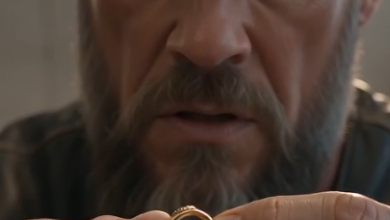
Part 2: A 280-Pound Tattooed Biker Cried on a Therapy Couch for the First Time in Forty Years — And His Six-Year-Old Daughter Never Let Go of His Hand
PART 2 — THE BOY WHO LEARNED NOT TO CRY
Mason did not learn to fear tears in the military.
The Army simply gave structure to a lesson his childhood had already taught him.
He grew up in a rural Oklahoma household where his father, Earl Avery, repaired farm machinery and believed emotional pain should be handled like bad weather: acknowledge it briefly, then continue working.
Earl was not physically cruel. He provided food, kept the electricity on, and worked until his hands became permanently bent.
But affection made him uncomfortable.
When Mason fell from a tree at eight and fractured his wrist, Earl drove him to the hospital while saying, “Save your crying for something serious.”
When Mason’s dog died three years later, Earl handed him a shovel.
“Men bury what they love,” he said. “Then they keep going.”
Mason cried while digging until he heard his father approaching.
He wiped his face with dirt and never admitted the tears.
His mother, Ruth, offered gentleness privately, but she had learned to live around Earl’s rules. She hugged Mason inside the laundry room, where nobody could see, and told him his father had been raised the same way.
That explanation gave history to the wound.
It did not heal it.
At eighteen, Mason enlisted.
The Army rewarded many qualities he already possessed: endurance, obedience, physical strength, and the ability to continue functioning while frightened.
He learned that fear could be compartmentalized.
Pain could be postponed.
Grief could wait until after the mission.
The problem was that after the mission kept moving farther away.
Daniel Riley arrived in Mason’s unit during his second deployment. He was shorter, thinner, and incapable of entering a room quietly. Daniel carried playing cards, hot sauce, photographs of his family, and an apparently endless supply of jokes nobody found funny.
Mason disliked him immediately.
Daniel responded by sitting beside him at every meal.
Within months, they became inseparable.
Daniel was a combat medic and understood that wounds rarely announced their full depth immediately. He checked soldiers who insisted they were fine and asked questions that required more than yes-or-no answers.
He did the same with Mason.
After a roadside explosion killed two men from their unit, Daniel found Mason cleaning the same rifle component repeatedly.
“You know that part is clean,” Daniel said.
“It can be cleaner.”
“You want to talk?”
“No.”
Daniel sat nearby.
“All right.”
“You can leave.”
“I know.”
He remained for almost an hour.
That was how their friendship worked.
Mason provided physical safety.
Daniel provided permission to remain human inside the uniform.
Daniel spoke openly about fear. Before missions, he sometimes admitted that his hands shook. He missed his wife, complained about nightmares, and cried after losing patients.
Mason never judged him.
He simply believed Daniel’s emotional openness was a privilege he himself could not afford.
One evening, Daniel asked why.
“Because somebody has to stay solid,” Mason replied.
Daniel looked around at the concrete barrier where they were sitting.
“Solid things break too.”
“Not if they’re built right.”
“Everything breaks under enough pressure.”
Mason smiled.
“Medic becoming a philosopher?”
“No. Just telling you what I’ve seen.”
Years later, Mason remembered that conversation more clearly than entire missions.
The convoy explosion occurred during their final deployment together.
Mason’s vehicle was damaged but remained upright. Daniel’s vehicle struck an explosive device several yards ahead.
Mason reached him before the evacuation team.
Daniel’s injuries were severe.
Mason applied pressure, called for support, and used every procedure he had been taught. Daniel knew enough medicine to understand the outcome before Mason accepted it.
“Stay,” Daniel said.
“I’m not leaving.”
“Don’t let me be alone.”
“You aren’t.”
Daniel’s hand closed weakly around Mason’s wrist.
Then he asked for something else.
“Tell them I was scared.”
Mason thought he had misheard.
“What?”
“My wife. My boys. Tell them I was scared, and I still did my job.”
“Save your strength.”
“Promise.”
Mason promised.
Daniel died minutes later.
But when Mason visited Daniel’s family, he did not tell them the truth.
He said Daniel had been brave.
He said he did not suffer alone.
He said his final thoughts were of them.
All of that was true.
Mason omitted the fear because he believed it might diminish Daniel in his sons’ eyes.
For almost twenty years, Mason carried the promise he had technically broken.
He did not understand that by hiding Daniel’s fear, he had also hidden the most courageous part of his friend’s final message.
PART 3 — FIVE YEARS ON THE SAME COUCH
Mason entered therapy because his wife gave him a choice.
Not between therapy and divorce.
Jenna loved him, understood his history, and had no intention of using abandonment as leverage.
She told him he could seek help voluntarily or she would call emergency services the next time he woke holding a weapon he did not remember retrieving.
Grace was eleven months old at the time.
Mason had awakened from a nightmare believing someone had entered their house. He moved through the hallway before becoming fully conscious.
When he realized Jenna was standing between him and the nursery, horror replaced confusion.
The weapon was unloaded and no one was hurt.
That did not make the event acceptable.
The following morning, Mason placed every firearm inside a secured safe at his brother’s home and called the veterans clinic.
He entered my office three weeks later.
The first session lasted fifty minutes.
Mason spoke for seven.
He answered questions politely, watched the door, and refused to sit with his back toward the window.
When I asked what he wanted from treatment, he said, “Better sleep.”
He did not say peace.
He did not say grief.
He requested a practical repair for a body behaving incorrectly.
We began there.
Over the following years, Mason worked harder than most people knew. He practiced grounding exercises at grocery stores, attended a veterans support group, adjusted medication with a psychiatrist, and learned to leave crowded spaces before panic became anger.
He apologized to Jenna for expecting her to interpret silence.
He learned that saying, “I need ten minutes,” was not the same as abandoning a conversation.
He stopped drinking after recognizing that alcohol made his nightmares worse.
Recovery came in increments so small that outsiders often missed them.
The first time Mason attended fireworks with noise-reduction headphones.
The first full night he slept without checking the front door.
The first time he told another veteran, “I am not doing well today.”
Still, one door remained closed.
Daniel.
Mason could discuss the facts, but he could not experience the feelings without immediately shutting them down.
His body protected him through numbness, tension, and control.
After five years, I did not consider therapy a failure. Healing cannot be measured only through tears.
Mason was safer, more connected, and increasingly able to live rather than merely endure.
Yet he still believed emotion and fatherhood were opposing forces.
Grace began noticing.
At five, she asked Jenna why Daddy went to the garage whenever he became sad.
At six, she drew a family picture in which everyone had mouths except Mason.
When Jenna asked why, Grace answered, “Daddy keeps his words inside.”
That drawing changed something.
Mason brought it to our next session and placed it on the table.
“She thinks I don’t talk to her.”
“She thinks you are holding something alone.”
“She’s a child.”
“Yes.”
“She shouldn’t carry my problems.”
“She should not.”
Mason looked relieved, believing I agreed that Grace should remain outside therapy.
Then I continued.
“But seeing that a parent has feelings is not the same as being made responsible for fixing them.”
Mason became quiet.
That distinction required six additional months of conversation.
Grace would not hear graphic combat details. She would not be asked to comfort him. The session would focus on family communication, emotion, and the memory of a friend.
Most importantly, Grace could leave at any moment.
Mason agreed only after Jenna asked one question.
“What lesson do you think she learns when you hide every tear?”
“That fathers are strong.”
“Or that crying is something people do only when nobody loves them enough to stay?”
Mason looked toward the room where Grace was singing to herself while coloring.
Three days later, he called my office.
“Fifteen minutes,” he said.
That was all.
It was enough to open the door.
PART 4 — “I’M STILL HERE, DADDY”
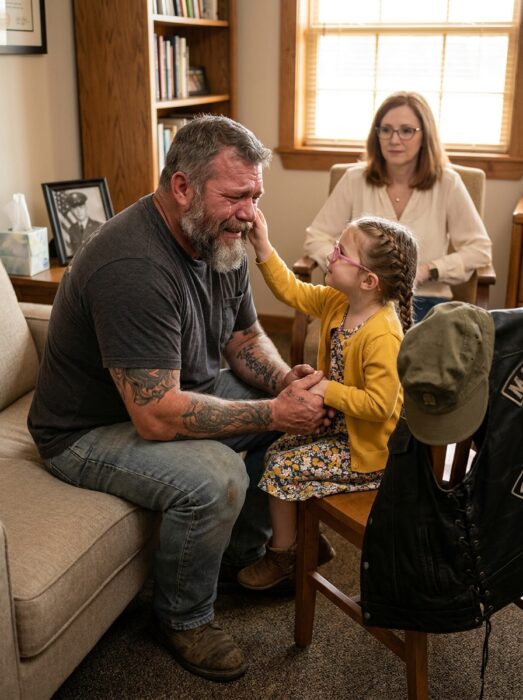
Grace stayed in the session for forty-three minutes.
After Mason began crying, I watched carefully for signs that she felt overwhelmed. She remained calm, leaning against his arm while her fingers stayed wrapped around his hand.
The tears were not dangerous.
They were delayed.
Mason cried for Daniel, for the men he could not bring home, for the frightened soldier he had once been, and for the child inside him who had buried a dog while pretending grief was weakness.
He also cried because Grace was watching and had not withdrawn her love.
That was the belief breaking apart before us.
Not that Mason had pain.
That pain made him unworthy of closeness.
After several minutes, he tried to apologize again.
Grace shook her head.
“You tell me not to say sorry when I’m sad.”
Mason laughed once through the tears.
“I do.”
“So you can’t either.”
“Fair rule.”
She took a tissue from the box and attempted to wipe his beard, but most of the paper became trapped in the hair.
“This is too much beard,” she announced.
Mason laughed harder.
The laughter immediately became another sob.
Grace looked toward me.
“Is he okay?”
“He is feeling something he has held for a long time.”
“Will it hurt him?”
“No. We are here with him.”
Grace returned her attention to her father.
“What was your friend’s name?”
Mason inhaled carefully.
“Daniel.”
“Was he nice?”
“He was annoying.”
Grace smiled.
“Like Uncle Rick?”
“Exactly like Uncle Rick.”
“Did you love him?”
The question entered without clinical language or hesitation.
Mason nodded.
“Yes.”
“Did he know?”
“I hope so.”
“Did you tell him?”
“Not enough.”
Grace considered this.
“You can tell him now.”
Mason closed his eyes.
“Doc, I loved you, brother.”
The room became completely still.
No therapeutic technique could have manufactured that sentence. Years of safety, preparation, professional treatment, family patience, and Mason’s own courage had made it possible.
Grace had not healed him by herself.
She had provided the final permission he could not give himself.
At the end of the session, she asked whether they could get ice cream.
Mason looked surprised by the ordinary request.
“You still want ice cream after seeing me like this?”
Grace adjusted her glasses.
“You always look weird after therapy.”
I turned away to hide my smile.
Mason knelt before her.
“Did I scare you?”
“No.”
“Did I look weak?”
“You looked sad.”
“Is that bad?”
“No.”
She touched one of the tattoos on his forearm.
“You’re still my dad.”
Those four words dismantled forty years of training.
That evening, after they left, I opened the private journal I used for professional reflection and wrote:
“Today, a six-year-old child helped her father do something five years of therapy could not force. She did not cure his trauma. She did something more honest: she showed him that love would remain in the room when he cried.”
I underlined the final sentence.
Children do not always need invincible parents. They need parents who return after feeling difficult things.
Mason called the next morning.
His voice sounded rough.
“I have a headache.”
“That can happen after prolonged crying.”
“My eyes are swollen.”
“Also normal.”
“Grace told her teacher I leaked at therapy.”
I paused.
“How do you feel about that?”
“Humiliated.”
“And?”
Another pause.
“Lighter.”
That word marked the beginning of the next stage.
Not the end of treatment.
The beginning of recovery that included grief instead of working around it.
PART 5 — THE PROMISE FINALLY KEPT
Three months after the session, Mason contacted Daniel’s widow, Rebecca Riley.
They had exchanged holiday cards for years but rarely discussed the war. Mason believed reopening the past might hurt her.
In reality, Rebecca had spent almost two decades wondering what Daniel’s final moments had been like.
They met at a diner halfway between their homes.
Rebecca brought Daniel’s two sons, now adults. Mason brought Jenna, but Grace stayed with her grandparents because the conversation belonged to the adults first.
Mason carried a folded piece of paper in his vest pocket.
He had written Daniel’s final message several times, unable to find words that felt sufficient.
When the family arrived, Mason stood but could not move forward.
Rebecca hugged him.
“You came home with him,” she said.
“No.”
Mason’s voice broke.
“I came home when he didn’t.”
They sat.
Mason described Daniel’s courage, the medical help he provided, and the way he continued thinking about his family.
Then Mason finally kept the promise.
“He was afraid.”
Daniel’s oldest son lowered his eyes.
Mason continued before shame could silence him again.
“He asked me to tell you that. He wanted you to know he was scared, and he still stayed with his men. I thought saying it would make him seem less brave.”
Rebecca began crying.
Mason unfolded the paper.
“I was wrong. Fear was not the opposite of what he did. It was the reason his courage mattered.”
Daniel’s younger son covered his face.
“My dad was scared?”
“Yes.”
“Did he suffer?”
“He knew he was hurt. But he was not alone.”
Mason’s voice shook.
“I held his hand. I promised I would stay, and I stayed.”
Rebecca reached across the table.
“Why didn’t you tell us before?”
Mason stared at her fingers over his.
“Because if Daniel was allowed to be scared, then maybe I was too.”
Nobody rejected him.
Nobody accused him of making Daniel smaller.
The family thanked Mason for giving them the truth.
Rebecca later showed him a box containing Daniel’s letters. In one, written months before his death, Daniel described Mason as “the strongest man I know and the only one who thinks strength means pretending he has no heart.”
Mason laughed and cried at the same time.
That evening, he returned home after Grace’s bedtime. She had left a drawing on the kitchen table.
Two enormous stick figures sat on a couch holding hands. Water fell from one figure’s eyes into a blue puddle.
Across the top, she had written:
DADDY WASHING HIS HEART.
Mason framed it.
Not because Grace had become responsible for his recovery.
Jenna and I were careful about that boundary. Grace was never asked to manage his symptoms, calm nightmares, or remain near him when she wanted space.
Mason continued professional therapy, medication management, veterans support meetings, exercise, and honest conversations with his wife.
Grace’s role was simpler.
She reminded him that being witnessed was not the same as being judged.
PART 6 — WHEN THE DAUGHTER BECAME TWELVE
Six years passed.
Grace became twelve, traded pink glasses for black frames, and developed strong opinions about music, clothing, and the unacceptable volume of her father’s motorcycle.
Mason remained large, tattooed, and intimidating to strangers. His beard became whiter, while arthritis made long rides harder.
He also became easier to know.
The nightmares did not disappear completely. Certain anniversaries still brought tension, and unexpected fireworks could send his body into high alert.
But Mason no longer vanished into the garage without explanation.
He would say, “I’m having a hard memory. I am safe, but I need a little time.”
Sometimes Jenna sat with him.
Sometimes he called another veteran.
Sometimes he returned to therapy.
And occasionally, Grace found him on the porch.
She never rushed to give advice.
She sat nearby and offered her hand.
Not because she had been assigned the job.
Because holding hands had become part of their language.
One evening, Mason received news that a former soldier from his unit had died. Grace found him sitting outside with Daniel’s old photograph.
“You want company?” she asked.
“Yes.”
She sat.
After several minutes, Mason began crying quietly.
Grace did not repeat the childhood speech about washing hearts. At twelve, she understood grief was not a problem requiring a perfect sentence.
She simply held his hand.
Later, Mason told me, “She’s the best therapist I ever had.”
I corrected him gently.
“No. Grace is your daughter.”
Mason nodded.
“I know.”
“That distinction protects both of you.”
“She doesn’t treat my PTSD.”
“No.”
“She reminds me I don’t have to hide it.”
“That is different.”
Mason smiled.
“Then she’s the best reminder I’ve ever had.”
He began volunteering with a veteran motorcycle outreach group. The program connected retired service members with licensed counseling, peer support, housing services, and crisis resources.
Mason’s job was not to provide therapy.
He sat beside men who were afraid to enter the building.
When one veteran insisted he was too strong to cry, Mason showed him Grace’s framed drawing.
“What is that?” the man asked.
“My daughter’s medical opinion.”
The veteran studied the blue puddle.
“Did crying fix you?”
“No.”
“Then what good did it do?”
Mason answered honestly.
“It let me stop spending all my strength hiding that I was hurt.”
That difference mattered.
Tears were not a cure.
They were one form of truth the body had been denied permission to tell.
PART 7 — THE COUCH SIX YEARS LATER
Mason’s final regular appointment occurred nearly eleven years after he first entered my office.
He did not stop therapy because every symptom had disappeared. He reached a point where monthly sessions were no longer necessary, though the door remained open whenever he needed support.
On that final afternoon, he arrived wearing the same leather vest he had folded over my chair for more than a decade.
Grace came with him.
She was twelve now and nearly as tall as her mother. Mason asked whether she could join the last fifteen minutes, just as she had joined the session that changed everything.
Grace sat beside him on the same couch.
Her feet reached the floor now.
“You remember this place?” Mason asked.
She looked around.
“It smelled different when I was six.”
“That’s the same carpet cleaner.”
“Maybe my nose matured.”
Mason glanced toward me.
“She talks like her mother.”
“You’re welcome,” Grace replied.
We discussed what had changed over the years.
Mason slept better.
He maintained relationships instead of withdrawing when grief intensified.
He could speak about Daniel with sorrow, humor, and affection rather than only facts.
Most importantly, he had stopped treating emotion as a threat to his identity.
I asked what he had learned about being a father.
Mason looked at Grace.
“I thought she needed me to be a wall.”
Grace leaned against the couch.
“Walls are boring.”
“I thought if she saw me hurt, she’d stop feeling safe.”
“Sometimes I feel safer when you tell me why you’re quiet.”
Mason nodded.
“I wanted to protect her from knowing I had pain.”
Grace took his hand.
“You protected me better when you taught me pain doesn’t make people leave.”
Mason’s eyes filled.
He did not apologize.
He did not turn away.
He allowed the tears to remain visible.
Grace smiled.
“Heart laundry?”
“Something like that.”
When the session ended, Mason stood and placed his vest over his shoulders. He paused near the office door.
“Doc?”
“Yes?”
“Thank you for waiting.”
I knew what he meant.
Five years without tears had not been five wasted years. Trust cannot be forced into the timetable of the person trying to help.
“Thank you for continuing to return,” I said.
Grace pulled gently on his hand.
“Ice cream?”
Mason laughed.
“You asked for ice cream after the first session too.”
“I believe in traditions.”
They left together.
From my window, I watched Mason place a helmet over Grace’s head before helping her onto the motorcycle. He checked the strap twice, climbed on, and waited until she wrapped both arms around him.
Before starting the engine, Grace reached forward and tapped his chest.
Even through the glass, I recognized the gesture.
She was asking whether he was all right.
Mason placed one hand over hers.
Then they rode away.
That evening, I opened the old journal entry from six years earlier.
I added one final line:
“The child did not save the father by carrying his pain. She saved a place beside him where pain no longer had to be hidden.”
There is a crucial difference.
Children should never become responsible for keeping their parents alive, stable, or emotionally regulated. Mason’s healing required trained professionals, family boundaries, medical care, peer support, and years of his own difficult work.
Grace offered something treatment alone could not prescribe:
Love without alarm.
She saw tears on the face of the strongest man she knew and did not confuse sadness with failure.
Mason had survived combat by learning how to remain functional while feeling nothing.
He learned how to come home when his daughter showed him that home could contain everything he felt.
The anger.
The fear.
The grief.
The love.
And finally, the tears.
Forty years after a boy wiped his eyes beside a grave because someone told him men must bury what they love and keep moving, a six-year-old girl held that man’s hand on a therapy couch.
She did not ask him to stop crying.
She did not tell him to be strong.
She said:
“I’m still here, Daddy.”
For Mason, those words became the sound of war finally ending.
Follow the page for more unforgettable biker stories about rough-looking fathers, wounded veterans, and the quiet acts of love that help strong people discover they no longer have to suffer alone.