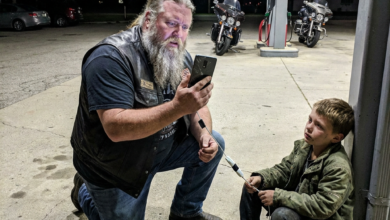
A One-Armed Man Played the Same Wedding Song on a Street Corner for Six Years — Then a Biker Realized Why His Daughter Refused to Marry
Claire did not come that night.
She said she could not.
Thomas watched my phone after the call ended, although the screen showed nothing except my reflection beneath the streetlight. He had recognized Claire’s voice immediately.
“You’re Mason,” he said.
I nodded.
“Lily’s friend’s father.”
“That’s me.”
Thomas looked down at the guitar.
Six years earlier, our families had occupied the same orbit. Claire and Lily met in seventh-grade science class when Claire accidentally set fire to a worksheet near a Bunsen burner. Lily extinguished it with her water bottle, then lied that they had both misunderstood the experiment.
They became inseparable.
Lily slept at our house on weekends. Claire spent summers at the Bells’ small home in South Knoxville. I drove them to concerts and complained about the music. Thomas taught both girls three guitar chords, though Claire preferred piano.
They called us “the two impossible dads.”
Then adulthood scattered the routine.
Lily worked at the florist while studying event design. Claire joined a nonprofit and met Daniel. Thomas and I exchanged fewer calls. We remained connected through our daughters rather than friendship of our own.
The crash cut every line at once.
I attended Lily’s funeral. I remember Thomas in a wheelchair, one sleeve empty, medication flattening his face. I stood thirty feet away because I did not know whether approaching him would add pain.
Claire refused to enter the viewing room.
I took her home.
After that, I assumed grief required privacy. Thomas assumed Claire wanted distance. Claire assumed Thomas blamed her for surviving a friendship his daughter did not.
None of us checked.
At the street corner, I asked why he played for two hours.
“That’s how long Lily’s shifts overlapped with closing. Seven to nine.”
“Every night?”
“Six nights.”
“You’ve done that for six years?”
“The first year I couldn’t play outside. I was still learning to fasten the brace.”
He said it without pride.
Just accounting.
The original guitar had survived the collision because it was at home. Thomas sold his truck, his tools, and nearly everything else during rehabilitation, but kept the instrument.
Learning with one hand began with humiliation.
He could not hold the neck and strum simultaneously. He tried laying the guitar flat, using his feet, building clamps, and taping picks to different fingers. Online instructors offered advice designed for people missing the opposite arm.
Nothing fitted.
A retired machinist created the first lever mechanism. It allowed Thomas to form three crude chords by pressing his forearm against a paddle. The wood brace stabilized the body. Thomas played melody and bass with his remaining hand.
One measure took months.
The full song took years.
“What happens when you remember all of it?” Brick asked.
Thomas considered the question.
“I start again.”
That answer landed heavily.
We invited him to the clubhouse. He declined. We offered a ride home. He pointed to an old sedan parked across the street, modified for one-handed driving.
Before leaving, I asked whether he wanted to see Claire.
“She knows where I am now.”
“Does that mean yes?”
“It means I won’t chase another girl who’s running from a dead one.”
He packed the guitar carefully, using his knee to hold the case while operating the zipper. None of us helped until he asked.
He never asked.
At home, I found Claire sitting at my kitchen table.
She had used her old key. Daniel waited in the living room, giving us space while pretending to read. Claire was thirty years old, competent, stubborn, and usually impossible to intimidate.
That night, she looked seventeen.
“You saw him?” she asked.
“Yes.”
“Does he hate me?”
“No.”
“You don’t know.”
“I asked.”
That was not entirely true, but fathers sometimes push open a door before knowing what waits behind it.
Claire walked to the piano and played the melody’s opening. Her hands knew every note Thomas had struggled six years to recover.
She stopped at the same place.
“Lily wrote the ending,” she said.
I waited.
“We wrote it together. Mr. Bell thinks it was only their song, but Lily changed the last section for my wedding.”
The room became smaller.
Claire explained that she and Lily planned to use the same melody at both weddings, altered slightly for each bride. Thomas would play at Lily’s. Lily would sing at Claire’s.
After the crash, Claire hid the final sheet music.
She had it still.
Upstairs, inside a box she had not opened for six years.
Claire refused to take the sheet music to Thomas.
That surprised me.
I expected the discovery to break the stalemate. Instead, it strengthened it. She said Thomas had spent six years learning the version he remembered with Lily, and showing him her arrangement would reopen everything.
“You think he’s not already standing inside it?” I asked.
“You don’t understand.”
“Then explain.”
Claire closed the piano.
The night of the crash, Lily had called her.
Lily and Thomas were leaving the florist late because a wedding order arrived damaged. Lily sounded tired but excited. She asked Claire to cover for her the following morning and said she had finally chosen a wedding date.
Then she made Claire promise something.
If anything ever happened to one of them, the other would still get married.
Girls in their twenties make dramatic promises because death feels imaginary.
Claire laughed and agreed.
Twenty minutes later, a truck crossed the center line.
The hospital called before midnight.
Claire had carried the promise as an accusation ever since.
Marrying felt like continuing without Lily. Wearing a white dress felt like stealing a day they were supposed to share. Asking Thomas to play felt cruel. Allowing anyone else to perform the melody felt worse.
Daniel understood only part of it.
He knew Lily died. He knew weddings triggered grief. He did not know Claire had accepted his proposals in her heart while refusing them aloud.
Daniel entered the kitchen after hearing his name.
“I stopped asking,” he said.
Claire looked away.
“Why?” I asked.
“Because every proposal hurt her.”
“Do you still want to marry her?”
“That isn’t the problem.”
Claire’s eyes filled.
Daniel sat beside her.
The decision belonged to them. The grief did not.
Meanwhile, Thomas continued playing at the corner.
The club began stopping regularly. Not all at once. One or two riders would park nearby, buy coffee, and listen without placing money in the case.
Thomas tolerated us.
Barely.
Rook discovered Thomas lived in a narrow apartment above a laundromat. He repaired musical instruments for schools, although one-handed work limited how many jobs he could accept. His prosthetic arm caused nerve pain and offered little fine control.
Sparks found a custom instrument maker in Nashville named Eleanor Price. She specialized in adaptive guitars for musicians with limb differences. Her designs used foot-controlled chord changes, stabilized bodies, altered tunings, and lever systems far smoother than Thomas’s wooden brace.
A custom instrument would cost nearly eight thousand dollars.
The club voted to pay.
Thomas refused before Sparks finished the sentence.
“I’m not your project.”
“It’s a guitar,” Brick said.
“It’s charity.”
“It’s equipment.”
“It’s still no.”
Sparks argued that Thomas could repair instruments for the club’s youth program in exchange. Thomas recognized the disguise.
“No.”
Dean became frustrated.
“We’re trying to help.”
Thomas’s expression hardened.
“Help with what? My arm isn’t coming back. My daughter isn’t coming back. The song is mine to carry.”
He packed his guitar and left early.
The next night, he did not appear.
Nor the next.
By Friday, the corner was empty.
I found Thomas at his apartment after three days of unanswered calls. He opened the door wearing an undershirt, his empty sleeve unpinned. The guitar lay on the table with one broken string and a cracked lever mount.
The mechanism had failed.
Thomas had attempted to repair it alone. A tool slipped, cutting his right palm. Bandages wrapped the only hand he could use.
“How long before it heals?” I asked.
“Doctor says three weeks.”
“You can’t play.”
“I noticed.”
For a man who claimed he played to remember, silence looked like terror.
The apartment walls held photographs of Lily. As a child with missing front teeth. At graduation. Wearing an apron inside the florist. Beside Claire at the beach, both holding cheap plastic bouquets and pretending to be brides.
Thomas saw me studying that photograph.
“They planned everything.”
“I know.”
“No, you don’t.”
His voice sharpened.
“Your girl is alive. You can call her. Fight with her. Watch her walk out and know she might come back.”
I took the hit.
He had earned it.
Thomas looked at his bandaged hand.
“I drove.”
“The truck crossed your lane.”
“I was driving.”
“You didn’t cause it.”
“I was driving.”
Guilt does not care about police reports.
The official investigation found the truck driver responsible. He had crossed a double line to pass traffic and struck Thomas’s vehicle almost head-on. Thomas survived because Lily’s side absorbed less direct impact than investigators expected.
That technical sentence haunted him.
The side where she sat had become the side that killed her.
He believed his survival was theft.
I understood then why the song never changed. Learning another would imply time had moved. Finishing this one before an audience would mean the promise had reached an ending.
Thomas did not want an ending.
Neither did Claire.
The song tied them to Lily from opposite sides.
I called my daughter.
“She broke his guitar,” Claire said when I explained.
“The guitar broke.”
“You know what I mean.”
“Yes.”
She came to the apartment anyway.
Claire stood outside for eleven minutes before knocking. Thomas opened the door and stared at her.
Six years disappeared.
She looked like the girl who had once eaten cereal in his kitchen. He looked like the father she remembered before the hospital.
Neither embraced.
Claire placed a worn music folder on the table.
“I kept the ending,” she said.
Thomas did not touch it.
“You had this?”
“She gave it to me the week before.”
“For six years?”
Claire nodded.
His face changed.
All the grief he had shaped into discipline turned toward her.
“You let me play it wrong for six years?”
The words struck harder than shouting.
Claire stepped back.
Thomas opened the folder with his bandaged hand. The pages contained Lily’s notes, corrections, and small drawings in the margins. At the end was a written instruction.
Dad plays. Claire sings.
Thomas closed the folder.
“Get out.”
Claire did.
The meeting we believed would heal them had split the wound wider.
For two weeks, Thomas did not return to the corner.
Claire stopped answering me.
Daniel said she had boxed the sheet music again and placed her engagement ring in a drawer, though she had never officially accepted it.
The club turned on itself.
Dean blamed me for forcing the meeting. Brick blamed Thomas for punishing Claire. Sparks blamed all of us for treating grief like an engine that would start once the correct part arrived.
He was right.
Brotherhood works well with flat tires, unpaid bills, and leaking roofs. Grief does not take instructions from twelve men carrying tools.
Then Eleanor Price called.
The adaptive-guitar maker had already begun studying the photographs Sparks sent of Thomas’s homemade brace. She did not ask whether Thomas deserved charity. She asked whether he wanted to work.
Eleanor needed a consultant.
Most adaptive instruments were designed by technicians imagining what disabled musicians required. Thomas had spent six years discovering those requirements through failure.
She offered him a paid contract to help develop a new one-handed guitar system.
Not a gift.
Work.
Thomas agreed to speak with her after I delivered the proposal without mentioning the club’s planned donation.
Eleanor drove to Knoxville with three prototype instruments. She met Thomas in his apartment. We waited downstairs.
Their first session lasted five hours.
Thomas tested foot pedals, shoulder levers, locking chord bars, and a rotating pick system. He criticized nearly everything. Eleanor took notes.
By the third meeting, they had a design.
The guitar body locked against a custom waist support rather than a stool. Six programmable chord bars sat above the fretboard. Thomas could activate them with small movements of his upper left arm, while his right hand played melody and rhythm. A foot pedal controlled sustain and alternate voicings.
For the first time since the crash, he could change chords without interrupting the line.
The club purchased materials through its youth-music fund. Eleanor paid Thomas for consultation. Thomas accepted because the work belonged to him.
The instrument took four months.
During that time, Claire attended therapy.
She told me only after the fifth appointment. The therapist specialized in traumatic bereavement and survivor guilt. Claire learned that her refusal to marry had become a ritual just as rigid as Thomas’s nightly performance.
He repeated the song.
She repeated no.
Both called it loyalty.
Neither felt closer to Lily.
Daniel did not propose again. Instead, he attended counseling with Claire and asked what marriage meant without a ceremony.
Claire surprised him.
“I want the ceremony,” she said.
She wanted her mother’s dress altered. She wanted flowers from Lily’s old shop, reopened under new ownership. She wanted the club’s Harleys parked outside because Lily used to complain they drowned out conversation.
And she wanted Thomas to play.
But she would not ask until he was ready.
The final guitar arrived at the Iron Hollow clubhouse on a rainy Thursday.
Dark walnut body. Reinforced strap. Brushed-metal chord mechanism. Small lily flowers inlaid near the sound hole—not our idea, but Eleanor’s after seeing the photographs.
Thomas ran his hand over the wood.
He found the flowers.
His jaw tightened.
“Too much,” he said.
“You can sand them off,” Eleanor replied.
He did not.
The first chord rang cleanly.
Thomas froze.
For six years, every chord change had contained a scrape, delay, or buzz. This one opened fully and remained in the room.
He tried another.
Then the first four notes.
Pause.
Six more.
Men who had heard the melody dozens of times looked at the floor.
When Thomas reached the final section, he stopped.
The new guitar waited.
He could play it now.
He simply did not know whether he should.
I placed Lily’s sheet music on a stand. Claire had allowed me to bring it.
Thomas read the final page.
Dad plays. Claire sings.
Below that line, in smaller handwriting, Lily had added something none of us noticed before:
If I cry, keep going. If Claire cries, play louder.
Thomas laughed once.
It became a sob.
He did not hide it.
After six years of repeating the beginning to prevent forgetting, Thomas played the ending alone inside our clubhouse.
The final chord lasted until the wood stopped vibrating.
No one applauded.
Thomas looked at me.
“Does she still love him?”
“Yes.”
“Then why are we wasting time?”
Claire and Daniel came to the clubhouse the next evening.
Thomas stood when she entered. The adaptive guitar hung against him.
Claire stopped beneath the doorway.
“I’m sorry,” she said.
“So am I.”
“I thought keeping the pages protected her.”
“I thought repeating the song did.”
Neither explanation repaired six years.
Truth rarely does everything at once.
Thomas began playing.
Claire sang without words at first, following the melody Lily had written. Her voice broke during the final passage.
Thomas played louder.
When the song ended, Claire crossed the room and wrapped her arms around him. He held her with his right arm, the guitar trapped awkwardly between them.
Then he asked about Daniel.
Daniel stepped forward.
Thomas studied him like a father evaluating the man who wanted his daughter.
“Ask her again,” he said.
Daniel looked at Claire.
She shook her head.
Everyone went still.
Then Claire removed the ring from her pocket and placed it in his palm.
“No more asking,” she said. “My answer is yes.”
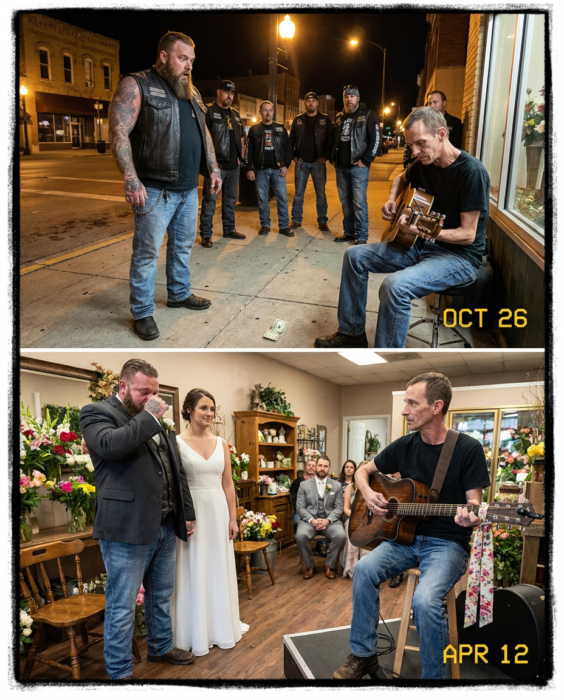
The wedding took place six months later.
Claire chose the old florist shop.
The business had reopened under a new owner who remembered Lily and agreed to close for the ceremony. The walls were cleared, the floor refinished, and the front windows left uncovered so the street corner remained visible.
Claire did not want to hide where the story hurt.
She wanted to change what happened there.
Iron Hollow handled practical work. Brick repaired the rear steps. Rook rewired lights. Sparks managed expenses so carefully that Claire threatened to seat him beside the loudest children.
Thomas rehearsed every day.
Not at the corner.
Inside the clubhouse, the florist, his apartment, and Eleanor’s workshop. The adaptive guitar allowed him to play the full arrangement, but endurance remained difficult. His right hand cramped. Phantom pain flared in the missing arm. The shoulder mechanism bruised him.
He never complained.
He did accept adjustments.
That mattered.
Old Thomas had viewed assistance as an accusation of weakness. The man preparing for Claire’s wedding began to understand that using a tool did not erase the years he taught himself alone.
Eleanor widened the support. A physical therapist changed his posture. Claire altered the vocal tempo so he had space between complex transitions.
They built the performance together.
The guest list included both families, the club, former florist employees, hospital staff from Thomas’s rehabilitation, and several musicians who tested Eleanor’s adaptive designs.
One chair in the front row remained empty.
A small bouquet of lilies rested on it.
Thomas objected when he first saw the chair.
“I don’t want her represented by absence.”
Claire understood.
They moved the flowers to the stage beside his stool. Lily would belong to the music, not an empty seat.
On the morning of the wedding, Thomas disappeared.
His guitar remained inside the florist.
We found him at the street corner.
He sat beneath the repaired light without an instrument, his right hand resting on his knee. Traffic moved around him. Six years of evenings seemed gathered there.
I stood beside him.
“You running?”
“No.”
“Good. I’m too old to chase.”
He looked at the florist window, where people arranged white flowers.
“I promised to play at my daughter’s wedding.”
“I know.”
“This isn’t hers.”
“No.”
He flinched.
I did not soften it.
Claire’s wedding could not become Lily’s substitute. Thomas could not fulfill one promise by pretending the bride was another daughter. That would be unfair to both women.
“So what am I doing?” he asked.
“Keeping the other half.”
He looked at me.
“Their promise had two weddings,” I said. “You lost one. She nearly lost the other.”
Thomas rubbed his right palm.
“I should have known Claire was hurting.”
“So should I.”
“We were standing one corner apart.”
“For six years.”
Two fathers.
Two forms of guilt.
Same useless distance.
The florist door opened. Claire appeared in a simple robe, her hair unfinished. She crossed the sidewalk despite her mother shouting that the groom might see her.
Thomas stood.
Claire held out a small cloth object.
It was a strip cut from Lily’s old florist apron, saved by the shop’s former manager after the crash. Claire had embroidered it around the guitar strap.
“She used to complain this apron smelled like wet stems,” Claire said.
Thomas touched the fabric.
“It did.”
“I’m not asking you to pretend this is her wedding.”
“I know.”
“I’m asking you to play at mine.”
Thomas fastened the guitar strap.
“That I can do.”
The ceremony began at five.
Harleys lined the curb, polished but silent. Club members wore clean cuts over white shirts. I walked Claire halfway down the aisle, then stopped beside the stage.
Thomas waited there.
He wore a dark suit modified for the shoulder mechanism. The custom guitar rested firmly against his body. Lily’s apron strip circled the strap near his chest.
Daniel stood at the front.
Claire reached him.
The vows were short. Honest. Neither promised never to grieve again.
Then Thomas played.
The first four notes carried through the florist.
Pause.
Six more.
Claire turned toward him.
For six years, Thomas had repeated the melody beneath a streetlight for passing strangers, never finishing it, never allowing applause, never accepting money.
Now every chair was filled.
His foot controlled the sustain. His upper arm changed the chord bars. His right hand plucked the melody he had rebuilt one note at a time.
Halfway through, Claire began singing.
There were no lyrics.
Only the wordless line Lily had planned to sing.
Claire’s voice trembled as the final measure approached. Thomas looked at the handwritten instruction attached discreetly to the music stand.
If Claire cries, play louder.
She cried.
Thomas played louder.
The last chord filled the room, passed through the open door, and reached the corner where he had practiced for six years.
This time, he did not begin again.
He lowered his hand.
Silence held for one breath.
Then Claire crossed the small stage and embraced him.
The applause came after.
Thomas accepted it.
That was the miracle.
Thomas returned to the street corner the following week.
The club tried to stop him.
We thought the wedding had completed the ritual. We imagined the corner belonged to pain and that healing required abandoning it.
Thomas disagreed.
“I like playing there.”
So he played.
The first evening, he began with “Until the Porch Light.” People gathered expecting him to repeat it.
When he reached the end, he changed chords.
A second song followed.
Then a third.
Thomas played old folk tunes, blues progressions, improvised melodies, and awkward versions of songs customers requested. Some were polished. Others fell apart halfway through.
He laughed when they did.
The guitar case remained open, but its purpose changed. A small card explained that donations supported adaptive instruments for disabled musicians.
Thomas accepted the money now.
Not for himself.
For the next player.
Eleanor and Thomas developed three additional prototypes. A veteran missing his right arm used one. A teenager born without a left hand tested another. An older woman recovering from a stroke played a full chord for the first time in years and refused to stop.
Iron Hollow funded an annual adaptive-music workshop inside the clubhouse.
The sight confused visitors: massive tattooed bikers adjusting straps, soldering switches, carrying amplifiers, and arguing over chord diagrams.
Thomas became the loudest critic.
Claire and Daniel visited the corner on the first Friday of every month. Sometimes she sang. Sometimes they listened from the curb. Their marriage did not erase Lily, but it stopped asking grief to approve every happy day.
A photograph from the wedding hung above Thomas’s workbench.
Claire and Daniel stood together. I stood on one side. Thomas stood on the other, adaptive guitar across his chest.
Near the frame was Lily’s original music.
Not hidden.
Not worshiped.
Used.
Each year on the crash anniversary, Thomas played the melody once at nine in the evening. The club shut off every Harley before he began. Traffic continued, strangers passed, and the florist light burned above him.
When the final chord faded, Thomas always chose another song.
That choice mattered more than the first.
Thomas played at the corner for eleven more years.
His hair turned white. My beard did too. Claire and Daniel eventually brought a daughter named Elise, whose middle name was Lily.
Nobody asked Thomas to replace the child he lost.
They gave him another child to teach.
Elise learned her first chords on the adaptive guitar while sitting on Thomas’s knee. She pressed the metal bars with both hands because she did not understand why anyone would use only one.
Thomas never corrected her.
The Iron Hollow adaptive-music fund purchased twenty-seven instruments over those years. Each carried a small lily inlay near the sound hole.
Thomas objected to the first.
He requested it on every one after.
When people asked about the symbol, he told them about a daughter who planned two weddings, a best friend who stopped her own life beside an invisible grave, and a group of bikers who heard one melody long enough to notice it was calling someone.
He never described himself as inspiring.
He hated that word.
He said he was a musician with one arm and an unfinished promise.
Eventually, even that changed.
“A finished promise,” he corrected me once.
The old homemade guitar remained inside the clubhouse. Its crude wooden brace, rusted lever, and scratched body hung beside a photograph of Thomas beneath the streetlight.
We offered to restore it.
He refused.
“Leave the struggle visible.”
Claire’s wedding video ends with Thomas lowering his hand after the final chord. For half a second, his face contains every year behind it.
Then Claire embraces him.
That is the part I replay.
Not the perfect notes.
The moment a man realizes finishing a song does not finish his love.
Thomas once practiced a single melody with one hand for six years, preparing for a wedding that could never happen. My daughter spent those same six years refusing a wedding because her best friend could not stand beside her.
They lived one corner apart.
The song found the distance.
Comment MELODY and follow the page for more biker stories about impossible promises, quiet grief, and the people who help each other finish.
Then play the next song.