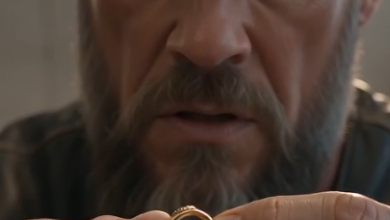
A 6’6 Tattooed Biker Locked a Birthday Clown Outside and Tore Down His Sick Son’s Balloon Garland — Then Everyone Learned What He Had Practiced in Secret for Six Months
PART 2 — MISUNDERSTANDING GETS WORSE
By the time the clown drove away, the video was already online.
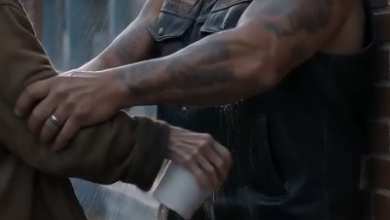
It was not the whole moment, of course. Viral shame rarely travels with context. The clip began after Marcus had already ripped the balloon garland from the porch. It showed him slamming the front door, blocking the clown, and popping the blue balloon in his fist while Noah stood crying behind the window. It caught Sarah’s voice shouting, “You’re ruining his birthday,” and Evelyn saying he was scaring the boy.
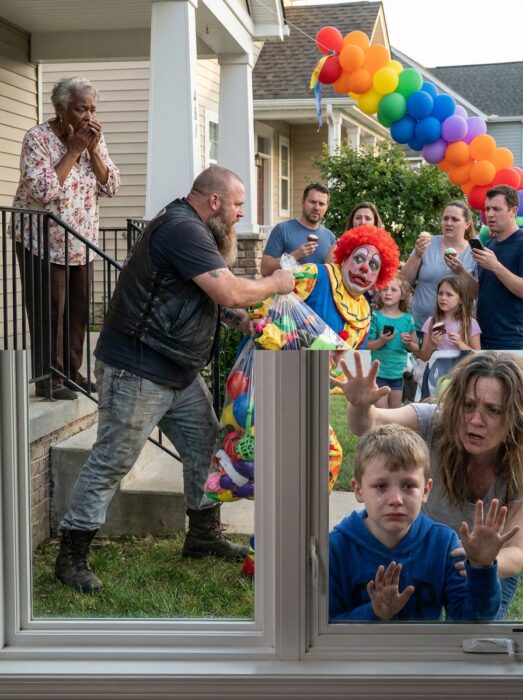
It did not catch Marcus looking at the open bag.
It did not catch the bubble machine.
It did not catch the used face-paint sponge or the damp gloves Victor had wiped on his costume after arriving from another party across town.
The caption did the rest.
Biker dad cancels sick kid’s birthday because he hates clowns.
People who had never met Noah decided they loved him. People who had never stood in Marcus Rowe’s driveway decided they knew what kind of father he was. By late afternoon, strangers were calling him cruel, unstable, controlling, and worse. One woman wrote that men like him should not be allowed near fragile children. A man from three counties away commented that if his son were sick, he would give him anything he wanted, not tear it away in front of him.
Marcus did not look at the video.
He did not need to.
He had spent most of his life watching strangers build stories out of his face. At gas stations, mothers pulled children closer. At restaurants, hostesses looked relieved when he asked for takeout. At the hospital, new nurses sometimes stiffened when he stood too quickly beside Noah’s bed, as if grief wrapped in leather was more dangerous than grief in a clean shirt.
But Sarah looked.
She hated herself for it, but she looked. She sat at the kitchen table with her phone in one hand and Noah’s untouched birthday cake across from her. The cake was shaped like a rocket ship, blue frosting along the sides, silver candy stars on top. Noah had chosen the design when his counts were good enough for hope. Now the candles remained unopened in the box.
Noah had gone back to his room.
That was the part that hurt Sarah most. He had not yelled. He had not demanded the clown come back. He had simply walked away from the window, climbed into bed with his dinosaur blanket, and turned his face toward the wall. The silence of a disappointed sick child can make a house feel accused.
Marcus stood in the laundry room washing his hands again and again.
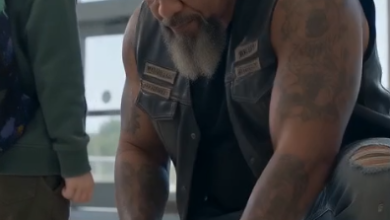
He scrubbed beneath his nails until the skin around his knuckles reddened. His leather vest hung on a hook beside the back door. Without it, in a faded gray T-shirt, he still looked enormous, but less like a threat and more like a man holding himself together with bones and willpower.
Sarah stood in the doorway. “You should have told me.”
Marcus kept washing. “I tried.”
“No,” she said. “You ordered. You blocked. You popped a balloon in front of him.”
His shoulders tightened.
“You scared him,” she said.
That made him turn off the water.
For a moment, neither of them spoke. The house hummed softly around them: refrigerator, oxygen concentrator in Noah’s room, rain tapping the back steps. Birthday plates sat on the counter, covered in cartoon dinosaurs that now looked painfully cheerful.
“I know,” Marcus said.
His voice was lower than usual.
Sarah expected more. An explanation. A defense. Something. Instead, he dried his hands with a paper towel, folded it twice, and threw it away. He looked toward the garage door, then back at Sarah.
“Did you check the green folder?”
“No,” she said, anger rising again. “Because I was busy telling our son why his father just destroyed the only party he might get this year.”
Marcus flinched.
That one hit harder than she meant it to.
She regretted it immediately, but regret did not bring the words back.
Evelyn knocked softly on the back door before stepping in. She was seventy-one, Black American, widowed, warm-eyed, and built with the kind of calm authority that made adults feel like children when they were acting foolish. She had known Marcus since before Noah was born. She had seen him fix her porch rail after a storm, shovel her walk at dawn, and sit in his truck outside the hospital because only one parent was allowed in overnight and Sarah had fallen asleep in the chair.
“I brought the cupcakes inside,” Evelyn said. “The kids went home.”
Sarah closed her eyes.
Marcus leaned against the counter. “Thank you.”
Evelyn studied him. “I also saw your garage.”
Marcus looked away.
Sarah turned slowly. “What is in the garage?”
He did not answer fast enough.
That silence, after everything else, felt like betrayal.
Sarah walked past him and opened the door to the garage before Marcus could stop her.
The light flickered on.
She stopped on the threshold.
The garage was full of balloons.
Not loose party balloons, not store decorations, not anything she recognized from the porch. Twisted animals hung from fishing line across the rafters. Dogs, swords, giraffes, monkeys, flowers, dinosaurs, crooked hats, a purple octopus, a yellow tiger with one leg too short. On the workbench were hand pumps, sealed packages, disinfectant wipes, gloves, and a notebook full of practice sketches.
On the wall, taped above Marcus’s tool chest, was a child’s drawing of a blue balloon dog wearing a rocket helmet.
Under it, in Marcus’s rough handwriting, were two words.
For Noah.
Sarah could not speak.
Marcus stood behind her, huge and ashamed, as if the secret room had exposed something more private than anger.
Evelyn whispered, “Oh, honey.”
But Sarah’s hurt did not vanish. It changed shape. That was all.
Because now the question was worse.
If Marcus had built a secret birthday in the garage, why had he destroyed the one outside?
PART 3 — FIRST HIDDEN CLUE
The first person to understand part of it was Noah’s home nurse.
Elena Ramirez arrived just after four, carrying a medical tote in one hand and a grocery bag of plain crackers in the other because Noah sometimes got nauseous after his afternoon medicine. She was a forty-six-year-old Latina American nurse with dark hair streaked silver at the temples, brown eyes that missed very little, and the practical gentleness of someone who could comfort a child while checking vital signs.
She found Sarah in the garage staring at the balloon animals.
Marcus stood near the tool bench, arms crossed, expression locked down. Evelyn sat on a folding chair beside the door, one hand pressed over her heart. The birthday cake still sat untouched in the kitchen. From Noah’s room came the faint sound of cartoons playing too low to be cheerful.
Elena looked at the balloons first.
Then she looked at Marcus’s fingers.
Every fingertip was nicked, taped, or rubbed raw near the nail. The skin around his thumbs had tiny splits where balloons had snapped during practice. On one wrist, half-hidden under his sleeve, he wore a faded hospital bracelet Noah had given him months earlier as a joke when he said Daddy should have a patient bracelet too because he never left.
Elena set her medical tote down slowly.
“Marcus,” she said, “how long have you been doing this?”
He shrugged like it was nothing.
Sarah answered for him without meaning to. “Apparently long enough to build a zoo.”
Elena walked to the workbench and picked up the notebook. She did not open it until Marcus gave the smallest nod. Inside were rows of notes written in his blocky handwriting: dog, too loose at neck; giraffe pops if twisted too fast; dinosaur tail needs three bubbles; wash hands before every batch; no mouth inflation; sealed packs only; no glitter; no scented markers; ask Elena about cleaning pump.
Sarah read over her shoulder.
Her anger faltered again.
Elena turned a few pages. A date appeared at the top of one sheet from six months earlier. Beneath it, Marcus had written:
If he makes it to seven, learn fifty.
Sarah’s hand went to her mouth.
Marcus reached for the notebook. “Don’t.”
But Elena kept reading, not aloud now. Her face softened in a way that made Sarah’s chest tighten. Nurses see love in forms most people miss. They see it in washed hands, organized pill boxes, blankets warmed in dryers, fathers sleeping upright with boots still on because they are afraid the monitor will beep if they lie down too fully.
Elena closed the notebook gently.
“Where is the green folder?” she asked.
Marcus pointed to a metal cabinet.
Sarah remembered then. The green folder. He had mentioned it on the porch. She opened the cabinet and found a folder labeled Noah, Birthday Rules, written in black marker. Inside were printed instructions from Noah’s pediatric oncology clinic, the home care plan, notes from Elena, and a list Sarah had seen weeks ago but had not connected to the party because her mind had been full of cake, medicine schedules, and the terrifying hope of a birthday.
Elena took the top sheet and looked at it.
“No large gatherings. No unscreened visitors. No shared face paints. No recently used costumes or props. Avoid bubble machines, aerosol sprays, confetti dust, and anyone coming directly from another children’s event.” She looked up. “The clown came from another party?”
Evelyn nodded. “His van had streamers from a daycare.”
Marcus said nothing.
Sarah felt the memory rearrange itself. Victor’s bag. The gloves. The sponge. The bubble machine. The way Marcus had stared at everything before moving. The way he had blocked the door with his whole body, not because he hated joy, but because he had seen risk where everyone else saw entertainment.
Still, there was pain in how he had done it.
Sarah looked at him. “Why didn’t you say that outside?”
Marcus’s jaw worked. “Because Noah was listening.”
“He heard everything anyway.”
“I know.”
Elena put the folder down. “Sarah, he was right to stop the clown.”
The words landed heavily.
Marcus did not look relieved.
Sarah turned toward him, tears rising now. “And was he right to pop the balloon in front of Noah?”
Elena did not answer. Marcus did.
“No,” he said.
That mattered. It did not fix it, but it mattered.
Evelyn looked toward the garage rafters. “What were you planning?”
Marcus stared at the blue balloon dog drawing above the tool chest. “A smaller party.”
“How small?” Sarah asked.
He swallowed. “Just us. You. Noah. Elena if she cleared it. Evelyn if she wore a mask and washed like the clinic said.”
Evelyn smiled through tears. “I would scrub down like surgery for that boy.”
Marcus almost smiled, but it broke before reaching his eyes.
Then Elena picked up one of the sealed balloon packs. “These are new?”
“All sealed,” Marcus said. “No mouth. Pumps only. Gloves. I practiced after midnight so he wouldn’t hear.”
Sarah looked at the fifty animals, the notebook, the taped fingers, the months hidden behind his silence.
“You learned all this alone?”
Marcus looked embarrassed, which was strange on a man his size.
“Internet videos,” he said. “Library book. One retired clown on a biker forum.”
Evelyn blinked. “There are retired clowns on biker forums?”
Marcus shrugged. “Apparently.”
For the first time all day, Sarah almost laughed. Then she heard Noah cough from his room, and the sound pulled the air out of everyone.
Elena moved first.
Marcus followed, but stopped at the hallway door and looked back at the garage. Something had changed in him. Not fear now. Decision.
On the workbench beside the notebook, half-hidden under a clean towel, lay one unfinished blue balloon dog.
Its front leg was twisted wrong.
Across the balloon, in tiny marker letters, Marcus had written a word Sarah had never seen before.
Rocket.
PART 4 — TRUTH BEGINS TO TURN
Noah did not want to talk to his father.
That was the part nobody could fix with medical instructions or hidden balloon animals. Facts explained Marcus’s fear, but they did not erase the image Noah had seen from the window: his father ripping down color, shutting out laughter, and crushing a blue balloon like the birthday itself had done something wrong.
The boy lay in bed with his dinosaur blanket pulled to his chin. His room was carefully clean, filtered, and too quiet for a child’s birthday. A small oxygen tube rested near the nightstand in case he needed it. His rocket cake waited in the kitchen. The paper crown Sarah had bought from the party store sat unopened on the dresser.
Marcus stood in the hallway, too large for the narrow space, holding a mask in one hand and the broken ribbon from the porch garland in the other.
Elena checked Noah’s temperature, listened to his lungs, and looked at Sarah with a small nod. Stable, for now. Not perfect. Stable. Families like theirs learn to treat that word like a fragile gift.
Noah turned his face toward the wall when Marcus came in.
The movement was small. It hurt like a blade.
Sarah stood near the closet with her arms folded. She loved Marcus. She also wanted to shake him. That was the truth of caregiving couples under pressure. Love did not stop exhaustion from turning sharp. Fear did not always speak kindly. They had both been living six months inside a house where every cough could become a hallway sprint, every clinic call could change the week, every birthday wish had to be whispered carefully so hope would not hear itself too loudly.
Marcus sat on the floor beside Noah’s bed instead of the chair. He always did that. He said chairs made him feel like a visitor. On the floor, his knees rose high, and his giant frame looked folded and awkward, but less intimidating. He placed the porch ribbon on the carpet between them.
“I messed up,” he said.
Noah did not answer.
Marcus waited. He had learned from hospitals that silence is not empty. It is often where a person decides whether they are safe enough to speak.
Finally, Noah whispered, “You made him go away.”
“The clown?”
Noah nodded without turning.
Marcus looked down at his hands. “Yes.”
“I wanted a balloon dog.”
“I know.”
“You popped one.”
Marcus closed his eyes.
The room held him accountable more honestly than any online comment ever could.
“I shouldn’t have done that where you could see,” he said. “I saw something that scared me, and I moved too fast. That wasn’t fair to you.”
Noah sniffed. “Everybody left.”
“Some people had to.”
“Because of me?”
Marcus’s head lifted sharply. “No.”
The force of that word made Noah turn slightly.
Marcus softened his voice. “Never because of you.”
Sarah’s eyes filled, but she stayed quiet. It was not her moment to rescue him from his own apology.
Marcus reached slowly into his back pocket and pulled out a photo folded in half. He had meant to show Noah later, maybe after cake, maybe never if the day went badly. Now he unfolded it and placed it on the blanket.
The photo showed Marcus in the garage, sitting on an upside-down bucket at midnight, wearing reading glasses he hated, twisting a long blue balloon into something that looked more like a worm than a dog. Around him were popped balloon pieces, a hand pump, and a laptop paused on a tutorial video.
Noah stared.
“You did that?” he asked.
Marcus nodded.
“When?”
“After you fell asleep.”
“How many times?”
Marcus looked at Sarah, then back at Noah. “A lot.”
Noah’s eyes moved to his father’s bandaged fingers.
That was the first clue the boy understood not as a medical rule, but as love.
Marcus said, “I wanted to make you one myself.”
Noah’s voice was suspicious and wounded. “Why didn’t you tell me?”
“Because I wanted it to be a surprise.”
“It was a bad surprise.”
Marcus gave a broken little nod. “Yeah. The beginning was.”
From the doorway, Evelyn wiped her eyes with a tissue. Elena watched carefully, not as a nurse now, but as a witness to a family stepping over broken glass.
Noah looked back at the wall, but not as firmly as before.
“What did you make?” he asked.
Marcus’s shoulders lowered for the first time all day. “A dog. A giraffe. A bad monkey. A better monkey. Three swords Sarah said absolutely not. A dinosaur with short legs. A rocket hat.”
At that, Noah’s mouth moved.
Not a smile. Not yet. A shadow of one.
Sarah noticed and covered her mouth.
Marcus did not push. He knew better than to rush a child who had spent months having adults rush around his body. He folded the photo again and placed it on the nightstand.
“Noah,” he said quietly, “if you still want a party, I can do it safe. Small. No strangers. No cameras. No bubble machine. No face paint. Just us.”
Noah looked at him.
“And balloons?”
Marcus swallowed. “If Elena says yes. New ones. Clean ones. Pump only. Just like the rules.”
Elena nodded. “I can help keep it safe.”
Noah’s eyes shifted to his mother. Sarah nodded too, though tears ran down her face now.
The boy was quiet for a long time.
Then he whispered, “I still want the blue dog.”
Marcus looked down, because if he looked at his son too long, he might fall apart.
“I’ve been practicing that one the most,” he said.
The truth had begun to turn, but it had not become simple. Sarah was still angry. Noah was still hurt. Evelyn still believed Marcus owed the clown an apology for the frightening way he handled the moment. Elena still wanted the video taken down because sick children did not deserve to become public entertainment.
Marcus did not argue with any of it.
He did not want to be called right.
He wanted his son to make it to cake.
PART 5 — BIKER’S PAST / DEEPER TWIST
Marcus Rowe did not learn fear when Noah got sick.
He learned it much earlier, in a trailer park outside Paducah, where his mother worked nights at a laundry and his father came home mostly to prove the house could still become smaller. Marcus was a large child, too tall too young, the kind teachers placed in the back row and expected to behave older than he was. At twelve, he looked sixteen. At sixteen, he looked like trouble even when carrying groceries for elderly neighbors.
He learned that big boys were not allowed to be scared.
When his little sister Lily was born, Marcus became gentle in secret. Lily was tiny, brown-haired, and fascinated by anything that floated. Bubbles, leaves, dust in sunlight, balloons tied outside grocery stores. She would laugh so hard at balloons that Marcus once spent his last four dollars at a county fair trying to win her a red one shaped like a dog. He failed, of course. The carnival man twisted it in twelve quick movements, and Marcus watched like he had seen magic done by ordinary hands.
Lily carried that balloon dog for two days until it shriveled beside her bed.
Then winter came hard.
Lily got sick during a week when everyone in their trailer park was coughing. Their mother wanted to take her to the clinic, but the car would not start, and the neighbor who usually drove them was working a double shift. Marcus remembered holding Lily in the back seat of a borrowed truck the next morning, watching her breathe too fast while his mother whispered prayers into her hair.
Lily survived that time.
But the memory never left him.
Years later, Marcus became a volunteer firefighter, then an EMT, because fear had turned into a need to arrive fast enough. He learned to read rooms. He learned to smell electrical heat before smoke showed. He learned that a damp cough in the wrong body could matter. He learned that people often said, “It’s probably nothing,” seconds before nothing became everything.
He also learned failure.
One call in particular stayed. A birthday party. A child with a fragile immune system, a crowded living room, too many adults saying it was just a cold, just a little fever, just a party. Marcus was not allowed to know the full medical story afterward, but he knew enough. He remembered the cake on the counter. He remembered the deflated balloons on the floor. He remembered a father standing in the driveway with frosting on his shirt, saying, “I only wanted him to have one normal day.”
That sentence became a nail in Marcus’s chest.
Years passed. He left emergency work after a back injury and too many nights waking to sirens that were not there. He rebuilt motorcycles. He rode with men who looked as rough as he did and loved softer than anyone guessed. He met Sarah at a roadside diner after fixing a flat tire for a nurse on her way home from a double shift. She was not impressed by his size. She was impressed that he had changed the tire in the rain without once mentioning how cold he was.
Noah was born three years later.
Marcus had never held anything so small with hands so scarred. In the hospital room, he looked terrified to lift his own son. Sarah laughed gently and told him babies were not made of glass. Marcus believed her for almost seven years.
Then came the bruising.
The fevers.
The tests.
The words parents hear but never fully absorb because the mind refuses to let certain sentences become permanent. Treatment began. Life narrowed into clinic rooms, medicine schedules, good counts, bad counts, masks, hand sanitizer, and the cruel mathematics of hope. Birthdays became medical questions. Holidays became permission slips from lab results.
Six months before Noah’s seventh birthday, a doctor told Marcus and Sarah the truth with kindness, which somehow made it worse.
“We hope he gets there,” the doctor said. “But we need to prepare for the possibility that he may not.”
Marcus did not cry in the room.
He carried Sarah to the truck because her knees gave out near the elevator. He drove home. He put Noah to bed. He stood in the garage until sunrise, one hand on his motorcycle, the other pressed against his mouth so nobody would hear the sound coming out of him.
The next morning, Noah asked for a birthday party.
Not a big one. Not superheroes, not a bounce house, not a crowded room. He wanted a rocket cake and a balloon dog. Blue, if possible. He said a real dog could not come into his clean room, but maybe a balloon one could.
Marcus said, “I’ll see what I can do.”
That was how six months began.
He called entertainers first. Most were kind, but none could meet the restrictions. Some did parties all weekend with dozens of kids. Some used shared props. Some inflated balloons by mouth. Some wore costumes that could not be sanitized. One honest clown told Marcus, “Sir, I would not risk it with your boy.”
So Marcus went to the public library and checked out a book on balloon twisting.
The librarian, a Black American woman in her fifties named Denise Hall, looked at his leather vest, tattoos, and the book cover full of smiling clowns. She did not laugh. She only slid it across the counter and said, “Starting with the dog is hardest if you’re impatient.”
Marcus said, “Then I’ll stop being impatient.”
He practiced in the garage after midnight. Balloons popped in his face. The first dog looked like a snake that had lost an argument. The giraffe collapsed. The sword was easy, which annoyed Sarah when she found three hidden behind the toolbox and banned them from the medical-safe party. Marcus watched tutorials with the volume low. He washed every surface. He used a hand pump. He wrote notes like a mechanic learning a new engine.
And every week, after Noah fell asleep, he made one blue dog.
Most were bad.
He kept trying.
The notebook became more than instructions. It became a place to write the things he could not say. If Noah makes it to seven. If we get cake. If the blue dog survives. If my hands can do one gentle thing well enough.
He did not tell Sarah everything because Sarah already carried too much. That was his mistake. Loving someone quietly can become another kind of loneliness if you hide the work too well.
On the morning of the party, Marcus had the garage ready. Fifty animals. One for every day Noah had been home since the last hospitalization. A blue dog at the center. A rocket hat. A crooked dinosaur. A giraffe named Long John because Noah liked stupid names. He had planned to bring Noah into the garage after cake, after Elena checked him, after the house was calm.
Then Victor arrived.
A clown nobody had cleared.
A bag full of shared props.
A bubble machine.
A van fresh from another children’s party.
A porch garland made from store balloons touched by half the neighborhood.
And Marcus saw that old birthday call again.
He saw the father in the driveway saying he wanted one normal day.
He saw Lily breathing too fast in the borrowed truck.
He saw Noah’s small hand pressed to the window.
So he moved.
Too hard. Too fast. Too frightening.
But he moved because love, when soaked in old fear, does not always look gentle from the outside.
PART 6 — PUBLIC REVERSAL / EVIDENCE
The video came down after Elena called the neighbor who posted it.
Not immediately. Nothing online disappears immediately, especially when people have already decided anger feels righteous. But Elena spoke with the calm authority of a nurse who knew exactly which words mattered: minor child, medical privacy, immunocompromised patient, incomplete footage, unsafe exposure, please remove this now. The neighbor, a twenty-year-old white American cousin named Tyler, sounded embarrassed before the call ended.
“I didn’t know,” he kept saying.
Elena’s answer was firm. “That is why we do not post children in crisis before we know.”
The sentence traveled through the family faster than the video had.
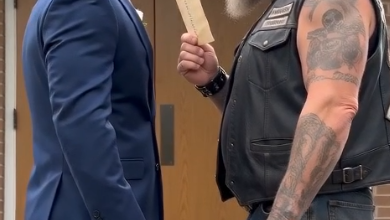
Victor the clown returned too, but not to argue. He came back without the costume, wearing jeans, a clean sweatshirt, and a face stripped of paint and pride. He stood on the sidewalk with a sealed envelope in his hand and would not step onto the porch until Marcus opened the door.
“I’m sorry,” Victor said.
Marcus stood in the doorway, still huge, still hard-faced, still holding himself like a man waiting for blame because he knew he had earned some of it.
Victor swallowed. “Mrs. Keller hired me. She said the boy was sick, but she didn’t say restrictions. I should have asked. I came from a party with thirty kids. I had used props. I should have known better.”
Marcus nodded once. “I should’ve handled it better.”
Victor looked relieved and ashamed at the same time. “Your nurse explained. I deleted my post too.”
Marcus frowned. “You posted?”
Victor looked down. “Just a picture of the house. No kid. Still wrong.”
Sarah watched from behind Marcus. Her face softened a little. Not because everything was fine, but because responsibility was finally being shared honestly around the circle where harm had happened.
Mrs. Keller came next.
She was the yellow-cardigan neighbor who had arranged the clown as a surprise. A white American woman in her late sixties, kind, lonely, and often too quick to fix other people’s pain with gestures they had not requested. She brought a covered dish in both hands and tears already sliding down her cheeks.
“I thought I was helping,” she said.
Sarah hugged her, then pulled back and said gently, “You scared us.”
Mrs. Keller cried harder. “I didn’t know.”
“We know,” Sarah said. “But Noah’s rules are not suggestions.”
That public reversal was not dramatic. Nobody clapped. Nobody declared Marcus innocent and everyone else guilty. Real life rarely reverses that cleanly. It was more uncomfortable than that. People apologized in pieces. People admitted they had judged from the porch. People realized Sarah had been shamed too, not just Marcus. They realized Noah had been made into a symbol before anyone asked whether he wanted to be seen.
Evelyn made coffee in the kitchen for the adults, which was her way of telling the room it was time to act human again.
Meanwhile, Marcus cleaned the living room.
He worked silently, moving furniture away from Noah’s path, wiping surfaces, setting out the small approved plates Sarah had sanitized that morning. Elena checked the air filter, washed her hands, and helped Sarah decide who could stay. In the end, the party became what Marcus had planned but had failed to explain: tiny, careful, and deeply protected.
Sarah.
Marcus.
Noah.
Evelyn, masked and scrubbed in like she was entering an operating room.
Elena, half nurse and half aunt by now.
Mrs. Keller watched through the porch window after apologizing to Noah from outside because she did not want to risk stepping in.
Victor left a sealed pack of professional balloons on the porch with a note that said, For when the doctor says safe. No charge. No pictures.
Marcus read the note twice.
Then he tucked it into the green folder.
At five-thirty, Elena cleared Noah to come to the living room for a short party.
The boy moved slowly, wearing his blue birthday hoodie and a paper crown Sarah had finally opened. Marcus stood near the garage door, hands behind his back, as nervous as he had ever looked. His fingers were bandaged. His beard looked freshly washed. His leather vest was gone. He wore a clean black T-shirt with a faded motorcycle logo and jeans with one knee patched.
Noah stopped in the doorway.
The living room had no crowded decorations now. No loud clown. No bubble machine. No face paint. No strangers laughing too close. Just a small table with the rocket cake, three chairs, a clean blanket on the couch, and a handmade sign Evelyn had taped to the wall.
Noah’s Flight Crew.
Noah looked at the sign.
Then at Marcus.
“Where’s the blue dog?” he asked.
Marcus’s face broke open for half a second. Not into a full smile. Into fear, hope, and something painfully tender.
“In the garage,” he said. “Waiting for permission.”
Elena looked at Noah. “Do you want to see?”
Noah hesitated.
That hesitation mattered. He was still hurt. He had the right to be. Marcus knew it. Sarah knew it. The room waited, giving the child the choice he had been denied earlier by adults moving too fast around him.
Finally, Noah nodded.
Marcus opened the garage door.
The light came on.
Fifty balloon animals floated from strings, shelves, tool hooks, and the rafters of a place that usually smelled like oil and rubber. The motorcycle was covered with a clean sheet. The tool chest had been turned into a display table. A parade of bright animals surrounded the room: giraffes, dogs, monkeys, flowers, hats, snakes, bears, and one ridiculous green dinosaur with short legs and a long tail.
At the center, taped gently to a cardboard rocket ship, was a blue balloon dog wearing a tiny paper helmet.
Noah stared.
Sarah cried quietly.
Evelyn whispered, “Lord have mercy.”
Elena covered her mouth.
Marcus stood behind them, too large for the doorway, looking more frightened now than he had when half the neighborhood called him cruel. Because this was the part that mattered. Not the comments. Not the apologies. Not the video being deleted.
This.
His son looking at the birthday his father had built in secret, one popped balloon at a time.
Noah stepped forward.
The blue dog bobbed slightly in the air.
“Did you make all of them?” he asked.
Marcus nodded.
“For me?”
His voice nearly failed. “Every one.”
Noah looked back at him. “Even the ugly dinosaur?”
Marcus glanced at the green animal. “Especially him.”
Noah smiled then.
It was small and tired and real.
That was the moment the story reversed in every heart inside that house.
PART 7 — EMOTIONAL PAYOFF / FINAL TWIST
They sang happy birthday softly.
Nobody told Noah to blow out candles. Elena had already said no, and Marcus had taken that rule more seriously than gravity. Sarah placed one battery tea light on the cake instead, its fake flame flickering in a way that made Noah laugh because it looked like a tiny rocket engine trying its best. Evelyn sang off-key through her mask. Marcus sang low, almost under his breath, as if the song might crack if he pushed too hard.
Noah sat on the couch with the blue balloon dog in his lap.
He named it Rocket.
The name made Marcus look down quickly, but Noah caught it.
“What?” the boy asked.
Marcus shook his head. “Nothing.”
Noah narrowed his eyes with the ancient suspicion of children who know adults are hiding feelings. “You wrote Rocket on it before.”
Sarah looked at Marcus.
He sighed, then went to the garage and returned with the unfinished blue dog from the workbench, the one with the twisted wrong front leg. The tiny marker letters still showed near the side.
Rocket.
“This was the first one that looked almost like a dog,” Marcus said. “I kept it because I thought maybe if I could make it right once, I could make the birthday right too.”
Noah touched the lopsided balloon gently. “It’s not wrong.”
Marcus gave a rough little laugh. “Buddy, that leg points west.”
“It’s a space dog,” Noah said. “Maybe space dogs have west legs.”
Evelyn laughed through tears. Sarah leaned into the kitchen counter and cried harder, quietly enough not to turn the moment heavy for Noah. Elena checked the boy’s color, then looked away because nursing did not protect anyone from that kind of love.
The party lasted only thirty-eight minutes.
That was all Noah had energy for. Thirty-eight minutes of cake bites, one sip of juice, a rocket hat that kept sliding over his eyes, and Marcus making three more animals live while Noah directed from the couch like a tiny tired king. A giraffe for Evelyn. A flower for Sarah. A sword for Elena, who said absolutely not, then accepted it because Noah giggled. Marcus twisted carefully, methodically, pumping the balloons by hand, washing before each set, keeping every motion slow enough to look safe and magical at once.
Noah watched his father’s hands.
Those hands had always seemed enormous to him. They fixed motorcycles, carried laundry baskets, opened stubborn jars, held him upright during weak days, and hovered near hospital beds as if afraid to touch too hard. Now they were doing something absurdly delicate. Pinching, twisting, shaping air into animals because a little boy had asked for one beautiful thing.
After the third balloon, Noah said, “Daddy?”
Marcus looked up.
“You looked funny learning.”
Sarah smiled. “You saw the picture?”
Noah nodded. “You had glasses.”
Marcus groaned. “That was supposed to stay secret.”
“You looked like a biker teacher.”
“Worst kind of teacher.”
“No,” Noah said, serious now. “Best kind.”
Marcus stopped twisting.
The balloon in his hands squeaked softly. His eyes moved to Sarah, then back to his son. Compliments from grown-ups bounced off him. Compliments from Noah entered somewhere unguarded and stayed.
Elena checked the time gently. “One more minute, sweetheart.”
Noah nodded. He was tired enough now that his eyelids looked heavy. Marcus sat on the floor beside the couch, exactly as he had in the bedroom earlier. Noah held Rocket the blue balloon dog under one arm and rested his thin hand on Marcus’s shoulder.
“I thought you didn’t want me to have a party,” Noah whispered.
The room went still.
Marcus closed his eyes.
This was the wound beneath the whole day. Not the clown. Not the video. Not the neighbors. This sentence.
Marcus opened his eyes and turned so Noah could see his face. He did not hide behind roughness this time. He let every broken thing show.
“I didn’t know if you would live to your birthday,” Marcus said softly. “So I learned balloons for six months because if you did, I wanted you to have the best party I could make with my own hands.”
Sarah covered her mouth.
Evelyn bowed her head.
Elena stepped into the hallway, giving them privacy though she could still hear.
Noah stared at his father, too young to carry the full weight of those words, but old enough to understand the shape of them. He understood that his father had been afraid. He understood that the garage was not just a surprise. It was a waiting room made of color. It was his father saying maybe with every dog, giraffe, dinosaur, and flower. It was hope twisted into shapes because hope by itself had become too dangerous to hold.
“Did you think I wouldn’t make it?” Noah asked.
Marcus’s face crumpled.
“For some nights,” he said. “I was scared.”
Noah touched the blue dog’s paper helmet. “But I did.”
Marcus nodded. “You did.”
“And you learned the dog.”
“I did.”
Noah thought about that for a long time.
Then he handed the blue dog to Marcus.
At first, Marcus did not understand. “You don’t want it?”
Noah shook his head, weak but certain. “I want you to keep Rocket. For when you get scared.”
That was the final twist nobody in the house had expected.
Marcus had spent six months building a birthday for his son. He had thought the blue dog was proof that he could give Noah one beautiful day if the boy survived long enough to receive it. But Noah saw something else in it. He saw his father’s fear. He saw the man behind the tattoos, the leather, the slammed door, the bad apology, the bandaged fingers. He saw that sometimes fathers need comfort too, even when they are six-foot-six and built like nothing can reach them.
Marcus took the balloon dog with both hands.
He held it like it was made of glass.
Then Noah leaned forward, placed one tired hand on his father’s beard, and whispered, “You can be scared and still be my dad.”
Marcus broke then.
Not loudly. Not dramatically. He simply lowered his forehead to the edge of the couch and cried with one hand wrapped around a blue balloon dog while his sick son rested a small palm on his head. Sarah knelt beside them and put her arms around both. Evelyn turned toward the window, wiping her eyes beneath her mask. Elena stood in the hallway with one hand over her heart, listening to a family survive a day that had almost become another wound.
Outside, the neighborhood was quieter now.
The video had been removed. Apologies had been sent. Mrs. Keller sat on her own porch with a cup of tea and a face full of regret. Victor had texted Sarah to say that if Noah ever got cleared for an outdoor show, he would come in fresh clothes with new supplies and let Marcus inspect every inch of the bag. Sarah replied thank you, then turned off her phone.
No more audience.
No more comments.
No more strangers voting on a father’s worst thirty seconds.
Inside the Rowe house, the party ended with Noah asleep under his dinosaur blanket, the rocket cake half eaten, the balloon animals floating quietly in the garage like a bright little zoo waiting for morning. Marcus stayed on the floor beside the couch long after Sarah told him he could get up. Rocket rested on the coffee table, its crooked paper helmet shining under the lamp.
Before bed, Sarah found Marcus in the garage.
He was taking down the animals one by one, not throwing them away, just arranging them carefully in clean bins so Noah could see them again tomorrow if tomorrow was kind. His leather vest hung over the back of a chair. His bandaged fingers moved slowly. He looked exhausted in a way sleep would not fix.
Sarah stood beside him.
“I’m still mad about the porch,” she said.
“I know.”
“And I’m sorry I didn’t check the folder.”
He nodded. “I should have talked before I moved.”
“Yes,” she said.
They stood in that honest, imperfect place for a moment. Marriage under illness had taught them that love was not the absence of blame. It was returning after the blame, carrying what was true, and setting it down where both people could see it.
Sarah picked up the lopsided green dinosaur. “This one really is ugly.”
Marcus looked offended. “That is Long John.”
“He has three legs.”
“He’s been through a lot.”
Sarah laughed then, softly, and the laugh loosened something in the garage.
Marcus looked toward the house. “He smiled.”
Sarah leaned her head against his arm. “He did.”
For the first time all day, Marcus let himself breathe fully.
Weeks later, people in town still talked about the biker who tore down a birthday party and then turned out to be the one who built it. Some told the story badly. Some made it sweeter than it was. Some forgot the anger, the fear, the hurt, and the apologies. That is what people do with stories. They polish them until the rough parts stop cutting.
But Sarah remembered the whole truth.
Noah did too.
And Marcus kept Rocket the blue balloon dog on a shelf in the garage until it slowly softened, sagged, and became a wrinkled little shape of air and memory. When it finally deflated, Noah helped him place it in a clear box with the paper helmet, the first photo of Marcus practicing, and one page from the notebook.
The page said:
If he makes it to seven, learn fifty.
Under it, in Noah’s handwriting, added weeks later in blue marker, were the words:
He made it. Daddy did too.
Follow this page for more unforgettable biker stories about misunderstood heroes, quiet kindness, and the rough-looking people who notice what everyone else misses.