Part 2: He Hated Becoming His Father — Until He Found 20 Years of Letters Hidden Inside the Harley the Old Man Left Behind
If you had met me that summer, you would have thought the story was simple.
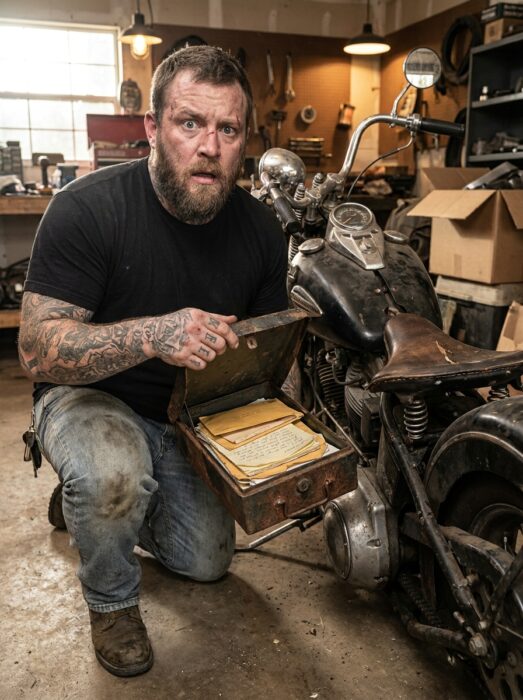
Big guy.
Thirty years old.
Blue-collar.
Probably trouble in a bar after midnight.
I was living outside Joplin then, just over the line from Kansas, working heavy equipment repair and taking side welding jobs when bills pinched. I rode sometimes, though I told people I wasn’t in a club and never would be. My bike was a used Dyna with more road grit than shine. I wore black more out of habit than style. Boots always dirty. Jeans stiff with work. Cut-off sleeves in summer. Flannel in winter. A few tattoos I got for the wrong reasons and a few I got for the right ones after I stopped knowing the difference.
Men like me get read the same way everywhere.
Waitresses bring coffee quick and leave quicker.
Hardware store cashiers glance at the neck ink, then the counter, then the exit.
At gas stations, decent people decide whether you’re dangerous before you pull your wallet chain free.
They were not always wrong.
There was enough violence in my posture to make strangers cautious. Enough damage in my eyes to make women with children watch where I stood. I knew that. I had used it before when it was easier than explaining myself.
But like most men trying too hard not to become somebody else, I had contradictions.
My fingernails stayed clean because I couldn’t stand the idea of reaching for a child someday with dirt crusted in the cuticles the way his had been.
I carried a tiny travel bottle of hand lotion in my truck because my mother’s skin used to crack every winter and nobody in our house ever learned that roughness wasn’t the same thing as strength.
And I never let my voice get loud indoors if I could help it.
That was the first seed.
The second was the garage key.
I had kept it on my ring for five years without ever using it.
My uncle Ray gave it to me right after the funeral and said, “Whenever you’re man enough to decide whether you hate him or the parts of you that look like him, go open that door.”
I told him to go to hell.
Then I kept the key.
My father’s name was Dean Mercer.
In town, older men still remembered him in pieces depending on which version of him they knew. Some remembered the early Dean, the one who could tear down a carburetor by sound and get a dead shovelhead running with half the right tools and none of the right patience. Some remembered the fight years, when he ran with a rough crowd out of Oklahoma, drank like thirst was a moral problem, and wore his cut like it gave him the right to scare people. Some remembered the later ghost version, seen once in a while near truck stops and cheap motels, thinner every year, never staying long enough to make amends and never disappearing so completely that you could call him fully gone.
I remembered him by noises.
Keys on the counter.
Boots in the hallway.
A garage door slamming at the wrong hour.
The click-click of a lighter.
The ugly laughter men use when they are too tired to be kind.
My mother remembered him by absence.
She raised me on diner shifts, second jobs, bad coffee, and the kind of exhaustion that makes a woman quieter rather than weaker. She never romanticized him. Never fed me lies about a misunderstood man. If I asked where he was, she’d say, “Not here.” If I asked why, she’d say, “Some men love their damage more than they love the people watching them drown in it.”
That was about as close as she ever came to a speech.
When he left for good, I was ten. Not a dramatic departure. No one packed in front of me. No great declaration. He simply failed to come back one time too many, and then the gap kept growing until it became a fact.
By thirteen, I was already broad enough to scare other boys. By fifteen, I could outfight most of them too. By sixteen, I had figured out that anger gets you mistaken for powerful if you wear it right.
That’s how men like my father reproduce themselves without ever entering the room.
You inherit the climate before you inherit the man.
I got good at work early because work felt cleaner than emotion. Engines either ran or they didn’t. Metal either warped or it held. A weld either set or it cracked. Compared to family, machinery was honest.
Still, I kept circling biker spaces even while telling myself I hated them. I spent time at garages. Stopped too long at roadside diners where men in cuts gathered. Took jobs from old road guys because they paid cash and talked straight. I liked the sounds. I hated that I liked them.
The brotherhood part tempted me more than the bikes ever did.
Not the fake social media brotherhood.
The real version.
A man stranded at midnight does not stay stranded long if the right kind of biker hears about it.
A widow’s lawn gets cut.
A new father gets diapers left on his porch with no note.
A drunk gets cornered, fed, and sat on until morning if that’s what saving him from himself takes.
I saw that and hated my father more for failing at something that other damaged men managed every day.
Because that was the thing no one tells you when you grow up hating your father.
The world keeps offering evidence that he had choices.
Once, outside Baxter Springs, I watched a grizzled biker with “SINNER” tattooed across his fingers kneel on wet asphalt to tie a stranger kid’s sneaker while the mother tried not to look terrified. Another time, at a diner near Miami, Oklahoma, I saw three club guys silently pay a waitress’s rent after hearing her landlord had thrown her kid’s asthma medicine into the yard.
Men worse-looking than my father.
Kinder by a mile.
That did not soften me.
It sharpened me.
By twenty-eight, I had my own garage corner at Ray’s place, my own tools, my own bad habits, and a girlfriend I lost because she once said, very calmly, “You don’t throw things. Good. You just make the whole room feel like it’s bracing.”
I laughed when she said it.
Then I saw she was serious.
Three weeks later, she was gone.
That was the beginning of the real crisis, though I didn’t know it yet.
The day I went into the garage where Dean’s Harley sat, it was because something in me had finally run out of excuses. I had started sleeping badly. Started drinking alone more than I wanted to admit. Started hearing my own voice get flat and dangerous in rooms where nobody deserved it. One night I caught my reflection in the microwave door while I was furious over nothing, and I saw my father so clearly I had to sit down.
So I drove to Ray’s place.
The garage was hot, dark, and full of old metal smell. The Harley sat under a canvas cover Ray had never bothered to replace. Black Road King. Dust over the tank. Rust nibbling at the chrome in spots. One saddlebag buckled wrong because no one had cared enough to fix it.
I stood there a long time before touching it.
Then I did the smallest thing first.
Ran my hand over the seat.
The leather gave a little.
Too much.
That’s what made me look underneath.
At first, I thought I had found money.
That’s the kind of stupid thought grief and heat can put in a man’s head.
The underside of the seat had been hollowed slightly and fitted with a flat metal box taped in place with old weatherproofing that had gone brittle with age. I had to pry it loose with a screwdriver and more swearing than skill. When it came free, it was heavier than paper should be.
Twenty envelopes.
Brown.
Numbered in black marker.
All the way to 30.
My throat went dry.
I sat down on the concrete beside the bike and just stared at them. In the far corner, Ray’s old box fan pushed warm air around without helping. Outside, a truck passed on the county road. Somewhere a dog barked. In the garage, everything smelled like old leather and the part of my life I had spent a decade trying not to touch.
I opened Age 11 first because I am a coward in the most predictable ways.
The letter wasn’t elegant. My father never wrote the way decent men in movies write. No beautiful apologies. No polished wisdom. The handwriting leaned hard to the right, same as his, pressed deep enough into the paper to leave marks on the sheet behind it.
He wrote that he did not know where I lived exactly that year because my mother had moved and he was too ashamed to ask anybody who still respected her. He wrote that he had seen a boy in a gas station holding a comic book and realized he didn’t know what kind of books I liked anymore. He wrote that if my hands ever started looking like his, I should remember hands are tools before they are weapons.
I stopped reading there.
It made me furious.
Not because it was cruel.
Because it wasn’t.
Cruel I understood.
Cruel would have been simple.
This was worse.
This was a version of him I had no use for.
A man capable of understanding things too late still leaves the same wreckage behind. A letter doesn’t un-break a dish. Doesn’t un-scare a child. Doesn’t un-exhaust a woman. I knew that. I stood up so fast the envelopes slid across the concrete. I kicked the fan over and it clattered against the wall like I was fifteen again and proud of the wrong kind of noise.
Ray came in from the side door before the fan finished spinning out.
He looked at the bike.
Then the envelopes.
Then me.
“So you found them.”
I wanted to punch him for knowing.
Instead I asked, “You knew about this?”
He nodded once.
That almost finished me.
“You let me hate him while these sat here?”
Ray leaned against the workbench, arms crossed, old biker posture, patient in the way older men get when they’ve outlived the illusion that yelling solves anything.
“Your hate wasn’t waiting on new information.”
That line landed because it was true.
I told him letters change nothing.
He said maybe.
Then he said something worse.
“He came by every year until he couldn’t.”
I stared at him.
Ray kept going.
Dean had written one every birthday after he left, sometimes drunk at first, then sober later, sometimes from cheap motels, sometimes from a recovery house, once from a hospital bed in Tulsa. He gave them to Ray because he said if he mailed them, he was making contact before he had earned the right. He said if he ever got himself clean enough and straight enough, he would bring them himself.
He never did.
He died five years ago of a heart that had been asked to forgive too much chemistry and too little mercy.
That should have been the climax.
The dead father leaving letters.
The uncle keeping the secret.
The son exploding in a garage.
It wasn’t.
Because Ray said one more thing before I could leave.
“He rebuilt that Harley twice and never rode it after he got the box made. Said the bike had one job left.”
I looked at the Road King.
“What job?”
Ray answered like it hurt him too.
“To carry you when you were ready to know him without the fear in the room.”
The main twist was not that my father had written letters.
It was what was inside them.
I went back the next day. Alone. Brought a thermos of bad coffee and enough anger to keep the garage warm if the weather turned.
I read the letters in order.
Age 11 was awkward.
Age 12 was defensive in places.
Age 13 was the first one where he admitted he used drugs because silence scared him more than prison ever could have.
By 14, he had started writing cleaner.
That was the first shock.
By 15, he wrote that he had entered rehab not because he believed in redemption but because one day he saw a boy in a hardware store flinch when a man with his same haircut reached for a hammer, and he realized his own son probably flinched at shadows shaped like him.
By 16, he was sober six months and didn’t trust it yet.
By 17, he wrote that if I ever thought tattoos or bikes or fists were the inheritance, I was looking at the costume instead of the illness. He told me the real thing passed from father to son was not leather or temper. It was the belief that shame should be hidden until it turned into rage.
I had to put that letter down and walk outside.
The second twist hit at Age 18.
He had enclosed a copy of a photo I had never seen. Me at nine years old on a minibike in a gravel lot, grinning through a split lip, my father crouched beside the frame tightening something with both hands. On the back he had written: You were happiest when you were moving. I pray I did not teach you to run.
There were more.
At 21 he wrote after seeing my name in a local paper for placing second in a welding competition. He clipped the article.
At 24 he wrote that Uncle Ray told him I had nearly gotten into a bar fight and walked away instead. He underlined one sentence: Walking away counts, even if no one claps.
At 26 he admitted he used to listen outside the diner where my mother worked because he did not trust himself to go in sober and not ruin her shift.
That one made me set the letter down and stare at the wall so long the light changed.
The deepest cut came at 29.
Dean wrote that if I had started seeing him in my own hands by then, I needed to know the resemblance was real but not final. He said fear of becoming your father can turn a man into the same thing just by keeping him locked in reaction. Then he wrote the line I still know by heart:
You do not beat a ghost by dressing different. You beat him by choosing different when no one is in the room to watch.
That was when I understood the real twist.
My father had not hidden the letters because he didn’t care enough to send them.
He hid them because he believed presence without repair was another form of theft. He did not trust his own need to be forgiven. So he kept writing, year after year, building a version of fatherhood he was too late to live out, hoping maybe the words could arrive one day without dragging the man with them.
It wasn’t noble.
It was tragic.
And it was more disciplined than I ever gave him credit for.
That is a much harder thing to carry than hatred.
Once I had read all twenty letters, the details of my own life started rearranging themselves whether I liked it or not.
The clean nails.
Not vanity. Refusal.
The way I kept my voice down in rooms.
Not natural decency. Learned resistance.
The fact that I had avoided clubs out of fear while still circling biker spaces like a stray dog around a lit porch.
Not contradiction. Inheritance trying to become choice.
I started seeing the seeds everywhere.
Why Ray gave me the garage key and never mentioned the letters. He knew a man cannot be argued into readiness. He can only get tired enough of living in reaction that he chooses curiosity over contempt for once.
Why the Harley had been kept whole. Why Ray changed the fluids every so often and covered it from dust even though nobody rode it. Why he never sold it for parts when money got thin.
Because the bike had become a vault.
Not for chrome.
For time.
The letters also explained things about Dean no one had said out loud. He had been clean the last seven years of his life. He’d worked at a recovery garage in Tulsa teaching younger addicts how to rebuild engines because, as he put it in one letter, broken machines were easier to face than broken men, but both got less dangerous if somebody stayed with them long enough.
He also never remarried. Never tried to start another family to prove to himself he was repairable. That mattered more than I wanted it to.
There was one last thing inside the metal box beneath the envelopes.
A small key wrapped in black electrical tape.
I almost missed it.
Ray knew immediately what it was for.
The saddlebag.
Inside the left bag, under the liner, was a second compartment. And in that compartment was a cheap cassette recorder with one tape inside, plus a note that said: If you’re reading this in a year when nobody owns tape players anymore, ask Ray. He keeps obsolete mercy in the top drawer.
He did.
We listened to it in the garage with the side door open and moths starting to gather around the porch light.
My father’s voice came out older than I remembered and kinder than I trusted.
Not polished.
Still rough.
Still breathing too close to the mic.
He said he didn’t know if I’d ever hear it. Said if I did, it meant I had at least opened the seat and that alone was more grace than he’d earned. He said the bike was mine, but only if I understood it wasn’t an heirloom of freedom or rebellion or any of the garbage men sell themselves. It was a machine. A beautiful one maybe. A dangerous one if used wrong. A shelter if used right.
Then he said the line that cracked everything open.
“I left you the Harley because I was scared you’d spend your whole life trying not to be me and never get around to becoming yourself.”
I didn’t cry then.
Biker blood or not, some things still get held in the chest first.
I sat there with both elbows on my knees, staring at that old cassette player while the tape hissed in the gaps between his words, and realized something awful and clean at the same time:
He had changed.
Not enough to save my childhood.
Not enough to repair my mother.
Not enough to walk back through our door and deserve dinner.
But enough to die trying to interrupt the damage instead of export it.
That did not redeem him.
It humanized him.
Sometimes that’s the more difficult mercy.
I did not ride the Harley right away.
That would make a tidier story than the truth.
The truth is I spent three weeks restoring small things first. Replaced the battery. Flushed fluids. Changed lines. Cleaned the tank. Rubbed the seat leather until the dust stopped turning my rag black. I touched every inch of that bike the way some men touch a scar they are trying to decide whether to keep hidden or claim.
Each evening I read one letter again.
Same garage.
Same fan.
Same folding chair.
Not because I liked reopening it.
Because repetition is how some truths stop feeling like attacks and start becoming tools.
I also started paying attention to my own choices with an almost embarrassing level of discipline.
When I got angry, I left rooms instead of freezing them.
When I drank, I noticed why.
Then I stopped drinking for a while because I didn’t like the answers.
I apologized to the woman I had scared with my silence months earlier, not to get her back, just to stop pretending my damage was atmospheric and therefore not my fault.
On the first anniversary of finding the letters, I rode the Harley to a diner outside Baxter Springs just after dawn.
Same part of the country where my father had once listened outside my mother’s workplace without going in.
I parked, shut the engine down, and sat there listening to metal tick itself cooler under me.
The sound no longer made me feel trapped.
That was new.
I took the Age 30 letter from my inside pocket and read the last paragraph again. He wrote that if I ever got this far, I should know the resemblance would always be there. In the hands. In the jaw. In the way silence gathers around some men. But resemblance is surface tension. Character is what you do next.
Now I keep the letters in a metal box in my own garage. The Harley stays running. Once a year on my birthday, I ride alone out through the old roads near Galena and stop at the cemetery where Dean is buried under a plain stone that says less than the truth and more than he probably deserved.
I never stay long.
Some rituals are for honoring.
Some are for measuring distance.
This one does both.
Last fall, I was in a hardware store when a boy of maybe twelve dropped a box of screws trying to carry too much.
His dad snapped at him hard enough that the kid flinched before the words even landed.
The sound of those screws bouncing over concrete took me thirty years back in half a second.
I bent down before I could overthink it and helped the kid gather them up.
His father started to say he had it.
I looked at him once.
Not threatening.
Just direct.
Then I handed the boy the box and said, “Use both hands. Heavy stuff don’t care if you’re embarrassed.”
He nodded.
The dad went quiet.
When I got back outside, the Harley was waiting in the lot, black paint catching late light, the same machine my father had turned into a time capsule because he was too late for almost everything but not quite too late for honesty.
I touched the seat once before getting on.
Then I rode home through the long Kansas dusk with the Age 11 letter in my vest and the engine low under me like a heartbeat I had finally stopped mistaking for a threat.
He didn’t beat the ghost.
He left me a map.
Follow the page for more biker stories that stay with you.